Showing posts with label '100 Days'. Show all posts

Saturday, 4 March 2017

Katty Kay and the Swedish integration minister both get things wrong


Breitbart London has a story today in which it claims that the Swedish integration minister "admits lying" to the BBC about her country's rape statistics. 

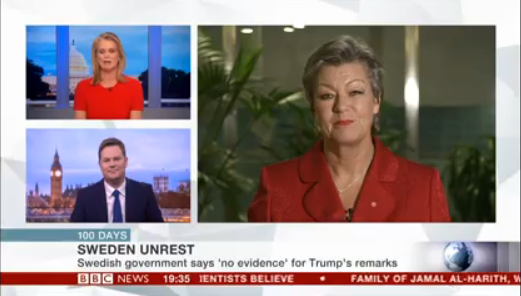
The story relates to a 100 Days interview on 22 February with Ylva Johansson:
KATTY KAY: Minister, I wanted to put to you something Nigel Farage, the former leader of the UK Independence Party has said about Sweden. He has called Stockholm "the rape capital of Europe, possibly even the rape capital of the world". His implication is that actually with an influx of immigrants and particularly a lot of young male immigrants, the crime rate, particularly around sexual crimes, has risen in the capital. 
YLVA JOHANSSON: He does not really know what he's talking about. When we make service about... If any woman has been... If there has been a rape towards her and sexual harassment, we can see that the level is going down and going down and going down. But we encourage women to actually report to the police and we also broaden the scope of what we define as a rape, because we would like every woman, because every rape is one rape too much. We encourage every woman to report to the police so we have a high level of reporting to the police and it is good they report and, of course, it is bad if rape is committed, but when we make service at the actual level of rapes is not high in Sweden. 
As far as Katty Kay is concerned here, she got her facts wrong there. Nigel Farage has never said any such thing about Stockholm. He's said it about Malmö, Sweden's second city. 

Is Breitbart engaging in fake news about Mrs Johansson though? (I always feel the need to check with Breitbart). 

Using Google and Google Translate, the report on what she said in Sweden's leftist tabloid Aftonbladet confirms that the Swedish minister said that she got it wrong ("It was wrong of me to talk about a development based on one year") and that official statistics show that reported rapes have risen over the last decade, and rose again last year. 

It also notes - interestingly - that the Swedish Moderates, forcing her admission (along with a similarly disbelieving criminologist and a journalist), described her BBC remarks as "fake news", and that the paper says that President Trump's comments have provoked "a major debate" in the country "on the image of Sweden and the country's potential problems of integration and crime".

It will be interesting to see if any of this gets reported by the BBC.

Monday, 27 February 2017

Mutual grooming


Tonight's 100 Days featured a classic, cosy interview between two BBC reporters and a CNN reporter about how badly Donald Trump is behaving towards the media - with mutual reinforcing laughter at each other's digs at the US President. 

Plus, echoing Nick Robinson yesterday, Christian Fraser invited further criticism for Amber Rudd over her use of language.

Quite how the BBC think their viewers perceive this level of smugness I can only guess.

Here's a transcript:


KATTY KAY: The feud between Mr Trump and the media keeps growing. On Friday several news organisations, including the BBC, were excluded from a White House press briefing. 
CHRISTIAN FRASER: Then on Saturday the President announced he wouldn't be attending the White House Correspondents' Association Dinner. 
KATTY KAY: The media received support from an unlikely source today - the former President George W Bush. 
CHRISTIAN FRASER: Not only did he say that "we all need answers'' on the extent of contact between Donald Trump's team and the Russian government, he also had this warning for the President over his criticism of journalists. 
GEORGE W. BUSH: I consider the media to be indispensable to democracy. We need an independent media to hold people like me to account. I mean, power can be very addictive, and it can be corrosive. And it's important for the media to call to account people who abuse their power. Whether it be here or elsewhere. One of the things I spent a lot of time doing was trying to convince a person like Vladimir Putin, for example, to accept the notion of an independent press. It's kind of hard, you know, to tell others to have an independent free press when we're not willing to have one ourselves. 
KATTY KAY: George W. Bush speaking earlier. And, by the way, Christian, some people here are suggesting that George Bush has been more critical of Donald Trump in one interview so far than he was of Barack Obama over the course of eight years. Let's get more on this relationship with the press with Frank Sesno - who spent more than two decades at CNN, where he served as White House correspondent, anchor, and Washington Bureau Chief. He's now the director of the School of Media and Public Affairs at George Washington University. Frank, why is the President ratcheting up this war of words - and actions, indeed - with the American press now? And will it work? 
FRANK SESNO: Well, why is the ratcheting it up? It plays to his base. There is a tremendous traction for blaming the media in this country among conservatives and others who really do believe that there is a very liberal press that is hostile to this president and hostile to conservative values generally. Secondly, it deflect attention from some of the stories that would otherwise be gaining traction about the disarray and disorganisation in his White House, despite the fact that they say it's running like a well-oiled machine. It is not - and people who have been through transitions in the White House before will freely say so. Republicans and Democrats alike. Finally, it is a message that allows, I think, the President to try to inoculate himself from setbacks and criticism to come. The more you demonise or marginalise the media, the less, in this way of thinking, the media may factor in down the line. That being said, huge criticism is proper for the media. That's out there. It's the way he's going about it, the personal vindictiveness, and going as the former president said, in an institutional way against a fundamental pillar of the democracy.
KATTY KAY: Frank, as we were suggesting earlier, the American press's reputation is not particularly strong. You have alluded to it. But I did see one poll that showed that actually the media is more popular at the moment than President Trump. That's quite a feat for the President Trump (sic) to have achieved that! [Frank Sesno laughs]. Is there a sense, do you think, that this might be producing a bit of a backlash? 
FRANK SESNO: Yeah. I mean, it is phenomenally ironic. Donald Trump is the ultimate media irony. [Katty Kay laughs]. He is a media creation who ran against the media to be elected. He has been railing against the media since it's been elected, and now the media are showing signs of rebirth and real mission. And it was a Quinnipiac poll that you cited, and more Americans said they trusted for credibility the media than the President of the United States. It's a dangerous game the President is playing. 


CHRISTIAN FRASER: Sorry Frank, I was just going to say, there's obviously a lot of concern a swell within the White House, not just about the press but about the leaks to the press, that was particularly taken by one quote today in the New York Times from Sean Spicer, the communications director, who says if this fight against leaks is leaked, then there's going to be big trouble. [Katty Kay laughs]. And of course, it was leaked. But they clearly have big problems with leaks. Does that say a little bit about how the administration is being run? 
FRANK SESNOYes. Having covered other White Houses, the more competition there is in the White House, the more power centres, the more leaks there are. And so I think that is what they are experiencing now. They also rail against anonymous sources. And yet the budget briefing that the Office of Management and Budge did today, they insisted on being anonymous, their names were not attached with it. Welcome to Washington! Washington is a town that leaks, there are a lot of people here who know a lot of people. It's easy to leak without getting caught. In fact, we have whistle-blowing protection in this country that protects people leaking information about wrongdoing. So this just goes with the territory. They will have to get used to it. 
CHRISTIAN FRASER: One of the stories in the British press today is that Amber Rudd, our Home Secretary, has been using the term 'fake news' to describe criticism that she doesn't like. How corrosive, do you think, that term is? 
FRANK SESNO: Very corrosive. Very, very corrosive. This is one of my biggest concerns as a journalist, former journalist and an educator now, because we're confusing the public with this. Fake news is deliberately, maliciously, completely fictitious creation of information to mislead and misdirect. News you don't like, including unfair or sensational reporting, may be irresponsible news. But it's not fake news. Fake news is exploding around the world, and eople need to be informed about it. And people in public life should be joining with news organisations to figure out what fake news is and how the public needs to distinguish from it. We should be wanting a public here, on all sides, that is informed with real facts. 
KATTY KAY: Frank Sesno, thanks very much for joining us.
Topsy-turvy


If my Twitter timeline (which deliberately contains a variety of viewpoints) is anything to go by it's been a topsy-turvy day, politically.

Many of the left-wingers I follow have been full of praise for Sir John Major and George W. Bush (yes, George W. Bush!), while many of the right-wingers I follow have been pouring nothing but opprobrium on Sir John and President Bush.

My favourite 'topsy-turvy' moment of the day was seeing this headline for the latest Guardian editorial:


(That isn't a spoof, by the way.)

Watching tonight's 100 Days on the BBC News Channel also gave me a bit of a 'topsy-turvy' feeling as the BBC's Nick Bryant began sounding as if he though the Tea Party might have had a point after all!

It's a reasonable-sounding analysis, albeit a very unexpected one from a BBC reporter like Nick Bryant.

(Cynics might think he's cynically advancing such an un-BBC argument only to undermine President Trump).

The following transcript, incidentally, highlights a lovely use of the "But to many people..." (degrees of separation) formulation that, as the interview goes on, quickly reveals itself to actually mean "But to me, Nick Bryant..."


KATTY KAY: What does Donald Trump want his first budget? 
NICK BRYANT: Well, it's clear he wants...what he's called an historic rise in defence spending. 9% - that's an absolutely massive amount. He wants, along with that splurge on military spending, to have this binge on infrastructure as well. One of his key campaign promises was to rebuild America's roads, its creaking bridges, its rundown airports that often, in places, look like they're from the Third World. And he's also said he can make these savings by cutting things like spending on the Environmental Protection Agency, and also the State Department, the foreign aid budget for instance. But to many people, these sums just won't add up, because he says he wants to have tax cuts, he says he wants to have all this big spending, big-ticket items like the wall, etc. But one thing they've signalled they're not prepared to touch is so-called entitlement spending, which accounts for about 80% of the federal budget, on things like social security, medicare, paying down the federal debt. It's what we call 'autopilot spending'. It's spent already, as it were. So the sums just don't seem to add up with this budget
KATTY KAY: So Nick, I'm young enough to remember, as are you, the days when Republicans were deficit hawks, when what they really wanted to do above anything else - it was almost an issue of values and patriotism - was balance the US budget, cut that deficit down from its existing $20 trillion. It doesn't sound like President Trump is remotely concerned about deficit spending. 
NICK BRYANT: You've got historic problem here, Katty. The national debt right now is 77% of gross domestic product. I mean, that is huge. That is unmanageable. And although this huge increase in defence spending might sound like music to the ears of the kind of a foreign policy hawks on Capitol Hill, the people with the louder voices in recent years, especially in the Republican party, have not been the defence hawks, they've been the deficit hawks. And you can see here the problem, a political problem, for the White House. Up until now, the Congressional leadership, Mitch McConnell in the Senate, Paul Ryan in the House, the House Speaker, the Republican House Speaker, they've gone along with what the White House has done. They've been very acquiescent. But here, there might not. It's setting up this sort of battle somewhere down the road between the White House and figures like Paul Ryan on Capitol Hill, who for years have been saying, "We've got to take control of the national debt and that means tackling entitlement like social security". 
CHRISTIAN FRASER: And Nick, with that in mind, would they have to blow the spending cap that was put in place in 2011? 
NICK BRYANT: Well, it looks like it at the moment because, as I said, the sums just don't seem to add up. If Trump gets his way and gets his budget through Congress...To give you an example, Christian: If you zero down foreign aid...it's just 1% of the budget...it puts a small dent in bringing down what is a ballooning national debt. At the moment, there's a discrepancy of $600 billion each year between the amount of money the federal government spends and the amount of money it raises through taxation, and that figure is going to balloon out over the next few years because of the increased costs of social security and medicare. So again, you know, this just seems like fuzzy maths and voodoo economics, to use a phrase from the past.

Monday, 20 February 2017

Navel-gazing


For fans of BBC interviewers where the two BBC presenter-reporters decide to talk about themselves (sometimes cruelly but accurately described as 'navel-gazing'), here's a transcription from tonight's 100 Days, co-starring Christian Fraser and the famous Jon Sopel:


CHRISTIAN FRASER: Stay with us, because I want to discuss strategy with Jon. We really should talk about his attitude to the press, Jon. The media is, according to the tweet, "the enemy of the American people". That came last week. Now, you were on the receiving end of it last Thursday. I was sitting in the chair watching you. Let's just remind our viewers of of how that went. 
Trump: Where are you from? Sopel: BBC. Trump: Here's another beauty. Sopel: It's a good line. Impartial, free and fair. Trump: Yeah, sure. Sopel: Mr President... Trump: Just like CNN, right? Sopel: On the travel ban... We could banter back and forth. On the travel ban, would you accept that that was a good example of the smooth running of government? Trump: Yeah, I do, let me tell you... Sopel: Were there any mistakes in that? Trump: Wait! Wait! I know who you are, just wait. Let me tell you about the travel ban. We had a very smooth roll-out of the travel ban...
I love that! "I know who you are". What do you make of the strategy, Jon? 

JON SOPEL: I think that, if you look down the ages, every president has tried to communicate directly with the electorate without the mediation of newspaper journalists or people like us. You go back to the Second World War, it was Roosevelt with his fireside chats. Today, Donald Trump has 25 million followers on Twitter. He wants to go to rallies where he can address the crowds, like we saw over the weekend. I think that part of the strategy absolutely makes sense. I think the other thing about Donald Trump is he loves to have an enemy. If you think about when he was running for the Republican nomination, it was "lying Ted", "low-energy Jeb", "little Marco". And then it was onto the election itself and it was "crooked Hillary" and "Lock her up!". And I think he needs an enemy now, and he's determined to make the enemy us, and we must resist the temptation to fall into the trap of thinking that we are the opposition. We're journalists holding him to account.

CHRISTIAN FRASER: But there are people on both sides of the House...I mean, John McCain was saying this weekend, if you want to have a free democracy, you have to have an adversarial press, and there are people on both sides of the House that are concerned about the tone. 

JON SOPEL: Yeah, I think there are, and I think there are people who would want him to dial it back. I mean, the idea of saying that journalists are "the enemy of the people", I think that went too far for some people, but broadly speaking, I think an awful lot of Trump supporters believe that we are the bad guys in all of this, they think that Donald Trump is the purveyor of truth, and sometimes it will be our job to say, "You know what? What he just said is not as truthful as first appears". But it's going to be contentious, I think it is fair to say.