Showing posts with label 'BBC Election Debate 2015'. Show all posts

Friday, 1 May 2015

Odd Q.T.

Further to Craig’s heroic live-blog, a few afterthoughts.

I don’t know (neither do you) whether the avalanche of criticism over the recent crescendo of lefty bias affected the strategy of David Dimbleby and his BBC back-room team, but something strange happened last night.  Rather, something unusually unstrange, which was of course the unique reversion to balance, from both chairman and audience. 

I know many left-leaning viewers didn’t much like it, but one could gloat over the fact that they were experiencing at long last a taste of their own medicine. Anyway, to many people it looked less like bias than a well-timed reversal to normal.

I’m inclined to agree with Nick Robinson, or was it Norm, who said that the audience won. It was a sharper than usual audience, and there was little of that appalling whooping that was allowed to wreck previous election programmes with audiences.

I am not much of a political aficionado, but there are certain things that interest me more than others. One topic I would have liked to have seen addressed was the Islamophobia come antisemitism pledge, be it Theresa May’s ‘Crackdown” or Ed Miliband’s ‘criminalisation’, but I might as well admit that if it had been raised, it would inevitably have been couched in such obfuscational language that we would have been none the wiser. 

In fact that was a theme throughout all the electioneering to date.  Politicians (apart from Nigel) trying not to reveal their hand, as in poker. “Who will you team up with?” Can’t show my hand. “What will you cut?” Can’t possibly show my hand.

Of course they can’t. They’d be crucified if they did. So why the pointless, hiding-to-nothing, persistent  badgering from ALL the BBC’s finest? Andrew Neil is as bad as the rest on that score.

The most memorable aspect of the debate was Ed’s attitude towards the previous Labour government’s mistakes. One, squandering the crown jewels and plunging us into massive debt. Two, deliberate open door immigration. On the first, Ed revealed that at the end of the day, he thought that the spend spend spend principle was justified by the acquisitions it brought ‘are country’, as he pronounces it. Schools, hospitals and so on. This exposed him as the serious lefty he is. But my goodness me. He is always inclined to admit to his party’s failure on immigration with the phrase, “we got it wrong.” Is that phrase really suitable for something that has had such a massively detrimental effect on ‘are country?’

It’s a phrase more appropriate to something like placing a wrong bet. Heads or tails? Oops. Got that wrong! Winner of that match? Wrong again. 
But it wasn’t a sport, it wasn’t roulette. It was a much more fundamental gamble, and saying “We got it wrong” is a very offensive and glib. It’s an understatement and a gigantic cop-out.  It’s beyond a cliche, reminiscent of that grotesquely emotive and misleading phrase “What Israel is doing to the Palestinians.”

I want to hear someone from Ed’s party saying our open door policy was a mistake that had huge negative ramifications, and what’s more it was a deliberate megalomaniacal ploy to keep us in power.

David Cameron spoke well but he said very little. Yes, we know bringing down the deficit is his priority, and it seems like a worthy objective.  Duh!
At least he didn’t stumble over the ‘accident-waiting-to-happen’ podium ‘Q’ shaped thingy that some lunatic from W1A had managed to dream up and get past the department of stupid.

The collapse of the Lib Dems has absolved Nick Clegg from serious electioneering. He went through the motions dutifully and came across as a nice bloke. One could almost forget the bitter toxicant within the party. But not quite. 

 Nigel Farage was relegated to past-my-bedtime hour. But there’s always iPlayer. Dealing him Jo Coburn, on the other hand, was a mean trick that can’t be rewound and undone. She can be unpleasant, can’t she? She was so witch-like and irritable that no-one could resist feeling  a pang of sympathy for Nigel Farage.  All that was achieved by her intrusive interruptions was more evidence that Ukip has been dealt a bad hand by the BBC. 

There were a couple of strategic blunders in the area of general performance. The first miscalculation was producing that infamous ‘No money left’ note. Props are unpopular. Second one was asking the questioner’s name all the time. Some of them seemed irritated by this, and who wouldn’t be?


There were a few ‘Let me be clears’ and ‘right thing to dos’ and an awkwardly choreographed ‘walk towards the audience’ from Ed.  

I notice these things, and I suspect many other viewers do too.


Friday, 17 April 2015

End of the debate?


Before I leave the subject...

I must note that others have put forward points that readers familiar to this blog will doubtless already be well aware of - points we've (repeatedly) endorsed in the past (in connection with BBC One's Question Time)...

Doublethinker and John Anderson, commenting at Biased BBC, made the same point that people like Janet Daley and Nigel Farage have previously made (over the past couple of years): 
Doublethinker: As to the bias of the audience there are only two explanations, either it was selected with a large far left bias, or those who weren’t leftists were cowed into silence for some reason or other. Perhaps being at a BBC event makes non leftists fearful.
I am now thinking that the PM will get a very rough ride when he appears on Question Time shortly. Even if a few Tories have slipped into the audience they will be terrified into silence by the leftists surrounding them who no doubt will bay for his blood and scream their support for the Mad Marxist.
John Anderson: Yes all the noise in the audience came from lefties. But on several occasions it looked as though a lot of people in the audience were not joining in the applause for leftie nonsense, they were just sitting on their hands.
I suspect Doublethinker's prediction that the forthcoming Question Time will turn out to be a rough ride with the BBC audience for David Cameron will prove to be right.

And John is certainly correct to say that - re-looking at it - a lot of the audience last night did appear to be sitting on their hands. 

This, as I've said before, is a problem the BBC really needs to tackle, though I'm not sure how. It afflicts episode after episode of Question Time, and results in the appearance (if appearance it be) of a massive bias.

And last night it may have further discredited the corporation with a swathe of licence fee payers.  

I thought Farage was rather good in that debate yesterday. It’s about time someone stuck it to the bovine, self-important, audiences – it takes a bit of guts to do that. My suspicion is not that the audience was unrepresentative (although it often is in these shows) but that the liberal left simply will not listen to views with which they disagree and feel a childish need to boo. It is the mindset which insists not that other people may be mistaken, but that they are foul for having the views they hold and should be subjected to spite and nastiness. As you are aware, I hate these totalitarian people and – pace my earlier blog – yes, I do understand that a large proportion of them are Labour supporters.
Another explanation espoused at the Speccie, from Ross Clark, is that the audience was engaging in groupthink (another Orwellian term) resulting from the 4 Left v 1 Right bias of the 'contestants': If all but one speaker was saying roughly the same (left-wing) thing then the audience might, lemming-like, follow them over the (left-wing) cliff {not, I feel the strong need to say - and putting my scientific hat on - that lemmings actually behave like that at all}.

This explanation, I think, would only work, however, if conjoined with the 'intolerant lefties silence shy righties' theory outlined above.

The fact remains that there was something seriously wrong with that studio audience last night. (Even quite a lot of gloating leftists on Twitter seem to have recognised that). The BBC may be officially 'intensely relaxed' about that, but a good portion of its audience isn't....

....and a truly impartial BBC, rather than imperiously brushing off all complaints, would surely seek to tackle the problem. Wouldn't it?

*******


Yesterday the BBC refused to disclose how many people had complained about its broadcast.
‘Our data shows the number of audience contacts were heavily influenced by the issue being raised during the debate and therefore we won’t be giving out figures,’ a BBC spokesman said.
John Hemming, Liberal Democrat MP for Birmingham Yardley, said the BBC’s behaviour was ‘ludicrous’ and its refusal to publish the number of complaints ‘added insult to injury’.
*******

The BBC has, of course, being tardy about answering questions over this from the very beginning. They had to be forced into it. Also according to the Daily Mail:
The BBC initially refused to disclose the political make-up of the audience but eventually released figures late yesterday. Of the 200-strong audience, about 58 were Conservative or Ukip supporters while about 102 backed left-leaning parties – Labour, the Lib Dems, SNP, Plaid Cymru or the SNP. The rest – 40 – described themselves as undecided.
The BBC told ICM to make sure a fifth were so-called floating voters, and for every five Labour supporters in the room, it made sure there were five for the Conservatives, four for the Lib Dems, two for the Scottish National Party, two for the Green Party and one for Plaid Cymru.
The figures suggest supporters of the Tories and Ukip were significantly under-represented.
Conservative MP Andrew Percy said: ‘The audience should reflect the opinion polls and the fact is that nearly half of the country say they would vote Conservative of Ukip’.
The Daily Mail writer makes that look worse for the BBC (unintentionally no doubt) by forgetting to include UKIP in those figures! The Daily Telegraph, more accurately, writes,
About 20 per cent of the audience were undecided. Of those who were decided there were five Conservative voters for every five Labour, four Lib Dem, three Ukip, two SNP, two Green and one Plaid Cymru voter, the BBC said.
and then adds what seems like a mitigating factor:
An ITV spokesman said the audience for its seven-way debate reflected the same proportions.
Anyhow, even if there were 3 UKIP members of the audience for every 2 SNP supporters and 5 Conservatives for every 5 Labour supporters, the question still remains as to why the SNP supporters seemed to outnumber the UKIP ones and why those '58 right-wing people' (one-third of the partisan part of the audience) made little or no noise during the debate - in complete contrast to the '102 left-wing people' (two-thirds of the partisan part of the audience) who most assuredly did....assuming, of course, that ICM succeed in translating the above ratios into actual people who genuinely hold those views and really do support those parties.

The plot thickens.

ICM, UKIP and the BBC


Sometimes these things go wrong, sometimes you get groups who apply to be on programmes who perhaps aren't as truthful on their applications as they could be.
In this case, the BBC gave the job to a polling company called ICM who are famous for getting everything about Ukip wrong and that I think was the mistake.
Am I going to make a complaint? I've got an election to fight. What matters isn't the 200 people in the room, what really matters are the millions of people watching on television.
Is Nigel right that there's a problem with ICM and UKIP? 


Only one polling company gives UKIP a single figure average this year - ICM. 

And that's not the only result that seems out-of-step with other pollsters. The same post at UK Polling Report also features a graph monitoring the average Conservative lead in 2015 and, again, ICM is at the furthest extreme from the average:


Is there something about ICM's methodology which produces results that - at least in these two respects - seem very much like statistical outliers?

Could it be something to do with their reliance on telephone polling? Do people lie more when polled by telephone (I know I do!)? 

Could that help explain why the audience seemed so unbalanced? Could it be that it was unbalanced because of ICM's methodology?

And was the BBC aware of any of this when commissioning ICM?

All of this may well back up Nigel Farage, but it still doesn't explain the loud applause for the many attacks on David Cameron and the Conservatives or the whoops for the idea of Labour and the SNP getting together to kick the Tories out. ICM's polling doesn't seem at all biased against the Conservatives, does it? 

"Boo!" - The Official Response


Still on the subject of that BBC debate and that audience...

All the broadcasters and the political parties agreed that the appropriate way to recruit audiences for debates was to ask a respected independent polling organisation to do the job on our behalf. That was the case for all the debates in 2010, for the Clegg/Farage debates last year, as well as for both the debates during this campaign - ICM has an established track record of recruiting the audiences for all these debates.
We asked the polling company to work to proportions which take account of a number of factors in recruiting the audience - in other words, recent polling figures are only part of the equation. We also look at past electoral support, as well as the different party political make-up in different parts of the UK. 
We set out clear objectives to ensure there is a broad range of political preferences - around 20% are undecided voters, from varying perspectives. The ratios then for those with a party preference are in the following ratios:
Conservative 5, Labour 5, Lib Dems 4, UKIP 3, SNP 2, Green 2, Plaid 1.
The aim was to recruit ordinary members of the public, not necessarily committed party political activists. As with any such audience, once assembled, we cannot dictate how it will participate - who chooses to applaud, or not to applaud, to agree or disagree with what different party leaders might say.

And, as per the Daily Mail, who do the fullest write-up I can find of this, here's ICM's response (as filtered through the Mail's reporting):
Independent pollsters ICM were hired by the BBC to select the audience of around 250 people.
After facing stiff criticism from Ukip, the firm today released a statement on how it chose the audience members.
They were selected from a 20-mile radius of the venue in Westminster. The region was broken up into 30 small areas, and at least 8 people were chosen from each area.
Each person was selected to reflect the 'composition of the UK population by gender, age, ethnicity, and social grade, and political protocols that reflected the balance as agreed between the broadcasters and the political parties', ICM said.
A fifth of the people declared themselves to be 'undecided voters'.
A 'small number' of SNP and Plaid Cymru supporters were brought in from Scotland and Wales.
ICM added: 'The recruitment approach replicated those used by ICM at all the 2010 leader debates, both the Clegg vs Farage debates last year, and the recent ITV debate.'
Mr Farage was widely considered to have won the debates against Nick Clegg last year, after which the Ukip leader made no complaint about the audience composition.
Earlier in the Daily Mail piece, the paper quotes ICM saying that they were "using random location selection techniques".

The two accounts - the BBC's and ICM's - may converge at a point as yet unseen, somewhere in the distance, but they seem to run on different tracks. The somewhat haughty-sounding BBC response doesn't really say what ICM are saying.

The BBC fails to mention the 20-mile radius around Westminster (famously out-of-step with the rest of England in the European elections as regards UKIP) and forgets to even hint at the bused-in supporters of Plaid and the SNP.

More questions need answering here - especially at the ratios the BBC produced seem so massively at odds with the audience's responses.

You might have expected that the SNP had a ratio of 9 to the Conservatives' -2 and UKIP's -5 from watching that debate.

And, as Peter noted on a previous thread, both ICM and the BBC had, by all accounts, to be dragged screaming this afternoon to finally offer these justifications.

Credit to Nicola...


I'm not quite sure why this has been haunting me all day, but as no one else (anywhere) seems to have been commenting on it in detail I will...

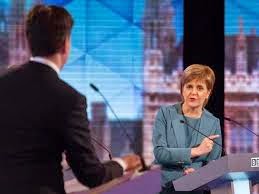
The end of last night's leaders debate ended with Nicola Sturgeon of the SNP going up and shaking hands with Natalie Bennett of the Greens and Leanne Wood of Plaid Cymru. All three of them then hugged. (That certainly has been well commented upon). Ed Miliband, hanging back, then approached and Nicola Sturgeon shook hands with him, as (in her wake) did the Plaid and Green leaders (in that order). Nigel Farage remained isolated at his podium. Natalie Bennett and Leanne Wood began to leave the stage, deliberately snubbing the UKIP leader, but Nicola Sturgeon turned round and made for Nigel Farage and deliberately shook his hand. Ed Miliband followed her and patted Nigel on the back. 

Nicola Sturgeon, whatever else you might think of her, remains a class act. 

Thursday, 16 April 2015

"This audience, which is a remarkable audience even by the left-wing standards of the BBC"


Well, it happened again.

Tonight's BBC One election debate featured a studio audience that appeared to bear little or no resemblance to the electorate it was meant to represent. It appeared to be strongly biased - even by the BBC's usual standards.

The opening discussion saw repeated applause for attacks on austerity and for calls for public spending. The UKIP leader spoke out:
Nigel Farage: There just seems to be a total lack of comprehension on this panel and, indeed, amongst this audience, which is a remarkable audience even by the left-wing standards of the BBC. I mean, this lot's pretty left-wing but...
David Dimbleby (interrupting): Hang on a second, let me just say one thing. This is an audience that has been carefully chosen...
Nigel Farage (interrupting): Very carefully!
David Dimbleby: ...not by the BBC...not by the BBC, by an independent polling organisation to represent the balance between all parties.
Sky News tonight is leading with this intervention, and making out that Mr Farage was "rattled":


I have to say that I thought the UKIP leader may have taken on the BBC audience here deliberately, suspecting, as he indeed went on the say, that "the real audience is at home".

That "real audience at home" will have heard an audience that appeared, through its patterns of applause, (a) to strongly oppose austerity and strongly favour public spending, (b) to oppose the Conservatives' right to buy policy (c), to favour 0% private involvement in the NHS, (d) to want the Tories' trade union legislation repealed and (e) that was very keen to back speakers defending high immigration. 

They'll also have heard an audience that applauded and often loudly cheered attacks on David Cameron and the Conservatives, and that either jeered at or received in stony silence much of what Nigel Farage said. 

Most astonishingly of all, they'll have heard huge applause and wild cheers for Nicola Sturgeon's call for Labour and the SNP to get together and kick out the Tories. 

A representative audience? If so, representative of what? A joint SWP/SNP rally?

******

Incidentally, the BBC's own 'worm' showed an interesting reaction from its sample of voters to Nigel Farage's attack on the audience - a somewhat approving one - as posted on the BBC's own live election feed:

.
******

Here's a flavour of some other reactions:
Tim Montgomerie on Twitter: 70% of Britons think immigration is too high. 90% of #BBCDebate audience claps defence of high immigration.
Breitbart London: 20:43  Is the audience balanced???
Format for tonight's debate: BBC Election Debate 20154. There will be a live audience selected by a reputable polling company mainly from the surrounding region. That means they are from London, which is a separate BBC region to the South East (where UKIP is strong). UKIP does not do well in London, it is far stronger elsewhere in England. 
Tim Montgomerie on Twitter: Summary of #BBCDebate: Privatisation. Boo! Public spending. Hurrah! Trident. Yuk. Scotland. Lovely. Right-to-Buy. Boo!
Andrea Leadson, Conservative economics secretary
Appalling left wing bias in BBC audience – not reflecting views of the country. Easy to applaud spending money – shame we don't have any.
Stephen Pollard on Twitter: If this audience is representative of the electorate I'm Natalie Bennett's speechwriter.
James Forsyth on Twitter: I expect Ed Miliband is now wondering about the balance of the audience as it whoops.
Janet Daley, Telegraph: The loser? Nigel Farage – because he completely lost it over the Left-wing bias of the audience (even though he was right, it was truly shocking even by BBC standards).
Tim Montgomerie on Twitter: Although Farage was tactically unwise to criticise the audience some very big questions for the BBC about audience selection #BBCDebate 
Patrick O'Flynn, UKIP: The BBC ought to check that it wasn't skewed because of some systematic bias or failure and ought to be transparent about that - but I'm not saying there was a systematic bias but I think they should check and reassure those viewers who might be unhappy. I don't personally think it's going to to turn into a problem for Ukip, but were I the BBC I would think I'd be feeling a little bit awkward because it clearly seemed to be a very skewed to the left audience actually.