Showing posts with label 'Lent Talks'. Show all posts

Thursday, 19 March 2015

Lenten drama


I was slightly worried, you may recall, that the Daily Mail's Quentin Letts might lower the quality of the superb series of Lent Talks now running on BBC Radio 4

I needn't have worried. Quentin managed to hit the spot again. He was typically jaunty, but not without this moments of depth.

His theme was the theatrical potential of the Passion story, as realised in the medieval mystery plays that he, his family, friends and neighbours, still perform from time to time. 

Here are some samples: 
Is it disrespectful to compare Holy Week to a drama? I hope not. Drama can be a form of high art, illustrating elusive truths by means of plot and personality. From Palm Sunday to Easter morning, the Passion has everything required of great theatre. Misfortune's screw tightens. There is betrayal, political manipulation, heroic determination, death. Christ gives up the ghost at Golgotha - the field of skulls, which may take us back to poor Yorick. And then, if we can hop to another Shakespeare tragedy, there is a storm, cataracts and hurricanoes, the heavens opening. This was the moment in that 1965 film, 'The Greatest Story Ever Told', that John Wayne says 'truly, this man was the son of God'. Hollywood may have hijacked the line but it is there in Matthew and Mark, albeit without the Texan accent.
**** 
Betrayal is a boost to any theatrical plot. Holy Week has Judas Iscariot, his name a byword for treachery. A shrewd dramatist will not caricature Judas as evil. Merely to ham him up, eyes a-gleam as he fingers his slivers of silver, would be to throw away the character. It would not be truthful to human nature. Judas had believed in Jesus but he suffered doubts. Though Judas is now reviled, what Christian can claim never to have had doubts? One of the worse slanders on churchgoers of late has been this notion of swivel-eyed certitude, this coarse, clumsy idea that 'faith' pings on like an electric light bulb and that anyone who attends church is ‘devout’. Tosh. Many of us go to church hoping to believe, or because we are curious, or because we enjoy the old hymns and the proper prayers. Belief may take hold slowly, unevenly.  
Uncertainty is essential to faith. Without doubt, belief becomes nothing more than factual obligation. Faith demands a leap across a gap. Judas baulked at that gap, poor man. A theatre director has a chance to show us this truth in Iscariot. How long does it take Judas to realise that he had made a ghastly mistake? How long does it take the Apostles to forgive him? The Bible does not tell us. 
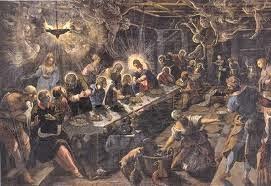
Plus Quentin's favourite Lenten painting is my favourite Lenten painting (especially as it graces the front cover of my favourite book of poetry, The English Poems of George Herbert) - Tintoretto's beautiful Last Supper:
The Last Supper's most celebrated depiction in art, by Leonardo da Vinci, conveys little drama. Leonardo's upstairs room has the rigid lines of a multi-storey carpark. I prefer Tintoretto’s bustling Last Supper. A kitchen helper is in the foreground, packing dishes. A cat pokes its whiskers into the dirty plates.  
Tintoretto's painting says 'this happened, this was human'. The Passion should not be muffled by hesitant politeness. Let it surge, pulsate, brim with life. These disciples must have been excited and fearful about the discreet rendezvous. Imagining those days, re-creating them in drama or art, can help us see the Passion anew.

Friday, 13 March 2015

More Lent Talks


When we began this blog our aim was to be scrupulously fair to the BBC - even though we suspected that being unscrupulously unfair to the BBC might work better, given that no one (except, possibly, a Loadicean) really likes a Laodicean. 

So, persisting with that lukewarm spirit (and in spite of any potential spitting-out), I really, really feel the need to add something to our previous posts about Radio 4's annual series of Lent Talks - pieces I've been listening to for years.

Our previous posts have laid out, in some detail, the programme's past record of (by and large) promoting liberals, leftists and Muslims at the expense of conservative/traditional Christian believers and, thus, giving what I believe (rightly, if I say so myself) to be compelling evidence of BBC bias.

And we've had years of that (eight years, to be specific).

This year's talks, however - so far - have been absolutely beyond reproach. In fact I'd go so far as to say that I've found the first three episodes (the ones broadcast so far) to be among the most rewarding features that I've heard on Radio 4 for a long time.

They have been beautifully-written, insightful pieces from Christian believers which even I, a non-believer, have found...how can I say?...illuminating and...dare I say?...thrilling.


First came crime writer James Runcie's piece (yep, son of Robert). His piece began by outlining how his work is rooted in traditional crime fiction and medieval mystery plays before moving onto envisioning the story of Christ's Passion as a contemporary thriller complete with plot twists, a whodunit aspect (spoiler alert: it was God) and a (surprise) happy ending. It may sound a bit naff, like a Thought for the Day talk, but it wasn't. Far from it. It was gripping. I think C.S. Lewis would have approved:
Twist Two:  The revelation of the Murderer.  In all the night-time confusion of the drama the viewer is left wondering who is ultimately responsible for Christ’s death; is it Caiaphas, Herod, Judas, Pontius Pilate, or the soldiers who nailed him to the cross? Could any of these suspects admit their guilt or become the solution to the mystery? 
Well, it turns out none of them can claim responsibility because all of these actions were plotted by an over-arching mastermind who has been behind the whole thing all along. That mastermind is, of course, God.  
This is the plain and shocking truth of the Passion. God is the murderer of Jesus. He may not have physically nailed his Son to the cross, but death was inevitable. 
“For God loved the world so much that he gave his one and only Son, so that everyone who believes in him will not perish but have eternal life.” 
This leads to:
Twist Three: It’s not death, but life.   
The final twist is one of transformation. The mystery genre is subverted. Through the Resurrection we have a happy ending; tragedy is transformed into what, in its broadest sense, we can call a comedy, the happy ending that is the salvation of mankind.  
Then came former Only Fools and Horses actress (turned writer) Kate Saunders and her piece on Anglo-Catholicism - warm, ritual-loving, nostalgic, 'Smells and Bells', Victorian-born Anglo-Catholicism. Her descriptions of the Lenten/Eastertide rituals of Anglo-Catholicism were spellbinding:
Lent is a time of penitence and mourning, and that is taken quite literally in an Anglo-Catholic church, where all the statues and Crucifixes wear purple shrouds.
The colour and theatre burst back on Maundy Thursday, the Thursday before Easter Sunday, arguably the most dramatic performance of the year. We're commemorating the origin of the Mass itself; the Passover supper that Jesus shared with his disciples in an upper room in Jerusalem, where he first consecrated the bread and wine, and gave it to his disciples as his body and blood.  In an Anglo-Catholic church, the scene will be set with a choir and possibly an orchestra and crowds of servers in satin and lace.
After the singing and bells, however, comes the solemn Stripping of the Altars, where everything decorative in the church is ceremoniously removed - like striking the set at the end of a run in the theatre, or clearing the table after Christmas lunch. After the Stripping comes the Vigil - that is, hours of silent worship in the Chapel of the Reserve Sacrament. Technically the Vigil should last all that night. I've never been hard enough to go through a decent vigil - by that stage in the week, I'm half-dead from incense-fumes and my knees have callouses - but I can't tell you how beautiful the Chapel looks in the candlelight - how hushed and mysterious. 
It transported me into a world I didn't know too much about (having been brought up fairly-high Anglican). Yes, she added cautionary notes, but she affirmed her faith it the end. I was floating in incense for several minutes afterwards. I strongly recommend it.

Then came the talk from Catholic poet Michael Symmons Roberts (librettist for the wonderful contemporary composer James MacMillan). This was a tougher listen, being suffused with modernist poetry - and, even more, the spirit of modern poetry. It made me Google up some poems by the two unfamiliar American poets he dwelt on, and made me want to read Rilke (though I've not gone quite that far yet!).

He focused on Christ's wounds - those wounds so graphically depicted by Medieval/Renaissance artists, where "thirsty saints pucker up to drink the blood from the spear wound in Christ’s side, or gaze lovingly at lurid close-ups of the nails puncturing his hands and feet", which he said were, perhaps "the hardest mental leap for a contemporary observer". He himself has confronted those very wounds via poetry, with one sequence of poems ending with the speaker climbing inside one, imagining it as a place of refuge and healing. He asks, "But what could that possibly mean?" Though no longer an atheist, he's still not sure. And, as an atheist, I'm unsure too.

Next week comes Quentin Letts. No left-liberal Muslim he. Still a gulp: Will he don fez and dressing gown (as he does on TV) and spoil the series with flippancy? Hopefully not.

Sunday, 6 April 2014

Lent Talks


Well, this week's edition of Lent Talks was little more than a political speech.

It was from Labour's Lord Adonis, arguing that our present system of democracy is a good thing but that young adults need to be involved in it from an early age by voting at school, changing voting registration procedures and lowering the voting age to 16. [He also sneaked in a little dig at the coalition government for good measure]. Oh, and Jesus. 

Last week's one was very political too, with Telegraph reviewer Nicholas Shakespeare relating the Easter story to the those struggling against brutal right-wing dictatorships in Latin America.

Next week it's feminist, myth-weaving novelist Marina Warner. I can hardly wait. And then 'left evangelist' and Obama advisor Jim Wallis.

All of which calls for a list, of course.

Who's been on Lent Talks over the years? 

Despite the occasional Tory MP and Christian apologist, it's as good a demonstration of BBC Radio 4's general left-liberal bias as it's possible to get - though the severe bias of the first few series has slackened somewhat. 

Please see what you make of it.

2014
1. Bonnie Greer
2. Catherine Fox
3. Nicholas Shakespeare
4. Lord Adonis
5. Marina Warner
6. Jim Wallis

2013
1. Baroness Helena Kennedy
2. Alexander McCall Smith
3. Benjamin Cohen
4. Loretta Minghella
5. Imam Asim Hafiz
6. Canon Lucy Winkett

2012
1. The Rt Rev Nick Baines, Bishop of Bradford
2. Prof Linda Woodhead
3. Prof John Lennox
4. Martin Wroe
5. Prof Tariq Ramadan
6. Sr Gemma Simmonds CJ

2011
1. Lord Ian Blair
2. Austen Ivereigh
3. Feisal Abdul Rauf
4. Professor Stephen Reicher
5. Madeleine Bunting
6. Mark Oakley

2010
1. Will Self
2. Andreas Whittam Smith
3. Maajid Nawaz
4. Sr Elizabeth Obbard
5. Rev Prof Alister McGrath
6. Rev Dr Giles Fraser

2009
1. Martin Bell
2. Richard Holloway
3. Sister Frances Dominica
4. Professor George Pattison
5. Frank Field
6. Melissa Raphael

2008
1. Jude Kelly
2. Terry Eagleton
3. Mary Loudon
4. Clive Stafford Smith
5. Ann Widdecombe
6. Tom Wright

2007
1. Armando Iannuci
2. Chas Bayfield
3. Cherie Booth QC
4. Shami Chakrabarti
5. Douglas Hurd
6. Jeffrey John

Monday, 24 March 2014

The perfect bias-free BBC day (Part I)


AdrianD posted a thought-provoking comment on our 'Daytime Radio 4' thread today:
AdrianD 24 March 2014 10:42
I’m not sure whether you, or anyone who contributes to this blog, has done this before, but I think it would be interesting to see what you thought a good, non-biased, day of BBC broadcasting might look like. Apologies if you have (please send a link). I know what I want to see less of – I was just wondering what you would like to see more of. Thanks.
Oddly (or otherwise) we have never done such a thing, but it really is an interesting idea, isn't it?

I shall write here as if I'm replying to AdrianD [which, I hope he won't mind], and continue with the theme over several posts as it will give me the chance to dig a little deeper into things, as the day in question provides a useful (if untypical) case study of BBC bias:


As you probably worked out from the blue bits of that post [and an earlier comment or so], I thought that much of Sunday 23 March 2014's Radio 4 output (or at least its daytime broadcasting) lived up to my idea of what a good, non-biased day of BBC broadcasting should be like.

It was one of the best days of BBC broadcasting that I've ever heard, and I fancied PARTIALLY defending it in that post as being atypically unbiased...though, by some accounts, I only made it look even worse for the BBC's reputation for impartiality!

Looking at this Sunday's Radio 4 methodically then...

I always like Bells on Sunday (5.45am): a bit of history & British geography - plus bells. Who, atheist or believer, hates church bells (except the odd noise-averse grump)? Two minutes of weekly bliss.


As I commented on an earlier thread, I thought this week's edition of Lent Talks (5.47am) made up for/balanced out Bonnie Greer's dreary effort the week before. Yes, the speaker made a left-wing point or two along the way, but that's only to be expected for the wife of the dean of Liverpool [Anglican] Cathedral these days. (See various surveys on the disconnect between the liberal C of E leadership and its more conservative membership). But, still, I liked her talk.

There are a few more episodes to go, so an assessment of whether it represents unbiased broadcasting will have to wait. My idea of unbiased BBC broadcasting would be that each programme surprised me in some way, from contrasting angles.

Has that usually happened with Lent Talks?

Too often, past series of Lent Talks have espoused concerns that seem (to me) to reflect with I think of as the BBC's natural biases.

Take last year's series: Its presenters were (1) a Thought for the Day liberal Anglican, (2) a Muslim, (3) a Labour baroness, (4) a well-connected charity worker, (5) a gay Jew who feels abandoned for being gay, and (6) a fiction writer.

That's the sort of thing that makes me write about BBC bias.

We'll see where the rest of this series goes.


Next up came that edition of Something Understood (6.05am) about which I wrote with such mixed feelings yesterday....

A great series, often a jewel among Radio 4's output, usually thoughtfully constructed yet whimsical...yes, such a programme would undoubtedly be a part of my kind of BBC broadcasting day. On a good day, it appeals to believers, non-believers, and those who lie somewhere in-between.

(Two Palestinian poets in two weeks though, and no Israeli poems for months?...oh dear (as I'm sure you'll agree, Adrian.))

Its main presenter has long been that nice Mark Tully (see Sue and myself's discussion of him here). Alongside him have been John McCarthy, Chris Brookes, Hardeep Singh Kohli, Tom Robinson, Lucy Mangan, & various BBC reporters (including the ever-excellent Samira Ahmed)...which is, undeniably, about as left-liberal a collection of people as you could gather together to host a weekly BBC Radio 4 programme.

Conservative voices need not apply it seems - a recurring theme with such BBC Radio 4 staples, as we shall see...


Pause for thought

So where are we now?

Just beginning Sunday morning on Radio 4, yet using it as our kind of BBC broadcasting day.

Praise so far then for Bells on Sunday and Lent Talks (and, therefore, both included in my model BBC day on the strength of this week's editions), balanced by qualified praise for Something Understood (only conditionally included, due to this week's lapses) all set in the context of evidence-backed claims of left-liberal bias on the part of both Lent Talks and Something Understood.  (Deny that evidence if you can!)

Both of those provide easy-to-prove claims of BBC left-liberal bias [and, please!, feel free to ask me to go back over several years and prove it even more! ---- In fact, don't bother: I'll do it myself over the coming weeks!].


Next up came an edition of On Your Farm (6.35am) that had me hanging on its every word. 

It related the experiences of a farming family on the Somerset plains, and pushed no apparent agenda (just as I want it) whist so doing. The slow,-slowish,-suddenly fast, &, soon after, very-fast -indeed rise of the flood waters was made to hit home, as was exactly what it meant for the farmer, his family and his cattle. The willingness of British people to come to this good farmer's aid was something I found deeply reassuring.

The programme's presenter here was our old friend Charlotte Smith, whose past feminist agenda-pushing has provoked a pair of previous posts at "Is" (here and here). My vision of an unbiased BBC day of broadcasting would involve Charlotte reporting at she did here (rather than as she did there.) 


My ideal Sunday BBC schedule would have to include my pet project, Sunday (7.10am), as the idea of a religious current affairs programme at breakfast on Sunday morning appeals to even an atheist like me... but, oh, the eternal, devilish bias!...It's so off-putting.

Alan at Biased BBC has (by his own confession) moved his tanks onto my lawn today (good man!) by outlining his own feelings about the clear bias embedded in the latest edition of this most reliably liberal-biased of BBC Radio 4 programmes, and Chrish did the same in the comments field of my own thread about this programme. 

They both made explicit what I made implicit - that Sunday is strongly and instinctively left-liberal in orientation - something this blog has, if it has proved anything, has proved beyond doubt. (Surely? 73 posts about it, and counting!)

So, to keep on answering AdrianD...

...just what do I want from Sunday? What should it be doing in my perfect BBC day (while we're all drinking sangria in the park, hanging on, and reaping what we sow)?

Well, will I want is a range of views (from atheist to creationist, as it were) on matters religious, though with a central focus on mainstream Judeo-Christian beliefs. That wouldn't neglect Britain's new minority religions - Hinduism, Sikhism, Islam, Buddhism, etc - but nor would it make such a great fuss about just one of them at the expense of all the others...as this week's edition most certainly did. Nor would it ignore those who doubt or reject religious belief. 

It would also be the kind of programme that doesn't just push a liberal Catholic perspective on Catholic matters, or that prefers liberal Jews to Orthodox Jews (as guests), or that promotes left-wing causes and dismisses right-wing causes, or that advances socially liberal morality at the expense of socially conservative morality...or that...until this blog stopped it...promotes a left-leaning Catholic magazine at the expense of a right-leaning Catholic magazine in the most blatant way imaginable. 

I want Sunday to keep repenting of its sins, putting its rosary to good use, wearing its Sunday best and giving us an agenda-free buffet of religious affairs. (Mmm...cheese and pickles, sausage rolls, crisps, hot-cross buns and egg sandwiches).

Some of its features and reports already achieve that, of course. Too many don't though. 


Second pause for thought

So where are we now? 

Well, we're finding that the BBC can often be heavily biased, but that sometimes even those sometimes-biased (and biased in-only-one-direction) programmes - Lent Talks, Something Understood, On Your Farm and Sunday - can be good in parts and, on occasions, wonderful...and that such is the BBC for you.

We're still near the beginning of our perfect BBC day. ("You made me forget myself/I thought I was someone else").

Over the coming days, we'll continue outlining what a good, non-biased, day of BBC broadcasting might look like. 

Will the way that real day, this Sunday, reflect those hopes? 

No flicking!! 

Saturday, 15 March 2014

By the Bonnie, Bonnie banks of the BBC


It speaks volumes, I think, that Bonnie Greer was invited to give the first of this year's Lent Talks on Radio 4. 

That the BBC would choose someone like Bonnie Greer - a left-leaning, arts-orientated writer - to open this year's series is hardly surprising. (Even Feedback's Roger Bolton would have to admit that.) 

In fact, I'd go so far as to describe her as an entirely 'predictable choice' for the left-leaning, arts-orientated BBC. 

BTW, "left-leaning" and "arts-orientated" is certainly how I tend to think of Bonnie Greer. She, however, seems to think of herself, first and foremost, as "black".

What is it with some people and race? Bonnie Greer is absolutely obsessed by it. (Maybe Radio 4's More or Less should carry out a statistical analysis to settle the question, 'Who bangs on more about race, Bonnie Greer or Nick Griffin of the BNP?' The sharp money's surely on Bonnie.)

I will admit though, before listening, that I hoped that Bonnie might just move beyond her comfort zone (in a series called Lent Talks), and talk about something other than race for once.

I should have known better.

Race was there right from the start, and it continued all the way though her talk...race, black people, race, slavery, race, '12 Years a Slave', race, a (white) racist Scottish taxi driver, race, more race, black people, race, etc, etc....

Still, eventually, the religious stuff appeared and, yes, Jesus was a street fighter, a rabble-rouser, sticking it to The Power - Rome - and behaving exactly like a character in '12 Years a Slave'. 

Yep, it was the usual Bonnie Greer stuff, sadly. We've heard it from her so often before on the BBC, ...so, so often...so much so that, despite its moments of heightened language, it sounds over-familiar, faded, cliched and dull. (No offence.)

Oh dear. Will poor Bonnie Greer ever escape her comfort zone? 

Five more episodes of this series of Lent Talks remain. Let's see if the BBC can escape its own comfort zone over the course of the remaining episodes, and give us something fresh and inspiring instead.