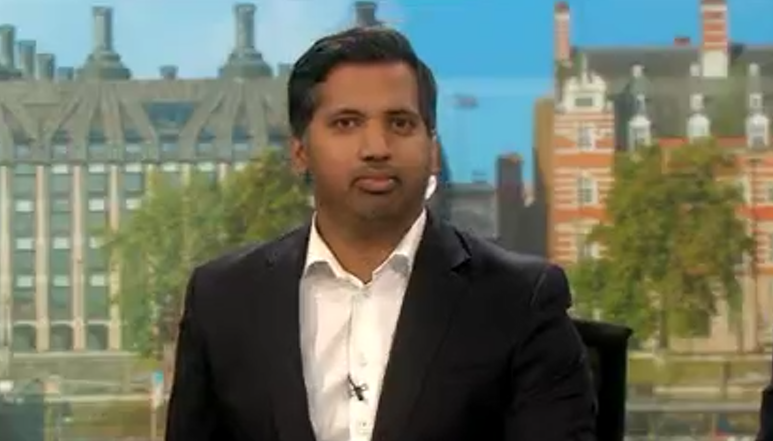
Showing posts with label Faisal Islam. Show all posts

Wednesday, 6 January 2021

BBC producer elected to US Senate? (to be confirmed)


Blimey, the BBC's economics editor Faisal Islam has a bit of breaking news from Georgia..
And - blimey the 33 year old who could be about to lose POTUS’s party the senate, Jon Ossoff, was a producer on some documentaries... including the BBC 3 Stacey Dooley ones...

Apparently, he worked on both 2016’s Stacey on the Frontline: Girls, Guns & Isis and 2018’s Stacey Dooley Investigates episode Face to Face with Isis, both broadcast on the BBC. 

Friday, 1 January 2021

To the accompaniment of 'Albinoni's Adagio'


This is amusing:

It all backs up a comment from Dominic Farrell:
MSM didn’t disappoint last night. I’ve been to funerals which were more upbeat and positive. One reporter looked like he was about to cry. This is what we had to beat. The entire Establishment, including its ministry for propaganda. The thin red line held firm at the ballot box.

Até logo to the Single Market


Among the headlines on the BBC News website this 1 January 2021 morning is Adieu to the single market created by the UK.

It's a piece by the BBC's economics editor Faisal Islam, and reads like a fond adieu on Faisal's part, of the 'What has the EU ever done for us?' variety.

Of its 38 paragraphs, only 5 focus on potential positives from leaving the EU. Most of the rest only look at the positives of being in the EU and the problems raised by leaving the EU. 

Anyhow, the piece also contains historical nuggets such as this:

The inadvertent diplomatic consequences of changes in trade patterns can be profound. If, for example, the eminent historian RW Johnson is to be believed, the UK's accession to the EEC in the first place, created the conditions for the fall of South Africa's apartheid regime which was "hurt in several ways". 

British trade was remodelled away from the Commonwealth to Europe, the EEC offered favourable trade with all of Africa except Pretoria. And then when Portugal followed its ally the UK into the EEC, its African colonies and white rule quickly lost to revolutions by black liberation movements in Angola and Mozambique.
That last paragraph seems to be missing a word - shouldn't there be 'were' before "quickly lost"?' - so might just be poorly written. Still, it seems to be claiming that Portugal joining the EEC led to its African colonies being "quickly lost to revolutions by black liberation movements in Angola and Mozambique". If that's what Faisal is claiming, he's wrong. Those countries became independent (under the MPLA and FRELIMO) respectively in 1975 following Portugal's Carnation Revolution the previous year, 11 years before Portugal joined the EEC. 

Saturday, 28 November 2020

"Do you ever feel that you are being played?"


For transcript fans, here's one featuring the BBC's economics editor Faisal Islam talking to Samira Ahmed on this week's Newswatch about the challenges of reporting government spending reviews and Budgets...

Samira Ahmed: Not everyone finds it easy to get their heads around those numbers, not only because they are large but, in the case of a Spending Review or a Budget, there are simply so many them. And as the report released by the Office of National Statistics on Wednesday found, a large proportion of people lack a basic understanding of economic statistics such as employment figures or the deficit and also mistrust official data. That is one of the challenges faced by Faisal Islam, who joins me now from our camera position upstairs in the newsroom. Welcome to Newswatch. Even if we are not in a pandemic, the spending review would be a huge task for you to process and explain, can you briefly talk us through how you go about doing that? 
Faisal Islam: In the days running up to it, we obviously try and scope out exactly what the broader parameters and exactly how much is going to be spent. You tend to get quite a lot of it pre-announced by the Treasury, a mixture of leaks, unauthorised, but also actually the announcements that are going to come on the following Wednesday happening during the course of the previous few days. We have to analyse there. There is a particular challenge there because you don't get all the information, so you might get a partial announcement, the full announcement is to come a few days later, so you have to be wary of exactly what is being communicated. 
Samira Ahmed: And, Faisal, you have already hinted at that one of the concerns that viewers have, which is how far you should be reporting government leaks and rumours put out beforehand. If you take the example of the cut in the foreign aid budget, which was definitely leaked well in advance, do you ever feel that you are being played? 
Faisal Islam: I think whenever you get a piece of information unofficially, you do have to process the motive for getting that piece of information, kick the tires on it, make sure that it isn't only being given to you in a partial way so that it will be reported in a slightly...with a lack of nuance. You have to be aware of the basis upon which information is turning up in your inbox or on your WhatsApp or your messages or occasionally by carrier pigeon. You have to be aware of why you are getting that information and how you report it. But I tend to find that actually it is worth just waiting a little bit until the official information comes out and you can fully assess the context of that government announcement. But I think it would be naïve to assume that you would never report these things in advance. These discussions and debates are happening in private. Good journalists would want to be in on that. But you are right to say that we should put a certain health warning on the quality of some of that information that comes through before it is official. 
Samira Ahmed: The Office for National Statistics this week reported that most people don't really understand very much about economic data and its terms, and I wonder if you shouldn't be doing even more to explain, to spell out the difference between say debt and deficit, some of these concepts, for viewers. 
Faisal Islam: Yes, and it think it depends on the outlet as well. But you are absolutely right. I would say that there are twin deficits, but this would run up against the problem, even in my answers, the twin challenges is probably what I should say, of complexity and controversy. And we need to be able to guide viewers, listeners, readers, through all of that. On complexity, it is true that we have to bear in mind some basic concepts for an economic audience or a political audience, such as the deficit, needs to be unpacked but I also think there is a challenge as well with brevity. If you try to explain with a sentence or a couple of sentences every single thing every time you said that, you would never actually say anything.
Samira Ahmed: The numbers that we are now talking about because of the pandemic are so huge - you know, the scale of borrowing - it can be hard for many of us to grasp. But equally, I'm wondering as an economist yourself, when you report that we're talking about the biggest debt situation for 300 years, is that actually a bit scary, even for you? 
Faisal Islam: Yes. I mean, I think you to bear in mind, it is not our job to scare anybody. It is our job to inform people. I think one was to communicate to that and give context to that is to give historical comparisons. You mentioned the borrowing as a proportion of our national income, the largest since World War II. Perhaps a better way, which is one that I tried to use to explain it, is that we have only seen this level of borrowing in world wars. So that gives you a letter idea of the scale of the crisis that the Government has dealt with. It's like a world war. You need to come up with ways of explaining things that bring alive a decimal point or a percentage and give some context to the challenge. But it is a challenge and it is not surprising that some would feel that this is daunting. It is daunting, but there are obviously ways through it. 
Samira Ahmed: Faisal Islam, thank you so much.

Saturday, 21 November 2020

ITBB has learned...


ITBB has learned that Robert Colville of the Centre for Policy Studies was a 'talking head' in a BBC News at Ten report last night. He tweeted this about it: 
Just watching my News at 10 appearance on public sector pay freeze. Introduced with 'The BBC has learned that...' this could happen. By reading the front pages of the Times, Mail and Guardian this morning?
The relevant bit ran as follows:
The BBC has learned that millions of public sector workers in England, including teachers and police, could face a pay freeze next year. There are 5.5 million public sector workers, but it's thought that NHS staff may be exempt from the measures.
The BBC's use of 'The BBC has learned that...' has been a standing joke for some time of course. 
  
The report itself by Faisal Islam contained a fair range of public and private sector voices disagreeing with each other but ended with Faisal saying, "As the economy continues to suffer, the bulk of the tough decisions on tax and spend are to be put off, but not for public sector workers", thus making it sound as if public sector workers have been particularly hard done by.

Sunday, 27 September 2020

Or are we being wound up?

Transcript time:

This was how The Andrew Marr Show's paper review discussed the Charles Moore/Paul Dacre story this morning. 

What stood out for me was Camilla Tominey's delivery of a delicious jab against Andrew and the BBC. 

It brought a smile to my face:

Andrew Marr: Let's talk about the front-page of the Sunday Times. Lots of papers, in fact virtually every paper, carries the same story: that Paul Dacre of the Daily Mail, one of the most famous and controversial newspaper editors of his time, is being lined up to head Ofcom, overseeing broadcasting, and Charles Moore, now Lord Moore, who was an editor of your papers and the Spectator and is a Conservative commentator and biographer of Margaret Thatcher - no great fan of the BBC it has to be said - is being lined up as chair of the BBC. Very straightforward question Camilla: Is this true, do you think? Or [laughing] are we being wound up? 

Camilla Tominey: I like the fact that the BBC reaction is to consider it a wind-up, simply because both of these figures are right of centre, representing right of centre newspapers in their time. It does seem a little bit tricksy. But, at the same time, perhaps that is the problem. Perhaps the fact that if Alan Rusbridger, the former editor of the Guardian had been put up for either of these roles, no-one would have paid a blind bit of notice. Perhaps that, therefore, does... 

Andrew Marr: They would have been purring across north London [laughing].   

Camilla Tominey: Well, exactly! So maybe that does suggest...maybe the reaction to this does suggest there is a problem Andrew!

Andrew Marr: Alright. Of course, we have to say, that there is a proper process for this kind of thing, and there is is a tweet from Peter Riddell, who heads the body that looks over public appointments. He says, "Public competitions for the new chairs of the BBC and Ofcom, both regulated by the Public Appointments Commission, have not yet been launched. Each would involve a Senior Independent Panel Member to provide assurance of a fair and open process as in the Government's Governance Code." Now, we should say, Faisal, both of these characters are very, very eminent journalists and they are serious contenders for anything. 

Faisal Islam: They are. Certainly in the case of the Ofcom chair, that has traditionally being filled in the past by kind of PhD or professors of economics because the role isn't mainly about content regulation, though there is an important role in online [indecipherable] coming forward for Ofcom. It is about broadband, and telephones, and mobiles, and all that sort of stuff, so it tends to have been a technical appointment. But it is a new Government. They may have a change of direction on who they think should run these things. 

Andrew Marr: It will be very, very interesting to see what happens next. 

Friday, 29 May 2020

Credit where credit's due


Today's Downing Street briefing, led by the highly fluent Rishi Sunak, did the attendant journalists great credit.

All the preening prima donnas of the press pack were rested today. The room was left to the adults.

And, from the BBC's Faisal Islam and Sky's Ed Conway and the Telegraph's Anna Mikhailova to the chap from the Daily Mail and the other chap from the Hull Daily Mail, they all asked the Chancellor good, tough questions - questions I bet most of the watching public actually appreciated them asking.

Friday, 20 September 2019

Er...starring Faisal Islam


Faisal Islam

Talking of Twitter exchanges, here's another between two people I 'follow' - one the BBC's editor of live political programmes, the other a not unfriendly critic of the BBC - rounded off by a comment from someone I most certainly don't 'follow' (my loss?):
Rob Burley: Coming up at 1215 on BBC2 it's Faisal Islam with Politics Live and guests Trevor Phillips, Sherelle Jacobs, Zing Tsjeng, Liam Halligan, Ann Pettifor and Matthew Syed.
BBC Waste: Can't you find anyone better than Faisal Islam? You have great talent in the ranks. Wouldn't be in my top 25 choices.
Rob Burley: I think he's an excellent presenter. Unnecessary unpleasantness.
Raymond Bennett #RevokeA50 and #MakeItStop: He is. Good choice, credit where it's due.
Now, in fairness to Mr Waste, he's long been a critic of Faisal Islam. He thinks the former Sky man isn't very good and that he has an especially strong anti-Brexit bias - a bias that he, BBC Waste, feels repeatedly gushed out of Faisal's reports on Sky like tell-tale blood strains in fifty Edgar Allan Poe short stories. 

(I've seen too many images of Boris's decapitated head today. It's informing my choice of contrived similes). 

And in fairness to Rob, I thoroughly enjoyed his programme today - a good spread of interesting guests with diverse opinions often strongly disagreeing but in such a way as to generate light as well as heat. And fun too. 

But, while trying not to be unnecessarily unpleasant myself, I must say that Faisal erred on the side of er-ing far too much - meaning that he said 'er' a heck of a lot, especially when stumbling through reading the autocue, as he did throughout. 

He really doesn't seem to have got the hang of reading the autocue. (Not an autocutie, our Faisal - at least not yet). At one point he moved beyond nervous/confused hesitancy and came perillously close to collapsing into 'dead air'. 

I worried for him. 

Still, we've all got to start somewhere. He obviously needs to practise more. Hopefully he'll soon get beyond making viewers feel tense on his behalf soon and flourish (if he isn't biased, that is, of course).  

Trevor and Sherelle

But, talking about tension...

The central discussion on 'Islamophobia' in the Conservative Party got somewhat heated, especially between Trevor Phillips and Faisal Islam.

The BBC had been gifted some 'Islamophobic' Twitter stuff embarrassing to possible Conservative members by someone who is very interested in such stuff - i.e. an activist (wonder who? an Islamist? a Corbynite?) - and was making headline news of it. 

Faisal was - as is the BBC's way - quick to shoehorn in Boris's letterbox quip about niqab-wearing Muslim women in that article in favour of NOT banning the niqab/burka. 

Trevor demanded to know what was 'Islamophobic' about the comparison and asked whether Faisal's question reflected the BBC's point of view. 

Faisal tried the old, tried-and-trusted 'Ve are arsking ze questeeonns' line...

(...actually, I meant 'tired-and-trusted' there...)

...which never really cuts the ice, does it?

Hmm. I'm not too familiar with Faisal Islam (unlike his critic BBC Waste), but I'll be nice and wish him good luck in getting to grips with reading the autocue and handling criticism better. 

And, Faisal, please don't be too biased!

Curiously, it's still (nearly four hours later) not available to view again on the famous BBC Sounds. Is something up? Are there technical problems? Has some interest group complained? (The Muslim Council of Britain perchance?)

Tuesday, 6 November 2018

"All we need now is for Andrew Adonis to be appointed entertainment correspondent"


The comments under the BBC Press Office's tweet announcing Faisal Islam's new BBC Economic Editor job are really quite something - and possibly highly revealing. If you 'do Twitter', you ought to give them a read.

Yes, there are lots of fellow journalists wishing him well and saying good things about him, but mainly its ordinary Twittering members of the public, and there's a massive split among them:

On one side there are lots and lots of anti-Brexit people very warmly welcoming his appointment, heaping praise his 'balanced reporting' and praying he'll bring more 'balance' to the BBC's Brexit coverage. It really is striking seeing so many #FBPE types singing a senior broadcast journalist's praises in so an unqualified a fashion. They seem to really like him. (One non-parody #FBPEer even seriously tweeted, "BBC News, please allow him the freedom to express his views as he does now"),

On the other side there are lots and lots of pro-Brexit people very strongly not welcoming his appointment, calling him a 'Remoaner' and saying that the BBC is cementing its reputation as 'the leading broadcaster for Remoaners' by picking him for the job. ("Whilst I hate to talk ill of a fellow United fan, Faisal's leanings toward Remain have been undisguised since the referendum. Did that not concern the BBC, even slightly?", asked Dr Paul Stott, for example).

The partisan reaction suggests that Faisal is a 'controversial' choice. Maybe even, as the BBC might themselves put it, a 'divisive' one?

Faisal Islam to become Economics Editor for the BBC


Guido Fawkes has been tracking biased and/or innacurate reporting at Sky News for a while, particularly from its political editor Faisal Islam. Here's are three Brexit-related examples:


So, in the light of that, if Guido is correct, what shall we make of the announcement today that Faisal Islam is joining the BBC and taking over Kamal Ahmed's old job as BBC Economics Editor?


Well, at least his reporting now comes under the remit of Is the BBC biased?!

Wednesday, 31 May 2017

BBC's Own Brand National Treasure gets stuffed


Own Brand National Treasure

You’ll have already read the abundant criticism of Jeremy Paxman’s disappointing performance on Channel 4’s much anticipated Great Political Event. I haven’t got much to add, but I felt that Paxo deserved a mention purely because of his status as the BBC’s Own Brand National Treasure.  

After all, Channel 4 and Sky had gathered together a politically balanced audience and bagged The Great Paxo to eviscerate the leaders of the two main parties. What’s not to like.

Personally I’m not a fan of Paxo’s stock-in-trade repetitive-questioning technique, which proved to be such a hit with Michael Howard’s enemies. Cornering interviewees into making panicky and convoluted attempts to avoid incriminating themselves merely for your (and the audience’s) amusement is a tactic of the bully. Especially if the admission you’re trying to force out is about as deceitful as getting an interviewee to confess to cutting the flesh of his fellow man but not letting him say he’s a surgeon. If you see what I’m getting at. 
I particularly dislike it when other interviewers emulate this unfair tactic; making a spectacle of an interviewee who is already at a disadvantage because you’re ‘at home’ and he’s ‘away’. 

Viz. Mishal Husain’s notorious, “How many Israelis?” question, repeated over and over. Hoping to score a devastating point against ‘Zionists’ by trying to force Gil Hoffman to utter the word “none”, having asked, over and over again “how many Israelis have been killed by Hamas’s harmless home-made contraptions?” But she came off looking biased and cruel, and I’m not the only one who thought this reflected badly on her.

I suppose Channel 4 and Sky thought they were hiring a titan, but Paxo’s failure to deliver proved universally disappointing. Everyone was so looking forward to it as well. 

First of all people were disappointed by his rudeness, which backfired spectacularly, diverting sympathy from interviewer to  interviewee. 
Secondly people were appalled by his ineffectual lines of questioning. He seemed so out of touch. He persisted in a line of attack  that was obviously going nowhere, something that should have been evident as soon as Jeremy Corbyn produced the first answer. 
Q: “Why haven’t you managed to get your radical, hard left policies into the Labour manifesto? “ A: “Simples. We’re a democracy, not a dictatorship. Next! “ 
But cloth-eared Paxo wasn’t for moving on. 
  

In today’s Times (£) Matthew Parris explains why he believes Corbyn’s affiliation with the IRA hasn’t dented his popularity.

“Why Corbyn isn’t being hurt by the IRA issue”. 


Apathy? Yes. Ignorance of, and boredom with recent history? yes. But crucially:


We hate and fear terrorists, of course, but the English have never warmed to Ulster's orangemen, I have the feeling that though in England knowledge of the Irish Question is hazy to the point of ignorance, there's a deep if vague collective recognition that, over centuries, England screwed the whole thing up horribly: that it was us who started this"

The very same phenomenon applies to Israel and antisemitism. If the Labour Party plans to officially recognise Palestine first thing sharp on the morning of June 9th, or if Emma Barnett receives a few antisemitic tweets after exposing Corbyn's ineptitude, so what? As for Israel, "Britain screwed the whole thing up horribly: that it was us who started this"

We don't know history and we don't like Zionists anyway. Antisemitism in the Labour Party?
We. Ain't. Bovvered.

The BBC's veteran presenter used a similar approach in his questioning of Theresa May. Of course she was at a disadvantage, being part of the sitting government. A P.M. has a lot of policies to defend; Policies with records.
Instead of choosing the government's failure to deal with immigration or the chronic underfunding of everything but overseas aid, Paxman decided to attack May's ability to negotiate a 'good' Brexit on the grounds that prior to the referendum she had campaigned for Remain. "Simples. I'm acting on behalf of the people. Next!"  But Jeremy wasn't listening.

Faisal islam didn't do much better, but the audience managed to get some important points across. Particularly notable was the Irishman who criticised Corbyn for attending a commemoration for an IRA terrorist. Corbyn's well-trodden claim that he wasn't honouring a terrorist but commemorating "all who died" wasn't allowed to stand unchallenged. One point to the member of the audience, nil points to Jeremy Corbyn. There was also the small business owner and disillusioned labour voter who questioned the Labour party's plans for increasing corporation tax and raising the minimum wage. Why, he wondered, should he vote Labour when such policies would damage or destroy his business?

The unsustainable policy of "hammering the industrious to fund the idle" is the fundamental weakness of the Labour party's 'vision', but the birthday boy didn't give the businessman the opportunity to protest at his question being side-stepped, when it so very plainly had been.
I'm sure a lot of small, and not so small, businesspeople wanted to hear the answer to that one.


Saturday, 4 June 2016

The "Leave" show


I haven’t watched much TV lately, but something I did watch last night was the ‘Leave’ show, starring Michael Gove and Faisal Islam on Sky. Also present, Kay Burley and “the public”. 

Faisal Islam seems to have turned into Mehdi Hasan. That irritating, non-stop hectoring style is just up Mehdi’s street. I’m really surprised that no-one has mentioned it.

Ah! I’m wrong. Janet Daley has:
In spite of – or maybe because of – being relentlessly barracked and harassed by Faisal Islam, Mr Gove won the room. He repeatedly got spontaneous applause from the audience. In fact, he seemed to gain in confidence as he went on, looking amused rather than defensive even when Islam absurdly likened him to Mr Trump.

I didn’t see the ‘Remain’ show, starring David Cameron (and I haven’t caught-up with it yet) so I don’t know if Faisal Islam was just as exasperating and intrusive with Dave as he was with Mike, but relentless pursuit of a yes/no answer to an ill-conceived ‘killer’ question is pure Mehdi, and a bit Mishal too. 

Have you (or have you not) stopped beating your wife?  Have you? Have you? Have you?

How many economists have come out on your side? How many? Name one. 
Can you guarantee that no-one will lose their job as a result of leaving the EU?  Can you? Can you guarantee that the weather will improve on June 24th? Can you?

No, Faisal made matters much less clear with his obtrusive interventions. A skilled, less terrier-like interviewer would have calmly let the questions and answers flow, one after the other. We would have learned more.

From the reaction of the MSM, I really did wonder whether I’d watched the right programme. Maybe they’d been watching the real one and I’d somehow stumbled upon the dress rehearsal. 

The chap in the audience who compared  Gove’s ‘Leave’ advocacy to a World War 1 general waving the flag and saying "over the top, men!” did have a point, but prediction is not a science, and that particular argument is predicated upon the certainty and stability of a turbulent and unstable EU, which of course there  ain’t.