Showing posts with label Stephen Glover. Show all posts

Saturday, 8 January 2022

Recommended reading


Stephen Glover lays out a detailed charge list against BBC Radio 4' Today programme at the Mail: 
A week in the life of Today that has made me despair of BBC bias: Flagship news show offers only a Left-wing progressive take on everything from Brexit to statue toppling and the NHS.
I thought of attempting a summary of the piece, but the detail is what's important and it's well worth reading from start to finish. 

And I hope the people behind the Today programme read it too, and don't just sneeringly dismiss it. The one prediction I'd make is that if Nick Robinson does respond, he will just sneer at it.

Here's a taster - the section headlined TOPPLING OF THE COLSTON STATUE:
On Wednesday a jury in Bristol acquitted four people responsible for toppling a statue of the 17th-century slave trader and philanthropist Edward Colston in June 2020. 
The following morning, Today interviewed the distinguished black historian David Olusoga. He declared that the acquittal, which he enthusiastically supported, was a ‘historic landmark’. 
During a sympathetic interview by Nick Robinson, Professor Olusoga stated that the jury’s decision hadn’t created ‘a legal precedent’. That is highly debatable, yet he wasn’t challenged. Nor did Mr Robinson care to mention that Mr Olusoga gave evidence for the defence during the trial. 
Colston was obviously responsible for many wicked acts. But no one was given an opportunity by the Today programme — Mr Olusoga being the sole interviewee — to say that it is wrong to go around toppling statues of long dead people, whatever some may think of them. 
Yet another example of Today ignoring one side of an argument because it doesn’t approve of it.

Update: David Olusoga was also interviewed about it by BBC Breakfast that same morning. 

Further Update: I see that blog favourite Dominic Casciani has been reporting developments in this story as impartially as ever yesterday evening and this morning, giving a wholly one-sided take on the matter: 

If the Attorney General asks the Court of Appeal to review the case, it won't be able to reverse any of the acquittals, let alone order a retrial, but the judges could consider whether the case's outcome means the law needs clarifying for future cases. The protesters had told the jury the deeply divisive statue belonged to the city's people, who largely wanted it removed. They added that its continued presence amounted to crimes of indecency and abuse that caused distress, and far from damaging its value the graffiti-daubed statue was now worth vastly more since its installation in a museum. They also argued the prosecution was disproportionate in light of a recent Supreme Court ruling on the boundary between protest and crime. One of the defence team Raj Chada said there was no confusion about the law other than among some Conservative MPs. He said the review would smack of Trumpian politics and would undermine trial by jury, a cornerstone of British justice.

That defence case-style contribution evidently got the seal of approval from whoever edited Radio 4's Six O'Clock News and Midnight News. 

Sunday, 4 March 2018

Where's Max?


One of the examples of BBC bias used by Stephen Glover in his recent column I say this in sadness, but unless the BBC gets its act together it may not be here in 15 years was the BBC's Max Mosley coverage (or the lack of it):
The third example of bias came yesterday after the Mail revealed how Max Mosley supported the revoltingly racist far-Right in the early Sixties, and apparently concealed this fact when successfully suing the now defunct News of the World in 2008 for describing his orgy as Nazi-themed. 
You'd have thought this was meat and drink for the Beeb, especially after Channel Four News brilliantly eviscerated Mosley. But for several hours it was shtum. When Labour announced it wouldn't be accepting more money from Mosley, the BBC carried a brief story on its website, but still ignored it on its news bulletins. 
Was it fear of the tycoon that held Auntie back? Or was she unwilling to pick up the story because it had originated in the Mail, which her left-leaning journalists regard with suspicion? Either way, it was another instance of disgracefully inept journalism.
Well, today, Labour's shadow chancellor John McDonnell made life very difficult for Labour's deputy leader Tom Watson over Max Mosley by telling Sky News that Mr. Watson should consider returning Mr. Mosley's £540,000 donation - the headline for which could be: Labour Shadow Chancellor Chucks Labour Deputy Leader Under a Bus over Max Mosley Racism Claims. 

It's obviously a newsworthy political story, and even the Guardian is now reporting it in great detail. But so far the BBC is staying shtum, again. 

Will they report it? And if they do, how will they report it? And (if they bury it in the deeper recesses of the BBC News website) will anyone notice?

Monday, 19 February 2018

Watertight oversight - 'Cob' and the BBC


Please bear with me on this one (as I weave my way through my thoughts on this), and please also try to remember that not all tl;dr posts are really 'tl', and that (maybe) they should be 'r' after all...


Stephen Glover of the Daily Mail has excoriated the BBC for "ignoring" the allegations about Jeremy Corbyn being "a Czech ‘asset’" - and agent codenamed 'Cob', approved by the Soviet Union in the dying years of the Cold War: 
Far more worrying is the way the all-powerful BBC has hitherto avoided Sarkocy’s allegations, which have been met with vehement denials by the Labour Party. If you relied on our public service broadcaster for your news, as about half the nation does, you wouldn’t know anything about ‘Cob’. 
I watch and listen to the news on BBC television and radio almost obsessively, and I have picked up only two fleeting references [on a Today newspaper review and The Andrew Marr show yesterday - the bit where Andrew called the story 'rather thin] to the extremely grave charges against Mr Corbyn. All I can find on Auntie’s voluminous website is a tiny mention of a newspaper report....
There may have been other passing references, but it can be fairly stated that the BBC has done its utmost not to give this story wider circulation even though it contains the mind-boggling suggestion, of course unproven, that as a young MP Jeremy Corbyn betrayed his country.
Oh Stephen! Much as I like and admire you and much as you may have a point here, the canny BBC's tradition of 'watertight oversight' means that it was never going to be that easy for a critic of the BBC like you here (though please bear with me!)...

...and, sure enough, Dino Sofos, Senior Social Media Producer at BBC News, found a 'gotcha' answer for you (and, specifically, for Guido Fawkes) :


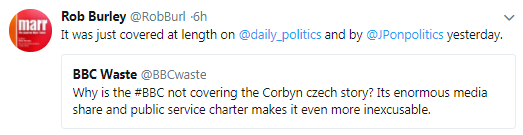
And so did Rob Burley, the Ed-Sheeran-averse editor of The Andrew Marr Show:


So (apparently) John Pienaar's Radio Sunday show covered it "at length", and so did today's Daily Politics. 

QED for the BBC? (Not really. See below).

And, similarly, when Guido Fawkes asks, "Any chance the BBC will cover it properly now the PM has commented?", the BBC will point to a report on BBC News website this evening headlined Corbyn should be 'open' on spy's claims - May and say 'Yes, we did report it'.

Ah but....

...(long sigh)....

....in the venerable tradition of BBC 'watertight oversight', just check out where on the BBC website the BBC published this headline story (and where it's stayed ever since). [You'll have to click the image to enlarge it, and then you'll see that the BBC hasn't made it a prominent story.] Yes, it appeared near the exit door of the BBC's Home page, so to speak. But, yes, they have reported it on their Home page, so....'watertight oversight' kicks in and the BBC is off the hook.


Or is it?

Read that BBC report, however, and it's mostly 'the case for the defence' as far as Jeremy Corbyn is concerned.  The caption to the opening image puts Jeremy's case for him, rebuttals of the claims against Mr. Corbyn get the lion's share of the reported speech, and the BBC itself gives its own imprimatur to those rebuttals. Plus the whole report is full of 'health warnings' ("claims", "alleged", "reportedly", "possible") about the claims against Mr. Corbyn.

The BBC, rightly or wrongly, is essentially rubbishing the story here - 'belatedly reporting it and frantically trashing it', unkind folk might say!

As I'm wary of taking the BBC on trust these says (even those BBC people I like), I've also checked out Dino and Rob's claims. 


As for John Pienaar on Pienaar's Politics, yes, the story was discussed - for fully 5 minutes - but John Pienaar himself immediately rubbished those claims that Jeremy Corbyn might have been an agent for the Soviet Bloc by describing them as "pretty absurd" and ended the big discussion (twently minutes later) by saying, flippantly, "this story may be going absolutely nowhere but it doesn't stop us talking about anything!" - both of which statements clearly signalled to the Radio 5 Live listener that the BBC's Deputy Political Editor personally doesn't reckon much to the story. 

As for the discussion itself, two defenders of Jeremy Corbyn (Labour's Peter Dowd and pro-Labour journalist Jenni Russell) rubbished the story for nearly all of and then, just before the end, the Sun's David Wooding got a brief say and voiced some criticism of Mr. Corbyn's past. 

So, yes, Pienaar's Politics did devote a whole segment of the programme to the story yesterday, though John Pienaar began and ended his programme's coverage of it by strongly suggesting his own sense that the story doesn't amount to much and doesn't really merit reporting, and - separately - the 2:1 imbalance of the discussion (made worse by David from the Sun getting far less time than either of the two Labour-defending guests) didn't really cover this segment in impartial BBC glory either, did it? 

So, Pienaar's Politics is classic BBC watertight oversight in action. 'See, we discussed it after all!' , says the BBC. Yes BBC, you did. But HOW did you discuss it on this rare occasion when you seemingly reluctantly consented to finally discuss the story? That is the question.

As for The Daily Politics, well, yes, they too did discuss it today, as Rob said. ('What took them so long?' I imagine many people crying). Did they, as Rob contends, discuss it "at length"? Well, I think Rob is definitely stretching it there! So how long did they discuss it for? For 3 minutes and 2 seconds.


And Jo Coburn began the segment by stating, "Our man in Prague has spoken to the head of the Czech secret service archive who has reiterated that there's absolutely nothing in the archive to suggest that Jeremy Corbyn was an informer but he was a 'person', according to her, 'of interest' to the secret service."

Again, this is classic BBC watertight oversight in action. The story that many people claim the BBC is "ignoring" is then (after those complaints have been pouring in for days) finally discussed on the flagship Daily Politics...albeit for just three minutes and with the BBC presenter sounding a very strong 'health warning' about it from the word go.

So there we are. The BBC - like the Guardian but unlike several right-wing papers - isn't buying these claims about Jeremy Corbyn.

And it's not encouraging you to buy them either.

And what does that say about 'BBC impartiality'?

For a firmly non-BBC take on all of this you might want to read the latest article from Douglas Murray. It's quite a 'think' piece.

Friday, 13 October 2017

Getting it wrong again


It's an old theme but the latest variation on it is well worth hearing: Stephen Glover's Daily Mail piece headlined 'How the Mail got it right on Romanian and Bulgarian migration and the BBC got it so wrong – and deceived Britain'. It's spot on and thoroughly damning.

The shocking thing about it, looking back, is that the BBC didn't just "get it so wrong" and "deceive Britain" for the first time here. They simply replayed almost note-for-note their earlier 'mistakes and deceptions' from the post-2004 mass influx from Eastern Europe. They clearly refuse to learn.

Back in the early 2000s we had reports such at that by the BBC's Dominic Casciani giving credence to claims that the influx from Eastern Europe after the borders opened in 2004 would be much smaller than the 'hype' suggested - and by 'hype' he specifically meant Migration Watch's claims. In the end Migration Watch proved right and the official UK projections proved wildly, spectacularly wrong. 

So you would have thought that the BBC would have learned its lesson by the time January 2014 came and the gates were opened to Romanians and Bulgarians, but no, no such lesson had been learned. 


They repeatedly and doggedly played down the likely numbers, with BBC reporters (such as Phil Mackie and Mark Lowen) not just reporting others saying that the numbers would be much less than Migration Watch and UKIP were predicting but stating themselves that they (as BBC reporters) didn't see any evidence that large numbers would be coming to the UK.

And when a small, unexpected dip in the numbers was reported in May 2014, the BBC splashed the story, with Eddie Mair talking of "all the hype" about the numbers, and Mark Easton saying of the "flood" that "if anything, the reverse" was happening, and Nick Robinson opining, "Well, well, well. So much for those predictions of a flood of immigrants coming from Romania and Bulgaria once the door to the UK was opened - ie after visa restrictions were removed on 1 January this year!" and crowing, "However, today the questions will be for UKIP who warned of a flood of new immigrants from the two countries". 

And what has happened ever since has been more and more data on the actual numbers and less and less BBC reporting of them. The OBS reported that there are now 413,000 Romanians and Bulgarians in the United Kingdom, equivalent to the population of Bristol, over whom some 263,000 or so came after January 2014. 

Yet again, the previous Labour government projection of 13,000 a year (the then Labour government's estimate) and he more recent NIESR's guess of 21,000 a year were shown to have been complete rubbish. Even Migration Watch's prediction of 50,000 a year now looks like an underestimate. UKIP looks likely to come closest with their much-derided prediction of 350,000-400,000 over five years. 

Why would the BBC get it so badly wrong not once but twice? 

To paraphrase Marx: History repeats itself, first time as terrible, biased reporting, second time also as terrible, biased reporting. 

Is there any other explanation for this?

And did they report the latest figures? Well, I've seen reports on the OBS's figures from everyone from the Guardian to the Daily Mail, from Sky News to Xinhua, from the Times to the Irish Times but I can find nothing on the BBC News website on the story. 

As far as I can see the BBC has studiously ignored the story, yet again.

Once again the BBC has betrayed its reporting responsibilities by failing to follow through on a story it massively hyped and got badly wrong. The BBC should be reporting these figures and pointing out who got it right and who got it wrong. 

There's no good reason why the Corporation isn't doing so, is there?

Saturday, 30 May 2015

Impartiality


Here's proper impartiality for you: two pieces from Standpoint magazine - one bashing the BBC, the other bashing people who bash the BBC:
Here's a sample from each of them:

Stephen Glover
If the Tories can reasonably consider themselves hard done by during the election, UKIP is entitled to think it was taken to the cleaners by the Corporation. Despite Ofcom’s decree that it should be treated as a “major party” on the same basis as Conservatives, Labour and Lib Dems, it was regularly tacked on to the end of BBC political reports, and sometimes entirely ignored. In one television debate Nigel Farage was barracked by a BBC-selected audience that appeared predominantly anti-UKIP. When grilled by Newsnight’s Evan Davis Mr Farage was treated as though he was batty or an extremist or both, though when Mr Davis came to interview the SNP’s Nicola Sturgeon, he was full of smiles and reassurance. 
By way of further supporting evidence, let me point out that the editor of Newsnight, Ian Katz, is a former deputy editor of the Guardian, its political editor hails from the same newspaper, and its economics editor was previously an economist at the TUC. Ask yourself whether it is imaginable for the editor and political editor of the most important current affairs programme to have worked for the Daily Telegraph, or for its economics editor to have cut his teeth at the Institute of Economic Affairs. The answer is obviously “No” — as it is equally inconceivable that an ex-Tory cabinet minister would be appointed as the £300,000-a-year “director of strategy and digital”, as the former Labour cabinet minister James Purnell was in 2013. The same point can be made about the centre-Left participants who monopolise the Beeb’s satirical and culture shows. Sometimes it seems as though Tony Hall, director-general, as well as its head of news, James Harding, are ’avin’ a larf. 
I don’t doubt there are many fine journalists working for Auntie who strive to be neutral and objective, and often succeed in being so. But with a few exceptions they are what they are — metropolitan, conventional members of the slightly left-wing cultural elite, wary of Tories and their strange antediluvian beliefs. Appointing right-wing BBC chairmen or director-generals won’t affect the direction of travel, as Margaret Thatcher discovered in the 1980s. It is surely instructive that almost every BBC journalist to whom one talks is convinced that the organisation is even-handed.

Nick Cohen
You have to read the right-wing press to see how unrelenting the assault on the BBC is in England. You have to read Bella Caledonia or one of the other SNP blogs to see how Scottish nationalists ape English Tories. It’s not that the BBC deserves to escape scrutiny for its biases and faults, or for the many follies of its managers. Rather, you need to look at the cultish refusal to allow one good word to be said about the corporation, and at how this stifling uniformity reveals the emptiness of nationalist and Tory myths.
Conservative intellectuals are fond of Jonathan Haidt’s argument in The Righteous Mind that liberals do not understand tradition and therefore cannot tolerate conservatives. Haidt’s thesis is highly dubious — the American and European liberal-Left are suffused with traditions of their own. But when conservatives go on to say that the Right is more broadminded than the Left, they reduce Haidt to absurdity.
A glance at the conservative press shows you that dissent not only on the BBC but also on the EU is simply not allowed to exist. Even civilised conservatives, who deplore the dumbing-down of British culture, can never discuss in public what would happen to that culture if their allies succeeded in abolishing Radios Three and Four. Scottish nationalists boast that theirs is a warm and cuddly “civic” nationalism, yet they demand the sacking of BBC journalists who fail to show proper deference to their leaders.
The easy explanation for the group-think is that many journalists act like prostitutes, whoring out their integrity to whoever pays them. It is certainly the case that you cannot defend the BBC in most right-wing newspapers without running into trouble.

Saturday, 29 March 2014

The Crystal Methodist, the BBC and the Daily Mail


Tuesday's Newsnight was the edition which featured Jeremy Paxman's 17 minute-long interview with the disgraced former Co-operative Bank boss, Paul Flowers.

Taken together with Laura Kuenssberg's introductory report and her closing chat with Jeremy Paxman, that night's Newsnight gave over just under half an hour to this story - a considerable amount of time to give over to one man's self-justification.

The former Methodist minister clearly doesn't go a bundle on the old-fashioned idea that you should, "Love your enemies, do good to those who hate you, bless those that curse you, and pray for those who mistreat you", for as the Gospel of St. Luke says, "And if any Sunday newspaper strikes you on one cheek, offer them the other one too". 

Oh, no, Rev. Flowers is certainly not for turning the other cheek at all, and most definitely doesn't believe in loving his enemies, the Daily Mail and Mail on Sunday. He smote back at those newspapers with all the strength - plus reserves of venom ("pseudo-fascist", "far-right"). Plus he was clearly prepared to smiteth his political opponents, the Tories, in the process too. 

Those who believe the BBC is left-biased have seized on this decision to give the Labour-supporting disgraced ex-bank boss a very sympathetic interview from Jeremy Paxman as clear proof of that bias.

The most powerful assault on this interview - and the BBC - came (perhaps unsurprisingly) from Stephen Glover at the Daily Mail:
But the interview of Paul Flowers constituted an abdication of proper journalism. That, and the way the BBC promoted it throughout its news programmes as a hugely important exclusive - whereas, in fact, it was intended as a piece of anti-Tory propaganda - betray some pretty twisted journalistic values. The truth is that the BBC would not have exposed his deviant behaviour and colossal mistakes - as newspaper journalism has done - in a thousand years.  
I think that Laura Kuenssberg's introductory report and her closing discussion with Paxo provided some counter-balance, going into some detail about his failings as a banker, mentioning his Labour links (and suggesting those should be borne in mind when he tried to implicate the Conservatives in the mess at the Co-op), and noting how his version of events in the Newsnight interview was different to his parliamentary evidence but, still, I think it's fair to say that the programme failed to robustly challenge/question his accusations. (For example, the was no attempt to explain how his two accounts differ.)

What was needed - quite obviously I'd have thought - was either a Conservative spokesman or a Daily Mail spokesman to respond (preferably both). 

Neither appeared, either on that night's programme or on the following nights' programmes, which seems rather remiss. 

Going back to Stephen Glover at the Daily Mail though...

He singled out Newsnight editor Ian Katz for particular criticism:
Mr Katz recently strengthened the Left-of-Centre line-up on the programme by appointing Duncan Weldon, a former Labour adviser and senior economist at the Trade Union Congress, who has very little journalistic experience. But he is a good Leftie!
The same Mr Katz gleefully tweeted Mr Flowers's outrageous remarks about the Mail on Sunday when the show had ended. Is this how a grown-up editor should behave? Is it serious journalism? No, and no.
Newsnight has nearly always had a Left-wing bias, but Mr  Katz appears to be in the process of shamelessly consolidating it. The appointment of Mr Weldon (another apparent Leftie, Chris Cook, has also recently jumped aboard as policy editor) amounts to another rude gesture towards those who don't share his prejudices.
Now, there's obviously something in that [as I've written before] and Ian Katz would certainly be best keeping off Twitter but, given Newsnight newbie Chris Cook's previously role as a Conservative Party advisor [specifically to David Willetts], it's very hard not to raise a Roger Moore-style eyebrow at Stephen Glover's casual assertion that he's probably a Leftie. [I would guess, I suspect more accurately, that he's a pro-EU Tory wet.]


That kind of confident but likely-to-be completely wrong assertion is something we BBC bashers have to guard against, he says sententiously [having done it himself on more than one occasion]...

...and so is seeing quality in a BBC journalist only if he or she happens to do something we like, such as giving some grief to one of our ideological opponents. 

Here's an absolute peach of an example of that particular specimen of faulty thought (based on nothing more than a single interview), courtesy of the self-same Mr Glover: 
Of course, the BBC has many fine journalists. Paxo should be one of them. Another may be Laura Kuenssberg — one promising recent recruit to Newsnight — who not long ago brilliantly eviscerated Harriet Harman over her links to the Paedophile Information Exchange during the Seventies.
Do you see what he did there? [Even though I think he's right].

Still, he's correct that Newsnight came far too close to absolving Rev. Flowers of his sins, with Jeremy Paxman (of all people) being his puppy-like confessor. Plus Newsnight - and the BBC as a whole - were too willing to plug his anti-Tory, anti-Mail message, and Newsnight failed to adequately challenge his claims, or plug the anti-Labour counter argument.

As a human being, I don't feel entirely unsympathetic to him [having faced what he faced in so short a space of time], but self-pity and self-promotion [much on evidence here] aren't entirely winning qualities either, and serving revenge as a cold dish isn't exactly endearing either - especially when the server has been a Christian preacher.