Showing posts with label Holocaust denial. Show all posts

Thursday, 20 February 2020

Holocaust denial


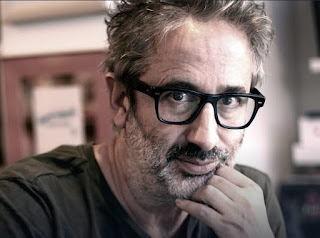
When I heard that David Baddiel was making this film for the BBCI did wonder if a notoriously pro-Palestinian Broadcasting Corporation and a comedian could really make a credible job of such a delicate subject. After all, does Baddiel look much like an historian? (Does he even look much like a comedian?) And is the BBC an honest broker all of a sudden?

Alarm bells went off when I heard Baddiel was off to see a Professor from the SOAS. Whose idea was that? The SOAS’s reputation (as a wing of Islamophillic academia) didn’t auger well for the programme's prospects.

Achcar’s contribution interested me the most, and unsurprisingly, it interested the MSM the least.
“…..But, about half-way through, he started talking about places where Holocaust denial was strongest, and came up with Gaza and the West Bank - ie Palestine - with a figure of 82%. So he headed off to SOAS to meet a supposed authority on the subject, Professor Gilbert Achcar.
[…]
So what did Achcar have to say for himself here, to Baddiel? Basically, he argued that because the Palestinians live in such a state of miserable oppression under the Israelis, their Holocaust denial should be seen as a “provocative” means of hurting their enemy - a kind of "fuck you" to their oppressors. “I don’t think you can generally, without some degree of pathology, be a Holocaust denier in Europe. But you can be perfectly sane and be a Holocaust denier in the Middle East because of ignorance of the topic,” he said. In other words there's "bad Holocaust denial" - the Western kind - and "good Holocaust denial" - the Arab kind. 
Arab Holocaust denial, in other words, gets a pass. As does Arab antisemitism...as always. No mention of Holocaust denial in the Middle East outside Palestine, so comprehensively documented, for instance, at MEMRI. No mention of Iran, or Syria, where denial is government sponsored.  
The subject wasn't pursued. Achcar's vile excuse for Palestinian Holocaust denial - understandable because of what the Jews are doing to them - was left unchallenged. Baddiel, to his credit, wasn't happy with that "good Holocaust denial" vs "bad Holocaust denial" distinction. But the episode still left a bad taste in what was otherwise an excellent programme.
You will have to read the whole thing and follow the links if you want to make sense of the following observations from me. (Forgive the proliferation of parentheses.)
Suffice it to say that just because an ideologically antisemitic individual like the good professor has been gracious enough to concede that the overwhelming documentary evidence of (the enormity of) the holocaust may have some validity, it doesn’t mean that this person is committed to impartiality where Jews are concerned. It doesn't guarantee consummate objectivity where personal prejudices might colour his judgement. 
Therefore his attitude to the Israeli / Palestinian situation is likely to be as objective as a fox in a henhouse.

Me and David Baddiel, (an unlikely couple)  can’t be the only non-observant, secular Jews who have only come to appreciate the significance of our heritage comparatively late in life. The question of confronting our ‘identity’ hasn’t been urgently thrust upon us by the (current) rising tide of antisemitism or the (thankfully) transitory threat of a Corbyn regime. Not quite yet; and unfortunately, forbidding political atmospheres are just as likely to propagate a seasonal crop of  ‘AsaJews’ who align themselves with antisemites as a glut of secular Zionists like me. 

My ‘Talmudic-like’ thoroughness (that’s a semi-insult I’ve had thrown at me) has compelled me to look at as many reviews of this programme as I can digest, and I have to say that Anthony Julius’s advice (“don’t go there”) was well worthy of consideration. Julius knew, of course, that it the MSM would automatically bestow the oxygen of publicity upon Holocaust-denying self-publicists like songsmith Dermot “Mulqueer”. Mul very queer indeed. 

Predictably, that was the only part of the programme that ‘OMG The Daily Mail’ was interested in. Mind you, the musical interlude can’t have done the poor chap’s musical career much good, and it was heartening to see that the comments in the Mail were overwhelmingly negative about the Irishman and supportive of Baddiel.  

The verdict? A curate’s egg. While Baddiel was thoughtful and sympathetic, it was unforgivable that he wasn’t able to challenge Professor Achcar on the most pertinent aspect of Holocaust denial, and the one with the most relevance to the rise in antisemitism. The selective blindness which pointedly (and necessarily) avoids acknowledging the driver behind it - Islamic antisemitism.

The highest Holocaust denial statistic (82%) was gathered from the Palestinian territories. Mahmoud Abbas’s so-called academic credentials are based on it. The BBC’s inability and unwillingness to address Islamic antisemitism is another manifestation of the same old missing link.  The unwillingness to confront something so basic makes its absence all the more glaringly conspicuous and its very absence propels it.

Saturday, 9 February 2019

Is Less More?


In which I accuse Craig’s appraisal of More or Less on the issue of Holocaust denial of being far too generous and gives the programme a pass it doesn’t deserve.

I should declare an interest - in the literal sense - meaning that the subject interests me, and not in the euphemistic sense, which suggests a financial or similar obligation that might tie one to a particular view.

I heard this programme because the subject matter caught my eye, (I suppose I should say “ear” ) which why I paid attention to a programme I haven’t properly listened to for ages. 

The treatment of the item about Holocaust denial seemed decidedly glib. To use one of More or Less’s favourite phrases, “let’s dig a little deeper” and ask who benefits from a thorough More or Less debunking of this survey’s findings. Cui bono?

Q. Why would the Holocaust Memorial Day Trust commission such a survey?

A. A survey might be useful to probe the extent of the perceived increase in antisemitic incidents, with relevance to the activities of Jeremy Corbyn and his merry men.

Q. Why would More or Less feel the need to analyse it?

A. The BBC might wish to put the survey under scrutiny for many reasons. 
        They don’t trust the findings; 
        they think they’re unreliable; 
        they don’t like the findings and wish it weren’t so.
The very idea of a massive groundswell of ignorance and racism is neither palatable nor credible to most people I’d imagine.

So here’s my take on the programme. 

The intro itself immediately brings in a kind of get-out clause, using non-committal language, which covers the whole issue: 
“As many as one in twenty adults in Britain don’t believe the Holocaust took place.”
("As many as" = "not categorically")

Then they define the word ‘Holocaust’, presumably to avoid any misunderstandings, but (problematically for me) emphasising the "even bigger" number of ‘non-Jewish’ targets, “Roma, disabled, political prisoners and many others.” This almost vindicates or diminishes Hitler’s underlying antisemitism - the specific scapegoating of Jews - that fuelled his extermination policy. It’s almost worthy of Ken Livingstone when you think about it.

Then the findings (of a 2,000 person survey) are extrapolated to a seemingly mind-boggling conclusion, which is that “as many as one in twenty”  people in the UK deny the Holocaust. 

Admittedly, the BBC is not alone in making this unlikely-sounding extrapolation from the figures. I think that’s the inherent flaw in all surveys. How do we (ever) know that any sample truly represents the entirety? I don’t know how they do that and it could explain why polls and surveys are often way off the mark.


Ruth Alexander has been trying to find out more. She proceeds to analyse the methodology and takes a look at the questions, bringing in Professor Peter Lynn, who raises an eyebrow.

'The number sounds too big.
 Other experts agreed there are some serious flaws in the study. 
The wording of the questions seems to have some serious shortcomings, which may have affected the findings.' 
Fair enough.

He explains that people may have appeared to have agreed that the Holocaust never happened when that wasn’t what they intended. Is he saying that people get easily confused by those pesky double negatives, which made them say they “think the Holocaust never happened” by accident?

The best example of this kind of confusion that comes to mind at the moment is the irritatingly frequent misunderstanding of the term “cannot be over-estimated”, which people so often mistakenly say when what they really mean is “cannot be underestimated.” 

But how confusing is it to be asked “Do you believe the Holocaust never happened? Well, do you? yes or no? And if you say 'yes, I do', do you mean it happened or it didn’t happen? 

“People taking part in a survey like this”, posits the good professor, “maybe they’re ticking boxes mindlessly, with one eye on the freebies?” 

Yes, good point. But that’s a criticism that could be applied to all surveys. In fact, it highlights the flaw in the entire notion of surveys, wouldn’t you say?

“And”, he continues, “some people may be ticking outrageous boxes just for the fun of it.”

Ruth Alexander takes that up and runs with it. “Yes,” she agrees, “look how many people follow the Jedi religion.” 

Well, in that case, we’re all finished. We’re all trolls, wind-up merchants or too bloody stupid to know what we’re doing. Survey, shmurvey, oy veh.

Another flaw in this survey they're claiming is that the term ‘Holocaust’ wasn’t explained. People may have thought they were answering questions about Hollywood, or holograms or holey socks.

This is looking more like a thorough debunking of surveys-as-a concept as opposed to this particular survey with its unpalatable findings. 

I must admit question No.1 was a bit tricky. It was about numbers. It resembled one of those multiple choice questions you get on The Chase or Who Wants 2 B a Millionaire
“How many people were murdered?
Was it: a) zero, b) 1000, c) one Zillion.  
The answer’s bound to be a guess, really.

The next question was in a similar vein, but it concerned the dates the Holocaust took place. The choices given were something like: 
Was it:  a) between100 BCE and 100 AD?
or b) between the Roman invasion and next week?
and c) it hasn’t happened yet. 
You could guess, but you could always answer “don’t know.” 

The next analysis concerned a consecutive list of questions containing confusing double negatives, in which the crucial question “The Holocaust never happened” was cunningly concealed. Further trickery involved the deliberate complexity of having to tick one box from a wide range of answers graded from ‘strongly agree’ to strongly disagree. 

Why am I calling it trickery? you ask. Well, the implication seems to be that the HMDT might have engineered the survey so that the findings would exaggerate the extent of Holocaust denial. Now, why would they do such a thing? To “smear” the whole of the UK, perhaps? 

I’m afraid both Ruth Alexander and Professor Lynn can’t really continue to debunk this survey without recognising that the points they're making will inevitably debunk most other surveys as well. Not to mention referendums. ‘We weren’t given enough information. We didn’t know what we were doing. We were misled.’ 

I wonder how Ruth Alexander’s inability to handle a double negative without getting the meaning completely wrong could be extrapolated?
“Does it seem possible or does it seem impossible to you that the Nazi extermination of the Jews never happened” 
Is that too difficult for you? It was for Ruth Alexander. She couldn’t figure out what the right answer was. What if this problem with basic comprehension were to be extrapolated and applied to the number of people working on More or Less? Would it be 20 per cent? 50 per cent? Hmm. 

In case you too are as confused by the double negative as she was, she gives the answer, slowly and clearly for those of us who have difficulty grasping the principle. 
"Listen up! If you said “possible” You.. Are.. A.. Holocaust Denier.”  
Doh!