Showing posts with label pro-EU bias. Show all posts

Friday, 15 April 2016

Katie Goes to Cornwall


Not 'EU and Yours'

Next was the first of a 'new series' on Newsnight - Episode One of Referendum Road, the programme's round-the-country series of reports gauging public opinion in different parts of the UK. 

The opening report came from Katie Razzall, who went to Cornwall and spoke to a lot of very charming people. 

She began with a fish-merchant who is for pro-Brexit. speaking to him and his customers (some of whom were pro-Brexit, some anti-Brexit). 

She then went to a local charity, which has received some funding from the EU's social fund. Everyone there was anti-Brexit. 

She then went to a local business which has received considerable EU funding. Its owner was anti-Brexit, though his employees had mixed feelings. 

Finally, she went to a Cornish language society meeting. She noted that the EU had officially recognised their language and described them as being mostly"Europhiles". 

So, a fish company that hasn't benefited from the EU was juxtaposed with (a) a charity that has, (b) a food company that has and (c) a Cornish language society that has. 

Katie Razzall

And Katie Razzall was considerably more detailed about the claimed benefits for Cornwall of EU membership than in spelling out the downsides. In fact, she didn't spell out any of the downsides (such as fishing statistics). 
There's real poverty in Cornwall. Because the county's GDP is well below the EU average EU money has poured in, funding infrastructure projects, airports, university departments, superfast broadband. Between 2000 and 2014 the EU invested almost £900 million in Cornwall and the Isles of Scilly. Another £480 million or so is allocated up to 2020. But it doesn't always buy appreciation.
Remainers will take comfort from those sentiments. Despite Cornwall receiving more money from the EU for each of its half a million inhabitants than anywhere in England there's been a lot of talk that it's veering Eurosceptic ahead of the referendum. 
Carley's Organics is one of more than 25,000 Cornish businesses to have got EU help. This pan-European enterprise received £300,000 from the EU's Regional Development Fund to build a new factory and help boost the local economy. Even here in a place that's benefited from EU support, attitudes as well as ingredients are mixed.
And she evidently kept putting the pluses of EU membership to various people in her questions.

Her closing words were:
They sang us out. Celts first, and Europhiles in the main, many here fear a Brexit will have an adverse impact on the land they love. But some of their Cornish neighbours may not be in tune with that sentiment.
If this anti-Brexit-biased piece is going to be typical of Newsnight's Referendum Road then there is going to be a lot more pro-Remain bias from Newsnight over the coming weeks. 

Monday, 11 April 2016

"How the European Union actually works" - a World at One primer

A blast from the past


Radio 4's The World at One began a new series this lunchtime, seeking to explain "how the European Union actually works" and "make it all clearer" to its listeners (as Martha Kearney put it). 

And the first talk came from Anand Menon, professor of European Politics at King's College, London. 

His task today was "to explain the institutions" of the EU.

As he was introduced as a non-partisan expert, listeners would doubtless have been listening for the facts, and nothing but the facts. 

Is that all they got?

Here's Prof. Menon's first talk in full:

People often complain that the European Union is just too complicated and too confusing, but actually it's probably no more confusing than any other political system. The problem is it's a unique system and so it's harder for us to compare it with things we're familiar with. 
There are four main institutions. 
Firstly, the European Commission, which is made up of a commissioner from each member state, under which are the civil servants - the "unelected bureaucrats" so beloved of tabloids. But let's face it, what civil servant isn't unelected? 
There's the Court in Luxembourg that adjudicates on matters of EU law. 
There's the European Parliament, directly elected by all of us, which is charged with providing democratic oversight.
And, finally, there's the Council of Ministers, where member state representatives, including ministers, meet to make decisions. 
So how does this system work? Let's think how laws are made. The European Commission is meant to represent the interests of Europe and so it gets to propose legislation. Then it's the turn of the Council of Ministers where our national ministers vote on the proposals from the European Commission. At around the same time so does the European Parliament, so in a sense our representatives get two bites at the cherry: in the European Parliament where people we elect vote and in the the Council of Ministers where the ministers of our government also vote. 
So what this whole process is about is trying to blend what is good for Europe (the Commission) with what its member states want. And once laws are passed the Commission and the Court then have the job of overseeing what happens - making sure that member states obey the laws they've signed up to. It would be a pretty senseless system if it generated regulations that people were free to ignore. And the ultimate backstop here is the European Council - the meetings of heads of state where David Cameron meets his peers and where the ultimate direction of the European Union is set.  
Now, this isn't a perfect system but it's quite hard to find a political system that is perfect. In some ways it's slightly remote and the lack of a sense of European identity means that not everyone has faith in EU-level democracy, even if we do elect the European Parliament. And, secondly, the system can be very slow, but it's slow for a reason. It's slow precisely because there are so many checks and balances to make sure things aren't imposed on member states against their will.

For me that sounded like an out-and-out defence of the EU's institutions rather than merely a disinterested, academic take on them. 

Anand Menon presented the EU in a very benign light there, didn't he?

He defended the EU against charges of being too complicated and confusing. 

He defended the European Commission against the charge (from "tabloids") that it consists of the "unelected" - and did so through what seemed to me to be a highly dubious point about civil servants everywhere being "unelected". (Doesn't that sidestep the obvious point that the "commissioners from each member state" - who he explicitly distinguished from the civil servants below them - aren't elected either?)

Also, strikingly, he kept using the words "us" and "our", over and over again, in what sounded to me like an attempt to show us that "we" really are closely involved in the EU's democratic processes. 

He made the EU sound much more democratic than many of us think it is, and said it's ultimately under the control of people like our elected prime minister. 

Even the problems of the EU, in Prof, Menon's take, were presented as being "slight", and - it seems - partly the fault of those (silly) people who don't have "faith" in "EU-level democracy" - even if they "do elect the European Parliament".

Anand Menon

******

Now, if The World at One genuinely believes that Prof. Menon's talk was truly 'impartial' then I think The World at One must  be very deeply lost inside the maze of its own pro-EU bias....

....unless I'm seriously missing something.

And there will be more. Martha Kearney ended the piece by saying, "Tomorrow Professor Anand Menon takes a closer look at the European Budget"...

******

P.S. I have to say that for someone chosen by the BBC to give a professorial talk to Radio 4 listeners "making clear" the institutions of the EU, his description of the European Council as "the meetings of heads of state where David Cameron meets his peers" didn't inspire me with confidence.

He surely meant 'heads of government'.

H.M. Queen Elizabeth II and Carl XVI Gustaf of Sweden don't attend too many European Council meetings as far as I'm aware.

Tuesday, 15 March 2016

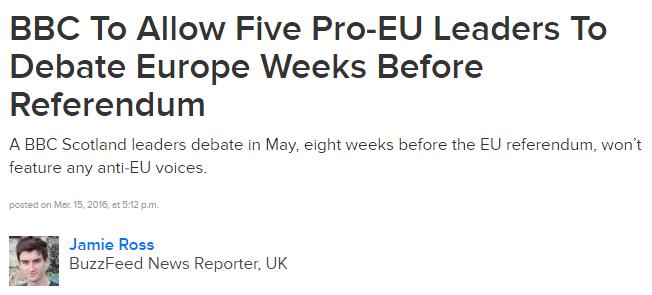
5-0 to the pro-EU side in a BBC Scotland debate


An entirely pro-Europe BBC panel will have free rein to discuss the EU referendum just eight weeks before voters across the UK go to the polls, despite impartiality guidelines that require balanced coverage. 
BBC Scotland is due to host two leaders debates ahead of May’s Scottish election, including one on 1 May in which all five panellists will be campaigning for the UK to stay within the EU. The only Scottish party leader backing a Leave vote, UKIP’s David Coburn, has not been invited.
The debate falls within the official 10-week campaign period for June’s referendum on EU membership – which begins on 14 April and runs all the way through to voting day on 23 June – during which time the BBC is required to produce impartial coverage between the Leave and Remain sides of the argument. 
The BBC Trust’s guidelines for the Holyrood election state: “If the election period overlaps with the referendum period on EU membership, content producers must also take account of the referendum guidelines and ensure due impartiality is achieved with regard to both votes.” 
A BBC spokesman "confirmed that the subject of Europe will not be off-limits despite the entirely pro-EU makeup of the panel in May".

From what Buzzfeed says, it looks as if the BBC is anxious about appearing to give UKIP a platform the party isn't entitled to (in the eyes of its opponents).

I'm guessing that the flexible term "due impartiality" is going to get stretched and stretched and stretched again by the BBC to make this decision appear defensible.

Tuesday, 1 March 2016

"Just three per cent of BBC guests back Brexit"


TCW's headline writer, as ever, captures the point succinctly: Just three per cent of BBC guests back Brexit

That's specific to the Today programme and is based on over ten years of comprehensive listening by the good folk at News-Watch

It's a dramatic and damning figure, isn't it?

The BBC itself is well aware that it's going to be watched very closely in the next few months. so it will be fascinating to see News-Watch's findings for Today over this period.

Can Today finally break out of their seemingly entrenched pro-EU rut?

Sunday, 21 February 2016

Snapshot I


Another snapshot.

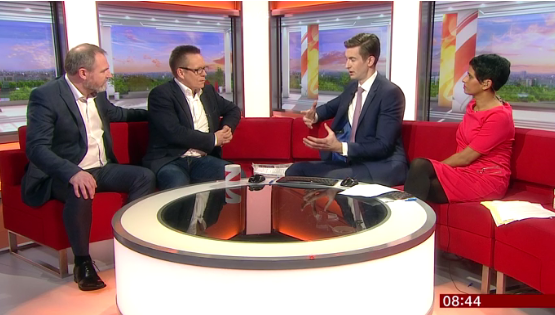
BBC Breakfast interviewed a couple of businessmen from small-and-medium-sized enterprises (SMEs) about the EU referendum - one a Leave supporter, the other a Remain supporter (both of whom did well). I thought I'd record it and check whether that balance was reflected in the questions put by the BBC presenters.

Here are the questions:
Questions put to the pro-Remain businessman
(by Ben Thompson, BBC) Marcus, you are clearly reassured by what you've heard from the Prime Minister. Reforms, a reformed EU and one you still very much want to be part of it. 
(by Ben Thompson, BBC) What's going to be so interesting as the campaigns now get under way for either side is the fact that this is not black and white. There are so many shades of grey about what people want out of the EU and what they don't. Marcus, what is it that you are most worried about? Clearly you are supporting our continued membership but is there a worry there? Is there something...?
Questions put to the pro-Leave businessman
(by Ben Thompson, BBC) It's interesting, Scott, isn't it? We talk a lot about that uncertainty, the influence it has on business. We don't know. It's unprecedented. No country has ever left the EU. We don't know what would happen. Are you not worried about that as a businessman? 
(by Naga Munchetty, BBC) Scott, tell me. When David Cameron announced that he was going to be embarking on these negotiations - these negotiations that have taken a lot time, a series of meetings - was there anything or were you hopeful that you'd be convinced to stay in or had your mind completely been made up? 
(by Naga Munchetty, BBC) And even with the spectre of that being renegotiated in the future?
As we were discussing on one of yesterday's threads, the language is something that's worth watching. The language of "spectre", "unprecedented", "uncertainty", "We don't know", "Are you not worried?" flowed from both BBC presenters here and related to the Leave side. On the other side we had words like "reassured" and "reformed" and "reforms".

And I suspect that David Cameron might be happy with Ben's description of what he's achieved as "reforms, a reformed EU" and Naga's "these negotiations that have taken a lot time, a series of meetings". 

On the question of whether they were challenged, or gifted with setup questions, I think there's a clear answer here.: The anti-EU guest was asked challenging questions while the pro-EU guest was gifted with setup questions. (Even the one about worries allowed him to amplify his worries about the uncertainty a Brexit would bring).

Incidentally, I had to smile at Ben Thompson saying "We talk a lot about that uncertainty, the influence it has on business".

You can say that again, Ben! 

Saturday, 13 February 2016

Mounting evidence


Last night's Newsnight featured an interview with the Royal Bank of Scotland CEO Ross McEwan.

At the interview's midway point Kirsty Wark asked the RBS boss the following question:
Can I turn now to Europe? Do you think the British financial sector will be better off or worse off outside the EU?
Mr McEwan replied that he'd not seen any figures showing we'd be better off if we left the EU in the short and middle term and complained about the uncertainty, saying it's slowing down businesses and banking, before repeating his point about the absence of data showing that we'd be better of if we left the EU in the short and middle term.

Now, the fact that Kirsty clearly knew that Mr McEwan was going to say that before she asked her question - as she should have known, given that she's (famously) well-clued-up on Scottish matters and that RBS's views on the matter have been widely reported before - is strongly suggested by her follow-up 'question' (which I read as little more than an invitation for him to expand on the point he'd just made):
Just more on that uncertainty because, you know, RBS has said that economic growth is being undermined by uncertainty over the EU vote...Yes?
Mr McEwan duly repeated his point. 

I'm pretty sure that Newsnight knew what they were about when Kirsty put those questions to Mr McEwan and, indeed, the programme's introduction specifically highlighted this part of the interview rather than the bits on RBS's past and present. 

I'm afraid I'm going to have to put that down to 'pro-EU bias' (and if you disagree please feel free to say so below).

******

As I'm still keeping a sleepy eye on Newsnight's coverage of the EU referendum (which so far has tilted markedly, in several ways, towards the 'Remain' side and against the 'Leave' side - as I've previously tried to explain)...

...here might be a good place to catch up on this week's other editions of Newsnight as regards this issue. So...

******


Monday's edition featured what I, in a rather cynical (but accurate?) way, saw as a canny pro-EU manoeuvre on Newsnight's part. 

In a feature about the use of big-denomination bank notes by criminals, Evan Davis interviewed the British head of the EU's police agency Europol, Rob Wainwright. 

Evan went on to question him on his views about a possible Brexit and the EU-employed Brit made his anti-Brexit views plain, claiming the UK would be at greater risk from international crime (financial, terrorist, etc) if we left the EU.

In fairness, Evan did remind Mr Wainwright that non-EU countries (like Norway) had alternative arrangements with Europol but Rob Wainwright stuck to his (pro-EU) point, Evan didn't pursue him further, and Newsnight viewers were, in the end, presented with yet another 'expert' opponent of Brexit, this time making the important security case against leaving. 


The same episode of Newsnight, however, also featured a short debate on how Margaret Thatcher would have voted in the EU referendum, featuring Charles Powell (who thinks the Lady would have voted to 'remain') and Annunziata Rees-Mogg (of 'Nancy Mogg' fame, who doesn't know how the Lady would have voted but seems to be going to vote 'Leave' herself). 

This was mostly historical tittle-tattle, though Miss Rees-Mogg did put across some pro-'Leave' points (in broad-brush terms)...whilst framed against a contradicting background!:


Did that really compensate for the head of Europol's warnings against Brexit? (I'm going for 'Hardly!')


And Tuesday's edition of Newsnight featured the former 'whatever the Portuguese is for Le Grand Fromage' of the EU, José Manuel Barroso.

Or 'Sir', as James O'Brien kept calling him.

James O'Brien usually interrupts guests on Newsnight like a man possessed (by his own ego) but here the LBC/BBC man largely let Sr Barroso go on and on (and on), with some answers stretching (uninterrupted) for over a minute and one reaching very close to two minutes. He asked him soft questions about how he feels David Cameron is doing, how optimistic he feels, what he thinks of Cameron's plans and sovereignty, etc, and "What would the European Union look like without the United Kingdom in it?" - the last being the closing question. The one bit where he did push a little involved Angela Merkel's migrant policy.

As you'd expect, Mr Barroso put the EU's case - and the case for the UK to stick with the EU.

I'm also chalking this up on the 'pro-Remain' side of the board.

******

And that was that for this week - three voices making the case (at varying lengths) against leaving the EU and one (briefly) putting the other side of the argument.

I think the evidence of bias on Newsnight here is really beginning to build up.

Some proper, lengthy interviews with 'Leave' supporters on the substance of the issue are urgently needed to even begin to rectify the situation.

Will we get any next week?

Tuesday, 9 February 2016

Mr Mardell Goes to Lisbon


I wish I was Mark Mardell. 

Or at least I wish I had his ability to wangle an all-expenses-paid trip to Portugal during the UK's bleak midwinter.

Yes, Mark wins this week's James Naughtie Memorial Award for 'Most Gratuitous License-Fee-Funded Jaunt by a BBC Presenter' with his trip to Portugal for this Sunday's The World This Weekend - narrowly beating James Naughtie himself.

(The former Today had managed to wangle himself a jaunt to "picture postcard" New Hampshire, which was nice for him).

Mark Mardell's report from Portugal told us one main thing: that the young, Anglophile Portuguese who flow in and out of our country, boosting our economy and keeping our hospitals afloat, are saddened and disappointed at the thought of the UK leaving the EU. They don't think it will benefit them, and they don't think it will benefit us. 

And that was it really.

And as for the Portuguese government? What did Mark get from them, having flown out all the way to their delightful country to sound them out ahead of 'the big deal'? Well, nothing really. They chose not to speak to him. 

Anyhow, lest anyone accuse The World This Weekend of pushing a pro-EU agenda, a double interview with two businessmen followed - one pro-Leave (Leave.eu's Richard Tice), one pro-Remain (BT boss Sir Mike Rake).

Fair enough, of course - except that Mark Mardell asked Richard Tice questions like "Leaving the European Union would be a huge leap in the dark, would it not?" before asking Sir Mike Rake, "What would it mean for BT if we left the European Union?" and "Would your business suffer?" ("Yes", replied Sir Mike).

Those, of course, are very different kinds of question. The first states an anti-Leave point: the second pair encourage the interviewee to make an anti-Leave point. That's not proper balance. 

P.S. Long may the British and the Portuguese continue to move between each others countries - whether we are inside or outside of the EU! 

Sunday, 7 February 2016

Ishoos versus personalities


Andrew Marr's interview with UKIP's Douglas Carswell today was entirely dominated by questions about the structure of/infighting within the 'Leave' campaign(s), plus the personalities involved in that campaign. 

So much so that Mr Carswell didn't actually get any time to spell out his arguments in favour of leaving the European Union.

This made me realise that any attempts to monitor BBC impartiality in the run-up to the EU referendum simply by counting and comparing the numbers of pro-Leave and pro-Remain interviewees on a given programme over a particular period of time...


... could well be a fruitless exercise.

Last month's Newsnight had five interviews with 'Remain' supporters and just 2 interviews with 'Leave' supporters. Last week (the first week of February) saw an interview with one (overwhelmingly likely) 'Remain' supporter, David Lidington, plus two 'Leave' supporters, Kate Hoey and Steve Baker. 

Now that might be supposed to have balanced things out somewhat...

...except that both of the interviews with the pro-Leave politicians (Kate Hoey and Steve Baker) were - like Andrew Marr's interview today with Douglas Carswell - almost exclusively dominated by the same kind of questions: questions about the structure of/infighting between the 'Leave' campaign(s), plus the personalities involved in the campaign. (Kate Hoey's was entirely dominated by such questions, thanks to James O'Brien). 

Again, neither Mr Baker nor Ms Hoey had time to spell out their arguments in favour of leaving the European Union...

...in marked contrast to the pro-Europeans (Alan Johnson, Ken Clarke, Carl Bildt et al) interviewed last month, all of whom got plenty of chance to speak up for the UK's membership of the EU.

It's to be hoped this trend doesn't continue.

Saturday, 6 February 2016

Mr Davis Goes to Paris


If you were wondering where Evan Davis is today (and why wouldn't you be?), well he's in Paris at a conference for UK school children (sixth formers) called Your Future in Europe.

(I stumbled across this by accident, so, no, I'm not stalking Evan!)


I was especially struck by the list of speakers for the conference. 

Along with Evan, there's also Shami Chakrabarti, Alan Johnson MP and Dominic Grieve MP. 

They all have something in common: Mr Johnson is leading Labour's pro-EU campaign, Mr Grieve is among the most pro-EU of Conservative MPs and Shami Chakrabarti turns out to be pro-EU too (surprise, surprise!)

I was curious about that 'And more to be confirmed' though, as it suggested there might be some balancing pro-Leave politicians too...

...but here's a photo (recently tweeted) showing the full panel for the conference's Question Time:


Yes, alongside Shami, Alan and Dominic is pro-EU Lib Dem Kate Parminter....


...and the SNP's Angela Constance, whose views I don't know but can guess, given that the SNP is presently fiercely pro-EU, so she'll doubtless be too. 

So that's an entirely pro-EU panel then.

Now, what take on the EU referendum might the near-voting-age British school kids get from this entirely pro-EU panel? I think we can guess that too.

Of course, this isn't a BBC event, so it's not a case of BBC bias, but...

...it's interesting, isn't it, that Evan Davis is there, chairing the interestingly-titled Your Future in Europe - as he apparently does every year? 

From what I can gather on Twitter, he also gives the opening talk and answers questions about the EU from the children. Wonder what he tells them? 

Returning to official BBC matters in the light of all this: How many episodes of the BBC's own Question Time will have an overwhelmingly (or entirely) pro-EU panel over the next few months? 

I bet someone will be counting.

******

"Rather unanimous"

Update: Participants on Twitter confirm that this very one-sided Parisian Question Time, chaired by Evan Davis, was focused specifically on the UK's membership of the EU. 


Saturday, 30 January 2016

Remain/Leave and 'Newsnight'


My own very small-scale contribution (at the moment) to monitoring the BBC's coverage of the EU referendum is to look at Newsnightspecifically the fairly-easy-to-answer question, 'Is there a balance of guests between pro-Leave and pro-Remain?'

It's only 'fairly-easy-to-answer' because you need a consistent starting-point for including the guest in the final list. In other words, if, say, Steven Woolfe of UKIP is interviewed by Newsnight (as he was on 20th Jan), but only on the topic of immigration, and he isn't asked about the EU and doesn't mention the EU himself, well, that obviously excludes him from the list.

But what of those who are on to discuss the migrant crisis and who do make strong pro-EU points (though not points about the UK's membership of the EU)? Veteran German MEP Elmer Brok (on 26th Jan) is such a candidate. That's a trickier one. He's famously pro-EU and was bound, when invited, to make pro-EU points - as Newsnight might have been expected to realise. But, no, overall I don't think he should be included because his comments were pretty much 'in passing'.

That leaves us then with the following list for January 2016:
5/1 - Ken Clarke MP, Conservative - REMAIN
& Liam Fox MP, Conservative - LEAVE
13/1 - Alan Johnson MP, Labour - REMAIN
14/1 - George Osborne MP, Conservative - REMAIN
27/1 - Carl Bildt, former Swedish PM - REMAIN
29/1 - Lucy Thomas, Britain Stronger in Europe- REMAIN
& Dan Hannan MEP, Vote Leave - LEAVE
These were all substantial interviews, exclusively or largely focused on the issue of the UK's membership of the EU.

Now. some might question the labelling of George Osborne as 'REMAIN' as he sometimes calls himself a 'Eurosceptic', even though pretty much every reporter (pro-EU or anti-EU) reckons he's among the most pro-EU members of the present government. Paddy Ashdown's hat would have to be eaten by huge numbers of people if Mr Osborne came out on the LEAVE side - and no-one, as far as I can see, thinks that's even remotely likely. So he remains a 'REMAIN' in my list.

What the list shows so far is that REMAIN has received five spots and LEAVE just two.

Both of those LEAVE interviews were conducted alongside interviews with REMAIN supporters (one consecutively, the other simultaneously). The other three REMAIN interviews had no such counter-balancing interviews with LEAVE supporters.

Even if you put George Osborne in some kind of Schrödinger's cat-style limbo - as neither REMAIN nor LEAVE (or both) - that's still a striking imbalance, isn't it? The interviews with Alan Johnson and Carl Bildt were both substantial, rather hands-off and heavily focused on why the UK should stay in the EU. There was no equivalent interview with a LEAVE supporter.

We'll have to see how Newsnight fares as the months go on (unless the BBC cancels it of course!). It's not got off to a good start though, has it, on this evidence?

Whatever Happened to the Likely La...er...the People Behind 'The Great European Disaster Movie'?


Having been largely out of action for the past couple of weeks, I know I've missed a lot of BBC-bias-related things - partly because I kept forgetting to remember them.

One thing I have remembered is that one of the people behind the infamous pro-EU BBC mockumentary The Great European Disaster Movie, former Economist editor Bill Emmott, has been made Chairman of the Content Board at Ofcom by Culture Secretary John Whittingdale - a choice that has certainly raised eyebrows. For full details on why that appointment is so surprising (and worrying) and of just how tangled the web of connections are at Ofcom (including with the BBC), please read News-watch's David Keighley's highly informative piece about it. 

All I'd add to it is that the other man appointed to Ofcom alongside Mr Emmott, Dutch businessman Ben Verwaayen (a close advisor to the present Dutch prime minister), is just as strongly pro-EU (and anti-Brexit) as Mr Emmott - as a read through his Twitter feed more than confirms.

With Bill and Ben joining the Ofcom board, it will be interesting to see how impartial Ofcom's rulings are in the run-up to the EU referendum.


The other person behind The Great European Disaster Movie, Annalisa Piras, was one of the guests on today's Dateline London. She's on the 'progressive left' politically, and alongside her today were left-wing Owen Jones of the Guardian, American left-liberal journalist Michael Goldfarb and Rashmee Roshan Lall of the National, the Arab Weekly (and, previously, the Guardian and the BBC World Service). They started by discussing the state of the European Union. 

Obviously Annalisa Piras spoke from a pro-EU standpoint. As did Rashmee Lall. And Michael Goldfarb. Only Owen Jones, in a rather detached way, focused the concerns of the Left about the EU. His semi-detachment probably arises from the fact that, after flirting with an 'Out' vote last year, he's now backing the 'In' side again

So that makes 4 out of 4 of today's Dateline London panellists wanting the UK to remain inside the EU. Wouldn't you have expected the BBC to put up a known pro-Brexit guest (or two) if this topic was going to be discussed (he asks rhetorically)?

This may be a sign of the way things are going. Compelling, detailed criticisms (from pro-Leave supporters) of Jonty Bloom's In Business and Carolyn Quinn's How to Make a Brexit have left both programmes looking deeply biased and demanding answers from the BBC.

As with this edition of Dateline, the BBC doesn't exactly appear to be going out of its way to dispel the fears of many that it will not be strictly neutral in the run-up to the EU referendum, does it?

Saturday, 19 December 2015

Why is the BBC receiving funding for R&D from the EU?


The Daily Telegraph had an overnight 'exclusive' about the BBC: 


Now, I have to say that I find these kinds of story very hard to fathom at times. Pinning down exactly what's what when it comes to EU funding for the BBC keeps proving a little bit tricky, especially as the BBC is never exactly forthcoming about it. Plus it would also help the reader's understanding if the Telegraph were to link to the source of its latest 'scoop' - namely the relevant pages of the EU's transparency register.

Anyhow, from what I can make of it, "The BBC has admitted taking more than £2 million in European Union funding over the past three years" and that this is above and beyond the £9.3 million its Media Action unit received between 2011 and 2014 and which went in part towards projects associated with the EU's European Neighbourhood Policy.


Just as a reminder about that previously disclosed funding...as Media Neighbourhood's own website puts it:
We are a journalism training project funded by the European Union and run by a BBC Media Action led consortium. We cover 17 countries in the European Neighbourhood.
The programme's "two key objectives", according to the same website, are:

  • To strengthen the professional capacity of journalists across the ENPI region, particularly in the areas of media independence and online media. 
  • To enable the public in the ENPI countries to have a more informed and objective understanding of EU social, economic and political issues and cooperation with the ENPI beneficiary countries. 
The countries in question are: Algeria, Armenia, Azerbaijan, Belarus, Egypt, Georgia, Israel, Jordan, Lebanon, Libya, Moldova, Morocco, Palestine, The Russian Federation, Syria, Tunisia and Ukraine.

Quite what "enabling the public...to have a more informed and objective understanding" of EU-related matters means and quite why the BBC's Media Action Unit is engaged in helping to deliver this project for the EU I really cannot say but I don't like the sound of it one bit, impartiality-wise. 


Anyhow, that's just a reminder of where we previously stood over the already-disclosed £9.3 million EU funding for the BBC's Media Action Unit. The money the Telegraph is reporting about EU funding that seems to be above and beyond that:
The broadcaster said it had taken the cash under the European Union framework programme, to fund its research and development arm, which is working on projects such as 3D broadcasting, and ultra-high definition filming. 
The BBC is not allowed to spend the money on programme-making or newsgathering, and corporation sources insisted that the grants helped the entire broadcasting sector develop new technology, and had no impact on editorial decisions. 
In the financial year 2013/14 the BBC took £878,000, while in 2014/15 it received £778,000. The broadcaster has received £476,000 in the current financial year, but that figure is expected to rise. The EU transparency register, where the payments are listed, states: “Grants are non-programme related projects undertaken by BBC R&D.”
Searching the EU's transparency register, I think this might have been one of the pages the Telegraph has been looking at, though I can't be sure. It's the BBC's own 'registrant' page on the register:


So what is going on here? 

Why is BBC Media Action receiving EU funding to help the EU "enable" the publics in countries like Ukraine, Moldova and Russia to "have a more informed and objective understanding" of the EU and its relationship with those countries? 

And why is the BBC receiving funding for R&D from the EU, especially in the run-up to the UK's in-out referendum on EU membership?

*******

The more you read the Media Neighbourhood website, the odder it all becomes. As it's banner says, "This project is funded by the European Union. This project is being delivered by a consortium led by BBC Media Action". 

Reading its 'European Union' page, however, the project's lack of impartiality could hardly be clearer. It begins...
The European Union (EU) is unique. It is not a federal state like the United States of America because its member countries remain independent sovereign nations. Nor is it a purely intergovernmental organisation like the United Nations because the member countries pool some of their sovereignty — and thus gain greater collective strength and influence than they could have acting individually. 
 ...and continues (at length):
The European Union (EU) is a family of democratic European countries working together to improve life for their citizens and to build a better world. 
Family squabbles and occasional crises are what make the news headlines, but away from the cameras the EU is actually a remarkable success story. In just over half a century it has delivered peace and prosperity in Europe, a single European currency (the euro) and a frontier-free ‘single market’ where goods, people, services and capital move around freely. It has become a major trading power, and a world leader in fields such as environmental protection and development aid. No wonder it has grown from six to 28 members and more countries want to join.
This is the pro-EU message this EU-funded project is projecting to those 17 other 'neighbourhood' countries and, to repeat, "this project is being delivered by a consortium led by BBC Media Action". 

What is the BBC doing being involved in this? 

Am I missing something? I'm beginning to think I must be because this seems too bad, too damning, too easy a 'gotcha!' to be true, doesn't it?

Saturday, 21 November 2015

BBC comedy, the EU and BBC bias


This week's Feedback featured a clip from the first episode of the 47th series of Radio 4's eternally somewhat-less-than-side-splitting Now Show - a comedic 'team rant' in favour of the EU and against critics of the EU, 

Unlike the recent 'rants' from Andrew Neil and Emily Maitlis, this particular rant was absolutely nothing new. 

And I'm not just talking about the 46 previous series of the Now Show either. I've heard many a pro-EU rant on BBC Radio 4 comedy shows over the years - or, more accurately, many a rant against critics of the EU - especially UKIP supporters and right-wing Conservatives. 

Left-wing bias on BBC comedy programmes is, of course, hardly news. Even Nick Cohen's recent robust defence of the BBC, which saw very little evil in the corporation, contained this brief aside:
And, yes, thank you for raising it, I know, there is BBC bias. I accept that Radio 4 will give us left- and extreme left-wing comedians but never their right- or far-right equivalents.
But, still, on it goes. 

What is the BBC going to do about it, especially as the EU referendum approaches? Cue Roger Bolton and the BBC's chief political advisor Ric Bailey - whose conversation I will now transcribe.

I can't say that Ric Bailey's tone overly impressed me, and he seemed quite evasive to me at times as well. (And all credit to Roger Bolton for pressing him somewhat here). 

You might also note yet another statement from a senior BBC boss of the BBC's outright refusal to carry out statistical studies - even very simple, routine ones - in order to help monitor and regulate its bias. 


Quite why it's so obvious to Ric Bailey that doing such studies, or even doing a basic count, is absurd isn't explained. He simply caricatures the whole idea, making it into a straw man (or several straw men) and repeatedly sneering at it (as you'll see). 

Frankly, if someone were to listen to all episodes of The Now Show over each series from now until the referendum - as people at the BBC will inevitably do, including the show's producers - it's hardly either time-consuming or rocket science to make a quick note of whether there are pro-EU-biased sections or anti-EU-biased sections in each episode, and then keep a tally. If there are, say, 17 pro-EU-biased sections (of the kind we heard last week) across six series between now and the referendum and 0 anti-EU-biased sections, then there's bias! And simple, cost-free counting will have proved it, won't it? 

Anyhow, here's the transcription:


Roger Bolton: Ric Bailey, will The Now Show be told to make anti-EU jokes in future?
Ric Bailey: Look, comedy and satire are absolutely part of what the BBC has to do when it's covering politics and, of course, when it's covering this referendum. The idea that you do that by numbers and that you count the jokes and then have a sort of grading system for how funny they are...you only have to say it to think how ridiculous that is.
Roger Bolton: But will it require some form of balance? You don't say it's got be 5 for, 5 against, but does there need to be some sort of balance?
Ric Bailey: So, the BBC...every genre has to be impartial. And the word that everybody always forgets when you talk about impartiality is the word "due". And that means thinking about the context in which you are doing the programme. So, a referendum clearly is a very particular context. Now, that's why we have guidelines to spell out what those particular circumstances are, what the context is. But also, different genres give you a different context for how you achieve impartiality.  
Roger Bolton: So in comedy is there any requirement for balance over a period over a controversial subject?


Ric Bailey: Well, like most programmes, there's a long way to go before the referendum. It's a topical satire programme, so its job is to take the mickey out of politicians. take the mickey out of what they say and so on. But the idea that you have to do it in one single programme in a beautifully perfectly mathematically-balanced way would be ridiculous. And the word that gets used in the guidelines for the actual referendum period itself is "broad balance". 
Roger Bolton: But over a period there should be jokes about all sides, not just one side?
Ric Bailey: I always take the view, particularly in comedy, the more the merrier. So, the more you are looking at the whole range of politicians, a whole range of views, and subjecting them to your biting wit the better. Of course, if week in week out any comedy show only took lumps out of one side of an argument or only took lumps out of one particular political party that would not be impartial. But those are the judgements that all programmes make, including comedy, day in, day out, and this is no different. 
Roger Bolton: Well, let's suppose it's 10 or 16 weeks, Before the period starts, when we know the date of the referendum but the so-called campaign period hasn't started, nothing will change? No extra requirements on people to be fair, balanced, to be duly impartial?
Ric Bailey: Roger, my view is: the BBC has to be duly impartial about this referendum. It has to be duly impartial about it today. It has to be duly impartial about it the day before the referendum. There is no difference. Part of the idea of the guidelines is not only to be clear about what impartiality means during that referendum period but it's also to set our the parameters so that programme makers, on behalf of the listeners and viewers, can scrutinise the arguments properly. Sometimes often people think, oh, the guidelines are there to stop broadcasters doing things during these periods. Actually it's the opposite. They're there to set out a broad territory in which broadcasters have the freedom and the editorial judgement. That's the first principle. Editorial judgement must dictate how you approach it. 
Roger Bolton: How well qualified do you think BBC journalists are to cover this issue? Because it seems that James Harding, the director of news, thinks they need some mandatory training. He's going to introduce that. Do you think that's a reflection on the fact that, in the past, the journalists have not been particularly well qualified? 
Ric Bailey: Absolutely not. No, I mean...
Roger Bolton: So why might there be training?
Ric Bailey: Before every election I, as part of the guidelines, talk to journalists right across the board about the particular circumstances of any election or referendum. This is a very important referendum and, whereas most of the time there will be a specialist number of journalists who are likely to cover Europe, this is something that's going to....you've already pointed out, it's already in The Now Show. So lots of people who may not normally be covering this sort of story...It will be part and parcel of their journalism for up to two years. Now, it's really important in those circumstances that we know that everybody understands the issues, the arguments and the very particular context of this referendum.

Saturday, 31 October 2015

That would be an EU matter


The more I think about it the more daunting it becomes thinking about seriously monitoring the BBC's galaxy-sized output, especially when seeking to explore how impartially the corporation covers the EU referendum debate. 

The BBC is far too huge for any small number of people to keep track of. Covering just Radio 4 would be more than enough for any one person. Covering Radio 5 would, I suspect, be even worse. And then there's Newsnight,  Victoria Derbyshire and The Daily Politics on BBC Two. And the BBC One News bulletins, plus Andrew Marr, BBC Breakfast, The One Show etc. Oh, and the vast empire of the BBC News Channel and the even vaster empire of the BBC News website. And the worldwide empire of the BBC World Service. And doubtless Newsbeat on Radio 1. Plus the local news lot. And Twitter. And all the light entertainment stuff across the BBC (especially the topical comedy shows). And all the dramas. And all the one-off documentaries across the BBC networks, from BBC Four to Panorama. And who knows about CBeebies?

That's why it's probably best to focus, pace News-watchon flagship BBC programmes and/or to fix on one programme in particular, such as Radio 4's influential Today. 

In the spare bit of time I had earlier in the week I thought I'd follow in News-watch's footsteps and listen to Today's EU-related coverage

The chosen news angle on Wednesday was that David Cameron, travelling to non-EU Norway and Iceland, was going to lay into Eurosceptic arguments in favour of following the example of Norway, vis a vis the EU. 

I tried to stand back, in the original spirit of this blog, to see how fair it was. The result? I didn't think it was very balanced at all. 

The programme's coverage focused on the PM's criticisms of Eurosceptic arguments regarding Norway. Again and again the PM's criticisms were outlined in detail by Today presenters and reporters without the BBC presenters and reporters offering detailed counter-arguments (such as might be used by 'Leave' supporters). And no one else was invited on to give the counter-argument either. 'Norway', the straw man, was set up and duly knocked down by the PM, and Today did as little as humanly possible to dissent from it.

Though BBC reporter Ben Wright (in the 6.30 spot) appeared to be winging it somewhat, using the word "his" in relation to the Norwegian prime minister when the Norwegian PM is actually a woman (and not of the transgender kind either), his list of negatives for Norway didn't go quite as far as James Naughtie at 7.10, [Maybe that training for all BBC journalists to bring them up to speed with EU-related matters is urgently needed]. Ben said that Norway had no voting rights at EU meetings; Jim said Norway has "no voice" at all, which isn't true. Pro-EU voices appeared in clips from Norway, even though support from EU membership there is at a very low level (so people must be happy enough about their present non-membership of the EU after all).

Later came a strikingly gentle interview between Justin Webb and Frans Timmermans, First Vice-President of the European Commission. At the recent House of Commons ESC session on the BBC's coverage of the EU, Kate Hoey MP worried about the BBC having lots of European Union commissioners from other countries speaking on the EU. I think this sort 'grilling' was just the kind of thing she had in mind. (If the BBC ever introduced a mirror image programme to its 'HARDtalk', this interview might make a fine template. Obviously, it would have to be called 'SOFTtalk'.)

The BBC doesn't often give David Cameron a free pass, but he certainly seemed to get one here.

On Thursday's edition, in contrast, the chosen news angle went very much against David Cameron, with the focus being on how various Nordic/Baltic leaders had told the BBC that Mr Cameron hadn't said anything concrete about what he actually wanted. 

Curiously the bit with Laura K, prior to the interview with Nick Clegg before the 8 o'clock news, where we actually got to hear directly from the two leaders cited, didn't sound anywhere near so damning to me as the BBC had been making out.


There were two James Naughtie interviews with UK politicians about the EU on that edition - one with pro-EU Nick Clegg, one with anti-EU Kate Hoey.

Even though I've been mostly out of action this week regarding BBC bias, even I spotted lots of complaints that the two interviews differed greatly, with Nick Clegg being said to have got a free run just before 8 o'clock, plus lots of time, and Kate Hoey being said to have got significantly less time, getting relegated to the 'dead zone' and having to repeatedly ask James Naughtie to let her finish.

Checking this for myself - and applying my trusty stopwatch - Mr Clegg got to speak on the EU for 228 seconds (he got an extra bit on tax credits too above and beyond this) while Ms Hoey got just 152 seconds. (Both of those totals come after deducting James Naughtie's contributions from each interview.) So that's well over a minute more.

Ms Hoey did have to ask Jim Naughtie twice to let her answer after he attempted to interrupt her - his first attempt being made only 8 seconds into her first answer. Mr Clegg's first answer ran for 75 seconds, uninterrupted. However, in fairness to ol' Jim, Kate Hoey won out and she did get to give the answer to his final question uninterrupted. (For stats fans that final question of Jim's lasted 57 seconds - classic Jim Naughtie!)

All such things add up. So far the 'Stay' side was clearly 'winning' the battle for Today coverage, thanks to Today.

Friday and Saturday's Today haven't been EU-focused, so that's as far as this goes this week.

As you may be aware, James Naughtie is leaving his presenting role on Today soon. He's becoming a roving correspondent for the BBC. The UK's EU referendum is one of the main subject areas he's going to be focusing on, apparently.

Oh dear.

Sunday, 25 October 2015

The smoking gun


The row over EU funding for the BBC rolls on.

This week's European Scrutiny Committee questioning of the BBC's Tony Hall, James Harding and David Jordan contained several mentions of the BBC's Media Action unit, such as this from the BBC's head of editorial policy and standards (Mr Jordan):
The BBC, as a public service broadcaster, does not take money from the EU. The organisation to which you were referring that takes money from the EU is an organisation called Media Action, and that is an independent part of the BBC, with independent trustees, whose job is to do something very different from broadcasting to the UK. The job of Media Action—it is engaged in a number of current projects funded through the EU—is, for example, in Afghanistan, to work with the Afghan media sector to develop its news and other programme-making skills, including the adoption of public service broadcasting values. In Bangladesh, it is to work on disaster preparedness. In Syria, it is to build on the achievements of an FCO-funded socially responsible media platforms programme, which has successfully established a web-based training facility for journalists and bloggers. In Iraq, it is to help to contribute to the development of an open media environment through improving legal and regulatory freedoms, and then it has a project on governance, which is about holding decision makers and media leaders to account in Algeria, Egypt, Israel, Jordan, Lebanon, Libya, Morocco, the Palestinian Territories, Syria and Tunisia. You would probably agree that those sorts of projects are desperately needed in those countries. That is very separate from making programmes for the BBC.
Today's Sunday Telegraph, however, claims that the BBC's Media Action isn't just a democracy-spreading, pro-media freedom charity working in the Arab World and South Asia, uninfluenced by its EU funding (and, therefore, also uninfluenced by the EU's contractual demands on those who receive funding from it that it won't say or do anything to harm the interests of the EU). 

The Telegraph makes the explosive-sounding charge that BBC Media Action was "paid to deliver key parts of the EU’s political strategy in countries on the fringes of Europe":
BBC Media Action received £9.3million between 2011 and 2014, much of it to deliver the EU’s “European Neighbourhood Policy”. European Union officials have described this as “a broad political strategy” designed to strengthen the “prosperity, stability and security of Europe’s neighbourhood in order to avoid any dividing lines between the enlarged EU and its direct neighbours”. 
As part of this work, BBC Media Action led the consortium of media companies that delivered a three-year project called Media Neighbourhood, which provided training for hundreds of journalists in 17 countries on the outskirts of Europe.
Reporters taking part in the scheme attended “study tours to the EU in Brussels” during which they were able to interview “top EU policy makers” in the European Commission and the European Parliament. 
I have to say that I still found that puzzling. The article is a bit too vague and lacks a smoking gun.

The second paragraph there sounds as if Media Neighbourhood is merely the application of the unit's usual democracy-spreading media action, just as David Jordan was saying - albeit in countries closer to the EU than Mr Jordan was suggesting. Is it really seeking to enhance the EU's cause too, as the Telegraph alleges?

Checking out the BBC's Media Neighbourhood website, those countries are: Algeria, Armenia, Azerbaijan, Belarus, Egypt, Georgia, Israel, Jordan, Lebanon, Libya, Moldova, Morocco, Palestine (sic), The Russian Federation, Syria, Tunisia and Ukraine. 

It is interesting that David Jordan's list to MPs - which appears from his description to relate to this specific project - only consisted of "Algeria, Egypt, Israel, Jordan, Lebanon, Libya, Morocco, the Palestinian Territories, Syria and Tunisia". He omitted to mention Armenia, Azerbaijan, Belarus, Georgia, Moldova, The Russian Federation and Ukraine. Wonder why he did that? 

The BBC Media Action/EU joint project has two stated aims, according to its website. The first is the one that David Jordan was happy to acknowledge to parliament:
To strengthen the professional capacity of journalists across the ENPI region, particularly in the areas of media independence and online media.
The second, however, is something he most definitely did not mention:
To enable the public in the ENPI countries to have a more informed and objective understanding of EU social, economic and political issues and cooperation with the ENPI beneficiary countries.
So, yes, the BBC Media Action project does have an explicit role in promoting the EU's cause, doesn't it? 

It's not just about helping journalists (public broadcasters, bloggers, etc) in various countries after all, apparently. It's also about "enabling the public" in those countries "to have a more informed and objective understanding" of the EU and their countries' relationship with the EU...

...a form of words I can't say inspires me with confidence about its impartiality.


Now - unless I'm missing something - that really does seem like a smoking gun. 

What on earth is this BBC-owned project doing helping the EU to influence public opinion towards the EU in 17 countries close to the EU's borders - especially in those that used to belong to the Soviet empire (like Ukraine)? 

Maybe a few letters to MPs on the European Scrutiny Committee are needed, asking them to try to get to the bottom of this. (Rona Fairhead is due to appear before them soon. Maybe they could ask her.)