Showing posts with label 'BBC Correspondents Look Ahead'. Show all posts

Monday, 3 January 2022

The BBC's worldview


UnHerd's Peter Frankin has a piece today about how Radio 4's Correspondents Look Ahead reflects the BBC's worldview to perfection. 

The BBC may say it hasn't got a worldview but it certainly has, on subject after subject. 

He gives some examples, including:
There was also a preachy little section on “global vaccine inequality”. Noting the low levels of vaccination in many developing countries, the question asked for 2022 was “will the West do better?” No consideration was given to the performance of developing world governments or to local levels of vaccine hesitancy. That’s not to absolve the West of its responsibilities in this matter, just to point out that yet again the discussion was one-sided.
When I listened to it on New Year's Eve I made the following note for this section: 
St. Gordon of Brown - vaccine inequality - “a moral issue” [Lyse Doucet] - GB's “stain on our global soul” mentioned twice - “No one is safe until everyone is safe”.

Over on the BBC World Service's equivalent programme the BBC's Africa correspondent Andrew Harding went even further. This is how he rather hotly characterised it: 

Andrew Harding, BBC - The last two years, it's clear, have been about apartheid, if you like. It's been a systemic failure of the international community. Those with their stockpiles, those democracies looking after their own people first. And you mentioned earlier that idea of no one's being safe until everyone's safe, completely ignoring that basic fact and, despite plenty of promises, denying Africa its fair share of vaccines. 

Going back to the Radio 4 one, Peter also notes how they didn't ask why the biggest economic story of 2021 — the global supply chain crisis” happened:

Perhaps that’s because one of main causes of the crisis — the surge in demand created by the American government’s excessive stimulus program — doesn’t fit the “Trump bad, Biden good” narrative. Similarly when contemplating America’s continuing political polarisation, the Republican delusion about a stolen election was highlighted, but not the doctrinaire woke politics of the other side. For instance, the campaign to “defund the police” at a time of surging crime rates might have been worth a mention.

One thing they did discuss, of course, was the Capitol riot on 6 January. Indeed, from Sunday to Pick of the Year, that's been the US event every BBC journalist seems to want to talk about above all else. 

Peter gives another example:

The partiality of BBC’s analysis doesn’t just apply to American politics. Inevitably it also applies to Brexit. Attempting to explain continuing UK-EU tensions, the BBC’s Europe editor Katya Adler repeated the EU line that the British government is playing to a domestic audience. The idea that the gratuitous Brit-bashing of the French government might be similarly motivated went entirely unspoken.

It did indeed. My note on the night for that bit ran as follows: 

Katya on EU/UK. Brussels perspective given. UK side presented cynically. Usual language about Tory Brexiteers - ''hard wing'', ''hard''. Brussels perspective. Brussels perspective.

Indeed, no one countered Katya's Brussels perspective with an attempt at presenting the UK perspective in similar terms. 

Katya also talked of the rise of “illiberal democracies” like Poland and Hungary, characterising that rise as “extremely dangerous”. 

Peter Frankin concludes by noting that, whatever the BBC says, BBC correspondents “do have opinions”, as shown by this programme, and though “in itself that’s not a problem,...the issue is viewpoint diversity and the lack of it.” He ends

Instead of maintaining a semblance of neutrality, I’d much rather the BBC allowed and encouraged its journalists to examine the great issues of our time from a variety of different ideological perspectives. We might just get a clearer view of the future if they did.

He can hope. 

Saturday, 1 January 2022

“We're not supposed to have opinions, but...”


I listened to Correspondents Look Ahead - Looking Ahead to 2022 on Radio 4 last night. What I didn't know is that the BBC World Service has an equivalent called BBC Correspondents Look Ahead. A parallel section from each programme got be thinking again about BBC groupthink. 

Here's the passage from the Radio 4 programme:
KATYA ADLERI'm going to try and be positive and say that there is more environmental awareness. I like the fact that...we're not supposed to have opinions, but I do like the fact that it was young people that put the environment on the political agenda. Kicking and screaming might I add from the political class. They don't want to know. It costs money. It's difficult. It means making difficult political decisions they don't want to take. And I don't have great faith in any big decisions being taken by those who should really not waste any more time in the coming year. But I think this idea of people power. younger people pushing forward, that has to give us some hope. So it's a struggle, really, to be watched. And I think we should all have our fingers and toes crossed that, you know. We're in a pandemic but this is a literally burning problem that is creeping up on us. It's causing mental health problems amongst those who are worried about it and the planet is being destroyed. So let's hope 2022 is moving towards more action.
And here's its equivalent on the World Service:
RAZIA IQBAL - I just gonna throw one positive thought out. A final one. Young people are my positive thought. In 2021 we saw the likes of Greta Thunberg really galvanise people on the issue of climate change. She may be disappointed by COP26 and the outcome of that, but I still believe that there are hundreds if not thousands of Greta Thunbergs, Malala Yousafzais, all over the world - young women in particular - who really feel...To me they bring me encouragement. They are so heartening, that they are committed and dedicated to being agents of change. So I feel very, very encouraged by that.
LYSE DOUCET - Hear, hear. Hear, hear. 
Now, if you watch GB News or listen to talkRADIO or read websites like this you'll tend not hear such enthusiasm for the Greta Thunbergs and Malala Yousafzais of this world. [I refer you to Sue's posts about Malala for starters]. 'We' tend to think differently to 'them' at the BBC. But it's their views that are publicly-funded. 

Thursday, 30 December 2021

Looking Ahead and Back


This year's Correspondents' Look Ahead will be broadcast on BBC Radio 4 at 8pm on New Year's Eve. 

In anticipation of that, here's a review of last year's edition when BBC correspondents Lyse Doucet, Aleem Maqbool, Dharshini David, Gabriel Gatehouse, Justin Rowlatt and Katya Adler gathered on New Year's Day this very year to look ahead to 2021.

It's a remarkable listen, showing the BBC echo chamber in full cry  - or, perhaps more accurately, full echo. 

I've never attended an Observer-sponsored round table conference for journalists, left-wing activists and campaign groups, but I imagine this is what it might be like. 

For starters

Just consider this, for starters: from Lyse Doucet's introduction as she looked back to 2020 and said that, “as always”, there was “some good” amid “so much bad” in 2020. These are the two things she put on 2020's 'plus' side:
The Black Lives Matter movement put injustice and diversity on the agenda as never before and the pandemic focused minds on saving not just lives but our planet in our climate emergency.

Hm. I rolled my eyes at that! The BBC's Chief International Correspondent was signalling her very BBC views there.

Dharshini David opines and predicts

The programme's powers of prediction haven't greatly improved over the years. The first substantial contribution came from BBC economics reporter Dharshini David. Having nailed her colours to the usual BBC 'spend, spend, spend' mast by openly praising the Bank of England and Chancellor Rishi for pumping money into the furlough scheme - a “financial vaccination” she called it, describing it as both “good” and “good news” - she went on to make predictions for the UK economy in 2021. She said a double-dip recession “is pretty much a given, Lyse. I think that ship has really sailed. Well, we're 12 months on and it's still not sailed quite yet. She also predicted unemployment “continuing to grow for some time”, which again didn't happen this year. Bias and inaccurate predictions - a cracking start!

My eyes kept on rolling, but they needed to calm down as we were only in the foothills and they needed to brace themselves to follow my eyebrows as they rose up ever higher... 

Familiar fare 

Katya Adler then, predictably, painted a rosy view of Mrs Merkel's Germany.

Left wing round table chat

Lyse then discussed protests and coronavirus in the US in terms of how the pandemic had exposed inequality in its disproportionate effect on African-Americans, Hispanics and Latinos and Aleem Maqbool drew the comparisons with how much better white Americans were doing in a context-free, BLM-style fashion.

Lyse then discussed with Justin Rowlatt the issue of “less privileged” countries not receiving their fair share of vaccines and Justin criticised the “unseemly behaviour” of the developed world. He held out hopes though for Bill Gates and the WHO riding to the rescue and getting a project going. 

Do you take my point about it being like eavesdropping on a left-leaning convention?

Box-tickers to watch

Moving on to a regular feature, the next section was the BBC correspondents' traditional 'persons to watch' bit. Those for this year were:

[1] Alexey Navalny, who Gabriel Gatehouse predicted would “make waves” if he went back to Russia - which he did in January before being imprisoned in February and dropping out of the headlines.

[2] Deb Haaland, a Biden appointee who Aleem Maqbool discussed in identity politics terms as being “the first native American to lead the Department of the Interior...with its history of oppression against native American people”. It was all about identity politics. 

[3] Janet Yellen, a Biden appointee who Dharshini David also discussed in identity politics terms as the the first woman Treasury Secretary. “The US have beaten us...we've had none...” here in the UK in the top financial jobs, she said. It was all about identity politics. 

[4] Alok Sharma, who Justin Rowlatt chose for his role in the “crucial”, “terribly important”, “very important” and “crucial” COP26.

[5] Crown Prince Mohammed bin Salman, who Lyse Doucet predicted would become Saudi king in 2021, which didn't happen. She also predicted he'd become more powerful. Except for taking over Newcastle United FC, he didn't really feature on BBC News very much this year.

[6] “The ever growing shadow behind Angela Merkel”, which Katya Adler also discussed in terms of identity politics, talking of the “three slightly aging, middle-aged white men” of the CDU fighting to succeed Mutti and “probably” win the September election - which none of them actually did as the CDU failed to win. 

Besides the inaccurate predictions, it really is quite something how much identity politics informed this part of the conversation. It continued from the earlier discussion. And it continued. 

It was the 'post-BLM' edition of Correspondents' Look Ahead.

The man who tweeted too much

US politics - the change from Trump to Biden - was next for discussion.

I had to chuckle on hearing Lyse Doucet begin it by sticking to focusing on The Most Important Thing For The Likes of the BBC for the Entirety of the Trump Presidency  - Donald Trump's tweets - saying he's “still certain to unleash tweets from his own account”. Well, she got that wrong as the censors at Twitter swiftly banned him. 

Aleem Maqbool goes full CNN

Aleem Maqbool then talked about inequality, and the plight of women and minorities, and the polarisation that “won't go away” even after the “figurehead” [Donald Trump] has been removed - thus presenting the polarisation in a rather one-sided fashion himself. 

And - of course - Aleem talked about race, which he very much filtered through a BLM lens, saying:

The race issues. So much protest happened, so many people took to the streets. There's been very little in terms of structural change on race and policing over the last year.

Aleem predicted a lot of political violence in 2021. I suspect the events at the Capitol in January will be dwelt on and cited as a successful prediction in this Friday's programme. He also predicted the return of mass shootings. 

Aleem then talked of fixing immigration and asylum and “reuniting children who were separated from their parents under that system under Donald Trump” - which [a] was a very BBC focus on the needs of immigrants rather than numbers or the problems caused to the host community and [b] repeated the falsehood that the child separation issue arose under Donald Trump when it actually arose under Barack Obama and his VP Joe Biden. [As we now know, because of the Biden administration's policies, there's been chaos on the southern UK border this year]. 

As for Joe Biden, Aleem Maqbool said he's playing the card of “a uniter” - “and he's playing it relatively well so far”. [Well, that didn't last long]. 

More good news

Then “Good news” from Day 1 was predicted by Lyse and Justin for the Biden administration's climate change actions for what Lyse called the “climate emergency”. She also worried about people she called “climate deniers”. Quick as a flash, Aleem replied “But at least there won't be one in the White House”, said Aleem. 

Are you feeling the impartiality? 

Lyse pulls the rug from under Aleem

One amusing moment came when Aleem employed the 'some say' strategy beloved of BBC reporters trying to make a point through other people's mouths, talking of “a lot of.. as many people see it” regarding “the damage done” by Donald Trump's environmental policies. He later added an “as they see it”, referring to Trump critics' claims of damage, thus putting further 'fake impartiality' distance between him and them. And then Lyse Doucet went and ruined it all by giving her opinion and dropping him in it too, saying “As Aleem says, a lot of the damage has been done”. Haha!

Justin sings 'For Xi's a jolly good fellow'

On the same theme, Justin Rowlatt found President Xi's climate pledges “enormously optimistic”, which he seems to believe. Green energy is “the cheapest”. he said. [Fact check?]

Places to watch [or not]

For flashpoints/places to watch: 

Gabriel chose Taiwan [a very safe bet that it would remain a worrying issue in 2021].

Aleem chose Venezuela for a looming humanitarian crisis moving towards a flashpoint [well, it didn't really reach that point].

Dharshini chose Dover [for possible Brexit problems].

Justin chose Denmark [for a company that's transitioned from being an oil company to a renewables company and that might become a giant].

Katya chose Italy [to wonder how it would cope in 2021. I wonder how many reports she did about it in 2021 as I've heard very little about it?].

And Lyse, inevitably, chose Afghanistan, predicting that the Taliban might come close to power or achieve power either through negotiation or the battlefield. [She didn't predict the disastrous handling of it by the Biden administration which gifted the country and billions of dollars of US equipment to them].

OMG, Brexit!

The final segment seems 'very a year ago', as Lyse asked whether there would be a Brexit trade deal between the EU and the UK - then still in doubt in a 'final hours of diplomacy' kind of way. 

This was a classic BBC discussion:

Darshini said there should be if economic sense is followed but 2020 suggests that if we've learned anything it's that “Brexit isn't about the economics” and there'll be “a fudge”. 

Gloomy Katya said “the thing that's really going to hit us in 2021 is that even if there is a deal it's a very narrow deal because this is at best a hard Brexit and at worst a no-deal Brexit” and piled on the negatives about both, including worrying about whether you'd be able to take “Boris the dog” to Europe if you're blind and need your guide-dog - a stark reminder of the remarkable negativity and negative language about Brexit that assailed us on a daily basis back then. 

Justin said he “agreed” with both Darshini and Katya [of course he did because they were in an echo chamber] and thought “a very, very narrow deal” would be “sneaked over the line”, predicting “a very, very uncomfortable New Year for the UK”. 

And Gabriel, continuing to be cautious, sensibly said he'd “duck the question”. 

Are you still feeling the impartiality? 

Looking ahead

Friday's panellists looking ahead to 2022 will be Faisal Islam, Gabriel Gatehouse, Katya Adler, Laura Trevelyan and Nick Eardley. It looks as if there's a greater focus on UK politics from the presence of Laura and Nick, but we'll see. I expect it will be blander. I wanted Aleem Maqbool, Darshini David and Justin Rowlatt back. Still at least Lyse Doucet's still in the chair. 

Sunday, 6 January 2019

Trouble at t'mill


This year's Correspondents Look Ahead on Radio 4 lacked its long-term host Owen Bennett-Jones.

I've always liked OB-J, and was going to joke that his eternal prophecy about Imran Khan becoming PM of Pakistan, made year in and year out, actually came true last year, but unfortunately the freelance BBC World Service host didn't get the gig this time. 

I wonder whether that was in any way connected to the coruscating piece he wrote for the London Review of Books just before Christmas, in which he delivered elegant punch after elegant punch to the BBC's solar plexus and left it reeling.  

It's a remarkable read, and I'll post a few extracts from it over the next few posts. 

This is whistleblowing at its finest. (Ignore the fact that he's obviously a typical BBC Remainer).

It obviously didn't go down well with the BBC as below the LRB article there's a snarky right-to-reply comment from Jamie Angus, Director of the BBC World Service, which goes so far as to say that Owen "should have known better" and to damn his "careless remarks" for endangering BBC journalists, provoking an aggrieved OB-J to reply:
To suggest that my citing publicly available and widely discussed information about the BBC’s relationship with the state puts staff at physical risk is ridiculous – a flailing attempt to sidestep scrutiny. 
 Time to renew my subscription to the leftist London Review of Books.

Saturday, 29 December 2018

Jon Sopel and Katya Adler on Brexit


Correspondents Look Ahead 2018 turned briefly to Brexit. This is what was said:

Lyse Doucet: Let's stay on Europe. We've managed to talk for quite some time without mentioning that B word, Brexit, and who can possibly predict a Brexit? Does anyone want to give a punt on this and be prepared to face up to the consequences next year? What about you, Jon Sopel? 
Jon Sopel: I think that as someone who spent ten years covering politics at Westminster during the dog years of John Major, all the struggle that he was having with the Maastricht Treaty, that was as nothing. There is total collective nervous political breakdown in the UK. Nothing has a majority. The only thing that commands a majority is to say no to something. We don't want that. We don't want this. We don't want something else. And I don't see if you can't get a majority how you either avoid one of two conclusions: One is you park Article 50 and say, OK, we're not ready for that to implement and, therefore, we won't go on March 29, or we have to put the question back to the people with seismic consequences, I think, for faith in British politics, for all sorts of other things as well. 
Lyse Doucet: Katya, how does it look from Brussels? What do you think? 
Katya Adler: The huge outpouring of European emotion the day after the UK voted to leave has given way to dispassion. You know, there's a dispassionate viewpoint now. Brexit either happens or it doesn't happen. They hope we'll change our mind. They hope that they've made this process hideous enough that the UK will change their mind. And if they don't the UK will leave and can forget any special deals as a former member. The UK becomes officially what's known as a 'third country'. which in EUspeak means 'an outsider'. And that means it will be treated as such. It's not about punishment, as it's so often viewed from the United Kingdom. It is about the EU, which on the world trading stage is a feared player that sets the rules. It is a rule setter. And the UK is going to end up being a rule taker. Whether it stays very close to the EU or has a more distant relationship with the EU, the EU will set those regulations. And the public in the United Kingdom was never given to understand that when it was time to vote.

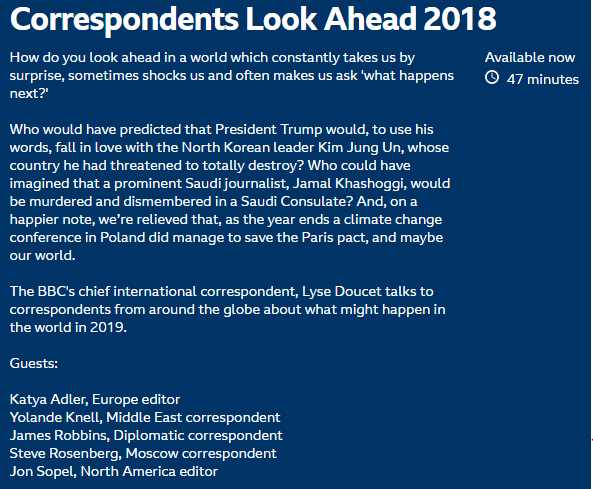
"And on a happier note, we're relieved that..."


The blurb for this year's Correspondents Look Ahead provided the opening words spoken by Lyse Doucet herself. You'll note that she openly speaks for the BBC on the matter of the climate change conference in Paris here:

Sunday, 31 December 2017

Correspondents Look Ahead


As I've written before, I've been tuning into (and enjoying) Radio 4's Correspondents Look Ahead for decades now, and this year was no different. 

A few years back, in the early years of this blog, I posted a review of the predictions made on the previous year's edition and found them to be almost entirely wrong, and I had great fun pointing it out (especially at Paul Mason's expense). The post even got a mention on that year's Correspondents Look Ahead where I was cast as "a rather unkind blogger". 

Unfortunately for me, however, it backfired. I really do think that the programme became far more cautious - indeed boring - as a result, especially for the next couple of years when hardly any concrete (i.e. potentially embarrassing) predictions were made. 

Thankfully, especially as I've held back recently in pointing out the wrong predictions recently, we've finally arrived back the stage where caution is being thrown to the wind again - though, that said, quite a few of this year's predictions weren't exactly that daring!

Here's a list of the predictions for 2018. Should we all rush out to the bookies?

*******

James Naughtie 
  • Donald Trump will be devastated by insider revelations about chaos in the White House.
  • The Democrats will win control of the House of Representatives in the November election.
  • Donald Trump's tax bill is going to prove "spectacularly unpopular with voters".
  • Russia will have a successful World Cup.
  • Joe Biden will announce that he's running for the presidency but won't win the nomination.
  • There'll be some form of internet collapse.

James Robbins

  • The Democrats will win control of the House in the November election.
  • There will be a Cuba+++ moment in South Korea with the mass evacuation of Seoul due to US/North Korean tension.
  • There will be "a non-disastrous rumbling on" of the Brexit talks. 
  • The UK government will suffer at least one substantial House of Commons defeat led by Remainers but will then narrowly squeak through a confidence motion and avoid a general election.
  • Russia will not have a successful World Cup because of its far-right and outside media scrutiny.
  • 2018 will be the year of renewables and batteries. 

Carrie Gracie 

  • Donald Trump will announce a series of "robust measures" to try to deal with the enormous trade deficits that the United States suffers in relation to China.
  • There will be negotiations on the Korean peninsula between China, the United States, South Korea and North Korea. A deal will be struck whereby North Korea agrees to freeze its nuclear and missile programmes in exchange for the US and South Korea "dialling back" their military exercises on the peninsula.
  • Either the Dalai Lama or the Pope will make a visit to China.

Yolande Knell 

  • The Democrats will win control of the House in the November election.
  • Donald Trump will launch and pursue a peace plan for Israel and the Palestinians which won't succeed.
  • Donald Trump will reimpose US sanctions on Iran but the Iran Nuclear Deal will survive thanks to its other signatories.
  • Russia's Syria peace conference will fail to bring about peace.
  • PM Haider al-Abadi and President Abdul Fattah al-Sisi will win their respective elections.
  • Yair Lapid (a "moderate") will lead the next Israeli government after the fall of Benjamin Netanyahu.
  • Mohammed bin-Salman's popularity will drop with the young because of his austerity measures and the contrast with his own lavish lifestyle.
  • Mohammed bin-Salman to squeeze Jordan and the Palestinians over accepting the terms of a Trump peace plan.
  • There'll be a resurgence of al-Qaeda.

Owen Bennett-Jones 

  • Imran Khan to become PM of Pakistan.

Kevin Connolly 

  • The Democrats will win control of the House in the November election.
  • Because of his "terrible" polling numbers Donald Trump might be content to be a one-term president and stand aside.
  • Brexit is going to rumble along "a bit less disastrously than you might think".
  • Russia will have a successful World Cup.
  • Trouble for the EU will come from Poland and Hungary for the EU and they may be more awkward for the EU than the UK ever was.

Everyone

  • Vladimir Putin will win the Russian election.

The one that made me chuckle was OB-J's prediction that Imran Khan might become PM of Pakistan. Imran Khan's big breakthrough has been a regular prediction on Correspondents Look Ahead, on and off, for years now. And it's never happened so far. Will it finally come true?

Saturday, 30 December 2017

But the truth is we all say that...


This year's Correspondents Look Ahead featured a new member of the cast - namely BBC Special Correspondent James Naughtie.

As you might guess, his first answer was so long and laboriously delivered it swallowed up around half of the 50-minute programme, leaving little time for any other predictions or anyone else to speak. The rest of the BBC reporters just sighed, gave up and went home, and Jim just carried on talking. I fell asleep.

Here's how it began, with Jim's 'take' on President Trump:

Owen Bennett-Jones: We're going to start with the United States and Donald Trump. And we've all followed the last year of Donald Trump, Jim. What's ahead for Donald Trump in 2018? 
James Naughtie: Well, I think we've got to start with the fact that some people forget, Owen, which is this: that his rating at the end of one year in office is lower than the ratings, on equivalent poll findings since the '50s, than any other President in our lifetimes. I mean, a CNN poll in December, which is following on the whole Gallup/ORC thing over the years - same questions, same timing - had him at 35%. Obama at the same time was at 75%. Now, this is extraordinary. It doesn't mean he can't excite that base - and he does, every day on Twitter and with these regular rallies - but the truth is he is fantastically unpopular among Americans. If you were a Republican member of Congress in a, what the Americans would call, an 'upscale district' - you know, a reasonably affluent district, let's say in California, where there are five Republicans very worried about their seats now. If you look at what's happened to women voters vis a vis Trump, they're deserting him like snow off a dyke. (I speak from a very frosty Edinburgh.) I think that, you know, we all say that, you know, this can't go on, he does things that no-one else has done but he does it. I mean, my feeling about Trump is that at some point I suspect - and this is my prediction on Trump, Owen - that somebody somewhere in the administration, either in the White House or very close to it - will break cover this year and tell us what the chaos in the White House (which it's generally accepted to be) has been like. And I think that will be devastating for Donald Trump. Of course, there's a section of the American public which simply won't believe it, but I think it will be out there. 
Owen Bennett-Jones: That 35% may well stay loyal.

Saturday, 3 January 2015

Correspondents Look Ahead - a look back


Having lived alongside BBC Radio ever since I was a (geeky) teenager, I seem to have been tuning into Radio 4's annual Correspondents Look Ahead for what seems like forever and a day - so long, in fact, that I can't even remember if it actually was  broadcast during my teenage years or not. Is my (middle-aged) memory playing tricks on me?

It's certainly been going on for a long time though.

The sharpest memory I have of the programme comes from the early 2000s and concerns the BBC's then Washington correspondent Matt Frei. 

For a few years, his sneering take on the Bush administration was a regular feature of the programme, and one year (I can't remember which) he confidently predicted that George W Bush would be a one-term president. 

Given that Matt barely ever bothered to disguise his utter contempt for President Bush, that incorrect prediction almost certainly sprang from his personal bias (i.e. wishful thinking on his part) and I listened for that sort of bias thereafter - and for more wrong predictions. 

Finally, as 2012 drew to a close, I thought it might be interesting to try and track this and see, as 2013 dawned, just how many of the predictions made on the previous year's edition had panned out correctly. 

You can read the results here. They show that most of the predictions made for 2012 had been wrong, often very wrong. 

Paul Mason, in particular, made some spectacularly off-target predictions, mostly based on his biased assumption (i.e. wishful thinking) that "people power" would cause uprisings across the world (including Iran, Israel and the U.S.).


Having published the piece before the pre-2013 edition of Correspondents Look Ahead, it appeared to have caught the attention of the programme's makers and my mockery of the section called 'Wild predictions' was duly paraphrased thus by Owen Bennett-Jones:
A rather unkind blogger put up a comment the other day saying we don't need any wild predictions on this programme because all the predictions are badly off-the-mark so it's not a necessary category.
And he ended by saying, 
I hope you enjoyed listening to that and agreed with some of it and kept notes or digital records so that everyone can be held to account.
Well, oddly enough, it was surprisingly hard to take Owen B-J up on that because, perhaps (just perhaps) because of  the filleting the previous edition had just received, the reporters on that pre-2013 edition were vastly more cautious than in preceding editions of Correspondents Look Ahead. 

Trying to find specific, concrete predictions to hold them to account to was much, much harder because they all seemed to be trying so hard not to say anything that could come back to embarrass them the way they'd been embarrassed over the previous edition of the programme. They'd started playing safe.

So, if the pre-2012 edition had been like shooting fish in a barrel, the pre-2013 edition was like trying to capture several dozen eels single-handed. 

And it's been pretty much the same ever since. The BBC clearly hates being embarrassed. (Who doesn't?)

That pre-2013 edition was so slippery and safe that only one cast-iron prediction stands out from it - the prediction of Lyse Doucet (and others) that Bashar al-Assad would fall from power before the end of 2013. 


The BBC was, at the time (as I see it) still in the throws of its naive enthusiasm for the Arab Spring and saw "people power" in Syria too and, as the BBC so often does in such situations, sided somewhat with "the people" against "the regime". If this bias existed (as I think it did, though not universally at the BBC), then it was hardly surprising that BBC reporters like Lyse Doucet might 'wishfully' think the Assad regime out of power and 'the people' into power.

Perhaps another bias (speculating aloud, on a laptop) - the bias against 'overstating' the danger posed by Islamists - led none of the BBC's ace reporters (or most of the mainstream media for that matter) to predict that the vast, competing swirl of variously unpleasant Islamists in Syria (and the region as a whole) might just possibly spawn a monster to out-monster all the other monsters (so far), namely Islamic State. 

This year's edition of Correspondents Look Ahead 'fessed up to having failed to foresee Islamic State (and Russia-Ukraine and Ebola) but last year's edition reflected on that wrong prediction regarding Assad, especially Lyse Doucet who, while generalising the matter beyond the BBC to the West as a whole, seems to sum up some of the biased thinking that pervaded the BBC's reporting of the story:
I think we look at them with the wrong lenses. I think in the West we look at it through the lenses of what we want to see. So for a long time we saw President Assad as a westernised leader with a British-born wife. Then we saw him in the mould of Colonel Gadaffi and Hosni Mubarak, i.e. about to be toppled. It is a police state, so it's very difficult to get to the heart of what's happening in Syria, and my view, in covering this closely, is that many western capitals have seen it through ideological lenses as well, coming out with statements like "Assad must go", "His days are counted". They're not counted, and he's not going anywhere any time soon. 
Well, I would say that I saw a lot of comments at blogs like Biased BBC (and made a few myself) criticising the BBC's sometimes rose-tinted take on "young" Bashar before the 'revolution' began, and Israel and the U.S. never looked at President Assad Jnr so sympathetically, so you can speak for yourself there, Lyse!


And I recall reading plenty of posts and comments (including plenty from Sue) cautioning against what might come in the wake of the fall of Mubarak, Gadaffi and Assad. (Some of the comments from RGH at Biased BBC at the time outpredicted everyone over what would happen in Libya were Gadaffi overthrown before Gadaffi was overthrown) as we denounced the BBC for enthusing over the uprisings. (Ah, alas, they didn't listen to us bloggers!)

And as for "many western capitals" having "seen it through ideological lenses", well, Lyse, is that a beam I see in your own eye?

Most of the successful predictions on last year's programme were so vague (the economy will get a bit better) or so widely expected to happen (like Mr Modi winning the Indian election or Mr Erdogan becoming president of Turkey) that they don't really stand out as prize-winning predictions.

Among the bigger unsuccessful predictions, however, were (1) that John Kerry would help bring about a major breakthrough in the Israeli-Palestinian conflict and (2) that talks with Iran would also result in a successful deal. Neither happened, and I'm putting forward both of those wrong predictions as candidates for bias-suggesting wishful thinking. Neither of them were 'fessed up to on this year's edition.

And, returning almost to where the post began, it was on the (then) upcoming U.S. mid-term elections that the BBC reporters got it most obviously wrong last year.

Both Mark Mardell and James Robbins predicted that it would be a bad year for the Republicans with the Republicans failing to take the Senate and the Democrats making gains in the House (though not enough to take it). They reasoned that the public had taken against the Republicans over the budget crisis of late 2013 and that they would punish them for that in November 2014...

Didn't happen. Bias. Wishful thinking. And, again, Mark Mardell didn't 'fess up to it.

As for this edition's predictions, well, we'll review those in a year's time. If we're still here. Which we probably will be.

Mark Mardell's beard


The above image shows the team of BBC reporters involved in this year's Correspondents Look Ahead on Radio 4. 

From left to right, there's Carrie Gracie, Kamal Ahmed, Lyse Doucet and Bridget Kendall. Furthest to the right (ironically) is presenter Michael Moore...er no, actually it's Mark Mardell with a newly-grown beard, though he certainly does a bit like Michael Moore these days...


If this year's Correspondents Look Ahead were Jesse Jesse from the Fast Show, it would emerge from its luxurious Islington shed saying, "This year I 'ave mostly been talking China". 

More considered thoughts will follow...

Saturday, 29 December 2012

BBC Correspondents Look Back Again...In Embarrassment


Just an update on a previous post, BBC Correspondents Look Back...In Embarrassment....

Last night saw the broadcast of this years BBC Correspondents Look Ahead, again presented by Owen Bennett Jones. Mark Mardell, Lyse Doucet and James Robbins returned to face the music over last year's many, many awry predictions and to lay out their predictions for 2012. Sadly Paul Mason, whose prognostications were in a league of awryness all of his own, was a no-show (being replaced by Stephanie Flanders). Was he otherwise engaged, or just too embarrassed?

The programme didn't entirely avoid airbrushing some of the wrong predictions from last time but, all in all, they did an admirable job in 'fessing up. James conceded he'd had a below-average year and Mark was made to squirm over some of his predictions - gales of laughter surrounding his off-target man-to-watch from last year!

I was intrigued to hear Owen say, "A rather unkind blogger put up a comment the other day saying we don't need any wild predictions on this programme because all the predictions are badly off-the-mark so it's not a necessary category" - which, I believe, is a free paraphrase of a crack of mine from that post. 

I was also intrigued to hear Owen say, "I hope you enjoyed listening to that and agreed with some of it and kept notes or digital records so that everyone can be held to account." 

I will be doing precisely that. 

Rather disappointingly, however, this year's predictions seem to have been made in a much greater spirit of caution, with a greater number of safe bets being made. There were few examples of the correspondents really going out on a limb this time. Surely reading my hatchet-job on their last set of predictions hasn't spooked them into playing safe?

Saturday, 22 December 2012

BBC Correspondents Look Back...In Embarrassment


A long-standing BBC Radio 4 New Year tradition has been the annual BBC Correspondents Look Ahead special, where a handful of the corporation's star news reporters get together to predict what they think is going to happen over the following twelve months. 

One of its fun features is the initial run-through of what they foretold the previous time and how correctly - or spectacularly incorrectly - they foretold it! The presenter usually makes them blush a bit then points to some of their successful predictions, thus proving that BBC correspondents are shrewd commentators after all. However, as a devoted year-in-year-out listener to BBC Correspondents Look Ahead, I have noticed a certain tendency not to remember some of the most embarrassing predictions from the previous year, so it might be interesting (he says optimistically) to look back at the last edition of the programme in advance of this year's edition and mark the BBC reporters' scorecard for them (thus saving the presenter a job). It's nearly Christmas, so such an act of charity is surely just what's needed.

The presenter last time round was Owen Bennett Jones. His team were the BBC's North America editor (has he ever reported from Canada?) Mark Mardell, Newsnight economics editor Leon Trotsky Paul Mason, roving Everywhere correspondent Lyse Doucet and BBC diplomatic editor Kate James Robbins. My favourite was Paul Mason, whose ability to get his predictions and analysis wrong puts even Karl Marx to shame. 

I'll ignore the initial recap of the previous year's prediction, except to note that OBJ's recall of Mark Mardell's somewhat awry 'name to watch', Mitch Daniels - the Republican Mark tipped in the race to be selected as the GOP's candidate to lose to Barack Obama - drew the ever-so-(not)-impartial comment from Paul Mason:
"Mark, you're being too polite here. 'He wasn't crazy enough' is the answer." 
That's perhaps what a few fair BBC listeners might have been thinking but, by my understanding of BBC impartiality guidelines, Paul's intervention there was a revolutionary-exile's-air-miles-to-Mexico away from being an impartial BBC comment! 

The first topic up for discussion was the likely fate of Bashar Assad of Assyria. Owen Bennett Jones predicted that he was safe and that the danger had passed for him. James Robbins thought that OBJ was wrong and that by the end of 2012 Bashar's people would be starting to desert him. Now that's looking like a good prediction to me. Lyse predicted he wouldn't "survive the entire year." Well, she's still got a few days to go to spare her blushes! Still, pretty sensible stuff...until Paul Mason entered the debate, that is.

Newsnight's clueless Wolfie Smith impersonator gave BBC listeners this inspired insight about the Syrian conflict:
"There is this other elemental force, isn't there? People power!"
OK, Paul. "People power!" being the explanation of the Syrian civil war? Hmm, best stick to tweeting Laurie Penny perhaps?

Predicting "social unrest" in Russia and Iran throughout 2012, Paul ended with the question, "So where do the sources of support come from from a regime like Assad any more?" Well, throughout almost the entirety of this year, from Russian and (socially restful) Iran...and China...and significant sections of his own people.

James Robbins thought it was "possible" that the revolutions in the Middle East would spread to Central Asia. Er, no.

Lyse Doucet informed listeners that it wasn't just an Arab Spring it was also an African Spring and posited the possibility of the nine very long leaders left in sub-Saharan Africa being swept away too. She was cautious in her predictions though. She specified Uganda (wrong) and Senegal (correct, but in democratic elections which the outgoing President Wade conceded with grace).

Paul Mason then gatecrashed the discussion to...as is his way...bring up the Occupy protests and predict "the urban poor" moving against the system in the United States. Er, no, Paul. Didn't happen. Dream on!

Mark Mardell worried about what would happen "if Obama loses". A lot of people would feel "disenfranchised by the media, by the corporations", he said. "The system...doesn't work any more", he added, agreeing with Paul Mason. "Hmm," someone else added.

What of that U.S. election? Mark predicted that Obama would "win, very narrowly". James Robbins agreed. Lyse hmmed her agreement too, though she regretted the lack of the "excitement" and "magic" that made the 2008 elections so special.

They all got the outcome correct, though it was only fairly "narrowly" in the end. Owen Bennett Jones then quoted the bookies' prediction: A 51% win for Obama. Well done, bookies!! Mark then predicted an "ugly mood" if the "very, very hardline" Right lost the election. Well, that hasn't really happened, has it?

France? The bookies gave Sarkozy only a 39% chance of winning. Did any of the panel think he could win? "Nope", came the reply. Correct, but....not one of them foresaw just how close Sarkozy came to proving them all wrong. His losing margin was smaller than that between Obama and Romney. Paul Mason crowed that Sarko was actually at 32% in the polls, "which is surprisingly high", and predicted a Hollande-Le Pen run-off. Er, no, Paul. "I'll go out on a limb on that", he said. Shouldn't have done, Paul, really shouldn't have done! (At least Lyse Doucet noted that there wasn't a great well of enthusiasm for M. Hollande.)

Onto Russian. Lyse, would Putin win or lose? "Win. Narrowly", replied Lyse. Result? Putin 63%, his nearest rival? 17%. So, that's "Win. By a Tolstoy-novel-page-count" and another "Er, no" for a BBC correspondent. James Robbins sounded much surer that it would be a win for Putin, given...well...that it's a Russian election. Narrow wins don't tend to happen in Russia, Lyse.

China next. "Remarkably little coverage" was predicted by Owen Bennett Jones for this year's leadership change. That's something for a BBC presenter to say - as, presumably, he also meant it about the BBC. There was, it turned out, quite a bit of coverage after all this year. Hu's now the leader of China (on first base, so to speak?). Er, no, it's...that chap with the...er...Where's Wikipedia when I need it? ..... Xi Jinping, of course. Owen Bennett Jones said that everyone (in the world) said it would be him. It was him. Everyone was correct. No prizes to anyone there then.

OBJ gave us a quick profile of Mr. Xi. "He's not Berlusconi anyway", chipped in Paul Mason.

Talking of whom (Paul Mason, that is)...the ever-inaccurate predictions of Paul Mason continued. He "could see" lots of countries becoming protectionist against China, especially if a major incident sparked something off. No major incident, Paul, and no great wave of anti-Chinese protectionism either - yet. So, that's yet another "Er, no" for the Newsnight economics guru then.

The others complained about us in the West (do we ever get anything right in the eyes of BBC reporters?) overemphasising things from our own perspective (tut, tut!), such as going on about the lack of freedom of the internet in China (which, ironically, Paul Mason was doing on Newsnight this very week!!). They then piled in with their other thoughts, such as that the Chinese people might follow the Tunisian example and start losing their fear of/start "taking it out on" the government in Beijing. Er, not yet, O wise BBC reporters.

North Korea. James Robbins predicted "that the regime will try to do very little...and not risk throwing the furniture around" in 2012. "There has been a lot of belligerent talk of the possibility of military exercises, of deliberate sabre-rattling, but I think that will be quite restrained."

Er....

North Korea defies warnings in rocket launch success

The news of the rocket launch was announced on state TV

Oh well, can't get 'em all right!...or, indeed, most of 'em right!!

Talking of which (again), Paul Mason was unfraternal in floating the idea that communist North Korea might find in 2012 that "durable authoritarianism is probably not that sound". Er, no, Paul. The Great Successor is proving a great success. All hail the Great Successor! - as Lyse Doucet (far shrewder than Paul Mason) pointed out, the Kim Dynasty ain't going anywhere....yet. (Fingers crossed though).

Europe in 2012? Cue Paul Mason. "I think the Greeks will default". Another very confident, very wrong prediction from the master of very wrong predictions.

Fiscal union by the end of 2012? "That's the direction they're going in", said Mark Mardell, hedging his bets wisely. There's "a higher possibility" that Greece will be ejected from the euro, he added, not so wisely. Fiscal union is needed, they all agreed.

Names to watch? Amusingly, when this topic came up OBJ did recall Paul Mason's prediction for 2011 - a German central banker - Axel Webber -, who promptly "disappeared from the scene." Paul really shouldn't go on BBC Correspondents Look Ahead.

Actually, this has just prompted me to seek out his 2011 predictions - which also included his prediction that Sarah Palin's momentum to become the U.S. Republican candidate would keep on growing (er.....), that Ed Balls would begin rousing the rabble against Ed Miliband in 2012 (er.....) and that "there is a new zeitgeist within protest movements in Europe (on the left) and the US (on the right) - new ways of online organising and a new plebeian individualism. I am keen to see what happens." (Er.....)

If you wan't to go back even further, to his 2010 predictions (for 2011)..the fall of the Lib-Con coalition in the UK, the stalling of Sarah Palin's momentum (!!), Greece being driven out of the euro, etc,...well, feel free to click the link above and have a good laugh!

Anyhow, that's enough fun with Paul Mason for a while. What of their names to watch for 2012?

Mark Mardell nominated the "charismatic" Bo Xilai - the man who was reinventing Maoism - for a key role in the Chinese politburo. Well, Bo was certainly someone to watch. Instead of winning a high place in the politburo, he actually plunged headlong from grace following the scandal around the death of Neil Heywood. He was expelled from the Communist Party and his wife convicted for murder. I'm not sure that can count as a point on the Mark Mardell scorecard.

Paul Mason nominated Ron Paul, the U.S. libertarian Republican candidate. "I think he's going to do very well. That's my prediction". Well, "very well" was a considerable overestimate. Mr. Mason specified the Iowa caucus as Mr. Paul's potential breakthrough moment. Mr. Paul came third behind Mr. Santorum and Mr. Romney. So, er, no, Paul...and Mr. Paul.

Lyse Doucet nominated the Emir of Qatar. Again, Lyse proved herself the BBC reporter to watch on this programme. Yes, Sheikh Hamad bin Khalifa Al Thani has, indeed, played a big role in pushing a game-changing agenda in the Middle East throughout 2012. Full marks for her.

James Robbins nominated President Santos of Colombia, predicting major economic strides for his country in 2012. I've no idea whether this prediction came true or not (not being an expert on Colombia's economy), so it's time to google...."Colombia economy 2012". Click 'search'.........

Colombia posts weakest quarterly growth in 3 yearsThe Andean country's gross domestic product grew just 2.1 percent in the third quarter from the year-ago period - its slowest pace since the third quarter of 2009 - and well below analysts' expectations.
The result was also much slower than the 7.5 percent expansion recorded in the same quarter last year.
 http://www.reuters.com/article/2012/12/20/us-colombia-economy-idUSBRE8BJ13R20121220

Dear Lord, can't these BBC reporters predict anything right? (Ha, ha!) Well, that's as nothing compared to James's next prediction:
"....Hugo Chavez, who I think stands stands to lose the presidential election in 2012."
Wrong again!! Chavez won. All hail Hugo Chavez!

Owen Bennett Jones nominated Bilawal Bhutto, son of the late, lamented Benazir and the current leader of Pakistan, President Zardari. He predicted that Bilawal would be "pushed forward" this year as his father sank into ever greater political difficulty. A quick google suggests that 2012 hasn't brought about much of a change at the top of the Pakistani political tree and that Bilawal hasn't progressed much beyond where he was at the end of 2011.

Lyse turned to Afghanistan and Pakistan too and feared that things would get even worse in 2012. Worse than 2011? Better? The same? I can't say.

James Robbins came in to predict "I don't think President Zardari will survive in office", which which can notch up as yet another prediction that went somewhat astray, given that President Zardari most certainly did survive in office. (There are about nine days still to go though, so fingers crossed, eh, James!!)

OBJ predicted that Imran Khan would, if Mr. Zardari fell, become his successor (in power terms if not as president). Not yet, Owen, not yet. (Hopefully, not ever, not ever.)

Paul Mason brought in Iran and predicted that "the unrest of a generation" would result in something giving at some point there. Not in 2012 it didn't, Paul. And you're sound like a stuck record now. Power to the people! It's kicking off everywhere! Occupy, occupy, occupy!

As for a Israeli or U.S. airstrike against Iran, James Robbins said the U.S. would prevent military strikes against Iran in 2012. Mark agreed. Paul Mason talked about the "uprising youth" of Iran again - as is his way. Stuck record.

Israel-Palestinian peace process? Lyse quoted Gramsci. James Robbins predicted nothing would happen until after the U.S. elections. Paul Mason (by this stage of the programme fast becoming a parody of himself, as well as a stuck record) talked of the "street protest movement" in Israel (remember them?), and said "But it's not over". (Er, well, it actually was, Paul, pretty much).

Good news stories for 2012? Well, James Robbins talked of "signs of real progress" in Ivory Coast and "the countries that have been the beneficiaries of the Arab Spring." I can't comment on the Ivory Coast but James's "beneficiaries of the Arab Spring" (now known as the Arab Winter) can hardly be said to be "good news" any more, and its beneficiaries don't feel like beneficiaries any more either. Egypt until Morsi? Tunisia under Ennahda? Oh, happy days - not!

Paul predicted a bottoming-out of economic graphs in America (such as the house price graph), which seems essentially correct. Wow, he sort-of got one right! He then predicted the continuing relentless rise of the BRICS. Well, that was a bit of a no-brainer and a very easy prediction to get right. Strangely enough, he didn't quite get it right, failing to foresee the recent widely remarked economic slowdowns in Brazil, Russia, India and China. They will probably start spurting forwards again, but nothing is guaranteed - and Paul Mason failed to foresee that their "relentless rise" might not be quite as "relentless" by the third quarter of 2012 as everyone (everyone?) was assuming.

Lyse's heart was warmed by "the young people" of the world. "They are the future". (Someone should write a pop tune about that). She also likes the internet and social media. "I want to celebrate that," she said. Amen, sister.

Mark Mardell's heart-cockles were warmed by Burma.

The next section was "WILD PREDICTIONS!" - as if most of what had gone before hadn't been full of wild predictions!

Mark's wild predictions: The Republican field would look so grim that Jeb Bush would be forced to come in and will win & that Einsteinian physics would be overturned by the Large Hadron Collider.

James's wild predictions: Britain will top the Olympics medal table for a few hours by winning the first gold. First hypothermia death at a health spa (something to do with snow showers).

Paul's wild prediction: "Prime minister Berlusconi" makes a comeback. The technocrats fall. (I don't think he was being serious. Oddly, this looks like his best prediction - as it could be about to come true!!)

Lyse's wild prediction: The Taleban will stop their assassinations & come to the negotiation table.

Owen's wild prediction: Hamza Bin Laden could become the new leader of global jihad.

Finally, "things we haven't dealt with." The war on drugs. "The people think it's a nonsense", said Mark Mardell of the American people. Lyse is dismayed.  Climate change? No one took that up. Boko Haram in Nigeria mentioned but no predictions made.

So, there you have it - an absolute deluge of dismally inaccurate predictions from the sage analysts of the BBC!

I'm really looking forward to this years BBC Correspondents Look Ahead to hear the presenter list all these many, many wrong predictions made the corporation's BBC's star reporters last time round. Lyse Doucet did OK, but poor, poor, poor Paul Mason is going to be blushing redder than the flag of a communist youth movement by the end of it, surely?