Showing posts with label Syria. Show all posts

Sunday, 28 February 2021

How would the BBC have reported the US airstrikes on Iran-backed targets if Donald Trump had launched them so early in his presidency?


Did you know that President Joe Biden has already bombed Syria? 

It's something that could easily have been missed if you simply relied on BBC TV/radio news. 

Here's Rod Liddle in The Sunday Times this morning: 
Joe Biden’s kinder, gentler America fired a number of missiles into Syria last week, killing an estimated 22 people. I assume it was some kind of goodwill gesture towards foreigners. Certainly that’s how it was reported by the BBC. Whenever Trump did anything similar it was presented as “fascist madman murders civilians and starts Third World War”.
That sounds like the sort of thing the BBC would do, but did they? I've searched via TV Eyes and I can only find one reference to the US airstrikes on Syria on BBC One or BBC Two or the BBC News Channel, at around 5am on Friday morning - which is quite some feat of under-reporting. 
  
I see Radio 4 reported the US strikes though, intermittently, throughout Friday and Saturday. Except for a brief mention during a news bulletin, Today ignored the story, as did The World at One and The World Tonight. However, Friday's P.M. asked one question about it. Rod must have heard it somewhere on Radio 4.

How did they report it then? 
  • 2am, Friday: The Pentagon says the US military have hit facilities in eastern Syria used by Iran-backed militias in retaliation for recent rocket attacks on US troop locations in Iraq. A defence spokesman said the air strikes were carried out following a directive from President Biden.
  • 6.35am, Friday: Joe Biden has authorised his first known air strike since becoming US President. It targeted facilities in eastern Syria used by militias backed by Iran and was in retaliation for recent rocket attacks on American targets in Iraq.
  • 11.02am, Friday: The US says its air strikes on targets in eastern Syria have destroyed 9 facilities controlled by Shia militia. It's the first US military operation since Joe Biden became president. The attacks were ordered after a civilian contractor was killed by rockets fired at US positions in Iraq.
  • 5.50pm, Friday: Evan Davis: Now, the first military action of the Biden administration was carried out last night - an air strike targeting Iran-backed militias in Syria. That came 10 days after Americans were targeted. A civilian contractor was killed in a rocket attack on US targets in Irbil. Syria has condemned the attack as "a bad sign" from the new US administration. But are we able to say much about American foreign policy under Joe Biden? As we speak in fact, lines are coming out of the White House. It has just said "strikes were necessary to reduce the threat of further attacks" and the Americans have also said they will be releasing later today their evidence, their intelligence, on the killing of Jamal Khashoggi, that killing. We can talk to Karin von Hippel, who's Director General of the Royal United Services Institute for defence and security studies. This strike last night, Karin, some might say it shows a a willingness to get dragged back in. I don't know. What did you make of it? Karin von Hippel: I actually think it was a targeted and limited strike and, in a sense, a response to say 'you can't attack American bases or American personnel or troops' and also a message to Iran, that's getting involved in a lot of proxy conflicts, or has been, for a very long time in the region and Biden is very desperate to get back into an Iran deal, the JCPOA plus whatever the new version will be, and there's a big debate going on about whether or not Iran's involvement in the region should be brought into the deal or not. So this is sending a message to the Iranians essentially. Evan Davis: Great.
  • 4.04am, Saturday: President Biden has said that Iran cannot act with impunity, and he warned the country's leaders to be careful. He was speaking after US warplanes attacked facilities in eastern Syria controlled by Iran backed Shia militias. At least 17 people were reported killed. With more detail, here's Gary O'Donoghue. Gary O'Donoghue: The Pentagon spokesman John Kirby said two F15 aircraft dropped a total of 7 precision-guided munitions totally destroying 9 facilities and partially destroying two others. Battle damage assessment, he said, was still being carried out and he would not confirm reports that 17 people have been killed on the ground. The strikes, he said, were justified under both US law and United Nations statutes and were directed at Iran-backed Shia militia groups.
As well as a few other short summaries overnight on Friday night and Saturday morning, that seems to have been it. 

Even the likes of Jeremy Bowen have kept quiet on this story.

It's as if, without Donald Trump, the urge to report - and denounce - certain actions holds less appeal.

Sunday, 13 October 2019

Reporting with feeling


The BBC has discovered three young children in a Syrian camp for detained IS members. They are said to have originally lived in London. The BBC reporter involved, Quentin Sommerville, is live-tweeting the news and crossing the line between straight reporting and active advocacy:  

  • These three kids, Amira, Hamza and Hiba, are orphans of the Islamic State. Their nationality has been a mystery since they were found after the fall of Baghouz. Their in a Kurdish-run camp in NE Syria not far from the Turkish-led incursion.
  • They speak Arabic. Amira, who is ten, was brought to Syria five years ago. Like many of the children left by radicalised parents, they are wary of revealing details about themselves.
  • But when the kids are alone together, it was noticed that they spoke English.
  • Amira hasn’t written in English for a long time. But slowly and carefully she wrote down what she could remember, spelling phonetically. She writes she’s from LaNDN uKeH - london, UK?
  • After a while, she spoke to us in English. Have a listen, she’s trying to remember her life back in the UK.
  • Amira told us about their escape from Baghouz. The BBC Syria team has dealt with a lot of traumatic testimony over the years, but this was particularly hard.
  • “We were sitting there. They were hitting so much,” she said. “There was a little house and that big dusty mountain and behind it everybody was dead. In front of us was everyone who was not killed, the other people.”
  • She continued, “We were going to pack our stuff and get out, the airplane came and bombed. So then my mum died, my littlest brother, my little brother and my sister. Then after that, all was getting on fire. We had to walk out.”
  • “After that, I saw my (older) brother. He was walking up. He knows my mum was dead there. I think he was down there hiding from snipers and guns. So then after that, he ran there. When he was running that little house broke and went on fire so he died.”
  • She goes on to describe - this girl of just ten years old - babies dying in her arms. Leaving aside nationality for a moment - this is a disgrace. There are kids in the camp who’ve been through the worst trauma imaginable and we aren’t giving them sanctuary?
  • Their scars are real. This is eight year old Hiba. They have no trauma counsellors, no relatives who love them, no place to call home. We fought ISIS and said, “to hell with the rest, let them rot”.
  • It’s thought there are around 30 british children in the camps. But all have parents - Amira, Hamza and Hiba may be the first British orphans. They want to come home.
  • We have given all the details we have to the British authorities who are investigating. The kids aren’t far from the Turkish assault. This is a matter of urgency. They’ve already endured so much.
  • The kids may not qualify as British nationals. But are we content with leaving them there in a camp full of radicalised women, and with another conflict about to overwhelm them? There are thousands of “IS” children stranded in Syria. Who will help them?
  • And what does a little London girl, sitting in the Syrian desert dream of?
  • You can listen to Amira here. We’ll be putting her story out across the BBC today, radio, TV and online in the hope that someone recognises her, Hiba and Hamza.
  • *Feel free to retweet. There’s a granny in London somewhere who doesn’t know her grandkids are still alive. ENDS

Sunday, 24 February 2019

Foreign affairs


Especially for those of you who don't use Twitter...It's really easy to click on a random tweet that various algorithms forward in your direction. And, yes, I clicked on one yesterday morning. It came from this fine, upstanding-looking fellow:


Now, as a BBC-watcher, what really caught my attention here was that Mr. Shoebridge went on to predict that the mainstream media (including the BBC) would not report Foreign Secretary Jeremy Hunt's embarrassing blunder in stating, in the very presence of the Slovene leader, that the former (Titoist) Yugoslav republic Slovenia was a "Soviet vassal state".

And, by and large, Charles hasn't been wrong, has he? (Yes, I've checked).

Now, the odd thing here is that Charles Shoebridge turns out to be a left-wing, Craig-Murray-type and that he's going at this from the 'the BBC is a state media lackey of the US/UK military-industrial complex' angle...

...while, in contrast, I'm going at it from the 'Well, the BBC would have gone absolutely haywire and made this headline news for days if ever their pro-Brexit bogeyman Boris Johnson had commited such a spectacularly historically uninformed gaffe' angle.

Anyhow, I have to say (and I sincerely thank myself for so doing) that I still think that I'm nearer the truth here that the esteemed Charles, and I'm presently toasting myself in consequence, in true John Sweeney fashion, with a flaming sambuca on BBC expenses. (In reality, an under £5 Pinot Noir from Aldi).

But, in fairness - and I'm sure Mr. Shoebridge will appreciate this - at least the eternal flame of the true spirit of the BBC (alongside the mighty John Simpson) - namely veteran BBC reporter Hugh Sykes - is on the present Foreign Secretary's case, agreeing (on Twitter) with a professor that poshly-educated Mr. Hunt may have graduated with first class honours from one of the twp usual posh universities but that - in BBC Hugh's words - Mr. Hunt is "clever but not very bright".

...breaking news...BBC reporter says Foreign Secretary Jeremy Hunt is "not very bright"...breaking news...BBC reporter says Foreign Secretary Jeremy Hunt is "not very bright"...breaking news...BBC reporter says Foreign Secretary Jeremy Hunt is "not very bright"...BBC reporter Hugh Sykes says he hangs his view up with his coat at the BBC door...breaking news...Empire star Jussie Smollett says he's been attacked by a racist emu...breaking news....Empire star Jussie Smollett says he's been attacked by a racist emu...breaking news...the late Rod Hull has refused the BBC's request for a comment...breaking news. .the late Rod Hull has refused the BBC's request for a comment....BBC reporter says Foreign Secretary Jeremy Hunt is "not very bright"...breaking news...(etc)...


*******

And by a remarkable coincidence, Mr. Shoebridge also cropped up related to other story getting the Media Lens end of the internet (including Mr. Shoebridge) excited: "BREAKING: BBC journalist confirms the Douma chemical attack was staged by the White Helmets. The US bombed Syria over this"

Riam Dalati's job title is "BBC Syria Producer". He often works with Quentin Somerville, and both Quentin and Lyse Doucet have been tweeted for their reactions to this. (They've not responded yet): 


So what's this all about?

Saturday, 27 October 2018

Assads


What an absolutely gripping series the BBC's A Dangerous Dynasty: House of Assad turned out to be.

And watching it was (I felt) three hours well spent. 

It was, of course, an absolute hatchet job on the Assads, with talking head after talking head after talking head after talking head disrespecting The Family. 

That said, there were no horses' heads on pillows on beds featured in the programme, thank goodness.

Bad, bad, bad, bad Assads. Very, very bad Assads. 

That - spoilers, if you haven't seen it - was the main message.

Big, bad Assads.

Big and bad. Especially bad.

Assads.

Bad.

Saturday, 13 October 2018

Dynasty


Yet more about Charlotte Moore, albeit in passing...

In her Steve Hewlett Memorial Lecture this week, she described the new three-part BBC Two series A Dangerous Dynasty: House of Assad as a "must-see" programme. So, being an obedient soul, I obeyed and watched the first episode. And it really is excellent.

The opening programme took us up to 2003, three years after the death of the Don Corleone of the family, Hafez al-Assad, and the assumption of power by his Michael Corleone-like second son Bashar. 

Old Hafez, a skull with a moustache, always struck me as a wrong 'un, but I didn't know that "at his military parades, soldiers were forced to kill puppies in front of him" and "female soldiers were made to bite off the heads of snakes". And lest I didn't want to believe that, there was the grainy black-and-white footage to prove it. (And I don't think I'll forget that for a while). He was also the sort of socialist dictator who would spent over a billion dollars creating a family palace. 

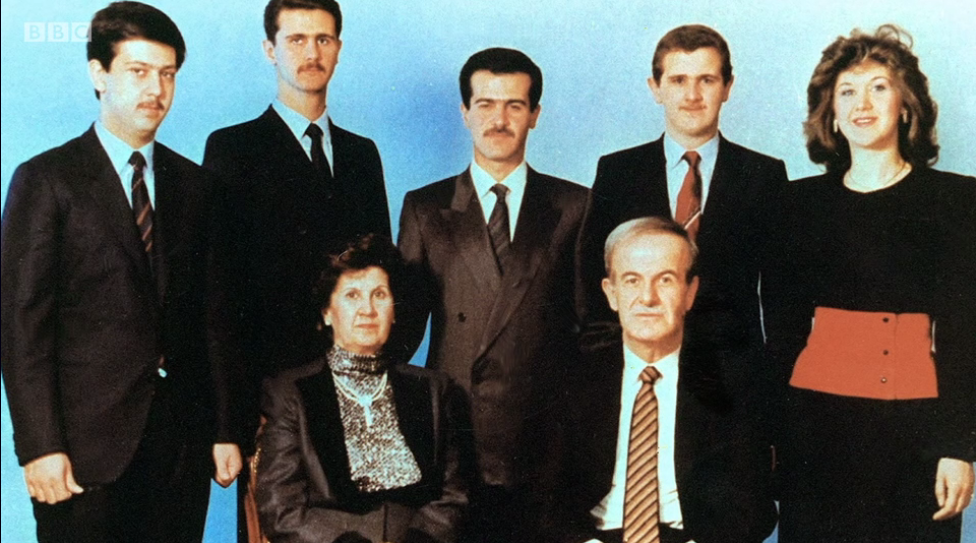
His eldest son, Bassel (middle of the back row in the photo above), was meant to be his successor. As a clue to his character we were told that he was a champion horse rider but, in 1993, one of his rivals beat him in a competition. Bassel had him arrested and put in prison. Anyhow, he also loved fast cars and died after crashing one in heavy fog.  

Who should Hafez chose next? Not his brutal treacherous brother Rifaat, who tried staging a coup against him after he had a heart attack in 1987. Not his preferred choice, his forceful daughter Bushra, because, well, she was a woman. Not the third son Majid, because he was mentally ill. Nor the youngest son Maher, because he was too young and hot-headed. So there was only one choice left - bashful Bashar, the softly lisping ophthalmologist. He was fast-tracked through the army and given a crash course in how to be a dictator. 

The series is also closely following his British banker wife Asma, who it's portraying as someone who wanted to be a a princess in a fairy tale and who was delighted when Tony Blair, after 9/11, invited her and her husband to meet HM the Queen. 


Old Hafez was the master of 'the hamburger trick'. This involves a hamburger sandwich seller. When the customer takes the bread, he finds that the seller has withdrawn the hamburger and he's eating just bread. The dictator used it on six US presidents, always giving them the hope that he'd be their ally in the Middle East but, at the last minute, not delivering. And we saw Bashar using it on Tony Blair. The British Prime Minister went to Syria, received the full charm of Bashar and private promises of support for the West in the War on Terror as the Iraq War neared. At the final press conference Tony Blair strongly welcomed President Assad's support and President Assad...well, President Assad pulled the rug from under the British PM and said that he didn't support the war at all, leaving Mr Blair looking on in severe bemusement - a remarkable scene. 

And this brings me to the most thought-provoking idea in the programme:
Narrator: At this point [the Iraq War], Bashar does something that will change history. He secretly releases Islamic fundamentalists from his prisons, arms them and sends them over the border to fight the Americans. The Muslim prisoners that Bashar released and sent over the border are a major reason that America and Britain get bogged down in Iraq. 
Sir John Sawers, head of MI6 2009-2014: There's no doubt that the fundamental security problems arose because extremists sympathetic to Al-Qaeda were fuelled with weapons, ammunition and support from Syria. So the task of stabilising, especially the west and north of Iraq, became vastly more difficult because of the actions of the Syrian regime.
The West usually gets the blame for the massive destabilisation of the region and the worldwide Islamist terrorism that followed the Iraq War, but what if it wasn't the West that made the big difference but Bashar al-Assad? If he hadn't released and armed those jihadists and sent them into Iraq and caused so much chaos, would the world be a very different place now? (There's a counterfactual for you!). Of course, in a few years' time, the Muslim fundamentalists that Bashar released would cross the border back into Syria.and try to set up an Islamic State there. But they are now (almost) gone and he's still there. 

Wednesday, 25 July 2018

Blow me down (updated)

Remember I told you I haven’t been watching much TV lately? Well, blow me down, no sooner had I (recklessly) switched on the BBC news channel this afternoon than I was confronted with an appalling report fronted by Paul Adams. 

Even Happy Goldfish flagged it up, which is unusual.  Usually, H.G’s posts are merely ‘alerts’ to programmes with any Jewish or Israeli content.


I must admit I missed the Today Programme this morning, and as the website no longer publishes the Running Order I haven’t time to fish it out amongst all the other silly-season dross. In any case, I don’t know if I could stomach it. Even for you, dear reader. (But you could  follow the link

It seems that this bizarre topic (Why?) is being presented to us at this particular time for no particular reason. A slow day at Broadcasting house? I think not. There’s tons of real news. 

Yes, there probably is mental illness in Gaza. So there undoubtedly is in Pakistan, where they blow each other up a great deal; and I’d wager most Islamic hell-holes have more than their fair share of mental disorders, psychosis, paranoia, suicidal and homicidal mania due to the oppressive nature of their unnatural religion and the ever-present threat of violence and murder.

Of course, if the BBC were suddenly to become honest, or impartial, or competent, or observant, or unbiased it would report, in full, exactly what has brought about this sorry state.


the Palestinian Authority and its leaders are opposed to any humanitarian aid to the Gaza Strip because they fear that this would embolden Hamas by encouraging it to maintain its tight grip on the Gaza Strip and absolving it of its responsibilities towards the residents living there. Once others start providing the residents of the Gaza Strip with aid, Hamas would be able to continue investing millions of dollars in building tunnels to attack Israel and smuggling more weapons into the Gaza Strip. Hamas would no longer have to worry about paying salaries to Palestinians or purchasing medicine and food. 
The Palestinian Authority is hoping that conditions in the Gaza Strip will get so bad that the Palestinians there will rise up against Hamas. It is worth noting that the Palestinian leadership in Ramallah itself has imposed severe sanctions on the Gaza Strip in the past year. 
These punitive measures include halting payments to thousands of civil servants and suspending social welfare assistance to hundreds of families. The sanctions have triggered a wave of protests throughout the West Bank and Gaza Strip in recent weeks, prompting Abbas's security forces to use force to disperse the protesters.

But it’s worse than that. Why the sudden interest in this subject from the BBC? At a time when the Labour Party’s credibility is crumbling, has the BBC, literally, joined forces with Jeremy Corbyn and John McDonnell? Or has it joined the foreign office and become full-frontal Arabist? They can’t report Syria properly and they can’t get their heads round the reality of the situation in the Golan. 

All they can do is emote about self-inflicted immiseration (Great word, meaning economic impoverishment - thanks Douglas) in Gaza, and, through not telling the truth, i.e., through actually withholding the truth, blame Israel by inference. And get away with it.

It’s so blatant, so biased, so gratuitous, so untimely and completely indefensible.

Update:
After I posted the above, I saw this piece by Sean Durns which further advances the point I’m making. It sets out some pertinent facts about the nature and origins of the distress suffered by the inhabitants of Gaza, which, if he’s anything at all of a reporter, Paul Adams must know. Mustn’t he?
“In fact, many in the media—and the policymakers and pundits that they influence—tend to ignore internal Palestinian issues when Israel can’t be blamed. And recent events prove it.”

Having read Matti Friedman’s (essential reading) lament about his battles with Associated Press, detailing the deliberate suppression of stories that didn’t suit their preconceived Israel-bashing agenda, perhaps it’s not Adams, but someone higher up the chain that deliberately ignores awkward facts.
It has to be one or the other.

This particular report by Paul Adams (aired across the BBC) is just one example of the BBC’s crusade-like mission to acclimatise us to some kind of New Order. Delegitimise one group, appease another - ‘for social cohesion’ I think is how they see it. We are all Hezbollah now, don’t forget.

Anyway, it seems deliberately designed to inflame the existing animus towards Israel. As Billy Bragg might put it - “pouring petrol on the fire”.

“The Palestinian Authority, dominated by the Fatah movement, rules the West Bank. Under PA President and Fatah head Mahmoud Abbas, the authority has enacted punitive measures towards Gaza in an attempt to apply pressure on Hamas, Fatah’s rival that rules the Strip. Hamas, a U.S.-designated terrorist group with a fiercely antisemitic ideology, has controlled Gaza since besting Fatah in a short but bloody civil war in 2007.” 
Among other actions, the PA has cut salaries to its employees living in Gaza, suspended social assistance to hundreds of families residing there, forced the retirement of thousands of civil servants, and reinstated the collection of taxes from previously exempt Gazans. The PA also quit paying Israel for the electricity and fuel that it provides to the Strip—resulting in severe power shortages for Gazans. 
For its part, the misery endured by the average Gazan—misery that is not shared by their leaders, many of who live in luxury in Qatar —is a frequent media topic. Many journalists, however, blame Israel’s security blockade for Gaza’s troubles, often failing to note that it exists only because Hamas expends international aid and resources on rockets and terror tunnels to attack the Jewish state.  [...]

When Walid Al-Duheini of Rafah dared post on Facebook that Hamas was both stealing from and using the Palestinian people, operatives of the terror group murdered him. On June 22, 2018, the Israeli Prime Minister’s spokesperson, Ofir Gendelman, posted pictures of Al-Duheini, saying that ‘There must be international outcry over this.’ Yet, the media couldn’t spare a word. 

Thursday, 31 May 2018

In the view of the ECU


For those who think The Two Peters (Hitchens and Oborne) are onto something when they complain about BBC bias towards the Syrian rebels, well, the BBC has conceded a fairly minor point to them and one of the Peters (Hitchens) is almost pleased:


The BBC's ECU (nothing to do with the EU, by the way, despite what you might think. It means Executive Complaints Unit), has published a short statement about its ruling about BBC One's News at Ten:


I do like the "In the view of the ECU, this sufficed to resolve the issue of complaint" bit there. That's very BBC! 'It may not be the complainant's view, despite the complainant being right, but it's ours and that's that!'

Tracking the report via the TV Eyes archive, I believe that the offending reporter (reporting the UN perspective) was Nick Bryant. 

Saturday, 21 April 2018

The BBC's coverage of Syria


Him again

Even Helen Boaden, the BBC's then Director of News, admitted that the Corporation had, at times, become too "over-excited" about the so-called Arab Spring and that some of the BBC's reporting, due to BBC reporters being "embedded" with the opposition, had "taken on the colour" of the protestors.

The BBC's own impartiality report (which, of course, largely gave the BBC a clean bill of health), immediately after citing Ms. Boaden saying the above, then singled out Jeremy Bowen for specific criticism:
On 29 January even Jeremy Bowen could be heard on the Today programme referring to “the great mass of people in Cairo celebrating”, and making the surprising claim that “I don‟t think I've ever really spoken to an Egyptian who doesn't believe that Mubarak is part of the problem, and definitely not part of the solution”.
Ms. Boaden also admitted that "it took (the BBC) a while to understand" the Islamist element in the uprisings. 

That background is worth bearing in mind when you read the Newswatch transcription below. Even now Samira Ahmed is saying that the spark for the Syrian Civil War was "pro-democracy protests". To what extent were the protests in Syria, even at the very start, ever free from heavy amounts of Islamist extremism? 

As for the substance of the complaints featured on Newswatch, well, to find out if they're true you'd really need to properly monitor the BBC's coverage and see if, say, the BBC really did use phrases like "very likely" as far as the Assad regime being responsible for the recent apparent chemical attack (thus backing the Government's line) or if (as the BBC claims) words of caution were used (thus putting such distance between the BBC and the Government's line). 

Have alternative viewpoints (rejecting the line that President Assad carried out the chemical attack) been ignored by the BBC? Obviously, to answer that you'd also have to monitor the people interviewed. What little I've heard and seen of the BBC's Syrian 'chemical attack' coverage, I'd have to say that I've heard plenty of people expressing various degrees of scepticism about the UK Government's line against President Assad (including several Labour frontbenchers) and plenty of people asserting that it was President Assad wot did it. 

What do you make of the BBC's coverage of the apparent chemical attack?

And what do you make of Jeremy Bowen's comments?

Except for the bit where he says he's not really bothered by Twitter (something he keeps on saying, usually tetchily, so he obviously is deeply bothered by Twitter!), it's sensible-sounding stuff - journalistic motherhood and apple pie even. 

I've wondered before why he gets all the interviews with President Assad and always seems to report from the Syrian government side while every other BBC reporter seems "embedded" with the rebels. It looks as if Jeremy is the BBC's designated "visa holder" when it comes to reporting from the Syrian government's side. 

Also interesting is his scepticism about the UK Government's reaction ("And I must say, they must have very efficient intelligence services if they can get stuff out of eastern Ghouta that quickly and get it analysed") - though he immediately adds a softening speculative caveat ("But maybe they have men on the inside, who knows?").

The full transcript is below. Please see what you make of it.

Transcript of BBC News Channel, Newswatch, 20 April 2018


SAMIRA AHMED: Hello, welcome to Newswatch with me, Samira Ahmed. Has BBC News been too quick to accept the British Government's narrative of what is happening in Syria? And how does Middle East editor Jeremy Bowen face the challenge of getting to the truth about that country's civil war? Who is doing what to whom in Syria, and what the West can or should do about it, has been much argued over in the seven years since pro-democracy protests sparked the civil war there. The debate has been particularly impassioned since Saturday's air strikes by the US, the UK and France in retaliation for the suspected chemical weapons attack two weeks ago by President Assad's forces. And part of the discussion has focused on how the BBC has reported that alleged attack, and the military response to it. Brian Tickle describes himself as: 
Extremely angry that the BBC is not challenging any of the narrative our government is continuously spouting regarding the airstrikes. It should be the BBC's job to hold our government to account, and not just to regurgitate their press releases, which closely resemble the Russian propaganda that our government is so derisive of. Come on, BBC, investigate, don't regurgitate. 
Max Retallack agreed, e-mailing us to say:
We're bombarded by a cannonade of anti-President Assad propaganda, based on unproven speculation and supposition. Phrases such as 'highly likely' pervade your slanted broadcasts, while finding a guest to give an alternative perspective is like searching for a needle in a haystack.
Well, one guest who did provide a sceptical perspective was former head of the Royal Navy Lord West. Speaking to Annita McVeigh on the News Channel on Monday, he said the sources for the supposed chemical attack were not neutral, warned that we have had some bad experiences on intelligence before, and added the idea of President Assad unleashing a chemical attack on Douma seemed extraordinary. 
Lord West: He'd had a long, long, hard slog, slowly capturing the whole area of the city. And then just before he goes in and takes it all over, apparently he decides to have a chemical attack. It just doesn't ring true. Annita McVeigh: We know that the Russian Foreign Minister, Sergey Lavrov, said on Friday, or accused a western state on Friday of perhaps fabricating evidence in Douma or somehow being involved with what happened in Douma, given that we are in an information war with Russia on so many fronts, do you think perhaps it is inadvisable to be stating this publicly, given your position and your profile? Isn't there a danger that you are muddying the waters? 
That question was considered inappropriate by some of those watching, with Caitlin Johnstone reacting like this:
Whoa, did that just happen? Did a BBC reporter just suggest that it could possibly be 'inadvisable' for a retired naval officer to make public statements questioning what we're being told to believe about Syria? That the conversations shouldn't even be had? That the questions shouldn't even be asked? Because we're trying to win an 'information war'? 
And others agreed. Harry Carson tweeted:
To express doubt over intelligence reports is to be considered an apologist for Assad. Shameful.
Well, we put those points to BBC News, and they told us:
It is the job of BBC presenters to ensure all angles within a debate are explored and challenged. That is exactly what happened in the interview with Lord West, whose opinion added to an already wide range of views aired on the BBC, but which was rightly explored by the interviewer. In a wider context, reporting on conflicts such as the one in Syria is always challenging, but we have taken great care to ensure that claims made by all sides are thoroughly analyses and verified through the use of trusted sources and evidence. When definitive evidence is not available, we will always treat a claim with an element of caution and make sure our audience knows it may be unsubstantiated.

Well, one of those with the task of providing some clarity on Syria's civil war through reports from the region, or, as he has been doing this week, through analysis from here in London, is the BBC's Middle East editor Jeremy Bowen. And he joins me now. Welcome back to Newswatch. The last time we spoke it was also about Syria. How hard is it now to get the truth of what has been happening in Syria? 

JEREMY BOWEN: Well, it is always hard, it has always been hard, to be honest. It was pretty hard before the war as well because of the nature of the regime. But since the war started, it's always difficult. If you are working in daily news, or sometimes when I am in Syria we might spend a week putting together one piece that runs, you've just got to do your best. Dig through things as much as you can, use basic journalistic tools like your eyes and your ears to try to find out what is going on. But, no, it's not easy, it's hard. 

SAMIRA AHMEDOne of the other things that seems to have changed over the last few years is the role of social media. There are concerns about governments using it as a way of asserting their version of events. What impact does it have on your reporting? 

JEREMY BOWENWell, you know... Maybe I shouldn't admit this, I don't look at social media that much. I keep an eye on Twitter. I put things on Twitter. But I think that social media has changed our job. Things fly around the world much more quickly, and social media is a big part of that. But I don't think that the essence of journalism has changed. You still need to find out what's been going on, you still need to be accurate, you still need to be timely. You still need to be fair. 

SAMIRA AHMEDYour colleague, Lyse Doucet, is out there now in Syria. You have, of course, been many times as well. When you are on the ground, inevitably, you probably find yourself embedded with either the Syrian government or the rebels. Is it possible to get the whole picture that way? 

JEREMY BOWENWell, when you do Syria, you basically either do the rebels or you do the government. Because to do the government's side you need a Visa, issued in Beirut, the Syrian Embassy. If they find out that you have been working on the rebel's side, you will get blacklisted and you will not get another visa. The thing about daily news is that it's a snapshot of what is going on. You really do your best to try to make that snapshot as sharp and as true as possible. But it's sometimes not the last word, because if it is a breaking story, we might have very little time to put it together. So the key thing is to be accurate. Don't say things you don't know. Try to give people a flavour of what it is like to be there. But, most of all, it's got to be real, it's got to be true. 

SAMIRA AHMEDThere has been, or there have been, some significant voices, including Lord West, former head of the Royal Navy, who said that there is some doubt about the chemical attack. What would you say? 

JEREMY BOWENWell, until there are definitive scientific tests from the site, saying, yes, we found traces of whatever it may be, chlorine or sarin, or nothing, then we don't know. Up to now, it has been governments saying, "Yeah, we've got intelligence, we've got information." And I must say, they must have very efficient intelligence services if they can get stuff out of eastern Ghouta that quickly and get it analysed. But maybe they have men on the inside, who knows? As well as that, there's the evidence of testimony from people. And there's also the pictures. I've seen lots of them, I've seen all of them that I could, which showed lots and lots of dead people, lots of children dead as well, with foam all around their mouths, which tends to be a sign of having used chemical weapons. Those scenes were so realistic that I would find it very hard to believe they could be faked. Now, maybe something else caused that. But no, that is why we have been quite careful to use phrases like suspected chemical attack. We haven't been saying, yeah, it's a chemical attack. 

SAMIRA AHMEDBecause some viewers feel that the BBC has been too quick to treat it from the British Government's assertions? 

JEREMY BOWENI don't think we are treating from the British Government's assertions. I think that if you get reports and testimony from people that there are possibly dozens dead because of an attack, and there were clouds of some kind of white smoke, people were dying foaming at the mouth, you've got to take those kinds of things seriously. Considering the track record in that particular country. We are very sceptical, I am very sceptical, about what governments say. Really, believe me. If viewers look at our scripts, we are careful with the language we use. 

SAMIRA AHMEDDo you have any frustrations about the coverage of Syria? 

JEREMY BOWENYeah, of course. Access is one. Sometimes it's very hard to get visas to get in. Sometimes we wait months. Answer - I haven't got a visa! So, yeah, access, visas, ability to move around when you are there. And there are other kinds of frustrations as well. I get frustrated. I have an ongoing dialogue here, a long-running dialogue in this building between myself and programme editors, which frankly has been going on in different versions for about 30 years. Which is, I think we should show more of the horror. Because I think people need to see that realism. The policy here, though, is that we should be a lot more considerate of people's feelings and not upset them. My argument is, you know, and it's an amiable argument that we have here, but my argument is that you see people watching video games, and there's a lot of shooting going on and it's completely unrealistic because it's a video game. And you see people watching TV dramas, shooting and killing, and it's completely unrealistic because it's a TV drama. But if you see real shooting, and real killing, and the effect sometimes high explosives have on humans, and the suffering that it causes, then you get closer to the essence of what being in a war is. And I actually do think that if people have a better idea of that, they might be even more... They might find it even more abhorrent than they already do. 

SAMIRA AHMEDJeremy Bowen, thank you. 

Sunday, 22 October 2017

Questions for 'Panorama' from Emily Thornberry


The famous Emily Thornberry

This morning's Andrew Marr show also featured Emily Thornberry, newly sensible-sounding and boring. (Has she been coached?)

You might not be aware though of a letter which Ms Thornberry has recently sent to the BBC  on behalf of a constituent concerning a 2013 edition of Panorama. It was addressed to Panorama editor Rachel Jupp: 

Saturday, 15 October 2016

Jeremy Bowen, Syria and BBC bias


Talking of Samira's Newswatch...

This week's 'We're Getting It About Right' BBC editor up for interview was none other than the BBC's Middle East Editor, Jeremy Bowen. 

He was on to answer criticism that the BBC's coverage has been one-sided and given a distorted picture of the multi-faceted Syrian civil war. 

Viewers accused the BBC of focusing exclusively on the suffering of the anti-Assad side and ignoring all the suffering on the government side and the atrocities perpetrated by the anti-Assad rebels (other, of course, than Islamic State). 

His defence was that he had reported frequently from the government side - as he's just been doing again recently - and has shown suffering on the pro-Assad side. Therefore, the BBC has shown both sides.

My impression prior to this interview was that the BBC has concentrated overwhelmingly on the anti-Assad side of the civil war to an astonishing degree, interviewing rebel spokesmen and sympathisers far more often than regime spokesmen, regularly reporting regime atrocities but rarely (if ever) rebel atrocities, and focusing pretty much exclusively on anti-Assad victims of the civil war. They've struck me as having (whether intentionally or not) a strong anti-regime bias.

The exception I would always have instantly made to that was Jeremy Bowen's reporting, which has seemed throughout - very unusually - to be coming from the Assad side, including several interviews with Bashar himself (which I always put down to Jeremy Bowen's long reporting links to the Assad government, his past pretty soft interviewing of the Syrian president and - quite possibly - his anti-Israel bias too). 

Jeremy Bowen's 'Reports From Both Sides' defence, therefore, doesn't wash with me as a result. He reports the Assad side a few days every year or so. Everyone else at the BBC overwhelmingly reports the rebel side week in week out. The imbalance still strikes me as very pronounced.

Sunday, 2 October 2016

On Syria


Here's a thought-provoking piece by Peter Hitchens in today's Mail on Sunday. Is he right?:
If a small army of Islamist terror fanatics makes its base in a crowded city, and will not let women and children leave, it is very hard to know what to do. For instance, the Iraqi army was faced with this problem in 2014 when it sought to recapture the city of Fallujah from Jihadists. Nouri al-Maliki, then President of Iraq and so the West’s ally, used barrel bombs to fight ISIS terrorists in Fallujah. Pro-ISIS propaganda made much of the civilian deaths, but I don’t recall the USA, or the BBC, or the moralizing choir who now emote over Aleppo and shout ‘war-crimes’, saying much. Nor do we hear at all from these moralists about Saudi Arabia’s rather savage little war now going on in Yemen (using British munitions) [well, in fairness, we do hear about Saudi Arabia, Yemen and British munitions on the BBC's 'Newsnight'. They've been heavily reporting the story for months] in which more than 2,000 civilians are said to have died. There’s a similar problem over the severe criticisms of the Syrian government made by the USA’s diplomats and their mouthpiece, the BBC. 
Near-identical repression of dissent in Bahrain and Egypt (currently our allies) passes with barely a mention. Their governments aren’t called ‘regimes’. Why is this? For instance, on a recent edition of BBC Radio 4’s over-rated ‘Today’ programme, the presenter, Justin Webb, stated as a matter of fact that Russia ‘has no obvious interest’ in bringing the Syrian war to an end. How does he know? He then used that interesting phrase ‘some who think’. There are some (namely me) who think this is a BBC way of sliding an opinion into a place where it shouldn’t be. Anyway, according to Mr Webb ‘There are some who think they (the Russians) want it to go on and on and on in order to damage Europe with the flows of migrants’. No doubt there are, but who are they, and are they right, and why is Justin Webb smuggling this opinion (especially if it isn’t his) into a major news programme? 
A BBC spokesperson says feebly that this is ‘news analysis’, but it looks to me like taking sides. From the start I have been shocked by the BBC’s partial coverage of this issue, and its willingness to be a conduit for war propaganda in Syria, as it was in Libya. This is important because we are being softened up for a war far more risky than that in Libya or Iraq. In Syria, western forces might actually find themselves in direct combat with Russian troops and planes. Can you begin to imagine how dangerous that could be for Europe and the world? 
Please don’t be rushed into supporting such a thing, even by the BBC.
As everyone's writing about Syria today, here's something I prepared earlier on the subject (about a month ago) but didn't get round to publishing because I wasn't sure it was well-thought-through enough. Still, as it ties in with the above piece, here goes anyhow. Please see what you make of it:
Having been focused so much on Brexit-related matters in recent months I must have failed to notice a lot of other BBC bias-related issues. But out of the corner of my eye I do seem to have semi-registered a lot of the BBC's Syria-related coverage. And I think, not having much of a bone in the fight, that I can state with some confidence that the BBC has overwhelmingly featured partisan voices from only narrow side of this many sided-conflict - and, far more than anyone else, the voices of/supporters of 'the moderate Syrian opposition'. Voices supportive of what the BBC calls "the Assad regime" (with the same regularly that it calls IS "the so-called Islamic State") are voices I've very rarely heard. 
I almost blogged about it a couple of months ago when a Newsnight special on Syria was so staggeringly one-sided (in favour of 'the moderate Syrian opposition' against 'the Assad regime') that it struck me as something quite extraordinary. And an episode of PM  reminded of that, featuring (as it did) two anti-'Assad regime' voices. 
As one of those people who used to kind-of think of the BBC as having its own foreign policy rather than merely following the dictates of the Foreign Office, I've started to rethink matters. Of course, my rethinking might be leading me into Corbynista-style conspiratorialism, but the BBC's apparent siding with a particular stand in the Syrian conflict (against the 'regime') does strike me as being worth getting a serious handle on. 
My personal bias on this is that I can't really find any side, other than the Kurds (and even they - in Syria - are linked to Turkey's far-left, terrorist PKK), to root for. Like many though, I find the barrel-bombing, Hizbollah-backed/backing butchers of 'the Assad regime' a somewhat safer option than the heart-eating, 'moderate Syria opposition' who have aligned themselves with the al-Qaeda boys there, if only because Bashar and Asma aren't the types to slaughter non-Muslims, run amok in Paris or behead Catholic priests in Normandy. They keep their own atrocities local (though their well-recorded, highly cynical use of the very worst Islamists to help them survive gives me another cause for having a 'pause for thought' about them).

Friday, 11 December 2015

Scam for Syria

Yesterday afternoon Sky reported the elaborate scam whereby several elderly folk were callously diddled out of large sums of money - probably their life savings. 


Yes, Sky News read out the names of the perpetrators: Mohamed Dahir, 23, Shakaria Aden, 21, Yasser Abukar, 23, and Mohammed Abokar, 28.  A certain commonality exists.

Meanwhile on Another Television, deep in the east wing of Mansion Sue, BBC news 24 was broadcasting a report of same case. Only the BBC did not read out any names. As far as that particular viewer of BBC News could tell, the perpetrators were ‘men’. 

Admittedly, this is hearsay, so if he got it wrong do correct me, but it was odd and enough and awkward enough to be a matter of some incredulity on the part of that viewer; worthy of more than one “I don’t believe it” and a few ‘unbelievables’.

As you will know by now, the scam in question involved the theft of thousands of pounds. Later in the day it emerged that the stolen money had been diverted for the selfless purpose of jihad in Syria.  
To complicate matters further, last May Jeremy Corbyn had arranged for his constituent Mohamed Dahir to be released on bail pending the trial.  

Corbyn’s pleading letter was even produced a second time in the hope that it would secure bail once again between the guilty verdict and the sentencing for Corbyn’s Islington constituent. (This time it was unsuccessful.)

The story was getting bigger by the minute. The whole Dahir family say they are Corbyn’s friends. They don’t say whether they are “friends” or personal friends, but their statements imply it’s the latter.
After that bombshell the perpetrators’ identity had to be fully revealed by the BBC, which it duly was.  Couldn’t really sweep all that under the rug, could they?


Wednesday, 2 December 2015

We are all terrorist sympathisers now. Or are we?

Norman Smith was positively jumping with excitement this morning while reporting what David Cameron allegedly said last night about members opposed to bombing DAESH in Syria. 
According to the Guardian he was:  “warning them against voting alongside “Jeremy Corbyn and a bunch of terrorist sympathisers”.

Norman’s theory was that Cameron had dropped his own bombshell and had blown his Syria pitch altogether. The thought of such a thing obviously made Norman’s day.  He earnestly suggested that those Labour MPs who had been teetering on the edge of voting with the government would now plump for the opposite position.

Can you imagine what sort of MP would abandon their principles on such an important issue over a childish, if hard to take, home-truth?  What sort of mentality is that? kindergarten? (Well, Alex Salmond seems a bit that way inclined)

In any case, there’s little justification for any Corbynite being affronted by what is after all a mere statement of fact. Corbyn openly sympathises with Hamas and Hezbollah and the shadow chancellor (!)   with the IRA. What could be clearer than that?

Sympathiser

The Telegraph has this:
“David Cameron describing those opposed to air strikes as "terrorist sympathisers" has actually hardened support amonh (sic) Labour MPs for military action, a Labour source has said. It was thought that the comments, which the source described as "crass", would deter Labour MPs from backing the Prime Minister.”

I wonder who that Labour source was? Did Norman Smith plant the idea, or perhaps he was the source. Who knows.
"But it now appears that it has had the opposite effect with Labour MPs wanting to show they will make up their own mind regardless of bullying by anti-war activists or the controversial comments by Mr Cameron.
It could prove to be a disastrous night for Jeremy Corbyn who is trying to persuade his MPs to back his opposition to air strikes.”


Anyway, it seems Norman’s theory didn’t exactly stack up.

*******

I couldn't find a suitably animated image of Norm, so I'm posting an example of the BBC spelling Frank Gardner's name wrong instead (for your entertainment.)


Tuesday, 1 December 2015

Let's not bomb Luton

This house is divided over Syria. (chez Sue, not the HoC) One side says bombing ISIS may not be perfect but it’s a start. The other side is sorely tempted to offer the trusty old  internet cliche: “what could possibly go wrong”?

After the BBC’s misguided optimism over the Arab Spring (which should have indicated that your shiny new Arab World was not full of right-on pro-libertarian dudes whose passionate desire for western-style democracy was only thwarted by the tyrants) and taking into consideration David Cameron’s stubborn delusion that “ISIL” has nowt to do with Islam, (which should indicate that the PM and the Home Secretary haven’t got much of a clue about Islam) the establishment’s utter failure to come to terms with reality does not inspire confidence in their plans for dealing with it. 

On the other hand, ‘cutting off the head of the snake’ has a very definite appeal. But what then? Will we have to start all over again, when Al Qaeda, Al Nusra Front, Islamic Jihad, Boko Haram and all the other nothing-to-do-with-Islam jihadis start flexing their muscles?  I demand a list from David Cameron specifying precisely which groups have anything to do with Islam, and which have not.

One thing about the anti-bombing argument is potentially heartening, which is the gradual recognition by the anti-war brigade that the terrorists’ tactic of cosily embedding themselves with innocent civilians throws up a dilemma. A little lightbulb is flickering on and off in the distance. If the anti-war crowd can grasp the implications of this fundamental moral dilemma, then they might be close to understanding what Israel is facing. 

Maybe when they’re seeing their countrymen being stabbed with kitchen implements or mown down in their hundreds they might get it. That is, they would if they weren’t immune to logic.

Kitchen implements

Nevertheless, they might be asking themselves whether that unsportsmanlike tactic can, or should, prevent all retaliatory activities whenever and wherever they are employed? For how long? in perpetuity? Till the end of time?
In other words, does the human shield manoeuvre automatically ensure victory for the bad guys? Or is there a point where the bad outweighs the good?
They might decide that innocent civilians caught up in this way are hostages, and in effect already sacrificed. Life as human ransom can’t be much fun. They are in jeopardy if they do and in jeopardy if they don’t, if you think about it.

What does Jeremy Corbyn’s “political” answer entail?  Bribery? Appeasement? Capitulation? Human sacrifice? A world-wide Caliphate? How does he propose this political solution would be achieved? 

Go on, tell us. Give us the answer, do.

I noticed that even Corbyn has started using the word “Jihadi” in a pejorative tone of voice. Does he extend that disapproval to his ‘friends” or is it just for the particular Jihadis of ISIS, the criminals who have nothing-to-do-with Islam?

I see that David Cameron’s bombing campaign would be part of a broader approach, which is tantalisingly close to saying something. But what? Is he going to tackle the enemy within? Are the extremists in, say Luton, or the Rotherham, Oxford, Bradford, etc etc  nothing-to-do-withs part of the strategy? 

Rod Liddle has got himself into trouble for making a flippant suggestion. (It’s a good thing I’m unimportant. It’s tough being flippant, as anyone who’s a hostage to their own flippancy will attest)

If anyone reading this is wondering what it has to do with the BBC, let me remind you of Craig’s previous post. It seems that the BBC is complicit in a kind of  ‘no-platform’ / ‘safe-space’ scenario of its own. The above was a preamble to this.

One of our commenters has mentioned Sarah AB’s latest post on Harry’s Place concerning Maryam Namazie, which addresses a more overt manifestation of the same thing, namely trying to silence people you disagree with by foul means. 

If our universities and our national broadcaster follow this insidious pattern of ‘no-platforming’  with the aim of silencing vociferous opponents of radical Islam in the UK, no amount of bombing campaigns in Syria are going to solve the problem.

Everyone accepts that the media wields enormous power and influence. It can edit interviews, emote, select and propagandise to its heart’s content while the truth is slowly putting its boots on and before people start noticing that something sinister is going on. The Conservatives have been subjected to a little of this themselves, so they should realise that some of society’s current  problems are exacerbated by irresponsible conduct from some of the BBC’s ignorant and immature employees. 
Should the BBC bosses give free reign to Anne-Marie Tomchak and Mobeen Azhar to edit material, cherry pick from it, and chat about it in negative terms when the unfortunate target is no longer present and unable to defend him/herself? 

Maryam Namazie recounts her experience at Goldsmiths on her website and intends to post a video of the disruptive and thuggish antics of male members of Goldsmith’s Islamic Society. 

Further evidence of the cognitive dissonance that has polluted academia is illustrated here: (H/T EoZ)
An American academic who belongs to Jews for Justice for Palestinians has penned a hurtful reply to an email she received from an Israeli girl. 13 year old Shachar Rabinovitch had approached her on the topic of ‘the history of the domestication of horses’, Ms. Lavine’s area of expertise.  
As a former Cambridge researcher Dr. Levine must have taken some of her ‘facts’ from the BBC.  Apart from her appallingly insensitive, insulting and inappropriate response to a 13 year-old child, Dr. Marsha Levine has further disgraced herself by setting out her reasons for belonging to this organisation:
“The violence against Palestinians never stops”, the Cambridge-based former academic said. “The people who live in Gaza cannot get education, health, water. What does it say about Jews that they support that? Jews have turned themselves into monsters.”
If any of the inaccuracies in the above originated from the BBC, then the BBC should be obliged, under its charter, to correct them. We can find the truth elsewhere, but why should we have to? 
The jury’s still out on the bombing, but very clearly something must be done. 

It all hinges on the recognition that the flippant remark “we might as well bomb Luton” ... no, to be precise:  “We’d be as well off bombing Luton as Syria” refers to the futility of bombing ISIS in Syria without addressing the enemy within. It wasn’t a straightforward call to bomb our own democratically elected mini-caliphate.

Let’s not forget, mass immigration from the third world was deliberately encouraged by the Blair/Brown Labour party to keep them in power in perpetuity, and as they must have said at the time “what could possibly go wrong?”


Interruption (Craig): Rod Liddle's fiesty encounter with Three Counties Radio can he heard at 2:18:10 here.

Rod gives presenter Justin Dealey and reporter Gareth Lloyd both barrels - and when you listen to their absurd setting-up of the whole thing you'll well understand why.

You really will be missing out if you don't listen to it!