Showing posts with label Norman Smith. Show all posts

Thursday, 18 June 2020

A good deal of criticism


I suspect the silent (silenced?) majority in this country appreciated Dominic Raab's refusal to 'take the knee' in support of the extremist Black Lives Matter movement.

But there's no escaping the engulfing madness at the moment, and - after a huge Twitterstorm - he's now been forced to semi-apologise, despite being right.

Turn to the BBC though, and it's clear they think he was wrong.

You had, for example, their obedient deputy political editor Norman Smith babbling on this lunchtime about "the fact that [Dominic Raab] knows he has blundered badly and caused unnecessary offence by his remarks, and bear in mind this is the Foreign Secretary, so one of the most senior figures in government and, on top of that, the man meant to be in charge of the diplomatic service and yet, at the very least, his remarks are deeply undiplomatic".

And, reviewing that on TV Eyes, you see that disapproval in BBC News Channel presenter Martine Croxall's facial gestures and vocal intonations as she tees up Norman's damning commentary by describing what Mr Raab said. Every contour of her face, every modulation of her voice, signalled the presence of a ten-foot barge pole between her and the BBC and Mr Raab's comments.

BBC One's News at One was at it too, focusing on the "The Foreign Secretary Dominic Raab has been heavily criticised" angle. After playing a clip from Mr Raab's interview with Julia Hartley-Brewer which ended with Julia laughing, the BBC's Chris Mason put on his most serious voice and said "Others aren't laughing" and quoted David Lammy slamming Mr Raab. Two 'talking heads' were also featured (Lisa Nandy and Sir Ed Davey), both slamming Mr Raab. And Chris Mason's narration then ended by saying: 
Taking the knee has become a symbol of global protest loaded with huge feeling and sensitivities. One critics insist their man's diplomatic language from the Foreign Secretary. Chris Mason, BBC News. 
Lots of people agreed with Dominic Raab's original comments. So why not feature some of those? Why only feature critics? And why back up those critics with a narrative wholly in tune with theirs, rather than a balanced report?

And Chris Mason is usually one of the better ones at the BBC. 

And going back to Norman Smith earlier, he'd ended his chat with Martine Croxall entirely in terms of this 'critics are saying' angle, so beloved of the BBC these days: 
Quite apart from the row his comments have caused [not how Norman 'victim-blames' Mr Raab for 'causing' the row with his comments, rather than putting it more neutrally, or noting the fact that the row was 'caused' by his critics concocting a storm about them], the timing is also deeply damaging, because it comes, of course, as President Macron is about to arrive in London a hugely symbolic moment, to mark the 80th anniversary of the wartime broadcast by General de Gaulle encouraging the French to carry on with their resistance against the Nazis, and it is a big, big moment diplomatically, but also for the French, so the timing for the Foreign Secretary to be embroiled in a separate set of headlines is not good, added to which it comes just days after Boris Johnson launched his race commission, in part in response to the protests we saw from the Black Lives Matter movement. At the time, it also faced a good deal of criticism from people who suspected that it was all being rushed out and hadn't really been thought through and it was just another report and an attempt to deflect attention from the protests, and [and here comes the editorialising!] I suspect the fears of those critics, that somehow the government just doesn't get it, will have been further bolstered by Dominic Raab's comments this morning.
I like Norman Smith, but that's not neutral reporting.

And how did Martine Croxall interview Sir Ed Davey? Well, she began with this question...
Dominic Raab has issued a correction, clarification, he's saying that people have every right and he respects anyone who chooses to take the knee. How sufficient is that?
…and then let him speak uninterrupted and without challenge throughout. Sir Ed duly delivered an Emily Maitlis-style diatribe.. The only other thing the BBC's Martine said was, "Sir Ed Davey, acting leader of the Liberal Democrats, thank you very much for your time today".

And how sufficient is that, Martine? Why not challenge him?

There's more of this kind of thing that ever at the moment, which is why - for me - the BBC is becoming absolutely insufferable. 

Monday, 30 September 2019

Things I don't want to see

Things I don’t want to see on TV (or read online or in the press.)

1) Do people really care what Boris Johnson did under the dinner table twenty years ago? Back then the killer look was an effective way of dealing with creepy things like that.

Norman Smith is in Manchester. He likes to use his own brand of flippancy to spin the news. He thinks Boris’s irrelevant, electioneering-motivated promises about 'busses' is sheer deflection from the far more serious matter of inappropriate thigh-squeezing. In the studio, Joanna Gosling jokes chummily, “He likes busses” 
If that ain’t Naga style editorialising I don’t know what is. 

Don’t you just hate it when people you quite like say really stupid things?

2) Take, for example, Brendan O’Neill. He’s written about Naga-gate over at the Spectator - You’ve probably read it by now. Everything he’s written is negated by his opening remark, which is that Trump’s abbreviated (quote-mined)  tweet was racist. Fortunately for my continuing sanity, most of the btl comments took him to task over this. 
To elucidate: Trump’s tweet was crude but he was trying to say to those dear ladies that they’re in no position to criticise. In playground language, “you can’t talk!” or, “If you can do any better, go ahead, let’s see you do it.” He sees their ‘holier than thou’ criticism of the US as disloyal and unAmerican. Simples.  And surely it’s not automatically racist to allude to someone’s geographical ‘ancestral’ origins nowadays, is it? 

3) Here’s another one. I really admire Rachel Riley for what she is doing to raise awareness of the alarming tsunami of antisemitism that’s sweeping the world. She’s putting her popularity, her beauty and intelligence to good use; making the best of her assets by devoting them to a worthwhile cause. 

However, I was disappointed to see that she too has used the Corbynista “all forms of racism” appendage in her anti-antisemitism speech at the Algemeiner  “J100 list” ceremony.


If you read her full speech you might notice that she alludes to people who have stood up against antisemitism, specifying: “Jews, Christians, Muslims. People of all faiths and people of none.” 
Fair enough if she’s praising religious and non-religious groups (including Muslims) who condemn hatred of Jews. But is she? it’s not clear whether she actually means ‘people who fight antisemitism’ or if she’s merely empathising with everyone who has suffered from ‘bigotry.’ 

Further on she declares her support for a bill in the UK Parliament to make online hate a criminal offence.
“….material that incites violence against women, against Muslims, indeed against any group they seek to target with their bile, to make them civilly and criminally liable for the content they recklessly allow to be published there.
This skates perilously near to blasphemy-law territory. I want her to at least acknowledge that much of the problem emanates from Islam. Rachel Riley came to the party surprisingly late in the day. She only noticed antisemitism after the “Enough is enough’ protests. So where was she during the 2014 anti-Israel crescendo? I may have got this wrong, but I can’t help being disappointed.

4) Criticism of the BBC. That’s another area that’s full of stupid stuff. Not only the ‘complaints from both sides’ meme - people saying the BBC is too right-wing - but eg., on rare occasions on our ‘sister’ blog when a commenter cites or links to an antisemitic website or makes a hideous, white-supremacist type of comment. The Biased-BBC comments field fills up fast, so the admin team (if there is such a thing) has its work cut out, but these things need to be flagged up so they could at least be challenged.

5) Last but not least, I’m puzzled by the fact that so many erudite and knowledgeable writers and bloggers who are brave enough to criticise Islam and the Islamisation of the West are terrified of being associated in any way with the artist formerly known as Stephen Yaxley Lennon. 

He’s working-class, and self-educated (to a pretty remarkable degree) on the subject of Islam. He’s reckless, impulsive and can be his own worst enemy, but I can’t quite work out whether he’s earned the disdain of people I admire merely because of class prejudice or for some other reason beyond my ken. After all, some of these people have been on ‘journeys’ themselves - commonly from the political left to the right rather than from skinhead to the Oxford Union if you see what I mean. But a journey is a journey. 

So, these are five examples of the things I don’t want to see on TV or read online. Maybe this post itself is something you don’t want to read either; but if you have been reading, 'thanks for your time' as they say on TV,  and be thankful that I’ve only got up to number five.

Tuesday, 24 September 2019

By such things do we know them


It was a nice, quiet day at work this morning. 

After savouring its soothing delights I retreated to my car this lunchtime to check the news and listened to The World at One,

and OMG!!...

...11 unelected judges have ruled against the elected Government over its prorogation of Parliament!!!

And the BBC's Norman Smith, in his usual hyperbolic way, is calling it "catastrophic for the Prime Minister!!!!!!!!"

Really?

Despite the BBC, might not 'some say' that it could actually be much more catastrophic with regards to people's faith in UK democracy and the impartiality of Britain's major institutions?

And then, on WATO, we heard an endless parade of people opposed to Boris Johnson, exulting in the court's ruling, with just one single defender across the course of whole hour...

...which, I must say, didn't feel entirely impartial to me.

I did,  however (being ever willing to be fair to the BBC), consider that the very heavy imbalance of voices might be down to some people wanting to talk to the BBC and some people (i.e. Boris's government) not.

And, apparently, if the reporting is to be believed (and it's something Evan Davis emphasised later), Boris's Government has told its MPs to stay quiet.

So fair enough then? 

Well, in the midst of a sea of unchallenging interviews, featuring very few interruptions and an otherwise low-key interviewing technique by blog favourite Ed Stourton, came the exception to the rule.

Yes, Ed's interview with Steve Baker MP of the (anti-EU) ERG stood out like a fairly sore thumb. 

It was the only one that featured BBC Ed doing what BBC Ed does so often when he talks to people he doesn't agree with.

He began making all manner of strange, loud extraneous noises - wheezes, intakes of breaths, snorts, huffs - while Mr Baker was speaking, keeping it up throughout to a rather distracting degree, making his presence felt.

And, of course, he also made constant attempts to interrupt Mr Baker (occasionally successfully) - much more than against anyone else. 

Some analogy to a hunting hound straining at its leash with loud excitement might be made here. 

That multitude of weird noises. which never occurs during interviews with like-minded people, and the upsurge of interruptions, is surely evidence of bias (conscious or otherwise)? 

It's not major evidence, but it's surely evidence nonetheless?

(Possible rule?: If you've got one contrary voice on Brexit among six or seven other voices don't go in strongest, huffing and puffing, againt the one exception.)

As is BBC presenters' choice of language. 

Call me Chris Mason, but I'm nerdy enough to quickly pick up on Evan Davis, on tonight's PM, using the words "wheeze", "dodge" and "trick" to describe Boris's prorogation of Parliament. 

And, no, it didn't come across as him quoting others. It sounded like him entirely choosing his own words.

And what a biased choice of words it is!

Elsewhere, in the traditional BBC way, Evan put in the odd 'either/or'-type sop to impartiality and, in fairness, really didn't go 'the Full Emily' on the Boris defender (Charles Walker MP).

But just listen to him and you'll still hear him being noticeably nicer to Boris's opponents (Joe Moor and former Tory MP St. Rory Stewart) than the one-and-only pro-Boris guest (Charles Walker).

By such things do we know them.

Saturday, 6 April 2019

Hand signals in the air


One of the dafter claims of bias from the Left this week arose after the BBC's hyper-demonstrative deputy political editor Norman Smith appeared on Wednesday's BBC News at One and reported the fury of several Conservative MPs at Mrs May's announcement that she'd be meeting Jeremy Corbyn to try and work out a cross-party deal over Brexit. 

Hands-a-flapping, Norman said the following:
We've had a whole series of Tory MPs getting up amazed that Mrs May is prepared to do a deal with a Marxist rather than with her own party. 
A few Corbynistas saw this and rushed to their phones and iPads, and the Red Guards of Twitter were soon marching out against Norman Smith, accusing the BBC of "blatant bias," and of "parroting" the Right's attacks on the Labour leader, and of giving the term 'Marxist' "currency" in connection with the sainted Jeremy. 

Of course, Norman had simply been reporting what had happened and quoting the term used by Conservative MPs in the House of Commons. 

He even used the hand gestures some people use to show that they're quoting people - the 'in inverted commas' gesture. (I always think of it 'drawing rabbits ears in the air'). 


And it's a gesture that doesn't only signal that the user is quoting somebody else, but usually signals that the user is distancing himself from the word (or words) being used, and frequently suggests they're being ironic (sarcastic) about them...

...and given the wide-eyed, body-swerve kind of 'double-take' Norman did whilst doing the 'drawing rabbits ears in the air' gesture around the word 'Marxist' I think you'd have to be a totally ideological, confirmation-bias-driven fool (no offence) to think that the BBC man was himself calling Jeremy Corbyn a Marxist rather than quoting - and distancing himself from - those Conservative MPs in the House of Commons.

But plenty of pro-Corbyn Twitter people evidently thought just that. I've chosen the first one I came across just now by doing a Twitter search where the Corbynista lady says: "The BBC's Norman Smith stating Corbyn is a Marxist without so much a cough or a wink. [She obviously completely missed the dramatic air quotes]. BBC News is using the sublime to normalise lies as they have with  UK Labour being anti-semitic ..dangerous times with our state broadcaster". 

Of course, we might now, in turn, say that Norman Smith actually showed pro-Corbyn bias by so flagrantly placing the word 'Marxist' in the irony marks of inverted commas and by distancing him self from those Tory MPs too much and too ostentatiously. After all, isn't Mr Corbyn as close to being as Marxist as you can get without being John McDonnell?

So how about it?

Tuesday, 5 March 2019

False equivalence


"Well, have a sort of almost parallel controversy in the Tory Party as we do in the Labour Party". 
"Fascinating to look at the parallels, but clearly, both parties now facing very, very  significant difficulties and criticism, Labour obviously over antisemitism, but it would now appear an emerging controversy and problem for the Conservative Party too over Islamophobia".
So said the BBC's deputy political editor Norman Smith on the BBC News Channel this lunchtime. 

Here's a comment at 'the other place' about the very same BBC moment. I think it sums it up very, very well:

AsISeeIt
“A peculiar kind of parallel”
So says BBC man Norman Smith of the current problems Labour have with Anti-Jewish sentiment among its members and Baroness Warsi’s claims of institutional Islamophobia in the Tory Party.
Of course such apparent mirror images are absolute grist to the mill of supposed balance in BBC reporting. They are therefore quickly and unthinkingly made by the chap passed over by Ms Kuenssberg for the top Corporation political journo job.
Smith, who makes a name for himself popping up outside Westminster with pink ties, extravagant cartoonish reporting and his catchphrase “..but Labour say…”, is delighted to dish it out to the Tories and cover his own rear end from the Lefty Twitter mob who idealise Corbyn and will hear nothing against the Dear Leader.
Despite the BBC’s delighted newfound equivalence the two notions of actual Anti-Semitism and supposed Islamophobia are very very different beasts.

Saturday, 22 December 2018

Hardline Watch drones on


'Hardline Watch' continues. (I know it's riveting you all). Since last Saturday, on the BBC News Channel, the only uses have been for "hardline Brexiteers", "hardline Tory Brexiteers" (repeatedly) and "hardline conservative". So the familiar pattern continues. The guilty BBC hardliners this week have been Norman Smith (a repeat offender), Tina Daheley and David Willis. 

Saturday, 24 November 2018

Ruddy Hooligans!


Norman, looking hard

Credit to Samira's Newswatch this week for featuring a couple of complaints about hardline BBC labeller Norman Smith. 

The background was that Newsnight's Nick Watt had asked Jacob Rees-Mogg about the ERG-led attempt on Mrs May's premiership,  "Doesn't it has more of the Dad's Army feel about it?", and Mr Rees-Mogg had replied in his deadpan way, "I always admired Captain Mainwaring". On Thursday's News at One, however, Norman Smith said: 
Hope will be, no it's not going to win over the hard-Brexiteers, the Dad's Army Brigade, but there may be enough in this to get some of those middle-ground Brexiteers on board to back the government.
...and that drew criticism:
Chris Oldershaw: How dare your political 'guru' use the offensive expression 'Dad's Army Brigade' to describe people who want a clean break from the EU? 
Phil Carr: Pretty derogatory language - or do you want to nudge listeners in a certain direction?

Thursday, 22 November 2018

Hard lines, Norman!


Norman and friend

Just following up a point from Monkey Brains on the Open Thread about how the BBC talks of "hardline Brexiteers" but very rarely of "hardline Remainers" ....

A survey of BBC Radio 4's output so far this month (using TV Eyes) reveals 23 uses of "hardline" in connection to groups of people and Brexit - and, yes, all of them refer to pro-Brexit people and none to anti-Brexit people. 

The 23 uses here specifically refer to BBC reporters, presenters and newsreaders using the term themselves. It doesn't include non-BBC guests or quotes from newspapers. So it's all authentic BBC usage. 

Here are the phrases used, and the number of times they've been used:

hardline Brexiteers - 12
hardline Tory Brexiteers - 3
hardline Eurosceptics - 2
hardline pro-Brexit members of Mrs May's Conservative party - 2
Mrs May's hardline Brexit critics - 1
hardline Leavers - 1
hardline Brexit supporters within the Conservative party - 1
Conservative hardline Eurosceptic Brexiteers - 1

And, of course:

hardline Remainers (and variants) - 0

As for the people using those phrases, one was Steve Richards, whilst presenting The Week at Westminster. He presents a BBC programme but isn't a BBC journalist, of course. The others, however, are. And here's their roll call:

Norman Smith - 9
John Pienaar- 5
Nick Robinson - 2
BBC newsreaders - 2
Justin Webb - 1
Razia Iqbal - 1
Luke Jones - 1
Paul Moss - 1

That Our Norm is the most hardline BBC journalist here doesn't surprise me one bit. He's always been a particularly hardline BBC hardliner when it comes to slinging labels around.

Update: With thanks to Peter, here's Terence Trent D'Arby's famed 1980s album in its latest re-issue:

Saturday, 20 October 2018

Crash Norman


Norman

Talking of Norman Smith, here's something from this weeks' Newswatch:
Samira Ahmed: First, the B-word has again dominated the news this week with much discussion of the likelihood of leaving the European Union without a deal in place. That was one of two possible outcomes laid out recently by the BBC assistant political editor Norman Smith: 
Norman Smith: One, another referendum on Brexit itself, or two, crashing out of the EU without any deal. 
A number of viewers have taken exception to the phrase used at the end there with Ian Frost asking:
Ian Frost: Why does the BBC use the emotive term 'crashing out of the EU'? 'Crashing out'? It could be a soft, gentle and fluffy occurrence - no one knows. Come on it - the water's lovely!  
Indeed.

Chinese Whispers


Xi Jinping being whispered to

Links hereherehere and here will give you the whole story, but here's a summary... 

A rumour began spreading on social media, concerning the UK's future migration policy. It said that the Government and Migration Advisory Committee have recommended that the bar for 'high-skilled' immigrant workers will be raised to £50,000 per annum post-Brexit. This is false - the actual proposal is that the bar should be £30,000 per annum - but lots of pro-immigration people and organisations (from the Welsh government to the Wirral Chambers of Commerce, from the Guardian to Glasgow University, from The New Statesman to UCL) took to Twitter and print to wax furious about it. 

Sunder Katwala of British Future set out get to the bottom of why so many people were tweeting this piece of fake news ("Chinese whispers") and, with help from others, seems to have finally pinned it down as beginning with a piece of muddled BBC reporting. 

The culprit? Norman Smith on the Today programme (at 2:01:28). 

Professor Alan Manning of the MAC said it's "completely without foundation, the £50,000", that's it not from the MAC or the Government, and it's a mistake by the BBC on Today, tweeted by a FT journalist. It was "widely believed", he said, "because the BBC & FT are trusted, then amplified". 

So the BBC (Today programme), by being thought safe to trust and repeat without checking by so many, appears to have caused a whole heap of confusion here. 

The moral of the story? Probably: Don't trust and repeat BBC claims without checking!

I am highly aware that its very difficult to "myth-bust" untrue things that people want to believe. 
However, I think its reasonable to ask broadsheet, broadcast media and professionals concerned about "post-truth" problems to try to avoid our version of it too.

Sunday, 17 June 2018

Questions, questions


Norm

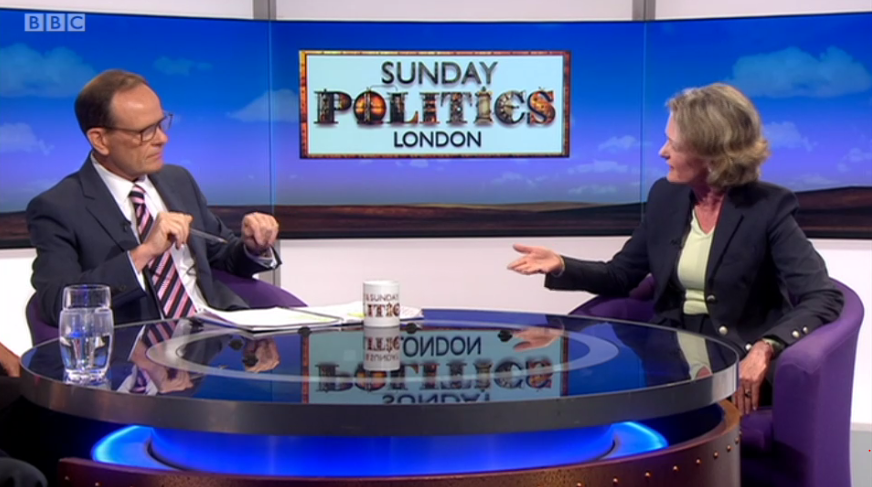
I usually try to post tidy-looking transcripts, but this one is too long and I'm running out of time today. So please find below a transcript of the part of today's London section of The Sunday Politics, hosted by our old friend Norman Smith. 

It's taken straight from TV Eyes, with a few corrections from me. I hope it's still easy to read. The bold bits are Norman Smith speaking. The non-bold bits are his various guests. I've indicated who is being questioned at which point by highlighting their names in red

I haven't marked out the interruptions though, but there were quite a few and you'll easily be able to guess where they came. (Look for the balance of bold lettering and non-bold lettering. The closer they are the more interruptions there were. And the longer the length of the non-bold lettering the more the interviewee got to make their point). 

This is for those of you here at ITBB who know a lot more about this than I do and will be able to spot any bias (or lack of bias) much better than me here.

So, dear reader....

Was Norman Smith as factually mistaken about everything as Elizabeth Campbell, from Kensington and Chelsea Council, implied in her often incredulous-sounding responses to his accusatory ('accuse-a-Tory'?) questions?

Did Norman go way too far for a BBC journalist in suggesting that Mrs May "misled" Grenfell survivors (i.e. lied)?

Did Norman's questioning of his two Labour guests provide proper balance? Was he as tough with them as with his Conservative guests? 

Here then is the transcript:


Joining us now is Elizabeth Campbell, from Kensington and Chelsea Council, who took over as leader in the immediate aftermath of the fire. Elizabeth Campbell, your predecessor when he quit, said he was resigning because of the perceived failings of the council. Now, do you think the failings of the council are perceived or real? Well, I think we have to wait for the inquiry. You don't know? Well, soon as I took over as leader the first thing I did was to apologise and to say that actually the council did not cope well enough in the face of an overwhelming national tragedy and I still hold to that. We obviously didn't cope well enough. But as to the details, that's what the inquiry's for. Let me put it to you - the failings are not historic in terms of the immediate aftermath, which many people would say the council failed to get a grip on the situation. They're current in terms of your failure to rehouse residents, and as you yourself promised to do within a year, something like half are still in temporary accommodation. Well, I don't accept that because about 90... But you've broken your promise. You said you would get them... Hold on, let me just finish. 90% of those who need to be rehoused have accepted permanent accommodation now. But the accommodation is not available or suitable. Again, I don't agree. Well, why are they not in the properties then? Because it's complicated. It's very complicated and it's difficult and, you know, having been at the commemoration hearings every day, if you've got a family and you've had the opening of the public inquiry, well, the commemoration hearings for two weeks, then you have the opening of the public inquiry, you've got Ramadan going on at the same time, and yesterday you had the first anniversary. Meanwhile, the children are doing A-levels. When people are ready to move they'll move and we are doing everything we can to support them, help them, to encourage them to take up the flats and properties that are available. Let me put it to you, the facts are against you. If you have a situation where you have 200 or so households and only 80 or so after a year have been permanently rehoused, how in any way can you be satisfied with that? I'm not satisfied with it but I'm saying that it's... There are reasons for it. These aren't just figures that you can just move from one side of the sheet to another. They're individuals and they will have individual reasons. And I'm saying that... Yesterday I was speaking to quite a lot of our staff in the resettlement team, the allocation team, we know everybody, we know them very well. OK, but let's get a sense then, here we are one year on, half have not been put in permanent housing. How long do you think will it be before you will be able to ensure all of them are in permanent housing? Well, I'd just like to pick you up on what you said. You said "When they will be put". It's not a question of us putting them in. Yes, but you know the You know the thrust of my question. Yeah, I do, but I think... I don't think it is about having fake deadlines. But if you are a resident you want to know when you can expect to move into a permanent home. That's not an unrealistic ambition. Well, 90% have accepted it. So when will they actually be in housing which they can go into? They will move when they are ready to move. Well, when you can supply housing that is fit to go in because as you will know there has been criticism that much of the housing you have bought is inadequate, requiring repairs, damp, not suitable for people with disabilities etc etc. Again, I think the story is more complicated than you make out. You know, we went out and we bought 307 properties so everyone would have a choice. Then we have a duty to make sure that those properties are absolutely the best they can be, whether that's from fire regulation, whether that's from gas, whether that's from electricity. If people came to us and said, "Actually, I don't want to have gas in this flat." We'd say, "Fine, OK, we will change it." This is about getting homes for people. It's not just properties. I understand it's complicated... And if people want to say to us, "OK, I'd like a new kitchen, or I'd like a different tile, or I want to change that carpet. You seem to be suggesting that somehow it's the residents who are the problem, that they're too picky and finickity about what they want. No, I haven't said that. I've said... You're saying if they want a different kitchen... I don't think that's being picky. I think if you've lost your home, I think that's fair enough. All right. All I'm saying is that we're doing absolutely everything we can to make sure that, you know, having lost everything that they can have a home that they wish to move into. OK. But if you are a resident you would accept that you would want to have some sort of timeline in which you would feel confident that your family could move into permanent housing. Can you give them any reassurance that by the end of next year or whatever this will be sorted? 90% have accepted their flats. You're not answering the question. I think I am. Because you're trying to say that it's their fault. If I'm a resident I would want to know when I can move into permanent housing - confident that I'd be able to get into it. You can move in when your flat is ready. 90% are ready to move into as well. So, the flats are there. It's up to us to try and encourage people, to support them. Having been to the commemoration hearings, having been to the services yesterday, imagine it was you, imagine you've been married 30 years and you've lost your wife and you're going out buying, I don't know, towels or things for your flat and you're moving in on your own. That's quite a difficult... Let me... Bob Blackwell, let me bring you in. I mean, Theresa May her record too does not stand close examination does it? Because in the immediate aftermath she said, "Don't worry, you will all be permanently rehoused within three weeks." I mean, what a preposterous thing to say! Well, I think Theresa as Prime Minister has apologised. Not for that. Not for that. Not for that. She's apologised for her reaction in the immediate aftermath. In the immediate aftermath. But not for misleading residents about when they would be rehoused. But I do think that we have to empathise with the survivors of this terrible tragedy. We have to remember that they've lost absolutely everything. I understand that. They literally walked out in the clothes that they were wearing and everything else is gone. Now, when you're under those circumstances I don't think there's any council in the country that could have coped with that. Do you think Kensington handled it well? No, I don't they handled it well but I don't think any council in the country could have handled it well. Can I suggest... What I do think is important, however, is that we've got to give the survivors both the appropriate amount of time to grieve for the ones they've lost, and also to get a settled home, which they can call home after their recovery. The point is that we cannot ask the council or the Government to force people to go into homes. But can I suggest to you...? They've got to be offered a home that is suitable for them that they will then be able to regard as home. I don't think you can fix times. All right, but can I suggest to you, there is an obligation on political leaders in the aftermath of such a tragedy to be honest, to be candid with the sort of scale of reconstruction, and time that will be involved? And I would suggest to you that Theresa May, in effect, misled residents by giving them false expectations of when they could expect to be rehoused. And the Government has continued to do so. We have had quotes from Sajid Javid saying - you will be in by Christmas. I mean, that actually is unfair on the residents. Well, I think the clear point here is that the most important thing was that properties were being offered by the council, with assistance from the Government, for those residents to move in. Now, if they felt that those properties were not acceptable to them, they were either in the wrong place or the wrong type, and they rejected them. I think the figures are something like 866 offers made by the council to the 203 households. OK, let me... If that is the case, a lot of those residents have said... It depends what they are being offered. .."Thank you for the offer but it's not acceptable." OK, let me just bring Clive Efford in. I mean, the response of Jeremy Corbyn, too, is questionable, isn't it? I mean, he politicised an already utterly devastating and fraught circumstance for the residents by suggesting that somehow this was the consequence of austerity - the fault of the Government. Well I think that... I mean, clearly this is a... ..as a result of a local authority that quite frankly refused to listen to its local residents. That's not... Hang on a second. These people were disenfranchised. But on this question of austerity, Jeremy Corbyn blamed it on austerity. They are a disenfranchised working class community in a Conservative Borough that disregarded them. And there is no getting away from this. This is a council that couldn't even pick up the phones the following day to answer the calls from other local authorities who were offering assistance. I mean, it was a disgraceful state of affairs. Do you see this... But just let me finish because you've made that accusation. And also the standard of the work that was done on that block, we can only wait for the outcome of the inquiry and police investigations, but I think we all know what the answer to that is going to be. So I think it's wrong to suggest that Jeremy Corbyn politicised this. OK, OK. Now let's hear from the local MP for Kensington, Labour's Emma Dent Coad. The council has to accept that they can't deal with it. They don't have the capacity to deal with it. And they have made some huge errors. They must either invite the Government in to help them or the Government send in commissioners now. They need expert help now to deal with this. The council has made some terrible mistakes by buying the wrong kind of housing for the right kind of people. And this has to be dealt with. Otherwise, people continue to languish in hotels. Trust me, I've been in some of those hotel rooms. You don't want to be in a Premier Inn for a year. Joining us now is James Murray, the Mayor's Deputy Mayor for Housing. James Murray, what on earth has Sadiq Khan been doing? He seems to have been invisible throughout all of this. Right from day one, Sadiq was down there meeting people affected in the local area. What has he actually been doing? Whilst he was out there meeting people who were affected, his team, me and the other people at City Hall were there helping out with the local council, with the other councils who were drawn in to help out, the Government and so on. People from City Hall were seconded to help out with the response effort. And over the last year we have put money in to helping Kensington and Chelsea to buy replacement social homes. The Mayor has launched a fund to help local businesses. The mayor has secure an extension for people who are survivors trying to secure indefinite leave to remain. So, there's been a lot of ways in which the Mayor has been involved The Mayor has also, I think, really found it important to to keep up the pressure on the Government and the council to make sure they don't continue to let down residents. OK. Elizabeth Campbell, have you found the assistance of the Mayor's Office useful? Well, I certainly haven't had any personal contact from Sadiq Khan at all. No personal contact at all? No. But, you know, fair enough... Well, there we are, James Murray, here you have the leader of the Council on the front line of this issue, haven't even heard from you. I don't want to make it too personal here. It's not personal, it's just, are you actually in contact with them? Elizabeth and I have had a number of meetings together. That's fair enough. I've had meetings with her and with her cabinet member for housing both in Kensington Town Hall and at City Hall. Sadiq has been out there being visible right from the very beginning, meeting people, making sure that he's a leader in the local community. There's a broader issue in terms of tower blocks in London. Why doesn't the Mayor issue some sort of instruction, guidance, ultimatum, call it what you will, to say - no more cladding on the side of tower blocks, and that cladding that is there in London should be removed? Because at the moment it seems a lot of tower blocks have still got this cladding. So, let's be really clear the difference here between the Mayor's planning policies, which he has responsibility for, and building regulations which are national regulations. And the Mayor has been absolutely clear the Government needs to get on and issue new building regulations that people can have full confidence in to make sure they ban combustible materials. That they say sprinklers should be mandatory over 18 metres. To say, let's ban desktop studies. The Mayor has been very clear that building regulations need to be updated by Government as quickly as possible to give people that confidence. In the meanwhile the Mayor has some control over planning policy in London and what he set out there in publishing his new draft London plan is a way in which planning policy can ensure higher standards of fire safety. Can you explain this, which I genuinely don't understand, why have tower blocks got flammable cladding on the side of them? That would seem barmy to me. The Mayor has made very clear that he thinks that the combustible material should be banned. As someone who is involved in housing, can you tell me why on Earth it was put on in the first place? There has been a system of building regulations and building control which has not been fit for purpose for some time. And so what the Government needs to do is make sure that all those existing buildings are made safe and to make sure the building regulations for the future are regulations that we can have full confidence in. OK. Bob Blackman, when we had this review, the Hackitt Review, published recently, which seems to have caused more confusion than illumination, saying we don't need to get rid of the cladding. The Government has to act on this? Absolutely. And I think that both the previous Secretary of State and the current Secretary of State have made clear that the desktop studies are going to be either barred completely or very much minimised in terms of their impact. One of the problems we have to face in these tower blocks is, of course, that the reason for the cladding being put on is because of leakage and also the fact that these blocks are often very cold. That's one of the reasons why this was put on. Unfortunately, one of the problems here is to assess at what level materials are combustible. Clearly, we've got to look at what the inquiry says and what the outcome is. The regulations I'm afraid have been neglected by governments for 20 years or more and need to be completely updated. Clive Efford, you touched on this a few moments ago but I want to ask both of you. Do you regard what happened at Grenfell as, in effect, a modern morality tale? About how the poor, the disenfranchised, are treated by those in power? We haven't got much time. Yes, I do. And I think in the aftermath of Lakanal and the report from Lakanal there is no justification for that cladding having been put on that block. Bob Blackman? I think we've got to review this to make sure this never happens again but it could unfortunately have happened in any of the boroughs, which have these high-rise blocks. That needs to be put right urgently so that people don't suffer such a terrible fate anywhere ever again. And, Elizabeth, do you think it is, in effect, a modern morality tale? I think that, as Bob has said, it's something that could happen anywhere. We weren't unique and we just have to be really open with the inquiry. We need to find out what happened. And we just need to make sure that it never, ever, ever happens to anyone else again. Well, that's all we have time for. My thanks to Elizabeth and James, and, of course, to Clive and Bob. And with that - it's back to Sarah. 

Tuesday, 17 October 2017

Norman Smith, sadly


Our Norm

This lunchtime's BBC One News at One featured the following exchange, with the BBC's assistant political editor Norman Smith letting slip a word he ought not to have let slip:
Sophie Raworth: Let's talk to Norman Smith, who is in Westminster. Well, we've got the OECD, the international think-tank, saying that a second referendum would have a positive, a significant effect on the UK economy if it reversed Brexit. That's not a realistic option though, is it?  
Norman Smith [shaking head]: Sadly not now. Mr Hammond has already said this lunchtime it's not happening and, to be honest, even the most optimistic of Remainer would probably concede it's about as likely as the Loch Ness Monster putting in a surprise appearance. At least for now. 
'Sadly', eh, Norman?

Saturday, 18 March 2017

Tally-ho!


Norm in full flow

This week's Newswatch began with an interesting complaint, prompted by a characteristic piece of arm-waving hyperbole from the BBC's Norman Smith:
SAMIRA AHMED: First, how significant is it in news terms when politicians listen to criticism and rethink controversial decisions? On Wednesday the Prime Minister announced the scrapping of the plans announced in the Budget to raise national insurance payments for millions of self-employed workers. Norman Smith described this "u-turn" to Sophie Raworth like this:
NORMAN SMITH: Sophie, let's just get this in perspective of grand government u-turns: This is a full-blown, howling, screeching, Italian Riviera, hairpin-bend, smoke-bleeding-from-the-tyres sort of u-turn! In terms of the speed, just seven days ago Philip Hammond announced this tax rise. And the scale of it! It is a complete abandonment of a key tax rise. Not a tweak, not a nudge, not a review - it's out the window!
SAMIRA AHMED: But some of you thought there was too much relish and shock over a simple change of mind, including Robin Petherbridge: 
ROBIN PETHERBRIDGE: Politicians get all excited about policy u-turns because they love finding fault with each other. You people in the media love them because you have the same mindset, and also you can't resist a bit of conflict. But most of us are actually quite happy when politicians admit they have made a mistake, and take action to correct it. It would be good if your reporting could better reflect the mindset of the public, rather than that of politicians.
I'm not quite so sure about this one. 

Robin Petherbridge clearly has a sensible 'real world' point. We surely do all like people who change their minds when they get something wrong, and a politician who changes their mind in such circumstances might be regarded in a positive light by many ordinary voters - if they are perceived to be doing so with good grace.

But the media and politicians and enthusiastic followers of party politics all love a good 'u-turn' story, and have done for since time immemorial. To try and convince them that a 'u-turn' is a sign of something good (individually, politically) is surely a lost cause. It's always a sign of weakness to them. It's the smell of blood. The pack always rides out in full force, and the reporting (including the BBC's reporting) inevitably has a strong 'Tally-ho!' flavour about it - as with Norman Smith's highly excited contribution here. 

I don't think I'm too bothered about that though. Should I be? Does it matter? Does making politicians feel deeply unwilling to change their minds do harm or good to our political system?

Saturday, 11 March 2017

Was the BBC biased over the Budget?


The pressures of extra hours at work (employed not self-employed) has kept me away from the blog for a few days (have I missed anything?), so it's 'catching-up' time again...


The Budget has been the big domestic news story of the week. My Twitter feed showed that something remarkable had happened when hordes of right-leaning tweeters were pouring derision on Philip Hammond for his NICs rise on the self-employed while a few prominent left-leaning tweeters were advising others on the Left to consider that Mr Hammond was actually doing something 'progressive', something they could and should approve of.  

The BBC's News at Six on Budget Day opened with the following strongly-angled headline:
The Chancellor's Budget .2.5 million self-employed people will pay higher National Insurance contributions. That's despite pledging not to raise National Insurance in the party manifesto. But Mr Hammond says his Budget promises a better future. An extra £2 billion is found for social care in England to be spent over the next three years. We'll be looking at the impact of today's Budget and how it could affect you.
BBC bias? Fair comment? I'd go for 'fair comment' here. It's the angle everyone else seemed to be leading with and 'everyone else' was calling the Chancellor out of that too (and, if I'm expected to give opinions, I'll add 'And quite right too!' on the manifesto point).

The loudest accusations of bias against this bulletin came from the Left, especially for John Pienaar's opening report, which Corbynistas accused of being 'pro-Tory' and 'anti-Corbyn' - especially for highlighting the mockery at Mr Corbyn's expense and for saying that Mrs May "rightly or wrongly, seemed to see Labour's leader as a bit of a joke". 

(Was that biased? Or was it balanced? I can't make up my mind. It's certainly a striking turn of phrase.)

Here, for the record, is John Pienaar's report - or at least his parts from it. Please judge for yourselves whether they constitute pro-Tory/anti-Corbyn bias or not:

  • Chancellors always hang around in the street on budget day. But Brexit, a bit like the weather, turned out nicer so far than the forecasters expected. He had more spending power thanks to higher growth and lower borrowing. But Brexit will not be a smooth or quick journey. Not that he is too worried about his Labour opponents. Here at Westminster, as the time came round towards the Budget, his boss, rightly or wrongly, seemed to see Labour's leader as a bit of a joke. And more than just a bit. And the Chancellor allowed himself to keep the tone upbeat.
  • They call him Spreadsheet Phil, businesslike, proud to be boring. So, no spending sprees. But we would have higher bills to pay and, for millions, that meant higher taxes, on company owners, who pay themselves in share dividends, and a hike in national insurance for the self-employed, though the Tory manifesto did promise to keep National Insurance down. 
  • On National Insurance, there is a tax hike for the self-employed. Their national insurance contributions will go up to 11% in 2019. The Chancellor says this will help raise £145 million. Other changes raise much more. But some Tories are unhappy. Paying for social care is now an urgent problem and the Chancellor had promised MPs he would find cash to buy more time. 
  • For social care, there'd be an extra £2 billion over three years, with £1 billion available in the next year. He said the long-term funding options would be announced, but what he called Labour's death tax on estates was ruled out. Companies, including pubs, are being hit by higher business rates after revaluation and that's worried MPs and forced the Chancellor to pour out a little comfort. 
  • So to ease the burden of business rates, local councils will be given £300 million to help the worst hit. No small business losing rate relief will see their bill increased by more than £50 a month. There would be a £1000 discount on rates for but, with a rateable value of less than #100,000, 90% of them. Getting Britain fit for Brexit meant cash for new schools, grants for technical education and spending on technology and science. Cue another joke at the expense of Jeremy Corbyn. He didn't see the joke at all. But the Chancellor was into his stride and feeling upbeat. Mr Corbyn had his counterattack ready: The Government was failing in its own ambitions. 
  • Extra money for Wales and Scotland, meant to cement the case for the union, was never likely to head off nationalist condemnation. 
  • A strong backlash then for a relatively small-scale Budget. But fierce controversy is normal now, on Britain's long march to Brexit.
*******

And now for Norm.....


The other 'big thing' I noticed about the Budget was Norman Smith's characteristically hyper Twitter commentary.

Here, in reverse chronological order, are Norm's tweets as the Budget proceeded.

If the jury's still out on whether Jon Pienaar was making particular points there, there's no doubt whatsoever that Norman was most definitely trying to make a point here.

Now, many (including me) would agree it's a valid point Norman Smith was plugging away at so relentlessly here, but was he doing so for purely journalistic reasons or was he displaying 'anti-Tory bias'?

(He was certainly being opinionated. That's for sure!)

Again, you decide!

  • "People who are the backbone of the Conservative party - the aspirational working class - are being hammered." - @TheLTDA
  • Cabbies lash out at Hammond NICs rise. "We're being hammered" - @TheLTDA
  • For the avoidance of doubt. Tory 2015 manifesto....
  • Treasury seem completely blind sided by broken manifesto row. Looks like their political antennae gone seriously wonky. #Budget2017
  • This is a Govt committed to its manifesto say Treasury. #Budget2017
  • Self employed hit by NICs tax rise will be £240 a year worse off #Budget2017
  • One and a half million self employed to be hit by govt NICs tax rise #Budget2017
  • Methinks...Bottom line is Tory election manifesto broken on NICs. End of. #Budget2017
  • Treasury sources say tax lock legislation AFTER election did not exclude NICs tax rise ...! Er..so Tory manifesto doesn't matter ?? 
  • Increase in NICs tax for self employed is "a fairness argument" say Treasury sources #Budget2017
  • Nics tax rise designed to avoid loss of revenue in future as more people opt to work for themselves #Budget2017
  • Nics tax changes for self employed raise around £200m . #Budget2017
  • Im guessing £ 2 billion for social care cd come from local council savings #Budget2017
  • Chancellor promises extra two billion for social care. But where does this extra cash come from ??? #Budget2017
  • From where I'm sitting 2% rise in NICs for self employed is breach of tory manifesto pledge not to raise direct personal taxes. #Budget2017
  • Two per cent rise in national insurance for self employed #Budget2017
  • Tax rise Claxon. Whoop. Whoop. National insurance tax rise for self employed #budget2017

Friday, 27 January 2017

#SoFar


It looks as if #DespiteBrexit might be about to be displaced by #SoFar. This tweet from the BBC's Norman Smith, for example, comes from deep inside the #SoFar camp: 


As did Kamal Ahmed's report on last night's BBC One News at TenYes, the economic news has been good and the experts confounded but there's still what Kamal called "the shadow of Brexit". 

And, spoken with a dying fall, his report ended with these ominous words:
The nation of shoppers forges on. Britain's growth last year was the highest of any of the major Western economies. Are we still waiting for the full Brexit effect?
Update: Kamal Ahmed's blog post on the same subject is open for comments. The top-rated comments are all making similar points. Here are the Top 5 comments:

  • If there had been no Brexit vote and no US election, you'd have been praising the British economy and saying how strong it was. Your article is based entirely on the presumption of pain based on these two events as predicted by those who wanted a different result.
  • Here we go again-BBC watering down the good news and moving the goal posts. Pre-Referendum, we were told there would be emergency budgets, instant recession, all sectors would suffer etc. Virtually every prediction made by Remain before the referendum has proven wrong yet, ironically, Brexit is still accused of misinformation! Things are on track for Team GB. More than can be said for the EU!
  • Pain? What pain? We are now at the start of a long and exciting journey of discovery with all the indicators being in the right direction after years of floundering in the sticky morass of EU red tape. Long may it continue.
  • At some point the economy will take a dip. The economic cycle. This will be global factors and not Brexit. Please BBC give it a rest.
  • I, for one, am sick and tired of hearing Ahmed's and the BBC's negative, anti-British, pro-EU, and totally biased reporting. As Ahmed said: "And, of course, confidence tends to beget confidence" - and, so does pessimism beget pessimism! The true British character is to be optimistic and get on with the job.

Friday, 13 January 2017

Methinks


Methinks he probably thinks he's being impartial there. Methinks others won't have seen it like that.

Should Norm, the BBC's deputy political editor, be methinking out loud like that anyhow? It's a hot political issue, so why is he sounding off like a blogger about it at Mrs May's (and the licence fee payer's) expense?

Of course, he could very well be right on both points. But, methinks, that's not the point. 

Monday, 25 July 2016

Out of the shadows

Norman Smith got very excited today. He couldn’t fathom why Sarah Champion MP (Lab) has written to Jeremy Corbyn to unresign and Jeremy Corbyn has accepted her unresignation. She’s to get her old job back on the front benches. What was her role again? The MP for Rotherham was shadow home office minister for preventing abuse and domestic violence.” 

That appearance on the Victoria Derbyshire show must have whetted her appetite for more of the adulation to which she has become accustomed. 


Norman Smith thought her mysterious capitulation would herald an avalanche of returning MPs, as in the domino effect. Someone had compared the Labour Party’s resignees to the striking miners. Norman Smith thought the miners’ strike had lasted about a year, whereas Ms Champion’s spell in the sidelines has only lasted for about two weeks. 

Wot no Flying pickets? Now that Corbyn looks set to stay indefinitely, deciding to ‘blackleg’  looks like a good career move. Get in quick so no-one else can nick your seat.. 
Sarah Champion is campaigning about raising awareness of bullying and online abuse, which is all very well. But it’s a bit like protecting synagogues rather than addressing antisemitism. Shouldn’t Ms. Champion prioritise raising her male constituents’ awareness of the modern, British, enlightened attitude to girls and women?

Talking of child sexual abuse, the BBC is to dramatise the Rochdale abuse scandal.

Filming begins this week on Three Girls, a new three-part BBC One drama based on the true stories of victims of grooming and sexual abuse in Rochdale.The drama will look at the way in which these girls were groomed, how they were ignored by the authorities directly responsible for protecting them, and how they eventually made themselves heard. A BBC Studios production in association with Studio Lambert, Three Girls is made by the team behind the multi-award winning BBC drama Five Daughters. 
Maxine Peake (Silk, A Midsummer Night’s Dream) and Lesley Sharp (Scott And Bailey, Capital) will play two women who were instrumental in getting the girls’ voices heard.Other cast includes Paul Kaye, Lisa Riley and Jill Halfpenny as parents of the girls, alongside Ace Bhatti as Nazir Afzal, former Chief Crown Prosecutor for the North West. They will be joined by Olivia Hill, Ria Zmitrowicz, Molly Windsor, Simon Nagra, Qas Hamid and Wasim Zakir. 
Written by Nicole Taylor (The C Word), Three Girls is produced by the same team as the acclaimed and award-winning BBC Drama, Five Daughters including director Philippa Lowthorpe (Call The Midwife, Jamaica Inn), producer Simon Lewis and Executive Producer Susan Hogg.

I can’t imagine hard leftie, pro-Palestinian Maxine playing anything other than a passionate Social Justice Warrior. It will probably be all about the struggle against those heartless authorities who wouldn’t listen. Not about the grooming gangs with a warped attitude to females.


Saturday, 2 July 2016

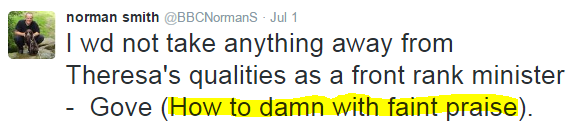
Is Norman Smith the BBC's "main pro-May, kill-Gove voice"?


Charles Moore on the BBC's Norman Smith:


I don't know if that's fair or not, as I've not caught Norman Smith's reporting in the past couple of days or so, but Norm's Twitter feed (which he uses as an important part of his BBC reporting) does show quite a striking difference in treatment between Mrs. May and Mr. Gove.

Compare and contrast and see what you think:

About Theresa May:


About Michael Gove: