Showing posts with label BBC 'News at Six'. Show all posts

Saturday, 20 August 2022

Mark Easton gets it wrong again


And talking about the BBC getting its facts wrong...

As Arthur T notes on the open thread, blog favourite and arch-BBC narrative setter Mark Easton has been rebuked again by the corporation's Editorial Complaints Unit.


BBC News (6.00pm), BBC One, 12 April 2022
18 August 2022

Complaint

In a report on the Prime Minister receiving a fine for breaching lockdown restrictions the BBC’s Home Editor said:

Now each one of those Fixed Penalty Notices requires the police to believe that a criminal offence has been committed. Now it doesn’t go on anybody’s criminal record but it will go on the Police National Computer.

A viewer complained that this was incorrect, as breaches of lockdown restrictions incurring a fixed penalty notice were non-recordable crimes. The ECU considered the complaint in the light of the BBC’s editorial standards of accuracy.

Outcome

The Home Editor acknowledged that he was mistaken in saying the offence would be recorded on the Police National Computer. As the error could have misled viewers as to the seriousness of the offence, the ECU accepted that it was a breach of the relevant editorial standards.
Upheld

Further action

The finding was reported to the Board of BBC News and discussed with the programme-makers concerned.


As ever, beyond being published on a part of the BBC website very few people read [and being picked up by the odd newspaper], what is the BBC doing to make this known to BBC viewers who might have been misled? A prominent apology/correction on BBC One's News at Six?

I've scanned TVEyes to see if any apology/correction has been broadcast on BBC One since this ruling was published two days ago. You won't be surprise that it brings up no results.

Note also that it took four months and an escalation to the ECU to even get this. The BBC's complaints process isn't fit for purpose.

You really do have to watch them like a hawk.

Sunday, 31 July 2022

Priorities


As discussed on the open thread, here's the running orders of the main BBC One news bulletins since Friday...

Friday News at One
1. 'Wagatha Christie' trial
2. Fatal stabbing of a nine-year-old girl in Lincolnshire

Friday News at Six
1. 'Wagatha Christie' trial
2. Calls for compensation in blood scandal
3. Fatal stabbing of a nine-year-old girl in Lincolnshire

Friday News at Ten
1. Commonwealth Games
2. Calls for compensation in blood scandal
3. 'Wagatha Christie' trial
4. Cost of living
5. Ukraine War
6. Fatal stabbing of a nine-year-old girl in Lincolnshire

Saturday 1pm Weekend News
1. Train strikes
2. Fatal stabbing of a nine-year-old girl in Lincolnshire

Saturday 5pm Weekend News
1. Train strikes
2. Fatal stabbing of a nine-year-old girl in Lincolnshire

Saturday 10pm Weekend News
1. England women's football final the next day
2. Fatal stabbing of a nine-year-old girl in Lincolnshire

Saturday, 9 July 2022

The BBC bending the truth again


As I posted on Tuesday, it took 36 minutes from the news of Rishi Sunak and Sajid Javid's resignations breaking on the BBC News website for BBC One's News at Six to 'break' it too. Why? Because the BBC chose to stick with the tennis and postponed the news until 6:18pm. This week's Newswatch featured three aghast viewers. Then Samira Ahmed said:
We asked to speak to someone about the decision to postpone Tuesday's News at Six, and more widely the practice of live sports events displacing scheduled news bulletins, but our invitation was declined. Instead we were given the statement.
It's the statement itself that particularly struck me:
We understand scheduling changes can be frustrating and we don't take these decisions lightly. We always try to minimise disruption but during times of live tournament sport, like our extensive coverage of Wimbledon, we do make occasional changes. Cameron Norrie was the first British man in a Wimbledon Quarter Final since 2017 and we wanted to capture that moment live on BBC One. We switched to the News on BBC One as soon as news of the resignations broke and extended our coverage on the channel as a result. This is a balancing act and while catering to audiences with such a wide range of tastes and interests, we recognise not everyone will agree with certain changes made.
My problem with that is that it's factually untrue that the BBC switched to the News on BBC One as soon as news of the resignations broke. They did no such thing. They switched 36 minutes after news of the resignations broke - resignations that came 18 minutes before the News at Six should have started. And even then, after breaking away from the tennis - with the match still ongoing - they still put in two adverts (for the BBC) before the News finally began 18 minutes late.

As for and "we wanted to capture that moment live on BBC One", they'd been capturing it live since 4:55pm on BBC One.

Why can't they just own up when they've made a mistake, and stop lying about it too?

Tuesday, 5 July 2022

Break of serve, starring Rishi and Saj


While not watching any of it, I've read so many complaints recently about falling BBC competence when it comes to scheduling and sports broadcasts. 

This afternoon, for example, I read complaints that the BBC was dumping Novak Djokovic and focusing on someone the complainants clearly considered 'a British little-hoper'. 

On both BBC One and BBC Two, simultaneously.

I must admit that my immediate reaction was to think that the BBC clinging onto British hope for 'a British little-hoper' was no great sin, even if they were doubling-up and messing-up across two channels. 

And then came the resignations of Rishi Sunak and Sajid Javid well before 6pm. 

And BBC One continued broadcasting the match featuring the 'British little-hoper', even after their news website had reported the breaking news at 5.42pm, postponing BBC One's News at Six...

...until, with the tennis match reaching a 2-2 situation and a final set yet to play, the BBC realised that they had to bail out and drop the match in favour of the news.

And even then the BBC couldn't simply switch from a tennis match to the news of the Chancellor and Health Secretary resigning. Immediately after finally, sensibly, cutting away from the tennis match to tell the news - albeit half an hour too late - they still felt they had to put out their usual string of self-promoting adverts. 

Here BBC One viewers had to watch an advert for a BBC Freddie Flintoff series about underprivileged kids and a plug for the BBC's One Show featuring something about Doctor Who between the cut-off from the tennis at 6.17pm and the very late arrival of the News at Six a minute or so later. 

Some immediate reaction:
Alastair Stewart: Extraordinary BBC decision to have delayed the news for the tennis, given the lead story...

Simon McCoy: Lots of jobs suddenly available. In politics. And BBC scheduling.

The BBC is too big and bureaucratic. It can't react quickly enough, even when their news department must be feverishly chomping at the bit to finally finish off Boris [Johnson, not Becker].

Saturday, 18 June 2022

Is the c-word highly controversial?


Costing some £5 million, the BBC's highly controversial News at Ten/News at Six studio revamp, aimed at attracting a younger audience, was the main topic on this week's Newswatch as viewers objected to the cost of it - especially as it was carried out at the same time as the BBC has been pleading poverty and making cuts.

By describing it as 'highly controversial' there, I was of course trying to make it look bad.

As regulars will know, I've long had a bee in my bonnet about the BBC's used of the c-word. 

Now, sometimes 'controversial' can be used to describe something that is indeed 'controversial' - i.e. with an air of objectivity - but it can also be used as a negative label to predispose an audience against something or someone - i.e. in a biased fashion.

This week, the man on the new highly controversial BBC curved catwalk himself, Huw Edwards, presented Wednesday's News at Ten and read out a bit about the government's Rwanda plan, saying that “the UK Government says it remains committed to its highly controversial plan of taking some migrants to Rwanda”. 

So not even merely 'controversial' but “highly controversial”. 

If he had said 'the UK Government says it remains committed to its plan of taking some migrants to Rwanda', would that have less impactful? 

It would certainly have told us the news, shorn of any suspicion that “highly controversial” was being used there to convey a partial point of view, that the Rwanda plan is a bad thing.

At least the BBC are consistent. Using TVEyes to look back to the News at Ten on the day the Rwanda deal was announced in April [the 14th], the newsreader that day - I'm assuming Huw - described it as “a highly controversial change to UK immigration policy”.

Am I right to have such a long-lived bee in my bonnet about this? Is it the BBC casting the Rwanda plan in a bad light through its use of a negative term?

Friday, 25 March 2022

Edits, fake news and BBC misreporting


That people on Twitter - especially anti-Brexit people - would put out and spread a 25-second clip 'showing' Boris Johnson looking isolated, a 'Billy-no-mates' at yesterday's EU/G7 summit despite longer videos of the event showing no such thing is, well, just typical of Twitter. Twitter partisans are not always noted for their fairness, or honesty. Where it becomes serious is when the BBC's main news bulletins spread this 'fake take' too.

Sarah Smith, the BBC's new North America editor, was one of the guilty parties yesterday.

On yesterday's BBC One News at Six, while a 6-second edit showed Boris 'standing alone' as others greeted each other, she said:
This show of solidarity is why President Biden's here. With the Nato chief and over 30 other world leaders to display the unity they believe is their strength. Although Boris Johnson looks remarkably isolated, even as the Kremlin crowned him the most active anti-Russian leader.
But she cannot take all the blame for this as that bulletin has editors, especially as they allowed her to broadcast the same brief misleading clip on the News at Ten too and say:
Boris Johnson looked a little isolated but remains in step with allies over Ukraine. Everybody wants peace, including the United Kingdom.

A lot of complaints seem to be going in to the BBC about this. And rightly so. 

Here's are two longer videos disproving Sarah Smith and the BBC's misinforming take:

Saturday, 12 February 2022

I hear you're a racist now, Mr Coyle


The suspension of Labour MP Neil Coyle yesterday is receiving the kind of low-key BBC reporting we'd expect. 

The story appeared on BBC One's News at One and News at Six but not on BBC One's News at Ten. On both News at One and News at Six it was treated as a minor story, getting just 18 seconds on each bulletin.
 
The News at One version lacked detail:
The Labour MP Neil Coyle has had the party whip suspended, following allegations that he made racist comments to a journalist on the Parliamentary estate. Mr Coyle said he was "very sorry" for his "insensitive comments", which politics reporter Henry Dyer said made him feel uncomfortable in his place of work.
And the News at Six barely added much more:
The Labour MP Neil Coyle has been suspended from the party following allegations he made racially insensitive remark in a bar in the House of Commons. Mr Coyle says he's very sorry for his insensitive comments, which were reported in a formal complaint by a journalist who's of British-Chinese heritage. 
This morning's BBC Breakfast has been giving it 24 seconds:
The MP Neil Coyle has been suspended by the Labour Party after allegations he made racist comments in a House of Commons bar. The member for Bermondsey and Old Southwark has apologised for what he called his "insensitive behaviour" when talking to a political journalist of British-Chinese heritage. Mr Coyle said he wants to "re-prove" his Labour values and be readmitted to the party in due course.

Another interesting aspect of the reporting of this story is how the BBC has sensitively avoided mentioning, or even hinting at, the "racial stereotype" Mr Coyle is said to have used - Sax Romer's Chinese supervillain Dr. Fu Manchu. Other broadcasters mentioned it. 

And the BBC's online report went through 6½ hours and seven edits before finally getting the name of Mr Dyer's employer correct. 

For trivia fans, here's Wikipedia's list of who's play Fu Manchu in film. It's an intriguing list:

Harry Agar Lyons, Warner Oland, Boris Karloff, Lou Marcelle, Henry Brandon, John Carradine, Glen Gordon, Christopher Lee, Peter Sellers and Nicolas Cage.

Saturday, 5 February 2022

A Saturday Selection


I've been a bit out-of-action recently, but here are a few things I noted down this week:

I

Never mind Partygate. Sue Gray and Dame Dick need to investigate the Foreign Office for blowing lots of licence fee payers' money on a sparkling farewell party for departing BBC North America editor Jon Sopel. 

That's reported by Steerpike at the Spectator. 

You'll find beneath his piece this comment from former Harry's Place regular Lamia which will doubtless strike a chord with many of us:

Sopel spent the four years of Donald Trump's presidency Tweeting his disapproval of Trump and his Tweets, helping keep the humble folk of Broadcasting House and North London in a permanent state of gratified superior outrage. Once Joe Biden got into power, Sopel and the BBC simply lost interest in reporting about the US President, except what flavour of ice cream he likes. Sopel is a worthless journalist, let alone a journalist for a supposedly impartial broadcaster, because his personal and political biases have infected and dictated everything he reports (and everything he doesn't report about). Not only should he not be the BBC's political editor - if the BBC had any standards (yes, we know it doesn't...) then he would have been sacked years ago. So obviously he's a shoe-in as BBC political editor.

II

Rod Liddle probably ought to hang up his satirical spurs because BBC reality is outpacing him faster than the winner of the Kentucky Derby. A Guardian exclusive reports that the BBC is preparing to broadcast a new take on Dickens's Oliver Twist that will “make a conscious effort” to put food poverty “to the fore” and echo footballer Marcus Rashford’s campaign to reduce child hunger. Very BBC.

III

The BBC is celebrating what they call “a hundred years of our BBC” and they've released a two-minute campaign video - in response to Nadine Dorries - about how the “BBC belongs to all of us”. As you'd expect,  the last word - “every one of us” - goes to Sir David Attenborough and the whole party political broadcast on behalf of the BBC ends with the caption, “This is our BBC.”

The estimable Lance Forman responded:

If the BBC belongs to me - Please can they release the Balen Report which examined anti-Israel bias at the BBC. The BBC have spent circa £500,000 to keep this covered up. With antisemitism rampant there is a public interest in releasing this. Transparency belongs to us all!

IV

The BBC's world affairs editor John Simpson pompously gives us “a reminder”:

Just a quick constitutional reminder for the BBC’s 100th anniversary: it belongs to the people of the UK. It doesn’t belong to the government. And, contrary to what the current Culture Secretary seems to think, it isn’t state-funded.
It may not be, but it still drags thousands of reluctant viewers through the courts.

V

As Paul Homewood notes, BBC Future has a piece by some white woke guy called Jeremy Williams headlined Climate change divides along racial lines. Could tackling it help address longstanding injustices? The pasty-faced gentleman in question has a book out too, Climate Change is Racist: Race, Privilege and the Struggle for Climate Justice, thereby evidently making him absolutely irresistible to the BBC. I'm not sure I was even aware of BBC Future. The BBC has no many tentacles it's hard to keep track.

VI(a)

I see some people on Twitter have been complaining that BBC One's main new bulletins gave mere seconds to the jailing of former Labour peer Lord Ahmed of Rotherham for paedophilia last night. Indeed, News at Six gave the story 17 seconds and News at Ten gave the story 13 seconds. It beggars belief.

VI(b)

It remains a telling fact that Newsnight has still never covered the Barry Gardiner/Chinese Communist Party influence story or that their policy editor Lewis Goodall, despite being a hyperactive Twitterer, has never tweeted about it either - despite the CCP's influence on the UK being one of the biggest new stories out there. I put it down to bias. 

VII

Wagner's Ring cycle lasts 17 hours and runs for over four days. In it the bronzed Valkyrie Brünnhilde disobeys the Director-General of the gods Wotan, ensconced in Valhalla House. The weak Wotan, despite Brünnhilde's flagrant disregard of Valhalla editorial guidelines, merely slaps her wrist by giving her a talking-to and then sentences her to a good night's sleep on a luxury bed surrounded by fire. The dragon-slaying idiot Siegfried awakens her with a kiss and an embittered, self-righteous Brünnhilde then - after various twists and turns - mounts her mighty steed Grane and, immolating herself in the process too, brings about the fiery destruction of Valhalla House and the godly board. Similarly long-lasting is the BBC's Monologue cycle. In this saga the bronzed Emily Maitlis disobeys pasty-faced chief god of the BBC Tim Davie. Tim Davie weakly slaps her wrist by mildly saying she might, possibly, not have been quite entirely right - and then does nothing more. She disobeys him again. And again. And again. Always playing throughout to her main audience, her fellow Valkyries on Twitter. The Trump-slaying Jon Sopel awakens her with a kiss and she mounts her mighty stallion Twitter and disobeys Tim Davie yet again. So what happens next? Well, if my tortuous Wagner analogy runs on, Emily's biased behaviour will help precipitate BBCdämmerung, The Twilight of the BBC, as Tim Davie sits forlorn in Broadcasting House as everything around him goes up in flames and, amid floodwaters, the Thamesmaidens swim in to take back the BBC licence fee. So is Tim Davie ever going to do something about her? She's making a mockery of 'BBC impartiality' and sneering at her BBC bosses, but I doubt he'll do anything. He doesn't seem the type to tackle BBC bias full on. As BBC TV sitcom Valkyrie Mrs Slocombe was wont to say, he's ''weak as water''. 

VIII

BBC disinformation reporter Marianna Spring has been busy promoting a new 10-part podcast series “investigating the human cost of pandemic conspiracies online in one town, who believes them - and why” for Radio 4 and BBC Sounds. She “will share more details soon!” This drew a sarcastic reply from Peter Hitchens: “Looking forward to this, Marianna Spring. Obviously this is the most urgent lack in BBC coverage of the last two years. But will a mere ten episodes be enough?”

IX

The BBC's diplomatic correspondent James Landale followed UK PM Boris Johnson to a press conference in Ukraine with the Ukrainian president and provoked criticism in some quarters for “making the UK look like a joke” by asking Boris about Partygate rather than Russia-Ukraine. I suspect that as extraterrestrials first emerge from their twenty-mile-long mothership to make contact with humanity for the first time BBC types will be there at the front of the press pack asking about the Sue Gray report. 

Tuesday, 7 December 2021

Transcript - Mark Easton, BBC One 'News at Six', 7 Dec 2021

  
The panel [click to enlarge]

For those who want a transcript for tonight's Mark Easton segment on BBC One's News at Six, here it is. 

According to its polling, [a] 80% said they're concerned about Covid risks to the country, while 18% said they're not concerned, and [b] 63% said we should do whatever is necessary to prevent its spread - ''the highest proportion since the pandemic began'' Mark Easton said - while 21% said controls should be relaxed. 

---------------------------

Mark Easton - Christmas is coming, but so too we're told is Omicron, the latest Covid variant. So after last year's festivities were thrown into disarray by those last minute restrictions, how do people feel about Christmas this year, with case numbers rising FAST once again? We have assembled a cross section of people from across Britain with the help of pollsters IPSOS Mori. 

Mark Easton - Well, welcome one and all. I thought we'd start by getting a sense of how excited or worried you are about Christmas 2021. How you all feeling? 

Man 1 - We cancelled our Christmas dinner last year. There's no way we're going to cancel it this year. We've already bought all the food. 

Man 2 - I'm a little bit apprehensive. The health minister said it's the worst possible time for this current strain to appear. 

Woman 1 - I used to go to a winter wonderland which was all rides and extremely busy. This year I've chosen not to do that because I don't want to expose them to Covid and to ruin our family time over Christmas. 

Man 3 - I live my life now more scared that somebody else is going to impact my family Christmas. I live in fear that I'm going to get that NHS ping. 

Mark Easton - IPSOS-Mori conducted some polling to assess the nation's mood. 80% said they're concerned about the Covid risks to the country. Just 18% say they're not concerned. 

Mark Easton - We don't know how dangerous Omicron is going to be, and I want to know whether you think we've got the restrictions about right, are they too tough, or should we be bringing even more in? 

Man 4 - That is something, I'm quite upset about the fact they haven't toughed up on the masks. 

Mark Easton - So you would like to see even tougher restrictions, Nadeem? 

Man 4 - We have to see tougher restrictions just to make sure everyone else is safe, cos you'd rather me safe than sorry.

Man 5 - For me personally, I think everyone should just judge their own risk in an individual way. 

Mark Easton - You care about your liberties? 

Man 5 - You can't keep locking down, and I look at Europe and some of the restrictions seem quite scary. 

Man 6 - If a new variant comes up, that just means we're going towards being locked down again, so at some point we need to find a way to live with the various variants. 

Mark Easton -  IPSOS-Mori also asked about restrictions. 63% said we should do whatever is necessary to prevent spread and reduce deaths, the highest proportion since the pandemic began. 21% said controls should be relaxed. 

Woman 2 - I think people have lost respect and if you've lost respect, you've lost us. 

Mark Easton - What did our panel think about those rumours of a Christmas party in Downing Street last year? 

Man 3 - Now I completely believe about the party that the politicians had, because it's one rule for them, as we saw early on last year with the visit to the castle, and another rule for us. 

Woman 1 - Yeah. We have to wear masks, but they don't wear masks in Parliament. It is not a big deal. At the school gates. But I think it would be a disaster if the schools closed, so...

Woman 3 - For me wearing a mask isn't a big deal. At school gates. Yeah, I think it would be a complete disaster if the schools closed. That would be my biggest fear if everybody goes crazy at Christmas.

Mark Easton -  Well, thank you for your thoughts. And however you end up spending it, I wish you a peaceful and hopefully joyful festive period. So Happy Christmas to you all! 

Participants - Happy Christmas! 

Saturday, 27 November 2021

The world is changing fast


While watching yesterday's BBC One News at Six, Patrick O'Flynn took to Twitter to make a point that from the response clearly echoed with a lot of people:
Have we become so desensitised to knife crime that the murder of a 12-year-old girl by other children doesn't even lead the news?
The story of the murder of Ava White in Liverpool and the arrest of four boys - one aged 13, two aged 14 and one aged 15 - on suspicion of murder was reported 12 minutes into the bulletin.

My first thought was to remember the murder of Jamie Bulger and how that haunted our memories for many years. Events of this kind were so rare they shocked the nation and the media dwelt on them at length. Now, with rare exceptions, they just seem to pass by.
 
Indeed, by the time BBC One's News at Ten was broadcast yesterday the story had fallen even further away from being a main story, being reported 24 minutes into the bulletin.

Update 14:20: The murder of Ava White is still a top story on the Sky News, ITV News and GB News websites. It's nowhere to be seen though on the BBC News website home page. 

Update 15:50: The story is back on the BBC News website home page. A new article appeared an hour ago headlined Ava White: Police release image of van after girl stabbed to death. 'The occupants are in no way suspected of being involved in Ava's death'', according to the police. 

Were the BBC shamed into making it headline news again?

Saturday, 6 March 2021

Clarification Time (again)


Aficionados of the BBC's Corrections and Clarifications page have been treated to five new specimens this week. 

The oddest one is the Andrew Marr correction at the bottom of this post. Why on earth did it take 11 months to correct that?

The most striking one is the George Floyd one, because it's a lapse in journalistic accuracy that they've made before, for it's not the first time that the BBC's been forced into 'correcting and clarifying' that the police officers involved in his death weren't all white. (Two out of four were non-white). This is surely a classic case of BBC groupthink in action, leading to false and inaccurate reporting. 

News at Six
BBC One and BBC News Channel, Friday 26 February 2021
We reported Alex Salmond had said Nicola Sturgeon had broken the ministerial code and that he thought she should resign in his evidence to a Scottish Parliament Inquiry. 
In fact Mr Salmond did not say that the First Minister should resign; he told the Inquiry “I've got no doubt that Nicola has broken the ministerial code but it’s not for me to suggest what the consequences should be”. 
03/03/2021 

World at One, Tuesday 2 February 2021
We said Israel had vaccinated 5 million people with the Pfizer jab and that a million of these had had two doses. 
In fact, more than 5 million doses of vaccine had been given to Israeli citizens. Over 3 million people had received the first dose of the vaccine at that point and over 2 million the second. 
01/03/2021 

Midday Bulletin
BBC Radio 4, 6 February 2021
We reported that it was the 70th anniversary of the Queen’s accession to the throne. As the Queen acceded the throne in 1952, this was in fact the 69th anniversary.
01/03/2021

BBC News Channel, Friday 23 July 2020 
We referred to George Floyd’s death as occurring during an encounter with white police officers. The officer who knelt on his neck is white, but two of the other three involved are not. 
01/03/2021

Andrew Marr 
BBC One, 19 April 2020 
We referred to the Black Death, which it’s estimated killed millions of people in medieval times, as a virus. In fact it was a bacterial infection. 
01/03/2021

Saturday, 27 February 2021

Aye Right, Sarah


I see a dark Twitter storm gathered around BBC News's Scotland Editor Sarah Smith overnight with the usual calls for her sacking. 

(The inevitable hashtags like #resignsarahsmith and #SackSarahSmith are trending).

In fairness, the complainants had something substantial to complain about. She made a horrendous mistake at the start of yesterday's BBC One News at Six, saying:

Alex Salmond said he believes Nicola Sturgeon has misled Parliament and broken the ministerial code, which he thinks means she should resign. 

I actually spent the start of my weekend last night watching, on catch-up, the whole of Alex Salmond's appearance at the Scottish Parliament select committee. The last few hours of it were particularly gripping. So I know for a fact that Mr Salmond went out of his way throughout not to say that Ms Sturgeon should resign but to say that that's a matter for others to judge. Therefore, it simply beggars belief that a BBC journalist of the standing and seniority of Sarah Smith should say otherwise - and get it so wrong - during the BBC One News at Six headlines. It leads me to wonder: Hadn't she been paying attention?

She later issued a 'clarification' (though not an apology) on Twitter:

1. On the 6 o’clock news headline tonight I said that Alex Salmond had claimed the First Minister had ‘broken the ministerial code and that he thinks she should resign’. I would like to clarify that Mr Salmond did not say that the First Minister should resign.  
2. He said “I've got no doubt that Nicola has broken the ministerial code but it’s not for me to suggest what the consequences should be”.

I don't think there's been an on-air correction/apology yet, though the BBC Press Office put out a Twitter statement saying pretty much word-for-word what Sarah said there.

Sunday, 31 January 2021

It's the way she tells 'em


Following on from a post earlier today (to narrow it down, this one: Some people might say...)...

BBC One's early evening news bulletin stuck with the BBC template of the day with Clive Myrie introducing the CPTPP story and asking Dharshini David (in an incredulous tone of voice) "We have just left the European Union, now we want to join another trading block?"

That question struck ex-MEP Roger Helmer (watching and tweeting) as a very poor one:

For heaven’s sake, after the Brexit saga do they still not know the difference between an FTA and a political union?
Dharshini, probably not giving Roger's non-BBC groupthink distinction even a second's thought and evidently being very fond of her joke from earlier, responded "And one with an even less catchy name, of course, Clive". 

A career in Radio 4 comedy beckons.

*******


Immediate Update: And it continued on the BBC News Channel later, though with a different newsreader, Lukwesa Burak. 

(Clive Myrie had probably slipped out to the morgue again).

And Lukwesa's question to Dharshini, again adopting an incredulous tone of voice as if it's something laughable that's being mooted, said "We've heard Liz Truss there. Very hopeful. BUT....We've just left a huge trade bloc and we're applying for another!?"

Dharshini, adopting an even more incredulous tone of voice, replied: "We've just left one that's literally on our doorstep [ed - that "literally" is questionable] and we're talking about applying to one that's thousands of miles away! And it has a far less catchy name than the EU as well"....

....at which she laughed. At her own joke.

They really aren't that keen on us joining the CPTPP. Or leaving the EU. They're never going to get over it, are they?

P.S. Please also see earlier comments here. 

Saturday, 23 January 2021

TV tears at teatime


A letter to The Telegraph:

And almost finally...


Yesterday brought us the news that Nissan has committed itself to a long term future in Sunderland, with 6,000 jobs now seeming secure and the future for 70,000 ancillary workers looking bright. 

Nissan's boss Ashwani Gupta said:

Brexit for Nissan is positive, and being the largest automaker in the UK, we will take this opportunity to redefine the industry here. 

Brexit gives us the competitive advantage, not only in the UK, but outside the UK also. Because in how many [manufacturing] locations in Europe are the batteries localised? Very few." 

The sort of problems that we are seeing in the ports is peanuts, frankly. For a global manufacturer that is running 150 markets and 40 plants around the world, to have additional documentation and to fill out a form at the border, it's nothing. 

We were prepared for it, we had upgraded our software and our processes, it's okay. Of course when you bring a change you need to have agility, to adapt to the new change - that's the beauty of the organisation.

BBC One's News at Ten did report the story, but it was the final one before the sport and given just 22 seconds: 

The future of Nissan's car plant in Sunderland has been secured, with the company saying the Brexit trade deal will allow it to continue manufacturing in the North East - and give it a competitive advantage. Nissan will begin making the batteries for its electric cars at the plant so that it can take advantage of zero trade tariffs, helping to secure 75,000 jobs here and across the EU.

It got 25 seconds on BBC One's News at Six (where it was the next to last story before the sport). 

I'd have expected a report at the very least, especially given the sheer scale of the previous coverage given to Nissan's future in Sunderland vis a vis Brexit. But now it's a positive story about Brexit it suddenly doesn't seem anywhere near so important to the BBC.

*******

Incidentally, the BBC's website article by Simon Jack underwent a few headline changes. It began around midnight with Nissan says Brexit deal 'positive' and commits to UK but by 7am had become Brexit: Nissan commits to keep manufacturing in Sunderland, reaching its final form Brexit: Nissan commits to keep making cars in Sunderland by 9am - the latter a definite toning-down of the first headline's Brexit positivity. Wonder if Simon changed it, or a BBC website editor?

Sunday, 3 January 2021

"Doom, with added gloom"


Jeremy Clarkson caught Covid for Christmas and found it scary. 

What made it even more scary was not knowing and not being able to find out many of the most important things he needed to know about the disease as he lay in bed. 

It's information he wanted:

This is the problem we have. We keep being told that we know a great deal about Covid, but what I’ve learnt over the past 10 days is: we don’t. We don’t know how long we are infectious for. We don’t know how to tackle it. We don’t know what it does to us.

We don’t know how long the antibodies last. We don’t know how easy it is to catch it twice. And we certainly don’t know if any of the vaccines will work long-term. I don’t even know if I’m better now. Seriously, I have absolutely no idea.

He turned to the BBC:

In desperation I’d tune into the BBC, where things were even worse because all it did was try to belittle Boris Johnson by going onto the streets and asking passers-by what they’d do. If there’s ever an award for truly lamentable journalism, the BBC’s News at Six team should win it for its efforts last year. Its message has been constant. You’re going to die. And the Tories are to blame.

It’s strange, but when people catch cancer, they are always told about people who had the exact same thing and got better. No one says: “Ooh, you’ve got it in the liver? I had a mate who got it there. Dead in a week.” But it seems that’s what you get from the BBC. Doom, with added gloom.

He thinks the BBC should concentrate on finding out information about the disease that would help us all:

Maybe the BBC should consider this and in future stop asking clever-clever questions designed to make Boris look foolish, and instead ask clever questions that will help us understand something that scares us. 

Thursday, 31 December 2020

D.I.V.O.R.C.E.


Meanwhile, over on BBC One, the BBC News at Six's Reeta gave us this cheery (fourth-place) headline:

The end of a nearly 50 year marriage. At 11pm tonight, the UK leaves the trading bloc of the EU.

Ah, yes. We all love a wedding. We all admire long marriages. We're not so positive about divorces. What a headline!

It later became:

At 11 o'clock tonight, the United Kingdom will complete its transition from the European Union's single market and customs union - bringing an end to a partnership that lasted almost 50 years. 

We all like the idea of partnerships. And now this one's now no more. 

It's all so sad! I don't think Jane Garvey will be seeing too many empty champagne bottles strewn around Broadcasting House tonight, unlike in 1997. (Maybe the odd vodka or absinthe bottle?).

********

And what came next? 

The BBC's Alex Forsyth reviewing in fast forward the past 4+ years (starting, in true BBC/Remain style, with that bus with the £350m for the NHS slogan they think sums up the Leave campaign), and then  came her first 'talking head' - a butterfly farmer in Stratford-upon-Avon who exports butterflies to the EU, who doesn't like the "uncertainty" and whose opening words are "This Brexit malarkey". 

Then came a clip of Hilary Benn railing against Brexit, followed by two more 'talking heads': pro-Brexit Iain Duncan Smith and anti-Brexit Hilary Benn (again). 

Alex ended with:

The ports and borders may be the first to feel the impact in coming days and weeks ['impact' implying something negative hitting you]  but whether time for rejoicing [positive], regret [negative] or resignation [negative] this is the start of a wider change in our relationship with those across the Channel. Alex Forsyth, BBC News.

Thursday, 26 November 2020

Only, just, controversial


I was reading some comments on Twitter earlier about last night's BBC One News at Six concerning the BBC's coverage of the Government's decision to cut the UK's overseas budget from the sacred figure of 0.7%.

Tweeter 1: I've just watched the BBC News item on cutting foreign aid. The opening clip shows food being dropped directly to the people. That's the image they want you to take in - not grants to NGOs and Governments. Manipulation.
It continued with such comments as:
Tweeter 2: Said exactly the same thing myself when I saw that last night. They also opened up with the comment ‘widely criticised policy’ as opposed to ‘widely supported’ which it undoubtedly is across the UK. Total bias yet again in the way they portray/report!
The latter was referring to longstanding polling evidence that the public supports cutting the UK's foreign aid budget - a public mood reflected in YouGov's latest polling (from yesterday) showing that 66% of the public support cutting overseas aid while a mere 18% oppose the cut.

Naturally, I thought I ought to see that BBC report for myself. Were they being unfair to it?

Well, no, they weren't. Far from it. This really is classic BBC. 

It begins, as noted above, with the dubious contention that cutting overseas aid is "controversial" - despite all the polling evidence, which goes completely the other way:
BBC Newsreader: One of the more controversial aspects of the spending review is the Chancellor's decision to cut - for the time being - the amount of money the UK gives in aid to poorer countries. Mr Sunak told MPs that to carry on spending abroad when we have a domestic emergency would be difficult to justify to the British people. Here's James Landale.
Of course, it might seem "controversial" within the BBC and its bubble, but that's the point of the comment above: The vast bulk of the public believes it's "controversial" not to cut overseas aid, and the BBC is, yet again, massively out of step with public opinion on this.

As the first commenter said...

Accompanied by footage showing food being dropped directly to the people, a senior BBC reporter then sang what virtually amounted to hymn of praise to British overseas aid: 
James Landale: For years, the sight of a plane delivering British food and medicine has brought hope to millions. The humanitarian assistance and development that can, for some, mean the difference between life and death.

Isn't British aid wonderful!

James Landale: But now the Government has decided it's got to cut back. 

How  awful of the Government! 

After that first op-ed came a brief 'balancing' quote: 

Neil O'Brien MP, Conservative: This is not something anybody wanted to have to do, but the truth is the NHS and helping people who are unemployed has to be the priority next year.  

James Landale then 'contextualised' it. But just look at his language: 

James Landale: Last year, the UK spent £15 billion on foreign aid, about 0.7% of national income. Now the Government wants to cut that legally binding target to just 0.5%. That means spending only £10 billion on aid next year. This will leave the UK spending less in Germany on 0.6%, but more than France on 0.4%. 

The use of "just" and "only" there is loaded language, language that sends a message that 0.5% is both not much and not enough. 

It's not neutral language. 

A nod towards balance then followed, swiftly pursued by the first of James's onslaught of critics:

James Landale: The aid budget has long faced questions about priorities, such as why some goes to India, with its own space programme. But those who work to reduce poverty and disease say today's cuts will bite deep, particularly during the Covid-19 pandemic.

Romilly Greenhill, One Campaign: Cutting aid will make it harder to get vaccines to people all over the world, harder to get the treatments people need and ultimately it will extend the lifetime of the pandemic. 

The onslaught continued: 

James Landale: The Archbishop of Canterbury said the aid cut was "shameful and wrong".

The onslaught went on: 

James Landale: The Foreign Office Development Minister Lady Sugg resigned, also saying it was fundamentally wrong. 

And on: 

James Landale: And her old boss, the man who enshrined the targets in law, was equally unhappy:
David Cameron: Well, I think it's a very sad moment. It's not just that we are breaking a promise to the poorest people in the poorest countries in the world - a promise that we made, a promise that we don't have to break - it's that that 0.7% commitment, it really said something about Britain.

And then came another op-ed, hymning UK overseas aid and raising concerns about the cut: 

James Landale: For years, Britain's had a reputation as an aid superpower.  And that's got Britain a hearing on the international stage. It's opened door for ministers and officials here at the Foreign Office. The question is what impacts today's decision will actually have on that reputation just as Britain tries to carve a new role for itself after Brexit. 

And then, finally, came this more factual-sounding bit of reporting: 

James Landale: To spend less on aid, the Government will also have to change the law. That means a long Parliamentary battle ahead. James Landale, BBC News.

Does this feel like impartial reporting to you? 

It doesn't to me.

Saturday, 9 May 2020

Getting things into perspective


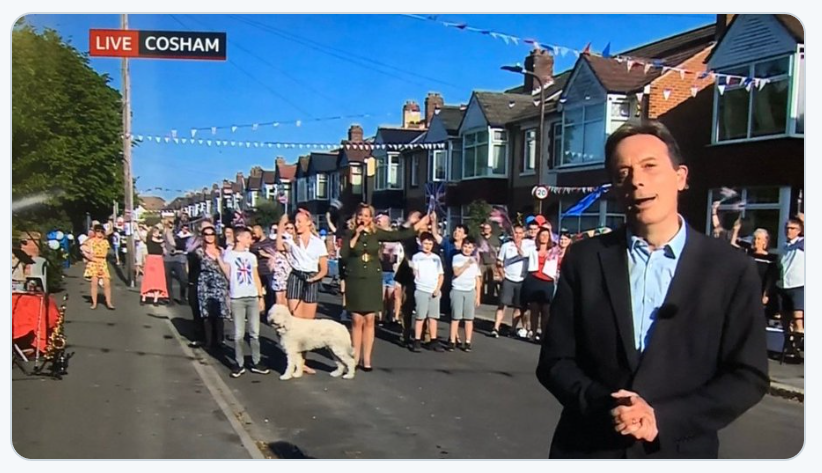
Cosham, a suburb of Portsmouth, has been trending on Twitter today - and not in a good way. 

It came about after a live report on last night's BBC One News at Six, a report from Duncan Kennedy showing the inhabitants of one of Cosham's UK-flag-festooned avenues enjoying their VE Day street party, and singing war-time songs, and getting it together - at a safe distance. 

I saw wine glasses on walls, and sunshine, and families having fun, and a woman celebrating her 75th birthday that very day.  

But soon metaphorical clouds arrived like frowns, all thanks to the unforgiving medium of Twitter. 

Yes, a backlash was brewing.

A screenshot was shared far and wide. It showed the patriotic street partiers standing behind the BBC's Duncan Kennedy and waving and cheering.

Now, it must be said that they did look rather close together, so...

...Cue uproar on Twitter.

Uproar, of course, quickly translated into the usual mass outpouring of bile, bordering on hatred, all directed against the happy people of Cosham - and also against the BBC for promoting such flagrant disregard for the lockdown guidance. 

Golden rule: Never just believe what you see on Twitter. 

I looked into it (via TV Eyes) and saw the report. The BBC newsreader and the BBC reporter went out of their respective ways to say that everyone in the report was obeying the social-distancing rules - it was said three times in fact - and other camera angles showed precisely that: family groups keeping apart while coming together to mark VE Day and to pose for the BBC's  cameras. 

So, to put it simply, that controversial screenshot was simply a trick of perspective. The whole Twitterstorm wasn't even worth calling a storm in a teacup. It was a fake storm.

As you'd expect from Twitter, not everyone was unaware of that, but, nonetheless, some of the critics who evidently knew as much still carried on regardless - something I put down to them enjoying their latest two-minute hate far too much to just let it go.

Examining the critical tweets, it's clear that many were criticising the folk of Cosham on Piers-Morganite grounds. They'd seen the screengrab, read the outraged tweets, failed to step back and think, and leapt on the bandwagon brandishing their pitchforks against the lockdown deniers. But a large minority went further and displayed an Emily Thornberry-style snobbery, with some even piling in with violent wishes against people they seem to regard with total contempt.

I know next to nothing about the suburbs of Portsmouth, so I looked. Cosham is a Conservative/UKIP/Brexit-Party-voting suburb of the city. I suspect many of the nastier elements commenting on Twitter didn't even check, just assumed from the flags, and the patriotic songs, and the working class voices that these were lockdown-breaking, knuckle-dragging, Brexit-supporting creatures. Hence the added ferocity of their pile-on.

But, as couldn't be clearer these days, Twitter isn't the UK, and I suspect that the vast majority of those watching the actual BBC bulletin, and seeing the footage, and hearing the words, and taking in the point from the BBC newsreader and the BBC reporter that everyone on the street was observing social distancing guidelines, will have taken the people featured in it for what they actually are - people who like their country and their neighbours - and liked them too.

Tuesday, 28 January 2020

The BBC rejects Trump's peace plan


BBC One's News at Six's coverage of the Trump administration's plan to settle the Israeli-Palestinian conflict was as relentlessly downbeat as you'd expect from Jeremy Bowen and Orla Guerin.

For Jeremy Bowen, Donald Trump "has absorbed the Israeli agenda". His plan "does not go anywhere near what the Palestinians want" and is "hedged with conditions no Palestinian leader could accept". The Palestinians aren't happy and "their internationally recognised leaders" aren't part of any talks. Why? Because the Trump administration has "adopted so much of Israel's agenda" and Palestinians' "hope" over Jerusalem has been dashed.

I heard that after deliberately seeking out a non-UK/non-US perspective and settled on Deutsche Welle - the first EU media outlet I could think of that has an English language website - and found them saying something far less black-and-white about the plan:
The deal makes more concessions to Palestinians than anticipated but asks that they accept West Bank settlements. 
Although the outline makes several concessions to the Palestinians, including doubling their currently controlled territory, it does ask them to cross what has previously been described as a red line by accepting the previously constructed West Bank settlements as Israeli territory.
Jeremy Bowen went straight on with his agenda,  talking of the "more than 50 Palestinian protesters" who were "shot dead" by the Israeli Army on the day the US accepted Jerusalem as Israel's indivisible capital before dwelling on "families" who "fled" or were "driven out" by Israel in 1948 and who "and the right of return"."Israel does not want to grant it", said Jeremy Bowen.

It's truly remarkable how Jeremy Bowen can make every so very black-and-white (against Israel).

Cue his final fling:
The timing of this announcement looks tailored to the short-term needs of the two leaders. They're both facing elections - and serious charges. High crimes and misdemeanours for Trump, bribery and corruption for Netanyahu. The stakes are high, the chances of success are low.  
That's editorialising, of course.

Then that eternal ray of sunshine Orla Guerin repeated the same point that the Palestinian president "was not invited....unlike his Israeli counterpart", and said the feeling thereabouts is that "this is one more time where the Israelis will make gains and the Palestinians suffer losses".

At least Jeremy and Orla were both singing from the same hymn sheet - or, to put it another way, pushing the same narrative.