John Simpson [2:03 PM]: The UN says the information it has gathered shows that Israeli soldiers fired the shots that killed the distinguished Al Jazeera journalist Shireen Abu Akleh on 11 May. She was covering an Israeli army raid in the West Bank town of Jenin.
John Simpson [2:13 PM]: The UN says Shireen Abu Akleh & her colleagues made a concerted effort to show the Israeli soldiers at the scene that they were from the Press. The Israelis issued no warnings. There was no shooting going on at the time. The bullets which killed her were ‘seemingly well-aimed’.
Alan Lyons [2:17 PM]: John, "seemingly well-aimed" is an unpleasant insinuation. If you or the UN wish to allege that the IDF is deliberately targeting or assassinating journalists Vs being unfortunately hit in the middle of a firefight, then you should state that clearly.
John Simpson [3:00 PM]: I don’t think the UN is insinuating anything, unpleasantly or otherwise. It’s openly saying that Shireen & her colleagues were clearly marked as journalists, there was no other shooting going on at the time, and that Israeli soldiers fired the aimed shots that killed her.
Alan Lyons [3:05 PM]: Could you post a link? I have some problems with this: 1. It would be an epic PR own goal for the IDF to be targeting journalists 2. I read that there was a firefight. Is that not true? Are they describing a "lull"? 3. Is it true Hamas has not allowed ballistics on the bullet?
John Simpson [3:19 PM]: I read this on the UN High Commission for Human Rights website. I’m not sure about its being an epic own-goal for the IDF, Alan — 30 journalists have been shot & killed by the IDF since 2000 in the West Bank. Video just before Shireen was shot seems to show no firefight.
The BBC has spent 17 years and lashings and lashings of licence fee payers' money refusing to release it to the public - or as Jan puts it ''wriggling and weaselling its way out of revealing'' it.
It's been a saga, far longer than most Icelandic ones.
Jan reports that BBC DG Tim Davie has now, ''very belatedly'', replied to her MP Theresa Villiers's letter about it.
And what did Tim, the So-Far Ineffectual Champion of BBC Impartiality, have to say when he did reply?
Well, to cut a long story short, he stuck to the BBC line - hook, line and sinker.
Yes, he'd discussed it with the people who'd previously refused to make it public and, yes, they told him it should still be kept under wraps.
So no change whatsoever. Suppression is still the order of the day.
There must be things in that report that very deeply embarrass the BBC.
Jan now compares their handling of it to the Bashir scandal and hopes Lord Dyson will help.
Her idea is that the BBC's cover-up over Martin Bashir took 26 years to be exposed, so one day the cover-up over the Balen Report will come out too, and Lord Dyson might be the man to help quicken the process.
We'll see. Sue and I have always hoped for a whistle-blower, but given the state of opinion held so widely at the BBC on matters Israeli/Palestininian, we're still not holding our breaths.
Version 1 - The photo of Celine holding a doll in the ruins of the tower block that was brought down by Israeli air strikes next to her family home - which was also hit - clearly struck a chord.
Version 2 [correction, 5 days later] - The photo of Celine holding a doll in the ruins of the tower block that was brought down by Israeli air strikes next to her family home clearly struck a chord.
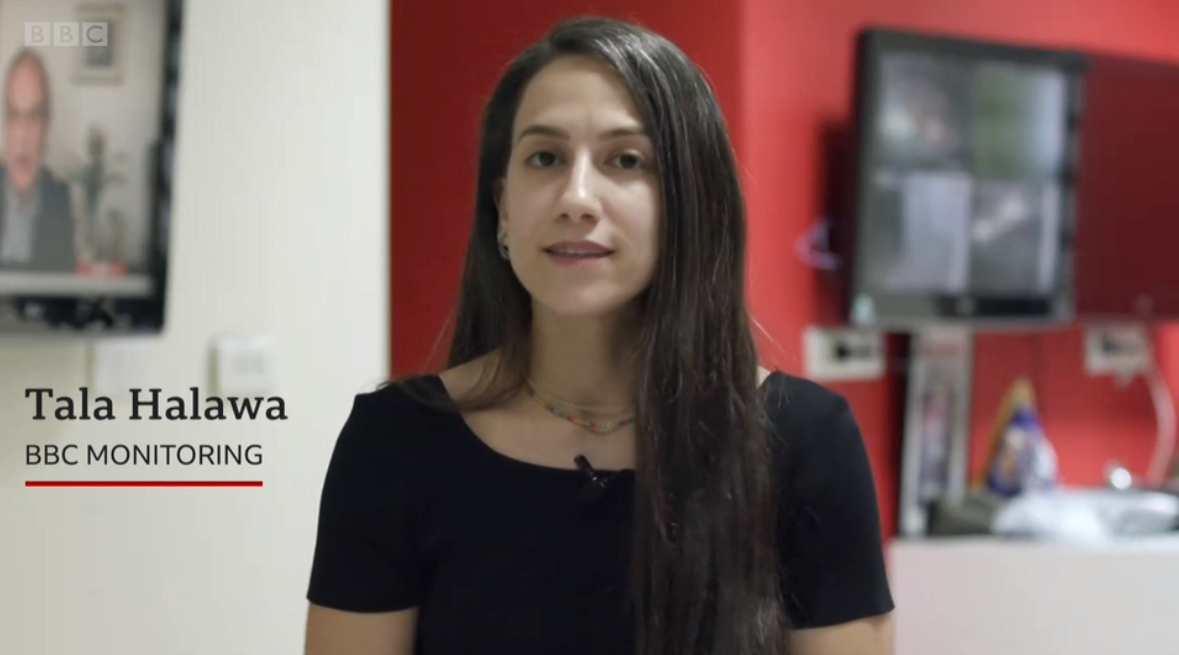
This morning they came across a BBC journalist called Tala Halawa, whose LinkedIn page reads:
Digital Journalist
Company Name: BBC Monitoring
Dates Employed: Jul 2017 – Present
Employment Duration: 3 yrs 11 mos
Location: Ramallah
Palestine Specialist in BBC Monitoring: specialized in Palestinian affairs and the media, as well as covering the Israeli-Palestinian conflict. In addition to reporting on the politics and media of Jordan. Produced and reported for several services in the BBC such as the Arabic website and TV, and the BBC World Service (radio and TV).
GnasherJew was objecting to the BBC and the Independent promoting someone they consider an antisemite [Eman Asker] and Tara Halawa of the BBC was one of those criticised for considering this particular person ''an acceptable voice to promote on Israel/Palestine''.
Here's how the thread continues:
While we’re on that subject. Tara Halawa has made one of the most disgustingly one-sided BBC videos, whitewashing antisemitism, we have ever seen. People like her are the reason antisemitism has been normalized.
I’ve just checked Tala Halawa's feed. She’s supposed to be an unbiased BBC reporter. She’s an obsessive anti-Israel campaigner.
We’ve found out why Tala Halawa is promoting an antisemite:
SUE - Col Richard Kemp’s authoritative views on military matters - notably other than I/P - are occasionally sought by the BBC. He is a staunch supporter of Israel and a huge admirer of the moral integrity of the Israeli Defence Force. His military expertise and intimate knowledge of the IDF is unique.
During an operation in Gaza last week, the Israel Defence Forces attacked a Hamas tunnel complex with 12 squadrons of 160 combat planes striking over 150 targets with hundreds of bunker-busting JDAMs [Joint Direct Attack Munitions] in less than an hour. Although the battle damage assessment is still underway, the raid destroyed perhaps the most critical element of Hamas infrastructure, wiping out vast stocks of munitions and likely killing dozens if not hundreds of fighters. This was a hammer blow to Hamas and may prove to be a turning point in the conflict. It also sent a powerful message to Iran and Hizballah, foretelling the consequences of an assault on Israel with their arsenal of tens of thousands of missiles in southern Lebanon.
The IDF operation was a carefully coordinated combination of intelligence, surveillance, knowledge of enemy tactics, deception, surprise, and precisely targeted, overwhelming force. Of all these, deception and surprise were key. Surprise is a principle of war in the American, British and many other forces, defined in the US Army Field Manual as "striking the enemy at a time or place or in a manner for which he is unprepared." The manual goes on to say: "Deception can aid the probability of achieving surprise". Throughout the history of warfare, surprise achieved through deception has led to many stunning military victories — often against the odds.
The usual crowd is up in arms about this, proclaiming “Assault on press freedom! “ and “No evidence of Hamas’s presence in the media centre’s tower block!”
If one can access viral videos from heaven above, Fred Dibnah must be looking down at the surgical precision of the demolition with awe.
To be honest, I couldn’t care less whether Hamas personnel were there or not.
Propaganda is known to be as dangerous a weapon of war as Mishal Husain’s infamous arsenal of ‘homemade contraptions’. The left-leaning mainstream media also known as The Ministry of Public Enlightenment and Propaganda is terrified of angering the ‘already angry’ Muslim community and collectively furious that the IDF exploited their very own left-wing journalistic anti-Israel zeal, knowing that they would be eager to disseminate one particular piece of fake news - namely that the IDF were on stand-by to invade Gaza. This they duly did so effectively that the brave warriors of Hamas scuttled underground to take shelter and hopefully eliminated in one fell swoop. (Echoes of a certain Iranian strategy for ridding the world of Jews).
As Nasrallah famously boasted “if they (Jews) all gather in Israel, it will save us the trouble of going after them worldwide.”
++++++++++++++++
More notable areas of one-sided reporting include the media’s tedious parroting of Hamas’s special death-toll figures, which conflate casualties from their own ‘shortfall’ accidents with the unfortunate ‘collateral damage’ that occurs as a result of Hamas’s ‘human shield ‘practices, which they know they can get away with due to the Western media’s ideological hostility to Israel.
+++++++++++++++++
Why the UK’s media is so mealy-mouthed in their condemnation of Hamas, Iran, Hezbollah, Islamism is understandable, but will be viewed - retrospectively - as a betrayal. Short-term gain, maybe, considering ‘demographics’ (the rise in antisemitism, civil unrest, BLM, the Labour Party etc etc) but long-term pain. Looking back, will future generations regret the West’s capitulation to Islam?
When I see an Israel-related article in the “non-left-wing press’ such as the Times or the Spectator, I am usually appalled by the politically correct editorial reins and restraints that abound. Nowadays I feel I have to skip straight to below the line for remedial reassurance that not everyone is taken in by it. Some of the ‘tell it like it is’ contributions are spot on. It still chills one to see the overtly antisemitic contributions from certain regulars amongst it all.
One exception is the Australian version of Sky. They have some Fox News-like pundits on their staff. Although subtlety doesn’t seem to be their strong point, it’s comforting to know that not everyone on this planet is out to crush you. Mind you, in view of America’s terrifying political about-turn, the UN’s and the ICC’s staggeringly unhinged anti-Israel animus, it looks like a gathering storm, all too reminiscent of the 1930s.
CRAIG - Col Kemp is a rare voice of informed reason these days.
Mishal Husain's infamous conflated, comparative body count is back.
His whole piece was geared towards making one main point: that Israel is acting disproportionately (as if he'd ever come to any other conclusion).
Well, that's his view.
In the past you might have expected that prominent BBC journalists would have either (a) kept their opinions to themselves or (b) expressed an opinion that sided with democracy against terrorists and their supporters, but not now. It's op-eds all the way from the BBC's Middle East Editor.
Here, as so often, he does the 'moral equivalence' thing first, then blames Israel.
SUE - For the integrity of this blog we’ve been focussing on the media’s bias rather than opining on the actual issues.
After all, what do I know? All I can do is digest as much available information and analysis as I can stomach and inject a little empirical evidence into it.
An HoL speech from 2009 by Baroness Ramsay of Cartvale (Labour) sticks in my mind. Perhaps because this baroness was a Labour Peer (not a ghastly Tory) it seemed extra significant and worth bearing in mind.
I first visited Gaza in August 1967, when Israel had taken control only a few weeks before. As I have said before in this House, I found Gaza an absolute hellhole. It is not easy to understand, and it is even more difficult to forgive, how prosperous Arab countries allowed their Palestinian brethren to live in such wretched conditions from 1948 to 1967.
[Baroness Ramsay of Cartvale Labour 10:51 am, 6th February 2009].
The implications here are profound. I probably don’t need to spell it out. Suffice it to say that when Israel did occupy Gaza after the six-day war (1967) the inhabitants’ conditions improved dramatically, most notably average life expectancy. However, Israel decided to make a disastrous but well-intentioned concession “for peace’! They evicted the Jewish residents and pulled out of Gaza in 2005 and You Know The Rest. As the well-worn Israel-bashing innuendo goes, “lessons should have been learned.” But they never seem to be.
The ease with which lazy and inaccurate memes are parroted is another pincer-prong with which the anti-Israel movement encircles its enemy. Naz Shah has taken full advantage of it, as Craig set out in part 1.
For Naz and her fan base, Tweeting about Palestinians ‘being kicked out of their homes’ was enough. And adding: Jews ‘celebrating the burning of a place of worship’ as if that needed no further examination. We await a sincere apology for the error and the humble pledge not to do it again. With bated breath.
One of the most egregious and ongoing omissions from Western media as a whole is the non-reporting of the vicious incitement that pours from the Islamic world. No story, no analysis, no curiosity. It has to be more than simple respect for other religions that’s preventing our renowned investigative journalists from ‘investigating’ this phenomenon. For example, the PA’s so-called Pay-For-Slay. This policy must be a drain on the PA’s GDP, and the monies would obviously be far better spent on bomb shelters or health care; surely that issue is worth exploring in one of the BBC’s hard-hitting documentaries (!). Mahmoud Abbas must be so confident of the media’s silence on the matter that he doesn’t even make an effort to keep it secret.
What about the unadulterated par-for-the-course anti-Jew racism entrenched in Palestinian culture? Racism is the most taboo of all ‘isms’ these days, yet there’s a collective silence over the racism that is part and parcel of the Arab psyche. I’m not much of a conspiracy theorist, but this looks like a conspiracy of silence.
The UN Security Council is having an emergency meeting at the time of writing, I watched some of it on Sky. The Palestinian rep has appropriated all the arguments for the defence from Israel. He has regurgitated a litany of upside-down facts that are almost laughable. How anyone could be taken in by this nonsense I do not know. But no doubt they’ll swallow it.
This is going on in the UK.
UNBELIEVABLE!
"F**k the Jews" "F**k their daughters" "F**k their mothers" "Rape their daughters"
SUE - We’re making this comeback, possibly a one-off - due to the exceptionally problematic media coverage of (how to put it) the current ‘Israel / Gaza’ war.
The BBC’s ‘domestic’ bias is capable of looking after itself on ITBB but we both think this topic merits special attention.
Really, can't think why!!??
BBC opens special complaints page over coverage of Israel-Palestine violence https://t.co/U9qPxf4Wb3
— SussexFriendsofIsrael (@SussexFriends) May 14, 2021
Unfortunately for the argument that we are about to make, most of the complaints are from people who like to believe that the BBC isn’t pro-Palestinian enough.
Global Chinese Whispers plays out like this. The media sets the stage. Feelings trump facts, and an inflammatory message travels around the world before the truth has time to put its boots on. We’ve covered much of this issue over the years, both on ITBB and (before 2012) over at Biased-BBC. It’s Remember the Hamas Bunny? MEMRI?
Not so long ago the many forms of media bias cited and defined by bias-watching fanatics like us would fall on deaf ears. Not so much now; we are no longer alone. The BBC is coming under much wider and closer scrutiny, partly due to the public’s belated recognition of the BBC’s left-wing, some say Marxist, agenda.
The comments in the non-left-wing press show how frequently that particular problem is alluded to in comments by interested members of the public. The bias is almost universally accepted as a given, which arguably downgrades ITBB to the status of self-indulgent irrelevance.
Obviously, the BBC is conscious of the criticism and perhaps it suspects its future depends on more rigorous compliance with its charter obligations, but even if it’s forced to adopt a genuine policy of impartiality over its output, other broadcasters (i.e., Sky, Channel 4) ain’t necessarily bovvered and can stir up trouble with impunity. The new BBC DG may have been ‘trying’, but his influence looks distinctly lip-servicey. When we get the obligatory ‘other side' of the story it’s delivered at arm’s length - impersonal - and framed with the disclaimer “Israel says”, which smacks of cynicism and a sarcastic voice comes on in my head as I read it.
The most pungent flower plucked from the bouquet of biased reporting is ‘omission’ where vital information is tacitly omitted or concealed, especially that concerning the religious indoctrination that underpins Palestinian rhetoric and incites violence against Jews.
And a close second, florid emoting. Gratuitously dwelling on the misery of one side. Loaded language; lazy, repetitive, and economical with the actualité.
[CRAIG - What follows are various parts of Sue and my email exchanges over recent days. Exclusive free, PREMIUM, director's cut material.]
CRAIG - You may already know this, but did you spot that Naz Shah returned to type? I've just not seen anyone commenting on it yet - though someone probably has and I've just missed - but I myself spotted three falsehoods from her in a single just-over-a-minute video, and I think it's newsworthy.
1. Israeli forces didn't attack innocent worshippers on the holiest of nights, in the holiest of places. [Those 'worshippers', stirred up by rhetoric from Palestinian leaders, had stocked the holy al-Asqa mosque with stones, firecrackers, and the like ready for violent protest].
2. Thousands of Israel weren't celebrating and chanting the burning of a place of worship. [It was a tree that was on fire, not the mosque, and it was accidentally set alight by the Palestinians, and the Israelis were celebrating an annual national day].
3. Settlers didn't illegally occupy or forcibly evict Palestinians from their homes. [The Palestinians are still there pending a Supreme Court ruling].
So, she made three statements, all wrong, and all attacking Israel.
Why has a Muslim Labour MP, who had to apologise for antisemitic anti-Israel tweets and was then widely portrayed in the media as being genuinely repentant, now reverted to blithely spreading lies about Israel?
-------------
I'm thinking that Naz Shah may have got her take on things from watching Aleem Maqbool's misleading piece on Wednesday's Newsnight which chose its words so carefully as to make one side appear almost entirely in the wrong:
Though the focus is now on Gaza and southern Israel, It was events in Jerusalem that led to what we are seeing now.
[CRAIG - And what of the possibility, approaching certainty, that another key cause [perhaps THE main cause] is an intense power struggle between Hamas and Fatah, fuelled by elections cancelled by Fatah, with Hamas ferociously attempting to outbid Fatah in terms of inciting violence against Israel in Jerusalem, and elsewhere, in the hope of reaping the rewards, and that this ultra-heightened level of incitement has been strongly encouraged by Iran and Turkey, emboldened by a weak US president? Shush!!]
An Israeli court decided it was right to evict several Palestinian families from their homes
[CRAIG - So, an Israeli court put in the dock by Newsnight. Whether those homes really are their homes and whether they were reneging on the terms of their occupancy by refusing to pay their rent, suddenly, for some reason, right now, being just a few questions ignored by Newsnight.]
in occupied east Jerusalem.
[CRAIG - The Israelis didn't evict anyone. It's now gone to the Supreme Court - something else unmentioned here].
Last Friday those families and others had gathered to break their Ramadan fast
[CRAIG - nice and peaceful family stuff, with lots of invited onlookers].
but Jewish settlers came to make their presence felt and stake their claim to the homes.
[CRAIG - Israeli settlers - boo! - joining that Israeli court in the Newsnight dock].
It quickly led to scuffles. The UN and US condemned any forced evictions of Palestinians in east Jerusalem
[CRAIG - which didn't happen anyhow].
but the issue had already sparked more confrontation in Jerusalem,
[CRAIG - so that's just the Israeli side in the dock then, so far].
Israeli police using rubber bullets and stun grenades and water cannons.
[CRAIG - Ah, now the Israeli police are in the Newsnight dock].
But it was Monday when things escalated so dramatically. Israeli nationalists
[CRAIG - Israeli nationalists, step into the Newsnight dock please!]
prepared to march through the Muslim quarter to celebrate their country's capture
[CRAIG - ''capture'', eh?]
of east Jerusalem 54 years ago. Palestinians had been in the al-Aqsa Mosque, some ready to oppose the march
[CRAIG - BBC understatement! They stocked this holy site with rocks, Molotov cocktails, firecrackers and the like],
when Israeli police stormed
[CRAIG - ''stormed'', eh?]
the mosque compound, once again using force
[CRAIG - ''using force'', eh? Unlike the violent, well-stocked protestors inside the sacred mosque, spoiling for a fight, ]
in the form of sound bombs and rubber bullets but now at the doors of one of Islam's holiest sites.
[CRAIG - Must remember to stock my parish church with rocks, Mototov cocktails, firecrackers and the like. Not sure if my vicar would agree though. Should I ask Jeremy Bowen if he can recommend an imam from a mosque in and around Jerusalem?].
Around the compound Palestinians threw rocks and bottles
[CRAIG - yeah, and the rest Aleem].
and more that 300 were injured and as well as 21 Israeli police.
[CRAIG - Imagine how that would sound the other way round ''More than 21 Israel police were were injured, as well as over 300 rioters'].
Later, when a fire broke out
[CRAIG - Just 'broke out', did it? Wasn't started by Palestinian rioters accidentally setting a tree ablaze with one of their firecrackers, Aleem?]
at the mosque compound, Israelis were seen celebrating.
[CRAIG - ''Seen celebrating'', eh BBC? Leaping to conclusions without fact-checking, BBC? As it was the annual Jerusalem Day celebration, where thousands of Israelis gather each year, were the several foregrounded Israel people filmed dancing actually celebrating the fire around al-Aqsa, or just celebrating and getting filmed against a background of a burning tree on the Temple Mount? Not that bigoted, vicious Israeli Jews have been absent from the recent violence - unfortunately, far from it - and I'd been full for admiration for how the pro-Israel people I follow on Twitter have both brought up their actions and damned them unequivocally. But I can't find any evidence that these people were rejoicing at fires on the Haram esh-Sharif / Temple Mount complex rather than just rejoicing as they do, every year, even amid the horrors of recent days. Wrong place, wrong time, perhaps, for the people featured in that 'viral' footage, dancing as a tree burned on the night sky as the backdrop of their celebrations? Or maybe, entirely guilty as charged by the like of Labour's Naz? But shouldn't the BBC do a huge amount of due diligence by trying to find out and not spouting off in a potentially inflammatory way without evidence?]
SUE - I did hear a leek Maqbool (autocorrect struck) speaking the other day but I’m thinking it was an abridged version, or maybe I was half asleep. The language he and his colleagues use is typically loaded and you are right that this kind of thing is where Naz and her ilk get their inspiration. Even in the first section of that transcription [below] there are clues that anyone with an interest in language could pick out:
This is not a story about buildings coming down, or a rocket count. It is about civilians suddenly being thrown into despair. A boy in Gaza running to a coffin, after his father and elder brother were killed. Dozens have now died. Panic and fear etched on the faces of those in Ashkelon in Israel as the warning sirens go off again and where the number of dead rises there too. Today started with more air strikes in Gaza, this tiny densely packed territory, just 25 miles long, five miles across, given a deadly wake up call. And the day was punctuated with more massive bombardment, Israel saying it is targeting places associated with senior figures in Hamas. And while militants have been killed, many civilians, including children, are known to be among the dead. And if they haven't lost relatives, more and more of those living in this impoverished strip are losing their homes and belongings, and are in fear. Overnight, militant groups in Gaza sent a huge barrage of rockets into Israel. And while most were stopped, many did manage to get through, some hitting buildings. In Rashon LeTsizon a 50-year-old woman became one of six Israelis who have now been killed. So how did we get here?
I mean Palis are always defined as ‘families’, usually with empathetic adjectives, whereas Israelis are held at arm’s length without “personalisation’. The lip service that is half-heartedly paid to balance is shamelessly gratuitous. Then there are the half-truths that have embedded themselves into the language such as ‘densely packed’. Then every single utterance about Israel’s action is reported as ‘Israel says” which implies reluctance at the compulsory obligation to ‘put the other side’. In fact, I’m sure that’s actually passive-aggressive.
And that’s even before the ‘how did we get here’ section.
The terms used are always emotive. Jewish Settlers. Right-wing. Etc. Not to mention the lazy, sloppy, malicious, deliberately misleading emoting throughout.
CRAIG - As we've quoted two-thirds of that report from Leeky Maqbool, as I'll think of him from now on, we might as well finish it off. This is how he ends it:
Several rockets were fired from Gaza, and although they were shot down Israel decided to hit back hard, with air strikes across the Gaza Strip. It said it was targeting militants but of nearly 30 people were ten children including a four-year-old and 6-year-old. By Tuesday, it felt like a point of no return had been crossed and Gaza had, as has happened so many times in the past, become the cauldron of conflict. For the most part, Gazans do not appear to blame the Palestinian militants or the rocket fire for bringing this catastrophe on them, saying it their occupier that is the aggressor. But Israel says this is entirely the fault of Hamas and that it will continue its military action. With neither side backing down, the funerals look set to keep coming for days.
First sentence, for starters: Just ''several'' rockets. Then Israel deciding to hit back hard ''although they were shot down'', making the Israeli response sound unreasonable, even disproportionate. And then comes another of those 'Israel says' phrases followed by a ''but'', i.e. language of contradiction. And another ''Israel says'' comes later, this time after a ''but''.
And there was a good example of Jeremy Bowen doing an ''Israel says'' on Thursday's BBC Breakfast. The ''they call'' bit was HIS emphasis:
You mentioned appeals for calm coming from abroad, but this is not going to end, I think, until both sides can find a way of declaring a victory that they like. Hamas will want to be able to say that they defended Palestinians and Jerusalem, and Israelis want to do something that they call "restoring deterrence", which essentially means giving a good hammering to anybody who raises a hand against them. So I think that this has got some way to go at the moment. The ''disproportionality'' charge was there too, of course, in his sneer about Israel ''giving a good hammering to anybody who raises a hand against them''.
What's happening in and around Israel at the moment is horrible, and worse than ever this time, with sectarian violence inside Israel adding to the usual story of genocidal terrorists trying to kill as many Jews as possible (and not caring how many of 'their own people' die in the process) and Israel robustly defending itself and being demonised for doing so.
And then, as if things couldn't get any worse, Jeremy Bowen - the man with a deep personal grudge against the State of Israel, one he's been nursing for a couple of decades - pops up at Heathrow Airport announcing to the world that he's on his way.
Living the dream (again) sitting on my bags on the pavement at Heathrow waiting for a plane I might not be able to board… no seats in the terminal. journalism in action pic.twitter.com/JyMTNgjClp
CRAIG - David Collier just replied to AP about that; ''If AP, Al Jazeera and co didn't know that the very building they are reporting from in Gaza is used by Hamas to hide military assets - then maybe they should change jobs?''
Jake Wallis Simons has a piece in The Spectatortaking Amnesty International to task for traducing Israel's much-admired handling of its coronavirus vaccination rollout.
Amnesty, which has become remarkably anti-Israel in recent years, has accused Israel of "denying Covid-19 vaccines to Palestinians", which is claims "exposes Israel’s institutionalised discrimination".
I'll summarise it:
The Palestinian leadership hasn't complained because, under the Oslo Accords, the Palestinian Authority runs health in the parts it runs (Hamas runs health in Gaza) and they don't like asking Israel for help, viewing it as collaboration with the enemy, and initially insisted on obtaining the vaccine themselves via the WHO/United Nations. Israel, meanwhile, speeded ahead impressively with Israeli Arabs being fully encouraged to take up the vaccines. The PA, seriously lagging behind, appears to have now changed its mind and (covertly) asked for - and received - Israeli help.
Jake concludes, "Seen in this light, the picture bears little resemblance to the narrative pushed by the likes of Amnesty International. The Palestinians neither expected nor requested help from Israel. They held no sense of grievance, even as hand-wringing commentators from overseas sought to stir up resentment by reporting that a great injustice had been done. Palestinians appear to be seen by some as an infantilised people in need of Western intervention. But this is certainly not how they see themselves."
Enter the BBC. On Friday, the BBC News Channel announced:
Israel is also facing criticism over what responsibility it has to share its vaccine supply with Palestinian communities in the West Bank and Gaza. Well, to discuss this more we are joined from Jerusalem by Dr Gerald Rockenschaub, head of the World Health Organization office in Palestine.
Anyhow, here were the BBC's questions to Dr Rockenschaub:
How many people - and we are talking about 5 million people, aren't we, in the West Bank and the Gaza Strip, roughly? What percentage of those people have actually received a vaccination yet?
So what are Israeli officials are saying about this criticism then?
If it has been doing really well vaccinating its citizens, what is it saying about the lack of vaccinations for people in the West Bank and Gaza? Why is it saying that has or hasn't happened?
I know you have said nobody is safe until everyone is safe, so presumably that's a message that you are really trying to hammer home with the Israeli authorities as you try to facilitate the fair spread of the vaccine, I guess, can we put it that way, through the region?
Looking at the new cases, more than 8000 new cases per day leading to a third lockdown, believed to be because of this new variant first identified in Britain. Do we think this variant started to take off before the effects of the vaccination programme could really be felt?
Getting new supplies in before hospitals become overwhelmed and before health care becomes overwhelmed is absolutely of the essence now, isn't it?
Dr Rockenschaub, thank you for talking to us today. Dr Gerald Rockenschaub, head of the World Health Organization office in Palestine.
It would have been interesting to hear an Israeli perspective on this.
I was just going to post the questions here, but why not post the whole interview? (I can guess an answer to that, it's Tony Blair!)
The questions are very BBC.
There's James Reynolds going straight for the negative and suggesting that Israel's agreements with Arab nations might be putting the region "on the road to open conflict", then pursuing the "sidelining" of the Palestinians angle, and then interrupting to point out that "many" more than just the Palestinians don't want peace with Israel yet.
And there's Katty Kay (naturally) going for the Trumps - as she did even more emphatically in her follow-up question about Trump and climate change.
Enjoy!
*******
James Reynolds: Let's look at the reasons for this alliance coming about. The Iraq War, which you co-led, got rid of Saddam Hussein but it also gave much freer rein to Iran to expand as a regional power. In order to counter that Israel and some of the Gulf States are getting together potentially putting the region on the road to open conflict. How is the Middle East a safer place after this deal?
Tony Blair: James, I think you can tell the history a little bit differently. The fact is, this is now just about security and about Iran. It's about the belief in the Middle East that if you want to establish a peaceful Middle East, then you have got to establish relationships between the State of Israel and the Arab nations. That is entirely sensible, not just for reasons of security, Yes, it's true, Israel and the Arab nations are very worried about what Iran does to destabilise the region, but they're also worried about the various extreme groups on the Sunni side who also want to destabilise the region. And what these agreements symbolise are people coming together in pursuit of a different Middle East, one that is based on religiously tolerant societies and modern economies. And that's what is really behind this. And I think what you will find with the agreement signed today is that this is not going to be a cold peace, and it's not going to be about security. It will be about a warm peace and it will be about actual engagement in the economy, in culture and, of course, in the resolution of the Palestinian issue.
James Reynolds: When you visited Israel and also the Palestinians as prime minister after 9/11...I remember those visits. I was a Jerusalem correspondent at the time...here was a common belief that you couldn't solve any of the problems until you had tackled and solved the Israeli-Palestinian conflict. But doesn't this 2020 agreement show something completely different, that you can solve parts of the Israeli-Arab conflict by sidelining the Palestinians instead of resolving their fate?
Tony Blair: You're not sidelining the Palestinians. Look, you're not going to get a...I've studied this now for the best part of 20 years, I was heavily involved as Prime Minister. I was involved afterwards as the quartet envoy, I've spent the last five or six years working on the Arab-Israeli relationship. You're not going to solve it unless two things happen. You've got to get a Palestinian politics that is unified and in favour of peace, and you've got to bring the Arab nations alongside the Palestinians in that peace effort. And so, when people say - and there are, of course, people on the Palestinian side who say - no, you should have nothing to do with Israel....
James Reynolds: (interupting) Many are saying that.
Tony Blair: ...until the Palestinian issue has been resolved. They do say that. but the strategy they've had up to now has not worked, and it won't work in the future. The right strategy is to encourage the relationship between Israel and the Arab nations and then say to the Arab nations. 'We need your support. A unified Palestinian politics in favour of peace needs your support. That is a strategy that can succeed. If we carry on doing what we have been doing for the last half-century, we'll carry on with the same result'.
Katty Kay; You've just came from the White House, Mr Blair. I remember speaking to Jared Kushner at the beginning of this administration, and he said that Donald Trump was the person to bring about the Palestinians and the Israelis, nobody else could do it, but he was the guy that's going to do it, but effectively they've given up on that, haven't they? I mean, they're now saying, well, if the Palestinians want to come along but I'm not seeing much outreach from the White House to the Palestinians to get that agreement between the Israelis and the Palestinians.
Tony Blair: Katty, the White House, to be fair, have been reaching out the entire time. It's the Palestinians that won't engage with the Americans at the moment. Now, I understand all the reasons for that, moving the embassy to Jerusalem and so on. But the fact of the matter is, the intervention of the UAE was what prevented the annexation plans going ahead, and if the Jordan valley were to be annexed that would make a Palestinian state very difficult. So that intervention has actually preserved the possibility of a future Palestinian state. And, you know, the best thing for the Palestinians to do would be to engage with the Americans, engage with them by the way not saying that we agree with your plan, but saying let us sit down and discuss the detail of it. Because otherwise, and this is why...I understand completely why...people like me, when we encourage this relationship between the Israelis and the Arabs, they say. oh, you're an Israeli stooge, you don't care about the Palestinians. If the Palestinians don't get a different political strategy they will never get a state. What they've got at the moment is a strategy for sympathy. They need a strategy for statehood, and a strategy for statehood has to begin with making sure you engage with the Americans because they are powerful, making sure you bring the Arab nations on side because they can help, and making sure the Israelis feel secure with a Palestinian state because at the present time they don't. So if you want the strategy to succeed, that's how to do it.
A relative of Palestinian negotiator Saeb Erekat carried out a car ramming terror attack, injuring an Israeli policewoman. Israeli police then shot him dead.
Well, that's one way of putting it. Sky News, however, put it like this:
Another one for connoisseurs of BBC complaint responses...
There's no such position as “the Palestinian ambassador to the UK” or “the Palestinian ambassador to London” but in late January the BBC - Today and the World Service - repeatedly described Husam Zomlot as being such. BBC Watch complained and, three days ago, received this reply:
Thank you for contacting us regarding the Today programme and Newshour, both broadcast on Tuesday 28th January.
We have spoken with senior staff about your concerns. We acknowledge the point that Husam Zomlot is not strictly speaking an ambassador, although the phrase is in common parlance in the media. We will remind editors of his actual title, but it is clear from our wider reporting that the UK does not recognise Palestine as a state.
That's an interesting precedent. BBC accuracy can go whistle if a phrase, it seems, jf something not strictly accurate "is in common parlance in the media".
It's common parlance, beyond the BBC, to call Hamas and Hezbollah 'terrorist organisations', so might this signal a massive shift in how the BBC refers to both of them from now on? (Very unlikely.)
BBC One's News at Six's coverage of the Trump administration's plan to settle the Israeli-Palestinian conflict was as relentlessly downbeat as you'd expect from Jeremy Bowen and Orla Guerin.
For Jeremy Bowen, Donald Trump "has absorbed the Israeli agenda". His plan "does not go anywhere near what the Palestinians want" and is "hedged with conditions no Palestinian leader could accept". The Palestinians aren't happy and "their internationally recognised leaders" aren't part of any talks. Why? Because the Trump administration has "adopted so much of Israel's agenda" and Palestinians' "hope" over Jerusalem has been dashed.
I heard that after deliberately seeking out a non-UK/non-US perspective and settled on Deutsche Welle - the first EU media outlet I could think of that has an English language website - and found them saying something far less black-and-white about the plan:
The deal makes more concessions to Palestinians than anticipated but asks that they accept West Bank settlements.
Although the outline makes several concessions to the Palestinians, including doubling their currently controlled territory, it does ask them to cross what has previously been described as a red line by accepting the previously constructed West Bank settlements as Israeli territory.
Jeremy Bowen went straight on with his agenda, talking of the "more than 50 Palestinian protesters" who were "shot dead" by the Israeli Army on the day the US accepted Jerusalem as Israel's indivisible capital before dwelling on "families" who "fled" or were "driven out" by Israel in 1948 and who "and the right of return"."Israel does not want to grant it", said Jeremy Bowen.
It's truly remarkable how Jeremy Bowen can make every so very black-and-white (against Israel).
Cue his final fling:
The timing of this announcement looks tailored to the short-term needs of the two leaders. They're both facing elections - and serious charges. High crimes and misdemeanours for Trump, bribery and corruption for Netanyahu. The stakes are high, the chances of success are low.
That's editorialising, of course.
Then that eternal ray of sunshine Orla Guerin repeated the same point that the Palestinian president "was not invited....unlike his Israeli counterpart", and said the feeling thereabouts is that "this is one more time where the Israelis will make gains and the Palestinians suffer losses".
At least Jeremy and Orla were both singing from the same hymn sheet - or, to put it another way, pushing the same narrative.
BBC Watch has been forensic about it. I'll confine myself to summing it up like this: There are shepherds abiding in the fields and a pregnant Mary-like villager, and they're unhappy, and it's all (Herod's) Israel's fault.
Some Christmas traditions - decking the halls with boughs of holly; singing old carols; eating, drinking and being merry; complaining that Christmas has become too commercialised; watching The Queen and Morecambe and Wise, etc - have been around for many a long year now.
Others are more recent, such as BBC Middle East correspondent Yolande Knell's pre-Christmas piece from Bethlehem where she uses the Christmas story to paint Israel as the modern-day Herod.
One of the BBC's hallowed Christmas Eve traditions is their now yearly piece from Bethlehem about how hard-done-by those poor Palestinian shepherds abiding in the fields (or in concrete buildings) are thanks to those horrible Herod-like Israelis.
Poor Lyse Doucet. People have been confusing her with Barbara Plett Usher for nigh on twenty years. And now comes this:
David Collier: Dear BBC News, you managed to run a whole segment on Christians in Bethlehem at Christmas without once telling viewers Christian numbers have fallen because of Islamist persecution. In fact, you even blamed the Jews. Well done (🤮). A bonus earned for Lyse Doucet. David.
Lyce Doucet: Thanks David. I am not in Bethlehem nor reporting on it. Best wishes of the season to you.
Yes, even the great David Collier mixes them up. And with Barbara Plett Usher back in Israel after a seven-year break covering the UN in New York, poor Lyse is likely to get lots more misdirected flak for some time to come.
For those who don't remember her, Barbara Plett - as she was then - was the one who was eventually rebuked by the BBC for reporting that she wept when Yasser Arafat died.
Anyhow, here's what David's talking about - a report that appeared (with various tweaks) throughout Christmas Eve...
It's proper early-2000s-style BBC reporting on Israel of the kind that originally provoked the commissioning of the Balen Report (think also Orla Guerin):
She blames Israel for all woes. Hamas and other Islamists don't get a mention.
She uses vox pops in the most lopsided manner imaginable, making one side look like idiots.
She uses dismissive language about Israel's claims about its security barrier and persists herself in calling it "the wall" when talking to the tourists, against post-Balen official BBC advise on the matter.
And she piles on the emotion with that heavily-patterned style of phrasing that was commonplace in BBC Israel reporting a decade or so ago.
Yes, it's like being taken back in time to, say, 2004.
P.S. Where's Yolande Knell gone? She usually does the Bethlehem Christmas Eve gig.
good tourist
bad tourist
Here's a transcript:
BBC newsreader: Few cities are in the spotlight more over Christmas than Bethlehem - the Biblical place revered as the birthplace of Jesus Christ. But tourism has been hit hard for the last 20 years. It's a Palestinian city in the Israeli-occupied West Bank and because of restricted movement out of the city by the Israeli government, its Christian community has dwindled - a move that Palestinians say harms their freedom and economic prospects. Barbara Plett Usher reports.
Barbara Plett Usher: This is Bethlehem's time of year. Dressed up in Christmas finery, it invites the world to celebrate the story of a humble birth that changed history. Tourism here is a bright spot, despite dark times for the Palestinian economy. For Bethlehem's Christians, there is a special gift from the Vatican, a splinter of wood believed to be from Jesus' manger. It's small but a big boost for a community decimated by waves of emigration, and an inspiration to priests like Father Emad, who provide aid to local Christians, trying to anchor them here.
Barbara Plett Usher: This year's different? Father Emad Kamil: This year is different because we remember the manger, so we must think more, our hearts must be the real manger to receive Jesus. Barbara Plett Usher: Your hearts must be the real manger to receive Jesus? Father Emad Kamil: I hope. I am working for that.
Tourists roll in past what Israel calls its security barrier. The wall, as residents call it, is squeezing Bethlehem into an ever shrinking space. That doesn't stop the tide of visitors, but many know more about the past than the present.
Barbara Plett Usher: What about the politics, you know, between..? Visitor 1: I don't know much about it, all I know is my saviour, Jesus Christ. That's all I know, that's all I care about. I just want to learn more about him. Visitor 2: I mean, this is where our Lord and Saviour was born and, oh, my goodness, this is where everything started. Barbara Plett Usher: What about the politics, you know? The Israelis and Palestinians? Did you hear anything about that, think anything about that? Visitor 2:Yeah, you know, it's definitely concerning, I guess. Barbara Plett Usher: What did you think of the wall when you came in? Visitor 2:Oh, that was substantial, of course, and you can tell that people that lived in old time, how protected they felt by the big wall and how amazing it is today. Barbara Plett Usher: It's a new wall, but anyway... Visitor 2:It's a new wall? Yeah. Oh OK. Barbara Plett Usher: The new wall, then? Visitor 2: That too, it's about the future as well.
You can't avoid politics in the nearby refugee camp of Dehaisha. Quite the reverse. Ahmed wants to show foreigners how Palestinians here live. He's renting a room to adventurous tourists, advertising on the internet. It was just the kind of alternative holiday Klara was looking for.
Klara Sirovnik, Slovenian tourist: In the end of the day, you see that you really think in the same way, but you come from two different places in the world.
That's the connection Ahmed is seeking.
Ahmed Farargam, Dehaisha Refugee Camp: You know, the people here are not... Most of them are not allowed to go outside, and especially to the outside world. And they see the outside world in your eyes.
Business is booming this year, but who knows? Next year could be a bust. When you don't control your own space, the situation is very fragile. I suppose the only constant thing is faith. The faith of things hoped for...if not yet seen. Barbara Plett Usher, BBC News, Jerusalem.
Literally, about a quarter of an hour after Sue wrote, "Come to think of it I haven’t noticed as many of the traditional yuletide Palestine-victimhood stunts this year. Wot, no Banksy? No Lucy Winkett? No Danny Boyle?
What’s going on?", the BBC News (UK) Twitter feed announced a brand new BBC News website article:
It's not too long ago that any conflict between Israel and the terrorists of Gaza would have received heavy coverage on BBC One's main news bulletins, with BBC reporters rushing to the scene. Except for overnight, when BBC One broadcasts the rolling news channel, this past week's BBC One news bulletins have totally ignored the latest goings-on there. I don't know whether this is a good or a bad thing, but they used to have an obsession with the story - and that wasn't good. Maybe the war in Syria has finally put things into perspective for them?
Even the BBC News Channel hasn't devoted much time to reporting the latest violence, with nearly all the coverage being broadcast overnight. Here, for the record, is the BBC's daytime reporting of the story. It all occured on Tuesday:
12 November 2019 1:38pm Newsreader: Fresh fighting has broken out between Israel and militants in the Gaza Strip, with dozens of rockets fired into Israel and air strikes being carried out against sites in Gaza. It follows Israel's killing of a commander of a Palestinian militant group. Tom Bateman is near the Israeli border with Gaza. This was a man that Israel said was responsible for hundreds of attacks on its territory? Tom Bateman: Yes, he was the senior commander for Palestinian Islamic Jihad in the north of the Gaza Strip. He controlled hundreds of fighters, but had ncreasingly been seen as acting independently outside of the control of the dominant militant force in Gaza, that is Hamas. I'll just give you a sense of where we are. This is the Israeli town of Sderot, which is a couple of miles from the Gaza Strip. Behind me here is a warehouse. These firefighters have been trying to douse the flames for well over two hours now. It took a direct hit from a rocket fired from the Gaza Strip. As we showed up we heard three extremely loud blasts which appeared to be interception by Israel's anti-missile system shooting down another barrage of rockets. The trigger for all of that is the predawn air strike by Israel of Abu al-Ata this this morning in which they said that he needed, in their view, to be killed because he posed an imminent threat to Israel. The Prime Minister Benjamin Netanyahu described him as "a ticking bomb", and the significance of that is this is something that Israel has not done in this way for a very long time, targeted killings of senior militant figures. We have not had that for around five years, this kind of level. As for militants in Gaza, well, they said this was "a red line ", that they would respond. We have seen now waves of air strikes by the Israelis on militant targets in the Gaza Strip and Palestinian media are saying that in addition to Abu al-Ata and his wife, who was killed, there have now been the deaths of another two Palestinian militants. 12 November 2019 7:20 pm Newsreaders: Fresh fighting has broken out between Israel and militants in the Gaza Strip. It follows Israel's killing of a senior commander of the Palestinian militant group, Islamic Jihad. Baha Abu al-Ata was killed along with his wife when a missile hit their home. At least 150 rockets have since been fired at Israel from Gaza in response, injuring more than a dozen people. More airstrikes are being carried out on sites in Gaza too. The Hamas-run health ministry says two Palestinians have been killed. Israel's Prime Minister, Benjamin Netanyahu, is warning of prolonged tensions in Gaza while the Palestinian presidency has called for international pressure to stop Israel's attacks. Let's speak to our Middle East correspondent, Barbara Plett Usher, who's in Jerusalem for us. Barbara, if I can go back a bit, what can you tell us about this top Gaza leader that's been killed, and how this operation, how long it was in the planning? Barbara Plett Usher: He is the head of Palestinian Islamic Jihad, the commander of the northern Gaza region, and he has been in the Israeli news and in the Israeli Defence Force's discussion for quite some time as a person who is quite aggressive and operates independently and has been responsible for many of the recent rocket attacks in Israel, and they say he was planning more to come and that he would even challenge the main Islamist movement in Gaza, Hamas, which had taken a more moderate approach. So there was a rocket attack in September in which the Israeli Prime Minister had to run for cover and, since then, there has been discussion in the security cabinet about his fate, and we understand that ten days ago they decided to kill him and they had been waiting for the moment, they said, when they could do it in a surgical way with as few casualties as possible, and so they said today that was the day. Newsreaders: And more rockets today from Gaza, Barbara, but it's interesting that the Israelis are putting the focus very much on Islamic Jihad and not on Hamas. Seemingly..,It looks as if they are trying to give them an off ramp here. Barbara Plett Usher: It is interesting, because the past three Gaza wars have been between Israel and Hamas, which is the governing body in Gaza and the main Islamist movemen. But the Israelis have been sending quite clear messaging that their confrontation is with Islamic jihad. They have been attacking Palestinian Islamic Jihad sites not Hamas targets, which they've done in the past. They've also said that they are not planning to resume their policy of assassinating militant leaders. They haven't done this for five years. It's the first time they've carried out a so-called targeted killing in five years, and I think the message behind that is they are saying to the Hamas leaders, we are not coming after you, this is about this particular leader of Islamic Jihad. Now, Hamas has so far joined together with Islamic Jihad in a statement saying that Israel has crossed all red lines and it's going to be responsible for the consequences, but it's not clear what action it' going to take. Newsreaders: Barbara we're going to have to leave it there. And some context: This comes as Israel is in deadlock after a second election this year didn't produce a government. That escalation of violence there likely to have a knock-on effect.
12 November 2019 9.15 pm Ros Atkins: There's been intense fighting in the Gaza Strip after Israel carried outa missile strike against his man. He's called - or was called - Baha Abu al-Ata, a senior commander of the Palestinian militant group, Islamic Jihad. And we have these pictures which show the aftermath of that missile strike. It destroyed a whole floor of his home. Authorities in Gaza say five people died - and two other missiles strikes elsewhere in Gaza killed three people. Well, in return militants based in Gaza fired around 150 rockets into Israel. This is footage of one of them striking a motorway, and you can see how close it came to hitting some motorists as they drove along near to the city of Ashdod. So far, more than 20 people in Israel have been injuredl Well, Benjamin Netanyahu, the Israeli Prime Minister, says Israel is not interested in an escalation, but he has said. "We will do everything required to protect ourselves..." And he's added, "This could take time". Well, let's here from the BBC's Barbara Plett Usher is in Jerusalem. Barbara Plett Usher: This is a serious escalation because this is the first time the Israelis have carried out a so targeted killing against a militant leader in Gaza in five years, and in the past that has lead to wider conflict. But the Israelis have very much been stressing that this is about this man, it's about these circumstances, they say that he is responsible for most of the rocket attacks in recent months from Gaza into Israel and that he was planning more attacks, and so they had to act. They say they are not looking for further escalation but they are prepared for it should it happen. Now whether this goes on for just a few more days or whether it continues for much longer than that depends on the number of casualties. So for around 20 or so Israelis have been slightly injured, and that includes people who suffered from shock or who hurt themselves as they are running for shelter. Seven Palestinians have been reported dead. It also depends on the position of Hamas, the main Islamist movement that governs Gaza. And it has a different strategy than Islamic Jihad. It has been involved in tacit truce arrangements with Israel, trying to alleviate the economic and humanitarian suffering in Gaza. And Islamic Jihad has been challenging that with these rocket attacks. Now, the Israelis have been signalling pretty strongly that they want Hamas to stay out of this fight, that this is about a confrontation with Islamic Jihad only. They've been targeting Islamic Jihadsites, not Hamas targets. And they've also said they don't plan to resume their policy of assassinating militant leaders. In other words Hamas leaders don't need to worry about whether they might get hit. So far the group has joined together with Islamic Jihad and put out a statement saying Israel has crossed all the red lines and that it will suffer the consequences, but it's not clear what sort of action it plans to take.