Showing posts with label Iran. Show all posts

Monday, 7 February 2022

Accidents will happen

I accidentally listened to Nick Robinson grilling James Cleverly on the Today Programme one morning last week.  

As others have mentioned a few trillion times, surely opposing the government is the role of Her Majesty’s Most Loyal Opposition and not the role of the Beeb.

Maybe someone could remind Nick Robinson that the BBC is not yet officially amalgamated with the Labour Party? Or am I missing something?


ll


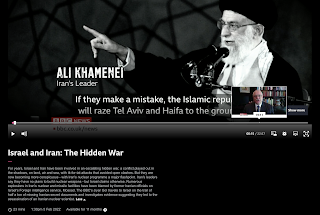
I was surprised to see this programme at lunchtime the other day, while the TV was accidentally tuned in to the BBC.


I hadn’t come across Jiyar Gol before. He’s a Kurd, I find.   I know it’s a bit of a stretch but this documentary reminded me of Fauda - but real-life!  (I looked at Rachel Shabi’s review of Fauda - in the Guardian, of course. Predictably, Shabi found a way of complaining that (the fictional ) Israeli series (made by Israeli TV) wasn’t anti-Israel enough.) 


I dread to think what the bulk of BBC-educated viewers made of this interesting documentary about the Iranian nuclear programme and Mossad’s efforts to disrupt it. BBC educated viewers will probably see things from a Guardianist point of view, but I found this film surprisingly impartial. Facts. Facts and derring-do. 


On the other hand, it’s possible that viewers more knowledgeable than I will have spotted flaws and biases that went over this viewer’s head. It was well worth watching.


Update:

And lo and behold, Camera has supplied more info. I hadn’t seen the BBC web article accompanying the film when I wrote the above. The flaws and biases may or may not have been more egregious in the written piece, but I’m linking to it. You be the judge.


lll


I meant to say something about this several weeks ago. It’s growing more belated with every day that passes.


Straight after the Ghislaine Maxwell verdict, the BBC accidentally aired an interview with eminent lawyer Alan Dershowitz - and, shock horror - without highlighting the fact that he ‘had a dog in the fight’.


We know the BBC believes this was ‘an accident’ because the BBC apologised for doing so. 

The fact that Dershowitz himself drew attention to his own involvement in the Epstein/Maxwell affair - he is one of Virginia Giuffre’s alleged abusers - didn’t seem to materially affect the BBC’s unique display of contrition. The regret was solely that they’d inadvertently given a platform to an undesirable speaker. After the broadcast, the corporation admitted that the US lawyer had not been "a suitable person to interview as an impartial analyst" at that time.


“4.3.12 We should not automatically assume that contributors from other organisations (such as academics, journalists, researchers and representatives of charities and think-tanks) are unbiased. Appropriate information about their affiliations, funding and particular viewpoints should be made available to the audience, when relevant to the context.” [emphasis added]


I hope that apology sets a precedent for all forthcoming interviews with agenda-driven and partisan spokespersons and that the BBC is obliged to state the interests and biases therein and provide relevant apologies where appropriate. 


Suggest all interviews with agenda-driven spokespersons be automatically accompanied by a sign-language interpreter signing ‘he (or she) would say that wouldn’t he’ 


Monday, 3 January 2022

A united front


Sticking with Radio 4's Correspondents Look Ahead and the BBC World Service's BBC Correspondents Look Ahead, I noted Lyse Doucet talking on the former about the "fear" that the Iran nuclear deal would collapse and talking on the latter about how "while it wasn't perfect...it was certainly better than it is now". 

That takes me back to February last year when the BBC's Middle East Editor Jeremy Bowen took to From Our Own Correspondent and sang the praises of the Iran nuclear deal and sounded off on how wrong it was that Donald Trump took the US out of it, telling Joe Biden what he needed to do: 
President Biden's big Middle Eastern challenge is to amend some of the damage done when Donald Trump pulled America out of the agreement to restrict Iran's nuclear activities. Iran has always denied that it wants a bomb but since President Trump made his move the Iranians have intensified their enrichment of uranium and are now closer to being able to create a weapon. He needs to avoid repeating the terrible mistakes of the last 30 years and that starts with restoring the agreement with Iran. It was far from perfect but it stopped a slide towards another Middle East war. Nobody wants one, but it's a possibility if the problem is left to fester. 
 I said at the time, "This is advocacy journalism, isn't it?"

John Simpson also took to Today in 2018 to outline his opposition to Donald Trump taking the US out of the deal.

All three of them think the same way about it, and have the opportunity to give their shared point of view from the BBC's bully pulpit , unchallenged.

This blog has several fine pieces from Sue putting the other side of the argument - that the Iran nuclear deal was worse that just 'not perfect' and that it was a bad and dangerous deal that Donald Trump was right to take the US out of:

Sunday, 17 October 2021

Random Thoughts for a Sunday Evening


I

Lib Dems, lib Dems and Facebook

It's been a while since I've made myself listen to The World This Weekend but I learned something quite interesting from it today - albeit only after a bit of Googling as they didn't disclose it themselves.

The programme's main focus was on demands to regulate Facebook, particularly in light of the murder of Sir David Amess. 

I avoid Facebook like the plague.

Being politically-minded I now associate Facebook with Sir Nick Clegg, as he's become their Vice President for Global Affairs and Communications at Facebook since 2018.

The World This Weekend's sole defender of Facebook today was one Lord Allan, Facebook's Director of Policy in Europe until 2019. 

Like former Lib Dem leader/Deputy PM Sir Nick, Lord Allan is a former Lib Dem MP. So Facebook seems to like UK Liberal Democrats. 

And it gets spookier.

Lord Allan, it turns out from searching for him on the internet, was the MP for Sheffield Hallam from 1997-2005 before giving way to the one Nick Clegg, who remained MP for Sheffield Hallam from 2005-2017. 

What are the chances of that happening?

My random thought here is that maybe the American liberal Democrats at Facebook chose the UK's Liberal Democrats because of their party name, assuming because they call themselves 'Liberal Democrats' they must think like liberal Democrats in the US...and, if so, they should be careful when hiring from Russia and Japan or they might end up with Vladimir Zhirinovsky and Shinzo Abe, and they might un-ban former US president/possible future US president Donald Trump while Mark Zuckerberg isn't looking. 


II

The BBC and the word 'terrorist'

The estimable Scottish blogger Effie Deans has a thoughtful piece on her Lily of St. Leonard's blog about the murder of Sir David. It made me re-think a few things. and is well worth a read. 

If Sue's not seen it yet, it begins: 

Whenever there is a terrorist attack in somewhere like Israel, we are told by the BBC that it carried out by militants. It gives the impression that the far left from the 1980s stopped handing out newspapers to blow himself up. Only when a terrorist attack happens here in Britain will the BBC allow itself to describe it as such. IRA militants after all did not try to blow up Margaret Thatcher. If a word is useful then we must use it consistently. If something is terrorism call it terrorism, otherwise you are lying in which case how can you be trusted on anything.

It then moves on.

It's certainly true that the BBC will use the word 'terrorist' more about terrorist attacks in the UK than anywhere else and that it goes out of its way to avoid applying it to the like of Hamas or Islamic Jihad or Hezbollah.

But the BBC has used it in connection to radical Islamic terrorism in the UK through the most gritted of gritted teeth over the last couple of decades. 

They were very reluctant to begin with post 9/11, and particularly post 7/7 in London. 

All of us hereabouts observed that at the time. 

It made the BBC look terrible and absurd. 

I'm guessing they finally realised that they were dangerously adrift from the public mood, so they eventually eased the prohibition. 

And that's where we are now - with a word that should never had been banned being grudgingly allowed in the UK context - albeit still through gritted teeth on certain BBC reporters' parts - but still being banned [except in heavy inverted commas] when it comes to terrorism against, say, Israel.


III

Sunday, Flipping Sunday

The one Radio 4 programme I've tried to keep up with during my blogging slumbers is Radio 4's Sunday, what with it being the starting point of this very blog. 

It never really changes. 

Todays programme featured:  

[a] Takes on the murder of Sir David Amess which avoided the thorny issue of Islamic terrorism.

[b] An entirely one-sided 'woke' segment on Ethiopian demands for the return of some sacred plaques held by the British Museum where neither context nor the other other side of the argument was given. Presenter Emily Buchanan simply announced that the Ethiopians were demanding them back, said that we [the UK] ''looted'' it, and stated that ''lawyers'' said it was legally right to return them, and then interviewed an Ethiopian Orthodox priest who told listeners how precious these plaques were to the Ethiopians. When it's that one-sided it reeks of abetting a campaign.

[c] A strange piece about how cuddly toy deities might be ''the best way to help children understand faith and culture'', reporting on how a range of cuddly toys of deities like the Hindu god Ganesha is ''expanding to include all major faiths'', including Jesus and Buddha. I googled the company and checked their range of cuddly toys and found that the phrase Sunday kept using - ''all major faiths'' - wasn't quite true. You won't be surprised to hear that Islam was the exception and that the BBC skirted around the point like a cat trying to avoid its fated date with a cage during a trip to the vets. 

[d] A piece on a Jewish comedy Fringe event featuring...and here's the BBC angle...''the only Orthodox Jewish woman on the British comedy circuit''. There's always got to be a bit of identity politics and marking of identity politics milestones. 

[e] The inevitable book-plug for a friend of the programme, here Catholic author Peter Stanford. 

[f] A somewhat campaigning closing segment about aggrieved Muslim women being refused entry to pray within some mosques and how ''conservative'' attitudes in mosques need changing, followed by an interview with Sunday's favourite Muslim, the silky Sheikh Ibrahim Mogra, who positioned himself somewhat vaguely on the matter, as is his way. At least Sunday raised the question of Deobandi influence.

I've been going on about the programme for over a  decade now, but there's now a small legion of people criticising Sunday every single week on Twitter and on blogs hereabouts. It's a growth industry that growing fast. The programme remains the ripest of ripe targets as far as BBC bias is concerned.


IV

Nancy wonders if it's just her

Following today's Sunday was - as ever - Sunday Worship. I was in the mood for hymns and heard it live. 

It provoked a murmur on Twitter when Annunziata Rees-Mogg [sister of Jacob] complained about it being about gender equality today when it should have been a Catholic service in honour of Sir David Amess.

Wouldn’t it have been nice if Sunday Worship on BBC Radio4 had been from a Catholic Church in memory of Sir David Amess? And perhaps a sermon about the value of public service rather than gender equality? Or maybe that’s just me.

Now, I have to say that - much as I can see where she's coming from -  I agreed with those of her critics who pointed out that these things are prepared weeks and months in advance. The BBC publishes the text and running order of the service in full before it's even broadcast. And this was coming live from Ely Cathedral. So this was a juggernaut that's being rolling for weeks ready for this morning, and the BBC couldn't just drop it and swap it with a different service. And, in the event, a pray for Sir David was said at the start before the feminist-influenced, all-women service about women in the Bible began.....though, amusingly, the male dean popped up at the end to read the blessing.

So Annunziata might have been better saying that, yes, the BBC couldn't reasonably have replaced this service at the last minute, but that it's still 'very BBC' that the identity-politics-obsessed BBC Radio 4 prepared yet another service with an 'identity politics' focus today, because Sunday Worship is doing that ever more often as the channel increasingly sinks into a smelly slough of 'woke'.


V

John Simpson says 'this can't go on'

Fantasies, born of childhood/adulthood reading of brave British men rescuing women in peril, have occasionally led me to dream that we British would somehow spring Nazanin Zaghari-Ratcliffe from jail in Iran, literally leaving behind a Carry-On-style black fingernail card of 'two digits rampant' for old 'Smiler' Khamenei to splutter at as his beard caught on fire humorously.

Five years younger than the Supreme Leader of Iran, the BBC's World Affairs Editor John Simpson is unimpressed

The rejection of @FreeNazanin Zaghari-Ratcliffe's appeal in Tehran is predictable but disgraceful. She is being held hostage for the repayment of a £400m debt the UK owes to Iran. Handing money to Iran is a big problem, given its support for terrorism; but this can't go on.

I do believe that the BBC's Mr Impartiality is demanding, ever so impartially, that the British Government cough up to the terroristic, hostage-holding Ayatollah. 

Hm. 
Sunday, 28 February 2021

How would the BBC have reported the US airstrikes on Iran-backed targets if Donald Trump had launched them so early in his presidency?


Did you know that President Joe Biden has already bombed Syria? 

It's something that could easily have been missed if you simply relied on BBC TV/radio news. 

Here's Rod Liddle in The Sunday Times this morning: 
Joe Biden’s kinder, gentler America fired a number of missiles into Syria last week, killing an estimated 22 people. I assume it was some kind of goodwill gesture towards foreigners. Certainly that’s how it was reported by the BBC. Whenever Trump did anything similar it was presented as “fascist madman murders civilians and starts Third World War”.
That sounds like the sort of thing the BBC would do, but did they? I've searched via TV Eyes and I can only find one reference to the US airstrikes on Syria on BBC One or BBC Two or the BBC News Channel, at around 5am on Friday morning - which is quite some feat of under-reporting. 
  
I see Radio 4 reported the US strikes though, intermittently, throughout Friday and Saturday. Except for a brief mention during a news bulletin, Today ignored the story, as did The World at One and The World Tonight. However, Friday's P.M. asked one question about it. Rod must have heard it somewhere on Radio 4.

How did they report it then? 
  • 2am, Friday: The Pentagon says the US military have hit facilities in eastern Syria used by Iran-backed militias in retaliation for recent rocket attacks on US troop locations in Iraq. A defence spokesman said the air strikes were carried out following a directive from President Biden.
  • 6.35am, Friday: Joe Biden has authorised his first known air strike since becoming US President. It targeted facilities in eastern Syria used by militias backed by Iran and was in retaliation for recent rocket attacks on American targets in Iraq.
  • 11.02am, Friday: The US says its air strikes on targets in eastern Syria have destroyed 9 facilities controlled by Shia militia. It's the first US military operation since Joe Biden became president. The attacks were ordered after a civilian contractor was killed by rockets fired at US positions in Iraq.
  • 5.50pm, Friday: Evan Davis: Now, the first military action of the Biden administration was carried out last night - an air strike targeting Iran-backed militias in Syria. That came 10 days after Americans were targeted. A civilian contractor was killed in a rocket attack on US targets in Irbil. Syria has condemned the attack as "a bad sign" from the new US administration. But are we able to say much about American foreign policy under Joe Biden? As we speak in fact, lines are coming out of the White House. It has just said "strikes were necessary to reduce the threat of further attacks" and the Americans have also said they will be releasing later today their evidence, their intelligence, on the killing of Jamal Khashoggi, that killing. We can talk to Karin von Hippel, who's Director General of the Royal United Services Institute for defence and security studies. This strike last night, Karin, some might say it shows a a willingness to get dragged back in. I don't know. What did you make of it? Karin von Hippel: I actually think it was a targeted and limited strike and, in a sense, a response to say 'you can't attack American bases or American personnel or troops' and also a message to Iran, that's getting involved in a lot of proxy conflicts, or has been, for a very long time in the region and Biden is very desperate to get back into an Iran deal, the JCPOA plus whatever the new version will be, and there's a big debate going on about whether or not Iran's involvement in the region should be brought into the deal or not. So this is sending a message to the Iranians essentially. Evan Davis: Great.
  • 4.04am, Saturday: President Biden has said that Iran cannot act with impunity, and he warned the country's leaders to be careful. He was speaking after US warplanes attacked facilities in eastern Syria controlled by Iran backed Shia militias. At least 17 people were reported killed. With more detail, here's Gary O'Donoghue. Gary O'Donoghue: The Pentagon spokesman John Kirby said two F15 aircraft dropped a total of 7 precision-guided munitions totally destroying 9 facilities and partially destroying two others. Battle damage assessment, he said, was still being carried out and he would not confirm reports that 17 people have been killed on the ground. The strikes, he said, were justified under both US law and United Nations statutes and were directed at Iran-backed Shia militia groups.
As well as a few other short summaries overnight on Friday night and Saturday morning, that seems to have been it. 

Even the likes of Jeremy Bowen have kept quiet on this story.

It's as if, without Donald Trump, the urge to report - and denounce - certain actions holds less appeal.

Saturday, 12 December 2020

Jeremy speaks


The Trump administration took the USA out of President Obama's nuclear deal with Iran. 

The US withdrawal was backed by Israel, Saudi Arabia and other Arab states but opposed by the EU, the UK, and the BBC's Middle East editor Jeremy Bowen. 

Here's the latter, on today's From Our Own Correspondent, expressing his view on the matter again: 
Donald Trump had an even bigger impact on policy towards Iran. The Obama administration, along with other permanent members of the UN Security Council and Germany, stopped what I believed was a steady slide to war by making an agreement with Iran about its nuclear activities. It wasn't perfect deal - show me one that is - but it was a chance for a new beginning.  
His FOOC piece was also notable for focusing on what matters to Jeremy Bowen - the Palestinians - while missing out the remarkable peace deals between Israel and Arab countries. And President Trump's dogged reluctance to entangle the US in Middle Eastern wars, unlike all his recent predecessors (also unmentioned), adds an ironic twist to his concluding advice (prayer?) for Joe Biden: "Perhaps the most constructive move Joe Biden can make after his inauguration is to concentrate more on diplomacy, less on drones and the other dogs of war."

Saturday, 28 November 2020

A tale of the BBC and two presidents


The BBC has spend most of this past month doggedly attaching phrases like "without providing any evidence" to headlines about US President Trump's claim of election rigging, so it's intriguing that they are adding no words of caution whatsoever to headlines like this this morning on the BBC News Channel: 
Iran's President Rouhani blames Israel for the assassination of a top nuclear scientist, saying his country won't be deterred from its nuclear ambitions. 
Shouldn't that be?: 
Iran's President Rouhani, without providing any evidence, blames Israel for the assassination of a top nuclear scientist, saying his country won't be deterred from its nuclear ambitions.

Saturday, 4 July 2020

Art of Persia


Samira Ahmed's three-part series Art of Persia, broadcast on BBC Four, was superb - though I'd say it was as much a history of Persia/Iran as it was about the art of Persia/Iran.

What a history though! And what art and architecture! What austerely beautiful landscapes! What magnificent camera work!

And Samira made for an enthusiastic, agreeable presenter. 

It was filmed over six weeks between March and June last year. 

It had taken three years for the BBC to secure visas from the Iranian regime but, as Samira wrote in the FT, the regime then proved to be very helpful, granting them "generous access".

She calls this generosity "an important olive branch". 

Indeed, she sees the series as a form of "cultural diplomacy", going beyond "the news headlines about the Iranian regime" and "offering the chance to make a connection with the Iranian people and gain a new perspective on the world. One that is less western-centric". 

I very much enjoyed it and marvelled at the clear, unashamed love of the Iranian people for their culture and history - very much including their pre-Islamic history. They won't be toppling statues from their past any time soon.

But Sue pointed out something she'd read: that the programme hadn't mentioned the regime. 

That was before the final episode, but when the final episode came I was surprised when it pretty much ended in 1979, with the bulk of its final section laying out the case against the last Shah of Iran and explaining why, through his un-Persian/un-Iranian folly, he helped bring about his own destruction and paved the way for the revolution. Of post-revolutionary Iran and the theocratic regime of Ayatollahs Khomeini and Khamenei and their attitudes to their country's heritage, there was literally just one, short, three-clause paragraph, and absolutely nothing critical of their rule. 


This left a slightly sour taste in my mouth. Yes, you're the BBC and you've been granted a huge favour by the Iranian regime, allowed in to glory in the country's past, to talk to its friendly people, and to go where no BBC presenter has gone before; you're allowed to see site after site, visit city after city, and look at rarely-seen hidden-away artifacts; and you show it all in the most glowing light, but you don't utter a single word of criticism of the rule of the Iran's latest rulers - the Islamist regime of the supreme leaders. Why did history stop in 1979 for this BBC series? Why such a slating for the Shah and no slating whatsoever for the cruel, despotic clerics who displaced him? Ah, because this is "cultural diplomacy", that's why, and the sharing of an "olive branch" with that regime. 

Oddly, it's only in her FT article that Samira Ahmed gives us the kind of information I think ought to have been in the series itself: 
After the 1979 revolution, there was a mood of purifying zeal. At Persepolis, Islamic revolutionaries turned up with bulldozers. But local people and the mayor of nearby Marv Dasht convinced them to turn back. In 1988, then president Ali Khamenei, now Iran’s supreme leader, visited the site and acknowledged its importance as national heritage, but also declared such places symbols of tyrannical monarchy (it is no coincidence that the Pahlavis, overthrown in 1979, keenly associated themselves with Persia’s historic kings). In recent years, protesters have gathered at Pasargadae, one of the last remnants of Cyrus’s capital city, adopting him as a figurehead of resistance to the regime.
Cyrus the Great was the king who freed the Jews from captivity in Babylon and allowed them to return home. Ayatollah Khamenei is an antisemite who wants to expel the Jews from their homeland. Things don't always get better.

Saturday, 9 May 2020

#IslamicRepublicOfBBC


A while back I spotted a large-scale, strange trend on Twitter and dipped into it. 

Its hashtag was #IslamicRepublicOfBBC. 

All the tweets on it accused BBC Persian of being biased in favour of the Iranian regime.  

It now appears that this is a regularly-trending hashtag, but the question is: does it reflect widespread anger among Iranians and the Iranian diaspora against the BBC, or is it a concerted attack on the BBC by a tiny clique of anti-regime activists? 

In other words, is it a genuine Twitterstorm or a fake Twitterstorm? 

Marc Owen Jones, a professor at Durham University, who several of the people I follow on Twitter also follow, has laid out evidence that it's largely an arranged campaign from a small number of right-wing, royalist, anti-regime accounts. 

His findings aroused the interest of the UK's Ambassador to Iran Rob Macaire, who replied,"Maybe someone should get all the people in the govt here who attack BBCP for being ANTI regime, and put them in a room with all the people in this Twitter storm accusing BBCP of being PRO regime. They could have an interesting conversation, about...eg...balanced journalism?". 

Neither Prof. Jones or Ambassador Macaire are going down well with the people supportive of/behind the trend, but - if the professor is right - well, they would dislike their posts, wouldn't they? 

*******

Ironically, in looking into this, I glanced down Professor Marc Owen Jones's Twitter feed and, within just a few more tweets, found him bashing the BBC himself.

This is what he tweeted yesterday:


And what was it that provoked him into Orwellian imagery exactly? Well, this
 

Hmmm, I rather suspect that George Orwell wouldn't have sympathised with Prof. Jones here.

*******


Looking further (as the professor himself is wont to do on Twitter), you find that his Twitter feed (unsurprisingly) reveals him to be a 'citizen of nowhere' who doesn't like Brexit.

It also reveals that he doesn't like Israel, and he's previously criticised the BBC for its "customary" pro-Israel bias - a criticism he repeatedly makes of the corporation. (He got into a short Twitter spat with Camera UK/UK Media Watch's Adam Levick last December). 


Hmmm, maybe he has an agenda himself? Should we. therefore, re-open our minds on that #IslamicRepublicOfBBC hashtag, or should we simply park that as 'still being likely to be true, despite the professor's own biases'? 

Probably the latter I think, but what do I know? 

Thursday, 23 April 2020

Losing control?

While I’m at it, (posting yet another slightly off-topic minority-interest screed) I might as well flag up this fascinating article by Con Coughlin

While still trying to digest Col Richard Kemp’s comprehensive observations on the global implications of China’s relations with the rest of the world, Gatestone Institute has thrown another politically seismic situation at us that needs to be pondered over.


It’s Iran. The oil price has collapsed, coronavirus has hit hard, Iran is running out of cash and the Ayatollahs are losing control.

“The scale of Iran's deepening economic crisis is reflected in the regime's recent decision to seek $5 billion in emergency funding from the IMF, its first request for outside help since the 1979 revolution. 
Iranian President Hassan Rouhani has tried to put a brave face on the latest setback to hit the regime, claiming that Iran is unlikely to suffer as much as other countries from the oil price drop because it is less reliant than others on crude exports. 
If that were truly the case, then Tehran would not be asking the IMF for a bailout, and Mr Rouhani, together with Javad Zarif, Iran's Foreign Minister, would not be begging Washington to remove sanctions. 
The truth of the matter is, for all the regime's attempts to claim it has everything under control, that the country is teetering on the brink of collapse, and the ayatollahs are fast running out of options to save themselves.”

Meanwhile, they’ve been demonstrating their technical prowess with the flamboyant launch of a military satellite, which has "successfully" gone into orbit


If anyone is interested in ITBB’s extensive back catalogue of Rouhani-related contributions from Craig and me, click here.    What could possibly happen next?

Sunday, 12 January 2020

"So why misrepresent?"


Only yesterday morning BBC & other UK media were salivating over fiction that Soleimani’s killing had brought national unity in Iran. Along with many others I told them the reality in this article. Their journalists are not stupid so why misrepresent?
To which can be added Suzanne Evans's reply:
Will never forget most broadcast journalists salivating over the Arab Spring too, thinking it was positive. Watched with utter disbelief. Nothing changes.

Our man in Iran


Our ambassador to Iran tweets:
Thanks for the many goodwill messages. Can confirm I wasn’t taking part in any demonstrations! Went to an event advertised as a vigil for victims of PS752 tragedy. Normal to want to pay respects- some of victims were British. I left after 5 mins, when some started chanting. Detained half an hour after leaving the area. Arresting diplomats is of course illegal, in all countries. See comments by Foreign Secretary.

Friday, 10 January 2020

Slip of the tongue?


Breaking news:
Adel Darwish: A BBC senior staff has just said “the murder of Qassem Soleimani” before quickly saying “killing of” live on @BBCr4today .. hopefully .. hopefully it doesn’t reflect Auntie’s groupthink on the issue!!
That was Frank Gardner (around 8.14 am) after seeming to bend over backwards to put Iran's possible shooting down of a Ukrainian airline in the most favourable (to Iran) context possible. 

Wednesday, 8 January 2020

The madman theory


A man with a tan

The BBC's permatanned North America correspondent Nick Bryant, talking on last night's BBC News at Ten of "the most unpredictable president ever to occupy the White House", concluded his latest editorial for the BBC by saying:
It sometimes feels like Donald Trump is pursuing a modern day version of what Richard Nixon called 'the madmen theory', creating a sense amongst American adversaries that he would be prepared to take the most extreme military options, casting aside the notion of proportionality. He has also repeatedly stated he doesn't want to embroil his country in another Middle East war, an objective made much harder by his decision to assassinate General Soleimani. America is sending B52 bombers to its base in the Indian Ocean, planes for decades that have symbolised its military might. Will the perception that Donald Trump lacks restraint check the response from Iran?

Sunday, 5 January 2020

Editorial


Here's Mark Mardell introducing the first item on today's The World This Weekend:
The body of General Qassem Soleimani has arrived back in Iran. Tens of thousands of mourners have packed the streets walking alongside the flag-draped coffin. Women sang a hymn to the fallen general. The depth of mourning for the infamous spymaster, Iran's chief foreign strategist, isn't in doubt. The consequences of the US assassination of him are still very uncertain. President Trump has announced in a tweet that if Iran carries out its threat to retaliate the United States is ready to hit 52 Iranian sites "very fast and very hard". He said they be at "a very high level and important to Iran and Iranian culture". Deliberately attacking cultural sites would be a war crime. The number of targets, 52, is rather bizarrely based on the number of US hostages taken by Iran some 40 years ago.

Saturday, 4 January 2020

Are we very, very lucky to have James O'Brien?


In the wake of the US's killing of General Soleimani, LBC's James O'Brien issued this effusive tweet in praise of the BBC:
Probably a good moment to remind ourselves that with journalists like John Simpson, Jeremy Bowen and Lise Doucet, we are very, very lucky to have the BBC.
(Yes, he spelt Lyse's name wrong). 

You won't be surprised to learn that Jeremy Bowen and John Simpson both put their retweet functions to good use. They do like being praised. 

Even if JO'B had copied in Lyse Doucet, I doubt she'd have retweeted it. She doesn't seem the type.

Friday, 3 January 2020

"Assassinating him seems like a step back to a more savage past"


I knew it wouldn't take long, and that he'd strongly disapprove:

Preaching? (2)


Further to the previous post, nothing stops the BBC's agenda-pushing juggernaut when it's cruising at top speed: 

BBC Breakfast's main story this morning concerns the Australian wildfires. After covering this they moved on to their second story, the Met Office on record temperatures over the past decade and climate change. Then five minutes into the hour came their third story, the US's killing of Gen. Qasem Soleimani, head of the Iranian Revolutionary Guards' elite Quds Force and overseer of Iran's proxy wars abroad. Clearly, even the killing of the effective No.2 in the Iranian regime wasn't going to stop the BBC putting a Met Office statement about climate change nearer the top of its news reporting on BBC Breakfast this morning.

Tuesday, 5 November 2019

I was about to post this yesterday, which was when this news appeared online, but  I didn’t get round to it. I couldn’t find anything about it at all on the BBC, so all I asked was: Is there any sign of this news on the BBC yet?  


Ali Akbar Salehi


This morning we did hear about it. From Sir Richard Dalton on the Today programme.
“It’s our own fault” seemed to be the gist of his message. Are these views still representative of “our” FCO?

Saturday, 27 July 2019

John Simpson does it again


Do I bother too much about BBC World Affairs Editor John Simpson's often highly opinionated Fran-Unsworth-busting tweets?

Well, even if I do, here's the great Afghan burka babe's latest Twitter outburst:


What tickled my fancy here, besides his telling EU reference, is than John didn't mention the only country to even remotely rival China, executions-wise, at the moment: namely the Islamic Republic of Iran.

This is relevant, particularly given that several earlier posts here at ITBB noted how BBC types, especially John Simpson, have been regularly defensive in favour of Iran. (Please read our linked posts about it if you doubt it).

Iran carried out more than 253 executions in 2018, beating Saudi Arabia by around a hundred executions and Pakistan by some 240 executions. It's either first or second (depending on the mystery on the numbers executed in China). 

So why did Impartial John 'forget' his beloved Iran here?

A tweet may be a minor thing, but if the BBC's World Affairs Editor is making a point here and, whilst doing so, somehow 'forgets' Iran - either the biggest or second biggest offender of all (with China as the complicating factor) - because he's sympathetic towards their country because of their past treatment at 'Western' hands, then that's surely something, isn't it?

Friday, 10 May 2019

Media round-up

On the whole, we source material from other blogs, press and media. I suppose it’s essentially churnalism, in that we regurgitate all sorts of news and views, but with a twist, as they say on The Great British Menu. Deconstructed fish ’n’ chips always goes down well. 

If it weren’t for our sidebar and various other online content, we’d be stuffed. If it weren’t for other blogs I certainly wouldn’t have a lot to say. To stave off dementia I might have to compose entertaining stories about our cat. Craig could seamlessly revert to blogging his favourite music and poetry and illustrate it with amusing videos of cats trying to squeeze themselves into tiny cardboard boxes. 

In the meantime, let’s persevere with the stolen goods. 

The Evening Standard has found yet another piece of the jigsaw that depicts Jeremy’s Corbyn’s antisemitism.   and yesterday Guido ‘had a little list’ of similar findings.

Melanie Phillips sums up recent ‘unsurprising’ examples of the media DOING WHAT COMES NATURALLY 
“A number of British media outlets led their reports with the false accusation that a pregnant Gazan woman and her 14-month-old baby had been killed by the Israeli strikes. In fact, as PIJ eventually admitted, they were killed by a malfunctioning rocket fired from Gaza. 
Some outlets corrected this error; others did not. None, though, pointed out that these particular casualties furnished graphic evidence that the Gazan warmongers weren’t only targeting Israeli innocents but using their own Gazan people as human shields by putting missiles in and around civilian homes – thus committing war crimes twice over. 

On Harry’s Place, we are treated to some nasty tweets by Mohammed T Akunjee whom the BBC apparently see as a credible guest. Here’s a nice one.

The Gatestone Institute has been featuring articles about Iran. Here, the author Majid Rafizadeh writes that Trump’s sanctions seem to be working.
“Feeling the pressure of sanctions on Iran, Hassan Nasrallah, the leader of Iran's proxy, Hezbollah, has also called on his group's fundraising arm "to provide the opportunity for jihad with money and also to help with this ongoing battle.”
Another piece addresses Iran’s persecution of Christians. Iran's 'Terror Factory' Targeting Christians by Uzay Bulut, and yet another tackles Iran’s expansionist aspirations.
“One of the primary revolutionary ideals to which the ruling clerics of the Islamic Republic of Iran are dedicated to upholding is not to limit the implementation of its version of Islamic laws to just Iran. The ruling clerics are also committed to exporting Iran's revolutionary principle and expanding the fundamentalist mission to other nations. 
How do they carry this out? By effectively taking over other countries. Lebanon, through Iran's proxy Hizballah, was the first. Then came Syria, and finally, Iraq -- with the Hamas-controlled Gaza Strip waiting in the wings. 
With each victory, the ruling mullahs of Iran have grown increasingly lethal and increasingly bold. At present, and for several years, Iran has set its sights on Yemen. 
This is not a random or new philosophy. This mission is part of Iran's constitution. Its preamble states that it "provides the necessary basis for ensuring the continuation of the Revolution at home and abroad.”

Why am I mentioning all this Iran stuff on a blog about BBC bias? Well, one reason is the way the BBC seems to carry out its deadpan impartiality to the nth degree. As if its policy is ‘über alles, avoid making value judgements’.

Last night I heard an item about an American-Iranian female football coach (Iranian-American coach Katayoun Khosrowyar) on BBC WS. She sounded jolly enlightened and liberated. 

However, the rules state that even in professional footy, the hijab is compulsory because the female body must be fully covered at all times, including during matches. It was duly acknowledged that this does restrict one’s ‘freedom of movement’, literally, but there wasn’t even a flicker, or a raised eyebrow to indicate doubt, dissent or curiosity about this, either from the lady herself or from the BBC anchor. Does the BBC demand impassive non-judgemental impartiality on all topics at all costs and above all else? 

It’s possible that a general atmosphere of stoic resignation to extreme religious dogma prevails in Iran amongst even the most liberal-minded citizens. But why do we have to ‘go along with it’ as if it’s a perfectly acceptable phenomenon? 

I know that’s a tiny, perhaps insignificant example of the kind of normalisation of Islam that one has come to expect from the BBC, but still, doesn’t the mind boggle at the idea of playing sport covered head-to-toe for ‘modesty’?

Mine does.