Showing posts with label BBC Bitesize. Show all posts

Saturday, 6 March 2021

'Why is "BBC Bitesize" Promoting Gender Ideology to Children?'


(h/t Stew Green)

Here's a well-presented video from Caroline ffiske concerning the BBC's reaction to criticism over its promotion of a particular ideology:

In response to her complaint about a BBC Bitesize feature pushing new gender pronouns like 'nem'. 'nir', 'viva', 'sphere', 'z', 'zamzia', etc, among school children, the BBC said, "As we have with Stonewall on this article, we have worked with experts to ensure that our content is factually accurate." But are Stonewall "experts"?

On which topic, here's a Twitter thread I was reading this morning which begins:
ripx4nutmeg: The BBC has refused to answer an FOI request about its work with Stonewall (but admitted it gives them thousands of pounds). Reason: 'The public interest is not served by [other] public bodies being less willing to engage in programmes which help them improve LGBTQ+ inclusivity'. 
Solange: The BBC really, really doesn’t want to spill the beans about its relationship with this political lobbying group. 
C Isaksson: Are you appealing? 
ripx4nutmeg: It wasn't me that asked for the FOI but is there even an appeal process? If there is, it probably isn't necessary - the 'impartial' BBC has now effectively admitted it is terrified of doing anything that will risk its project of disseminating Stonewall's gender identity propaganda.
Here is the BBC's response under discussion:


Update

The world turns topsy-turvy and, because of the viciousness of the transgender debate, the Guardian's previously ultra-Guardianista Suzanne Moore left the paper and transitioned to being something I'd never have expected her to be in several months of Sundays: a Daily Telegraph columnist. (What's next? Polly Toynbee writing for The Conservative Woman?)

Today she asks "a few little questions", one of which is: "Why can't the BBC talk about Stonewall funding?"

The same tweeter featured in the post above replied, saying "The BBC's argument seems to be that if they talk about their association with Stonewall this could have a detrimental effect on Stonewall's aims. But they don't explain why this would be the case or why that's any of the BBC's business when they're meant to be impartial."

Further Update:

And The Times's Janice Turner crystallises the argument further here: 

Here the BBC refuses to answer a Freedom of Information request about what advice it pays Stonewall £6k a year to give it. Because its reply might jeopardise the commercial interests of Stonewall. Amazing.

Tuesday, 12 January 2021

BBC Two's much praised lockdown educational output begins....with Greta


I was probably too sour the other day, and may have reacted in a knee-jerk fashion. (Or maybe not).

And it may very well be a wonderful thing that the BBC is broadcasting hours of extra educational programmes on CBeebies and BBC Two each day because of lockdown. (Or maybe not).

But...

...those tuning into BBC Two's Bitesize programmes today for secondary school children will have found the following at the start of the channel's two-hour educational package:

Since it's Science Week here at Bitesize Daily, our Big Read is Devika Jina's book, The Extraordinary Life of Greta Thunberg. 
Yesterday, we read about Greta's early childhood and how she first learned about climate change watching documentaries at school. 
In this extract, we get more insight into Greta's personal life and what makes her extraordinary. 

This isn't a parody. 

The sciences cover such a broad range, as does the science curriculum. Trust someone at BBC Two to place their favourite climate activist Greta front-and-centre of their opening week of educational programmes! 

And there was Professor Brian Cox to follow. (Things well and truly could only get better - it was his OK-ish The Planets series.)

I rather like Prof Cox, but he's long been the present BBC's idea of a 'hip-and-down-with-the-youngsters' scientist - despite being 52. He holds all the right views too.

You can just imagine the thinking at BBC Two as to what to choose for Week 1: 

(a) "Got to put out something about science. What can we put out? Something about climate change maybe? Ah, there's a book out about Greta Thunberg's extraordinary life. Good! Is there something on BBC Bitesize that? Yes. Should we put that out? Yes, that's a good idea. Let's do it." 

(b) "What else? Something from Brian Cox?".

Tuesday, 5 January 2021

Another Brick in the Wall


It all started with a tweet from Rory Bremner (as himself):


Yes, from 11 January CBBC will "have a three-hour block of primary school programming from 9am". And BBC Two "will cater for secondary students with at least two hours of content each weekday".

Update: According to this Twitter feed, Boris is a fan:
Fantastic initiative from the BBC, who will be helping children to learn while we all must stay at home. 

Dominic Cummings has certainly left the building. 

*******

Let's not forget, even if Boris does, that if you look up what BBC Bitesize says, on certain matters of public interest, they don't necessarily behave like disinterested educators. There's a strong whiff of BBC groupthink about their output.

If you look, say, at their Key Stage 3 section on Population and migration you find highly controversial statements presented as facts e.g.

Immigration is not new and the UK has been a multicultural society for thousands of years.

In my days, the word 'Discuss' would be put after that, at the very least. The BBC now presents it as fact.

Their 'case study' on Participation regarding Brexit is classic BBC (almost a case study, you might say). It ignores the left-wing case for Brexit and, in outlining the two sides (Leave and Remain) clearly favours Remain over Leave. The telltale language (one for English comprehension students?) is that Remain "highlighted the dangers" while Leave merely "argued" and "claimed". And it pushes the 'Russian interference' line regarding the outcome. 

And as for their coverage of Israel and the Palestinians, well, please read this if you think the BBC plays a straight bat on Israel:

Would you trust the BBC with your children? 

It remains a good question, doesn't it?

Wednesday, 5 August 2020

BBC Bitesize asks "What is white privilege?"


BBC Bitesize's latest tweet is this:

Tuesday, 4 August 2020

Craig's very important piece

Craig posted a significant piece on Saturday and it has quite rightly been picked up by The Conservative Woman. I hope it will be followed up by others as well.

The BBC has expressed an interest in delivering education directly to schools, allowing schoolteachers to concentrate on pastoral care.  Although left-leaning teacher training colleges are churning out graduates that share most of the BBC’s ideological and political views, could the BBC really make a useful contribution to the overall school curriculum? 
By the way, let’s just confirm what “pastoral care” is.
 “Pastoral care is defined as the commitment to, and active demonstration of concern for, the growth and wellbeing of each student, as well as the broader school community.
"Leave academic subjects to us", says the BBC, let’s make teachers provide the parental guidance that seems to have gone awol.
******
The BBC thinks it’s qualified to teach children M.E. history, a sensitive subject, and one that is particularly dependent on factual accuracy and rigour. Yet the BBC has proved woefully deficient in this area to date. It habitually allows ‘feelings’ to override ‘facts’ and in any case, it has trimmed and styled most facts appertaining to Middle Eastern history to fit its own fixed hostility to Israel.
This, from Wiki explains when and why Jeremy Bowen was appointed BBC Middle East Editor: 
"He became the BBC's first Middle East Editor when the position was created in June 2005 after the 2004 Balen Report on the BBC's coverage of the Israeli-Palestinian conflict[11] to provide a broader perspective on wider Middle East issues[12] and to add context to the reporting of events on the ground.
Bowen’s wrist has since been slapped for anti-Israel bias and he has held a personal grudge against Israel since his Arab driver was killed, in part due to Bowen’s reckless decision to film an on-the-spot report from a vulnerable hot-spot. Partiality coupled with superficiality do not a perfect reporter make.  (But it’s good enough for the BBC.)  
******
The responses to Craig’s post to date have veered off into two parallel but distinctly separate directions. One branch reflects a rapidly deteriorating trust in the BBC, which, if social media is in any way representative, is widespread.

However, the most directly relevant responses acknowledge that each time the BBC disseminates vague, half-understood and savagely cropped Israel-related material it aggravates pre-existing and equally half-understood anti-Israel and antisemitic animus. If the BBC is let loose on the state school curriculum, biased coverage of the Middle East conflict can only nurture and inflame existing antisemitism. 

Put in the form of the BBC’s favourite question: “How does that make you feel?” the answer has to be ‘Terrified’.
******
While palpable distrust of the BBC abounds, many commenters decided to leapfrog over the Middle East, so to speak, and skip straight to Jimmy Savile and BBC bias in general. Although understandable, I find that disappointing - but not as disappointing as the fact that antisemitic voices from ‘the right’ are still apparent on right-wing websites. This effectively hands ammunition to left-wing antisemites who rely on ‘whataboutery’ to deny their own racism.

Clearly, the BBC’s saccharine narrative that ‘all the Palestinians dream of is a state’ is so demonstrably false that the BBC’s chutzpah in promoting it makes the mind boggle. 

The tacitly agreed pretence that Islamic fundamentalism doesn’t feature in the Palestinian psyche is so conspicuous by its omission that I can’t even think of the most apt words to describe it. So I won’t.  The sources of reference for the BBC’s ‘bitesize’ history lessons need to be exposed for what they are. 

The selective array of Palestinian spokespersons and revisionist historians they’ve chosen to narrate their ‘story’ is telling. Collectively they’ve built up a picture so false, yet so beguiling that an insurmountable barrier obstructs every attempt to counter it. A wall of solidarity, if you like, which might also account for the racist rhetoric willingly showcased by the Seumas Milne arm of the press, The Guardian and Independent newspapers.
******
The BBC invariably misrepresents complicated situations by adding a little here and subtracting a little there, trimming and tweaking yet always leaving sufficient leeway for the BBC to demand 'benefit of the doubt', should any of it be queried. Their fairy tales are based on the myth that the ‘Palestinian people’ are uniquely indigenous to the region. Jesus of Nazareth and tales from the Christian bible have faded from the collective memory; the Jews are rebranded as interlopers in ‘another people’s land’. Stories concerning the creation of modern-day Israel have been turned on their heads, swallowed whole and regurgitated by fools. 

According to the BBC wars have ‘broken out’ spontaneously and the warring entities have been granted equal billing, like cowboys and Indians, cranes and crows or blacks and whites on a chequered board. 

The religion of Islam has been sanitised but when it hasn’t been completely erased from the narrative, Palestinians are portrayed as ‘devout’; their piety is ‘good’ piety and their zealotry is ‘good’ zealotry while Israeli Jews are portrayed as demonic religious zealots and baby killers. This is a trial in which evidence from only one side is ever given a fair hearing and the BBC is acting for the prosecution.

******
  
Ample evidence of bias has been cited by pro-Israel advocates over the decades but always ignored by the BBC. 

Has the BBC reported anything about Abbas’s ‘pay for slay’ policy? Has the BBC acknowledged any damning news about, say, the lies of the Palestinians’ chief negotiator Saeb Erekat? Gentle probing by Stephen Sackur, maybe?

If you want a typical example of one-sided biased journalism, look at the BBC’s recent ‘explanatory backgrounder’ “Israel annexation: What is the West Bank?” 
It was the subject of a Camera UK article, which deconstructed the piece with its customary forensic rigour. Both Camera UK’s critique and the BBC’s piece were posted on 30th June this year. 

Narrated by the BBC’s diplomatic correspondent Paul Adams, whose presentable veneer is plausible enough to mask the snake-oil-slick he must have ingested, inconvenient material has been slyly edited - added to or subtracted from - to evoke the usual predetermined anti-Israel message. 

Highly emotive language has been deployed; truth has been so steeply tilted that it’s effectively standing on its head. Looking at it again, the selective editing and production still strike me as particularly appalling. The scene is set with a ruthlessly trimmed, ‘bespoke’ version of Middle Eastern ‘history.:
  • Since the Middle East war in 1967 it’s been occupied by Israel.
  • Before that it was controlled by Jordan.
  • Before that by the British,
  • and before that it was part of the Ottoman Empire
Is that an example of the BBC’s prospective potted ‘bitesize’ history?
By the way, the 1967 war didn’t just ‘break out’. The BBC leaves out crucial facts that led to that war. The concerted plan by surrounding Arab countries to have another shot at wiping Israel off the map were preceded by a series of provocative acts of aggression and local skirmishes throughout the spring of 1967, eventually culminating in the short, sharp all-out war that was over in six remarkable days; the BBC cannot admit that the six-day war was intended as a rerun of the Arabs’ failed 1948 attempt at the very same thing that the Palestinian leadership is still trying to do -  annihilate Israel - and which is the very real, ongoing and fundamental obstacle to peace.


Using the emotive ‘occupied by Israel’ in contrast to the innocent-sounding “controlled by Jordan” wipes away a whole tranche of historical information, not to mention the complex role of the British nor of the nature of the ‘Ottoman Empire’.

When Paul Adams enunciated: 
“But for centuries it’s been home to Palestinian Arabs, as many as 3m of them today. And it’s long been seen by most people as the heart of a future Palestinian state.
you can see that the BBC has taken massive liberties with the actualité. “For centuries” and “the heart of” -  what emotionally loaded words to pick!


Then there is the imagery. The picture that looks like a sea of ‘invading’ Jews echoes the infamous anti-immigration campaign poster that Nigel Farage was vilified for exploiting, with excoriating accusations of racism. Does the BBC not recognise the irony in that?


And we haven’t even scraped the surface of it yet. If the BBC succeeds in taking over state education Britain’s future looks bleak.

Saturday, 1 August 2020

Would you trust the BBC with your children?


Following on from my earlier post about James Purnell's plans to place the BBC at the heart of British education where I wrote:

Blogs hereabouts, including ours, have picked up on some shocking stuff being put out by the BBC's online resources. 

But are those just rare lapses picked up on and massively amplified by bloggers and the anti-BBC papers? 

Well, I don't know the answer to that.

At the risk of creating work for myself and others, the BBC's online education resources - and children's output -  are a massive field that blogs and websites such as this barely even touch, but surely, urgently need to tackle.

What is the BBC teaching our children already? What will it be teaching them? 

I'd really like to know.

Well, to help me get started, I've just run a quick test, checking the BBC's online education resources for 'Israel'...

*******

All the first four links I clicked on took me to BBC Bitesize GCSE History and to their seven 'Middle East Class Clips'.  

Though labelled a 'Middle East' GCSE History page, its entire focus is on Israel and the Palestinians (with a little crossover into Lebanon).

All of them are long in the tooth, dating from 2004, but it's not an archived resource, it's still very much alive and kicking - and presumably, widely used in schools. 

I re-ran the search because, here in 2020, after the Iran-Iraq War, the Iraq War, and the Syrian War, and everything else, I still couldn't believe that BBC Bitesize was still wholly focused on Israel and the Palestinians.

It's like a curriculum devised by Jeremy Corbyn. 

What immediately struck me on scrolling through the blurb for each of the seven BBC videos was the name of the experts mentioned in the blurb for each video. 

It's like a list of experts devised by Jeremy Corbyn. 

  • Video 1 - Yezid Sayigh
  • Video 2 - Amram Mitzna, Yezid Sayigh & Robert Fisk
  • Video 3 - Noam Chomsky
  • Video 4 - (None)
  • Video 5 - (None)
  • Video 6 - Benny Morris, Robert Fisk & Noam Chomsky
  • Video 7 - Benny Morris, Rashid Khalidi & Yezid Sayigh

*******

Now, anyone who follows such matters will recognise many of those names. 

Yezid Sayigh is a former Palestinian negotiator. 

Amram Mitzna is a left-leaning, 'pro-peace' Israeli liberal and former Labor leader.

Robert Fisk is a pacifist, non-voting British journalist, highly critical of Israel. 

Noam Chomsky is a famous academic/libertarian-socialist activist, highly critical of Israel.  

Rashid Khalidi is a BDS-supporting Palestinian-American academic, highly critical of Israel.

And Benny Morris? Well, back in 2004, when these videos were posted, he was an Israel 'new historian' - a controversial critic of official Israel history. He's since regretted some of the things he said back then - and how they were interpreted by people critical of Israel. 

*******

That's an astonishingly biased list...

...but - as I like to be thorough - on watching all the videos I found that wasn't the full list of people necessarily featured in them. The new list consists of exactly the same people, plus Avi Shlaim, another Israeli 'new historian', and Hanan Ashrawi, another (bitterly anti-Israeli) Palestinian negotiator.

The complete list shows that not one of their seven 'Middle East Class Clips' includes a voice that strays from the BBCs left-of-centre, Israel-slamming narrative. 

Not one. 

Which is quite something - to put it mildly.

*******

The reason is simple: All seven biased clips came from the same 2004 BBC programme - surely one of the most biased BBC programmes ever broadcast.

(What was it?)

*******

2004, regular readers and readers hereabouts may recall, was the very year when anger at the BBC for being so blatantly anti-Israel led to the BBC launching an impartiality study from Malcolm Balen - a study that, notoriously, still hasn't seen the light of day - despite dogged Freedom of Information campaigns. 

*******

Personal note: I'm absolutely reeling tonight on finding this out. 

The big questions I need to know are:

Is this grotesquely biased pile of one-sided, anti-Israel venom - presented as BBC Bitesize - still being broadcast in schools? 

And is this what James Purnell has in mind for British schoolchildren?

And is this disgustingly unbalanced material typical of the BBC's educational output?

Especially in an age of reviving antisemitism, I think we urgently need to know.

Friday, 13 October 2017

Correction


St. Chad's Cathedral, Birmingham

Returning to a topic we looked at last month...


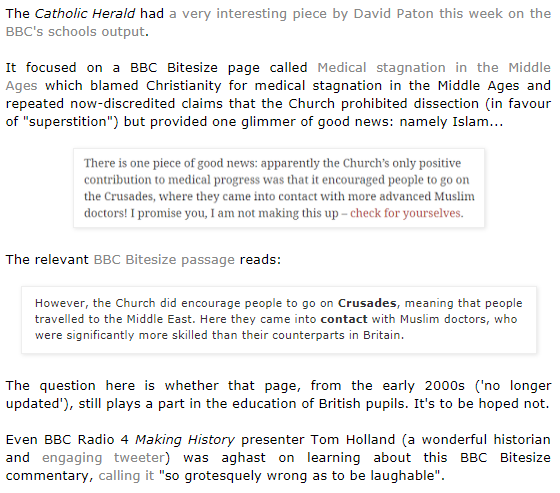
David has contacted me with an update (for which many thanks). Following his complaint to the BBC, BBC Bitesize have now updated their page to remove their grotesquely wrong claim that the Church banned dissection.  

Incidentally, it turns out that the Bitesize page I was looking at was an archive version. The live page had exactly the same statements. So, yes, British pupils were still being fed this false claim by the BBC right up until a few days ago.

Click to enlarge to compare versions

It's excellent that the BBC corrected this mistake following David's complaint  (after some fifteen or so years) but - as you'll see if you read the latest version - the overall bias of the page remains, including the closing 'cultural cringe' towards Islam.

Tuesday, 30 August 2016

Infamy


Further to a post here on Saturday night, the ever-excellent Daphne Anson has published a piece called Something To Do With Islam: The BBC befuddles British schoolkids. 

Exploring further, Daphne looked at the Test at the end of the Crusades section of BBC Bitesize's medieval history course and found this question, which she rightly calls "childish": 


Note that Muhammad got a "peace be upon him" bestowed upon him there by the respectful BBC.

She also provides neat little example of the BBC making a 'value judgement' on a political issue:


One of her readers put in a complaint about that and got a swift reply from the BBC (which you'll have to click on to enlarge and read, as our blog isn't wide enough!):


The BBC is standing by its 'value judgement' by refusing to admit that it's a 'value judgement'.

Saturday, 27 August 2016

A smorgasbord for a Saturday evening


It's a while since we've had a proper 'smorgasbord' post.

A 'smorgasbord' post is all I can manage today, so please prepare for a whole load of utterly random stuff.

*******

Shaun of the (Dead) BBC

Today's Dateline London was one of those editions where a single right-winger is allowed onto an otherwise entirely left-liberal panel (which is always preferable to those editions that have an entirely left-liberal panel - and, unfortunately, Dateline now appears to be regressing in that respect). 

Today's lone right-wing Daniel was Alex Deane, and the left-liberal lions roaring around him were Abdul Bari Atwan, Eunice Goes and Michael Goldfarb. 

The result was both fun and thought-provoking, and well worth watching (and Daniel did good). 

They discussed Syria, Trump 'n' Farage, and the burkini ban.

Presenter Shaun Ley gave the following three introductions (one to the entire programme, the others to the final later topics):

Introduction:
President Erdogan of Turkey has certainly bounced back after the coup attempt. This week he appeared to have the United States eating out of his hand. After a Turkish excursion into Syria to deny the group that calls itself Islamic State its only border crossing the US obligingly instructed Kurds to get out of the way if they wanted to go on receiving American support. Mr Erdogan is not the only populist politician basking in American adulation. Nigel Farage - one of the prominent voices in the successful campaign to get Britain out of the European Union - appeared at a rally with Donald Trump, telling his supporters the Establishment can be beat. Even as in Syria some women were celebrating liberation from Islamic State by taking off their burqas those wearing burkinis on the beaches of France were being ordered to take them off,
Second topic:
Let's move on to another populist leader - like President Erdogan perhaps! Donald Trump received some international aid of his own this week. Nigel Farage, who was instrumental in the campaign to get Britain out of the European Union, joined Mr Trump in Mississippi, where he suggested they were soul-mates battling the Establishment. 
Third topic:
Now, it was Churchill who promised to fight them on beaches - French beaches in the Second World War - but he certainly didn't have this in mind: The modern-day battle on the beaches (as Eunice was suggesting there) - and, yes, there has already been a punch-up in Corsica - is over the burkini ban - swimwear that covers almost all the entire body. Photographs of a woman being instructed to remove hers by four male police officers was deeply unsettling for some. Others insisted Islamic dress was provocative - a perhaps surprisingly statement when the French are unmoved by the sight of people sunbathing in the nude. On Friday the bans were thrown into doubt when the Council of State - France's highest administrative court - suspended the ban at Villeneuve-Loubet, pending a detailed judgement later in the year.
Were I some A-level student presented with those statements blind and asked to 'discuss' them, I'd say:
(1) that the speaker didn't approve of the US backing Turkey at the expense of the Kurds. 
(2) that the speaker called Turkey's president a "populist", and then called UKIP's Nigel Farage a "populist", and twice linked them together, and didn't sound complimentary about either. And then Trump.
(3) that the speaker really didn't approve of a 'burkini ban', given: 
(a) his pointed contrast of the liberated women of Syria with the burkini-wearing women being "ordered" about by the French
(b) his sardonic reference to Churchill's 'We will fight them on the beaches' speech to make the 'burkini ban' sound ridiculous, and...
(c) his mocking of those who argue that the burkini is provocative by sarcastically saying "a perhaps surprisingly statement when the French are unmoved by the sight of people sunbathing in the nude".
*******

A pretty mosque, Brexit Street, Thornaby-on-Tees

Over at Biased BBC David Vance posted a piece sent to him by a reader concerning the History section of the BBC's educational resource BBC Bitesize (a widely used tool in UK schools) - specifically the component in The Middle Ages section called The Islamic world in the Middle Ages. 

The B-BBC reader's complaint was that the BBC was projecting an extremely rose-tinted view of the medieval Islamic world whilst simultaneously mocking medieval Europe:


I would ask you (especially as it won't take you very long) to read the whole eight pages of the BBC Bitesize revision module and I think you'll agree that the B-BBC reader has a very real point. 

Take this, for example:


There's no mention of the term 'dhimmi', nor of those non-Muslims religious communities being 'second-class citizens'. And there were many times - as even Wikipedia admits - that non-Muslims were persecuted under Muslim rule. 

I would have hoped that the BBC would have encouraged nuance at the very least in their schools' history study guide instead of sounding oddly like proselytisers.  

*******

Oh, and the lefty BBC-haters are going mad for an LSE study that doesn't even mention the BBC. 

The LSE study found that the UK newspapers have posted lots and lots and lots of negative headlines about Jeremy Corbyn. 

Avoiding the possibility that some if not most of those negative headlines might have arisen because Mr Corbyn isn't really up to much, they say that the media is being soooo unfair to Jeremy.

The foreword to this LSE report comes from Nick Couldry, head of the LSE's Department of Media and Communications, and the report's lead author Bart Cammaerts. And if you're wondering who they are and where they're coming from, well,....:


Of course, the fact that a pair of Corbynistas have produced an LSE study proving massive media bias against their hero might be taken as automatically self-destroying their findings. But that's to succumb to the ad hom fallacy. Their findings, in fact, appear fair enough - except that, as I said above, they (fatally) choose to magic away the possibility that their magical leader might have deserved most of those headlines.

Academic studies of BBC bias are always to be questioned. Stick to blogs, folks! (h/t Michael Gove).

That said, they are probably right that the media is heavily biased against the Bearded One.

*******

RS Thomas, appearing on Rowan and Martin's Laugh-In

Meanwhile, I  was sitting in my sunlit garden this afternoon looking at the sky, the trees, the flowers, the birds, the butterflies, the bees, and a very colourful green-and-red fly that looked in shape just like the kind of fly people itch to swat but was so green-and-red that no one would ever want to do it harm. 

All was well with the world and I was happily reading the Collected Poems 1945-1990 of that English-hating Welsh vicar and semi-fascist (well, at least as far as us English were concerned) RS Thomas. 

He was echoing my mood, talking about a view from his window, writing that "these colours/Are renewed daily with variations/Of light and distance that no painter/Achieves or suggests". I thought, yes, that's true. (Sorry, M. Monet).

And now I feel I ought to add an "I suppose"....

....which is just typical of me as a blogger (these days). 

*******

No need for a caption here. See above. (Not Camilla B)

I've not had the time to monitor much of the BBC's reporting of Theresa May's proposed audit on inequality, especially racial inequality, but I heard the coverage on this morning's Today and watched this evening's BBC One evening news bulletin and both followed a basically similar pattern. 

On Today, we got two main segments - at 7.16 at at 8.10. The first was an inter-BBC discussion between Simon Jack and Ellie Price. It gave Mrs May a favourable review. Ellie talked about "how important to her this obviously really is" for Mrs. May, and Simon said:
And she does have some form on this because, of course, when she was Home Secretary there was the racial profile of the stop-and-search and she made some progress there. So she's on quite firm...on quite familiar territory.
(Some might say Simon's use of the word "progress" there was telling).

The interviews after 8.10, with (a) Simon Woolley of the campaign group Operation Black Vote (and the Equality and Human Rights Commission) and (b) Danny Dorling, the left-wing geography professor, also welcomed the move, whilst stressing that there's a heck of a lot to be done. Prof. Dorling, however, also complained about the effects of Tory cuts on making the problem worse.

On BBC One tonight Elaine Dunkley's report followed a fairly similar trajectory. It started with Elaine at the Notting Hill Carnival, talking about how multiculturalism is being threatened by unfair treatment of ethnic minorities. Three 'vox pops' attending the Carnival said, yes, the problem is very real. Mrs May's Downing Street speech was recalled before Elaine said that Mrs May would "have her work cut out". Then a lady from a campaign group Black Activists Rising Against Cuts (picture above) denounced the effects of Tory cuts. 

I suppose you could call that balanced in that in both praises the (new) Tory government for doing what it's now about to do and damning the (previous) Tory government for partly causing the problem in the first place - except that both BBC programmes seemed to be acting in full support of Mrs May's new strategy. 

Critics of that strategy from people who aren't from the pro-multiculturalism/anti-cuts Left seemed conspicuous by their absence...

...well, at least in the little bit of the BBC's coverage that I saw and heard today.

*******

Ellie Price of the BBC. Impartiality personified

During her 7.16 chat with Simon Jack on Today, Ellie Price let slip a turn of phrase that hit me as being 'very BBC'. Talking of Mrs May, she said: 
And this is a prime minister, of course, who's going to be laden with the legacy of taking Britain out of the EU.
"Laden" is a rather loaded word (appropriately enough), and it's not a positive one:


She could have said something along the lines of "...who's going to be busy with" or "who's going to be strongly engaged with" the legacy of taking Britain out of the EU but she said "laden with" instead.

Am I reading too much into that?  

*******

Ayatollah Khamenei and his friend Jeremy (in their younger days)

In a questionable editorial decision, this morning's Today chose to invite in comedian Jake Yapp to mock ITV for switching off all their channels this morning in a Team GB-related stunt to encourage children to go out and do some exercise...

The BBC mocking ITV for doing something noble doesn't strike me as being very...er...noble on the part of the BBC.

The one upside is that Jake, as ever, was funny. I like Jake. He does all the voices:
You're watching ITV One, the home of Saturday morning children's entertainment, with Ant and Dec ready to go live...fifteen years ago. 
Today though the channel's a bit different on Saturday mornings. It's time for all you kids to go completely wild for...Murder She Wrote. 
Man: Hello Angela Lansbury.  
Angela Lansbury: Hello dear old male friend with who I have a romantically ambiguous history. Oh dear, it looks like you killed someone. Oh well, it never would have worked out between us. 
As Ayatollah Ali Khamenei (is he still alive?) would say, lol!!

*******

Naga O'Brien

Talking of being still alive, Clive James was on last night's Newsnight, still being alive. 

Last night's Newsnight marked the debut of Naga Munchetty. She was wearing James O'Brien-style intellectual glasses, but, thankfully, wasn't James O'Brien. 

Clive was talking to Steve Smith of the BBC. Clive was funny. Steve asked him about his affair, among other things. (A time and a place please, Steve!)

And Clive admitted that he'd outlived that famous maple tree - the subject of a beautiful, moving poem of his which I (among many others) quoted (in full) this time last year. 

The point of the poem was that that newly-planted maple tree would outlive the dying Clive and be a source of joy to his children. 

Unfortunately, the famous tree has now died while (not at all unfortunately) Clive is still going! 

He's planted a new maple tree.

Oh, I do like Clive James. I even bought his Collected Poems in my recent poetry-buying splurge on Amazon. Whether they are all as good as Japanese Maple I'm yet to find out.

Presumably all his widely-mocked royal stuff will be in there too. (I've got a thing for the poetry of William McGonagall too, by the way).  

Of course, Ted Hughes, while Poet Laureate, used to get mocked for his royal poems....

....which gives me the chance, finally, to post my own sub-Private Eye Ted Hughes parody from my early Twenties (long, long ago):
The Corgi 
Slipped, a stone god, from entrails
Bloodied like lizards' skulls.  
Scarred black, the moronic silence
Raises a gloved hand of guts and carcase
Waving like a holocaust.    
Caton Moor, black, black.
A beefeater's hat,
Pouring down blood. 
A wound on earth, slitty-eyed. 
Pass, Raven (of the Tower of London). 
Happy birthday, Your Majesty! 

Monday, 31 August 2015

BBC Bitesize on 'UK migration'


BBC Bitesize, "the BBC's free online study support resource for school-age students in the United Kingdom", has a section on UK migration. 

This is what the BBC is presently teaching on the subject:

Thursday, 13 June 2013

Repeat after me...Islam is a religion of peace


We've not had a post about Islam for a while, so here's what the BBC teaches our children about that particular religion and its attitudes towards war:


Islam: attitudes towards fighting and warfare

Most religions offer teaching on war and conflict. And over time religion has been at the heart of conflict between nations.

Islam – war and peace

Muslim attitudes to war and peace are based on the teachings of the Qur’an (the Divine Book revealed to the Prophet Muhammad). There are two ideas in Muslim teaching that relate to war – Jihad (to struggle in the way of Allah) and Harb al-Muqadis (Holy War).
Islam is a religion of peace in which fighting and war are seen only as a last resorts:
"O mankind! We created you from a single (pair) of a male and a female, and made you into nations and tribes, that ye may know each other (not that ye may despise each other). Verily the most honoured of you in the sight of Allah is (he who is) the most righteous of you."
Surah 49:13


Jihad

There are different levels of Jihad:
Jihad means ‘to struggle in the way of Allah’.
Greater Jihad is the way in which every Muslim makes a personal effort to follow the teachings of Allah (God) and to fight evil.
Lesser Jihad is when Muslims fight to protect their religion.
When the Prophet Muhammad was asked which people fought in the name of Allah, he said: "The person who struggles so that Allah’s word is supreme is the one serving Allah’s cause".
The idea of Jihad is often misunderstood by non-Muslims who then see Islam as not being a pacifist religion.

Harb al-Muqadis - Holy War

Muslims may fight in self-defence but are forbidden to begin a fight. The aim of fighting is to create a situation where Muslims are free to worship Allah and live in peace.
One aim of Holy War may be to create a democracy where people are free to live their lives without beliefs and politics being imposed on them. There must be no hatred or vengeance in the fighting. As soon as peace is offered, fighting must stop. Once peace has been restored the differences between people must be resolved.
"Hate your enemy mildly; he may become your friend one day."
Hadith                                 


So now you know!


Here's the test they set. Please see how you fare. You'll find the answers below. (I didn't do too well!)


Islam - attitudes towards fighting and warfare - Test

1.
Muslim attitudes towards war and peace are based on the Bible.
2.
Islam is a religion of peace.
3.
Jihad means 'to struggle in the way of Allah'.
4.
Harb al-Muqadis means a Holy War.
5.
For Muslims war is fought for revenge.
6.
'Hate your enemy mildly; he may become your friend one day' is a teaching from the Qur'an.
7.
Once peace has been restored people should avoid one another so that there is no more risk of fighting.
8.
Fighting must continue until the Muslims are sure of victory.
9.
Islam teaches that all people are equal and deserve equal respect.
10.
War can only be used as a last resort.


Answers


Islam - attitudes towards fighting and warfare - Answers

You scored 5 out of 10
1.
Muslim attitudes towards war and peace are based on the Bible.
You said: False
Correct.
They are based on the Qur'an.
2.
Islam is a religion of peace.
You said: False
Incorrect.
The answer is true.
3.
Jihad means 'to struggle in the way of Allah'.
You said: True
Correct.
4.
Harb al-Muqadis means a Holy War.
You said: True
Correct.
5.
For Muslims war is fought for revenge.
You said: True
Incorrect.
The answer is false. There must be no hated or vengeance in the fighting.
6.
'Hate your enemy mildly; he may become your friend one day' is a teaching from the Qur'an.
You said: False
Correct.
It is from Hadith.
7.
Once peace has been restored people should avoid one another so that there is no more risk of fighting.
You said: False
Correct.
Once peace has been restored the differences between people must be sorted out.
8.
Fighting must continue until the Muslims are sure of victory.
You said: True
Incorrect.
The answer is false. Fighting must stop as soon as peace is offered.
9.
Islam teaches that all people are equal and deserve equal respect.
You said: False
Incorrect.
The answer is true.
10.
War can only be used as a last resort.
You said: False
Incorrect.
The answer is true.