Showing posts with label Shaun Ley. Show all posts

Saturday, 13 February 2021

The marriage of true minds


Meanwhile, over on the BBC News Channel's Dateline London Shaun Ley promised us they'd be discussing "business blues over Brexit", and the programme didn't disappoint on that front. 

This was his introduction:

If you are watching anywhere in the world, have you eaten Cornish sole? If you live in continental Europe you'll know it as Megrim sole. Renaming is the fishing industry's response to trading obstacles encountered since Brexit. Nor is it just exports to the EU. Consumers in Northern Ireland can no longer buy some products produced elsewhere in the UK. And financial services are also being affected. The Governor of the Bank of England, Andrew Bailey, warned this week there were signs the EU it was going to cut the UK off from trading shares on the continent where, before Brexit, the City of London did 40% of its share trading business. That has now been overtaken by Amsterdam. Stefanie Bolzen, we have the same standards as the European Union because we have only just ended the transition a matter of weeks ago. What's gone wrong? 

Stefanie Bolzen and Steve Richards, both unsympathetic towards Brexit, then piled on the agony, along with the BBC's Clive Myrie (though Clive mainly stuck to criticising the Johnson government for not warning the public how bad it would be).

They all kept saying that they agreed with each other too, so it was all a bit relentless. 

Correcting and Clarifying


For fans of the BBC's Corrections and Clarifications page, here are the two latest arrivals:

BBC News Persian, 19 October 2018

In 2018 BBC News Persian published an article (in Persian) which used an inappropriate word to refer to homosexuality. This word should not have been used and the article has now been corrected. We apologise for the offence caused.

11/02/2021

Quite a time lag there! 

Dateline London, BBC News Channel, 16 January 2021

We suggested that under the Oslo Accords, Palestinian healthcare is ultimately the responsibility of the Israeli government.

Although there is a wider dispute over the issue, the Accords - which Israel signed with the Palestine Liberation Organisation - give the Palestinian Authority oversight of public health under the principles of self-determination.

09/02/2021

It was presenter Shaun Ley making that error. He even added a "very clearly" to the thing the BBC has now had to clarify. 

Monday, 19 August 2019

Kicked in the head and "punched in the melee"


A remarkably resilient Owen Jones, bright, shiny and unscathed after a 3am assault by numerous far-right thugs.  


“Tommy Robinson ….a convicted far-right thug of…of..

“..of the EDL” interjected Shaun Ley, helpfully.


There are many other aspects to this fiasco that one could mention if one had the energy, but I do think the BBC should be made aware that Tommy Robinson shouldn’t be labelled “of the EDL" because that is misleading and it looks extremely biased. 

Friday, 12 April 2019

Transcript, 'Newswatch' 12 April 2019, Ric Bailey


Ric Bailey

The transcript below takes us into very familiar territory. 

Here again is a senior BBC figure denouncing "slide rules and stopwatches", and then rowing back somewhat when it's pointed out to him that the BBC itself is perfectly happy to use "slide rules and stopwatches" when measuring things like male-female balance on programmes. 

Shaun Ley did well in putting that point but could have gone even further by reminding Ric Bailey that the BBC's own landmark impartiality reviews also used such methods, without complaint from the BBC.

And, of course, as ever, it's all about 'due impartiality' - that most flexible of terms - which basically boils down to 'editorial judgement'...i.e. the very thing BBC critics are most distrustful of yet which Ric seems to be inviting us to accept on trust. 

And what's the main basis for slippery Ric's confidence that the BBC is getting it about right? Yes, astonishingly, opinion polls 'showing' that the BBC is trusted!

Now, I've seen all manner of opinion polls on the matter and they tend to say very different things, depending on how the question is put and who commissioned the polls. For the BBC to be asking us to trust it on impartiality because some polls say lots of people trust it is an argument built on quicksand. 

A lot of those polls also show plenty of 'don't knows' - and, frankly, why would everyone know whether the BBC is biased or not if many merely dip into BBC news and have never really considered the matter?

And this isn't just Ric Bailey garbling the BBC's case here. This really is the BBC's main argument: Trust us because opinions polls say we're trusted

Hmm. I think not, Ric.

Also, it's surely also perfectly possible to update the 'binary' Leave or Remain-voting tags of 2016 into something that isn't "arbitrary". You could, say, divide guests into (a) those who would vote Leave again or Remain again in the event of another referendum, or (b) those who want to stop Brexit completely, those who say they want to honour Brexit but want to keep us within the customs union and those who want us to leave the customs union.

Anyhow, here's the transcript:


Shaun Ley: Let's discuss this now with the BBC's chief political adviser Ric Bailey. Ric, thanks very much for coming in to Newswatch on what's turning out to be a very busy time politically. Has Question Time raised this question of Brexit balance with you? 
Ric Bailey: The obligation for all BBC programmes, and particularly for political programmes - including Question Time - is to be impartial - actually, to have due impartiality. And people forget that word 'due'. It means that programmes have got to think about the context in which they are making judgements about impartiality. So if you think of the context of the referendum, June 2016, voters had a very clear choice between Remain and Leave. It was a very binary moment in British politics, as all referendums are. But particularly so with that one. The situation has changed a lot since then. Our obligation as journalists after that vote was to hold politicians to account for that decision, to hold the Government to account. And don't forget, we've had a general election since then as well, in 2017, when people remind us a lot that both the big parties stood on a platform of exiting the European Union. So to define people individually on programmes like Question Time as either Remainers or Leavers, it's not something to ignore, we've got to take it into account, but it's not the be-all and the end-all any more, because people who might have been on the Remain side in 2016 have stood on a platform saying, actually, now we're going to leave. 
Shaun Ley: What you seem to be saying is that there's no actually objective measure of due impartiality, that the BBC decides from situation to situation what due impartiality means. Now, if that is the case, how do you demonstrate to the audience that you are being impartial if you don't have any criteria, objective criteria, against which that can be judged? 
Ric Bailey: I don't think that it's not objective. I think where you've got to be careful is thinking that you can do this by maths and slide rules and stopwatches...
Shaun Ley: (interrupting) Do you do anything of that kind? Because you do do it during elections. You measure the number of people, the number of contributions from political parties. At the moment, you're measuring the number of women versus the number of men contributors. So you are using those tallies in some circumstances. Are you tallying up people who supported Brexit and people who opposed Brexit? 
Ric Bailey: I'm not saying the maths is irrelevant. What I'm saying is it's not the be-all-and-end-all. So we need to be conscious of how much people are on and what their views are, but we don't go back to some arbitrary definition of what Remain and Leave was which doesn't necessarily fit exactly where we are now. 
Shaun Ley: If you don't have those figures, how can you refute the figures that, for example, Charles Moore used? He quoted the Institute of Economic Affairs. 18 months, it monitored, from June 2016 to December 2017 - so, after the general election - Question Time and its radio equivalent Any Questions, and it suggested that 69% of the panelists had been declared Remain supporters during the referendum and 32% had voted Leave. And even if you included in the Leave column the people who had shifted their positions - they had been Remain during the referendum but now support Leave - it was still split 60-40. 
Ric Bailey: You're still trying to put it in those terms of using slide rules and stopwatches, and measures which are not a definition of impartiality. Impartiality, in the end, is about good editorial judgement...
Shaun Ley(interrupting) That's the BBC's judgement, not the audience's, is what you're saying. 
Ric Bailey: Of course, and that's what journalism is. Journalism is being asked to make those judgements. And, if you like, one of the tests of that is, what does the audience think of that? And still, the BBC is trusted by more people than any other organisation to be telling the truth and to be giving an impartial account of what's been happening in Brexit, which after all is an incredibly complicated political situation. 
Shaun Ley: What advice, then, have you given to Question Time and to similar programmes about how they construct panels at this very sensitive time politically, when we are still aiming to achieve Brexit but it hasn't been delivered? 
Ric Bailey: So that question of due impartiality ... Obviously programmes have a long timescale in which to think about that. It might be over a whole year or a series of programmes where we make sure that views are represented appropriately. There will be moments where that impartiality needs to be judged on a shorter timescale, as now when we're in an election period, and it needs to be judged more carefully around parties as much as Brexit, Leave and Remain. So you're talking about different ways of approaching this. That's why I am not very keen on the word 'balance' because 'balance' implies only two sides, and actually this is much more complicated than that, and there are many different issues you've got to talk about. 
Shaun Ley: Just before we finish, as we record this interview, we know that there are expected to be European parliament elections. Whats sort of challenge does that pose to BBC News? 
Ric Bailey: I mean, it's a big challenge for everybody. We don't even know if the elections are actually going to take place, so we're starting an election period without knowing if people are actually going to vote. So it's a pretty unique set of circumstances. A and I go back to my word 'due'. Due impartiality means we've got to think really carefully about this particular context and make sure that we're thinking carefully about what 'impartiality' means when we have got this European election, in some parts of the UK we've got local elections at the same time. That's a really complicated position against that background of Brexit. 
Shaun Ley: So a lot of thinking to go on over the coming days and weeks. Ric Bailey, chief political advisor, thanks very much. 

Saturday, 6 April 2019

One of them, RIGHT HERE, is on your TV every morning


Ben, looking bashful (for some reason)

Here's a transcript of a segment from this week's Newswatch, presented (in Samira Ahmed's absence) by Shaun Ley:

*******

Shaun Ley: Last Thursday's edition of Question Time picked up on the protests against lessons in diversity and equality [by mainly Muslim parents] which are being taught at some Birmingham primary schools. They include same-sex relationships and the rights of LGBT people. 
Question Time audience member: Is it morally right that five-year-old children learn about LGBT issues in school?
Fiona Bruce: Oh, I can hear all sorts of sounds coming from the audience here, so...
There was an angry response from some members of the wider TV audience to the inclusion in the programme of that question which was then posted on Twitter by the Question Time team. One of those expressing views in a forthright way on that tweet was the BBC Breakfast presenter Ben Thompson:
Ben Thompson: LGBT 'issues'? Like what? That we exist? One of them, RIGHT HERE, is on your TV every morning. I held back on this hoping it was clumsy writing, done in haste. But it's still online. Would you ask if it's 'morally right' to learn about gender/race/religion/disability 'issues'. 
Others agreed, with Jerome writing:
Jerome: The question is loaded with prejudice and the premise is incorrect. Are we back in the 1950?
And Lil Tinge asked:
Lil Tinge: Do you want to explain to your LGBT licence payers why your producers thought this was an acceptable question for debate?
Well, the BBC issued the following explanation:
BBC News: Question Time is a topical debate programme. This was a question asked by an audience member on a subject which has seen a lot of recent discussion. 
This week the corporation's Director of News Fran Unsworth sent a general reminder about the use of social media to all staff in news which found its way into the public domain [i.e. was leaked by someone at the BBC to the Guardian]. It advised:
Fran Unsworth: We all have personal views, but it is part of our role with the BBC to keep those views private. You shouldn't state your political preferences, or say anything that compromises your impartiality. Don't sound off about things in an openly partisan way. We haven't always been consistent in dealing with this issue in the past, but we cannot afford for this to continue, and will consider appropriate action in the future.
*******

So it was BBC Breakfast's Ben Thompson, it appears, who brought down The Wrath of Fran on the BBC as a whole.

Now, I must say I'm with the BBC and Ivy Unsworth of In Loving Memory's grand-daughter Francesca here. 

This was a question from a member of the QT audience. Shouldn't he be allowed to ask it because it offends the easily-offended? 

And I don't think it's a remotely objectionable question anyhow. 

Contrary to what Ben Thompson of BBC Breakfast said, the question wasn't about the morality of teaching about LBGT 'issues' - or gender/race/religion/disability 'issues' - in schools per se. It was about teaching about sexuality to five-year-old children. 

Yes, people like Ben might be justified in blowing their tops if people called for such things to be banned from being mentioned in secondary schools, but teaching such sexualised matters to five-year-old IS a question that deserves moral querying.

Ben Thompson should have THIS pointed out to him too, whether by email or in person. Over to you Fran.

Saturday, 30 March 2019

BBC UK editor Richard Burgess on protests (again)


Here, from this week's Newswatch, is a transcript of the interview with the BBC UK editor Richard Burgess. He's talking about the BBC's coverage of protests. Enjoy!


Shaun Ley: From the Gilets Jaunes, or Yellow Vests movement, protesting for several months in France, to the now frequent demos across the UK, which are on subjects including climate change, supporters of such events demand and expect media coverage. To what extent should the BBC comply with their wishes? Well, one of those responsible is the BBC UK editor Richard Burgess, and he's with me now. Thank you very much Richard for coming into the Newswatch studio. What are the criteria you use to determine what demonstrations to cover and how much coverage to give them? 
Richard Burgess: Well, I don't think there are exact criteria, but I think there are a number of factors that you take into consideration. Scale is obviously one of them, which we saw with last weekend's march, a major march with a lot of people on it, that's something you've got to take into account. But I think there are a number of other factors around, is this a matter of national significance, is this is a live issue at the moment, and could the march lead to change in the future? So you take all those into account, but obviously there's the other factor, which is what else is going on on that day, what else is happening on the news agenda? 
Shaun Ley: You mention scale, and this is a very contentious issue with marches in particular, isn't it? I mean, last weekend, the organisers were saying they had more than a million people, the BBC was saying, I think, hundreds of thousands. How do you make that call? 
Richard Burgess: Well, I don't think you can ever absolutely say how many people are on a march, by their very nature, they are fluid events, people join, people leave, people move around, they're over large areas. It's almost impossible, if not impossible, to give an exact number. What we do is we obviously have people on the ground who will make an assessment, which is what we did at the weekend. And they were talking about, you know, how densely populated the march was, so we talked about hundreds of thousands, we talked in kind of, broad estimates. And then on the figure of a million, which the organisers were saying, we attributed that figure to the organisers whenever we used it. 
Shaun Ley: Difficult, though, isn't it? And it can be very politically charged, I mean one thinks of the Trump inauguration a couple of years back, that became a really serious issue about whether the media had distorted the numbers, had downplayed the numbers. You have to be really careful on this, don't you? 
Richard Burgess: I think that's right, and I think that's why we do talk in kind of broader terms, and when there are more definitive figures, we attribute those to the organisers or maybe to the authorities, although interestingly, the Metropolitan Police didn't put a figure on it at the weekend, and I think that's because they recognise the difficulty of putting figures on and the political sensitivity around those figures. 
Shaun Ley: You were candid in saying at the start of the interview that one of the things that can affect coverage is what else is happening in the news, there are lots of other things, it's going to get squeezed, if there aren't many other things, it may be something it's quite easy to fill airtime with. That's a difficulty, isn't it? Because you can spend the money, the resources, you are under an obligation then, live trucks, camera crews, producers, to get your money's worth for the licence payer. 
Richard Burgess: Well, not necessarily, I don't think there was a real issue at the weekend because of the size of the march and the issue that it was addressing. Which is... 
Shaun Ley: (interrupting) What about more generally, because there are lots of other demonstrations which the BBC covers, whether demonstrations on the future of the NHS, for example, or the Tommy Robinson demonstration outside the BBC's Salford headquarters? 
Richard Burgess: Again, I think we make decisions based on those criteria I talked about before, in terms of the scale and whether it's an issue of national significance, and what actually happens on the march as well is also a consideration. And then we will make a decision based on the news agenda that day, and sometimes we commit resources to staff and it doesn't get on, and that's - that's the business of news. 
Shaun Ley: I wonder what effect the referendum has had, because it's kind of created a very powerful sense of the will of the people. It's something politicians claim, we're speaking for the will of the people on either side of the argument. The protesters also say the same. Doesn't that perhaps require the BBC to develop a bit more of a careful judgment on this, because it is used so much to be, if you like, an emblem of a wider public feeling, rather than just those people who have turned up in a particular day for a particular project? 
Richard Burgess: I think you're right, and I think we do our best to reflect the range of opinion around Brexit. We know it's an extremely divisive issue, we know that it's a polarising issue for many of our audience, and one that people feel hugely passionately about. And so our aim as an impartial broadcaster is to give air to those opinions - not to create a false balance, but to fairly represent the views across the nation. 
Shaun Ley: What about other protests? I mentioned, in introducing the Gilets Jaunes protests, the Yellow Vests protests in Paris in particular. I mean they've been happening every weekend for months now,. We've covered them a lot on the News Channel. Some weekends, they are fairly quiet protests, other weekends, like the one when the Champs-Elysees was attacked, became much more newsworthy themselves. How do you make that call? Because I know it's not on your brief as home editor, but for BBC News in general, that's is a difficult judgment - which weekends we cover it, and if we cover it it because it's violent, are we in a sense creating encouragement for demonstrations to take a particular turn? 
Richard Burgess: I think that's a good point, and I think you need to be careful not just to cover protests when they turn violent or because they are particularly great pictures around fires in the Champs-Elysees and what have you, as you were saying. I think with our coverage of that, we've always tried to put it into the context of the wider political and social debate that's happening in France at the moment, and I think that's what's of interest to our audience around that story. 
Shaun Ley: And will you think carefully about the next Brexit protests, if there are any, how you cover them? 
Richard Burgess: Yeah, we do always, and we're careful how we cover them, the amount of coverage we give to them, and a range of voices that we feature throughout them. 
Shaun Ley: BBC News UK editor, Richard Burgess, thank you very much for coming in for Newswatch.

Saturday, 18 August 2018

A Tale of Two Editions of the Same Programme - and Two Complaints about it


Last week

Here's something about last week's Dateline London:

Talk of Gavin Esler reminds me that last week's Dateline London discussed Boris Johnson and the niqab.  
In time-honoured Dateline fashion all four members of the panel agreed that Boris was a bad 'un. They were all equally scathing of him. Eunice Goes said his words were "very dangerous" and "utterly irresponsible". Henry Chu accused him of making things worse for a vulnerable group in society. Abdel Bari Atwan got very het up (as is his way) and used the word "racist". And Polly Toynbee (as is her way) rampaged through a whole dictionary of condemnatory words - "offensive," "dangerous", "disgusting", "malice" - in her rant against the former foreign secretary.  
That was a panel whose views were utterly predictable on the subject and should easily have been foreseen by the programme's production team. Where were the alternative voices to provide balance? How could this clear breach of the BBC's legal duty to be balanced and impartial be allowed to happen? Was it just "coincidence" that four very likely critics of Boris Johnson were chosen as guests given the topic for discussion?  
And presenter Shaun Ley framed it as "Boris Johnson...supports the freedom to cover your face but manages to insult the Muslim women who do it", thus couching it as a statement of FACT that it was insulting to the Muslim women who where niqabs. He didn't even say, "some think" or "according to some". Doesn't this show that the presenter was himself betraying bias against Boris Johnson?

That's me. 


Just sent this complaint to the BBC about Dateline London just been on BBC...this makes me so angry and I know complaints however evidenced always receive sneery replies denying it all. Still its just about all you can do aside from #bbcswitchoff. 
I would like specific answers to each of the following elements of my complaint. 
1. The presenter asked  "as an ex editor of the Jewish Chronicle how badly has this been handled by the British Labour Party?".....the BBC has a legal duty to be balanced and impartial. This is clearly a breach of this duty. The question is couched as a statement of FACT that it has been badly handled and that the only question is how badly. And who better to ask than the ex editor of a newspaper that has already made its position very clear on numerous occasions. 
2.  In addition to the presenter being himself clearly biased against Corbyn all four of the guests were equally scathing of him. There was NO challenge to any of this as there was no alternative voice to provide balance. How could this clear breach of the BBC's legal duty to be balanced and impartial be allowed to happen? Was it just "coincidence" a very likely critic of Corbyn was chosen as a guest given the topic for discussion? 
3. There was both lack of balance and fairness when one of the guests referred to Corbyn's "body language when he rolled his eyes". The presenter then jumped in to say it showed Corbyn wasn't taking it (antisemitism) seriously...when in fact Corbyn rolled his eyes in sheer frustration at being asked for the umpteenth time about the circumstances around the wreath laying...nothing whatsoever to with him not being bothered about antisemitism. 
I have complained to the BBC before about bias and lack of balance/impartiality but without doubt this is the worst and seemingly pre-planned example.  Is it any wonder that #bbcswitchoff trends worldwide?

That's Pete. 

He's a Corbyn supporter and one of the BBC's fiercest and most prolific critics on Twitter. 

Now, of course, I cheekily 'borrowed' some of Pete's language in re-drafting my own bit, though most of it was already written in my usual way - and it's broadly true (if I say so myself).

It would be wholly true had I also mentioned Shaun Ley's two brief interjections - one quoting Rowan Atkinson's defence of Boris, the other stating that Boris Johnson agreed with the panel that such outfits shouldn't be banned - which could (correctly) be presented as evidence of some attempts at balance, but otherwise my criticisms are correct and to the point (again if I say so myself). 

Last week's Dateline should have included at least one guest who might have been expected to defend Boris Johnson or to take a different line from the rest of the panel (and Boris) on the burka/niqab question, and Shaun Ley made it a FACT that Boris was attacking the women (rather than their clothes) and was 'insulting' them (rather than 'making a joke') in his framing remarks. 

So I think my complaint holds. And I will send spruce it up, make it formal and send it to the BBC to see what happens.

What about Pete's complaint about this week's edition though? 

...(though before answering that, I must just say to his "I know complaints however evidenced always receive sneery replies denying it all", welcome to our world and I feel your pain about the BBC complaints process!)

...Well, the BBC will probably respond with the following points  - even the pit-nicking final one (seriously, I think they will): 

  • Pete misses out Shaun Ley's introduction, which gave Mr Corbyn's defence in detail and was delivered straight and, so, can be said to cancel out his later remarks..
  • Surely the presenter saying "as an ex editor of the Jewish Chronicle..." in that context is only right and proper. As he might be seen to have a dog in the fight through his former connections, he needed labelling as much so as to inform the audience. 
  • Ned Temko (the ex-editor in question) is a  longstanding Dateline regular.
  • The programme's production team might have assumed that Maria Margaronis would have defended Jeremy Corbyn, given that is generally sympathetic towards the Labour leader. Could they have guessed she would have slated his "tin ear" for antisemitism and joined in the criticism? (I wouldn't have guessed so). And, she did also say that the Right was using the antisemitism row as a stick to beat Mr Corbyn and Labour and that antisemitism was more common on the Right than the Left, points Pete doubtless agrees with.
  • It was Shaun Ley himself, not one of the guests, who brought Mr Corbyn's "rolling eyes" into the discussion. 

So much for the opening flaws in Pete's complaint. 

This week

Let's continue:

  • Pete has a point when he says the question "How badly has this been handled by the British Labour Party?" is a question "couched as a statement of FACT that it has been badly handled and that the only question is how badly".
  • It is true that all four guests were highly critical of Jeremy Corbyn's behaviour when it comes to antisemitism. 
  • Shaun Ley did made a powerful intervention, from his own experience, about why it is that Mr Corbyn's behaviour concerns so many Jewish people. 

So, yes, the first point is correct. (It matches and mirrors mine). 

The second one is correct too, but only because the left-winger Maria Margaronis was surprisingly critical of Mr Corbyn on the antisemitism question. As I said earlier, the BBC can, I think, reasonably use her known position on the political spectrum (a long way leftwards) to justify their panel selection this week (unlike last week!) and nullify Pete's point. 

The third point can be countered by the introduction, where Shaun put Mr Corbyn's side with gusto and, thus, 'balanced things out'. 

Thus, only the first point holds. 

But what of perhaps the most serious charge against Shaun Ley from Pete: that he "jumped in" to say that the "rolling" eyes "showed Corbyn wasn't taking it (antisemitism) seriously when in fact Corbyn rolled his eyes in sheer frustration at being asked for the umpteenth time about the circumstances around the wreath laying...nothing whatsoever to with him not being bothered about antisemitism"? 

Well, I think Pete simply misunderstood what he saw and heard. 

What Shaun Ley said, before his last words became indecipherable due to others talking over him, was: 
At one point he rolled his eyes I think. So the subtext is...the body language is, "I'm not taking this seriously", whatever the words are and that's part...(indecipherable)...
I take that as meaning that Jeremy Corbyn's "rolling eyes" during that interview "showed" that he wasn't talking the interview seriously (i.e ."I'm not taking this interview seriously"). In order words, Shaun was interpreting the Labour leader's body language in precisely the same way as Pete himself (except, of course, that Shaun evidently felt it made the Labour leader look bad while Pete felt Mr Corbyn was entirely right to feel miffed): that Mr Corbyn was getting annoyed at the interviewer for asking those pesky questions. 

Now it could be that Mr Corbyn wasn't taking the interview seriously because he doesn't take antisemitism seriously, but that was far from being implied by Shaun Ley there. So when Pete says...
The presenter then jumped in to say it showed Corbyn wasn't taking it (antisemitism) seriously...when in fact Corbyn rolled his eyes in sheer frustration at being asked for the umpteenth time about the circumstances around the wreath laying...nothing whatsoever to with him not being bothered about antisemitism. 
...I think he's simply got the wrong end of the stick and parenthetically projected that interpretation about Shaun Ley meaning 'antisemtism' onto Shaun Ley. 

All in all, Pete's complaint doesn't stand up to scrutiny. The BBC would be right to reject nearly all of it. 

That said, I suspect both complaints (his and mine) will be entirely rejected, with much talk of 'due impartiality' and 'judging over time'. Well, I have judged the programme over time and it was long had a very pronounced left-liberal bias. (We've got 119 posts about the programme here at ITBB - Lord help us! - as evidence). 

Sorry for the long post but I hope this post will prove instructive (if only to me). Pete made similar kinds of complaint to the kinds I've been accustomed to making about Dateline London for many, many years. I think the difference is that his complaints have very little substance. 

If you've slogged your way through all of this (and I have to say I've greatly enjoyed it!), then please feel free to have your say as ever below. 

Sunday, 1 April 2018

The feigned surprise of the media

“ ‘Great’ March of Return”. For a robust defence of Israel’s side of the story, see here. Of course, as pro-Israel critics of the BBC will often say, “You won’t seen anything like this on the BBC” and for once, that is particularly apt. Well, maybe not just for once.

Here’s another piece, this time by a Harry’s Place regular and former IDF soldier Marc Goldberg. By no means an “Israel firster”, this writer is often harshly critical of the Israeli government.
“It really doesn’t matter whether it’s guerrillas breaking into Israelis homes to murder them, suicide bombers on buses, terrorists popping out of tunnels, rockets being fired on Israel indiscriminately or demonstrators on Israel’s borders. Israel is not going to disappear. Israel is not going to allow the nature of the country to be changed by people who are so racist that they refuse to live in peace if Israel also exists.“ 
This project cannot achieve its 'stated' outcome. The ‘right of return’ is not a right, but even if, in some nightmarish world, such a right were to be brought into being, then it would mean the end of Israel as a Jewish majority state. That is what this march is about, so why not say so?  Anyone who fails to recognise the deviousness and dishonesty of the organisers of this life-threatening publicity stunt is a stupid fool or a racist fool.

The best piece I’ve read so far about the antisemitism-in-the-Labour-Party. (H/T commenter Jack on Harry’s Place) is handicapped by the grave disadvantage of being in the OMG Daily Mail.  However, it’s by Dan Hodges, and his article really nails this topic; perhaps the Daily Mail is the paper with the least timidity around publishing this type of no-nonsense commentary. Perhaps, rather like Israel, the notion of courting public opinion is a lost cause. That horse has bolted.

Most articles on the rise of antisemitism have a shared ‘missing element’. No matter how bold or outspoken the platform, the invisible elephant they have in common is perceived as too inflammatory to name. It’s the Islam factor. People are loathe to bring it up, lest they are indelibly tarnished with a phobia that isn’t an actual phobia.  Awkward, ain’t it?

The other invisible elephant is the fact that left-wing press, which has just begun joining in the outrage, is unable to admit its own part in the whole sorry affair.  I’ve just seen “little” Owen Jones being interviewed by a combative Shaun Ley. Owen was insisting that antisemitism must be rooted out, arguing more passionately and more animatedly than I've seen him for ages. He must have forgotten his disgraceful diatribe against Israel for the death of  Omar Jihad al-Mishrawi, which turned out to be the fault of one of Hamas’s more tragic shortfall disasters. I don’t know if he ever apologised. Shaun Ley seemed very cross and gave him a good grilling, which also looks decidedly hypocritical. 

During the season where there’s just about nothing at all worth watching on telly, one turns to the News channels. I hadn’t been particularly aware of how many times the BBC News Channel airs Dateline. Well, now I am. It’s been shown at least three times while I’ve been awake and viewing. 

To recap. When the topic of the recent shenanigans in Gaza was offered to the panel, which is supposed to represent European journalism, predictably all four guests opined, as they would - Dateline being what it is - (Unless they have Janet Daley or Alex Deane on) in the accepted anti-Israel fashion. 

A cursory mention of the ‘other point of view’ was contributed by Ley himself, which indicates that he had at least glanced at some of what “Israel says.” (He queried whether the protesters were all unarmed.) However, the panellists obviously weren’t having any truck with what “Israel says”.  

Did he challenge? Did he murmur? Not a squeak.  Okay, he was outnumbered. Brian O’Connell, “reporter on both sides of the border of the Island of Ireland” unleashed his opinion, which was so one-sided one had to wonder how impartial his Irish reporting must be. “Israel doesn’t care” he spluttered vehemently. “It has no regard for public opinion and it thinks it can do what it likes.”

 So, according to this man, “killing unarmed civilians” is what “Israel likes”. I wonder what that Dateline panel  would say about this. (They'd say "Fake" no doubt.)


Catherine Pepinster began in a more circumspect vein before coming up with the requisite condemnation of Israel. Greg Katz said Americans were tired of the whole Middle East thing and were far more bothered about gun control. I dealt with  Eunice Goes in my previous post. Amongst several other stupid remarks, she stated that Israel has turned Gaza into a prison. However it was actually Shaun Ley who specifically invited her to repeat her anti-Israel accusations in her ‘Easter message’ finale. 
Doing so was completely unnecessary. He was well aware what she would say. He may as well have come straight out with: “ Tell us once again why you despise Israel.”

Considering that certain websites and blogs have been dedicated to the topic of the BBC's bias against Israel for years, not to mention my own ten-year record of blogging about the BBC’s antisemitic and anti-Israel bias, what is most surprising to me, is that within the recent avalanche of media coverage of the issue, most journalists and reporters still feign surprised at what they’ve unearthed.  

Saturday, 11 November 2017

Slips (Freudian or otherwise)


I saw a comment elsewhere today saying that a BBC reporter, immediately after this morning's Two Minutes Silence (on the BBC News Channel), "described tomorrow’s commemorations as ‘celebrations’". The commenter elsewhere denounced that as "absolutely disgusting", and speculated that it could have been a junior BBC reporter. I investigated it (as you do as a blogger), and found it was no junior reporter but a seasoned BBC presenter: Shaun Ley. I suspect, however, that he'd be mortified if his slip was pointed out to him - and it obviously was a slip. Whether it was a Freudian slip or not, however, I cannot say, given that I'm not privy to the keys and locks of people's brains (other than on a purely amateur basis). 

Saturday, 15 July 2017

Business as usual


Eunice Goes and Mustapha Karkouti 

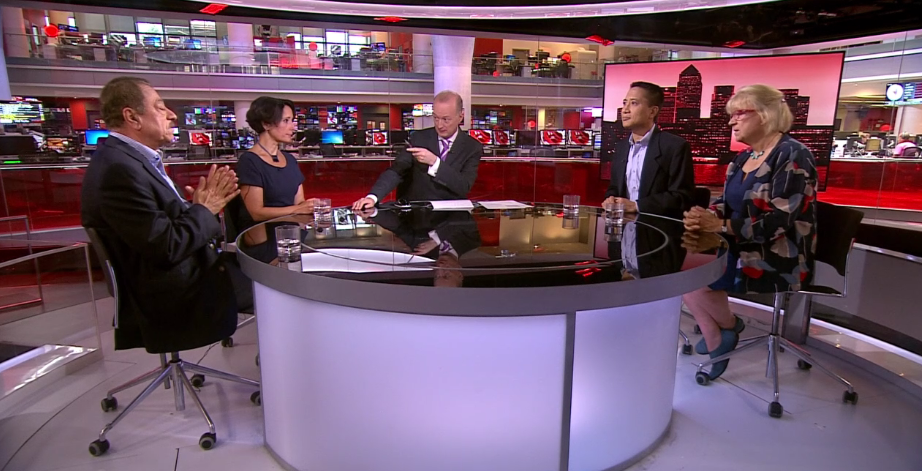
Today's Dateline (with Shaun Ley) had one of those generic Dateline panels that didn't include a single right-winger, only various shades of left-liberal thought. 

And Brexit supporters were also conspicuous by their absence - unlike their EU-enthusiast opponents, painting the "poorer" future we face as a result of Brexit (including Polly Toynbee ranting about how "ridiculous" the Brexit vote and how it will make the UK a "flyover zone for everybody else").  

President Macron also got a wholly positive press from the panel today....unlike President Trump, who was uniformly trashed again. 

So, alas, classic unbalanced Dateline then, almost approaching a parody of itself.

I wonder what Mark Urban would have made of Shaun Ley's framing narrative, summed up in these statements/questions?:
Hello. They're leaders, but are they leading? Donald Trump was treated like - well, royalty - in Paris as the French celebrated their revolution on Friday's Bastille Day. In London, Theresa May was trumpeting a different sort of revolution, publishing the legislation that will take Britain out of the European Union. Yet Mrs May is a much diminished figure after losing her parliamentary majority, and President Trump is distracted by the investigation into links between his campaign - and his family - and the Russians.  
And we have a European leader who's at least giving the impression of that. He sent his Foreign Minister after the Gulf, I am talking about President Emmanuel Macron of France, taking a lot of diplomatic initiatives - one in the Sahel a couple of weeks ago, now in the Gulf - trying to work as an honest broker. Is he filling a vacuum of leadership do you think?

Sunday, 9 July 2017

The BBC seems to be enjoying this


Continuing on from John Simpson yesterday and Paddy O'Connell this morning...

Matt Zarb-Cousin, former spokesman for Jeremy Corbyn (see also here), contributed to The World This Weekend's sympathetic profile of Robbie Gibb, and this is how part of his discussion with Shaun Ley went: 
Shaun Ley: In his view this is particularly the case because Robbie Gibb is not the only BBC journalist to leave broadcasting in order to work for the Conservatives:
Matt Zarb-Cousin: You look at the backgrounds of a lot of the political journalists at the BBC at the moment and you can maybe conclude that a lot of them are right-leaning or Conservative. Whether or not that manifests itself in their work is a matter of debate, but it's incredibly difficult, I think, to expect it not to.
Shaun Ley: A lot of people reading the press might think it was anything but the case. They might think the BBC was a den of lefties.
Matt Zarb-Cousin: That was the perception for a long time but, I think, if you just look at the background of the political staff the BBC at the moment I don't think you could really conclude that it's a den of lefties anymore. 
Note how Shaun blames "the press" for making people think that the BBC is 'a den of lefties'.

Augmented reality


I smiled at Shaun Ley's BH plug for The World This Weekend this morning. 

He was talking about why four-fifths of the people who downloaded Pokemon Go have already given up playing the game. "I've been off on a Pokemon hunt in the world of augmented reality to find out", he said, before adding, "I suppose that sort of sums up this place, doesn't it?" 

I suppose it does Shaun. And like Pokemon Go, the BBC's "augmented reality" seems to be losing popularity too (especially among the young). 

Thursday, 12 January 2017

One factual error corrected


The BBC's Corrections and Clarifications page now carries the following 'clarification':


This is a partial success for BBC Watch whose complaint brought that brief summary (on the BBC's Corrections and Clarifications page) about.

They are still pursuing other parts of their complaint.

The BBC's response to BBC Watch (re Shaun Ley on The World Tonight) is worth sharing - though you will have to click on it to enlarge it in order to read it!:

Sunday, 6 November 2016

And on it goes...


The World This Weekend has established a reputation (here) for being especially negative in its Brexit coverage. Here's today's opening angle, which was entirely in keeping with that reputation:
Shaun Ley (presenting): After Brexit, "a Britain more open to the world", Theresa May vows as she departs for India in the search for a free trade deal. This successful Indian-born businessman, who'll be part of the British contingent in Delhi this week, says it's Britain that needs to be more open. 
Successful Indian-born businessman: The anti-immigration sentiment is like I've never seen before. This year, before the European Union referendum and after it, I've personally received racism and hate crime that I've never received in three decades.
The 'successful Indian-born businessman' in question was Lord Bilimoria, a Remain-backing, strongly pro-immigration crossbencher who said "nobody in the world" wants us to leave the EU, and who deplores the effects ("racism", "hate crime") of "this wretched referendum". He wants things to stay much as they are - though with more immigration. He damned the government's current immigration policy (even before things tighten up) as "economically illiterate", adding "We will be the losers" if we don't open our borders to increased immigration from India. 

Lord Bilimoria was given the easiest of rides from Shaun Ley.

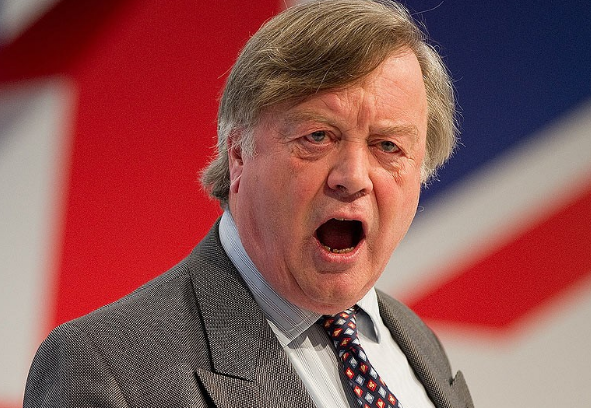
Next up for interview was....Ken Clarke (yes, really!). He denounced the "fascist" criticism of the judges, called the Brexit vote "a dreadful mess" and rehearsed the now-familiar arguments for parliamentary votes on the Brexit negotiations. The interview ended like this:
Ken Clarke: Let's get back to parliamentary democracy. That's what most of the Leavers said they were defending.
Shaun Ley: "A British law applied by British judges", I think, was part of the campaign.
Ken Clarke: Absolutely. So when the British judges confirm that the constitutional position is the same that it's been for really almost 250 years now they shouldn't be personally denounced by ridiculous newspapers.
Shaun Ley: Or some potentially ridiculous politicians. Are you saying that as well?
Ken Clarke: Some potentially ridiculous politicians. Any that agreed with the newspapers.
Shaun Ley: Ken Clarke.
And where were the balancing voices? There were none. Shaun simply said:
We did ask for an interview with a government minister to discuss its handling of the attack on the judges and to respond to Lord Bilimoria's criticism of Mrs May. We were told no minister would be available.
So who did they ask instead? (There are 17.4 million people to choose from after all.) Answer: Nobody.

Even without Mark Mardell, The World This Weekend is becoming particularly extreme in its anti-Brexit bias (even by the BBC's standards).

Saturday, 27 August 2016

A smorgasbord for a Saturday evening


It's a while since we've had a proper 'smorgasbord' post.

A 'smorgasbord' post is all I can manage today, so please prepare for a whole load of utterly random stuff.

*******

Shaun of the (Dead) BBC

Today's Dateline London was one of those editions where a single right-winger is allowed onto an otherwise entirely left-liberal panel (which is always preferable to those editions that have an entirely left-liberal panel - and, unfortunately, Dateline now appears to be regressing in that respect). 

Today's lone right-wing Daniel was Alex Deane, and the left-liberal lions roaring around him were Abdul Bari Atwan, Eunice Goes and Michael Goldfarb. 

The result was both fun and thought-provoking, and well worth watching (and Daniel did good). 

They discussed Syria, Trump 'n' Farage, and the burkini ban.

Presenter Shaun Ley gave the following three introductions (one to the entire programme, the others to the final later topics):

Introduction:
President Erdogan of Turkey has certainly bounced back after the coup attempt. This week he appeared to have the United States eating out of his hand. After a Turkish excursion into Syria to deny the group that calls itself Islamic State its only border crossing the US obligingly instructed Kurds to get out of the way if they wanted to go on receiving American support. Mr Erdogan is not the only populist politician basking in American adulation. Nigel Farage - one of the prominent voices in the successful campaign to get Britain out of the European Union - appeared at a rally with Donald Trump, telling his supporters the Establishment can be beat. Even as in Syria some women were celebrating liberation from Islamic State by taking off their burqas those wearing burkinis on the beaches of France were being ordered to take them off,
Second topic:
Let's move on to another populist leader - like President Erdogan perhaps! Donald Trump received some international aid of his own this week. Nigel Farage, who was instrumental in the campaign to get Britain out of the European Union, joined Mr Trump in Mississippi, where he suggested they were soul-mates battling the Establishment. 
Third topic:
Now, it was Churchill who promised to fight them on beaches - French beaches in the Second World War - but he certainly didn't have this in mind: The modern-day battle on the beaches (as Eunice was suggesting there) - and, yes, there has already been a punch-up in Corsica - is over the burkini ban - swimwear that covers almost all the entire body. Photographs of a woman being instructed to remove hers by four male police officers was deeply unsettling for some. Others insisted Islamic dress was provocative - a perhaps surprisingly statement when the French are unmoved by the sight of people sunbathing in the nude. On Friday the bans were thrown into doubt when the Council of State - France's highest administrative court - suspended the ban at Villeneuve-Loubet, pending a detailed judgement later in the year.
Were I some A-level student presented with those statements blind and asked to 'discuss' them, I'd say:
(1) that the speaker didn't approve of the US backing Turkey at the expense of the Kurds. 
(2) that the speaker called Turkey's president a "populist", and then called UKIP's Nigel Farage a "populist", and twice linked them together, and didn't sound complimentary about either. And then Trump.
(3) that the speaker really didn't approve of a 'burkini ban', given: 
(a) his pointed contrast of the liberated women of Syria with the burkini-wearing women being "ordered" about by the French
(b) his sardonic reference to Churchill's 'We will fight them on the beaches' speech to make the 'burkini ban' sound ridiculous, and...
(c) his mocking of those who argue that the burkini is provocative by sarcastically saying "a perhaps surprisingly statement when the French are unmoved by the sight of people sunbathing in the nude".
*******

A pretty mosque, Brexit Street, Thornaby-on-Tees

Over at Biased BBC David Vance posted a piece sent to him by a reader concerning the History section of the BBC's educational resource BBC Bitesize (a widely used tool in UK schools) - specifically the component in The Middle Ages section called The Islamic world in the Middle Ages

The B-BBC reader's complaint was that the BBC was projecting an extremely rose-tinted view of the medieval Islamic world whilst simultaneously mocking medieval Europe:


I would ask you (especially as it won't take you very long) to read the whole eight pages of the BBC Bitesize revision module and I think you'll agree that the B-BBC reader has a very real point. 

Take this, for example:


There's no mention of the term 'dhimmi', nor of those non-Muslims religious communities being 'second-class citizens'. And there were many times - as even Wikipedia admits - that non-Muslims were persecuted under Muslim rule. 

I would have hoped that the BBC would have encouraged nuance at the very least in their schools' history study guide instead of sounding oddly like proselytisers.  

*******

Oh, and the lefty BBC-haters are going mad for an LSE study that doesn't even mention the BBC. 

The LSE study found that the UK newspapers have posted lots and lots and lots of negative headlines about Jeremy Corbyn. 

Avoiding the possibility that some if not most of those negative headlines might have arisen because Mr Corbyn isn't really up to much, they say that the media is being soooo unfair to Jeremy.

The foreword to this LSE report comes from Nick Couldry, head of the LSE's Department of Media and Communications, and the report's lead author Bart Cammaerts. And if you're wondering who they are and where they're coming from, well,....:


Of course, the fact that a pair of Corbynistas have produced an LSE study proving massive media bias against their hero might be taken as automatically self-destroying their findings. But that's to succumb to the ad hom fallacy. Their findings, in fact, appear fair enough - except that, as I said above, they (fatally) choose to magic away the possibility that their magical leader might have deserved most of those headlines.

Academic studies of BBC bias are always to be questioned. Stick to blogs, folks! (h/t Michael Gove).

That said, they are probably right that the media is heavily biased against the Bearded One.

*******

RS Thomas, appearing on Rowan and Martin's Laugh-In

Meanwhile, I  was sitting in my sunlit garden this afternoon looking at the sky, the trees, the flowers, the birds, the butterflies, the bees, and a very colourful green-and-red fly that looked in shape just like the kind of fly people itch to swat but was so green-and-red that no one would ever want to do it harm. 

All was well with the world and I was happily reading the Collected Poems 1945-1990 of that English-hating Welsh vicar and semi-fascist (well, at least as far as us English were concerned) RS Thomas. 

He was echoing my mood, talking about a view from his window, writing that "these colours/Are renewed daily with variations/Of light and distance that no painter/Achieves or suggests". I thought, yes, that's true. (Sorry, M. Monet).

And now I feel I ought to add an "I suppose"....

....which is just typical of me as a blogger (these days). 

*******

No need for a caption here. See above. (Not Camilla B)

I've not had the time to monitor much of the BBC's reporting of Theresa May's proposed audit on inequality, especially racial inequality, but I heard the coverage on this morning's Today and watched this evening's BBC One evening news bulletin and both followed a basically similar pattern. 

On Today, we got two main segments - at 7.16 at at 8.10. The first was an inter-BBC discussion between Simon Jack and Ellie Price. It gave Mrs May a favourable review. Ellie talked about "how important to her this obviously really is" for Mrs. May, and Simon said:
And she does have some form on this because, of course, when she was Home Secretary there was the racial profile of the stop-and-search and she made some progress there. So she's on quite firm...on quite familiar territory.
(Some might say Simon's use of the word "progress" there was telling).

The interviews after 8.10, with (a) Simon Woolley of the campaign group Operation Black Vote (and the Equality and Human Rights Commission) and (b) Danny Dorling, the left-wing geography professor, also welcomed the move, whilst stressing that there's a heck of a lot to be done. Prof. Dorling, however, also complained about the effects of Tory cuts on making the problem worse.

On BBC One tonight Elaine Dunkley's report followed a fairly similar trajectory. It started with Elaine at the Notting Hill Carnival, talking about how multiculturalism is being threatened by unfair treatment of ethnic minorities. Three 'vox pops' attending the Carnival said, yes, the problem is very real. Mrs May's Downing Street speech was recalled before Elaine said that Mrs May would "have her work cut out". Then a lady from a campaign group Black Activists Rising Against Cuts (picture above) denounced the effects of Tory cuts. 

I suppose you could call that balanced in that in both praises the (new) Tory government for doing what it's now about to do and damning the (previous) Tory government for partly causing the problem in the first place - except that both BBC programmes seemed to be acting in full support of Mrs May's new strategy. 

Critics of that strategy from people who aren't from the pro-multiculturalism/anti-cuts Left seemed conspicuous by their absence...

...well, at least in the little bit of the BBC's coverage that I saw and heard today.

*******

Ellie Price of the BBC. Impartiality personified

During her 7.16 chat with Simon Jack on Today, Ellie Price let slip a turn of phrase that hit me as being 'very BBC'. Talking of Mrs May, she said: 
And this is a prime minister, of course, who's going to be laden with the legacy of taking Britain out of the EU.
"Laden" is a rather loaded word (appropriately enough), and it's not a positive one:


She could have said something along the lines of "...who's going to be busy with" or "who's going to be strongly engaged with" the legacy of taking Britain out of the EU but she said "laden with" instead.

Am I reading too much into that?  

*******

Ayatollah Khamenei and his friend Jeremy (in their younger days)

In a questionable editorial decision, this morning's Today chose to invite in comedian Jake Yapp to mock ITV for switching off all their channels this morning in a Team GB-related stunt to encourage children to go out and do some exercise...

The BBC mocking ITV for doing something noble doesn't strike me as being very...er...noble on the part of the BBC.

The one upside is that Jake, as ever, was funny. I like Jake. He does all the voices:
You're watching ITV One, the home of Saturday morning children's entertainment, with Ant and Dec ready to go live...fifteen years ago. 
Today though the channel's a bit different on Saturday mornings. It's time for all you kids to go completely wild for...Murder She Wrote. 
Man: Hello Angela Lansbury.  
Angela Lansbury: Hello dear old male friend with who I have a romantically ambiguous history. Oh dear, it looks like you killed someone. Oh well, it never would have worked out between us. 
As Ayatollah Ali Khamenei (is he still alive?) would say, lol!!

*******

Naga O'Brien

Talking of being still alive, Clive James was on last night's Newsnight, still being alive. 

Last night's Newsnight marked the debut of Naga Munchetty. She was wearing James O'Brien-style intellectual glasses, but, thankfully, wasn't James O'Brien. 

Clive was talking to Steve Smith of the BBC. Clive was funny. Steve asked him about his affair, among other things. (A time and a place please, Steve!)

And Clive admitted that he'd outlived that famous maple tree - the subject of a beautiful, moving poem of his which I (among many others) quoted (in full) this time last year

The point of the poem was that that newly-planted maple tree would outlive the dying Clive and be a source of joy to his children. 

Unfortunately, the famous tree has now died while (not at all unfortunately) Clive is still going! 

He's planted a new maple tree.

Oh, I do like Clive James. I even bought his Collected Poems in my recent poetry-buying splurge on Amazon. Whether they are all as good as Japanese Maple I'm yet to find out.

Presumably all his widely-mocked royal stuff will be in there too. (I've got a thing for the poetry of William McGonagall too, by the way).  

Of course, Ted Hughes, while Poet Laureate, used to get mocked for his royal poems....

....which gives me the chance, finally, to post my own sub-Private Eye Ted Hughes parody from my early Twenties (long, long ago):
The Corgi 
Slipped, a stone god, from entrails
Bloodied like lizards' skulls.  
Scarred black, the moronic silence
Raises a gloved hand of guts and carcase
Waving like a holocaust.    
Caton Moor, black, black.
A beefeater's hat,
Pouring down blood. 
A wound on earth, slitty-eyed. 
Pass, Raven (of the Tower of London). 
Happy birthday, Your Majesty!