Showing posts with label Fran Unsworth. Show all posts

Saturday, 22 January 2022

Fran's last outing

    
This week's Newswatch is worth a transcript. 

It featured outgoing BBC director of news and current affairs Fran Unsworth and got a bit 'meta' towards the end when the usefulness (or otherwise) of Newswatch was discussed. 

And it got odder still when Fran did what many a BBC editor on Newswatch has done before: She didn't answer Samira's question about editors avoiding the programme when big stories break and then asserted "we have the most robust complaints process as well".

Anyhow, enjoy!
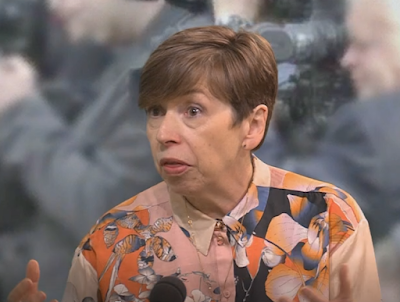

TRANSCRIPT

Samira Ahmed: Hello and welcome to Newswatch with me, Samira Ahmed. Not for the first time, the BBC's political coverage comes under fire for an alleged lack of balance. We asked Fran Unsworth, soon to leave the corporation after four years leading its news division, about impartiality, accountability and making the most of a shrinking budget. It's been a significant week for a BBC, with Monday's announcement from Culture Secretary Nadine Dorries that the licence fee would be frozen for the next two years. BBC chairman Richard Sharp reacted like this:
Richard Sharp: What it means for the BBC is with less money in real terms we are going to have to address how we do what we do differently. and there will have to be changes and consequences. If you diminish capital resources, there are going to be effects. Now, the BBC has already had ten years of real reduction by about 30%. 
The news department has not been exempt from those cuts with an £80 million savings target to be met by this year. And that's meant job losses in areas such as political and business news. Some viewers have been detecting an effect on the output over recent months, with Hannah Fearn tweeting: 
Hannah Fearn: Well, what do you know. Turns out journalists do a really important job and can't just be slashed without impact on quality and breadth.
Well, let's talk to Fran Unsworth, who first joined the BBC in 1980, starting in local radio, but who rose to become its director of news and current affairs and she retires next week. Thank you, Fran, for coming on Newswatch
Fran Unsworth: It's a pleasure. 
Samira Ahmed: Would you say you're leaving BBC News in a better place than it was when you first started working here? 
Fran Unsworth: Well, it's a very different place than when I first started working here because, of course, we do so much more output. So, when I joined BBC News, it was just radio and television. And now, there is the website, there's social, there's the app, there is continuous news TV, radio continuous news, so there's a lot more of it. 
Samira Ahmed: So, is that better or worse? 
Fran Unsworth: It's better in that I think we are responding to what people want and how they live their lives and how they don't want to just kind of make an appointment to see news or to listen to news. They need it there, instantly so it's better in that respect. Is the quality of what we do worse or better? I think the quality of what we do is actually incredibly good. 
Samira Ahmed: You mentioned quality but, as you've heard, some people think there has been a loss of quality because of the cuts that you've had to make of the past few years. Recently, the BBC admitted it had been a mistake to interview the lawyer Alan Dershowitz after Ghislaine Maxwell's conviction. Do you accept that with fewer experienced journalists in the newsroom, mistakes like that are going to happen more? 
Fran Unsworth: Well, mistakes do happen - I'm not going to deny that - but I think in that particular case, it was less to do with cuts, to be honest, and more to do with Covid! It was also 28 December, it was night. I think the teams, actually, are quite thinned out, there's no doubt about it, but that's not because of cuts so much as because of where we are between Christmas and new year. 
Samira Ahmed: Really? People thought you should have just Googled Alan Dershowitz, you'd have known you shouldn't be putting him on air in that context. 
Fran Unsworth: Well, possibly - actually, I think there was - I think the teams now know that actually, they could have avoided it by doing some kind of more considered handovers to each other on it. But - and we admitted it was a mistake and dealt with it. Mistakes happen - they do - but I don't necessarily think there are any more of them now than when I joined the BBC nearly 40 years ago - or if there are, it's probably a factor of having so much more output. 
Samira Ahmed: After this week's announcement on the licence fee, BBC News is going to have to make more cuts, it's a tough time. Is it time to just cut a whole programme or a service like say, Newsnight
Fran Unsworth: Well, it might be something we would want to look at. but obviously we are in the early stages of what this licence fee settlement means. We have planned quite carefully over the past few years. As you've alluded, in news, part of our modernising news plan was - it wasn't just about taking money out, it was in order to us to shape news for the future so that we could have more impact with what we were doing across a greater number of platforms and also put digital at the heart of our commissioning process. Now, it's not for me to second-guess my successor's views about if there are any further cuts expected of the News division, where those might be. I'm sure that she will come in and have a look around and think about it. But where we start from is what are the audiences that we need to serve, and how do we need to serve them? 
  

Samira Ahmed: Let's pause there for a moment, Fran, because since you've been in post, you've faced as busy a news agenda as most journalists can remember. And this week was no exception with the temperature at Westminster raised to fever pitch. 
Huw Edwards: Tonight at 10:00, we are live in Downing Street after a day in which Boris Johnson faced a wave of calls for his resignation. 
Reporter: Is it all over, Prime Minister? 
Well, we mentioned on last week's programme complaints that the BBC's coverage of those Downing Street parties has been "excessive" and "biased" against the Prime Minister. And those continued this week, for instance with this phone call:
Woman: I'm ringing to complain about the amount of news on Boris Johnson. It's about time you stopped being judge, jury and executioner. I think as for the BBC being impartial, I most certainly don't think you are. 
As ever, though, others see another side to the story, and Philip Pooley agreed that: 
Philip Pooley: So called BBC impartiality is a myth.

But he went on:  

Philip Pooley: Any honest assessment of news coverage over the last few years will clearly show a bias against the Labour Party and pro-government reporting.

You have been in news for a very long time so complaints like that - one side and then the other side - won't come as a surprise, but does it feel to you like the polarisation of political views has become kind of nastier? 
Fran Unsworth: Um, it's a really interesting question, whether it's become nastier. It certainly feels more polarised, yes. And it certainly feels as though people kind of want to default a bit to their own echo chambers sometimes. And if they don't see the views that they agree with reflected then I do think they perceive us as being biased. But, you know, our job is to hold a national conversation. Our job is to show people that there is a whole range of views on every subject. I don't subscribe to the view that just because we are getting hammered by both sides - one set of the audience sees us as biased and the other from another political perspective sees us as biased too - we must be getting it right. I don't buy into that idea. But I do think that the whole nature of discourse has been quite impacted by social media, for instance. It's become pretty robust. It's become quite difficult, well, very difficult for some of our journalists, in fact, who are repeatedly subjected to online abuse of the most horrible, vicious nature, quite often. Misogynistic. And I could - Laura Kuenssberg, Marianna Spring - and I think that's what I have seen change over the course of my career. 
Samira Ahmed: It's interesting you say that, because we do get complaints from viewers that they feel BBC political journalists are often putting a personal spin on stories, and I wonder if that compromises the BBC's commitment to impartiality. 
Fran Unsworth: Yes, it would do, and that's why we brought out social media guidelines, to remind our staff that we need to be cautious in the social media space about your insertion of your own political views and political opinions. Because if we are not impartial, there is no point to us. We can't charge a licence fee off everybody in the UK if we are not impartial. And it's beholden on all of our staff to remember that and to act accordingly in that way. 
Samira Ahmed: Stay with us again, Fran. We want to talk about another of the principles behind BBC News, which is accountability. And we want to talk in fact a little bit about Newswatch itself. This programme started in 2004 after the Hutton Inquiry which strongly criticised the BBC over its coverage of the lead up to the Iraq War and the death of the government scientist David Kelly. In response, Newswatch was established as part of an initiative to make BBC News more accountable. But viewers regularly question whether it is truly fulfilling that role. Here's Howard Price:
Howard Price: Does Fran Unsworth think there is enough accountability to licence fee payers, when very often we are told that 'no one was available to come on the programme' or 'a BBC spokesperson (anonymous) has issued this statement' and then a statement is read? Isn't the attitude of the BBC management that 'we are always right' and that 99% of the time they will ignore all criticism?
How would you answer that?
Fran Unsworth: Well, we obviously don't take the view that 99% of the time we're always right. and I will admit that we don't always get everything right. We actually, I think - executives from News do appear on Newswatch quite frequently. 
Samira Ahmed: (interrupting) Hmm, not a great hit rate, I would say. We've checked, and on the big stories, you're not coming on. 
Fran Unsworth: Well, we normally would give a statement if an executive isn't available. But I would also say it's not the only bit of accountability that the BBC has in place, of course. We have Feedback on radio. And we have the most robust complaints process as well. Which means that anybody can write in a complaint and get an answer to it. 

Samira Ahmed: Under your tenure, there's been a number of controversies involving BBC News management, such as the revelations about Martin Bashir and the row over Naga Munchetty's comments on Breakfast about Donald Trump. What's your biggest regret? 
Fran Unsworth: Oh... LAUGHS. I've got quite a few, to be honest! Hindsight is a wonderful thing, isn't it? You look back and you say, "Oh, if only I'd taken a slightly different decision there." I'm not going to go into them here, but believe me there are some things I wish I had done differently over the course of my career. It would be arrogant and blind of me not to recognise that. 
Samira Ahmed: Fran Unsworth, thank you for coming on Newswatch
Fran Unsworth: Thank you very much. 

END OF TRANSCRIPT

*********

Update: Talking of odd things...

This bit of the programme caught my eye (see transcript above): 


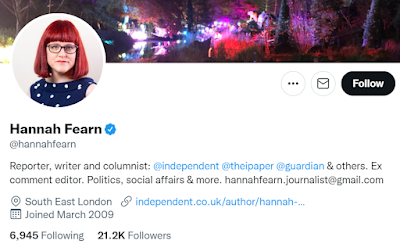
I was curious and checked it on Twitter. Unless I'm missing something, rather than reacting to event in recent months, Hannah Fearn tweeted that way back in March 2020: 


This leads me to wonder: Rather than Hannah Fearn being a viewer who contacted Newswatch over this, did Newswatch simply come across her tweet on Twitter and NOT realise it was nearly two years old, and then just put it out, without checking? If so, that's very strange behaviour on Newswatch's part. 
Thursday, 6 January 2022

BBC News gets a CEO


It's out with the old, in with the new at the BBC. 

Out goes Fran Unsworth as Director of BBC News, in comes Deborah Turness as CEO of BBC News - an upgraded job title with an upgraded salary, rising from £340,000 a year to £400,000 a year.

I see the Defund the BBC campaign has already given Ms Turness a warm welcome tweeting,  “The BBC have replaced Fran Unsworth with a new £400,000-a-year fat cat who’s getting an extra £60,000 on top of the role’s already monstrous salary. Stop funding big executive pay rises. Defund the BBC.”

Like Fran Unsworth, Ms Turness has worked in the broadcast media throughout her working life but unlike Fran, who's been a 'BBC lifer', Deborah has worked for several top broadcasters, rising to be President of NBC News and CEO of ITN.


Vanity Fair in 2015 described her as “a feisty, hard-charging, tabloid-loving British media figure” and claims the news programmes she supervised in an earlier period as editor at ITN “consistently humbled rivals at the BBC.” 

And if you enjoyed that bit of American purple prose, the same piece then calls her “a hip, sinewy blonde” who was “once been married to a roadie for the Clash and had competed in a Beijing-to-Paris road race” - which sounds someone different to Fran Unsworth, to whom the term “rock-chick swagger” has never been applied. As far as I know.

Another bit reminds me of Tim Davie though: “Turness’s presentations were a model of 21st-century media and corporate jargon and synergies.” Sounds fun.

Sunday, 14 November 2021

'Having to explain journalism to [BBC] idiots'


The BBC's very own culture war broke out into the open this week. 

The Sunday Times reports that during an “extremely hostile” Zoom meeting outgoing BBC Head of News Fran Unsworth told staff from the BBC’s Pride network, “You’ll hear things you don’t personally like and see things you don’t like — that’s what the BBC is, and you have to get used to that. These are the stories we tell. We can’t walk away from the conversation.”

The Sunday Times has quite the quote from a 'BBC source': “Fran was totally calm but determined about it. She was reacting to questions from the network that implied people shouldn’t come across views they disliked. To me, it felt like she was having to explain journalism to idiots.”

One member of staff told Tim Davie, who was also present, that he was “not in a position to make decisions on this issue, because he’s not trans” while another said the BBC was “institutionally transphobic.”

Sunday, 12 September 2021

Poison blades in shoes and BBC gossip


Thank you for your comments on the Open Thread. You've covered - and nailed - so much of the ground I would have covered, including the departure of BBC lifer Fran Unsworth.

Today's Sunday Times - featuring that photo of Ms Unsworth which always draws Rosa Klebb comparisons in comments fields - includes lots of BBC insider gossip, including claims that Tim Davie is glad to see her go because she's “stuck in her ways” and part of the “malaise” at the corporation.

Friends of Tim also give us some juicy quotes, including saying that he's engaged in “constant fire-fighting” and that “he feels he opens Pandora’s box every day, and only the bad stuff ever comes out”. 

As far as the general exodus of BBC lifers go, any BBC source quips “More people are leaving the BBC than Afghanistan.”

And who's going to replace Francesca as Director of News and Current Affairs at SPECTRE the BBC? 

The piece names four people: present Deputy director of news Jonathan Munro, Senior controller of news output and commissioning Jamie Angus, Digital director of BBC News Naja Nielsen, and Commissioning editor for factual and arts at Channel 4 Shaminder Nahal. 

Mr Munro has 'issues' involving the debacles over Cliff Richard and Martin Bashir while Mr Angus is considered “lightweight”. Cue two more insider gossip quotes:
On Jamie Angus: “He’s a dilettante. When he was at the World Service, and your job is to know this stuff, I remember him saying he hadn’t heard of Waziristan, which was where bin Laden was hiding at the time.”

On Jamie Angus and Jonathan Munro: “Angus is a man who has risen without trace and Munro is a man who should have sunk without trace”.
Ms Nielsen is a recent arrival from Danish broadcasting, and “relatively unknown.” while Ms Nahal has all the baggage of being associated with left-wing Channel 4 and was jointly responsible for Black to Front, the channel's recent racist day when only black people appeared on the channel. “We were tired of taking small steps, say Vivienne Molokwu and Shaminder Nahal”, Broadcast reported her saying two days ago.

Especially as she previously worked for Newsnight, I'd place my money on Ms Nahal.

Saturday, 26 September 2020

One minute to midnight


'Francesca' is a fine Italian name. Fans of Dante will recall poor Francesca da Rimini, blown about the first circle of Hell like a leaf in a never-ending whirlwind alongside her no less ill-fated lover Paolo. 

Most readers over the centuries have felt nothing but sympathy for her. 

Will they sympathise with Francesca della BBC though? 

Here's her story. (Please try not to faint with pity.)

Fran Unsworth, the BBC's Director of News and Current Affairs, jetted off to Italy this week to speak at the Prix Italia conference - it's a hard life, but I suppose someone has to do it - and reading her speech makes it sound as if she feels she's in the first circle of Hell at the moment being blown about like a leaf in a never-ending wind too. She even begins by saying:

We live in stormy times and are all trying to navigate through them with intelligence and with good hearts and good intentions.

What's bothering her especially is the impact of the 'culture wars' on the BBC and the fact that "many actors wish to co-opt us into their side of the culture war". She strongly hints that some BBC staff have already been co-opted:

Online warriors...can encourage staff with a particular interest in an aspect of the news, for example from their lived experience, to seek to persuade editors that their view of the world needs to be reflected in our coverage. Or that we should adopt the particular vocabulary they endorse.

She says this is "increasingly hard this is to resist" (we've noticed, as per Extinction Rebellion and Black Lives Matter!), but says if the BBC don’t resist it they will "undermine their future as a universal public service media organisation, taking money from everyone". 

What can be done? She says that newsrooms should

(1) "Decide on the right editorial way forward and the right language to deploy, in a clear, calm, considered fashion. And which when challenged can explain their decisions quickly and responsively to both the outside world and to our own staff".

(2) "Shrug off social media pressure and the cancel culture, and parry the unfair attacks on our honesty and intentions".

And, she adds:

(3) "More than anything, we need newsroom leaders who are ready to reflect a broad range of thinking, who don’t always go down the same narrow, well-trodden path because it is the one they have always followed". 

Shrugging off social media pressure and the cancel culture is a good idea, and of course the BBC should parry unfair attacks on their honesty intentions. And it's good that she acknowledges the narrowness of the range of thinking among BBC 'newsroom leaders'. 

But (1) is surely dependent on (3) already being in place, and the problem is that (3) is very far from being in place. 

BBC groupthink rules, and it will take a lot of blood, sweat and tears to change - if her and Tim Davie seriously want to change it. 

It is precisely because (3) isn't remotely in place that so many wrong editorial ways forward have been chosen in the past few years (and decades) - and it's getting worse. (Just look at Newsnight).

'A broader range of thinking' is surely the horse, 'deciding the right editorial way forward' the cart?

Anyhow, Miss Unsworth ended her speech with a rhetorical flourish:

If we don’t analyse the dangers these cultural issues pose to public service broadcasters and think them through, we may look up and see to our surprise that the hands of that clock we watch all day are pointing at one minute to midnight.

Many, of course, think it's past midnight already.

Wednesday, 27 May 2020

Lewis Goodall liked


It looks as some Newsnight journalists aren't happy with the BBC's ruling:


Lewis Goodall will have to be very careful. He's skating on thin ice now and publicly expressing dissent in this way could have consequences. The BBC's director of news Fran Unsworth wrote last year (in an email to staff):
We all have personal views, but it is part of our role with the BBC to keep those views private. Our editorial guidelines say BBC staff must not advocate any particular position on a matter of public policy, political or industrial controversy, or any other ‘controversial subject’. That applies to all comments in the public domain, including on social media. There is no real distinction between personal and official social media accounts.
Update: Others are now noticing Lewis Goodall's risky 'like':
Darren Grimes: BBC Newsnight’s Lewis Goodall agrees that it’s spineless of the BBC to admit that last night’s monologue wasn’t impartial. It wasn’t. It’s baffling to me that these entitled journalists think they can collect taxpayer funds and use it to present their left-wing opinions as facts.  
Rich: If you worked for a private company, what would happen to you if - after having a stern talking to for breaking the rules - you went onto social media and started liking posts criticising management?
Further Update: Lewis Goodall is doubling-down. He's continuing to 'like' tweets criticising the BBC's ruling:


These include:
  • Paul Bernal: I can see the point - but it’s nitpicking, really, and disappointing that the BBC felt the need to acquiesce in the way that it did.
  • James Armstrong: This is a disgrace. Maitlis is their best anchor & last night's episode was an example of exceptional journalism. I'd encourage everyone to watch, especially  Lewis Goodall 's piece. It's astonishing that this is the story rather than gov't evasion of legitimate questions.
Be careful, Lewis. Be very careful.

Thursday, 7 May 2020

The alliance between the hard, secular left and political Islam.”

I've been keeping half an eye on the ups and downs of the Jewish Chronicle. The FT reported the situation while it was still unresolved - I can’t give you the date of publication because won’t let me back into the website now - but here’s the excerpt I managed to grab, explaining the way things stood back then:
“The Kessler Foundation, a charitable trust that has owned the Jewish Chronicle since 1984, submitted an offer to the proposed liquidators Begbies Traynor this week, which would have seen them acquire the assets of both publications and run them as a merged publication. 
But a rival bid from a consortium through lawyers Osborne Clarke has also been submitted, according to two people familiar with the matter. 
The rival consortium is being fronted by former Downing Street head of communications Robbie Gibb, biographer William Shawcross, former Labour MP John Woodcock,
Rabbi Jonathan Hughes of Radlett United Synagogue, and prominent broadcasters John Ware and Jonathan Sacerdoti.”
Most of whom have been featured in this blog - (funny that.) The consortium’s bid was successful and they reinstated Stephen Pollard as promised. 

Those of you who take the Spectator might have read an article by Charles Moore in the magazine.
“………a new consortium moved fast to intervene, and outbid the existing management in order to reinstate Pollard, see the staff right, pay off the debts and secure the future. Headed by Sir Robbie Gibb, a Gentile, the consortium is serious about reinforcing the Jewish Chronicle’s strength rather than shutting it down. Behind all this I detect a battle for leadership in the community. Those who are braver about confronting Islamist anti-Semitism have prevailed over the outdated establishment view that the greater threat to British Jews is from the far right and that Islamists should be appeased in the name of ‘interfaith dialogue’. 
The consortium’s victory is good news. It would have been a weird epilogue to the successful exposure of Labour’s anti-Semitism under Jeremy Corbyn if the most prestigious Jewish paper in Europe had then folded. As the general election result proved, the supposedly anti-Semitic white working class saw through Corbyn. The rising danger to Jews — as, though more surreptitiously, to Christians — comes from the alliance between the hard, secular left and political Islam.”
Ah, the last few words open a Pandora’s box of inconvenient and hard to answer questions.

The reason for this post is simply this. (And it’s even BBC related) 


A particularly annoying photo of the BBC’s Fran Unsworth illustrates the piece. In it, she’s looking both startled and extremely pleased with herself all at once. 

The issue concerns a knotty problem. How much does political or personal prejudice affect one’s professional credibility? We’re talking about renowned antisemites being invited onto the Beeb to opine about supposedly unconnected matters. Notably but not exclusively, as per that Panorama.

Maybe there’s an element of  ‘intersectionality’ here? To what extent does a person’s race, class, and gender prejudice create a unique mode of discrimination dent one’s entire credibility? 

Can one’s irrationality in the form of racial hatred - viz  “the cognitively dissonant alliance between the hard, secular left and political Islam” be completely divorced from other areas of one’s personality. For example, does it affect one’s expertise in a seemingly unrelated sphere? Does that make sense?

Let’s temporarily forget Professor Ashton, whom Fran Unsworth says is “eminently well qualified to speak about this subject [public health]”. Let’s examine her reasoning, by using a more extreme example like, say, the late Stephen Hawking. 

Stephen Hawking was so highly regarded as a theoretical physicist, cosmologist and author that his reputation as such is untouchable and sealed forever. But even he fell foul of pressure from the hard, secular left and political Islam in his irrational decision to  join the academic boycott of Israel by rejecting an invitation to attend a conference there (despite relying on Israeli sourced technology  to help keep him alive.)  That was just common or garden hypocrisy, but we’re not concerned with that at the moment.

The conference, called “Facing Tomorrow 2013,” is billed as a meeting place for exploring the developments shaping the future of Israel, the Jewish people and the world. Its program includes former heads of state, academics, artists and business executives. Former President Bill Clinton is to receive an award from Mr. Peres.
Also listed among the speakers is Munib al-Masri, a Palestinian tycoon from the West Bank city of Nablus who has been working to promote internal Palestinian reconciliation.
If that is indeed an accurate description of the event that Hawking boycotted, doesn't the decision to boycott it look a bit stupid and ill-conceived? It does to me. 

However, as I know quite a bit more about factually and historically illiterate antisemitism than I do about theoretical or any other kind of physics, all I can possibly ask is ‘does a specific demonstration of irrationality and prejudice dent one’s whole credibility? A little bit? Not at all?  Does stupidity, prejudice and irrationality run through one like the proverbial stick of rock?

What I do know is that Stephen Hawking’s and professor John Ashworth’s reputations are seriously flawed in the eyes of this non-expert, and as far as Fran Unsworth's reputation is concerned, wheeling out the ‘Freeze Peach’ argument certainly dents the remaining dregs of it.

The issue here is that while antisemitism under the accepted definition is not actually illegal, and we don’t want to create a bespoke version of a blasphemy law to make it so, what can most effectively be done to show disgust and disapproval where anti-Jew prejudice raises its head?

For the BBC, maybe keeping known antisemites out of the limelight would go along with the spirit of the zeitgeist. However, as we’ve been saying for the last umpteen years, the BBC is not minded to keep antisemites out of the limelight. The BBC has tacitly taken the side of the antisemites and promotes the hard, secular left and political (and particularly cultural) Islam at every opportunity. It has made antisemitism a political choice and it’s not afraid to say so.

Monday, 23 December 2019

Playing his joker


As discussed on the open thread, Lord Hall, DG of the BBC, has played the 'complaints from both sides' card in his piece for the Daily Telegraph:
Around 27m people in the UK came to the BBC website to find out about the election results. It was a reminder of the trust people place in the BBC. Yes of course we faced some criticism for our election coverage. That is to be expected as the national broadcaster. Where we can and need to improve we will. But the fact criticism came from all sides of the political divide shows to me that we were doing our job without fear or favour.
As the paper's Anita Singh notes, however:
That assessment does not chime with comments made by the BBC’s head of news and current affairs, Fran Unsworth, who said earlier this month: “I don’t necessarily subscribe to the view that if we get complaints from both sides, we are doing something right.”
She's right not to subscribe to that view.

Wednesday, 18 December 2019

BBC Media Action is still receiving direct EU funding


It's not news to us, of course, that BBC Media Action has received money directly from the EU in the past, but, nonetheless, it's still surprising to learn that it's still going on:
Revealed: How BBC charity was paid MILLIONS by EU Commission 
THE BBC continues to face criticism over alleged bias in its election coverage, Express.co.uk can reveal that the broadcaster’s charitable arm BBC Media Action received more than £3million directly from Brussels in the financial year 2017-18. 
A spokesman for BBC Media action told Express.co.uk: “In the financial year 2017-18, BBC Media Action received approximately £3.1million from the European Commission. This funding has gone to programmes in Iraq, Afghanistan, Syria, North Africa, South Sudan and Ukraine. BBC Media Action is an independent charity which is not funded from the BBC licensing fee."  
Even though the charity claims to be fully independent from the state broadcaster, its board members are not only nominated by the BBC but its chair, Fran Unsworth, is the Director of News & Current Affairs for BBC News. 

Saturday, 14 December 2019

Friendship groups


StewGreen has pointed out a Guardian article about BBC election bias that might well tempt BBC types into their 'complaints from both sides' mantra, but oughtn't to. 

The vicious far-left/EU-fanatic Twitter bubble that terrified the BBC during the election, spraying nonsense over them, apparently made such BBC types feel deeply uncomfortable in their everyday lives. 

Fran Unsworth, the BBC's director of news and current affairs, has been defending herself to the Guardian

The line (highlighted by Stew) from the Guardian inadvertantly says a lot:
BBC journalists based in London, an area with strong Labour support, reported finding it harder now that their friendship groups were increasingly critical of the corporation’s output.
Of course BBC types have been in "friendship groups" with such people. (I'm not). 

Maybe they should 'unfriend' them. Many of them will have voted for Jeremy Corbyn after all, and no decent, informed person who hates antisemitism and left-wing extremism should have even considered doing so.

Thursday, 2 May 2019

More on John Simpson


Fran, on reading John Simpson's Twitter feed?

BBC Head of News Fran Unsworth could hardly have been clearer in her (leaked) email to BBC journalists earlier this year, that BBC journalists need to keep their personal views private and that this also fully applies to their time spent on social media as much as it does to their 'regular' reporting. She also explicitly warned against imperilling the BBC 'reputation for impartiality' through one-sided retweets as people can take them for 'endorsements'...

...just as I take this retweet from the BBC's John Simpson as an 'endorsement' of what Bonnie Greer says here about immigration:


Will Mr. Simpson be getting a verbal warning from Ms. Unsworth? 


Saturday, 6 April 2019

One of them, RIGHT HERE, is on your TV every morning


Ben, looking bashful (for some reason)

Here's a transcript of a segment from this week's Newswatch, presented (in Samira Ahmed's absence) by Shaun Ley:

*******

Shaun Ley: Last Thursday's edition of Question Time picked up on the protests against lessons in diversity and equality [by mainly Muslim parents] which are being taught at some Birmingham primary schools. They include same-sex relationships and the rights of LGBT people. 
Question Time audience member: Is it morally right that five-year-old children learn about LGBT issues in school?
Fiona Bruce: Oh, I can hear all sorts of sounds coming from the audience here, so...
There was an angry response from some members of the wider TV audience to the inclusion in the programme of that question which was then posted on Twitter by the Question Time team. One of those expressing views in a forthright way on that tweet was the BBC Breakfast presenter Ben Thompson:
Ben Thompson: LGBT 'issues'? Like what? That we exist? One of them, RIGHT HERE, is on your TV every morning. I held back on this hoping it was clumsy writing, done in haste. But it's still online. Would you ask if it's 'morally right' to learn about gender/race/religion/disability 'issues'. 
Others agreed, with Jerome writing:
Jerome: The question is loaded with prejudice and the premise is incorrect. Are we back in the 1950?
And Lil Tinge asked:
Lil Tinge: Do you want to explain to your LGBT licence payers why your producers thought this was an acceptable question for debate?
Well, the BBC issued the following explanation:
BBC News: Question Time is a topical debate programme. This was a question asked by an audience member on a subject which has seen a lot of recent discussion. 
This week the corporation's Director of News Fran Unsworth sent a general reminder about the use of social media to all staff in news which found its way into the public domain [i.e. was leaked by someone at the BBC to the Guardian]. It advised:
Fran Unsworth: We all have personal views, but it is part of our role with the BBC to keep those views private. You shouldn't state your political preferences, or say anything that compromises your impartiality. Don't sound off about things in an openly partisan way. We haven't always been consistent in dealing with this issue in the past, but we cannot afford for this to continue, and will consider appropriate action in the future.
*******

So it was BBC Breakfast's Ben Thompson, it appears, who brought down The Wrath of Fran on the BBC as a whole.

Now, I must say I'm with the BBC and Ivy Unsworth of In Loving Memory's grand-daughter Francesca here. 

This was a question from a member of the QT audience. Shouldn't he be allowed to ask it because it offends the easily-offended? 

And I don't think it's a remotely objectionable question anyhow. 

Contrary to what Ben Thompson of BBC Breakfast said, the question wasn't about the morality of teaching about LBGT 'issues' - or gender/race/religion/disability 'issues' - in schools per se. It was about teaching about sexuality to five-year-old children. 

Yes, people like Ben might be justified in blowing their tops if people called for such things to be banned from being mentioned in secondary schools, but teaching such sexualised matters to five-year-old IS a question that deserves moral querying.

Ben Thompson should have THIS pointed out to him too, whether by email or in person. Over to you Fran.

Thursday, 4 April 2019

Déjà vu


Ms Unsworth

Every four years or so a senior BBC figure ends up sending out an email to BBC staff telling them to stop tweeting personal views. In 2010 it was Helen Boaden. In 2014 it was Mary Hockaday. And in 2019 it's Fran Unsworth. In an email to all staff leaked to the Guardian, she says:
We all have personal views, but it is part of our role with the BBC to keep those views private. Our editorial guidelines say BBC staff must not advocate any particular position on a matter of public policy, political or industrial controversy, or any other ‘controversial subject’. That applies to all comments in the public domain, including on social media. There is no real distinction between personal and official social media accounts. 
We are living in a period of highly polarised opinions on a range of subjects and the BBC frequently faces criticism for the way we report and analyse events, with our impartiality called into question. 
Many of these criticisms are unfounded and we are prepared to defend ourselves robustly where necessary. We also need to make sure our own house is in order.
According to the Guardian, Ms. Unsworth also pulled the rug out from many a BBC Tweeter by "declaring that putting “retweets aren’t endorsements” in an online biography does not absolve an individual of responsibility." 

She went on:
Ignoring these rules risks undermining the BBC’s reputation, particularly given our renewed focus on impartiality. We haven’t always been consistent in dealing with this issue in the past, but we cannot afford for this to continue and will consider appropriate action in future.
Poor old Hugh Sykes and John Simpson, and countless others at the BBC, will have to drastically tone it down or end up before the BBC beak. Fran has spoken!

*******

Talking of John Simpson, here he is, juxtaposed with his BBC colleague Andrew Neil:


John agrees with the anti-Brexit NYT piece, Andrew disagrees with it. Will Fran be having words with them?

Wednesday, 18 July 2018

The BBC in the witness box - a judge rules


It's not been a good day at the office for the BBC today after a High Court judge ruled that the BBC's coverage of the arrest of Sir Cliff Richard was an invasion of his privacy. Sir Cliff has been awarded £210,000 in damages. 

The BBC's response to the judgment has been widely characterised as "sorry, not sorry". They are even thinking of appealing. (At what cost to the licence fee payer?)

Here are BBC Director of News Fran Unsworth two major statements today. The first was sent to the world:


The second was sent to BBC staff:


Reading that and then reading the judge's opinion on his BBC witnesses, as laid out here, it seems to me that Ms. Unsworth's comments are rather tinged with wishful thinking - especially as far as the BBC journalist accuracy and honesty goes. (I've highlighted the most damning passages):  


That...

...and particularly the comments about BBC reporter Dan Johnson "twist(ing) matters in a way that could be described as dishonest" and about him "letting his enthusiasm...get the better of his complete regard for the truth on occasions"...

...pulls the rug from under Fran Unsworth's claim that "the judge...was clear that what we broadcast was accurate". 

The judge, in fact, appears to have been "clear" that what the BBC broadcast was far from being wholly accurate.

As for the senior BBC editors involved, Fran Unsworth herself came out best. The judge evidently liked her and found her to be honest, thoughtful and conscientious. But his comments that, during the trial, she'd engaged in "wishful thinking" and "ex post facto convenient rationalisation" still sounds pretty damning. 

Gary Smith - now BBC Scotland's Head of News and Current Affairs - comes off worst. The judge found him to be an unreliable witness at times. 

And Jonathan Munro, the BBC's Head of Newsgathering - a familiar 'we got it about right' BBC defender on the likes of Newswatch and Feedback -  appears to have found that his 'we got it about right' spiel fails to wash with High Court judges. Though Mr Justice Mann liked his thoughtful manner, he found him "overly guarded" (Welcome to our world Mr Justice Mann!) and said he was "almost wilfully failing to acknowledge inconsistencies and refusing to acknowledge the plain effect of some of the emails in the case". (Again, welcome to our world Mr Justice Mann!).

There's an expectation floating around that, in true BBC style, assistant heads will roll over this. 

Update: In a fine example of that internet law (Muprhy's? Skitt's?) which states that any post criticising someone else's inaccuracy of another will contain an inaccuracy itself, I don't think I was entirely factually accurate in this post.

Looking at it again (with a little prompting!), it was the section on Dan Johnson which I read as being critical of the accuracy of the reporting itself. All the other criticism of the BBC here relates to their testimony only. 

Reading that section again and then reading on, the bit about Mr Johnson "twisting" things "in a way that could be described as dishonest" relates to his behaviour in getting the report - specifically twice giving "false impressions" to South Yorkshire Police - rather than the actual content of his report. Indeed, the judgment later goes on to say:
The veracity of the published information in this case is not in issue. What the BBC published was accurate. What is more questionable is the method of obtaining the information.
So Fran Unsworth's carefully worded statement is correct when she says "the judge...was clear that what we broadcast was accurate". 

Friday, 15 December 2017

Frantastic news?


Fran Unsworth 

So James Harding's replacement as the BBC's new Director of News and Current Affairs will be Francesca Unsworth. 

What do we know about Fran (besides what we can read on Wikipedia)? 

Well, she's a longstanding BBC insider and presently Director of the World Service, and, according to Guido Fawkes, has a "strong grasp of the impartiality rules". 

That latter bit sounds good, but...

She's also been the chair of the 'independent' BBC Media Action charity - and that's the charity, you may recall, which became controversial for its EU funding and its actions in apparently advancing EU priorities.

I'm not sure that anyone's ever quite got to the bottom of that yet, and it still smells bad to me.

She was (is?) also a board member (as per her BBC Declaration of Personal Interests) on the EU's world-embracing Erasmus Mundus programme.

That's seriously odd, isn't it? With all of her many BBC commitments, why on earth did she get involved at such a high level in a major EU project?

You can read about her 'very BBC' views on how to handle the issue of climate change here and here

Interestingly, she criticised Channel 4's Jon Snow for his impartiality-busting emotionalism over Gaza, saying "If one of our presenters had done something like that in a private capacity on YouTube, I'd have had to have said, this isn't really appropriate in terms of your public role as an impartial presenter of BBC news programmes. We take it very seriously." That's good.

Her BBC Media Action/World Service roles have involved her getting involved in public confrontations with the ayatollahs in Iran over their treatment of BBC staff and Nazanin Zaghari-Ratcliffe's involvement with BBC Media Action. (See here and here).

On her 'very BBC' dismissive reaction to the Centre for Policy Studies' review of the BBC's coverage of think tanks (the CPS found left-wing bias), see here.

She launched a new North Korean service late this year. She told (Breitbart) The Guardian, "We are reaching an incredibly febrile, dangerous atmosphere at the moment about that whole story, and isn’t it terrible for the people of North Korea that the only information that they getting about any of this is that woman who goes on North Korean television every night?".

Ri Chun-hee, North Korea's answer to Fiona Bruce

Francesca's not featured much on our little blog so far though. 

Good luck in your new job Fran! We'll be watching you.


P.S. Fans of people called 'Unsworth' might recall that wonderful ITV sitcom from the late '70s/early '80s called In Loving Memory, starring Morecambe-born megastar Thora Hird. She played Ivy Unsworth, owner of an undertakers' business. We've got a boxed set of it, and it's still funny (particularly when hilarious things go wrong at funerals with coffins). Who remembers the bassoon-heavy theme tune?


Update: Just a little more background on Francesca Unsworth, the BBC's next Director of News and Current Affairs...

Here's something intriguing from David Keighley's archive over at TCW (from 2014), concerning the BBC's much-criticised helicopter-festooned coverage of Sir Cliff Richard's arrest. It looks as if R Fran was heavily involved in that:
In what looks like a carefully organised off-the-record briefing last night, reporter John Plunkett says that it was deputy director of news Fran Unsworth who gave the go ahead for the coverage. The reason? Because the Corporation is ‘coming under increasing pressure in its news operation to beat rivals to exclusive stories’.
Hmm.

Saturday, 19 July 2014

Has Lord Lawson been banned by the BBC?


For those of you following the story about the 'banning' of Lord Lawson from the BBC's airwaves, here's a letter you may have missed from this week's Spectator. Make of it what you will:
Sir: You write that the BBC ‘has effectively banned’ Lord Lawson from items on climate change unless introduced with ‘a statement discrediting his views’ (Leading article, 12 July). There’s a lot of muddled reporting of this story. Lord Lawson hasn’t been in any sense ‘banned’, and the Editorial Complaints Unit finding didn’t suggest that he shouldn’t take part in future items. It found fault with the way the Today item was handled in two respects: firstly that it presented Lord Lawson’s views on the science of global warning as if they stood on the same footing as those of Sir Brian Hoskins, and secondly that it didn’t make clear to listeners that Lord Lawson represented a minority view. There is also no ban on other non-scientists discussing climate change. The BBC is absolutely committed to impartial and balanced coverage on this complex issue. Our position remains exactly as it was — we accept that there is broad scientific agreement on climate change and we reflect this accordingly. We do, however, on occasion offer space to dissenting voices where appropriate as part of the BBC’s overall commitment to impartiality.
Fran Unsworth Deputy director, BBC News and Current Affairs