Showing posts with label Robbie Gibb. Show all posts

Sunday, 13 December 2020

Have They Got Bias For Us


In what must surely be the least surprising report into BBC bias ever produced, the Campaign for Common Sense analysed comedy programmes on BBC One, BBC Two and Radio 4 throughout November and found - across 364 slots - and found that 74% of the slots were occupied by comedians “with publicly pronounced Left-leaning, anti-Brexit or ‘woke’ views.”

So that's 74% of 141 comedians, with only two comedians - Geoff Norcott (of course) and Gyles Brandreth - holding openly expressed pro-Brexit or Conservative sympathies. 

Even DG Tim Davie has acknowledged that BBC comedy has a problem in this respect, so a letter outlining the findings from the CCS's director Mark Lehain won't be News For Him.. 

The Telegraph quotes Sir Robbie Gibb responding to the study:
This report starkly reveals just how much the BBC has to change to be truly in touch with the people who pay its licence fee. 

Comedy is not the exclusive preserve of the left and the BBC has a duty to reflect in its programmes the wide diversity of opinions held in this country, not just those with anti-Brexit or woke views.
But the real punchline here is the statement from "a BBC spokesperson". Its glib, dismissive tone couldn't be more BBC:
We don’t analyse our comedy by comparing numbers. We judge it on it being funny, how popular it is and whether it reflects a range of different voices and views.
The BBC always says "We don’t analyse our comedy by comparing numbers" to any quantitative study that comes their way - unless it's research that comes from, say, Cardiff University and tells the BBC what they want to hear! 

And "We judge it on it being funny, how popular it is and whether it reflects a range of different voices and views" is particularly galling as the study proves that the BBC's judgement is faulty and that BBC comedy barely even begins to reflect a range of different voices and views.

Well done to the Campaign for Common Sense for trying to prove the obvious, but the BBC have had a couple of decades of honing their responses to the kind of two-sentence brush-off quoted above and they were never going to get a respectful hearing from the BBC. 

***********

And then there's Nish Kumar....

As Charlie notes on the open thread, the Telegraph article recalls the following:
On a past episode of BBC Two’s The Mash Report, Nish Kumar referred to the BBC’s impartiality guidelines as a requirement to provide “a platform for widely-discredited views because the licence fee dictates we should pander to weirdos”.

Thursday, 20 August 2020

Sir Robbie v Lewis (the re-match)


I don't think Sir Robbie Gibb (the BBC's next chairman?) is impressed by Newsnight's policy editor's latest lapse into opinion-mongering:


Monday, 17 August 2020

I dreamed a dream

Those hoping for drastic reform of the BBC aren't overly happy at some of the mooted contenders to replace Sir David Clementi as BBC chairman, especially Nicky Morgan and Amber Rudd - Remain-backing figures from the left of the Conservative Party who they suspect will go native at least as quickly, if not quicker, than Sir David did. 

Andrew Neil is proving a much more popular choice. 

I, personally, like the sound of Sir Robbie Gibb though. He's the Brexit-supporting former BBC head of political programmes who (for his sins) became Mrs May's director of communications. 

I'm backing him simply because his appointment would make Newsnight's Lewis Goodall feel highly uncomfortable. 

If you recall, he fell out with Lewis on Twitter last year after he critiqued one of Lewis's reports and found that it broke seven of his impartiality tests (it must have been one of Lewis's milder reports!) - criticism Lewis didn't like one bit, biting back with a sneer: 

Thanks for this Robbie. Maybe one day, if I’m as impartial as you, I can get a knighthood too. 

...to which Sir Robbie replied: 

My advice to you is listen to constructive criticism and try and improve. 

The thought of Sir Robbie Gibb's first action as BBC chairman being to bring Lewis Goodall into his office for a lecture on impartiality is one I'm finding highly pleasing - especially if Emily Maitlis, Esme Wren and the rest of the Newsnight team are sitting in an adjacent room while it's going on, waiting their turn. (Well, I can dream!)    

Thursday, 7 May 2020

The alliance between the hard, secular left and political Islam.”

I've been keeping half an eye on the ups and downs of the Jewish Chronicle. The FT reported the situation while it was still unresolved - I can’t give you the date of publication because won’t let me back into the website now - but here’s the excerpt I managed to grab, explaining the way things stood back then:
“The Kessler Foundation, a charitable trust that has owned the Jewish Chronicle since 1984, submitted an offer to the proposed liquidators Begbies Traynor this week, which would have seen them acquire the assets of both publications and run them as a merged publication. 
But a rival bid from a consortium through lawyers Osborne Clarke has also been submitted, according to two people familiar with the matter. 
The rival consortium is being fronted by former Downing Street head of communications Robbie Gibb, biographer William Shawcross, former Labour MP John Woodcock,
Rabbi Jonathan Hughes of Radlett United Synagogue, and prominent broadcasters John Ware and Jonathan Sacerdoti.”
Most of whom have been featured in this blog - (funny that.) The consortium’s bid was successful and they reinstated Stephen Pollard as promised. 

Those of you who take the Spectator might have read an article by Charles Moore in the magazine.
“………a new consortium moved fast to intervene, and outbid the existing management in order to reinstate Pollard, see the staff right, pay off the debts and secure the future. Headed by Sir Robbie Gibb, a Gentile, the consortium is serious about reinforcing the Jewish Chronicle’s strength rather than shutting it down. Behind all this I detect a battle for leadership in the community. Those who are braver about confronting Islamist anti-Semitism have prevailed over the outdated establishment view that the greater threat to British Jews is from the far right and that Islamists should be appeased in the name of ‘interfaith dialogue’. 
The consortium’s victory is good news. It would have been a weird epilogue to the successful exposure of Labour’s anti-Semitism under Jeremy Corbyn if the most prestigious Jewish paper in Europe had then folded. As the general election result proved, the supposedly anti-Semitic white working class saw through Corbyn. The rising danger to Jews — as, though more surreptitiously, to Christians — comes from the alliance between the hard, secular left and political Islam.”
Ah, the last few words open a Pandora’s box of inconvenient and hard to answer questions.

The reason for this post is simply this. (And it’s even BBC related) 


A particularly annoying photo of the BBC’s Fran Unsworth illustrates the piece. In it, she’s looking both startled and extremely pleased with herself all at once. 

The issue concerns a knotty problem. How much does political or personal prejudice affect one’s professional credibility? We’re talking about renowned antisemites being invited onto the Beeb to opine about supposedly unconnected matters. Notably but not exclusively, as per that Panorama.

Maybe there’s an element of  ‘intersectionality’ here? To what extent does a person’s race, class, and gender prejudice create a unique mode of discrimination dent one’s entire credibility? 

Can one’s irrationality in the form of racial hatred - viz  “the cognitively dissonant alliance between the hard, secular left and political Islam” be completely divorced from other areas of one’s personality. For example, does it affect one’s expertise in a seemingly unrelated sphere? Does that make sense?

Let’s temporarily forget Professor Ashton, whom Fran Unsworth says is “eminently well qualified to speak about this subject [public health]”. Let’s examine her reasoning, by using a more extreme example like, say, the late Stephen Hawking. 

Stephen Hawking was so highly regarded as a theoretical physicist, cosmologist and author that his reputation as such is untouchable and sealed forever. But even he fell foul of pressure from the hard, secular left and political Islam in his irrational decision to  join the academic boycott of Israel by rejecting an invitation to attend a conference there (despite relying on Israeli sourced technology  to help keep him alive.)  That was just common or garden hypocrisy, but we’re not concerned with that at the moment.

The conference, called “Facing Tomorrow 2013,” is billed as a meeting place for exploring the developments shaping the future of Israel, the Jewish people and the world. Its program includes former heads of state, academics, artists and business executives. Former President Bill Clinton is to receive an award from Mr. Peres.
Also listed among the speakers is Munib al-Masri, a Palestinian tycoon from the West Bank city of Nablus who has been working to promote internal Palestinian reconciliation.
If that is indeed an accurate description of the event that Hawking boycotted, doesn't the decision to boycott it look a bit stupid and ill-conceived? It does to me. 

However, as I know quite a bit more about factually and historically illiterate antisemitism than I do about theoretical or any other kind of physics, all I can possibly ask is ‘does a specific demonstration of irrationality and prejudice dent one’s whole credibility? A little bit? Not at all?  Does stupidity, prejudice and irrationality run through one like the proverbial stick of rock?

What I do know is that Stephen Hawking’s and professor John Ashworth’s reputations are seriously flawed in the eyes of this non-expert, and as far as Fran Unsworth's reputation is concerned, wheeling out the ‘Freeze Peach’ argument certainly dents the remaining dregs of it.

The issue here is that while antisemitism under the accepted definition is not actually illegal, and we don’t want to create a bespoke version of a blasphemy law to make it so, what can most effectively be done to show disgust and disapproval where anti-Jew prejudice raises its head?

For the BBC, maybe keeping known antisemites out of the limelight would go along with the spirit of the zeitgeist. However, as we’ve been saying for the last umpteen years, the BBC is not minded to keep antisemites out of the limelight. The BBC has tacitly taken the side of the antisemites and promotes the hard, secular left and political (and particularly cultural) Islam at every opportunity. It has made antisemitism a political choice and it’s not afraid to say so.

Tuesday, 14 April 2020

Questions


Robbie Gibb, Head of BBC Westminster before becoming Downing Street Director of Communications for Theresa May, has posted an interesting thread on Twitter this evening

What do you make of it? 

Are Laura K, Robert P, Beth R & Co. asking the right questions? What questions would you ask?

  1. Because journalists at the press conferences are asking questions through the prism of establishing political culpability, they are not asking the questions that matter.
  2. An opinion poll by Kekst CNC today suggests the media is the one UK institution that has seen a collapse in public confidence, a net 21% fall.
  3. Cheap, political, business as usual questions, such as the one from Ch4 News at weekend demanding an apology from the Home Secretary, completely misjudges the public mood. 
  4. Excitable questions about “government U-turns” (or responding to new advice when the evidence changes), “cabinet splits” (or just different points of view) and other “gotcha” techniques are jarring at best. 
  5. Questions designed to help understand how we can defeat this virus, what genuine lessons we can learn from other countries and updates on the developing science is what the public really want to hear. For example… 
Q. Is there evidence that the level of exposure to the virus – the viral load - will determine the severity of the illness?
Q. Are we getting very detailed data from other countries mapping the development of the virus?
Q. Are the countries who are lifting some lockdown restrictions basing their decisions on science or the needs of their economy? If the UK were faced with same data, would it come to the same conclusion? 
Q. Where are we on the trials of existing drugs that might help to tackle the virus?
Q. What is the latest research on re-infection showing? 
Q. What is the earliest possible timeframe for a UK vaccination programme? There are reports that one might be ready by September. Is that correct?
Q. Is there evidence that exposure to other viruses in a patient’s history can impact on the severity of Covid19?
Q. Do we use the same medical criterial for admission to ICU as other countries who seem to have different survival rates?

Saturday, 18 January 2020

Lewis Goodall v Robbie Gibb


A thread from Newnight's new policy editor on Sajid Javid's interview with the FT...
Lewis Goodall: Two points:
-final acceptance that referendum promise that we’d have exactly the same benefits of the single market was false.
-pledging to double economic growth at the same time as leaving world‘s biggest trade bloc seems, erm, ambitious.
Alternative trade deals won’t come online for years (if earlier it’s probably a sign they’re v basic) and as studies show, benefits of FTAs are pretty modest. Civil service estimates suggest that the biggest one, a US deal, will boost UK GDP by only 0.2% *after 15 years*.
Mr Javid was once rather more alive to these concerns:
Mr Javid was right then. It is difficult to imagine how an economy can undertake runaway growth whilst erecting significant trade barriers with its closest and most significant trading partner. Unless of course, they have some drastic plans on labour laws, regulation...And even that prob wouldn’t be enough. After all, cuts to domestic regulation in some areas will be matched by increases in the regulatory burden on business that divergence will inevitably bring.
...brought a response from former senior BBC editor turned Theresa May communications director Robbie Gibb:
Robbie Gibb: Applying my impartiality check to this twitter thread it fails on 1,2,3,6,8,9 and 15. Apart from that it’s great.
The rules in question, with Robbie alleges Lewis broke, are:
1) Always make impartiality the number one priority or it will take second place to other considerations.
2) On social media and broadcast it should not be possible to work out any journalist’s political views.
3) On Twitter look at your tweets in the round, check they don’t all point in one direction.
6) You can’t be both an impartial journalist and commentator - choose one or the other.
8) Don’t pretend you can predict the future - you can’t and your guess isn’t news.
9) Show some humility - you probably don’t know as much as the person you are criticising.
15) Avoid loaded language, it gives away your bias.
An unfriendly exchange then ensued:
Lewis Goodall: Thanks for this Robbie. Maybe one day, if I’m as impartial as you, I can get a knighthood too.
Robbie Gibb: My advice to you is listen to constructive criticism and try and improve. 

Saturday, 4 January 2020

Private polling from the BBC


Sir Robbie Gibb, once in charge of the BBC's political programmes before becoming Theresa May's communications chief, has a piece in The Daily Mail today about BBC bias

His main beef is with the Today programme - or 'Radio Misery', as his friends call it. He claims that during the election it "bombarded its listeners with a relentlessly negative and sneering tone and painted a picture of Britain that was monstrously out of touch". 

He also argues that it "spectacularly misread" the election with "endless" outside broadcasts from universites dominated by left-wing students and, therefore, missed "the real election story" unfolding in the working class towns of the Midlands and the North. 

The reason? Because its "trapped by its own woke 'groupthink'".

So far, so familiar. 

What's new here is his 'understanding' that the BBC has been carrying out private polling of the public's perceptions of its impartiality (or lack thereof) and that the results  apparently reveal that the Midlands and the North have the least faith in BBC impartiality while metropolitican centres like London and Manchester show the most faith in BBC impartiality. 

Hardly surprising, is it?

*******

Update: I was pleasantly surprised to hear Nick Robinson quote from Sir Robbie's Daily Mail piece during this morning's Today paper review without sneering or editorialising. That's very grown-up, I thought. Unfortunately, just a few seconds after thinking that Mishal Husain promptly read out Today's rebuttal of Sir Robbie's criticisms and then interviewed former universities minister Jo Johnson doing that very BBC thing of picking up a phrase in a piece - "left-wing, entitled, virtue- ignalling students" - and using it to clobber people they don't agree with. Here Mr Johnson was all to happy to take the bait offered by Mishal's invitations to criticise Sir Robbie - an invitation made even clearer by her issuing it more than once and doing so in that slightly jeering tone she adopts when she's signalling something.


*******


Further update: This was Today's case for the defence, as read out by Mishal Husain this morning:
So did this programme's broadcasts from universities mean that it was far from the real story of the election dominated instead by interviews with "entitled students", as put forward in that column by Sir Robbie Gibb? We did go to the Universities of Edinburgh, Cardiff, Oxford, among others, but also to Wolverhampton, to Sheffield College, and reported on constituencies including Mansfield, Darlington, Birkenhead and the views of voters in Crewe, Newcastle and Lyme [sic], and other places as well.
*******

Yet another update: Thinking more about Mishal's read-out statement from Today, were you also curious as to why she said "among others" there? Well, those "others" are Bristol University and Queens University, Belfast. Why not mention them?

And whether Wolverhampton University really merits the "but" it gets there is open to question - yes, it's a Midlands university, but it's a university nonetheless.

Sunday, 22 December 2019

Robbie Gibb's Little List - a further discussion


The conversation continues:
David Aaronovitch: There’s a lot to recommend several of your points Robbie. But if you were to critique them yourself, where do you think the weaknesses or complexities in your own checklist are?
Robbie Gibb: I’m not sure people truly understand impartiality - as you know it’s not just about balance. It requires broadcasting extending its gene pool of staff to include diversity of background and political views (as well as gender and ethnicity). It could take years.
Jill Jervis: Definitely no impartiality on TV or newspapers this GE. In fact there was nothing but pure lies about Labour & no critic of Cons so the sooner the better TV licence goes.
David Aaronovitch: Jill, how do you explain to yourself that Tories and Brexiteers seem just as convinced that broadcasters are totally biased against them? And if your explanation is that they’re mistaken then isn’t it just as possible that you are?
Peter Lamb: This argument that "everybody criticises us so we must be doing a good job' is way over used and fails the most basic scrutiny. A classic case of BS baffles brains.
David Aaronovitch: That’s not my argument.
Peter Lamb: My concern is that an assumption that criticism is symmetrical and of equal merit tends to encourage exaggeration. We now observe intense criticism of the BBC and others. Is it possible that this is amplified by the casual dismissal of criticism under the balance defence?
David Aaronovitch: Possibly, but I don’t think that’s a primary factor.
Robbie Gibb: It is possible that broadcasters can be biased against the right and left at different times. My argument is things need to change to prioritise impartiality starting with twitter and broadcast interviews.
Alistair Stewart: There is also the tricky issue of broadcast reporters being one thing 'on-air' - balanced & impartial - and believing they have can have another personae on social media - the partisan lobbyist. They are the same person, with the same duties.

Saturday, 21 December 2019

Playing the man


Oh dear. It looks as if young Lewis isn't happy about Robbie Gibb's intervention in the impartiality debate:

Robbie Gibb's Little List


Robbie Gibb, Rob Burley's predecessor at the BBC before he became Theresa May's Director of Communications, has today posted a checklist of what, in his view, needs to be done to improve impartiality and accuracy in reporting. I have to say that I think it's a superb list and the BBC should study it carefully. Many of its journalists break these 'rules' on an almost daily basis: 
Ch4’s decision to ban nonpolitical journalists from tweeting about politics is a step in the right direction and other broadcasters should follow its lead. However there is so much more that needs to be done to improve impartiality and accuracy in broadcasting. My checklist: 
1) Always make impartiality the number one priority or it will take second place to other considerations.
2) On social media and broadcast it should not be possible to work out any journalist’s political views.
3) On Twitter look at your tweets in the round, check they don’t all point in one direction.
4) Never like or retweet partisan comments that lean either left or right.
5) Ask yourself: am I providing a service that will be as congenial to a Telegraph reader as a Guardian reader.
6) You can’t be both an impartial journalist and commentator - choose one or the other.
7) Only say what you actually know. Journalists should apply the same standards of accuracy and fact checking on Twitter as they do on broadcast.
8) Don’t pretend you can predict the future - you can’t and your guess isn’t news.
9) Show some humility - you probably don’t know as much as the person you are criticising.
10) Don’t judge the success of an interview by retweets. It will distort how you conduct the interview.
11) Audiences want to know what’s going on, not just what’s going wrong.
12) The role of interviewer is to ask the questions the audience would ask if they had the chance. It should not become a game designed to embarrass the politician or raise the profile of the presenter.
13) Programme editors should constantly ask themselves will this running order look fair and reasonable to viewers with different political views to their own.
14) Avoid group think and metropolitan bias by regularly talking and listening to people outside the bubble.
15) Avoid loaded language, it gives away your bias.
16) In a democracy there are many ways politicians are held to account, not least in Parliament. So not every interview has to be the Spanish Inquisition.
17) There are lots of media outlets wanting to interview politicians. Programmes must avoid a sense of entitlement - you can’t always get what you want.
18) Empty chairing guests should only be done in exceptional circumstances & programmes should avoid becoming part of the story.
19) Presenters and reporters should avoid speaking engagements (paid or unpaid) where there could be a perceived conflict of interest.
20) Impartiality applies to everything, not just politics. Just because you think your opinion is common sense doesn’t mean you can express it on broadcast.
21) All broadcasters are covered by the Ofcom code on accuracy and impartiality. Understand that and act accordingly.

Sunday, 4 March 2018

Complaints from the Dark Side


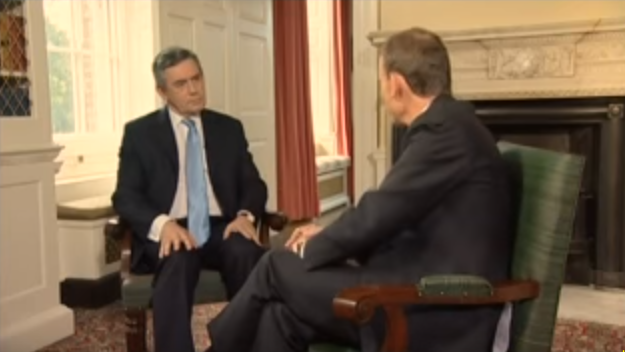
Remembrance of Interviews Past  (from Downing Street). AM talking to a Gordon Brown mannequin.

For those missing some Andrew Marr Show-related Sunday tomfoolery about bias, well, today's big 'scandal' (according to the louder, dafter parts of the Left on Twitter) has been the programme's decision to broadcast a pre-recorded interview with Theresa May in Downing Street rather than interview her live in the studio. 

Apparently, it's the pro-Tory BBC caving in to Robbie Gibb, the PM's ex-BBC director of communications.

And, for good measure (and going wilder), it's also apparently the case that the interview was then edited to help the Tories and that the Marr show is "on the Conservatives' payroll" (or variations thereon).

Are March hares really madder than these people?

Though having moved on to pastures fairly new (Robbie Gibb's old BBC job, no less!), the Marr programme's former editor Rob Burley has been back in action today.


He made the obvious point in response to this latest outburst of Corbynista anti-BBC lunacy  that "the last two Labour Prime Ministers both gave Marr interviews in Downing Street (as did David Cameron)" and that "it's far from new or particularly clever, it's just something that sometimes happens with PMs". 

(Indeed, thanks to Biased BBC, you can still see one such Andrew Marr Downing Street interview with PM Gordon Brown on YouTube). 

And he added, correctly, "And BTW PM did three - 3! - live interviews on Marr last year".

But still, like creatures out of a George A. Romero horror film, they've kept on coming....


...Jez4PM...Jez4PM...Must eat brains...Jez4PM...Jez4PM...

Conspiratorial thinking isn't new when it comes to considering the question of BBC bias (and the Right side used to be as guilty of it as the Left is now), but it's going ever more off the scale these days.

It's not good, but maybe it's best for the BBC to take to heart the stoical message imparted by one of their greatest philosophical thinkers from a bygone age (now, like Cicero, in exile from the BBC's airwaves for reasons of political incorrectness):


The rest of us meanwhile can just stockpile the popcorn and cheerily despair of some of our fellow human beings.

Crunch, crunch, crunch....


P.S. If you're wondering what the immensely likeable Rob Burley is now in charge of, having moved onwards and upwards at the BBC...

...well, from what I can see, he's now in supreme editorial charge of the Daily Politics, Sunday Politics, The Andrew Marr Show, Westminster Hour, Newswatch and "executive edit" (whatever that means) of This Week.

I'd wrongly assumed, from what I'd read, that he'd left The Andrew Marr Show and Newswatch behind him in his upwards move, but it appears that he hasn't.

The 'Editor, BBC Live Political Programmes' role seems to have expanded to embrace both programmes and he's gone, Napoleon-like, from being First Consul of two live BBC programmes to being Emperor of six live BBC programmes.

He'll be invading Sky, ITV News, Breitbart London and ITBB next and imposing members of his family on us all.

Me and Sue, like the Bourbons, will have to flee before his imperial might and seek refuge elsewhere.

I don't know about Sue (who's made of far sterner, Duke of Wellington stuff than me), but I'm already crying 'Vive L'Empereur!'

(Tip to Rob though: Don't try and conquer Russia Today. It won't end well if you try.)

Sunday, 9 July 2017

"I will always be a supporter because of its values and commitment to impartiality"


Just to emphasise the point (as noted by Robin Horbury on an earlier thread), Downing Street's new director of communications, the BBC's former Westminster head of operations Robbie Gibb, announced his career move on Twitter. For those wanting to see action on BBC bias, his pair of tweets won't have quickened the heart:


P.S. I used to have a dog called Robbie. He looked rather like this:


He was a huge fan of Andrew Neil. Used to wag his tail every time he came on the TV. And he got very excited by Jo Coburn. (Or was that just me projecting?) He ignored Michael Portillo though for some strange reason, but always, always growled at Diane Abbott. I used to think that was because he mistook her for a postlady but eventually came to realise that he simply didn't reckon much to her as a politician. I miss him very much.

Partly true story.

The BBC seems to be enjoying this


Continuing on from John Simpson yesterday and Paddy O'Connell this morning...

Matt Zarb-Cousin, former spokesman for Jeremy Corbyn (see also here), contributed to The World This Weekend's sympathetic profile of Robbie Gibb, and this is how part of his discussion with Shaun Ley went: 
Shaun Ley: In his view this is particularly the case because Robbie Gibb is not the only BBC journalist to leave broadcasting in order to work for the Conservatives:
Matt Zarb-Cousin: You look at the backgrounds of a lot of the political journalists at the BBC at the moment and you can maybe conclude that a lot of them are right-leaning or Conservative. Whether or not that manifests itself in their work is a matter of debate, but it's incredibly difficult, I think, to expect it not to.
Shaun Ley: A lot of people reading the press might think it was anything but the case. They might think the BBC was a den of lefties.
Matt Zarb-Cousin: That was the perception for a long time but, I think, if you just look at the background of the political staff the BBC at the moment I don't think you could really conclude that it's a den of lefties anymore. 
Note how Shaun blames "the press" for making people think that the BBC is 'a den of lefties'.

Lip-smacking, sandal-wearing, muesli-eating, left-leaning pinkoes


So it's not just Corbynistas who have been making hay with the appointment of the BBC's Robbie Gibb to be Mrs May's director of communications. Paddy O'Connell was coming the old 'complaints from both sides' game on Broadcasting House this morning: 
Downing Street has poached a man called Gibb from the BBC as its new director of communications. We thought this was Robbie Gibb, but it can't be him because the Right has long feared the BBC is full of lip-smacking, sandal-wearing, muesli-eating, left-leaning pinkoes. So has Mrs May instead hired another Gibb, Barry Gibb of the Bee Gees? 
(Cue a 'humorous' item on Bee Gees songs with messages for Mrs May -'For Whom the Bell Tolls', 'Stayin' Alive', 'Heartbreaker', 'You Win Again' and 'Tragedy' - and what splendid songs they are!)

Saturday, 8 July 2017

More complaints from both sides


Robbie Gibb (l); James Landale (r) - though you probably knew that already

Of course, the big BBC/political story of the week has been that the editor of The Daily Politics, The Sunday Politics and This Week, Robbie Gibb, has left the BBC to become Theresa May's new director of communications. 

As might be expected, there's been pandemonium on Twitter. Mr Gibb has long been a target of anti-BBC Corbynistas, partly because of his Conservative Party past and partly because his brother Nick Gibb is a Conservative MP. And because of Andrew Neil.

"It shows the BBC are run by Tory supporters" is the gist of their response.

(Having the BBC's Diplomatic Correspondent James Landale as his main rival for the post hasn't helped either).

The Andrew Marr Show's Rob Burley is already being mooted as his replacement. He's been  busy defending the BBC on Twitter over Mr Gibb's career move:


Of course, Robbie Gibb going to Downing Street, just as former BBC Question Time editor Craig Oliver went to Downing Street, does show that there are - or have been! - Tories at the BBC. How many there have been (or are) is another matter entirely. 

Another unusual feature of the story is that, as the Independent puts it, "BBC insiders say Mr Gibb is ‘very pro-Brexit’". Who knew there were any 'very pro-Brexit' people at the BBC? (And maybe there aren't any now that he's gone! - though on the balance of probabilities they would have to be some.)

Saturday, 9 January 2016

Attacks from two sides


The big 'BBC bias' story on the domestic front this week has been the extraordinary row between Jeremy Corbyn's Labour Party and the BBC over that deleted blog on the BBC's College of Journalism website by Andrew Alexander, an output editor for the Daily and Sunday Politics, entitled Resignation! Making the news on the Daily Politics:

Wednesday is always an important day for the Daily Politics because we carry Prime Minister's Questions live, which brings with it our biggest audience of the week and, we hope, a decent story. 
As I arrived at Millbank at 7am it was clear that Jeremy Corbyn's cabinet reshuffle, which had ended before 1am, was going to dominate at Westminster. 
When the programme editor phoned in we agreed that in addition to covering other major stories, including the junior doctors' strike, fallout from the reshuffle was likely to continue throughout the morning and this was a story where we could make an impact. 
When the producers arrived at 8am they began putting out texts and calls to Labour MPs we thought were likely to react strongly to the sacking of several shadow ministers for "disloyalty". 
Just before 9am we learned from Laura Kuenssberg, who comes on the programme every Wednesday ahead of PMQs, that she was speaking to one junior shadow minister who was considering resigning. I wonder, mused our presenter Andrew Neil, if they would consider doing it live on the show? 
The question was put to Laura, who thought it was a great idea. Considering it a long shot we carried on the usual work of building the show, and continued speaking to Labour MPs who were confirming reports of a string of shadow ministers considering their positions. 
Within the hour we heard that Laura had sealed the deal: the shadow foreign minister Stephen Doughty would resign live in the studio. 
Although he himself would probably acknowledge he isn't a household name, we knew his resignation just before PMQs would be a dramatic moment with big political impact. We took the presenters aside to brief them on the interview while our colleagues on the news desk arranged for a camera crew to film him and Laura arriving in the studio for the TV news packages. 
There's always a bit of nervous energy in the studio and the gallery just before we go on air at 11.30am, but I'd say it was a notch higher than usual this week. By this point we weren’t worried about someone else getting the story as we had Stephen Doughty safely in our green room. Our only fear was that he might pull his punches when the moment came. 
When it did, with about five minutes to go before PMQs, he was precise, measured and quietly devastating – telling Andrew that “I’ve just written to Jeremy Corbyn to resign from the front bench” and accusing Mr Corbyn’s team of “unpleasant operations” and telling “lies”. 
As Andrew Neil handed from the studio to the Commons chamber we took a moment to watch the story ripple out across news outlets and social media. Within minutes we heard David Cameron refer to the resignation during his exchanges with Jeremy Corbyn. 
During our regular debrief after coming off air at 1pm we agreed our job is always most enjoyable when a big story is breaking - but even more so when it’s breaking on the programme.
Corbynistas on Twitter and, now, the Labour Party itself have complained that the BBC has been 'making the news' rather than simply 'reporting it' (something the blog's title doesn't exactly disguise!), thus breaching the corporation's "role and statutory obligations". A Labour Party spokesman (namely Seumas Milne) said:
By the BBC's own account, BBC journalists and presenters proposed and secured the resignation of a shadow minister on air in the immediate run-up to Prime Minister's Questions, apparently to ensure maximum news and political impact. 
That was evidently done before any notice of resignation was sent to the Labour leader.
Such orchestration of political controversy is an unacceptable breach of the BBC's role and statutory obligations. 
Trust in the impartiality and independence of the BBC is essential. The BBC's role is to report the news impartially, rather than seek to influence events or promote a particular political narrative.
Well, it wouldn't be the first time the BBC had tried to "influence events or promote a particular political narrative", would it?


Anyhow, the BBC, in the form of editor of live political programmes Robbie Gibb, wholly rejected Seumas Milne's complaint:
I reject your suggestion that we orchestrated and stage-managed the resignation of Stephen Doughty. 
As he himself confirmed on Friday, Mr Doughty had decided to resign his front-bench position on Wednesday morning, before speaking to any journalists. He subsequently spoke to Laura Kuenssberg who asked if he would explain his reasons in an interview on the Daily Politics later that morning. Neither the programme production team, nor Laura, played any part in his decision to resign. 
It is true that we seek to make maximum impact with our journalism which is entirely consistent with the BBC's Editorial Guidelines and values. 
Your letter suggests that our decision to interview Mr Doughty in the run up to Prime Minister's Questions was designed to 'promote a particular political narrative'. This is simply not the case. 
The Daily Politics does not come on air until 11.30am on Wednesdays and the BBC's Political Editor always appears live on the programme in the build up to the start of PMQs. As the confirmation of Mr Doughty's resignation was Laura Kuenssberg's story, we felt it appropriate for her to introduce the item. Again I do not accept, in anyway, the programme has breached its duty of impartiality and independence.
Looking at Twitter, the reaction divides sharply (as usual). I've noticed that a lot of those who are backing the BBC are either journalists (such as Kay Burley) or, even more so, Blairite/Brownite Labour types (from Alastair Campbell, Dan Hodges, Kevin Maguire, etc, to all manner of local Labour types - and see also this article by a Labour councillor at the Huffington Post) Those supporting the Labour Party (of Mr Corbyn and Mr Milne) are mainly pro-Corbyn types. 

That, of course, leads to the question of why New Labour types are in full 'defend the BBC' mode while 'New Old Labour' types (so to speak) are in full 'attack the BBC' mode. The latter are likely to attacking the BBC because they think the BBC is biased against them and their leader; the former are likely to be defending the BBC because they either don't think the BBC is biased against Corbyn and his -istas or wouldn't mind if it is (given that they can't stand their new leaders)! 

Of course, that gives many of the BBC defenders the chance to say that the BBC is not biased at all because it's getting complaints from both sides. The interesting thing when you look at the profiles of the non-BBC people on Twitter doing that defending of the BBC is that a surprisingly large number of them describe themselves as being Labour supporters, occasionally distancing themselves from the Corbynistas. 

That, itself, is intriguing. Why are such people more likely to be pro-BBC than Corbynistas or right-wingers? Could it be because the BBC has a general centre-left bias which they're intensely relaxed about?

*****

A classic example of the BBC using the 'complaints from both sides' argument came from Newsnight senior broadcast journalist Jess Brammar, prompted by the row over the Daily Politics:


Now, as we've argued many times before, the 'complaints from both sides' argument isn't a good one (a) because one side may have a genuine case while the other doesn't and (b) because there may be more than two sides with the BBC being biased towards a third side.

In this case, maybe the BBC is biased against both the political right and the political far-left. 

Maybe, as its own internal polling famously showed, the BBC is an overwhelmingly left-liberal organisation. 

In party political terms, that might mean that it gravitates around a centre-left party - ranging from a few pro-EU left of the Conservative Party types (Newsnight's Chris Cook perhaps?) across the Lib Dems to the Blairite and Brownite wings of the Labour Party, with very few pro-Tory Right or pro-UKIP types and a small rump of pro-Corbyn Labour types (including some of their leading comedians, of course). 

If so, the BBC can still be strongly politically biased even if it's getting complaints from the Right and the Left, can't it?

*****

Going back though to the BBC's Robbie Gibb...

Another part of his response stands out for me - the bit where he said that he initially thought the BBC Academy blog had been for "internal purposes only"!:
When it became apparent that it had been published more widely, we decided to delete it as the piece was written in a tone that was only suitable for an internal audience. No other inference should be drawn from our decision to delete the blog.
Ha! Well, I for one am exercising my right as a BBC license fee payer to draw another, very different inference from the BBC's decision to delete the blog, Mr Gibb's stern command notwithstanding: They wanted to remove it from public view because it was proving embarrassing for them.