Showing posts with label David Aaronovitch. Show all posts

Sunday, 22 December 2019

Robbie Gibb's Little List - a further discussion


The conversation continues:
David Aaronovitch: There’s a lot to recommend several of your points Robbie. But if you were to critique them yourself, where do you think the weaknesses or complexities in your own checklist are?
Robbie Gibb: I’m not sure people truly understand impartiality - as you know it’s not just about balance. It requires broadcasting extending its gene pool of staff to include diversity of background and political views (as well as gender and ethnicity). It could take years.
Jill Jervis: Definitely no impartiality on TV or newspapers this GE. In fact there was nothing but pure lies about Labour & no critic of Cons so the sooner the better TV licence goes.
David Aaronovitch: Jill, how do you explain to yourself that Tories and Brexiteers seem just as convinced that broadcasters are totally biased against them? And if your explanation is that they’re mistaken then isn’t it just as possible that you are?
Peter Lamb: This argument that "everybody criticises us so we must be doing a good job' is way over used and fails the most basic scrutiny. A classic case of BS baffles brains.
David Aaronovitch: That’s not my argument.
Peter Lamb: My concern is that an assumption that criticism is symmetrical and of equal merit tends to encourage exaggeration. We now observe intense criticism of the BBC and others. Is it possible that this is amplified by the casual dismissal of criticism under the balance defence?
David Aaronovitch: Possibly, but I don’t think that’s a primary factor.
Robbie Gibb: It is possible that broadcasters can be biased against the right and left at different times. My argument is things need to change to prioritise impartiality starting with twitter and broadcast interviews.
Alistair Stewart: There is also the tricky issue of broadcast reporters being one thing 'on-air' - balanced & impartial - and believing they have can have another personae on social media - the partisan lobbyist. They are the same person, with the same duties.

Thursday, 6 September 2018

Pragmatic McDonnellism


A couple of recent articles cite Labour’s relationship with Manchester's 'Iranian shill' Yasmine Dar. Here’s Sohrab Ahmari writing in Commentary Magazine September 4th 2018. The Rot in the Labour Party
The first part of his piece is reproduced here, (scroll down) and the latter part includes this, via the Daily Mail: Unfortunately the video 'embed' link is broken, but you can get the drift here.


"Some may be tempted to think that the anti-anti-Semitic vote in the executive committee means that body can check the Cobynite fanatics. Except, no. The Daily Mail reported: 
The candidate who won the most votes for the Labour party’s ruling National Executive Committee celebrated the Iranian revolution when hardline Ayatollahs took over the country, repressing freedom and human rights… 
Yasmine Dar, who was elected top with 88,176 votes, has given speeches at an Islamist celebration of the Iranian revolution in Manchester for three years in a row. 
In the most recent, in 2017, she said: ‘We are here for a celebration, a happy time. Thirty-years of the Iranian Islamic revolution. So I’m absolutely happy, it’s the third year I’ve been coming.’ 
The rot seeps from top to bottom. It’s structural. No self-respecting Briton, Jewish or otherwise, should support this party.

The second piece is by David Aaronovitch (£) and it also tackles Dar’s relationship with the party. A member for only  “five or six years”,  Dar, by ‘popular vote',  ousted Ann Black who had been on the Labour party NEC for “the best part of two decades” and a member of the party for about 40 years.
"I know nothing to the discredit of Dar, save this. For the past three years she has attended an annual celebration of the Iranian Islamic Revolution in her home city of Manchester. At the last one she took to the platform wearing a black headscarf that she does not seem to wear on other occasions, framed by a large picture of the scowling theocrat, Ayatollah Khomeini. She made an unexceptional speech to say she was honoured to be there, how it was important to condemn hatred and intolerance and how nice it was to see “more women than men today”.

For all John McDonnell’s smooth-talking performance on Politics Live, “we must address the issue of antisemitism in the party” no-one from the Beeb seems to have confronted him with the specific issue of Labour Party members with blatantly antisemitic political affiliations publicly and directly. Correct me if I'm mistaken.


"The main battle now is between Momentum and what might be called Provisional Momentum. It’s pragmatic McDonnellism versus ideological Corbynism, a struggle between those who think a few friendly (if insincere) gestures to mainstream voters are worth making to get Labour elected on its radical economic programme, and those who think even that represents a terrible sell-out.
If this is called ‘pragmatic McDonnellism,’ and we have just 250,000 Jewish British citizens against … coming on for five million Muslim Labour voters, the future looks grim. Yes, the posters are 'unofficial'. Yes, they're being taken down. But someone has gone to great lengths to produce them and fly-post them around London.

Suitcases at the ready.

Sunday, 29 April 2018

BBC Radio 4 marks a year out from Brexit - a review


This, you may recall, was the BBC's way of marking one year before the date when we leave the EU, and it was evidently meant to showcase the BBC's range, depth and impartiality.  

I've not have the time to write about it so far, frustratingly, but I have (at last) finally heard it all.

In lieu of a full-scale review (to come, no doubt, from the good folk at News-watch), I'll give my own impressions at, hopefully, not too great length (as John Milton might have said before preparing to publish Paradise Lost)....

*******

Iain Martin in his lab

The Brexit Lab

Firstly, the day did feature a programme presented by a pro-Brexit (non-BBC) journalist. Iain Martin's The Brexit Lab focused on possible positive outcomes for the UK after Brexit. 

Lord Pearson of Rannoch has been challenging the BBC for nearly two years now to name a single example of a Brexit documentary that focused mainly on the positives of Brexit. Answer there came none...

...until The Brexit Lab.

I thought at the time that it was going to be used as the BBC's 'Get Out of Jail Free' card and that they'd plug it for all it's worth - and, if last week's Feedback is anything to go by, that's already proving to be the case.

The BBC's political advisor Ric Bailey said, if you recall, "And incidentally, there was an entire half-hour programme which Iain Martin did on Radio 4 a couple of weeks ago, precisely on that point about the opportunities Brexit, so they are there, and we are, you know, it’s an active part of our journalism."

Well no, Ric, it's not an active part of your journalism. On Radio 4, it's been a complete and utter one-off. 

(The occasional A Point of View from Roger Scruton or John Gray doesn't count as they aren't documentaries).

The fascinating thing though about Iain's The Brexit Lab is that it was 'more BBC than the BBC', so to speak. It really did try to be impartial. The guest list ranged far-and-wide and had a very decent balance of Remainers and Leavers, and lefties, righties and centrists (Caroline Flint, Paul Mason, Oliver Lewtin, Greenpeace's Douglas Parr on one side, Joshua Burke, Michael Gove, Mark Littlewood and Gerald Lyons on the other, with David Halpern, Nicole Badstuber and Julie Fourcade floating somewhere hard to place in between.) And Iain Martin was very generous in letting all sides have their say whilst toning down his own views.

The particularly interesting thing about this programme, however, is that Radio 4's continuity announcer announced it as:
a very personal view
I heard that live as I drove home from work that day and thought, "Well, I've never heard a programme announced like that before".

I mean, it wasn't just that the BBC announcer called it "a personal view", he called it "a very personal view".  

Have you ever heard a Radio 4 programme announced like that before (and, more importantly, can you name it)?

It strikes me as fascinating that the one pro-Brexit-leaning documentary broadcast by BBC Radio 4 since June 2016 was introduced with such a heavy distancing caveat by the BBC. 

No such caveats preceded (or followed) any of the other BBC programmes that day - even those presented by strongly anti-Brexit (non-BBC) presenters like David Aaronovitch and Jonathan Freedland.

*******

Uriah Davis?

The EU After Brexit

And now let's move onto the rest, starting with the only programme I listened to fully at the time: The EU After Brexit (though also half-hearing The Brexit Lab), co-presented by Evan Davis and David Aaronovitch.

I rolled my eyes at it at the time, and those eyes of mine are still rolling on (like Ol' Man River). Here - unlike Iain Martin - you have a BBC man and an anti-Brexit man. And yet - unlike Iain Martin - neither of them (BBC or non-BBC) made the slightest attempt to balance their programme. 

Seriously, please listen to this and compare it to The Brexit Lab. While The Brexit Lab had a wide variety of voices, The EU After Brexit - over the course of an entire hour of BBC broadcasting - did not see fit to include a single Eurosceptic voice. 

It's not as it there aren't plenty of Eurosceptic voices across the EU, but Evan and David didn't talk to a single one of them. 

Before listening to it I laid out my expectations for what an unbiased BBC programme about the EU after Brexit would be. and top of my list was that - given the depth of Eurosceptism across Europe - it would feature Europhile and Eurosceptic voices. I thought that was the least it could do, and actually expected at least some sop to 'BBC impartiality' by the brief appearance of, say, some 'far-right populist' (for balance!). But even that never came. 

There wasn't a Eurosceptic voice anywhere to be heard. This was a view 'from Europe' which excluded Eurosceptic voices. 

This programme was, therefore, deeply and unquestionably biased.

The David Aaronovich bits featured pro-EU former ECB banker Jean-Claude Trichet, pro-EU Daniela Schwarzer of the German Council on Foreign Relations, pro-EU Labour former Dutch finance minister Jeroen Dijsselbloem and an academic from Warsaw University called Justyna who put the Polish point(s) of view in a dispassionate, academic way. 

Then came Evan Davis's bit featuring three EU businessmen - Lorenzo Bini Smaghi, chairman of Société Générale (former ECB); Matt Regan, Senior Vice President & Head of Europe of Novo Nordisk (Denmark); and Teofil Muresan, chairman of Electrogrup (Romania). 

Evan's opening commentary was about UK pro-Brexit people saying that being attached to the EU was being "shackled to a corpse", to a "shrinking proportion of the world economy" and to a zone that's "ill-adapted to change". What did his three EU business leaders make of that, he wondered. Well, guess what? They all think the EU is flipping marvellous!! 

Evan's little 'Evanisms' were all present and correct too. His first question to his first question was 'What is good? What is bad? about the EU. This second question to his second guest dropped the 'What is bad?' part of it and just went with 'What is good?' And when Evan told one of them not to 'talk Brexit', he later asked all three of them for their views about Brexit (with very predictable results). 

This programme is one that goes entirely into the pro-EU-biased column. 

BBC reporter Adam Fleming's commentary during the programme is worth looking at too, especially as regard President Macron (a dubious pro-EU take on why people voted for him - because he's pro-EU!) and anti-EU "propaganda" (as Adam put it) from Hungary's Viktor Orban that would make UKIP types "blush" (as Adam also put it) - highly loaded language.

*******

Jean-Claude Juncker (after one too many glasses of claret)

The Long View

As for Jonathan Freedland's The Long View Brexit Special, well, yes, anti-Brexit Jonathan's guests throughout were pro-Brexit Kwasi Kwarteng and anti-Brexit Eloise Todd.  

So far so balanced. 

The programme, however, was fascinating, full of historically questionable analogies - and deeply biased. 

Expert One used to flight of some Anglo-Saxons to Asia Minor after the Norman Conquest to talk about the "rhetoric" of "nostalgia" that has "bled into the Brexit debate" - " the emotional connection to an ideal of a land rather than perhaps a more critical understanding that sometimes history changes and that sometimes you can’t turn back the clock". 

Jonathan Freedland then asked Kwasi Kwarteng about "older voters" behaving like those Anglo-Saxons "unnerved by hearing alien tongues" (nudge, nudge, hint, hint - not that Kwasi picked up on what JF was implying!) whilst asking Eloise Todd a very different kind of question, about whether it was her "understanding" that it was "a kind of nostalgic longing" that motivated those doomed Anglo-Saxons. Eloise then blew JF's not-so-well-hidden cover by immediately answering about Brexit and Leave voters and pretty much calling for a second referendum. 

The expert then praised the good things the Norman Conquest had brought and ended by opining, "And, in fact, the point about people today being uncomfortable about hearing different languages, again, I think goes back to the point of nostalgia for a place that is an ideal rather than a reality."

I won't go on, but the rest of the programme continued in a similar vein. 

There was the Napoleon blockade bit about how bad it was for the UK and how the UK wanted to be at the heart of Europe to counteract it. (JF: "So there’s George Canning then, Foreign Secretary, asserting Britain’s right to sit at the very centre of the European system.  Listening to that, Kwasi Kwartang, don’t you think George Canning would be amazed today if he heard that Britain was voluntarily taking itself out of the single market, the trading market of Europe, when he was prepared to use military might, naval might in order to make sure that Britain was right there in the centre of that trading system?") 

And then the programme, taunting Brexiteers, resurrected that old canard that Winston Churchill was in favour of an Anglo-French union in the early years of the Second World War. 

We've been here before. (See here too). It's not true.

Winston Churchill after bathing in the sea at Deauville, France (1922)

And JF, being biased, naturally used it in contrasting ways. To his pro-Brexit guest he asked:
Kwasi Kwartang, no figure in British history is more lionised by all sides, but especially by the Eurosceptic side of British politics than Winston Churchill, the great British bulldog, and there he is, calling for merger between Britain and France, the declaration says there won’t be two nations anymore. Surely that is a shocking fact for Eurosceptics and particularly their view of Winston Churchill?
To his anti-Brexit guest he asked:
Eloise Todd, when you hear that, of the man voted the greatest ever Britain calling for a union between Britain and France, does that alter your perspective on Britain’s relationship with Europe?
As you can see, he was asking the same question from the same stance both times, disadvantaging the pro-Brexit guest and advantaging the anti-Brexit guest. That's how biased interviewing works.

To conclude Jonathan Freedland asked his three experts for their summary. I think I need to quote this in full to give you a flavour of just how unbalanced the programme was in choosing its experts from all the available opinions and framing the questions. (Only David Reynolds refused to reveal his hand):
Jonathan Freedland: Let’s broaden out a little bit. History has played a big part in this Brexit debate, it’s raging right now with these protestors in Westminster. Erin Goeres and David Andress our historians from earlier have rejoined us here on College Green, and Erin Goeres, start with you, history is often very contested, what role do you think it has played in the debate about Brexit? But perhaps more importantly, what role should history play in this today?
Erin Goeres: I think looking back at history is a good reminder that we don’t stand at a unique moment we have seen from all of these examples that Britain has a long and complicated relationship with Europe, it is an issue that is revisited time and time again.  Britain has always been a part of Europe culturally, linguistically, politically, it’s just to what degree should we negotiate that.
Jonathan Freedland: But it seems like it’s almost always been an uncomfortable relationship, there’s always jostling and jockeying and arguing, David Andress?  I know there was a group called Historians for Britain that was on the pro-Brexit side, I think you signed a letter on the other side of the argument, can history play an important role in this discussion?
David Andress: Well, I think one of the important things we have to remember is that people don’t really learn very much history.  They learn a lot of things that they think are history, they think they understand where we’ve been in the past, because they vaguely remember things they were told at school, or politicians or newspapers use historical reference.  But in the context that I was talking about earlier, a couple of hundred years ago one of the things that you absolutely have to recognise is, on the one hand, Britain absolutely wants to remain part of this jostling European process, it cannot conceive of itself working in the world without being part of a European concert of nations. And on the other hand, when we look back and talk about British greatness, its prosperity, over the intervening two hundred years, it’s absolutely connected to the fact of Empire, to the fact of dominating and exploiting tens of millions of people all around the world. We’re simply not in that position any more.  We were the America and China combined of 200 years ago, and we no longer live in a world where we can expect to take anything by force, we have to cooperate and collaborate.
Jonathan Freedland: David Reynolds, the bit of history you talked about with us, of 1940 and Britain standing alone, it’s entered the mythology it’s in some ways the sort of founding narrative of modern Britain, it was a big part of the Eurosceptic case that Britain had stood alone, didn’t need the rest of Europe and could stand alone again.  What’s the reading you have of that 1940 episode in terms of Britain’s relations with Europe?
David Reynolds: Well you see, I’m not so keen on the idea of using history as analogy, I’m not so keen on the idea that it’s a source of lessons we can pull of the shelf and say, ‘Ah, this is a 1940 moment’ or whatever it is. For me, history is a way of thinking, and what one is trying to do as a historian is understand, if you like, complex situations from the past, what’s the elements that went into decision-making then, all the different factors and that’s then a way of helping people to open up their thinking about the situation is now, what kind of factors should be taken in, how should leaders respond, don’t go for the quick fix, ask yourself . . . don’t ask for the lessons from history, say, ‘Well, what’s the story we’re in now,’ and then try and make some sensible judgements. 

That could hardly be less impartial as a piece of broadcasting #despiteKwasiKwarteng. And yet, unlike with Iain Martin's programme, it wasn't introduced as either "a personal view" or "a very personal view" - something that speaks volumes about BBC impartiality and how the BBC sees BBC impartiality.

*******

Really, Craig? Are you really going with this image to illustrate the next section of the post?

Oh dear, this short summary is already getting close to Miltonian length (without the magnificent language), and I've not even touched on the big main Radio 4 current affairs staples on Radio 4's Britain at the Crossroads day.

I'll try to be brief (as Tolstoy said before writing War and Peace - according to the BBC's Reality Check)...

The World Tonight

Working backwords, The World Tonight featured (as its only Brexit feature) a truly classic BBC report from BBC veteran Allan Little.

It was everything a cynic would expect from a BBC report - and the mighty Allan is a veritable master of such things.

It featured a balance of talking heads - two pro-Brexit ones, followed by three anti-Brexit ones. The first pro-Brexit voice was an aggrieved fisherman, the second a pro-Brexit blogger.

After the latter appeared, Allan said (in a subtly undermining way), "But is this anything more than a leap of faith, based on ideological conviction, rather than evidence?

And guess what? Everything that followed gave an emphatic, undermining 'no' to that question.

First came an historian talking of "Imperial amnesia" on the part of Leave voters.

Next came a fruit processing company that fears Brexit - the "fear that that Brexit vision will cut Britain off from the workforce it needs".

And finally come another Kent businesswoman who pronounced herself "petrified" about Brexit.

And Allan Little ended with the less-than-reassuring words:
No one knows what kind of Britain will emerge in the years that lie ahead, but the journey begins a year from now.  There is no return ticket and the destination remains unknown...
Seriously, Allan is one of the absolute masters of biased BBC reporting. If I were teaching the dark angels of Hell in the arts of subtle reporting (to Hell's advantage) I'd start with a thorough exploration of Allan Little dark genius at this kind of thing - and this very example. 

Allan's particular genius, I suspect, is that he doesn't believe he's being biased, even for a second. I bet it never even occurs to him, and that he sees any criticism as his reporting as being simply invalid.

PM

That day's PM meanwhile gave over a lot of time to BBC Reality Check's supreme guru Chris Morris - someone whose bias against Brexit we've spent hours and hours detailing. It's no longer available on the BBC iPlayer but I heard it and it was typical Chris Morris as far as Brexit is concerned.

I should have transcribed it to capture it for posterity, but if you know your Chris Morris (as regular readers will), you'll easily imagine what you've missed.

The World at One

That day's The World at One featured (like that night's The EU After Brexit) the view from the Continental EU - from the BBC's Chris Paige in Ireland, the BBC's Lucy Williamson in France, Jenny Hill in Germany and Adam Easton in Poland. 

It was all disappointment and negativity about Brexit. 

The famous Laura Kuenssberg....

....(and, for all passing Corbynistas, I'll say "Boo!!" for you here to save you a little time)....

....popped up in between interviewing Theresa May on the Brexit issue. 

'Tory' Laura pressed the Tory PM on whether there would be a 'Brexit dividend', specifically as regards NHS spending. (We don't need to guess which much-mentioned bus motivated that line of BBC questioning). 

To sum up the other contributions here: Chris Paige said that Ireland is looking to the EU more than ever; Lucy Williamson said that "President Macron’s gaze is fixed towards Europe, not across the Channel"; and Jenny Hill said that the "back in business" Mrs Merkel is focused on the integrity of the EU, not Britain and its "baffling" decision to leave the EU.  Oh dear, Britain.

As for Poland, Adam Easton said that even the "most Eurosceptic" government there since Poland joined the EU "knows the benefits membership brings". 

And then Mark Mardell began his new history of the EU-UK relationship...to which I'll return when it finishes. It began with Mark highlighting that OMG The Daily Mail was in favour of us joining the EEC and went on from there. 


Some bridge in Stockton-on-Tees

Today

And as for Today, what can be said? 

Well, its starting point defined it. 

It started from Stockton-on-Tees with Mishal Husain saying "And to mark that anniversary we've come to a car parts factory on Teesside", and then adding: "Before the referendum its managing director warned that leaving the EU would be business suicide. Today, however they voted, his staff just want the process over with".

And guess what? The factory's managing director, interviewed later, still thinks that leaving the EU is a bad idea.

That's a good one for Lord Adonis. One this landmark day of BBC broadcasting why did Today decide to broadcast from a factory whose owner had previously declared it would be "business suicide" to leave the EU? Did they expect him (wrongly) to have changed his mind, or did they expect him (rightly) to still hold much the same anti-Brexit view?

Matthew Price was on hand throughout too. His first contribution was typically downbeat:
Absolutely, good morning, yeah. We’re going to hear a lot about the uncertainty that the people in this factory feel during the programme, and in fact, the BBC's internal surveys show us that people as a whole understand less about the Brexit process now than they did even just 6 months ago. 
And gloomy Matthew also ended the programme in the same downbeat way:
The BBC carries out internal research to see what audiences make of certain issues. People are concerned about the impact on the NHS, they are concerned about the way it’s going to affect the pound in their pocket, their jobs.  One of the most striking observations before we leave, one year before we leave the EU, is the growing number of people who feel they just don’t fully understand Brexit. 
To which Mishal gave the closing reply, "Matthew, thank you."

In between came sections featuring employees at that company and a young people's panel, plus BBC reporters from the three non-English nations of the United Kingdom, a section on the Arts and Brexit, as well as interviews with the Lib Dems (Jo Swinson), Labour (John McDonnell), the Conservatives (Liam Fox) and the SNP (Stephen Gethins). And, for good measure, there was a short, interruption-strewn interview with John Longworth of Leave Means Leave and a longer, much-less-interruption-strewn interview with Tony Blair. However you class John McDonnell, that's a tilt towards anti-Brexit interviewees. 

*******

So, as you can see, there's still at lot to dig into - especially as regards Today - but the trajectory remains clear.

For a day of Radio 4 broadcasting that was, apparently, meant to exemplify the BBC at its impartial best, this day of BBC broadcasting in fact showed the BBC to be incapable of producing a fair package of programmes on the issue of Brexit. 

It was - with the exception of The Brexit Lab - the usual BBC stuff, pumping out negativity about Brexit pretty much all of the ways.

And it really is no use the BBC citing Lord Adonis & Co. in 'complaints from both sides' evidence here, grasping at The Brexit Lab and instantly escalating it to Ofcom in a colossal huff. The balance of that day's Radio 4 broadcasting was a tsunami of bias in favour of negativity about Brexit. 

I seriously challenge anyone (with time on their hands) to review this day's output for themselves and argue otherwise. You will fail (I think).

Sunday, 12 February 2017

Impartiality guidelines


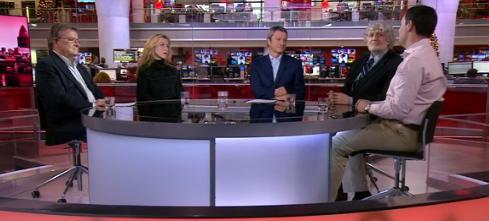
This morning's The Andrew Marr Show raised the issue of impartiality - in terms of the Speakership of the House of Commons and in terms of BBC presenters. and I had a wry smile over my face at something David Aaronovitch said... 


LAURA PERRINS: This is the story again of John Bercow, who seems to believe that the rules of Parliamentary neutrality do not apply to him. Coming after his outspoken remarks against President Trump, which I think bring Parliament into disrepute because he's clearly under a duty to remain neutral on these issues. He's also been found to be speaking in relation to Brexit. And of course, this has very serious implications because he'll be chairing the debate in relation to the Brexit bill, and for him to say "I voted to stay", I think puts him in an untenable position. 
ANDREW MARR: There's about twelve, I think, Tory MPs who have already lined up a motion against him. The question is does this story then turn that twelve into many, many more and start a process that gives him an impossible week? 
LAURA PERRINSI think there's a moral obligation now for him to stand down. It's very important that the Speaker is seen as being neutral. And the rules are very clear. It says that he must remain politically impartial at all times, and if you want to be Speaker = and you get various privileges that come with that role - then it's also your duty and your responsibility to remain impartial and not pick and choose your rules as you go ahead. 
ANDREW MARR: I saw a wry smile over David's face there. 
DAVID AARONOVITCH: I think it is daft. I really do. Who possibly imagined that John Bercow didn't have an opinion? And, incidentally, one of the candidates that the people who want Bercow out are saying should take over as Speaker is Jacob Rees-Mogg. No-one has the faintest idea want he thinks about Brexit, do they? You have an opinion, Andrew, but you're not allowed to voice it on this programme. But you will, when you go to schools, tell them what you think about things and you won't say "I can't have an opinion about it". We rely on you....
ANDREW MARR: Well...
DAVID AARONOVITCH: ....to do your job in the studio. We rely on the speaker to do his job in the House of Commons, not to be a political eunuch. 
LAURA PERRINS: No, the rules are very clear though. There's a reason behind the rules. They are not just there for the sake of it. He is chairing the debates, so it's incredibly important that's he's seen to be impartial and neutral. It doesn't say you must remain impartial neutral while chairing the debates. It says you have to remain impartial at all times. If he doesn't want the rules and wants to express his opinion - and, of course, he can have an opinion - if he wants to express the opinion don't take on the role. Just don't take on the role.

Friday, 20 May 2016

Canary in the room


Talking of The Canary, I listened to David Aaronovitch’s “The Briefing Room” having seen that the editor of the Canary was on the programme talking crap about the evils of Zionism.

They’re discussing it on H/P as well. Go there now if you’d like to see a wide variety of opinions on the programme. 

I just thought the 28 minutes was too short. No time to be of much consequence. Although David Hirsh refuted the forced sterilisation story, it hung in the air  - and lingered there. 

I had to look it up to remind myself what had happened. It’s precisely the kind of story that Israel-bashers pick up and run with; they get away with it simply because they can. No-one can be arsed to check it out.
Transcription thanks to "Happy Goldfish"
(Kerry-Anne Mendoza 0:18:26) "The Comparison of Israel to Nazism or the atrocities of the Third Reich. What evidence is there for that? Well, what other state in the world do I know of in the present day has been behind the forced sterilisation of Jewish women? That would be Israel, It was applying Depo Pravera**, long-term contraceptive injections, to Ethiopian Jewish women. I think that's an anti-semitic act. I think it has horrific echoes of some of the atrocities, not all of them, some of the atrocities perpetrated by the Third Reich, and I think it's right to call that out. I would call that out in any state anywhere in the world where Jewish women or any other group of women were subject to forcible sterilisation to prevent some sort of racial dilution, which wasthe theory behind that process. Do I think it's helpful for people to go around willy-nilly attempting to bait Jewish people by calling them Nazis? Absolutely not. But do I think there issome evidential case for saying there are echoes here of some the worst behaviour that we have committed in Europe? Yes I do."
** Depo Pravera is a 3-month contraceptive

I see Sarah AB has crashed Gene’s post (I do that here sometimes, it’s very jolly) and she has contributed a fuller summary of the programme.


It was good to hear Owen Jones talking more sense than usual, especially when he demolished Kerry-Anne Mendoza’s Nazi comparison, and I was impressed by his seemingly heartfelt admission that it was up to people on the left (like him) to speak out. 

He has come in for a lot of flak from some of his followers for what they see as a betrayal. 
It’s a common problem - one isn’t entirely responsible for the excesses of one’s fans. In fact the excesses of one’s fans can act as an eye-opener, and can prompt one to reevaluate some of one’s lazier assumptions. 
As for Owen, I can’t help remembering his passionate condemnation of Israel over the death of the baby Omar  Mashhrawi  which crossed the line between rational and irrational by way of his stubborn refusal to recant, even after the institutionally anti-Israel UN found that Israel was ‘not’ responsible.

The new Owen almost smacks of a bandwagon hastily jumped upon; the boy Owen with a youth’s keen sense of smell, having scented a whiff of an imperceptible shift in the direction of that elusive moral high ground. 
Owen, when did you stop being antisemitic?


The elephant was still there of course. The lazy repetition of that phrase “What Israel is doing”, which is never challenged  - and the blind spot that looms so large that it reduces everything else to candy floss, an inability to acknowledge let alone confront  the Jew-hate that emanates from the Arab world and the Palestinians that the silly lefties have adopted as pets. 

Thursday, 14 April 2016

Conspiracy theories


So was the BBC itself pushing a "conspiracy theory" (about Mr Whittingdale and the press) as part of an actual conspiracy of its own (to bring down its 'enemy', Mr Whittingdale)?


Quite a few people are claiming (or implying) as much - from the Spectator to Stephen Glover, from Biased BBC to Neil Wallis on Today

It was faintly comical that Emily Maitlis and John Sweeney (on Tuesday night) said - for 'balance' - that critics of Hacked Off and others might say that Hacked Off & Co. have an 'agenda', a 'grievance'.

The Newsnight pair didn't entertain the possibility that they ('Newsnight') might have been pushing "a conspiracy theory" for some reason too. 

According to David Aaronovitch in The Timessuch 'conspiratorial' thinking certainly was in the minds of some at the BBC:
It has been put to me by someone in the BBC that the simple fact of Mr Whittingdale knowing that there might be a story about him that someone might have wanted to publish was sufficient reason for him to be recused from any responsibility for the press. I think this is mad. Every politician (and public figure) has a story or picture from the past that they would prefer not to see printed. In any case the reverse logic would apply: since Mr Whittingdale’s Damoclean sword has now dropped he must currently be the best person to do that job.
This is where obsessiveness gets you: ridiculous conspiracy theories
My own pet 'conspiracy theory' is that Newsnight editor Ian Katz simply wanted another 'scoop' - a 'scoop' at any price, as it were - and spotted his chance. (He seems to be obsessed with Newsnight 'scoops' at the moment, perhaps because of his programme's dire ratings). And perhaps, if it harmed John Whittingdale, so much the better.

And the BBC's senior management gave him the go-ahead because they also want Newsnight's rating to go up and didn't want to get caught suppressing another Newsnight 'scoop' (given past humiliations) - and, well, if it harmed John Whittingdale, so much the better, perhaps.

And then the rest of the BBC piled in - as the rest of the BBC always piles in on such occasions. And, being John Whittingdale, maybe they piled in with even more relish than usual. Perhaps.

Perhaps.

Sunday, 20 December 2015

Good things


Has Anita Anand taken notice of all the flak that's recently been coming her way for her "hectoring and disapproving and opinionated" behaviour on Any Answers? 

I think she might have done given because her behaviour on this week's programme could hardly have been more different (for the most part). It really sounded to me as if she was deliberately on her best behaviour, taking a much more hands-off approach to her callers, allowing them to speak at length, asking them non-loaded questions (sparingly), not huffing and puffing at them if they said something she didn't approve of and not sounding as if she was pushing her own opinion either. Only near the very end, when an elderly lady who pronounced Kenya as 'Keenyer' and began arguing that Cecil Rhodes wasn't a racist appeared, did a bit of Anita's old disapproving tone begin to resurface, but even here she held herself back from actually hectoring the lady. 

The result was refreshing and interesting, and long may it continue that way. 


And while I'm giving credit where credit's due, this week's Dateline London was also refreshing and interesting with a decent range of views and some of my favourite Dateline guests - Thomas Kielinger, Agnes Poirier, Alex Deane and John Fisher Burns. 

They talked about the UK and the EU, the Middle East and Libya, and...of course...Donald Trump.

The mere mention of Donald Trump brought derisive laughter and some of the familiar kind of criticisms of The Donald that we've been hearing across the BBC for what feels like forever and a day now. However, John Fisher Burns of The New York Times did make the point that the second part of Donald Trump's statement about not letting Muslims into the U.S. - the bit about "until we can figure out what the hell's going on" (to paraphrase the point) - will strike a chord with a lot of people everywhere, and Alex Deane got to put a counter point to Thomas Kielinger, Agnes Poirier and Gavin Esler:
Well, I have bad news for you. That is, we - that is both 'we' the people sitting around this table and 'we' the people who might watch Dateline London are not Donald Trump's perfect audience. We are not the people he's seeking to communicate with and in the efforts he's making to win the nomination from his party he's doing very well. And when in fact you say you want to 'ameliorate some of his outrageous statements' it's those that mean he does best in that environment. 
And unless I've been misunderstood, and I don't think this was going on at this table at all, it has been very obvious that many people don't want him to succeed and I would suggest to those people that sneering at him is the worst tactic of all because when people sneer and say 'You know, this statement's been outrageous or that view is unacceptable' people who are deeply afraid about their children and their lives say, 'Actually, he speaks...I thought he had a point but now you say what he says is unsayable. He speaks for me. He's the only one that's saying it'.  

And while I'm praising stuff, I was going to write my own words of appreciation for David Aaronovitch's excellent Radio 4 discussion, What is IS? - one of the most interesting programmes from the BBC this year; however, as commenters at Biased BBC have put it so well already, I shall simply copy-and-paste their comments below and add 'Amen' to them:

Stuart Beaker
David Aaronovitch What is IS? R4 22.15, repeated from earlier in the week.
I have said before that we should be prepared to recognise and praise good programmes that the BBC produces, and journalists who present them. This was such a one, I think. I thought this kind of discussion had died a long time ago for the BBC. It was informative, it failed to patronise the listener, and above all it did not appear to be biased.
I am unsure whether Mr Aaronovitch has been pilloried here before, but this was indisputably a good programme, going into fascinating detail about the eschatological basis for Islamic jihad and (mainly) Isis, but also other apocalyptic Islamist groups. I found out much that I had not heard before, and the cross-referencing to non-Muslim cults through history seemed sound to me (I am much more familiar with Christian heresies and cults), which gave me confidence to trust what was being said about Islam in its radical formats.
Others might pick holes in its approach, contents, or conclusions, but that is not the point – it set out an ‘honest stall’, whose content invited comment and perhaps argument, but not the justifiable blanket condemnation that so much of the Corporation’s programming achieves now. I say well done!
chrisH
Agree entirely Mr Beaker.
I praised it earlier in the week, alongside Jonathan Freedlands programme on the Shoah film.
Neither were prefect-but Aaronovitch asked good questions,and genuinely seemed to want to know the answers. He was honest in his own limitations ,and inability to understand the eschatological implications of IS and what fuelled them.
Which I found refreshing and informative from a BBC who always seem to think they KNOW what answers their agenda requires-and will try to mould the quotes and soundbites for the editing suite to “analyse”.
Praise where praise is due-if only the BBC would not insult our intelligence with forever trying to cover Muhammads arse…the facts speak for themselves, and all involved in this programme gave us enough truth to draw our own conclusions,,,felt the Jonestown parallel failed, but at least they didn`t gloss over Islams ultimate aim…sad to say, it`s so unusual to get such a show these days though.


The Jonathan Freedland programme that chrisH praised there, Shoah in Jerusalem, was also exceptional and informative, containing several lump-in-the-throat moments. I'd urge you to give it a listen - and to read Jonathan Freedland's accompanying Guardian article, The day Israel saw Shoah, as your 'weekend long read'.

Tuesday, 11 March 2014

Playing your cards right.

You know when you’ve made a bit of an arse of yourself and later you go over it in your head thinking up clever things you should have said? Well most of us just have to ‘get over it’. But if you’ve got a column in the Times, (£) you can have a go at a spot of retrospective self justification for real. Or dig yourself deeper into your hole.
Wealthy, plutocratic, Jewish villain

I’m talking Question Time - David Aaronovitch and The Homeless Man in particular. Fortunately for David, he can fill half a page of the Times with his rationalisation, a heartfelt plea that ‘I have been unfairly ‘embroiled’ in the Case of the Callous Hack and the Homeless man.’

But was it more a case of self-embroiling than having had embroilment thrust upon him? 

He kicks off with some annoying tactics, which involve playing a few of those virtual cards I keep hearing about.
Number one.  Mentioning the BNP. A King, perhaps. So the BNP did rather well in Barking, did it? Hmm. I wonder what he’s getting at. Nothing subtle, anyway. 

Next up, let’s call it a Jack. Self-pitying. “I was only doing me job - David Dimbleby made me do it, sir, honest.  Could I help it if the Homeless Man took the audience’s hostility to heart and made a dramatic exit?  I only said the Homeless Man had confused ‘his perception’ with reality.(Or did I mean I had confused my perception with reality?)” Hmm.

Using  caps for ‘The Homeless Man’, thereby making him seem less ‘man’ and more caricature. I know this because I did it myself, as a joke. That’s another card by the way. The ace.

“And then I became the wealthy, plutocratic Jewish (oh yes, that too) villain who did him in.”
Several cards all at once. Half a deck.

The Jewish thing -  the race card -  “Oh yes, that too” . Who was it, may I enquire, who actually brought that up? Oh yes, it was you. You were the one that implied that antisemitism had reared its ugly head in the past, ergo present-day anti-immigration sentiment was racist. 
You rightly implied that in the early 1900s the indigenous British were initially suspicious and resentful of Jewish immigration, but you ignored the undeniable fact that a great many of the immigrants that people currently fear and loathe are inherently antisemitic Muslims from the third world, especially when they appear unwilling to assimilate. 

You did not become those things - ( wealthy, plutocratic Jewish and villain) then though, did you? You started off as them; you were them all along. You came across as them and the audience thought of you as them. If it looks like a duck, quacks etc etc.

In other words you looked just like someone who hadn’t been particularly inconvenienced by suddenly finding yourself a stranger in your own town. 
You did become something though!  (to me at least) You became Nancy Dell’olio on the Great Immigration Row.  “Could you imagine Britain withou’me?” (Yes)

The problem was that you actually said you loved immigration.The more, the better. 

No no. You can only afford the luxury of saying such a thing if you’re well educated, financially secure, and have lifestyle choices. Not so much if you grew up in relative poverty in an area that has lost ‘social cohesion’. Not if you’re a stranger in your home town with no sense of security, little familiarity with, or understanding of your neighbours. Not if you’re dealt a crap hand.