Showing posts with label Impartiality. Show all posts

Wednesday, 24 August 2022

Saturday, 21 December 2019

Robbie Gibb's Little List


Robbie Gibb, Rob Burley's predecessor at the BBC before he became Theresa May's Director of Communications, has today posted a checklist of what, in his view, needs to be done to improve impartiality and accuracy in reporting. I have to say that I think it's a superb list and the BBC should study it carefully. Many of its journalists break these 'rules' on an almost daily basis: 
Ch4’s decision to ban nonpolitical journalists from tweeting about politics is a step in the right direction and other broadcasters should follow its lead. However there is so much more that needs to be done to improve impartiality and accuracy in broadcasting. My checklist: 
1) Always make impartiality the number one priority or it will take second place to other considerations.
2) On social media and broadcast it should not be possible to work out any journalist’s political views.
3) On Twitter look at your tweets in the round, check they don’t all point in one direction.
4) Never like or retweet partisan comments that lean either left or right.
5) Ask yourself: am I providing a service that will be as congenial to a Telegraph reader as a Guardian reader.
6) You can’t be both an impartial journalist and commentator - choose one or the other.
7) Only say what you actually know. Journalists should apply the same standards of accuracy and fact checking on Twitter as they do on broadcast.
8) Don’t pretend you can predict the future - you can’t and your guess isn’t news.
9) Show some humility - you probably don’t know as much as the person you are criticising.
10) Don’t judge the success of an interview by retweets. It will distort how you conduct the interview.
11) Audiences want to know what’s going on, not just what’s going wrong.
12) The role of interviewer is to ask the questions the audience would ask if they had the chance. It should not become a game designed to embarrass the politician or raise the profile of the presenter.
13) Programme editors should constantly ask themselves will this running order look fair and reasonable to viewers with different political views to their own.
14) Avoid group think and metropolitan bias by regularly talking and listening to people outside the bubble.
15) Avoid loaded language, it gives away your bias.
16) In a democracy there are many ways politicians are held to account, not least in Parliament. So not every interview has to be the Spanish Inquisition.
17) There are lots of media outlets wanting to interview politicians. Programmes must avoid a sense of entitlement - you can’t always get what you want.
18) Empty chairing guests should only be done in exceptional circumstances & programmes should avoid becoming part of the story.
19) Presenters and reporters should avoid speaking engagements (paid or unpaid) where there could be a perceived conflict of interest.
20) Impartiality applies to everything, not just politics. Just because you think your opinion is common sense doesn’t mean you can express it on broadcast.
21) All broadcasters are covered by the Ofcom code on accuracy and impartiality. Understand that and act accordingly.

Tuesday, 17 December 2019

Of jargon and John Humphrys


From Patrick Kidd's Times Diary:
Nicky Morgan, who will stay on as the culture secretary, has BBC reform at the top of her agenda. Getting rid of jargon would be a start. A commissioning editor says that he was in a meeting with one of the Beeb’s directors who used the phrase “replenisher-facing content must be platform-agnostic”. Pressed on what that actually meant, he said: “Young people prefer Netflix.” The same exec added that “the lake of content is not vertical”, meaning that people can skim or dive into the BBC, “but they also want to explore horizontal opportunities”. To which the commissioning editor replied: “I think my definition of horizontal opportunities is different to yours.”
And:
John Humphrys was looking forward to this month’s election as it would be the first since 1966 in which he had played no part. After all those years of having to pretend to be impartial, the former BBC broadcaster could finally declare a preference and no one would demand that he be sacked. “Impartiality is rubbish,” he writes in the Waitrose house magazine. “Always has been. Most people vote for the party they think will improve their lives and we hacks do the same.” Liberated at last, Humphrys then surveyed the political landscape and his heart sank. “For the first time in my life,” he says, “I wanted an option on the ballot that says ‘none of the above’.”

Wednesday, 3 July 2019

Pause For Thought (a post without links)


The BBC says that it's impartial, but large numbers of people simply don't believe it.

The BBC knows that it's impartial. Many people know that it's not. 

So who's to judge if the BBC is impartial or not? And how is the BBC's impartiality (or lack of it) to be judged?

In the past, the BBC was largely its own judge, but - after some strong challenges in the mid 2000s (over its Israel and EU coverage, among other things) - it very briefly instituted counting-style checks.

It then just-as-swiftly dropped such checks for being "unhelpful".

The BBC then stated that it trusted its own editors to maintain the BBC's due impartiality over time - which was, to put it bluntly, little more than the BBC going right back to itself being largely its own judge and knowing best. 

Nevertheless, in the late 2000s and very early 2010s, the BBC launched its own large-scale 'independent' impartiality reviews, which 'found' that the BBC was broadly impartial but needed to do better on some things (like stopping being impartial over climate change). 

Behind those 'independent' reports, ironically, laid largely helpful 'counting' from, above all, Cardiff University.

The main controversy over Cardiff Uni's finding arose over whether the mainly ex-BBC and far-left activist Cardiff researchers cherry-picked their results over miniscule timescales (on one survey, a couple of weeks or so at  years apart) at insufficiently randomly-chosen times (on the same survey, only half a chosen Radio 4 programme when particular, similar news stories were dominating, years apart) 

Other researchers (some ex-BBC, none of them far-left, most of them right-wing), conducted studies over far longer timescales armed with a completist's rejection of randomness (recording every example over days and days, months and months, and years and years) and came up with very different results.

(I was one of them with my comprehensive 2009-2010 '1000+ BBC interviews' ultra-completist interruptions study. News-watch was another, over a vastly longer timescale). 

Anyhow, the BBC has, over the past decade, continued to maintain its total rejection of 'mere counting'...

...except, of course, as regards its endlessly ongoing diversity projects - such as committing itself to counting the numbers of female and male guests on its programmes, etc, and ensuring 50-50 balance - a species of 'mere counting' that the BBC joyously flaunts like an over-exuberant, social-liberal, number-crunching, identity-politics-obsessed peacock/peahen/peawhatever.

(I feel a Rudyard Kipling short story coming on there). 

But the BBC has shifted its ground in the last couple of years or so. It is now (seriously) citing as its MAIN proof of impartiality a few opinion polls (the merest one or two or so) which tenuously appear to show that the public probably thinks the BBC is impartial.

But, as something of a connoisseur of opinion polls about BBC bias, I know that the ground that the BBC's shifted itself onto is brimming and boiling and bebogged with quicksand.

Some of their takes on the poll findings they cite have been questionable at best. And those apparent poll findings are countered by other major mainstream opinion polls, conducted by some of the best-known pollsters, which show (including 'don't knows') that full faith in BBC impartiality is now very much in the minority. 

The detail, however, is irrelevant. The Big BBC Question here is why on earth the BBC thinks that a scattering of dubiously 'helpful' opinion polls is in any way proof of the BBC's impartiality.

Are opinion polls seriously the hill the BBC is prepared to die on in defence of its impartiality claims?

An ever bigger Big BBC Question is: If not (open to question) opinion polls and your own BBC staff's (highly open to question) judgement, then what? 

So what, oh BBC?

Maybe a judicial review is needed to answer that. 

Ah, but, let's not forget, the BBC is now under the charge of Ofcom. The BBC is no longer its own supreme judge. And Ofcom's pack of like-minded, largely ex-BBC-affiliated judges will surely hold their friends to account, won't they?

I put that facetiously, but getting Ofcom to rule on BBC may very well be like getting Jeremy Corbyn's extreme-left, anti-Semitic allies to rule on anti-Semitism in the Labour Party. Their vision isn't exactly unclouded, is it?

Maybe something is needed to burst those clouds?

As they stay on the BBC News Channel, stay with us...(or stay tuned)...

Thursday, 20 April 2017

Speak your brane


While we’re on the subject of Facebook, a couple of days ago I sent a message to Craig that went something like this:


“Talking of impartiality, remember what I wrote in the early days of the blog? I said I thought that true impartiality is well nigh unachievable unless the entire human race and the animal kingdom are force-tagged from birth with recording devices - a head-cam (or as science progresses a mind-reading device.) All inanimate objects must have fully operational CCTV at all times, pointing in all directions.Then all thoughts, sights and experiences are to be live-streamed everywhere indiscriminately and simultaneously for ever and ever ad infinitum." No more selectivity from the likes of the BBC, Sky, Channel 4,  al-Jaz or RT.  Just billions of ‘everywhere all-the-time’ screens continuously, live.”

Of course I was being flippant then but I’m not laughing quite so much now.

Monday, 17 April 2017

Another introspective post...plus Hugh Sykes on Turkey


Going introspective again for a few minutes...

It is certainly true that impartiality can be hard to achieve, as Sue has always reminded me (in reaction to my far more rigid views on the matter). It's true because we humans aren't robots and because impartiality is a slippery concept and, as a result, it's far from unlikely that the BBC will keep on failing in that regard, even if they were always trying to behave themselves (which they most certainly aren't always trying to do!)...

...and it's also true that a broad, cross-BBC bias might inevitably come about (as it has!) if BBC employees tend to come from much the same demographic and mindset (as they do, often via the Guardian's recruitment page!).

[Ed - That's enough exclamation marks for now, Craig.]

Here's a question though: Should the BBC actually be actively biased, with all of our blessing, in favour of 'good' rather than 'evil', say? Or in favour of 'democracy' rather than 'anti-democracy'? 

(Of course, that depends on what people think is 'good' and 'evil', or 'democratic' and 'anti-democratic', as cultural relativists might put it. I think cultural relativism is very over-rated though).

I was wondering about all this in light of what I've heard of the BBC's Erdogan coverage in recent days - and especially after Mark Mardell and Hugh Sykes's latest discussion on today's The World at One. 

Now, Hugh Sykes certainly got himself wound up this lunchtime in bizarrely contrived comparisons with Brexit (springing, no doubt, from his own views on Brexit) and only just managed to save himself by adding "possibly snobbishly" to his closing, loaded remarks about the Turkish referendum result being a case of "the educated for No against the uneducated for Yes" (and where have we heard that one before?)....

....but the really fascinating thing about this World at One discussion was Hugh's tone. I've never heard him sound so flustered on air before. He was babbling (eloquently of course) in a highly excited fashion at times and was so strongly inflecting his phrases with heavy tones of (unhappy) incredulity that his true feelings about events in Turkey could hardly have come across any louder or clearer - including his obvious view that what has happened in Turkey has been shabby, undemocratic and, all in all, a very, very bad thing. 

And the thing is, from my point of view, that he's obviously dead right about that. It is a very, very bad thing, and he's absolutely right to be so upset (and biased) about it. (Erdogan supporters would naturally disagree about that).

So was Hugh being biased against 'evil' and in favour of 'good' here? If so, good on Hugh! 

And if Hugh and the rest of the BBC were consistent in being biased in favour of 'good' against 'evil', and in favour of 'democracy' against 'anti-democracy', who on earth could object to them being so? 

If they didn't engage in false equivalences between democracies (shall we say Israel perhaps?) and their totalitarian, terrorist enemies (shall we say Hamas perhaps?), wouldn't that always be the right thing for the BBC to do?

And what could be sillier than Lord Hall, say, telling us (as he notoriously did) that the BBC can't call Islamic State 'Daesh' because that's a "pejorative" term used about them by their opponents and, thus, that using it would mean the BBC taking sides? 

Once again, I'm thinking on my feet here (though actually sitting down): Shouldn't the BBC be biased against President Erdogan if most people can agree that he's 'evil' and 'anti-democratic'? 

Or would that give the BBC a blank cheque to pile on the opprobrium even more against anyone and everyone they consider undesirably 'populist' (from Trump supporters to Brexit supporters) - something that most people in the UK might not agree with the BBC about? 

And, given how they already behave, wouldn't they keep on cashing that blank cheque day in and day out, making their bias even worse (if you can imagine that)?

As ever, your thoughts would be greatly appreciated.


Anyhow, here's a transcript of that World at One discussion:

Mark Mardell: Within the past few minutes the Organisation for Security and Co-operation in Europe, which has monitored the fairness of a referendum, has described it as being conducted in an "uneven" way, with a misuse of government resources. Our correspondent Hugh Sykes is in Istanbul. You've been out and about this morning, Hugh. What's happening?

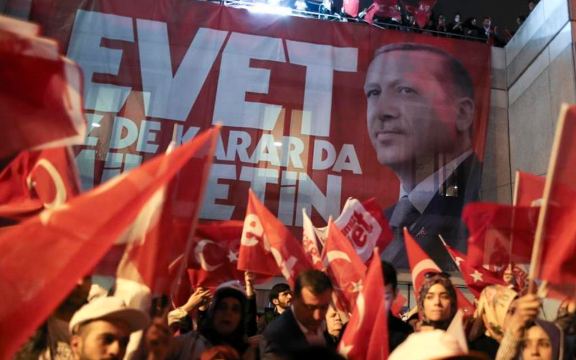
Hugh Sykes: Not a lot. Very little triumphalism. There was a bit of that last night, people roaring around in their the cars setting off fireworks. A lot of subdued despondency. I think the reality of this is only just sinking in. It's a bit like the day after the EU referendum in Britain last year. Brexit suddenly came into focus the next day. So people are being thoughtful and quite quiet. But the No side are furious. I mean, that description "uneven" is to put it mildly, from their point of view. They say that Yes played so dirty that they should have won an enormous margin. The Yes campaign got massive support from the government and from television. Imagine the government in Britain only supporting the Leave campaign and marginalising all the people who wanted to stay in the European referendum. It was very comparable to what that would have been like here. And the president is supposed to be above the party here. He certainly wasn't.  His face was on huge banners and billboards alongside that the word 'Yes' in Turkey 'Evet', and the No campaign got hardly any television airtime. There were few, if any, No political broadcasts and dozens for Yes. And to cap it all...They must...they really were desperate at the end. They thought they were going to lose, the Yes side. The prime minister tried to smear No voters by saying that voting No would be tantamount to supporting terrorism. "You're with us or you're with the terrorist." That remind you of anybody?

Mark Mardell: But given that sense of powerlessness from the opposition. do they stand any chance of stopping that, even with the sort of support of the OSCE?

Hugh Sykes: Well, it's a moot point, isn't it? They are going to appeal to the Supreme Court. Will the Supreme court by the time they appeal have been stuffed with Erdogan supporters, and that it doesn't stand a chance? But the appeal would be about the the ballot form decision, this very strange (at the very least) decision by the Electoral Commission last night...said in the middle of the count that they'd accept ballots with no official stamp on them...they are supposed to be stamped, every single ballot...and ballots in unsealed envelopes...every ballot's supposed to be an envelope that's sealed. otherwise it's fishy, and if it's not actual fraud there's plenty of opportunity for it. There's a really bad cloud of doubt hanging over such a tight result. The leader of the Republican People's Party (CHP), Kemal Kılıçdaroğlu, commented above all this, "You can't change the rules of the game in the middle of a match".

Mark Mardell: Doesn't sound much chance of a very divided society coming together?

Hugh Sykes: No, it's completely split down the middle. I mean, 51-49. It's not exactly a resounding victory for Yes. And if you look at the map there's a stark colour difference between the Yes places - Istanbul - sorry, I beg your pardon - beneath the No places - Istanbul, Ankara and prosperous industrial and tourism centres along the coast, the south coast and the west coast like Izmir - against the people of the hinterland, against Anatolia, characterised by some, possibly snobbishly, as "the educated for No against the uneducated for Yes."

Mark Mardell: Hugh, thanks very much indeed.

Tuesday, 10 May 2016

Two Mothers One Conflict

I put this question to an objective observer. 

"Do you think the BBC is justified in juxtaposing words and images of the mother of a terrorist and the mother of one of his victims?"

"Well, possibly. It depends if the mother of the terrorist is contrite."

"What if she isn’t?"

"Then it doesn’t seem ethical."

"The mothers were a Palestinian and an Israeli."

"Oh, well, I suppose some might argue along the lines that the Israelis have an army and the Palestinians have nothing."


The objective observer was playing devil’s advocate, by the way. He didn’t think there was any justification for giving the two mothers equal billing so to speak, but he does know a lot of people who would. 
They might say things like “What choice to the oppressed have when the oppressor is so powerful and so evil”
Only those hostile to Israel are likely to think there is any justification for the BBC presenting equally sympathetic pictures of victim and perpetrator, and even so, some may have reservations about the morality of placing a bomb on a bus carrying civilians, or glorifying the act itself.

We wrote about Jeremy Bowen’s report on 4th May.  Someone at the BBC must have made the decision to take Bowen’s footage and craft it into a human interest tear-jerker.


The Palestinian mother looks like a Modigliani painting. She’s speaking tearfully in broken English, pleading for ‘freedom’ and telling us “they took our land. They kill us” “If they want peace they give us our rights” 

All these things will resonate with the Israel-bashers, the pro-Palestinian agitators who stick with the belief that Palestinians are ‘just like us’ despite their enduring quest for martyrdom, which isn’t really a bit ‘like us’ as far as I’m aware. 
Note Bowen teasing out that selfless remark; sacrificing Abed’s life was 'the price of freedom.' How noble of Abdel the martyr and his principled, self-sacrificing family.   
“Of course, I was very, very sad as a mother but when I saw the people – how all the people are proud of what my son did. Because I think he did the thing that all the people wanted to do. He was very angry about what’s happened. He thought that they are our occupiers. They took our land. They kill us. They always do many things to make us angry. They don’t want peace. Always, he said, Israel don’t want peace. Because if they want peace, they give us our rights. We are Palestinian people and we know every people want to have freedom. We have to pay something. (Bowen: You have to pay for freedom?) Of course. Because Abed wanted that, I think. I always respect what my children want.”

 Big portrait of the martyr in the background, smiling.

The editing suite chose that bit of film, and they also chose the next bit of dialogue from the Israeli, which reinforces the concept of oppressor versus the oppressed.

“We simply can’t allow them to take over us” 
This was a subtitle. What can the Israeli woman mean by “take over us”? Is that an accurate translation?
“We simply can’t allow them to take over us....We can’t! 
The translator doesn’t seem quite sure. We can’t what?  

Then she continues:
“We need to live in peace, we need to live with friendship and love in our world, not to be in fear. I should be able to go out with my daughter to have fun and come back without us being hurt”

Which, out of context might seem inconsiderate and unfeeling. Why should the oppressors be able to have fun while the poor Palestinians are being oppressed, and why should they be able to do so without being hurt, when we Palestinians are being killed all over the place. 

It’s that same old half a story, cleverly cherry-picked to reinforce the BBC’s agenda. Half a story; no background, no context, no objectivity.   False equivalence is entirely different from impartiality

Even so, if you don’t see it like I do, and you really do think the Palestinians have no choice but to stab for freedom (from the river to the sea) then as BBC Watch points out, how can you blatantly justify an act of terrorism and glorify the terrorist on your website when you wouldn’t dream of doing so in the case of any other conflict? 


This ‘Two Mothers One Conflict” nonsense is utter manipulation, perhaps worthy of the advertising industry and patently unworthy of a National Broadcaster with the obligation to be impartial written into its charter.

Saturday, 3 August 2013

Recommended reading


There's an interesting and rather persuasive article about BBC from Graeme Archer in the Telegraph:

We need the BBC to be more like the newspapers - open about the unavoidably political beliefs of its staff 
It's the Today programme in particular which gets Graeme's goat:
It infuriates me, not least for that studied pretence of political neutrality, contradicted by every nuanced phrase, tone of voice or, indeed, official BBC investigation. (The BBC didn’t realise immigration was a political issue until some time around 2010, for example.)
In the wake of the BBC Trust's partial upholding of a complaint against a BBC documentary presented by John Humphrys, he argues that evidence and statistics are "not a substitute for ideology, for your political outlook on life, through which such evidence is (always) refracted" and that this has implications for the BBC - which, unlike newspapers, "you don't choose to buy":
Which makes it ridiculous for the BBC to pretend that its front-persons remove their own world views the moment they sit in front of a microphone. It’s absurd, because it is impossible, and were it possible, it would be uninformative. I could write these columns as though I weren’t a Tory (see above). I’m sure you’d pick up on it soon enough, and wonder why you’d paid to read someone pretending to be something they weren’t: that is, neutral. That is: a lie.
Such neutrality doesn’t fail only when it is used as an attempted mask for party affiliation. Any policy issue is identically afflicted. Do BBC staff really have no opinions about, say, fracking? Is it conceivable that those views don’t leak through into their broadcasts?
As with so much other establishment practice, this is one best tackled by transparency. Were the BBC to give up on its neutrality dogma – not least because it’s untrue – presenters would be free to say what they actually think. And we would be free to view their arguments through the prism of their beliefs.
Please give the article a read in full.


Update: Alan at Biased BBC makes an interesting point in response, which had (far too nebulously) also crossed my mind whilst reading the Telegraph article:
If the BBC were allowed to ‘take sides’, or at least its journalists allowed to shape stories using their own personal views there would have to be a balance of journalists….of all political, religious or other ideological persuasions….clearly impossible.
The BBC is already, to coin a phrase ‘left leaning’, imagine if allowed free rein to let rip and indulge in propagating their own world vision untrammelled by even idealistic notions of impartiality imposed upon them as now.
I think that's absolutely right. Graeme Archer's solution would only work if the BBC actively sought to recruit journalists whose personal opinions, in toto, represented a broad and fully representative range of British public opinion. (Wouldn't that be great?) 

Unfortunately, BBC employees are, by their own account, largely left-liberal in orientation. To give them license to express their opinions en masse would be unconscionable, especially if the license fee were still in place. 

So how could the corporation contend with that? Sack half of their journalists and recruit a fresh batch of right-leaning journalists to replace them? As if that's ever going to happen! 

Still, as Alan says, they could at least try to bring a lot of fresh, non-left-leaning blood into their news arm. That would be a start. It might begin to break down the groupthink that even Stuart Prebble, the BBC's own liberal choice of reviewer, found to exist at the corporation.  

Thursday, 1 November 2012

Universal Discredit?


Part of the BBC's proclaimed commitment to impartiality involves providing fair and balanced coverage of matters of political controversy. This must necessarily mean offering a wide range of conflicting opinions and ensuring that no important strand of opinion is significantly under-represented. Of course, this doesn't mean that every important stand of opinion needs to be represented on every occasion, nor does it mean that each side needs to have equal amounts of time given to them on every occasion.  However, balance (or at least something sufficiently close to balance) should be achieved over time. Well, that's the theory anyhow.

In the year or so leading up to the passage of Iain Duncan Smith's Welfare Reform Act in March 2012, BBC Radio 4's Sunday discussed the highly controversial bill on four separate occasions.

Given the criteria for impartiality outlined above, what could we reasonably expect from the team behind Sunday in their treatment of this extremely hot political issue? 

Speaking for myself, I certainly would not necessarily expect to hear an interview between a supporter and an opponent of the bill on every one of those four editions. That would be unreasonable. Nor would I expect (or require) that a simple tally of the numbers of supporters and opponents across all four editions would (or should) result in precisely equal numbers of supporters and opponents. That too would be unreasonable. What I would expect to see would be something roughly like this: Maybe one edition featuring an Anglican bishop opposing the bill, a second edition featuring a debate between a supporter and an opponent of the bill, a third edition featuring an interview with Iain Duncan Smith (perhaps discussing whether his Catholic faith has anything to do with the matter) and a fourth edition featuring a debate between a supporter and two opponents of the bill. Yes, that would give a 3:4 ratio in favour of the opponents, but that would surely be perfectly acceptable to any reasonable person. Isn't some permutation of that scheme roughly what you would also expect to happen?

So, what actually happened?

The first edition of Sunday to discuss the subject (27/3/2011) dealt with it by interviewing a critic of the bill, Ilyas Khan, Chairman of Leonard Cheshire Disability. No supporters of the bill were interviewed.

The second edition to discuss the subject (20/11/2011) dealt with it by interviewing a critic of the bill, John Packer, Bishop of Ripon and Leeds. No supporters of the bill were interviewed.

The third edition to discuss the subject (22/1/2012) dealt with it by interviewing a critic of the bill, John Packer, Bishop of Ripon and Leeds. No supporters of the bill were interviewed.

The fourth and final edition to discuss the subject (19/2/2012) dealt with it by interviewing a critic of the bill, John Packer, Bishop of Ripon and Leeds. No supporters of the bill were interviewed.

So, there were only opponents of the bill across all four editions and not a single supporter of the bill. Isn't that startling?

You might have wanted to hear an ethical case for the reforms alongside or in contrast to all the ethical objections being made against it but you weren't given the chance. 

I cannot see how that can be considered impartial, given that a very narrow range of opinions was offered, conflicting points of view were not heard, one side was so under-represented as to be completely absent and - above all - no balance was ever achieved, even over a whole year's worth of programmes. 

Can anyone see a defence for this?

Monday, 29 October 2012

A response to a response


Thank you, Sue, for your kind words. I'm looking forward to reading all your thoughts on the reporting of Jon, Jeremy, Yolande, Kevin, Wyre & Co. - and much else besides - in the months to come. 

You raise a lot of interesting points there, not all of which I entirely agree with. (I know you'll be genuinely relieved to hear that!)

I must admit to a certain Gradgrind-like obsession with "Facts, facts, facts" and I've not exactly taken a great deal of time to reflect on the conceptual problems underlying terms like 'bias' and 'impartiality' and such questions as "What hidden assumptions and misunderstandings might I be labouring under?" So your thought-provoking response tells me it's now clearly time to do so!

Is bias inevitable? If it is then the title of this blog, 'Is the BBC biased?' , becomes rather beside the point as it can only ever truthfully have one answer: "Yes." Maybe it should be titled 'What biases does the BBC have, and which ones matter?' instead. (Less snappy though!) 

I would be interested in hearing the case for for the undesirability of scrupulous impartiality and arguments for the inevitability of bias, as I may be missing something important here.

OK, time for a speech on 'What I think about bias and impartiality'!


Regarding the concept of 'impartiality', I would say that it simply means not taking sides (whether for or against) and being fair and balanced. I want my BBC to be impartial in that sense. Using Sunday's  treatment of the various shades of Catholic opinion as a yardstick, I don't want the programme to be either on the side of conservative Catholics or liberal Catholics. Of course journalists are only human and come to their work (like the rest of us) with their own opinions and prejudices, but if they are going to do justice to the depth and breadth of the news or to particular issues they will have to put most (if not all) of those opinions and prejudices aside, however hard it may be for them to do at times. That's the only thing they can do if they are truly aiming at impartiality. If they have personal reasons to dislike, say, the Catholic Church or Israel or if they object in principle to conservative Catholic attitudes towards gay marriage or to a particular Israeli government policy they should never allow that attitude to influence their reporting or interviewing.   The aim of journalism is surely to increase our understanding of the world and if a journalist fails to explain and give voice to the interests, opinions and motivations of a diverse range of parties to a subject or to a particular news item (even if they believe some of those parties to be wrong or mad, bad and dangerous to know) they are failing to report the story properly and do it justice, with potentially dangerous results. People in conflict with each other need to understand each others point of view and impartial reporters should always seek to help their audience to share that multi-faceted understanding too. 

What this would mean in practice is that the Sunday should provide balance, not just in terms of opinions but also in terms of the issues it covers. It should not fixate on particular stories. It should offer a wide - as opposed to a narrow - range of opinions (so not only 'The Tablet' but also 'The Catholic Herald'). It should seek to examine conflicting points of view and it should take strong steps to ensure that no important shade of opinion is either under-represented (e.g. conservative Catholicism) or over-represented (e.g. liberal Catholicism).  

Obviously, the balance sought doesn't mean that every edition of Sunday must feature every important shade of opinion on a particular topic and it is, of course, perfectly fine to feature just one shade of opinion on a single edition. If over time, however, one shade of opinion on a particular topic comes to dominate over the others, then the programme is not being impartial. The greater the predominance of one strain over all the others the greater the bias.

What does the BBC itself say about impartiality? 

Well, at the heart of the contract between the BBC and its licence-fee payers - according to the BBC Charter - is the public service commitment to be impartial. That commitment, as stated in its Editorial Guidelines, ranges across all its output (including magazine-like shows such as Sunday) and involves being "inclusive" and offering a broad range of views on matters on matters of public policy and political controversy. The BBC also says that it commits itself (above and beyond its original charter) to applying that concept of 'due impartiality' to all subjects. It defines 'due' as meaning "that the impartiality must be adequate and appropriate to the output, taking account of the subject and nature of the content, the likely audience expectation and any signposting that may influence that expectation". This, it states, is more than merely balancing opposing viewpoints. There is, however, some wriggle-room: "Equally, it does not require absolute neutrality on every issue or detachment from fundamental democratic principles."


If it truly has "points of view", such as a bias towards liberal Catholics and against conservative Catholics, then the BBC is surely breaching its own editorial guidelines. Which would be wrong, regardless of how we ourselves feel about the groups in question. 

I like this concept of 'impartiality' too much to give it up or downgrade it, however unrealistic some may consider this to be. I want it to be The Ideal towards which the BBC always seeks to strive. I don't want it to be dropped - unless and until the licence fee is dropped. I want the BBC to live up to its charter and its overall commitment and keep its wriggle-room to a bare minimum. Yes, it doubtless is impossible for the BBC to be truly impartial and  totally free from bias - just as it is for us as individuals to be perfect - but I think the BBC should always be trying as hard as possible to fight against the inevitable and strive towards the impossible here. This may sound old-fashioned, but I see this as a parallel with what I think individuals should (ideally) also keep trying to do - strive towards understanding and appreciating views other than our own, with a view to arriving at the truth, even when those views conflict with our own wishes and biases (though we aren't bound by a charter so to do, nor do we charge anyone a compulsory fee (or tax)  to fund our so doing!)

To continue with the classic argument (regardless of whether bias is inevitable or not)...The BBC is unique. Unlike its rivals, it is funded by a licence-fee. Newspapers, like the Guardian or the Daily Telegraph, can be as biased as they like as we don't have to pay a penny towards them. People who object to their biases can have nothing to do with them. Anyone who watches T.V. in the United Kingdom is legally required to fund the BBC, even if they fundamentally disagree with its "points of view".  If it truly has "points of view", such as a bias towards liberal Catholics and against conservative Catholics, it is surely doing a disservice to a significant proportion of licence payers.  We may ourselves share the BBC's bias against them, but does that make it right? I don't think so. (There are democratic reasons for strongly disapproving of this too). 

That is, as you say, often the criticism blogs (like this, and several others) which allege BBC bias receive - that we aren't against BBC bias per se, we are only against biases that don't suit us and are only interested in alleging bias when it's something we feel strongly about ourselves. If the BBC were against ideological opinions, religious beliefs, foreign governments, countries, political parties, and social attitudes of which we also personally disapprove, would we care and would we blog? Do we really want a BBC that is, say conservative in outlook and/or pro-Israel - our brand of bias?  I have to say that I think you're right to say that there's some truth in that, unfortunately. 


I will try to fight against my own biases (I'm not Catholic, or religious for that matter, and I'm socially liberal but I can still point out bias against socially conservative Catholics if I find any - which I do!), but do I only try to fight against the biases I don't feel too strongly about? If I found evidence that a BBC programme was strongly biased against the Labour Party, Palestinians and the European Union would I report it? I hope I would, but I'm not kidding myself that I wouldn't do so through gritted teeth and probably with a spectacular lack of enthusiasm. I don't doubt my prejudices will inevitably show through here on 'Is?' and I'll find myself blinded by them from time to time. If I'm going to criticise the BBC for such things I ought to keep a close eye on myself to and try to put some of my affection for the concept of 'impartiality' into practice. I would really hate to think that all I'm doing is trying to reshape the BBC in my own image.

I also see the force of your point about our not wanting the BBC to be so scrupulous in its striving for impartiality (if it really is still striving for impartiality, of course) as to end up in a moral relativistic quagmire where the accidental, unintended deaths of children in an Israeli air-strike intended to take out identified terrorist targets is reported as if it were morally equivalent  to the deliberate firing of missiles from Gaza into Israel (by those self-same terrorists) with the specific intention of killing civilians or to the bombing of an Israeli school bus. I see that, and yet I still don't want the BBC to force me into any moral reactions. I feel that they are trying to force me at times and I object to it. I want BBC reporters to report fairly, fully and accurately and let the fairness, fullness and accuracy of their reporting speak for itself. Then I'll form my own opinions. I don't want them to tell me or to steer me towards 'seeing' what's right or wrong, or evil or righteous. "I'll assess the facts you present, thank you very much Mr. Donnison, and make up my own mind - but please try to present them accurately, fairly and without trying to tug at my heart-strings."  

Of course, much of this has been giving the BBC the benefit of the doubt that it really is striving to be impartial. It's very much the issue at hand as to whether this is actually the case. Some people (and we've read their comments assiduously for several years) think it isn't striving to be impartial at all. (We've thought this ourselves from time to time). Others say that parts of it are trying, other parts of it aren't. Another point of view is that it is striving to be impartial, but failing! Of course, it may be striving and, by and large, not failing - 'On the whole, we think we got it about right', as BBC editors like to say. I've thought that the BBC has serious failings in this respect for years and - on two other blogs (Biased BBC and the embarrassingly-titled Beeb Bias Craig) - have, I hope, provided some stand-up evidence to back this up. However, my contributions were always based on the underlying, largely unexamined assumption that the question 'Is the BBC biased?' was pretty much equivalent to the question 'Is the Pope a Catholic?' (and 'Do bears shit in the woods?') and I didn't feel that its bias was either a good thing or necessarily an inevitable one. I want to challenge myself here to research a subject so thoroughly and in as 'impartial' a spirit as I can muster so that I can test whether I've been correct about the extent and seriousness of the bias all along, or not as the case may be. 

I know I've probably not thought everything through properly here and am open to having my eyes opened.