Showing posts with label Richard Burgess. Show all posts

Saturday, 27 November 2021

'Migrants', 'immigrant immigrants', 'people'?


This week's Newswatch discussed the issue of whether it's wrong to call the people crossing the Channel in small boats 'migrants' or whether 'less dehumanising' language, such as 'people', should be used instead. 

This is how the subsequent interview transpired. 

In it, BBC boss Richard Burgess also told us why the BBC believes it ''wouldn't be accurate'' to label such people 'illegal immigrants' [as, say, Migration Watch does]:


Samira Ahmed: And to discuss the use of language on this story I am joined now by Richard Burgess, Executive Editor for UK Content at BBC News. Richard, thank you very much for coming on Newswatch. A lot of viewers are saying why don't you just call them 'people'?
Richard Burgess: Well, I think, first of all, I should say, this was a terrible human, tragedy as you were reflecting there. And I think it's important that our coverage reflects that in a sensitive way and in a respectful way. In terms of the use of 'migrant', I think it's about being as clear and as accurate as we can be for the audience. It's a term that the audience understands, we know that from research. And, ultimately, it actually explains why those people were on the Channel. They were migrating, they were migrants, they were trying to move to another country. So I think it's about being clear and accurate. But at the same time, absolutely going on to try and tell the stories of those people as individuals.
Samira Ahmed: Some people - and including the Home Secretary, it seems - are apparently saying that the BBC's language is dehumanising.
Richard Burgess: I don't think so. And I think we need to be a little careful here. The term "migrant" is about a person on the move - and a person on the move, often, for very good reasons - to avoid war, to avoid persecution, to get a better life for themselves. And we work really hard with our reporting to humanise the story, to speak to people who who are making those perilous journeys, often. I don't know if you saw Nick Beake's report from Dunkirk on the six and ten o'clock news where he spoke to one of the people in the migrant camp there who had actually spoken to two people who were on that boat. And it was so moving. And I think that's really incumbent upon us to really work hard to tell the stories of these individuals, the journeys they've made, the pressures on them.
Samira Ahmed: I should say as well that there are some viewers who contacted us to say that they should all be called 'illegal immigrants'. What is the BBC's position?
Richard Burgess: Again, I think it's about being accurate because I don't think that is accurate. If you look at the UN's description on this, anybody has the right to claim asylum in another country. We don't know what the status of all those people who died on the boat were, but some may well have been seeking asylum, might've had refugee status. So it wouldn't be accurate to describe them as 'illegal'.
Samira Ahmed: How does the BBC decide what each word to use? You know, there's the word 'refugee', there's the term 'asylum-seeker', and then the term 'migrant'. How do you decide when to use which one?
Richard Burgess: We use 'migrants' in this case because often it's not clear the reasons why somebody is travelling. As I say, they could be seeking asylum, they may already have refugee status, they may be somebody who's on the move for a better life for themselves and their families. So I think it's about us being as accurate as we can. And as we get more information on people, we get more accurate. In this case we've talked furtherly about men, women, a pregnant woman on the boat, children. So as you get more information, you get names, you get back stories, and I think that's a really important part of a journalism.
Samira Ahmed: When a tragedy happens like in the past week with the 27 people who drowned in the Channel, it does create a huge emotional response from the public, and I wonder if it's a challenge particularly at those moments for the BBC to get the terminology right in reporting such a story.
Richard Burgess: Absolutely. And, you know, journalists within the BBC feel that emotion as well. I think it's about being accurate, as I say, but I think it's about trying to tell stories, but also trying to get to the issues that obviously relate to this matter. So whether that's political issues, diplomatic issues, issues for local communities, the bigger geopolitical issues around wars around the world. So it's important that we try to put these things into context, it's important we try and tell the human stories, and get our terminology right.
Samira Ahmed: Richard Burgess, thank you.

Saturday, 30 March 2019

BBC UK editor Richard Burgess on protests (again)


Here, from this week's Newswatch, is a transcript of the interview with the BBC UK editor Richard Burgess. He's talking about the BBC's coverage of protests. Enjoy!


Shaun Ley: From the Gilets Jaunes, or Yellow Vests movement, protesting for several months in France, to the now frequent demos across the UK, which are on subjects including climate change, supporters of such events demand and expect media coverage. To what extent should the BBC comply with their wishes? Well, one of those responsible is the BBC UK editor Richard Burgess, and he's with me now. Thank you very much Richard for coming into the Newswatch studio. What are the criteria you use to determine what demonstrations to cover and how much coverage to give them? 
Richard Burgess: Well, I don't think there are exact criteria, but I think there are a number of factors that you take into consideration. Scale is obviously one of them, which we saw with last weekend's march, a major march with a lot of people on it, that's something you've got to take into account. But I think there are a number of other factors around, is this a matter of national significance, is this is a live issue at the moment, and could the march lead to change in the future? So you take all those into account, but obviously there's the other factor, which is what else is going on on that day, what else is happening on the news agenda? 
Shaun Ley: You mention scale, and this is a very contentious issue with marches in particular, isn't it? I mean, last weekend, the organisers were saying they had more than a million people, the BBC was saying, I think, hundreds of thousands. How do you make that call? 
Richard Burgess: Well, I don't think you can ever absolutely say how many people are on a march, by their very nature, they are fluid events, people join, people leave, people move around, they're over large areas. It's almost impossible, if not impossible, to give an exact number. What we do is we obviously have people on the ground who will make an assessment, which is what we did at the weekend. And they were talking about, you know, how densely populated the march was, so we talked about hundreds of thousands, we talked in kind of, broad estimates. And then on the figure of a million, which the organisers were saying, we attributed that figure to the organisers whenever we used it. 
Shaun Ley: Difficult, though, isn't it? And it can be very politically charged, I mean one thinks of the Trump inauguration a couple of years back, that became a really serious issue about whether the media had distorted the numbers, had downplayed the numbers. You have to be really careful on this, don't you? 
Richard Burgess: I think that's right, and I think that's why we do talk in kind of broader terms, and when there are more definitive figures, we attribute those to the organisers or maybe to the authorities, although interestingly, the Metropolitan Police didn't put a figure on it at the weekend, and I think that's because they recognise the difficulty of putting figures on and the political sensitivity around those figures. 
Shaun Ley: You were candid in saying at the start of the interview that one of the things that can affect coverage is what else is happening in the news, there are lots of other things, it's going to get squeezed, if there aren't many other things, it may be something it's quite easy to fill airtime with. That's a difficulty, isn't it? Because you can spend the money, the resources, you are under an obligation then, live trucks, camera crews, producers, to get your money's worth for the licence payer. 
Richard Burgess: Well, not necessarily, I don't think there was a real issue at the weekend because of the size of the march and the issue that it was addressing. Which is... 
Shaun Ley: (interrupting) What about more generally, because there are lots of other demonstrations which the BBC covers, whether demonstrations on the future of the NHS, for example, or the Tommy Robinson demonstration outside the BBC's Salford headquarters? 
Richard Burgess: Again, I think we make decisions based on those criteria I talked about before, in terms of the scale and whether it's an issue of national significance, and what actually happens on the march as well is also a consideration. And then we will make a decision based on the news agenda that day, and sometimes we commit resources to staff and it doesn't get on, and that's - that's the business of news. 
Shaun Ley: I wonder what effect the referendum has had, because it's kind of created a very powerful sense of the will of the people. It's something politicians claim, we're speaking for the will of the people on either side of the argument. The protesters also say the same. Doesn't that perhaps require the BBC to develop a bit more of a careful judgment on this, because it is used so much to be, if you like, an emblem of a wider public feeling, rather than just those people who have turned up in a particular day for a particular project? 
Richard Burgess: I think you're right, and I think we do our best to reflect the range of opinion around Brexit. We know it's an extremely divisive issue, we know that it's a polarising issue for many of our audience, and one that people feel hugely passionately about. And so our aim as an impartial broadcaster is to give air to those opinions - not to create a false balance, but to fairly represent the views across the nation. 
Shaun Ley: What about other protests? I mentioned, in introducing the Gilets Jaunes protests, the Yellow Vests protests in Paris in particular. I mean they've been happening every weekend for months now,. We've covered them a lot on the News Channel. Some weekends, they are fairly quiet protests, other weekends, like the one when the Champs-Elysees was attacked, became much more newsworthy themselves. How do you make that call? Because I know it's not on your brief as home editor, but for BBC News in general, that's is a difficult judgment - which weekends we cover it, and if we cover it it because it's violent, are we in a sense creating encouragement for demonstrations to take a particular turn? 
Richard Burgess: I think that's a good point, and I think you need to be careful not just to cover protests when they turn violent or because they are particularly great pictures around fires in the Champs-Elysees and what have you, as you were saying. I think with our coverage of that, we've always tried to put it into the context of the wider political and social debate that's happening in France at the moment, and I think that's what's of interest to our audience around that story. 
Shaun Ley: And will you think carefully about the next Brexit protests, if there are any, how you cover them? 
Richard Burgess: Yeah, we do always, and we're careful how we cover them, the amount of coverage we give to them, and a range of voices that we feature throughout them. 
Shaun Ley: BBC News UK editor, Richard Burgess, thank you very much for coming in for Newswatch.

Saturday, 13 October 2018

The back with two beasts


Below you'll find two transcripts concerning the BBC's editorial policy regarding climate change. 

I'll use this post then to shove in my tuppenceworth. 

I've said before that I find that BBC TV's Newswatch and Radio 4's Feedback are different beasts. You're more likely to hear complaints of the kind we make on Newswatch than you are on Feedback. And Newswatch tries to project a more impartial style than Feedback, with Samira Ahmed taking more care to appear even-handed than Roger Bolton. And Feedback does seem to me to be more agenda-driven than Newswatch. 

So here you'll see that Newswatch features viewers' opinions from both sides of the climate debate while Feedback features just one side. And you'll see Samira Ahmed put questions from both sides too (albeit rather half-heartedly from the 'deniers' side') while Roger Bolton is relentlessly one-sided in his questions. And Feedback has been banging this one-sided drum for a long time now, leading the charge against 'deniers' being allowed on the station for at least a couple of years. 

That said, it was Roger Bolton who really made the BBC boss squirm this week. You'll note that both James Stephenson and Richard Burgess (one of whom said much the same as the other!) were reluctant to admit that the BBC got it wrong despite the BBC itself already having said that they got it wrong, with Mr Stephenson wriggling in particularly awkward ways and Roger calling him out on his use of weasel words and then embarrassing him even further by pointing out to listeners that he didn't look comfortable answering a particular question. All credit to Roger Bolton for not being a lickspittle there. 

And credit to Feedback too for highlighting the scientific ignorance of BBC Radio 4 journalists - bulletin writers and senior presenters, including Feedback bete noire John Humphrys and Sarah Montague. (That was the thing James Stephenson got particularly uptight about). It was a serious lapse in accuracy on Radio 4's part - and if both John and Sarah were involved that didn't mean it was simply a problem with one programme. It must have been both Today and The World at One. 

To end: One thing that unites both Feedback and Newswatch is their consistent use of 'denier', without inverted commas. This old term of abuse is evidently now an acceptable description for BBC presenters and editors to use. You'll see that in both transcripts. Why is that acceptable?

Transcript: 'Newswatch' 12/10/2018, Richard Burgess on the BBC's climate change coverage


Richard Burgess 

Samira Ahmed: Hello and welcome to Newswatch, with me Samira Ahmed. Is BBC News denying a voice to climate change deniers, or are they getting too much air time? Monday's report from the Intergovernmental Panel on Climate Change was the latest in a series of warnings about the risks of rising global temperatures, reflecting the scientific consensus on this controversial issue. Among the guests discussing the panel's findings on that evening's Newsnight was Myron Ebell. who used to be Donald Trump's environmental advisor and now runs a think tank which campaigns on behalf of the US energy industry. He was questioned by Evan Davis. 
Evan Davis: Do you think the scientists, who reviewed these 6,000 papers to produce this latest publication - 86 lead writers - do you literally think they don't believe what they have said? Is that your contention?
Myron Ebell: They're climate campaigners first, at the highest level, rather....
Evan Davis: (interrupting) Wow!...
Myron Ebell: ...than objective scientists...
Evan Davis: (interrupting) But you're a climate campaigner more than they are. They're not even paid, these guys. You're paid. They're not paid. It's absolutely... Go on.
Myron Ebell: Look, look...The study says that we've had about one degree of warming already. They don't consider the tremendous benefits that have flowed to humanity....
Evan Davis: (interrupting) But again..Sorry! Again, you're trying to show you know more about the science than the scientists! 
Some viewers thought Myron Ebell had no place as a guest on the programme, with Dr Mike Ward writing: 
I'm simply appalled that Newsnight and the BBC generally still find it necessary to have a climate science denier on whenever they report the latest findings on global warming. The BBC don't have moon-landing deniers on whenever they report on space flights, or flat-earthers on when they report on a round-the-world yacht race, so what's the deal with climate science?
And the author Philip Pullman tweeted his agreement:
This is an appalling misjudgement. By giving time to climate-change deniers, you make it harder for politicians to make good policy.
The editor of Newsnight, Esme Wren, took to Twitter before the programme aired to say:
As part of our coverage we currently plan to discuss the politics of climate change, and the mindset of the current US administration. In this section it is relevant to hear from those who have advised President Trump. The issue of false equivalence is only in play when discussing the science of climate change. This point is entirely recognised and adhered to by the programme.
That charge of false equivalence refers to the BBC's perceived practice in the past of balancing the views of the majority of scientists, that significant, man-made climate change exists, with the minority who challenge that analysis. But achieving a balance of that kind is not now the BBC's policy, as was made clear by an internal briefing memo, sent to news staff last month, which found its way into the newspapers. One passage said:
Climate change has been a difficult subject for the BBC, and we get coverage of it wrong too often. Man-made climate change exists. You do not need a 'denier' to balance the debate.
But that advice and Monday's coverage did not go down well with everyone:
Eoin McMahon: I watched in exasperation but not surprise at your naked bias all day. No guests who did not agree with the consensus were interviewed. I has been aware of the recent edict wherein your news staff have been directed that they are no longer required to be even-handed, and provide balance on the issue of climate change. But the bias across your news platforms was nothing compared to that which Evan Davis subjected Myron Ebell to on Newsnight.  
And Nigel Burn-Murdoch seconded that:
On the Breakfast programme there were three 'experts' who presented the IPCC report as fact, and there was no one present to advance a contrary view. Please do your duty and present both sides of a disputed area.
Well, let's discuss how BBC News handles this contentious issue with Richard Burgess, its UK news editor. Thank you for coming to Newswatch. Can you just sum up what exactly is the policy on giving airtime to climate change deniers now? 
Richard Burgess: Well, I think the policy is clear: that the science is settled on climate change, it exists, there is no debate around that. So we're not going to create a false balance or a false equivalence by getting a scientist on and then always getting a denier on. But that doesn't mean that we won't occasionally hear from dissenting voices within this debate, because there's debate beyond the actual science, there's debate around the intensity of climate change and then what to do about climate change. 
Samira Ahmed: Just to be clear - BBC News regularly did have on more climate change deniers in the supposed interests of balance. Are you now admitting that you'd got that wrong? 
Richard Burgess: No, I think what we're saying is that the science is really clear and that we do not need to get on a denier just to give some kind of, what we would describe as false equivalence. So the science is clear, we report the science, but there will be occasions where we get dissenting voices on. We're not going to shut out all viewpoints. 
Samira Ahmed: Because there is some dissent on the science and that Newsnight programme that viewers were commenting on, the moment you have a denier on - even though it's supposed to be about policy - it always ends up being a debate about the science. So the question comes down to, should the BBC be giving climate change deniers any air time any more? 
Richard Burgess: Because I think that was really interesting, that interview, because actually I think it really was interesting around the policy and the politics of the Trump administration, which is important in the whole climate change debate. And Evan asked him, "Actually, is there anything the scientists can say that will change the opinion of the Trump administration?" And he was really clear - "No." And when he tried to get into the scientific debate, Evan closed him down really quickly, and was, "You're not a scientist so we're not going to discuss that." So I think we really did gain some insight and some interesting perspective from that interview. 
Samira Ahmed: I mean, the trouble is, of course, some viewers are frustrated because - some of them contacted Newswatch - they feel there is scientific doubt and they are unhappy at the assumptions made in the BBC's climate change reporting. They were unhappy with the way Evan Davis was pressing. Can you satisfy them? 
Richard Burgess: I think the point is, is that the vast majority of scientific... The science is settled over this, the vast majority of scientific opinion admits that climate change is happening, it's a man-made phenomenon. But can we satisfy everybody? No, but are we going to shut out dissenting voices? Equally, no. But we're not going to create some kind of false equivalence between them. 
Samira Ahmed: You say there's a scientific consensus and we're not going to have a debate about that, but because the effects of it are still being discussed as something that will happen and not something that has happened, necessarily, there are people and there are viewers who say, I'm sorry, I think there's still a legitimate debate about the science. And I just wonder if the BBC can ever win this? 
Richard Burgess: I think, look, we have to reflect the debate around what we're going to do about this and the intensity of it, but when you have the overwhelming majority of scientific opinion being really clear that man-made climate change exists, then I think it's important we reflect that. 
Samira Ahmed: As we said at the beginning, the BBC has now put out a new memo and there is training guidance happening for news staff. So can you explain what that involves and what difference viewers might see and read in their coverage? 
Richard Burgess: Look, I think it's an attempt to explain to staff some of the changes in policy, research, science and to try and counteract some of the misconceptions that can be made around global warming and climate change. So we have offered some guidance, there's some training, as well, and it's just to make sure our staff are making informed decisions on this important issue. 
Samira Ahmed: But would it include things like "these people are not to be booked"? 
Richard Burgess: No, no. As I said before, we're not excluding viewpoints from this discussion, but what we're also not doing is creating this false balance that I've been talking about. 
Samira Ahmed: Richard Burgess, thank you very much. 

Saturday, 12 May 2018

To cover a protest or not to cover a protest....


The BBC News website currently has a UK political protest as one of its lead stories:


What protests, marches and demonstrations the BBC chooses to cover is a hot issue these days. Those whose protests don't get reported can become very angry at the BBC, and the BBC is facing more and more accusations of 'BBC bias' as a result - especially when other much (like this one) are given ample coverage?

Back in March the BBC's almost non-existent coverage of a day of anti-Brexit marches provoked a social media storm (starring Lord Adonis). 

And a couple of weekends ago a pro-Scottish independence march in Glasgow (which apparently drew between 40K and 80K attendees) and a pro-freedom of speech rally in London happening on the same day (which apparently drew around 4k attendees) also received the cold shoulder from the BBC, much to the fury of those taking part and those supporting each protest.

So why is the BBC giving this TUC-led rallies of "thousands" such prominence having given those either next to no coverage or no coverage whatsoever? 

Well, here's a transcript I prepared earlier (but didn't post) from the 30 March edition of Radio 4's Feedback in which the BBC's UK News Editor Richard Burgess lays out five criteria for assessing whether (or not) the BBC will cover a protest:
  • How much of a live issue is it? 
  • How much of a developing issue is it? 
  • Is this march likely to bring about significant change? 
  • Has it been influenced by very recent events? 
  • Is there a real developing new story around this march?
Obviously some protests do meet those criteria. 

The 'Enough is Enough' protest by Jewish groups and various parliamentarians in late March is one example: Antisemitism in the Labour Party was a live issue, and a developing issue; the march could have brought about significant change; it was influenced by very recent events; and there most definitely was a real developing new story around that protest.

Others, however, don't meet those criteria.

Saturday, 13 February 2016

A Storm of Complaints


This week's Newswatch (with Samira Ahmed) did a bit of 'on the one hand' and 'on the other hand' vis-à-vis 'complaints from both sides' over the BBC's coverage of the junior doctors' strike...

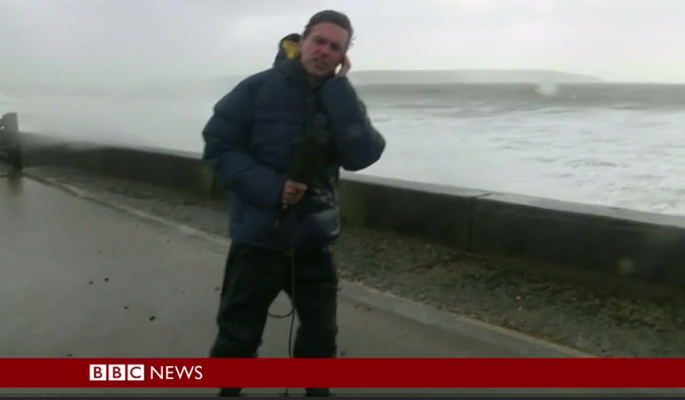
...but the bulk of the programme was taken up with discussing BBC reporters 'braving' the "extreme weather" - specifically a live report from the seaside on BBC One's News at One where experienced BBC reporter Duncan Kennedy stood next to the sea fighting against a heavy buffeting from the wind and sea-spray during Storm Imogen whilst at the very same time telling BBC viewers that the authorities had warned people to "batten down the hatches" and "don't come out and fight it". 

Viewers had written in saying that the BBC reporter looked as if he was in danger (even if he wasn't) and that the BBC was countering the official message by seeming to behave so recklessly.

Now, this may not strike you as being quite the burning issue these viewers felt it to be but Samira's interview with Richard Burgess, UK News Editor for BBC News is well worth watching nonetheless.


The BBC editor was rather woeful I felt, endlessly repeating himself and failing to properly get to grips with some of the points being put to him by Samira Ahmed. 

It was something of a car crash.

Samira herself didn't seem overly impressed either by his apparent inability to fully understand and answer her questions.

Oh dear!


Oh, and if you were wondering, Mr Burgess of the BBC felt that the BBC had got it about right.