Showing posts with label Eddie Mair. Show all posts

Saturday, 25 November 2017

Bias complaints against Evan Davis and Eddie Mair upheld


Evan Davis, sitting on the BBC's naughty step

This week's Feedback ended with Roger Bolton saying:
Finally, last week under pressure from Ofcom, its new regulator, the BBC agreed to publish the number of complaints it receives each fortnight and to reveal which individual programmes had over 100 complaints. We promised to keep you up-to-date with those that concerned radio. Well, the corporation has now published the first wave and...[drum roll]...O bathos! As yet no radio programmes have reached that bar. How inoffensive! The corporation must try harder.
It's quite surprising to think that, say, Today has received fewer than 100 complaints over a fortnight. People are always complaining about Today without, it seems, ever actually complaining about it (if you know what I mean!). 

According to the Guardian, only two BBC programmes have received over 100 complaints - Have I Got News For You and Strictly Come Dancing. 

There are, however, a couple of intriguing passages in that Guardian piece relevant to the main theme of this little blog of ours. 

Firstly,
The BBC has also revealed that a complaint regarding due impartiality and bias against Radio 4’s PM, which is presented by Eddie Mair, was upheld. The complaint related to an episode on 8 June, but details of the issue raised was not provided.
And secondly, 
An episode of Newsnight was also ruled to have bias in its coverage of the French presidential election, giving the impression that the host Evan Davis favoured Emmanuel Macron over Marine Le Pen. The BBC’s executive complaints unit, which handled the complaint, said: “Newsnight has been reminded of the requirements of due impartiality, so that the perception of its coverage matches its intent.”
The Eddie Mair one is mysterious. The BBC isn't saying how Eddie fell foul of the BBC's rules on bias. 

The Evan Davis one is much less mysterious. The only mystery there is why he's not received such a telling-off before!

Monday, 3 October 2016

Eddie Mair's sense of humour


Eddie Mair's first question (at 24:53) to the Colombian ambassador to the UK on PM today - following his country's referendum and the Colombian people's rejection of the peace deal struck between the government and the communist FARC rebels - was typical Eddie, and you'll either love it or loathe it:
Is the deal between the government and FARC off?
If you still don't 'get the joke', please click on the link and hear the way 'e tells 'em.

Sunday, 15 May 2016

Steady about Eddie!


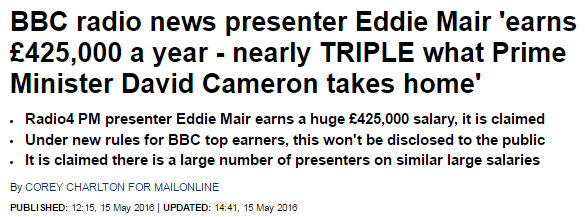
The Daily Mail has an arresting story this afternoon:


Now, I like Eddie Mair, and always have done (even if you don't!). But £425,000 a year sounds excessively excessive to me - on the "Yes, he's good. But not that good" principle.

Now, Corey at the Mail took this story from Miles Goslett at Heat Street and is decent enough to credit Miles and to link to his original post, noting that the gossip about Eddie came from were "a Radio 4 source". The Mail has followed it up with an enquiry to the BBC, but "The BBC declined to comment on Mair's salary when contacted by MailOnline." 

If you follow Corey's link though it turns out that the story has a twist: 
As it happens, one very well-placed Radio 4 source has told me that Eddie Mair takes home £425,000 per year.
When I put this to the BBC, they refused to deny it.
Indeed, a spokesman would not comment at all, but he did say that this is a “wild exaggeration”.
Well, maybe it is, but under Whittingdale’s new rules, we will never know the truth either way unless Mr Mair chooses to disclose his publicly-funded salary himself.
Now, even though the Mail has updated its article since I first saw it and followed that link, it still failed to report that bit about the BBC spokesman saying that the £425,000 claim for Eddie Mair's salary is "a wild exaggeration" - a possibility Miles Goslett properly concedes could be true.

Not that an obscure little blog like this can stop a mighty, Daily Mail-boosted rumour in its tracks, but nonetheless: Please bear in mind that it seems at least possible that Eddie doesn't earn "three times more than the Prime Minister".

Monday, 13 April 2015

More election coverage


I only caught a little of the election coverage today. 

Ed launched his big manifesto and made a big speech to match. Dead Ringers have emailed me this parody, which I'll quote in full:
"Britain can do better. I am ready, ready to put an end to the tired old idea that as long as we look after the rich and powerful we will all be OK.
"Ready to build a Britain that works for ordinary, hard-working, vulnerable families and people once again. 
"Ready to put into practice the truth that it is only when ordinary, hard-working families and people succeed that Britain succeeds.
"If you elect me your Prime Minister in just over three weeks’ time I will work for that goal, I will fight for that goal. Every single day, in every breath I take, in everything I do, in every decision I make, I'll be watching you.
"Our opponents will tell you this is as good as it gets for Britain. It isn’t. I know Britain can be better.The British people know Britain can be better.
"I say, Britain, Britain, Britain. 
"Let’s make it happen together."
The BBC's News at Six saw BBC deputy political editor James Landale call it a strong speech. However, nearly all of the vox pops in his - and Lucy Manning's subsequent report from marginal Bury North - saw 'ordinary, hard-working people' en masse expressing almost total scepticism about it and Labour. As a selection of vox populi, that was a surprisingly unfavourable one for Labour. (James and Lucy will doubtless be called 'Tory stooges' on Twitter as a result).

Robert Peston was on too, being surprisingly sceptical too (even citing the IFS against Labour). Plus, Nick Robinson returned, which was nice.

Still, the BBC's News at Six wasn't the thing that stood out for me. That was Eddie Mair on Radio 4's PM giving Labour's boring, snoring Rachel Reeves (h/t Ian Katz of Newsnight) a right old going-over. He interrupted her 33 times. (Obviously, I counted). Yes, 33 times. (And yet she still barely seemed to wake up.) 

Eddie's questions were deeply unhelpful to Labour. He pressed them especially over their failure to match the Tories' pledge to throw billions at the NHS (which, he repeatedly said, Labour supporters would expect them to do), over whether they'd reverse damaging Tory cuts to Her Majesty's Revenue and Customs in order to stop tax dodging, and over whether Scottish Labour leader Jim Murphy was wrong to promise no Labour cuts in Scotland. Pretty much every question, interruption and heckle was critical - and an attack from the Left. Remarkable stuff.

Eddie Mair has long positioned himself, in such interviews, as the BBC interviewer who makes Paxo and Andrew Neil look like complete wimps - quieter, but far, far more deadly. Tomorrow, he'll have a Tory in his sights. Gawd 'elp that Tory! And any Ukippers should write their wills before appearing.

Saturday, 11 April 2015

Complaining about 'PM' - A Cautionary Tale


Please brace yourselves for a very long post, but as we've been quiet for a few days (for various reasons)...


You may recall a post we did recently about an edition of Radio 4's PM (3 April) where UKIP appeared to be on the receiving end of an unusually high number of attacks (well, unusual for a single edition of a BBC current affairs programme during a general election that is.)

You may also recall Rod Liddle's take on the same programme at the Spectator:
I caught Radio 4 PM programme on the way home, on Friday. Its coverage of the debate consisted of taking three statements made during the debate and subjecting them to what they called statistical scrutiny. All three statements came from Nigel Farage and all three statements were deemed inaccurate by some supercilious bint. 
No other leader was subjected to similar scrutiny and even if the supercilious bint’s figures were correct, the points Farage made still pertained. (In other words, for example, while Farage said the vast majority of people obtaining new HIV treatment in the UK were health tourists, the supercilious bint pointed out this was only 54 per cent. And that some of those had every right to treatment etc, and might come from rich countries like the USA. Where of course they would have to pay for treatment, or have the requisite insurance, she failed to add.)
There was another dig at UKIP later in this execrable programme, during a piece of staggeringly unfunny “whimsy” about rail replacement bus services. I think I shall listen to PM each day until the election and monitor its commitment to fairness and impartiality. And then never, ever, listen to it again.
****

So, choosing the 'Bias' category [the one the BBC seems to like least], I put in the following complaint:
I wish to complain about the appalling level of anti-UKIP bias on PM on 3rd April.
Why did Ruth Alexander and Eddie Mair's review of the use of statistics during the leaders' debate begin with Nigel Farage, continue with Nigel Farage and end with Nigel Farage? Why were all of his facts found to be faulty? There were a lot of dodgy statistics used by all the party leaders, so why just pick on Nigel Farage?
Also, why did Carolyn Quinn's report from Hastings and Rye mention that the previous UKIP candidate there has been disgraced and forced to step down?
And why did Chris Mason's run-through of the spin from all the political parties in the debate omit UKIP's response?
And, finally, why was Guardian writer Gareth McLean's piece allowed to contain a negative assertion about the dangers of UKIP entering a coalition government?
This was on onslaught against UKIP and surely completely out-of-order during a general election. Please could this bias be dealt with as soon as possible and some redress given to UKIP.

****

The newly-arrived reply from the BBC Complaints department runs as follows:
Thank you for contacting us about ‘PM’ as broadcast on 3rd April 2015.
I understand you’re unhappy with the programme as you feel it was bias against UKIP on a number of occasions.
I appreciate your frustration with this and have reviewed the segment so as to provide further context with which to address your concerns however it should be noted PM is a very well known programme and it’s expected there will be political analysis and discussion on various aspects of the political arena.
I wish to stress BBC journalists are well aware of our commitment to impartial reporting and they are expected to put their own political views to one side when carrying out their work for the BBC.
That said it is not always possible or practical to reflect all the different opinions on a subject within individual programmes and our editors are charged to ensure that over a reasonable period they reflect the range of significant views, opinions and trends in their subject area.
More importantly the BBC does not seek to denigrate any view, nor to promote any view and it seeks rather to identify all significant views, and to test them rigorously and fairly on behalf of the audience.
In your correspondence you mention Ruth Alexander and Eddie Mair’s discussion regarding political statistics and you feel it was bias to mention only Nigel Farage however I should note Eddie Mair did support Farage with the statement ‘Well maybe he was not far off the point. Does that mean 54% are health care tourists?’. Furthermore they both come to the conclusion that Nigel’s statistics that one house needs to be built every seven minutes to cope with immigration was relatively correct.
Eddie also points out that anyone in the public can get facts checked, on any party, through BBC More or Less via Twitter.
You have also stated ‘Carolyn Quinn's report from Hastings and Rye mention that the previous UKIP candidate there has been disgraced and forced to step down’ however upon review Carolyn did not use the term ‘disgraced’.
Rather she explained Andrew Michael was chosen after the previous candidate was deselected and he is well known for his appearance on Gogglebox and we feel this is an accurate and fair explanation of the latest addition to the political arena in Hastings and Rye.
It should be noted the report also commented extensively of the Conservative candidate Amber Rudd, who we heard comment from and Sarah Owen of the Labour Party and it is common place when discussing the political climate of a constituency to include comments from a number of political candidates as was done in this case.
In reference to the comments made by Gareth McLean regarding a Conservative-UKIP coalition, you feel they were unfair and unnecessary and I’m sorry if Gareth’s attempts at humour fell short of the mark.
Throughout the segment Gareth mentioned many pop culture references and many socially recognised faux pas or clichés in an attempt to report on rail replacement bus services with somewhat dry and loquacious humour.
I sorry the report did not meet your expectations and rest assured your feedback is very important to us. As such I have placed your concerns on an overnight report which is a document that is made available to senior staff, programme editors and news teams across the BBC. This means your comments can be seen quickly and can be consulted in future broadcasting and policy decisions.
Thanks again for getting in touch.
Kind regards
BBC Complaints
****


The BBC clearly gave a reasonable amount of time and effort to answering my complaint, which is re-assuring, and some of it makes sense to me...

...however, I don't think their answers were entirely satisfactory. And I shall explain why here.

****

My complaint came in four parts.

****

Part One had an ABA structure. (In other words, I repeated myself somewhat!):
Why did Ruth Alexander and Eddie Mair's review of the use of statistics during the leaders' debate begin with Nigel Farage, continue with Nigel Farage and end with Nigel Farage? Why were all of his facts found to be faulty? There were a lot of dodgy statistics used by all the party leaders, so why just pick on Nigel Farage? 
The BBC's answer, you will note, only tackled the 'B section' ("Why were all of his facts found to be faulty?") and didn't give an answer as to why, specifically, on the post-leaders' debate edition of PM, only UKIP' Nigel was picked on. 

The BBC respondent was right, however, to note that Eddie raised a counter-point over health tourism which appeared to offer Nigel some support...

...though he fails to mention that Ruth Alexander then subsequently poured several further buckets of cold water over it. 

Plus, the BBC respondent was also correct to note that Ruth's detailed and emphatic rubbishing of (around) four 'Farage facts' was then followed by one final stat which she found to be (as the BBC respondent puts it) 'relatively correct'...

...though the BBC respondent is simply wrong to claim that "both [Eddie and Ruth] come to the conclusion" about that being "relatively correct", as Eddie said absolutely nothing to back that statement up. [Please listen for yourselves to confirm that]. 

However, on the question of not answering my 'A section'...

Well, the (cookie-cutter) preliminary comments about the BBC's stance on impartiality...(more dots!)...

...[it's "not always possible or practical to reflect all the different opinions on a subject within individual programmes" & BBC editors are "charged to ensure that over a reasonable period they reflect the range of significant views, opinions and trends in their subject area"]...

...were, probably, taken (by the BBC respondent) to sufficiently answer the "Why just pick on Nigel Farage?" question. 

Having heard a fair few of these More or Less spots on PM I'm aware that other parties are (of course) the targets for regular statistical debunking too, but I've noticed lots of light and shade and frequent features investigating stats from two or three parties at one sitting. This feature simply hammered away at one party, almost entirely to the disadvantage of that party (UKIP). 

My complaint should probably have established that context. 

And I should have made much clearer the point that this edition was somewhat different, context-wise. It was the post-leaders' debate edition. 

Given that event's (apparent) singular importance, it should surely have been incumbent on the BBC to focus on the dodgy stats from a range of party leaders, so, in that context, why only pick on Nigel?


****

Part Two asked a single question: 
Also, why did Carolyn Quinn's report from Hastings and Rye mention that the previous UKIP candidate there has been disgraced and forced to step down? 
The BBC Complaints respondent enlightened me on the need to give different parties a platform during an election [well, blow me down with a feather! Who knew?!] and picked up on my misuse of the word "disgraced", correctly pointing out that it wasn't used by Carolyn Quinn. 

And the report did - as he says - merely use the word "deselected". 

Fair points.

He also told me that Carolyn's mentioning of the fact that the UKIP candidate appeared on Channel 4 reality show Gogglebox was fair because he's well-known for appearing on it. 

Fair point too. 

However, to be equally fair, (a) I didn't complain about Gogglebox - except here at ITBB - so that's completely irrelevant! and (b) it still leaves totally unanswered the point I was trying to make (ineptly, as it turns out): that there was no obvious need to mention that the previous UKIP candidate had been either "disgraced" or "deselected". 

Still, that's a reminder to always quote correctly when complaining to the BBC. Any failure to do so will be picked up on and used in evidence against you (and rightly so). 

****

Part Three also posed a single question: 
And why did Chris Mason's run-through of the spin from all the political parties in the debate omit UKIP's comments? 
I should have spelled out the point that only UKIP and Plaid were not heard from in this package. All the other five parties were featured, all saying how great they'd done. Ergo, UKIP was hard done-by. QED. [Ignoring Plaid!]

You will have noticed though - regardless of the intrinsic quality of my complaint - that this question was completely ignored by the BBC Complaints department. They simply didn't answer it. 

A bit naughty?

****


And, finally, Part Four was no less of a single question: 
And, finally, why was Guardian writer Gareth McLean's piece allowed to contain a negative assertion about the dangers of UKIP entering a coalition government? 
The BBC respondent sympathised with me for not getting Gareth's humour and explained to me what his piece was trying to achieve. I'm grateful. [For any passing non-Brits, that's an example of British irony.]

Unfortunately, he didn't answer the question I actually asked.  

Now, you may think it was an unreasonable question anyhow - and, as Lord Dobbs would say, I couldn't possibly comment - but, still, the point was skirted here by the BBC Complaints department, wasn't it? 

****

Conclusions: This complaint got nowhere.

The BBC really doesn't like dealing with complaints about 'Bias' and, I'd say, selecting 'Bias' from the drop-down list on the Complaints website is a fairly sure-fire way to ensure your complaint will be looked at very unsympathetically by the BBC.

However, if you don't select 'Bias' the BBC's stats will show one less complaint about bias.

I wasn't wholly convinced by my own complaint anyhow - though it, hopefully, raised some important points. Enough people (at the Spectator and Biased BBC), however, were outraged enough by this edition of PM to make it an interesting exercise in testing out the BBC's response.

The BBC Complaints Department guy did the best he could here, I think. He made the general points about balancing things out over time (which I fully accept). He spotted my slip and made use of it against me. He didn't answer the parts that the BBC didn't want to answer.

However, there were some slips on his part too - and a certain slipperiness overall that, from my experience, is all part and parcel of the BBC Complaints process...

...though it shouldn't be.

Friday, 20 February 2015

Cannabis Week


Due to family matters (of the nice variety), I've not have much time to blog this week - or to listen to or watch much on the BBC. 

That said, I've tried to keep up with Newsnight (more of which over the weekend) and with Radio 4's PM and its 'Cannabis Week'. 


I've never hidden the fact (even on my old blog) that - unlike, I suspect, many of you - I've always liked Eddie Mair and PM. But PM is a BBC staple and, thus, natually prone to the BBC's apparently institutional biases. So if the bias I've previously accused the BBC of is to be proven, a week of in-depth reports/discussions on the issue on a flagship radio 4 current affairs programme is a good place to start. 

The first day, Monday, was largely given over to the pro-liberalisation side. A fairly lengthy New York Times editorial favouring a liberal approach was read out in full. A report from the U.S. showing how drugs liberalisation is spreading there, with a majority of supportive voices, followed. Then came an interview with one of the New York Times writers responsible for the pro-liberalisation editorial. 

To balance that Eddie noted, briefly, that day's academic report suggesting that strong cannabis could lead to psychosis and promised alternative views later in the week.

On the second day, Tuesday, we heard from the BBC's home editor, Mark Easton - the one I think is strongly biased in favour of drugs liberalisation. His commentary was short but stacked with statistics - seemingly impartial but not wholly lacking in bias. ("Only a few hundred are jailed for cannabis possession but many people would say that's too many"). 

Then we heard from two people with experience of cannabis use. The first, suffering from MS, was an eloquent man who made a very strong case for liberalisation and the benefits of cannabis use. I was won over. Only after Googling his name did I confirm to myself that he was - as seemed fairly obvious from the interview - a pro-liberalisation activist. Couldn't PM have made that clearer? 

Then came someone who is attending a cannabis user's equivalent of Alcoholics Anonymous because she's not had such a happy experience of cannabis. Her story was voiced by an actress, but was it a fair counter-balance? 

As I listened to it - and by checking the pro-cannabis supporters on Twitter I confirmed this (as they were calling her a "piss-head") - I thought that the woman's problems went well beyond her cannabis use. She was clearly even more of an alcoholic than a drug addict - i.e. someone with a strongly addictive personality. Many pro-cannabis types on Twitter said that cannabis wasn't the root of her problem, and I think that was pretty obviously true (and much have struck most PM listeners that way too) - and, thus, she couldn't be considered a proper balancing counter-example to the deeply persuasive, articulate, MS-suffering user who preceded her.

Wednesday's edition featured a report on the medical debate over cannabis for the BBC's science correspondent David Shukman. All in all it was a fair report, though it ended on a positive (for cannabis) use with points in favour of the medical use of cannabis, thus inevitably tilting things slightly in the 'pro' direction. 

On Thursday's PM we heard from Tom Burridge in Spain on the cannabis clubs there, living (largely) just within the law. His very interesting report featured some 'antis', showing some divergence of opinion over there, but was somewhat 'pros'-heavy (as you'll hear if you listen to it).

Finally came today's extraordinary discussion, featuring four 'experts' and listener comments/questions. 

PM voiced a variety of listener opinions, some for, some against. The best points, to my mind, were made in favour of cannabis legalisation. (Was that because that was really the case? Or because PM selected better 'pros' than 'antis' from their response? We'll never know).

The panel covered a spectrum of opinion. At one end you had pro-decriminalisation crossbench peer Baroness Meacher. Not too far from her was Professor Val Curran, who wants liberalisation of cannabis on medical grounds. Against them was 'addiction expert' Sarah Graham, who opposes cannabis use and any form of liberalisation...

...plus the oh-so-impartial BBC home editor Mark Easton, whose scant contributions (why was he there?) reminded listeners that the 'war on drugs' began with a Christian religious nut who compelled politicians to brand drugs as "evil" (and that really was the tone of Mark's point).

Some might call that a 3 against 1 bias (and, with Eddie Mair, a 4 against 1 bias - see below). It was certainly a 2 against 1 bias. The debate got very heated. Baroness Meacher and Prof Curran ended up scrapping with Sarah Graham in a manner that wouldn't have embarrassed Nicky Campbell's The Big Questions. Sarah Graham was the hottest-tempered, but had to face two hostile guests - and Eddie Mair, who - unquestionably, factually - gave her a much harder time than anyone else (despite her being the only non-pro-liberalisation guest)

Personally, I found Sarah deeply unpersuasive, and Prof Curran very persuasive. That's where I am, but it may also, if I'm being cynical, be where the BBC is too. 

Think conspiratorially for a moment please. Imagine if you're pro-cannabis liberalisation. What would you do? Why not get in a prominent and eloquent pro-decriminalisation speaker, and a prominent, fairly liberal, 'independent' professor, and, to 'balance' them, someone with no evident scientific background and who has a tendency to become aggressive and 'ranty' - and make a fool of herself by rejecting scientific evidence in favour of anecdotal evidence? Because that - to my way of thinking - is how things panned out this evening.

Please take a listen for yourselves and see if you agree that BBC Radio 4 revealed a socially liberal bias here as regards drugs, despite its pretensions to impartiality.

The Twitter reaction has been fascinating. 

Pro-cannabis people have been out in force. They've been condemning Sarah Graham's presence on the programme, but generally praising PM. A few anti-drugs people have denounced the programme as being biased in favour of liberalisation. One exchange saw one of those rare anti-drugs tweeters saying that the panel was heavy with pro-liberalisation types, and an pro-liberalisation tweeter responding that the panel was heavy with pro-good sense types. 

Fascinating as it was, PM's 'Cannabis Week' can hardly be said to escape the charge of bias.

Tuesday, 13 January 2015

Eddie Mair and David Aaronovitch v Nabila Ramdani


The seemingly omnipresent Nabila Ramdani turned up again on tonight's PM

Her apparent omnipresence, naturally, suggests bias. However, the treatment she got on PM for her extraordinarily disingenuous statements was a pleasure to hear. Between the two of them David Aaronovitch of The Times and Eddie Mair filleted her, fried her and served her up whole. 

Eddie Mair seemed to be hearkening to our call to stand up firmly for democracy and free speech against the dissembling enemies of democracy and free speech - and good on him for so doing. 

If you wish to linger over what happened here's a transcription of the whole thing:


Eddie Mair: David Aaronovitch is a columnist at The Times. He chairs the Index on Censorship, which is showing the Charlie Hebdo cover on its website. Nabila Ramdani is a French-Algerian journalist based in London. Nabila, what do you personally think of the new Charlie Hebdo cover?

Nabila Ramdani: Well, I've written about it today in the Guardian actually and I think, you know, we're talking about the most godless magazine in France...

Eddie Mair (interrupting): Is that a good or a bad thing? 

Nabila Ramdani: Erm...well, it's a thing. Er, I don't, you know. we..it can be an atheist magazine ..I have no issues with that...and yet it has published, you know, what is a remarkably...a show of remarkably Christian values, effectively turning the ultimate cheek, portraying a prophet crying and, all is, er, forgiven. I think it's a bit too soon, perhaps, in the wake of such sadistic murders really. 

Eddie Mair: What do you mean 'too soon'? When...when is the right time to publish that cartoon after the murder of 17 people by religious extremists? 

Nabila Ramdani: Well, my point is the idea that, you know, we're hearing reports that there might be, you know, other terrorist cells on the loose as well, ready to strike again, and this idea that, you know, you have a prophet who, you know, can just take so much violence on the chin and then move on...er...I think it's...er...it's sending a very muddled message really....

Eddie Mair: And what do you think...?

Nabila Ramdani: And no particular brilliance really in their imagination. It's rather dull. 

Eddie Mair: And what do you think British newspapers and publishers, broadcasters...What should they do with the image?

Nabila Ramdani: Well, Britain has been admirably restrained in its approach to publication. It doesn't allow racist and hateful material...er...aimed at stigmatising people to appear in print or, indeed, to be broadcast. So why should it suddenly allow this? I mean, isn't restraint and respect crucial in any civilised democracy? Is it really the suggestion that we should now all start drawing childish, racist pictures of black people or bigoted ones about homosexuals or anti-Semitic ones about Jews? Is that really what Britain wants? How far should we regress?

Eddie Mair: David Aaronovitch, what do you make of the fact that so few British publishers, including the BBC, have shown it, and then only sparingly?

David Aaronovitch: Well, I think it's not very surprising given the history of this and given people's twofold problem with it. Firstly, there's the fact that people genuinely are intimidated and, second is, there's a great fear of causing offence. We are, as a society, very reluctant to cause offence, even when, actually, in order to inform our audiences properly we would have to take the risk of causing a little bit of offence. I mean, Nabila Ramdani has just said she didn't take offence from this cartoon. In fact she criticised it on purely aesthetic grounds and from her argument, it seemed, she would have preferred it if Mohammad has been depicted...had been angrier and as something of more of a stereotype because that would have represented the moment better. Erm...If it's not at all problematic for Nabila then I can't really quite see why it should be problematic for our news sources. In other words, I can't see why it shouldn't be on the main news bulletins and why it shouldn't have been represented in all newspapers. In other words, this kind of inhibition which we have about it is actually wrong. It's not necessary. And it's also a kind of sign of the way in which a certain kind of commitment to free speech, I think, has been put at hazard in recent years as a result of this discussion.

Eddie Mair: David, do you know of any British editors or journalists who've been offered police protection in recent days?

David Aaronovitch: I don't personally of any, but I do know of many who've reviewed their own security, and I think, actually, it probably went the other way round. I think that there were quite a few publications who went to the police and said, 'What kind of things should we be doing to increase our security?' And, quite possibly, one of those organisations would be the BBC.

Nabila Ramdani: Well, actually, I think, David, you've got me completely wrong there. I was by no means suggesting that the cartoons were not offensive at all. In fact, my view is that the cartoons should not be published in France, especially not at these extremely sensitive times. They are very much provocative and they are evidently making millions of French citizens deeply unhappy, and...

Eddie Mair (interrupting): But was it offensive to you? Did you look at it and think. 'I'm offended'? Did you feel offended?

Nabila Ramdani: Well, absolutely. As a religious person I felt absolutely offended, and I think that a handful of criminals are even ready to kill over what they see as blasphemy is perfectly good reason to prevent them being published, and let's no forget....

Eddie Mair (interrupting): And that's not letting the criminals win?

Nabila Ramdani: No, absolutely not. Let's not forget that in 2012, when the cartoons were published, it led to so much anger in the Arab World that it led to a considerable loss of lives in the Middle East...erm...and I think, fundamentally, I can't see any great principle here either. This is not a test of free speech or any great democratic ideal...

David Aaronovitch (interrupting): Of course it is... 

Nabila Ramdani: It's an argument about mocking cartoons...

David Aaronovitch (interrupting): Of course it is, of course it is...

Nabila Ramdani: ...which insult millions around the world...and if we've got...

David Aaronovitch (interrupting): A test of...a test of...

Nabila Ramdani: ...and if we've got...

Eddie Mair (interrupting): Hold on, Nabila. David Aaronovitch?

David Aaronovitch: A test of free speech is not whether or not you publish things that you don't mind. A test of free speech is when you publish things that people do mind. That's fairly obvious. Now, you actually slid, very, very quickly, when Eddie asked you that question, from the question about whether or not the cartoon was offensive to the question of whether or not it might cause a breach of public peace because some people might overreact to finding it offensive. That's a category change. Those are two entirely different categories. I put it to you, Nabila, that actually you didn't find it offensive. There's nothing in that cartoon, if people were to look at it, which anyone could say was racist, that they could say was intimidatory, that would make any ordinary person feel that somebody was harbouring hatred towards them. And if there was, you tell me what in that cartoon actually suggests any of those things.

Nabila Ramdani: David, there are very strict legislations which actually, you know, legislate on the expression of racial hatred. You are not the person to tell me how I feel....

David Aaronovitch (interrupting): I'm asking you...I'm asking you a question.

Nabila Ramdani: ...especially when I'm telling you I'm deeply offended. I'm telling you.

David Aaronovitch (interrupting): I'm asking you...I'm asking you...I'm asking you to explain the offence, in the light of that particular cartoon...

Nabila Ramdani (interrupting): I believe...

David Aaronovitch: ...not by going off into generalities....

Nabila Ramdani (interrupting): OK, if you give me a chance I will...

David Aaronovitch: ...Pretty soon we're going to be in Iraq, etc, and the history of Western colonialism. 

Nabila Ramdani (interrupting): I will be extremely specific.

David Aaronovitch: ...That cartoon?

Nabila Ramdani: If you give me a chance, I'll be extremely specific. I'm utterly in favour of freedom of speech, but I also believe that the great tradition of satire where a cartoonist can literally draw a line....

David Aaronovitch (interrupting): But again...

Eddie Mair (interrupting): But, if I may say so, Nabila, you're not answering his direct point.  

Nabila Ramdani: I often visit the Holocaust Memorial in Paris where ...

Eddie Mair (interrupting): You're still not doing it.

Nabila Ramdani: Let me finish. And I can tell you that I saw the most disturbing images around about Jews, which are portrayed in the most hateful way, and these kind of cartoons have actually played a huge part in whipping up racial hatred in the years leading up to the war. Why can't we learn from that lesson? What do we once more have to regress into a situation where vicious stereotypes are used to harm communities and people hate each other?

David Aaronovitch (interrupting): The cartoon...the cartoon you described...the cartoon you described clearly did not fall into that category, did it? It did none of those things. It did not whip up hatred. It wasn't an attempt to create hatred of Muslims. It didn't even depict Muslims. You actually, as you first described it, seemed to suggest it was too mild. You've now come back and said that it is to be compared with the worst of the cartoons out of Der Stürmer which depicted Jews as being vermin. Nabila, that's utterly....

Nabila Ramdani (interrupting): That's exactly what Charlie Hebdo did with previous editions of its magazine...

David Aaronovitch (interrupting): No, they didn't actually, and that is utterly and completely wrong, but stick to this cartoon...

Nabila Ramdani (interrupting): No, I stick to Charlie Hebdo's cartoons in general...

David Aaronovitch: It didn't do that and yet you still...and yet you still don't want it published. And yet you still don't want it published despite the fact that it does none of the things you complain about.

Nabila Ramdani (interrupting): No, I'm talking about Charlie Hebdo's tradition in publishing cartoons about the Prophet Mohammad in general...

Eddie Mair (interrupting): We're trying to talk about what's topical and on the front page of the new edition, and that's really what David's question was about. 

Nabila Ramdani: And my point is this will inevitably lead to a great deal of anger in the Muslim World...

Eddie Mair (interrupting): But rather than predicting what other people might feel why don't you tell me what you feel about it? What is it that's offensive about what's depicted?

Nabila Ramdani: As a deeply spiritual and religious person I cannot...I do not accept that the Prophet is depicted on the front page of a cartoon magazine...of a cartoon that is not particularly funny, not particularly satirical, and which is utterly designed to whip up racial hatred.

Eddie Mair: David Aaronovitch, last word?

David Aaronovitch: Well, as you can see, that's not an argument about the cartoon itself. It obviously doesn't whip up racial hatred otherwise that's the first way Nabila would have said it. She objects to the depiction per se...

Nabila Ramdani (interrupting): David is...

David Aaronovitch: ...hold on...no matter what it actually does, and that, I'm afraid, is a prescription we cannot run with any more. Not in a free society. You're going to have to allow the possibility that people for whom Mohammad has become a very big figure, for all of us, are allowed to talk about and to depict it the way they see fit.

Monday, 12 January 2015

The real backlash

The other day I had one of those pyramid e-mails that seemed to have been cc’d to the sender’s entire address book. ‘Je Suis Charlie’ it said.
I assume the recipients were supposed to forward it to all their contacts till the message expanded into an all encompassing global expression of freedom. But cynic that je suis, I took it as a meaningless gesture. 
It’s not just that I don’t like being told what to think, and I’m not sure that ‘je‘ completely ‘suis’ Charlie.

I do get the principle of mass disobedience. United we stand. If we all drew Mohammed furiously we’d be like a massive trade union and we’d have those pesky Jihadis over a barrel.  As Ayaan Hirsi Ali put it, ‘spread the risk’ - the Islamists couldn’t murder us all.
Of course, if some of us falter, the rest are in the shit. So it has to be an all or nothing, and it’s really going to be a nothing;  we’re talking about depicting Mohammed, not sending each other pyramid e-mails with passionate futility.

We can do that till we’re blue in the face but so what? If Mahmoud Abbas can march and Hamas can send a message that Hamas, too, sommes Charlie, it’s all nowt but a pantomime. The media coverage of the Paris march was uncannily reminiscent of their euphoric coverage of the Arab Spring.

Let me talk about Mohammed for a mo, while we’re still allowed to. Can one mock Mohammed? Can one even reproduce a mere image of Mohammed?  

Muslims generally believe they can’t do either and think no-one else should be allowed to. To mock Mohammed is considered offensive by Muslims, quite understandably, after all to mock is to show contempt -  and obviously to those who love the prophet more than their own children, ridiculing Mohammed must seem pretty unfriendly. 

However, Muslims also believe that even reproducing Mohammed pictorially is not just offensive but blasphemous.
As far as I know there is no law against blasphemy in the west. You’re allowed to be blasphemous, in fact many people don’t even go along with the concept of blasphemy.

There’s no law against being offensive either, but deliberately setting out to mock or lampoon is bound to hurt someone, even though ‘being offended’ depends upon the personal sensitivity of the offendee. 

On the surface this free speech malarkey is all well and good. I’m all for being allowed to express odd, quirky and to a certain extent offensive opinions, but there are limits, which are already enshrined in law. You’re not allowed to commit libel or slander as it is. Slanderers have been fined fortunes.

I don’t know why I bothered writing any of that because the issue of ‘freedom of speech’ is being used as a smokescreen so that the masses can avoid dealing with something even more distasteful. Outrage against the slaughter of cartoonists is almost a universally acceptable outrage. “We will not have Islam dictating to us or curtailing our freedoms.” What’s not to like about that? But it masks the much more fundamental issue, which is the Muslims’ hatred for Jews.

Melanie Phillips has made herself unpopular with the entire left wing because she says what none of them want to hear. Don’t you just hate it when someone looks at you sadly and says “This is not going to be what you want to hear”? 

Well, none of us enjoy hearing what Melanie has to say, but some of us are relieved that she has the courage to say it on our behalf.

It’s a shame she is stuck behind a paywall. You can see one of her articles on JPost here  but the one I wish to share is in the Times. If you haven’t already got one I suggest you go and buy a copy or subscribe online.  "Jews, not cartoonists, are Islam's real enemy" Here are some of the best bits:

“Why is freedom of expression deemed more important that Jewish lives? The French have been slow to address this rampant Jew-hatred.
 “The decades long targeting of French Jews has barely been reported in the British or western media, which subscribes instead to the mantra that the main evil is ‘Islamophobia”. They ignore the fact that rooted in Islamic doctrine and appropriating obscene Nazi motifs, demonic Jew-hatred pours daily out of the Muslim world.
“Yet paralyzed by their phobia of Islamophobia, hung up by their obsession with “Palestine” and twisted by Holocaust guilt into a profound reluctance to acknowledge Jewish victimisation. Britain and Europe have failed to grasp that the fate of the Jews, in both Israel and the diaspora, is inextricably bound up with the fate of the west. For more than a decade western Jews have been living through the nightmare of the demonisation of Israel based on a unique set of Muslim-inspired distortions but whose anti-Jewish characteristic is denied.
 “As long as the ignorant, the complacent and the prejudiced dismiss this threat as caused by a few rogue actors, the west will surely lose this was it refuses even to name.
Do read it all.


The backlash.
There is a backlash. Not against Muslims. Against Islamophobes. Everyone on the BBC is saying ‘we must be careful not to stigmatise the Muslims’.
And that is what they are doing with a vengeance. The backlash is the BBC’s renewed drive not to stigmatise the Muslims.

One small example might be the blanket coverage they’ve given to the Steve Emerson gaffe. So he got it (slightly) wrong. The entire city of Birmingham is not a no-go area; ‘non-Islamised’ areas of Birmingham are (still) available. 

It’s been in the headlines all day, taking priority over most other news. This shows how trivial and ignorant the BBC editorial staff actually are. 

Yes, this embarrassing gaffe was aired on the right wing Fox News, and yes he is, apparently, an American, and a commentator on terrorism to boot. All fully-sanctioned by the BBC as legitimate targets for mockery and derision. 

Repeat after me. 
There are no such things as no-go areas in Britain. 
Muslims are innocent. 
The UK is a garden of tranquillity and harmony.
Muslims are full of love for their fellow human beings.
Islam is the Religion of Peace.

Today’s golden globe for most repulsive and objectionable BBC moment goes to James Naughtie and Sarah Montague for sneering at what they see as (and assume everyone agrees) a foolish but slanderous outrage against their precious Muslims.

The mammoth in the room is that there is more than a grain of truth in what Emerson said. Everyone know this.  It is their mockery that was the egregious gaffe. Emerson’s mistake was a simple exaggeration. 
They compounded the idiocy by quoting several unfunny Tweets from nonentities including one from the humourless Mitch Benn. This is poor even by BBC standards.

Next most repulsive, the wooden spoon award for crassness and bullying goes to Eddie Mair’s ‘interview’ with Emerson on PM.  Mair came across as a mocking, ignorant  bully. He should be ashamed of himself. He promised to put it online, via Twitter of course, so you can check it out for yourself.

Why does the BBC have licence to behave like this? It almost makes you wonder if freedom of speech is such a good idea at all.


Sunday, 14 September 2014

Some thoughts on Scottish independence and BBC bias


Given that both Sue and myself have - in our own different ways - had an absolutely crazy, hectic, unforgettable week this past week (massed cellos, new-born twins, overtime, exhibitions, Edinburgh...oh, yes, new-born twins!...), it's not surprising that Is the BBC biased? has been very quiet over the last few days (for which, apologies)...and might very well be just as quiet next week too (for which further apologies...but, fear not, our vast legions of readers, we will burst out with renewed vigour and purpose next month)...

As I've a spare few hours I intended to write about so much tonight, especially given the stomach-turning news from Syria, but instead I've got stuck [given time restraints] on the issue which is presently obsessing me...the potential break-up of my country within the next week. 

So...


I see that the article Scottish independence: Crowd protests against 'BBC bias' has been kept well away from the main headlines of the BBC News website home page this evening. It even took a wee while to spot it on the site's Scotland page.

The article is initially just as coy about exactly which side is protesting and what they are protesting about:
A large crowd gathered outside BBC Scotland's Glasgow HQ to protest about coverage of the referendum.
Police said up to 1,000 people took part although other observers suggested a much higher figure for the crowd.
Only in the third paragraph is it made clear:
The protesters said BBC coverage had been biased against independence.
This is only the latest protest in an ongoing series of anti-BBC demonstrations from pro-independence supporters. As far as I am aware, there have been no such sizeable anti-BBC demonstrations from 'No' supporters. 

Similarly, Facebook, Twitter and the blogosphere are full of 'Yes' supporters facebooking, tweeting and blogging en masse about BBC bias against Scottish independence. 

The 'cybernats' have pretty much succeeded in  monopolising the social media debate over BBC bias, and blogs like Newsnet Scotland and that of former BBC presenter Derek Bateman have been highly effective [and in my Mr Bateman's case very amusing] at amplifying those complaints against the BBC from the 'Yes' side. 

Now, there have been occasional stray unionists (like Lord George Foulkes, Alan Cochrane or David Vance) claiming bias in the opposite direction - and one-off media upswells like the second Salmond-Darling debate [the one hosted by the BBC] which saw more pro-independence questions/heckling from the audience than otherwise - but the complaints of Scottish politicians, commentators , activists and (apparently) ordinary folk criticising the BBC for bias have come Overwhelmingly [capital  letter deliberate] from the pro-independence side (including Jim Sillars and Alex Salmond in recent days). 

There's even been a widely-aired study from Professor John Robertson claiming clear evidence of such bias. 

This huge imbalance suggests that one side really thinks it has a case against the BBC while the other side sees little problem with the BBC. This indeed appears to be the case. 

Some might, therefore, take that as evidence that there is bias against Scottish independence at the BBC. 

That, of course, is to fall into the trap of thinking that just because the 'Yes' side are so vociferous and numerous with their complaints that those complaints are in any way justified. It could be merely because they are loud, numerous - and wrong. After all, the large demonstrations against BBC bias over Gaza came from just one side (the pro-Palestinian side), and were completely without substance.  

All of these 'Yes' supporter complaints could all be (as the BBC says they are) completely false charges of bias. Professor Robertson could be no better than Greg Philo and his colleague Mike Berry at Cardiff University - an activist in academic's clothing. (I don't think he is though. Even though he is open in being pro-independence himself, his methodology and results look much stronger than theirs. They certainly rattled the BBC.)


Still...

I never really looked into it myself, regrettably, other than dipping a little toe in from time to time. 

All I can say I what I see, and I began by examining James Naughtie's Today interviews with politicians from both sides and found - in the early stages - that, for example, the ones with Alistair Darling were noticeably gentler and less-interruption-ridden than those with Nicola Sturgeon.

However, that was early on and I failed to follow up on it. I've heard a lot of James Naughtie pieces since then though and, as time has passed, I've rather come to agree with Rod Liddle that "Jim Naughtie’s stuff from north of the border has been admirably meticulous and even-handed". 

Yesterday's Today (minus Jim) couldn't have been more scrupulous, despite Sarah Montague's scrap with Jim Sillars [which was at least as much down to him as to her], with Justin Webb's interview with the three elderly voters an exemplary piece of interviewing. [I can imagine some 'Yes' people quibbling that Justin did adopt a surprised tone and also ask one slightly tougher question to the pro-'Yes' lady than to the 'No' man and the 'Undecided' man, but that really would be quibbling].

This week's PM saw Eddie Mair interviewing both Alistair Darling and Alex Salmond on one day. Both interviews had tough passages and both had somewhat more relaxed passages of interviewing. Eddie did get much more personal with Mr Salmond than with Mr Darling, doggedly questioning his personal honesty (though not quite going so far as to call him "a nasty piece of work", as he did with Boris), though he then eased off somewhat. Mr Darling was probed more quietly (though there was a passing dig at his poor performance in the second TV debate), but Eddie put plenty of pointed questions to him and interrupted him more often. [Eddie managed to sneak in more digs at Boris though, oddly]. 

I analysed the reaction to these interviews on Twitter and was intrigued at how varied and contrasting the reactions were. Some pro-'Yes' people denounced Eddie Mair, some praised him. Some pro-'No' people denounced Eddie Mair, some praised him. There was no strong trend of denunciation or praise either way, just lots of differing, strongly-held opinions.  

Criticism and praise from both sides? BBC getting it about right? In Eddie Mair's case there, I'd say yes. 

The much-derided new-look, touchy-feely Newsnight of Ian Katz has also been on good form, with far-from-touchy-feely interviews with politicians from both sides of the Scottish independence issue. 

Those complaining (elsewhere) that having 'orrible lefty Ken Loach and pretentious lefty Ekow Eshun on to discuss Britishness in the light of the referendum is proof of BBC bias ignore the fact that other Newsnight discussions this past week (on similar themes) featured counterbalancing right-wing pro-British guests (including Niall Ferguson and Fraser Nelson), and that out-of-Scotland unionists and English reactions were also spotlighted. By dipping in so randomly and them shouting 'Bias!' such people risk making fools of themselves (and their/our cause) as the BBC has them absolutely banged to rights. 

On a sort-of-related matter, a highly-rated comment at another blog ['The Other Place'] includes the charge that 
"...the BBC’s activists...have...for some considerable time been further to the left than even Miliband’s Labour Party...and it’s no surprise that was reflected in the ‘Scotland Decides’ debate last night with an unbalanced panel of:
  • The Scottish Green Convener Patrick Harvie (impeccable left wing CV)
  • Sturgeon (Left wing SNP)
  • Galloway (Left wing – from some party or other)
  • Ruth Davidson (Tory)"

That comment has 33 'likes'. Another comment from last night, responding to the above and linking to Harry's Place, has 0 'likes'. It says:
The answer, unfortunately, had nothing to do with BBC as the ever reliable Harry’s Place testifies. The Better Together mob chose him as one of their 2 spokespersons.
Indeed. Harry's Place says:
Last night the BBC carried a major debate on the referendum from Glasgow – with the audience specifically Scotland’s youngest voters. Both ‘Yes’ and ‘No’ were allowed to nominate two people for the debate.
The SNP and Green party represented the Yes campaign. The ‘No’ ( Better Together) chose the leader of the Scottish Conservative Party and incredibly George Galloway leader of the tiny far-left Respect Party. Just let that sink in for a minute. To defend the union – they chose not a representative of the Labour Party or the Liberal Democrats but a man who has shown nothing but contempt for the British state they seek to maintain.
One lesson here? Bloggers and commenters about BBC bias beware: Always check before you make serious charges of bias against the BBC lest your assertions are based on quicksand and you end up looking silly as the incoming tide draws near. The other lesson here? People who agree with you on blogs (your 'tribe'] will keep 'liking' you regardless...which is nice.

From dipped toes to Toenails...


What to make though of the Nick Robinson affair? 

The anti-BBC protestors outside Pacific Quay are calling for his sacking. Why? Well, follow the link here to Russia Today and watch both videos and (once you get over the deep, deep irony of Russia Today complaining about media bias from another state broadcaster!) you'll see for yourselves. Nick Robinson is being accused of lying about Alex Salmond, by claiming that Mr Salmond didn't answer his question, and the BBC is being accused of editing that report to make it look, indeed, as if Mr Salmond didn't answer Nick Robinson's question. A non-BBC video shows the whole exchange and shows Mr Salmond answering Nick Robinson at considerable length. Further exchanges, which Alex Salmond later described as 'heckling' from Nick, have also caused controversy. (The BBC is, of course, standing behind Nick 100%.)

I've got my fair hat on today, so I will say that the BBC's defence that Alex Salmond didn't answer that part of the question featured in Nick's highly-edited report - the one about why politicians should be believed over businessmen -  has some truth to it. Mr Salmond didn't directly answer that one (though his whole answer can be read as an indirect answer to it.) 

However, that part of the question was only one part of Nick Robinson's initial question to Alex Salmond and Mr Salmond did answer all the other parts of it and - keeping my fair hat on - probably felt he was addressing the serious parts of Nick's question. Nick Robinson's "He didn't answer", therefore, made it sound as if Alex Salmond ignored his whole question, which is far from the truth, and the report's editing [which ignored the other parts of Nick's question] strongly reinforced this false impression. 

Well, that's my take on it, and I think the BBC should 'fess up and admit that the editing of this report, at least, could have been much, much better.

By chance, I myself went to Edinburgh this week and found something curious - which I'm passing on just for the sake of it, as bloggers do...

I saw very little visible evidence that there was that a dramatic and highly historic referendum campaign going on there. 

I will admit that I was expecting to find the campaign hard to miss, but in all the time I was there I saw just four buildings across the whole of central Edinburgh with campaign posters up (three 'Yes', one 'No') and a 'Yes' sticker on a statue of Adam Smith [as if he were wearing it proudly]. Two small groups of 'No' campaigners were handing out leaflets to the vast hordes of shoppers and strollers on Princes Street (few of whom seemed very keen to take them, or to talk to the campaigners). A 'Yes' protest banner (denouncing Trident) was manned by two people at the foot of Arthur's Seat, just round the corner from the Scottish parliament, but was studiously ignored by everyone else - all of whom appeared intent on enjoying a lovely sunny afternoon in the scenic parkland and countryside into which Edinburgh opens at Holyrood. People were obviously chatting amongst themselves about it, at home and in pubs, rather than flooding the streets of the Scottish capital for political reasons during weekdays. 

Of course, they could have been talking about it whilst shopping or lying around in Holyrood Park or climbing Arthur's Seat and Carlton Hill...

Incidentally, it did strike me whilst exploring the area around the striking Scottish parliament building that Scottish parliamentarians couldn't have a better place to work. They step outside and there's Holyrood Palace directly in front of them, they go a couple of minutes round the corner and they are at the foot of Arthur's Seat, they walk a minute on and a lovely park unfolds before them. Wander in the other direction and you're at the bottom of Carlton Hill in about fifteen minutes, climb it in ten. Take along a fine whisky kickback and, wow, the world's your oyster! [Watch out for the BBC cameramen though. They are always up there.]