Showing posts with label Hannah Richardson. Show all posts

Thursday, 7 March 2019

Or am I missing something?


Driving to work this morning, the first item item the 7 o'clock news on Today was an interview with Mayor of London Sadiq Khan, whose response to the latest fatal stabbings in his city has been to write a joint letter with various Police and Crime Commissioners blaming school exclusions for the rise in attacks - despite Ofsted firmly rubbishing their claim and saying there's no evidence of any such causal connection - and demanding that the Government do something about it.

And, lo and behold, BBC One's News at Six tonight made Mayor Khan & Co's claim their second story.

And BBC education reporter Hannah Richardson has an online report about it too

On hearing the story this morning and especially after watching the report tonight I smelt an unpopular rodent and suspected a political stunt by the Labour mayor and those PCCs (a deflection attempt?). And I suspected the PCC's might all be Labour. 

So, waiting patiently for work to grind to an end, tonight I checked, and yes they are all Labour: David Jamieson, Alan Billings, Keith Hunter, Mark Burns-Williamson, Willy Bach, Vera Baird and Alun Michael

Shouldn't the BBC have made that clear?

Or am I missing something?

Friday, 23 September 2016

Grammar schools and the BBC


(h/t Andrew)

Can you spot Theresa May in this old grammar school photo?

There's a new BBC News website report by Hannah Richardson, one of the BBC's online education reporters, headlined Grammar schools expansion 'could dumb them down',

The piece is based on the findings of "an Education Policy Institute study" and extensively quotes from the research author, the EPI's Jo Hutchinson.

But who are the Education Policy Institute? Are they - as readers of Hannah's report might have assumed - an impartial, disinterested think-tank that just happens, from the findings of its study, to conclude that grammar schools are a terrible thing?

I had to look them up. It turns out that the EPI are the old Centre Forum think-tank under a new name. Centre Forum, if you recall, was a Liberal Democrat-aligned body. The EPI's leadership (David Laws, Sir Paul Marshall) is still linked to the Lib Dems. The Lib Dems oppose grammar schools.

That doesn't, of course, necessarily invalidate Ms Hutchinson's anti-grammar schools findings. But it does set them in a context that the BBC's Hannah Richardson chooses not to set them in - and which might give BBC News website readers a little pause for thought.

All in all, it's a typical Hannah Richardson report. It presents, at considerable length, the views of what Michael Gove used to call 'The Blob', then gives a tiny 'balancing' response from the government, and then ends with another 'Blob' criticism (echoing the first).


Looking into her recent reporting of the grammar schools debate, to see if she's improved,  I can see five articles over the past month:


The first, second and fifth follow the template outlined above and are typical Hannah Richardson articles, hammering away (through other voices) at the anti-grammar schools case. The third and fourth are more nuanced - as befits lead items on the BBC website - with a more balanced range of voices and I can't criticise them. I did smile at the following from the fourth article though:


That use of "literally" might not help Hannah's chances of passing her own 11-plus!

*******

Newsbeat image

...which reminds me of something I meant to post a week or so ago. 

The grammar schools issue prompted both the Daily Mail and the BBC's Newsbeat to set their readers an 11-plus test, both (apparently) based on genuine questions. 

Please try them for yourselves. (I found them great fun).


The Mail article gave its readers an 'on your marks, get set, go!' introduction. The BBC gave the test more pre-spin and pre-announced its sample 11-plus as "tricky".

Now, I have to say (as a middle-aged man) that I found the Mail's exam easy and, yes, found BBC Newsbeat's test quite a bit trickier. Here's one comparable example:

Question 1 (Daily Mail):


Question 2 (BBC):


...and the BBC really 'ram-packed' on the pressure by saying, just before the test begins: 
...but remember only about 15 seconds is spent on each one in order to get through the whole paper before the time is up.
15 seconds!!! I think not for some of those questions!

Now, I may be being overly self-revealing here, but I genuinely did have to think a lot more about the BBC test than the Daily Mail test. And I think that's because the BBC test really was a good deal more 'tricky' than the Daily Mail test. (You might have to try them for yourselves after all to see if you agree!)

Which prompts the obvious question (if I'm right): Which test best reflects the average 11-plus exam? 

Only in the light of the answer to that could we answer another question: Was the BBC trying to make the 11-plus seem far harder than it actually is? Or was the Daily Mail trying to make the 11-plus seem far easier than it actually is? And, if so (either way), which one was up to (presumably ideological) mischief?

[Answers: Photo question: Theresa is bottom row, centre; Q1 (Daily Mail), 71; Q2 (Newbeat), B].

Sunday, 4 October 2015

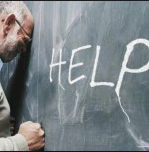
Help...


Talking about 'faking it'...

BBC education reporter Hannah Richardson has a piece on the BBC website based on an alarming (or alarmist) survey from the National Union of Teachers: 
More than 50% of teachers in England 'plan to quit in next two years'
The most immediately striking thing about the article though is its prominent use of an emotive, staged stock image:


The use of such an image gives the piece a bit of a propagandist feel, don't you think?

Still, at least they didn't use one of the other versions of this image that's also doing the rounds on the internet:

Sunday, 15 December 2013

The BBC v free schools (2)


As you may recall, various right-leaning commentators took the BBC to task for spinning a recent report about free schools to make it look worse than it was. They accused the BBC of having an "anti-free schools bias".

Toby Young, in particular, specifically charged BBC online education correspondent Hannah Richardson with having written a "misleading article", accusing her of "Left-wing bias". 

Just to test the grounds for this allegation, I've checked back through the BBC News website and tracked down all of Hannah's articles which focus (to a lesser or greater extent) on the issue of free schools. (I've not included all those articles where they are mentioned merely in passing, usually when some union leader is denouncing them in a speech).

Here are those articles in chronological order:
22 Jul 2010 
"The creation of Swedish-style free schools in England could increase social segregation but net limited improvements, a leading academic claims.
Dr Susanne Wiborg, of the Institute of Education, also says it could lead to many private providers running schools."
14 Aug 2010
"Private firms are lining up with parent groups to run the Conservatives' flagship "free schools" in England.
These are the new schools that Education Secretary Michael Gove wants parent or teacher groups to set up and run with public funds."
24 Nov 2010
"The National Union of Teachers warned the expansion of the academies and free schools programme was a wrong move that would a two tier education system."
2 Dec 2010
"Plans to shake up the schools system could lead to increased segregation, the Department for Education's own research warns.
Boosting school choice could lead to parents selecting schools for their "peer groups", a study on the impact of its Schools White Paper says."
14 Jan 2011
"A community-led group in Suffolk has become the first in England to get formal approval for their plans to open a new "free" school."
7 Jan 2012
"The government's flagship free schools programme is unlikely to boost access to good schools as they are too expensive, research has suggested.
The Bristol research said it was "inconceivable" more than one parent-founded school would be set up in an area with spare places."
20 Mar 2012
"The government should tackle the growing crisis in primary school places rather than approve more free schools, says shadow education secretary Stephen Twigg."
13 Dec 2012
"A flagship new free school where pupils practise transcendental meditation twice daily has been reprimanded by the government after it failed to put any of its pupils into compulsory national curriculum tests."
15 Oct 2013
"Michael Gove has been urged to monitor free schools more closely after a Muslim faith school was closed temporarily because of safety concerns."

17 Oct 2013

"Described as "dysfunctional" and "in chaos", there can be no doubt that the problems at the Al-Madinah School go right to its core.
Rated inadequate in all four inspection areas, Ofsted said problems at the Derby school were "myriad".
Not only does it lack the basic structures needed to operate, it is said to be close to "collapsing".
Al-Madinah is the second free school to be put into special measures, after Discovery Free School in May 2013."
24 Oct 2013
"Checks on inexperienced staff who want to be head teachers at free schools have been scrapped, despite warnings from civil servants."
11 Dec 2013
"The government's flagship free school programme will cost at least three times the sum originally allocated, the public spending watchdog has found."
13 Dec 2013
"The government has ordered the closure of a failing free school for the first time after education inspectors found standards there unacceptably poor."
As you can see from that list, Hannah has been consistently and almost unremittingly negative in her reporting of free schools since the very beginning. (The exception is First green light for community's free school plan.) 

Critiques from anti-free school academics, criticisms from union leaders and Labour, negatively-spun leaked reports, heavily-spun academic/civil service reports, plus every whiff of bad news about free schools (especially about the only two which have got themselves into serious difficulties) has been seized upon by Hannah Richardson.  

I'd say that this provides pretty clear evidence that Toby Young is correct about this particular BBC reporter's anti-free school bias and that she is in danger of being seen as a campaigning journalist if she's not careful. 

Don't you agree?

Wednesday, 11 December 2013

The BBC v free schools


Leading free school advocate and Telegraph blogger Toby Young is not happy with the BBC:
The BBC's anti-free schools bias is becoming laughable
The National Audit Office's report on free schools is generally favourable, though you wouldn't know it if you relied on this article on the BBC's website. 
Toby notes all the positives in the NAO's report and then argues that the BBC has opted to spin them into negatives. 

He specifically accuses BBC online education correspondent Hannah Richardson (the article's author) of having written a "shockingly misleading article" and accuses her of "Left-wing bias". (I've been reading Hannah's articles for several years and, yes, she does seem to have a strong Left-wing bias - even by the standards of a BBC reporter.)

To add a little more to Toby's analysis, I'd add this.

Just compare the BBC's headline about this NAO report:
Free schools budget trebled to £1.5bn, report shows
with that of the Times about the very same report:
Free schools ‘are good value’
As they say at primary school, "spot the difference".

Continuing in the same vein, now compare the opening paragraphs of Hannah Richardson's BBC piece
The government's flagship free school programme will cost at least three times the sum originally allocated, the public spending watchdog has found.
The National Audit Office said the scheme allowing groups to set up state-funded schools would cost £1.5bn - the original Treasury grant was £450m.
The NAO said the programme prioritised speed over cost and schools were not always where places were most needed.
The government insisted [there's that "insisted" again!] its free schools offered value for money.
with those written by Greg Hurst of the Times:
Michael Gove’s flagship free schools policy has received a boost after the Government’s spending watchdog said it appeared to deliver value for money.
Free schools cost on average £6.6 million each to open, which was about 45 per cent lower than previous construction costs of new schools, the National Audit Office said.
But it said that costs were creeping upwards as more free schools opened and called on the Department for Education to look at why some cost much more than others.
Free schools are new state-funded schools that are independent of local councils. In the past three years the Government has opened 174, which at full capacity would have 82,000 places, with another 105 schools due to open next year.
They could hardly be more different, could they?

Two key differences stand out: (1) The BBC's angle is negative while that of the Times is positive and (2) the BBC's opening paragraphs are wholly negative while those of the Times offer a measure of balance between positive and negative (i.e. they are more impartial than the BBC!) 

As angles go, the differences between the respective takes of the BBC and the Times are acute, certainly but is the BBC being obtuse here? Is either side right, and whose reaction is a reflex action, Toby's or Hannah's? 

Well, Googling around shows the right-leaning media in general opting for positive headlines. The Telegraph, for instance, has Free school boost for areas in need. The Spectator's What the National Audit Office really said about free schools also targets the the BBC's negative coverage.

The left-leaning media, in contrast, opts for negative headlines - such as the Independent's Too far, too fast: Free schools are costing £1.1bn – twice as much as planned, the New Statesman's How free schools are still failing to address the places crisis and the Guardian's Cost of establishing a free school doubles to £6.6m, auditors find

The BBC thus finds itself (surprise, surprise!) sharing the Left's angle on the NAO report.

The key to being sure about who's spinning here and who's being straight is obviously to read the (lengthy) NAO report and form your own judgement.

As far as I'm concerned though, that's not going to happen. So I'm stuck with an issue of lefty spin v righty spin, and another case of 'Who knows!' (You, however, may be made of sterner stuff!)

Tuesday, 30 July 2013

A Million+ reasons to mistrust the BBC's education reporting?


Here's a little something I posted as a comment nearly three years ago at Biased BBC.

Craig says:
Catching up on this week’s editions of Newsnight. On Monday night (the day of Lord Browne’s report on tuition fees), Michael Crick reported on the strains in the coalition. He badgered a Lib Dem MP (Stephen Williams) over the issue, then featured as ‘talking heads’ Pam Tatlow ofMillion Plus, which he described as “one university think tank”, and a Labour MP called Adrian Bailey. Pam Tatlow was very critical, and also attacked bankers and the City. 
What Crick failed to tell his audience is that Pam Tatlow is also a Labour Party member who tried to become the Labour candidate for the safe Labour seat of Ashfield (beaten by Gloria de Piero).
Yet again a BBC ‘talking head’ who is presented as an independent voice who turns out to be no such thing.

Moving on from October 2010 to July 2013 and guest what? Yep, they're still at it. 

Here's Alan at Biased BBC today:
Today the BBC brings us the Million+ think tank, ‘a think tank that also represents newer universities‘ which is telling us that ‘England’s teacher training system ‘broken down’
The system of planning teacher training in England has broken down and risks a future shortage of teachers, a university think tank says.
In her evidence to the committee, Pam Tatlow, chief executive of Million+ – a think tank that also represents newer universities – said School Direct, , which is focused around on-the-job, school-based training, had been introduced “without any robust assessment of its impact on teacher supply”.
Pam Tatlow?   Ever heard that name before?  You might have…she was in the news not so long ago….as a short listed Labour party candidate.
You’d have thought that might just be a bit relevant when you have a person strongly criticising government policy and yet is Labour through and through.
Apparently the BBC doesn’t think that to be the case.
Indeed.

The journalist behind that BBC report is education correspondent Hannah Richardson - the one who prompted this comment from me (here at Is...?) just three weeks ago:
I wondered what the BBC's online education reporter Hannah Richardson would make of it, as she's long seemed to me to be particularly close to those who oppose Mr Gove's educational policies and is always the BBC education reporter most likely to post a biased piece on any subject.
As a further flavour of Hannah's reporting, perhaps a couple more comments from me at Biased BBC from 2010 might be of use:

Craig says:
The main education story on the BBC’s website is another attack on the Tory ‘free schools’ policy:
Free schools ‘could widen social divide’
http://www.bbc.co.uk/news/education-10725724

The article by Hannah Richardson is almost entirely given over to the criticisms of the “leading academic” Dr Susanne Wiborg of the Institute of Education. Described as “an expert in comparative education”, she is quoted at great length. (20 paragraphs are given over to her attack, with just 4 paragraphs putting the government’s side.)

What Hannah Richardson neglects to point out is that left-wing Dr Wiborg is a outright advocate of comprehensive education:
http://www.amazon.co.uk/Education-Social-Integration-Comprehensive-Schooling/dp/1403983712/ref=sr_1_3?s=books&ie=UTF8&qid=1279820216&sr=1-3#noop

Toby Young in the Telegraph has a different take on the same story:
http://blogs.telegraph.co.uk/news/tobyyoung/100048174/ed-balls-in-last-ditch-effort-to-save-campaign-by-attacking-free-schools

Craig says:
This same reporter’s previous article College cuts ‘to hit class sizes’ follows a similar pattern, being based on criticism of government policy by a teaching union (the UCU), whose leader Sally Hunt’s views are quoted at much greater length that the government’s.
http://www.bbc.co.uk/news/education-10660570
Before that there was University ‘denied to thousands’, where Hannah Richardson again based an article on criticisms by Sally Hunt of the UCU.
http://www.bbc.co.uk/news/education-10648892
Then there’s this tear-jerker about devastated children, a councillor close to sobbing, bemused teachers (etc), let down by Michael Gove: Pupils ‘devastated’ by school rebuild let down
http://www.bbc.co.uk/news/10601967
Before that there was Nobel winners’ protest halts science funding change, which turns out to be just another story based on a campaign by Sally Hunt and the UCU.
http://www.bbc.co.uk/news/10572264
Then there was Schools buildings scheme scrapped, where Michael Gove is given plenty of space, but is followed by an endless stream of critics, including a ‘selection of your comments’ – ALL critical.
http://www.bbc.co.uk/news/10514113
All these stories come from this month alone.

Monday, 8 July 2013

Facts, facts, facts


If there's one area of the BBC's domestic news coverage which strikes me as needing a Prebble Review all to itself it's the corporation's coverage of education matters.

Today's announcement by Michael Gove of a new national curriculum which seeks to challenge children from an earlier age and to re-emphasize traditional science, grammar, punctuation, dates in history, times tables and fractions, etc, as well as boosting modern skills like computing, has provoked a lot of opposition from the usual suspects - educationalists, teaching unions, the Guardian, etc.

I wondered what the BBC's online education reporter Hannah Richardson would make of it, as she's long seemed to me to be particularly close to those who oppose Mr Gove's educational policies and is always the BBC education reporter most likely to post a biased piece on any subject.

She hasn't disappointed, publishing an article today, What can five-year-olds be expected to learn?, which barely even bothers to disguise its lack of impartiality.

It presents three critics of Mr Gove's new curriculum in a row - people described as an "education specialist", "veteran head teacher" and an "education specialist". All three of these experts undermine Mr Gove's position and attack his policies. There are no counters to any of their (many) arguments from Hannah herself, or from anyone else - which one exception. Her final commentator is the faintest of sops to the concept of impartiality. He supports one small aspect of Michael Gove's plans - the idea of teaching history chronologically in primary schools. Notwithstanding this, the whole report is decidedly one-sided, much as I would expect.

Those of you who follow your politics will know that Michael Gove is the man the 'educational establishment' (and the Left in general) love to hate. Often they like to paint him as a throwback to Dickens's Mr Gradgrind, the Victorian educationalist who believed that only facts matter. (The teaching unions, George Monbiot, BBC local radio showsBBC Radio 4 current affairs programmes, etc, all make use of this meme.)

Interestingly, for those fancying an antidote to Hannah Richardson's condemnatory piece, I'd like to recommend the Independent's more nuanced but rather supportive editorial on the subject. The Independent dismisses the 'Victorian' (mis)representation of Mr Gove's position by his many opponents.

Tonight's main BBC One news bulletin, BBC News at Six, however, featured a report on the story by Reeta Chakrabarti which - and I kid you not! - chose to report from a London museum which gives children "the taste of a Victorian classroom", in Reeta's words. The stern teacher shouted at the children and brandished a cane as she spoke! A visiting school kid was shown looking confused and unhappy.

No overt comparisons were made by Reeta between that scary "taste of a Victorian classroom" and what the Independent describes as the view of Mr Gove's critics ("browbeaten children forced into what many consider an educational torture chamber when they might otherwise be playing in the sun") but none needed to be. This was subliminal advertising for the views of Mr Gove's opponents at its most blatant. It was (well, so it seems to me) pretty damn obvious that Reeta Chakrabarti chose to go to that museum, show that melodramatic scene and linger on that actual scared school pupil for no other reason than to paint Mr Gove's reforms as Victorian, Grandgrindian.

Can you think of another reason for it? If it was to show imaginative ways to teach history, why not show history being taught imaginatively in a school? Why show that particular scene rather than a scene from Roman British, Tudor, or Edwardian history? Why show this recreation of a nightmarish Victorian classroom to illustrate this story?

Nope, I think it's bias - plain and simple.

Reeta's closing words, incidentally, were "...which will lead to some questioning its relevance" - a negative way to end a pretty negative report.

It's 3/10 and a 'See me' for both Hannah Richardson and Reeta Chakrabarti here.

Update: OFSTED has e-mailed to say that I've been guilty of serious over-marking there. They say 1/10 is the correct mark for both reporters.