Sunday, 12 September 2021

In which Nick Robinson avoids answering the question


The Telegraph features a letter from Nick Robinson replying to criticism from Lord Howard
SIR – I’m sorry that Michael Howard is turning off his radio. He will have missed some illuminating and civilised conversations this week on Today – with the head of MI5 and Tony Blair examining the fallout from 9/11; the Archbishop of Canterbury on climate change and the Health Secretary on the crises in the NHS and social care.

The joy of live radio is that it can move us – bringing joy when we hear of Emma Raducanu’s success; tears when we hear the memories of those haunted by 9/11 and, yes, sometimes anger when we shout at the radio at a politician who is being evasive or an interviewer who interrupts too much.

We presenters don’t always get it right but we do our best to balance allowing those we interview to get their message across and holding them to account. 
I hope Lord Howard will be back listening soon and, perhaps, back in the studio too, where he has always robustly answered, rather than ignored, challenging questions.
I had to chuckle at Nick's closing paragraph because he, Nick Robinson, didn't ''robustly answer'' the nub of Lord Howard's criticism of him. Or to put it another way, he, Nick Robinson ''ignored'' the ''challenging'' point at the heart of Michael Howard's piece:
The final straw, for me, was Nick Robinson’s interview with Nadhim Zahawi, the vaccine minister, on Tuesday of this week. Tuesday was, of course, the day when the Government announced its proposals for the reform of social care.
But as Mr Robinson well knew, the details had to be announced to Parliament before they could be broadcast. Indeed, had this convention been broken and caused a reprimand from the Speaker, the BBC’s journalists would have been the first, gleefully, to point to the Government’s discomfort.

Yet when Mr Zahawi attempted to explain this and said that he had come on to the programme to discuss the £5.4 billion which had just been announced for the NHS, Mr Robinson said that this was a complete waste of time and threatened to end the interview there and then.

You and I may think that listeners would have been very interested in how this money was going to be spent but not a single question was addressed to that topic. Instead Mr Robinson spent the whole interview berating the minister for not doing what Mr Robinson knew full well he couldn’t do.

So why did Nick Robinson avoid answering that? Was it a little too close to the bone?

Sunday, 5 September 2021

Deobandis in the UK


This feels like a traditional Sunday of years gone by here at ITBB, with me getting hung up on Radio 4's Sunday and posting piece after piece about it and having little time left for anything else. So on I go...

To do it credit, this morning's programme also featured a fascinating survey of opinion by the BBC itself of British Muslim opinion regarding the Taliban victory in Afghanistan.

They talked to imams and worshippers at Deobandi mosques - for understandable reasons, as Deobandis are the main group of Muslims living here in the UK, and the Taliban are also Deobandis. So it's important to know what such a large swathe of British Muslim opinion thinks.

The message couldn't have been clearer from every voice featured. The UK's Deobandis are feeling positive about/hopeful for the incoming Taliban government in Afghanistan. They are hoping for the best. And they are glad that The West [i.e. us] have been kicked out.

Curiously, every one of the British Deobandis they spoke to was a man - which might have pleased any passing Taliban Radio 4 listeners tuning in for The Archers.

This section of the programme did feature one woman though. The programme also interviewed the UK's small Shia community in the form of a female human rights campaigner. She, in contrast to the abounding Deobandis, was fearful.

My main thought here though is that the BBC will surely take note of the main mood among the UK's Muslims, as found here by Radio 4's Sunday

As the UK's mass of Deobandis are apparently intensely relaxed and happy about the Taliban's triumph, the BBC might very well adjust its reporting to reflect that sentiment on 'social cohesion' grounds.


And that makes me feel deeply queasy, because I fear we've brought foreign wars and foreign warriors ready to fight those wars to our shores and, alas, as a result, we'll inevitably pay a very heavy price for that in the long run.

And the BBC should be doing everything in its power as a Charter-bound protector of British democracy to prevent that. 

And the last thing it should be doing is to pander to the apparently huge pool of extremist Muslim opinion now dwelling in our midst, as per the BBC's Sunday

Is the BBC biased against Jehovah’s Witnesses?


Talking of this morning's Sunday on Radio 4, it also covered the latest Independent Inquiry into Child Sexual Abuse Report, which moved beyond the IICSA'S previous inquiry into abuse in the Anglican and Roman Catholic churches to embrace pretty much every other major Christian sect and all the  major world religions.


To repeat myself from yesterday:

I did a count of the mentions made of each religion/sect during the reports about this on each of the 10pm TV bulletins last night -

Sky News
Christian churches - 2
Judaism - 2
Islam - 2
Jehovah's Witnesses - 2

ITV News
Roman Catholicism - 1
Anglicanism - 1
Methodism - 1
Baptists - 1
Islam - 3
Judaism - 2
Sikhism - 1
Jehovah's Witnesses - 3

BBC News
Jehovah's Witnesses - 3
Roman Catholicism - 3
Anglicanism - 3
Judaism - 1

Only the BBC didn't mention Islam there.


But a peculiar feature of the broadcast media's coverage of this report was shared by all three of those UK broadcasters: They all mainly focused on the Jehovah’s Witnesses, despite the JWs not being singled out in any way as The Worst in the report

I thought at the time that this was probably just the broadcasters being cowardly and going for the safest option. 

After all, what are the JWs going to do? NOT ring the doorbell at Broadcasting House in protest? Send BBC home affairs reporter Tom Symonds of the BBC a few copies of The Watchtower [for it was he, rather than the reclusive Mark Easton, who did that BBC's report]? Boycott the BBC's Christmas Day Call the Midwife special?

And then came this morning's Sunday on BBC Radio 4, and it also focused on the Jehovah’s Witnesses.

The report is publicly available. I spent an hour reading quite a bit of it, and it's very much not mainly about the Jehovah’s Witnesses, despite what you may have seen on the BBC, Sky and ITV. It features four horrific case studies involving [a] Orthodox Jews, [b] Muslims, [c] Methodists and [d] Jehovah’s Witnesses. 

It focused on pretty much every religion and major sect.

To repeat myself repeating myself, what have the JWs done to deserve being singled out by the UK's main broadcasters, other than being safe targets / the easiest option? And if that's why, what does that say about our broadcasters? Are they nothing more than cowards?

This where I'm supposed to note that I'm not in any way affiliated with the Jehovah’s Witnesses. But that's not strictly true. I used to walk to primary school every day with a JW girl who lived on my street and I knew not to send her a Christmas present. And in my militant, Richard Dawkins-inspired, atheist mid-20s I once kept a very pleasant JW man - a teacher - on the doorstep for nearly two hours debating Biblical inerrancy and pointing out every contradiction between Biblical accounts I knew. In the end he said I had an answer for everything and said he had to go. And - having repented of my ways, at least as far as discombobulating kindly believers goes - I chuckled during lockdown on hearing that JWs weren't going to be ringing my doorbell. 

Gordon's alive!!!


This blog started with a series a posts detailing patterns of bias on BBC Radio 4's weekly 'politically left-of-centre and socially liberal' religion-focused Sunday programme.

And here's a new one: They like giving Gordon Brown a platform to promote his causes.

Despite it being a weekly programme featuring very few politicians, the son of the manse has been granted the Sunday bully pulpit no less than three times over the past year, pushing his agenda with the BBC's help.

Last October he was on demanding that the government 'must act to prevent the loss of a million young people to the job market'.

This May he was on advocating for G7 leaders to 'prioritise vaccines for developing countries ahead of the G7 summit'.

And today he was back saying that world leaders need to act now to end the 'moral outrage' that 'rich countries are amassing huge stockpiles of Covid vaccines they don't need'.

It's all very Sunday. In the years that I've covered them, they've always had their favourites and put them centre-stage

And that Crash Gordon is now their living saint among UK politicians brings me full circle as a blogger, as I began writing about and counting, counting, counting BBC bias during the Gordon Brown era. 

How lovely.

Don't be beastly to the Pakistanis!


There was a fascinating interview overnight on the BBC featuring Professor C. Christine Fair. Unfortunately it also got a bit feisty when the BBC began to panic over Professor Fair's analysis and Philippa Thomas rallied to Pakistan's defence. Professor Fair was soon being talked over and eventually faded out and cut off. Here, unredacted, is the full interview, preserved for posterity: 

Philippa Thomas: Right, let's speak now to Christine Fair, Professor of Security Studies at Georgetown University in Washington. Professor Fair, thank you very much for being with us. What you make of Faiz Hameed's visit to Kabul?
Christine Fair: First of all, thank you for having me. So I don't really make anything special out of this. I think for those of us that have been watching these affairs and Afghanistan evolve, not in the last 10 or 20 years, but actually the last, I mean, going back to 1973, this has been Pakistan's project. Without Pakistan the Taliban would be a nuisance, it wouldn't be the competent and capable terrorist organisation that is. So this is, in some ways for Pakistan, sealing the deal. You know, there are a lot of fissions across the different shuras of the Taliban, but the most important shura is the shura in Rawalpindi.
Philippa Thomas: Pakistan, of course, denies that it has created the Taliban or it supports it militarily behind the scenes in anyway. 
Christine Fair: Yeah, well, Pakistan gets away with lying largely because most people don't confront them. You know, various foreign ministers, various Pakistan army chiefs, presidents, prime ministers have come and gone before various shows like your own and they make these outrageous statements and most people are just too polite to question them. And then this just becomes part of their ossified fiction. But I've written an entire book on the Pakistan army using primary sources. And, you know, the Pakistanis first began the jihad in 1973. It didn't happen after the Soviets invaded Afghanistan, as is popularly believed. It actually began under Zulfikar Ali Bhutto. And even though the Pakistanis will make those claims, there's also those who very forthrightly admit it. MALIA LODI [spelling?], who has long been the amanuensis of the ISI with lipstick, you know, she'll very forthrightly say that the Taliban have long been supported by the Pakistanis...
Philippa Thomas: [interrupting] So...what...
Christine Fair: The Pakistanis...
Philippa Thomas[interrupting] What...what then do you think is the interest of the Pakistan government, and the intelligence agencies, when it comes to IS fighters, when it comes to al-Qaeda? Do they have a joint interest maybe with the Taliban in suppressing these other groups? 
Christine Fair: So, first of all, I think one just has to understand what Pakistan's interest in Afghanistan is writ large, and Pakistan inherited this notion of strategic depth from the British. The Pakistan army is a product of the British army in India, and so from the earliest months of the Pakistani state it has had a continuation of interests in Afghanistan. And the Afghans themselves did not help their own position by denouncing the Durand  Line, by interfering in Pakistan's restive Baluchistan province, so we cannot see this is something new. It is really important that we understand that this is part of...it's in Pakistan's strategic culture. So...
Philippa Thomas[interrupting] So I just want to...
Christine Fair: So the question that you have, the question that you have posed about Islamic State and Al-Qaeda. Right? 
Philippa Thomas: Yeah.
Christine Fair: So this is a complicated question because part of those organisations also advance Pakistan's interest. I think there's a lot of misunderstanding about the Islamic State - Khorasan Province that somehow it's joined tightly at the hips of the organisation that al-Baghdadi built, and that really isn't true. There were some early communications between them, but the differences...
Philippa Thomas[interrupting] OK, sorry, I want in the time that we have I also want to say, so you have a great deal of historic knowledge of what has happened, and Pakistan and Afghanistan. Given where we are now presumably it's in Pakistan's interest that there is stability, that there is not continued fighting in Afghanistan, or do you see that differently?
Christine Fair: No, no, this is also another myth. What Pakistan has objected to over the last 20 years is the emergence of a stable Afghanistan that is opposed to Pakistan...
Philippa Thomas[interrupting] But an unstable Afghanistan...
Christine Fair: ...and is friendly to India.
Philippa Thomas[interrupting]...surely means more refugees trying to get across the border to Pakistan. How is that in Pakistan's interests? 
Christine Fair: Yeah, right, so this is also a myth that I think Pakistan is very good at peddling. What Pakistan wants more than anything is an instability that it can manage, and also Pakistan will use the refugee story as a part of its usual rent-seeking strategy. You see, Pakistan likes to be thought of as the fire brigade when Pakistan is in fact the arsonist.
Philippa Thomas[interrupting] And Pakistan...
Christine Fair: Pakistan will monetise this. 
Philippa Thomas[interrupting]...of course would absolutely deny that, 
Christine Fair: How do you...how do you...
Philippa Thomas: And I want to come back to your phrase...let me come back to your phrase...
Christine Fair: Yes.
Philippa Thomas: ...''an instability that it can manage''.
Christine Fair: Correct.
Philippa Thomas: Even if, even if...if that is the case that is an immensely risky strategy?
Christine Fair: Pakistan has always been risk-acceptant. There has never been a risk-averse Pakistan, whether you're looking at incredibly outrageous terror attacks in India or whether you are looking at the support for the Taliban in the 1990s and all that that brought about. Look, even the fact that Pakistan harbours virtual petting zoos of terrorists in its own country, with the hope that they will only...
Philippa Thomas[interrupting] Christine, Christine Fair...
Christine Fair: ...only kill their neighbours is a risky strategy.
Philippa Thomas: As we cannot, as we cannot...We don't have a Pakistani diplomat or official to speak with us now, I'm going to say again...
Christine Fair[interrupting] Well, thank goodness you don't...
Philippa Thomas: No, I'm going to say again....
Christine Fair[interrupting] ...because he would pedal this fiction.
Philippa Thomas: ...that I know they firmly, they firmly deny that they have created the Taliban, and that they are the prime mover behind the Taliban...
Christine Fair[interrupting] To be fair, to be fair...
Philippa Thomas: ...and we have given you space to put your point of view, and we are going to leave it now, but thank you for being with us and for putting your point of view...
Christine Fair[interrupting] You are doing their propaganda...[faded out and cut off by the BBC]
Philippa Thomas: And there you go, and there is much more on what is happening in Afghanistan and the region and everything around that, on the BBC website of course.

Dame Jenni Murray on Emma Barnett's salary


Hell hath no fury like a Woman's Hour presenter scorned, as Dame Jenni Murray is proving.
 
She has been interviewed by the Sunday Telegraph's Louise Burke today and vents her spleen in fine fashion, coming close to sounding like a DEFUND THE BBC campaigner:
How does she feel about earning less than her replacement? ‘Well that really pisses me off,’ she says. ‘I was talking to an old colleague the other night and she was saying how horrified she is at what’s being paid now. We worked so hard and had high profiles, but we didn’t earn anything like [that]. It’s more than irritating. It’s infuriating actually. I don’t think, no matter how good they are, they are worth all that money. It’s a public broadcasting service. I’ll be hacked off when I still have to pay my licence in four years [after turning 75].’ She starts laughing.

Not that she's bitter of course, perish the thought:

So, dare I ask, does she still listen to the show? ‘I have long had a habit of getting up in the morning and putting the radio on and it’s always Radio 4,’ she humours me. ‘But I deliberately switch off just before 10 o’clock.’

It's not mentioned in the interview but I'm guessing Dame Jenni's secretary rang at that point saying, 'Sorry to interrupt, Dame Jenni, but there are several cats on the line wanting their meows back'. 

Sunday morning reading


I

The Mail on Sunday quotes Sir Iain Duncan Smith not so quietly ripping into the BBC's Covid coverage:

The vaccines are really good at stopping hospitalisation and death, yet every night we report the infection rate – why?

Why does the BBC throw over every single bit of data, when Covid is about sixth on the death toll? Can we have the death toll for pneumonia while we're at it? 

Cancer, heart disease, liver problems? Why are we continuing with the Covid stuff on the BBC and the main news channels? It frightens people.

Older people are still asking, 'Are we allowed to hug now?' Even when they have had all the jabs.

We have people who are now scared of normal life.

We certainly don't do it for flu, and we don't do it for cancer. 

Either we go the whole hog and every night publish a list of how you're going to die, or not at all. Covid isn't the major reason for death.

II 

The same paper also reports Peter Hitchens's rare victory over the BBC Complaints department. 

It concerned an episode from a Radio 4 series Mayday: The Canister on the Bed, broadcast on 20 November 2020. The BBC summarised the case like this:
The programme, part of a series on aspects of the conflict in Syria, dealt with the chemical weapons attack at Douma, which it described as “one of the most contested events in the war”, and included an account of the role subsequently played by a former inspector with the Organisation for the Prohibition of Chemical Weapons (OPCW), known pseudonymously as Alex, who had expressed concerns about the OPCW’s conclusions on the matter. The journalist Peter Hitchens complained that the programme had been inaccurate in insinuating that Alex’s disclosures had been motivated by a reward of $100,000 offered by WikiLeaks, that he believed the attack had been staged, and that he had made his views known only through “a select few journalists who share the Russian and Syrian state views on the war”. The ECU considered the complaint in the light of the BBC’s editorial standards of due accuracy.

And the BBC upheld Mr Hitchens's complaint, concluding that this episode in Chloe Hadjimatheou's Orwell Prize short-listed series [a] did indeed make an “insinuation” against Alex and that [b] the evidence for that insinuation wasn't strong enough to warrant the programme calling Alex's motives into question. It also found that [c] the programme's claim that Alex “believed the attack was staged” wasn't justified by strong enough evidence and [d] the programme mischaracterised Alex’s dealings with journalists, saying he had collaborated with journalists who held broadly the same views on the war as the Russian and Syrian governments, whereas he had in fact “also collaborated with journalists of whom that could not be said (Mr Hitchens among them)”.

The ECU found that, although they were limited to one aspect of a investigation into a complex and hotly contested subject, these points represented a failure to meet the standard of accuracy appropriate to a programme of this kind. The ECU noted that a posting about one point of the complaint had been made on the Corrections and Clarifications page of bbc.co.uk but, as it was not reflected in the extended version of the programme which continued to available on BBC Sounds and the website of the series, it did not suffice to resolve the issue in question.
And what Further Action has been taken? Well, “the finding was reported to the Board of BBC News and discussed with the programme-makers in question.” 

That'll teach 'em!

Saturday, 4 September 2021

''Watch the video for yourself''


I found this interesting from someone all the leading lights at the BBC Disinformation Unit follow.
 

SEPTEMBER 1 

  • New fact check: A viral photo makes it look like President Biden checked his watch during a ceremony honoring U.S. service members killed in Kabul. But that's misleading.
  • The way Biden honored the 11 caskets presented at Dover Air Force Base on Sunday was similar to how Trump paid respects to fallen service members during his presidency.
  • Biden checked his watch, but he did so after the ceremony had ended. Watch the video for yourself: https://c-span.org/video/?514338-1/president-biden-pays-respect-us-service-members-killed-afghanistan

SEPTEMBER 3

  • As many of you already know, this story has been corrected. Biden checked his watch multiple times during the ceremony. I regret the error.
  • Journalists and fact-checkers are human (yes, even me!) We make mistakes. When we do, we correct them and try to make it right.
  • It's easy to dunk on journalists when we get things wrong. I get it – to many, we're just another name on a screen. But behind that screen is a person trying to do their best.

It would make for a great BBC Trending/Disinformation Unit article.

Who are the militants in Afghanistan [and India]?


BBC World News, broadcast overnight on BBC One, looks to be recognising the new Taliban regime, even if the UK government hasn't yet.

Here BBC newsreader Karin Giannone describes the people opposing the Taliban as 'militants':
Now there are reports of from Afghanistan of heavy fighting between Taliban forces and militants who oppose the Islamist takeover around the Panjshir Valley.

The Daily Express today has it the other way round, with the Taliban remaining ''the militants'' and the forces of former vice-president Amrullah Saleh and Ahmad Massoud in the Panjshir Valley being ''resistance fighters'':

The Taliban have clashed with a group of resistance fighters in Afghanistan's Panjshir province as the final stronghold against the militants hangs in the balance. 

---------------- 

On a possibly related theme, this glowing headline following the death of a leading pro-Pakistan, Islamist Kashmiri separatist hasn't gone down well in India, where he's a highly controversial figure - understandably so given his pronouncements about Osama bin Laden and the Mumbai attackers:

The introductory paragraph goes on to say: 

Kashmir's top separatist leader Syed Ali Shah Geelani, who spearheaded the resistance movement against Indian rule, has died, aged 92. 

This is the language of approval. 

Here's a flavour of the reaction:

  • As expected, the BBC turns Syed Ali Shah Geelani into a freedom fighter when even Al Jazeera refers to him as "separatist". Is the BBC completely tone deaf when it comes to reporting? What's the reason behind this sustained anti-India stance? What kind of biased journalism is this?
  • Geelani fought to make Kashmir a totalitarian Islamist hellhole. He was partially responsible for massacres and ethnic cleansing of Kashmiri Hindus. He was an enemy of freedom. BBC's headline is unbelievable but reflects their anti-India and anti-Hindu bias.
  • If Geelani was a Hindu, the tone of the article would have been very different. 
  • Interesting. BBC News calls a Talibani-style terrorist Geelani a freedom fighter. The way it is BBC will stitch a burqa for the British queen. 

A ''virtue advertisement'' from the BBC


Even The Guardian is joining in, describing the new-look Question of Sport as ''a vapid BBC reboot'' and ''a howler''. Mark Lawson's review points out the typical BBC cack-handed virtue-signalling too:

The balance of the team feels off. [Paddy] McGuinness, who has telling moments of apologising that the script or format need more work, introduces the Olympic hockey gold medallist Sam Quek as “the first ever female captain” on the show. The producers leave in the audience applause for this virtue advertisement. Yet with former rugby union international Ugo Monye as the other captain and Barker replaced by McGuinness, there is still only one woman in the top trio, as has been the case for the past quarter of a century.


June Sarpong's salary


Looking back again....

It was a year ago, in September 2020, that we posted about the then mystery surrounding the salary of June Sarpong, the BBC's first Director of Creative Diversity. 

At that stage she'd been employed by the BBC for some 10 months but her salary was unknown. Her official BBC page at the time read ''June Sarpong's annual remuneration will the published shortly''.

Of course, it's become common knowledge since the BBC published its annual report in July this year that June Sarpong, the BBC's part-time Director of Creative Diversity, earns £267,000 for three days work per week - far more than the Prime Minister. The revelation has provoked widespread consternation and controversy.

There's something else though, and it happened between last September and this July. I half-saw at the time something, somewhere, about it being revealed that she was earning quite a lot less than £100K from a BBC job and have confirmed that now via the Wayback Machine

This has a snapshot of her official page from 24 December 2020 and reads ''Annual remuneration as of April 2020: £75,000'', something I presume it continued to say till this July. 

It's quite intriguing, isn't it, how long it took - nearly two years - for her £267,000 salary for a part-time job to be fully revealed? Were the BBC hiding it? 

UPDATE 

You do have to give it to June, she's very good at adding diversity to her business portfolios too. Bill Rodgers, as ever, has his eye on the ball:
Part-time BBC diversity supremo June Sarpong is still busy with business in the rest of her week. She's got a new company, called Womanly, set up in March, with four trademarks registered in May last year.

In May, she registered a trademark for The Africa Company, to be used with toiletries, cleaning products, food supplements and vitamins, tea, coffee, food products, beer and non-alcoholic beverages, and an online e-commerce platform. In July came a trademark for Kente Cola, seeking registration for non-alcoholic beverages.

Friday, 3 September 2021

Partly Upheld


At the height of the BLM protests last year the BBC's News at Ten broadcast a report about the Bengal Famine that proved highly controversial, especially regarding accusations against Winston Churchill.

Both last Monday's Today programme and last Monday's BBC One News at Ten featured reports by BBC journalist Yogita Limaye, and she clearly felt no obligation whatsoever to show fairness and impartiality. 
Her pieces were nothing more than concerted efforts to brand Winston Churchill a racist and hold him responsible for the 1943 Bengal Famine.
It generally aroused concerns that the activist foxes were taking over the chicken coop. 

Well, the BBC's Executive Complaints Unit has finally got round to ruling on complaints about this report - and by 'finally' I mean it's taken over 13 months to resolve - and it's partly exonerated Yogita Limaye's piece. But only partly. And what it upholds is that in the ECU’s judgement...:
...more exploration of alternative views of Churchill’s actions and motives in relation to the Bengal famine was required to meet the standard of impartiality appropriate to a report in a news bulletin of this kind. This aspect of the complaint was upheld
Or to put it another way, it wasn't fair and it wasn't impartial.

Marching in lockstep

 
A photo by Sopes from the south of France yesterday


It looks to have very much died away now, but the US liberal media's early spasm of fury at President Biden for leaving Afghanistan was much remarked upon by their critics. 

One piece, which I can't now place, observed that the last time the US liberal media very briefly put aside political partisanship was when their bogeyman Donald Trump bombed the Assad regime in April 2017 to their great approval.

It made me think about how Jon Sopel shocked many by strongly and repeatedly attacking Joe Biden for pulling out of Afghanistan. 


I've now just accidentally come across one of our posts here at ITBB from April 2017. It took me aback on re-reading it because I must admit I'd half-forgotten it, even though I wrote it. As now with Jon Sopel, so then too: the BBC marched arm-in-arm with their US liberal media equivalents. 

Most strikingly, the Washington Bureau Chief of the BBC, Paul Danahar, responded to a tweet announcing 'US launches military airstrikes in Syria' and wrote:
It should have been done by Obama. Those opposed to Trump should not oppose this just because he did it.

As a point of view, that couldn't be clearer.

And many of his staff - from Katty Kay to Kim Ghattas to Barbara Plett Usher - joined in the chorus of approval.

Looking back, isn't that a truly remarkable thing for the supposedly impartial boss of the BBC's US news output to state publicly? 

-----------------

And it's striking that this same Paul Danahar has just been promoted to the post of BBC Foreign Editor, replacing Andrew Roy. 

We've quite an archive of pieces about him. Being opinionated isn't something that's new as far as he goes. He presided over the BBC's Middle East coverage [i.e. was Jeremy Bowen's boss] before taking charge of the BBC's US coverage, and was just as free with his views then. 

Monday, 30 August 2021

August Continuing Open Thread


Hello to August. Time for a new open thread. Thank you for your comments.

Oh Tim!


I think it was right to give Tim Davie the benefit of the doubt when he was appointed BBC DG, especially as he said many of the right things about putting BBC impartiality first.

But it's led nowhere so far.

He won't step in and release the Balen Report, or stop BBC executives from loading the schedules with 'woke' programming, or rein in senior journalists from expressing their views in BBC reports...

...or, as Arthur T points out on the open thread, 'sanction' even the BBC's gobbiest tweeters. 

For as the Guido Fawkes site reports, not one person at the BBC has been sanctioned for social media breaches of impartiality this year - not even Lewis Goodall or Emily Maitlis.

This was one of the most widely reported promises from Tim Davie following his appointment - that there was a problem he acknowledged about BBC journalists sounding off on Twitter in flagrant breach of BBC impartiality guidelines and that he would be the man who'd crack down hard on such behaviour.

And then came the sound of crickets chirping.

In summary: He's vocalised the talk but not perambulated the walk so far.

Oh Tim, you've let me down, you've let Sue down, you've let the BBC licence fee payer down, you've let the hallowed memory of the BBC past down, and - drumroll for the inevitable end of this sentence - most of all you've let yourself down!

No change on the Balen Report front, despite Tim Davie getting involved


Writer and freelance journalist Jan Shure has an interesting piece at the Jewish News section of The Times of Israel concerning the infamous Balen Report into bias as regards the BBC's coverage of the Israel-Palestinian conflict.

The BBC has spent 17 years and lashings and lashings of licence fee payers' money refusing to release it to the public - or as Jan puts it ''wriggling and weaselling its way out of revealing'' it.

It's been a saga, far longer than most Icelandic ones. 

Jan reports that BBC DG Tim Davie has now, ''very belatedly'', replied to her MP Theresa Villiers's letter about it.

And what did Tim, the So-Far Ineffectual Champion of BBC Impartiality, have to say when he did reply?

Well, to cut a long story short, he stuck to the BBC line - hook, line and sinker. 

Yes, he'd discussed it with the people who'd previously refused to make it public and, yes, they told him it should still be kept under wraps.

So no change whatsoever. Suppression is still the order of the day.

There must be things in that report that very deeply embarrass the BBC. 

Jan now compares their handling of it to the Bashir scandal and hopes Lord Dyson will help.

Her idea is that the BBC's cover-up over Martin Bashir took 26 years to be exposed, so one day the cover-up over the Balen Report will come out too, and Lord Dyson might be the man to help quicken the process.

We'll see. Sue and I have always hoped for a whistle-blower, but given the state of opinion held so widely at the BBC on matters Israeli/Palestininian, we're still not holding our breaths.

Give that man an award!


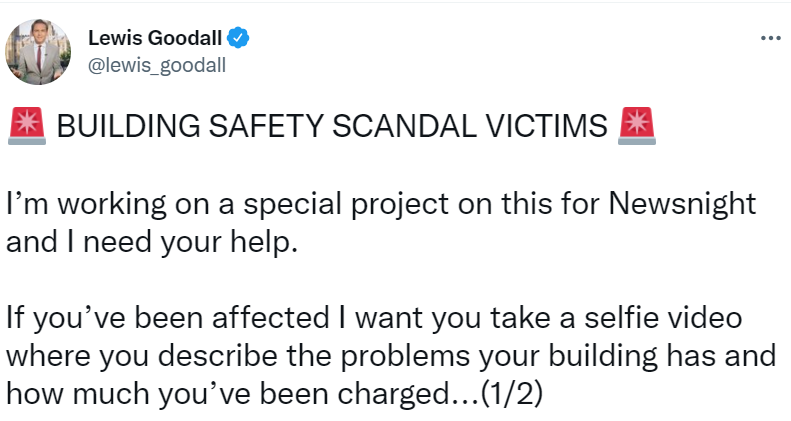
Wonder what Newsnight's Lewis Goodall is after here?


Well, whatever it is, I think Adrian Hilton captures it rather well:

I'm pleased to learn of this project from Lewis Goodall at BBC Newsnight. Please send directly to him your harrowing tales of grief, anxiety, depression, exasperation, desperation, and thoughts of suicide over the intolerable (/impossible) costs of the #claddingscandal.

Sunday, 29 August 2021

Not controversial, apparently


There was a revealing comment, in passing, from BBC presenter Martine Croxall to Dateline London Canadian regular Jeffrey Kofman this weekend:

What Extinction Rebellion are saying, Jeffrey, isn't exactly controversial, is it? 

Hm. 

Some - at the very least - of what they're saying is certainly controversial - e.g. their claims, and their targets, and the possible economic impact of their proposals.

Is this rosy view of XR common at the BBC?

Broadcasting Reclaimed


A prominent story in the Sunday Telegraph today, Top scholars launch fightback against woke brigade’s ‘blatantly false’ reading of history, tells how ''leading academics'' [e.g. Prof. Robert Tombs and Andrew Roberts] are ''joining forces'' for a campaign called History Reclaimed which is ''aimed at calling out misleading narratives about historical figures'' in the light of ''growing consternation at the steady march of “woke” ideology which has seen statues pulled down, university degrees “decolonised” and museum exhibits relabelled or removed altogether''. 

The Telegraph report was discussed on this morning's BBC Radio 4 Broadcasting House paper review and all three of Paddy's guests mocked it, presenting it a non-story, and dismissing concerns about “woke” as right-wing nonsense. 

It's the BBC, so who's surprised at this very BBC meeting of like minds? 

As Rod Liddle once put it, ''On Radio Four, you get the bien pensant toss rammed down your throat, almost without variation''. 

And that, ladies and gentlemen and others, is why GB News - or something like it - is needed. 

P.S. The young ''social justice''-focused pro-''woke'' woman on Paddy's wholly likeminded panel, Swarzy Macaly, turns out to be ''the official young voice of BBC Sounds''.

Naturally.

John's View


John Simpson, the BBC's impartial yet highly opinionated World Affairs Editor, having previously spoken his brains and splurged his spleen on Twitter against the Biden administration's withdrawal from nation-building in Afghanistan, has today posted a piece on the BBC News website saying the same at greater length.

The piece's headline doesn't bother to disguise its author's opinion - or his name. 

John Simpson on Afghanistan: A country abandoned 

And in it the famous John Simpson of the BBC gives a full-bodied defence of The West's 'liberal interventionalist' intervention in Afghanistan. 

To summarise: Our intervention was a good thing and it achieved even more than we think it did, and we could have kept on keeping on there. 

And he then gives a cry from the heart about the horrible consequences of our withdrawal.

I don't think Tony Blair himself would demur from a single word of it.

John Simpson may or may not be right, but it still fascinates me how he's allowed to be so bold with his opinions on a highly controversial matter at the impartial BBC whilst holding the surely impartiality-bound role of BBC World Affairs Editor. 

Swift Update

And the big guy's back on Twitter now with news of his Radio 4 report tonight featuring ''a leading UK diplomat'' who, you won't be surprised to hear, agrees with him 100%:
John Simpson: Just reported for the 6pm BBC Radio News on Britain's and America's serious defeat in Afghanistan - including the judgement of a leading UK diplomat: the withdrawal from Afghanistan is ‘a thoroughgoing abdication of everything we stand for.’
What are the chances of that happening? John Simpson finding ''a leading UK diplomat'' who says exactly what John believes and John then popping him into his impartial Radio 4 report? 

There can only be one explanation. It's a miracle of BBC impartiality.

You couldn't make it up


I suppose if you were wanting to write a satirical piece depicting the BBC as relentless purveyors of  ''metropolitan liberal elite'' groupthink and ''woke ideology'' you might imagine a fictional BBC Director, Factual, Arts and Classical Music Television ticking his boxes and announcing the following televisual treats:

His Arts remit might lead him to commission a profile of the personal and political life of an artist with trendy attributes, eg. someone who's a gender-bending, feminist icon, and a far-left political activist too. My satirical antennae tell me that the fictional Director would be best ticking the name 'Frida Kahlo'.  

Also on the Arts side of things, our satirist might imagine the BBC Director then commissioning a Black Lives Matter-inspired major arts series, provisionally titled 'Black Art Matters'. Even funnier, the satirist would joke that it's bound to be presented by one of the BBC's two go-to race-baiting activist presenters, Afua Hirsch, because it wouldn't be the BBC these days without a ''woke''-filtered documentary series starring Afua Hirsch.

And there'd have to be something for the other one too, as what BBC season would be complete without David Olusoga? Maybe our satirist would imagine the BBC commissioning a series from him about Britain and British identity and get him to talk again about race, given that that's what he always does. 

Hm, a major new series about Planet Earth is needed. Brian Cox is a bit passe, Sir David's done a lot in recent years, so which ubiquitous flavour-of-the-month would the BBC chose to present it? The satirist wouldn't hesitate, even for a second. It has to be Chris Packham.

As for Classical Music, our satirical BBC high-up would have to commission a documentary about a composer with certain attributes. It it isn't a composer of color, it must be a left-wing, homosexual, pacifist activist, or something of that kind for the programme makers to peg their politics. What about Sir Michael Tippett? He'd tick a few boxes. 

And so on.

As you've probably guessed by now, this isn't satire. It's exactly what the BBC announced for its new season. And the white, privileged BBC boss who did all this commissioning is called Patrick Holland.

Is Bari at the BBC no more?


Israel today is in a state of confusion, in a state of panic. They know very well that what happened in Kabul Airport will repeat itself at Ben Gurion Airport. But Ben Gurion Airport will be closed, there will be no planes in it…. Israelis should listen to the advice of [Hezbollah leader] Hassan Nasrallah and start learning how to swim, because their only option will be Cyprus, their only option will be the Mediterranean Sea.
Abdel Bari Atwan, Lebanese television station Mayadeen TV, 18/8


'Who's that?', recent newcomers might ask.

Well, he's a Palestinian leftist journalist based in the UK who sports a fulsome Saddam moustache and loathes Israel and is/was a favoured BBC go-to voice.

My main encounter with him was via watching the BBC's foreign flagship Dateline London and counting the number of appearances of each and every panellist on every episode over several years, and regularly posting an ongoing tally and analysis.

Every single year, without fail, Abdel Bari Atwan - came top of the tree as the most-invited panellist on the Dateline London panellist charts. 

He was the programme's most regular guest, frequently ranting away like an ill-informed maniac on most subjects yet being treated, on matters Middle Eastern, as if he were the expert's expert. 

It was weird.

The main Dateline presenter throughout most of that time, Gavin Esler, called him 'Bari' and even hosted Bari's book launch. He wanted his friend on the programme, he said, because he was ''subversive''.

And Bari was always a highly controversial figure, having made statements openly rejoicing in terrorist attacks against Israel and fantasising about dancing ''with delight'' in Trafalgar Square if the Iranians attacked Israel - something Gavin Esler and the BBC knew, yet evidently let pass.

Has he been finally dropped? I've searched via various methods and not found him on Dateline London recently.

He's evidently not been quiet though. As ever, he's been ranting away, away from UK television, recently expressing his hope that what happened at Kabul Airport will repeat itself at Ben Gurion Airport, and that Israelis should learn to swim like “rats fleeing a sinking ship".


To sum up: The man who the BBC made their MOST-frequent guest on their flagship foreign affairs panel programme over the course of several years - and treated with love and kid gloves - was an Israel-hating zealot, and the BBC knew this and kept him on, continually inviting him on more than anyone else.

So have they finally dropped him though? 

Stonewalling


Following on directly from Richard Morrison's closing question in the previous post...

BBC DG Tim Davie doesn't appear to be brave enough yet.

A recent report in Times reports that the BBC is still refusing to distance itself from the increasingly controversial campaign group, Stonewall.

That controversy partly comes from claims that Stonewall has, in recent years, transitioned from being a benign movement campaigning for gay rights into a malign 'woke' force advocating for trans extremism at the expense of gay/lesbian people and women. 

But, particularly as regards the BBC, it's also because Stonewall advocates a 'diversity programme' which it wants all organisations to adopt.

Critics say that Stonewall tries to shame those who don't adopt it.

And, to a remarkable degree, hordes of nervous-if-not-terrified large organisations duly adopted it.

And then came the opposite reaction. The Equality and Human Rights Commission pulled out. And Channel 4 pulled out. And then Ofcom pulled out.

And that's when things become relevant to this blog because despite the people who ultimately rule on BBC impartiality, Ofcom, withdrawing themselves from the scheme on the grounds that their involvement with it risked compromising Ofcom's impartiality, the licence fee-funded BBC is sticking with it.

Therefore, we're in the bizarre situation where the BBC's main regulator drops Stonewall because they say involvement with Stonewall compromises their impartiality, but their charge - the impartiality-proclaiming BBC - won't or daren't follow their lead.


None address the main point of course.

The questions on my mind are: 

[a] Are BBC executives too scared of offending the 'woke' elements in their own organisation and/or too fearful of the blowback on Twitter [which the vast majority of the population ignores] to do the obvious thing?

[b] If they are, what will Ofcom do about it, given that they feel involvement with Stonewall puts organisations at a ''risk of perceived bias'' and they ultimately rule on matters of BBC impartiality ?

[c] Will Tim Davie 'grow a pair' [if that phrase it still allowed], and step in and withdraw the BBC from this scheme and distance the BBC from Stonewall?

Friday, 27 August 2021

Unsurprising news


Richard Morrison, writing in The Times, notes the result of a survey conducted among nearly 200 TV programme-makers and executives at the Edinburgh TV Festival, doubtless involving large numbers from the BBC. 

They were asked to divulge their views about a variety of social issues and the results were compared to a poll of nearly 3,000 TV viewers.

Unsurprisingly, while the majority of TV viewers were 'proud of the UK', thought political correctness has 'gone too far' and are NOT 'ashamed of the British Empire', the vast majority of TV-makers and executives thought the opposite. 

Only 27 per cent of TV executives and programme-makers are 'proud of the UK', only 23 per cent think political correctness has 'gone too far' and just 19 percent are NOT 'ashamed of the British Empire'. [And my guess is that most of those aren't the ones working for the BBC].

As Mr Morrison says, that's a ''sociopolitical gulf between them and the majority of the public''. 

He talks of ''TV’s mad scramble to be woker-than-woke'', with independent producers ''having to supply evidence of cast and crew diversity when they pitch ideas to networks'' and ''storylines for soaps, serious dramas and even Doctor Who being manipulated so that issues can be given far greater prominence than they would if the dramas strictly mirrored reality'' and ''current affairs programmes and documentaries being skewered to favour the viewpoint of what’s usually labelled the metropolitan liberal elite''.

But he suspects this doesn’t happen ''because programme-makers are passionate about championing social justice'', given that ''most of them live in Holland Park in London on salaries well north of six figures'', but that it happens ''because they are supinely following quota rules issued from above''.

What has happened, Richard Morrison argues, is that the pendulum has swung too far, 

...possibly because of the “must please management” mentality ingrained into every organisation - even one where employees imagine themselves as creative and free-thinking. Pragmatism, common sense, moderation and subtlety go out of the window. Then programme-makers find themselves way out of step with the public, and people start asking themselves why they should pay the licence fee. 
A population as stubborn as the British will never respond well to arrogant preaching or their favourite shows being hijacked to represent views they don’t hold. Quite the reverse. People switch off. Government ministers sniff blood. Views polarise and harden, and fundamentally worthwhile institutions are threatened with break-up.

And he ends with a question:

Those delegates in Edinburgh did well to expose the sociopolitical gulf between themselves and the majority of the public. Now who’s going to be brave enough, clever enough and humble enough to bridge it?

Thursday, 26 August 2021

''Of course. I understand that. But where is safe then?''


This morning's BBC Breakfast saw Armed Forces Minister James Heappey being interviewed by Naga Munchetty. 

Twitter then caught fire, as usual.

Here's a representative selection of the early tweets from both sides, followed by a transcript of the interview, with Naga's questions in bold and underlined.


AGAINST NAGA MUNCHETTY

Ian Preston: I see that Naga Munchetty has got her stroppy face on again. Armed Forces Minister - There is a very credible threat to people's safety at Kabul airport so we are advising them to go to another place of safety.
Naga - So where would that be?
Minister quite rightly diplomatically didn't answer.
Naga - So where us this place of safety? Again, with stern face.
Minister - Well I'm not going to tell you as it will no longer be safe!
What did she expect him to say!
Come on BBC Breakfast, we can do better than this!

Les Douglass: Naga "Can you tell us what boarder crossings are safe for people to go to escape?" James "No, because the would tell the Taliban where to block their escape"! ..SUCH STUPID QUESTION...WHO WRITES HER COMEDY SCRIPT? It must so difficult for James Heappey to give informative answers from such stupid questions from NAGA. He is either correcting her false assumptions or explaining why her ideas can't work! NAGA Its not the BRITISH Army that abandoned the Afghans! It was the AFGHAN Army! The question is "did NAGA learn anything from James Heapey"? No. She did not understand a word...Thanks James, most of us did understand!

Hmmmm?: British soldiers and govt officials risking their lives to get British and Afghan vulnerable out and Naga Munchetty implies they are being abandoned "is it fair to say they've been abandoned?" What a bloody disgrace she is.

Annie_MacF: FFS. Naga M is a real nasty piece of work! Suggesting the people now in trouble due to ISIS in Kabul are being abandoned. Other Q & tone confrontational all the way through interview with James Heappey MP who was great. It was as if we had caused this.

JD: Naga, your aggressive line of questioning/interrogation isn’t clever or pleasant to watch. “Can you guarantee” seems to be one of your favourite questions in situations where clearly no guarantees would ever be possible.

Steve Weston: Despite moronic questions from Naga. Stop, stop, stop asking for specific timings, you are going to get people killed. I can't say why because I have integrity. The general UK audience does NOT need those answers. The Defence Minister's tolerance was excellent.

kirsty: [James Heappey] was doing his job by acting responsibly to protect the lives of the UK nationals, the Afghan people and our armed forces personnel by refusing to answer questions about the threat. I usually enjoy Naga’s interactions but her questions this morning were unrealistic.


FOR NAGA MUNCHETTY

BenDelaBen: Naga did her job. Being a journalist = Asking Hard Questions. The MOD Dodged half the questions with very vague answers.

Jangli Billu (Wild Cat): Love to see Naga Munchetty upsetting the natives again. Her name tending means the bigots are upset. She just needs to appear and the frothing starts.

Gwinnie: ‘Naga’ is trending so assume the gammon are out, yet again, attacking that poor woman on BBC Breakfast. She takes so much abuse every day she’s on. Wonder why?

J.-P. Janson De Couët: What it about Naga Munchetty that rattles gammon cages?

Peadar Mac Ciarraí: I love how all the Karens pretend their issue with Naga is anything other than pure racism.

Giorgio: Welcome to journalism. It's about holding people to account. Be honest what really upsets you is the colour of her skin and the fact that she confronts societal ugly truths and misconceptions. Naga is brilliant.


THE INTERVIEW

We're joined now by Armed Forces Minister, James Heappey. Good morning to you. 
Morning Naga. 
Morning. OK, so what details, if any, can you give of this imminent threat? 
I can't share with you the exact detail with you of what the threat is, that I can say that over the course of the week the credibility of the reporting has reached the stage where we believe that there is a very imminent, highly lethal attack possible within Kabul, and as a consequence we have had to change the travel advice to advise people not to come to the airport, to move away from the airport and find a place of safety and await further instructions. 
Do you have a timeline?
No.
OK. Where is safe then? If the environs of the airport is not safe, where is safe for those people who are waiting to leave the country? 
Well, as you're seeing on your TV screens I suspect already this morning, to an awful lot of people even knowing that the US, the Australians, the UK are giving the advice that we are now giving an awful lot of people still feel that the airport is the safest place. That is a concern because the crowds are still very large and that reflects I think the desperation that people have, and I suspect that people realise that by not coming to the airport with the 31st August still the deadline everybody is working to this isn't just a case of pausing, dealing with the threat and picking up where we left off. The reality is that the clock continues to tick even whilst we are having to give the advice that we are giving and asking people to stay away, but we know how desperate people's circumstances are. We would not be sharing the intelligence or the threat that we know of if we did not think it was credible, imminent and lethal. 
Of course. I understand that. But where is safe then? If there are people in Kabul who would have made their way to the airport to pass certain checkpoints in order to be able to get on transport to leave the country, if they're not supposed to do that where physically do they go now? 
Well, I can't advise them to go to any one place. In fact, you might see that to do so would simply be to advertise to Islamic State that there is another place that we are asking eligible people to go and concentrate, and that in itself becomes a target. The reality is that we are asking people to move away from the airport. You might argue that anywhere that isn't a large crowd in an obvious place that IS would target is a safer place, but the reality is - as you will see on tv - that there are still very large crowds outside the airport and that's a real concern for everybody. 
I mean, one of the processing centres - or the processing centre - is a hotel which is in the middle of the area where people are people told to avoid, so what does that mean in terms of processing people? 
It means I'm afraid exactly as it sounds, that we have processed 1,988 people or we have flown out 1,988 people in the last 24 hours. We have taken as many into the hotel as we physically could at the time when the threat reporting came as urgent as it was, but the reality is that clearly if we are asking people to move away we are effectively also saying that that reduces our capacity to process people. Now you may well see footage of people who have ignored the advice and remained in the queue that we are desperately trying to protect them by bringing them inside as quickly as we are able to, but that should not encourage people to travel to the airport because... 
So, OK...
I cannot stress the desperation of the situation enough. The threat is credible, it is imminent, it is lethal. We wouldn't be saying this if we were not genuinely concerned about offering Islamic State a target that is just unimaginable. 
If you are not in the hotel at this moment in time, will you be able to get into the hotel to be processed? If you are not in the hotel at this time, does that mean that, while this threat exists, there is no chance of being processed? 
I am not able to guarantee that if you are not in the hotel at the moment that you may have the opportunity to be processed. But I should stress that that is under constant review. We are not wanting to end the process at this point. We just have to be honest and responsible with the intelligence we have. 
Of course, of course, but it is now the 26th of August and the deadline is the 30th, at 11:59 at night, on either the 30th or on the 31st of August, that's not yet clear. So is there any indication that this threat may be over before then? 
The reality is that we have no depth in country in order to be able to go out and interdict the threat. We are effectively holding the hotel and the airport and providing security to that. And we are confident in our ability to secure that. Clearly what happens outside the immediate perimeter is to target, but when you have got so few troops on the ground, and when you have got no depth in the city beyond the airport, our ability to go out and find the threat and deal with it is very limited indeed. So I fear that this is a judgment to be made on the balance of probabilities between IS's ability to mount the attack that we have intelligence to say is imminent versus our desire to get out as many people as possible. We are not being overly cautious, I promise you. 
Of course. How many British citizens haven't been processed? Is there an estimate available? And those Afghans who are eligible to leave the country and be evacuated by the UK, how many...what numbers are we talking about who are not yet being processed or in that hotel? 
British citizens, it is very, very hard to nail down. There have been colleagues in the Foreign Office who have been trying to get hold of some people for weeks and then they get hold of them and it turns out they are already in Dubai. Our working number is we think there are around 400 eligible people, mostly British citizens, dual nationals, in country. Clearly we are working hard to find routes to safety for them, and indeed for those that remain under the ARAP scheme. But I hope you will understand that, given the threat, the last thing we would do is advertise what advice we might offer to those who have moved away to a place of safety, because in advertising it we risk making that alternative provision, if we are able to find an alternative provision, a target in itself. So it is suboptimal in terms of my ability to give you the detail what you quite understandably want, but... 
And I appreciate that, but how are they getting the information? How would they get the information? I appreciate you cannot advertise it, there is a security issue, but are they getting that information, those 400 who have not gone through the system yet? 
That is the job of work for the Foreign and Commonwealth Crisis Unit last night and today. There will be people who are absolutely desperate to have heard this news at what they know is the back end of the evacuation process. It is a concern for all of us that they are still there in the first place. The advice has been to leave for many months now, but a number of people have chosen to stay. Some of them, journalists for example, who have a... 
And some of them Afghan who love...and some of them Afghans who love their country and wouldn't want to leave because they didn't want to see it in that position. So can you guarantee...
You asked me about eligible people and I am just pointing out that there are some who do not want to leave at all. There are some who have, for various reasons, needed to stay until the very end. We are in the process of contacting them to try to discuss with them what their options might be for getting them to safety. But this is a very dynamic, very challenging situation, and I just have to be really honest with people and say that there is every possibility, as we've been saying all the way through, that we will not get everybody out. And the security situation worsening, as it has, makes that more likely. 
If you don't get them out, is it fair to say they have been abandoned? 
I don't think that would be a fair reflection of what has happened over the last ten or 11 days. 12,279 people have been brought out. We have been clear all the way through that there will inevitably be the reality that not everybody can be brought out and I think that whilst they personally might feel that, the reality is that we will have done our absolute best, militarily. Judgments will then be made I think about the political decision-making and the route to being in this situation in the first place. But I want to pay tribute to the Royal Air Force particularly for the way that they have facilitated the air lift over the last few weeks. 12,279 people is over 5,000 more than we thought we were going to need to evacuate from Kabul when this mission began. It is an extraordinary effort. But that is no consolation whatsoever to the people who are fearing that they are not going to get out. And that is why I say those numbers with no sense of triumph or accomplishment. I know that there are people who will feel desperate that they have not been one of those 12,000 who has been brought out.
The French Prime Minister has said that from tomorrow evening onwards we may no longer be able to evacuate people from Afghanistan. That is from the French Prime Minister. Is the UK in a similar position? 
I am not going to comment on the remaining time line for our evacuation flights. 
James Heappey, Armed Forces Minister, thank you very much for talking to us on Breakfast
Thank you very much indeed.