Regular readers might recall my liking for Michael Rosen's Radio 4 programme Word of Mouth. Its archive is a treasure trove for word lovers, worthy of comparison with the In Our Time archive.
Michael Rosen, sadly, has been very ill recently and the programme is now relying on guest presenters.
It led to the thought: Surely Word of Mouth hasn't fallen prey to the BBC's pandering to 'wokeness'?
Well, other, upcoming episodes in the new series have titles like 'Othering through the centuries: Translation to acronyms', 'The language of masculinity and patriarchy in a post-colonial world' and 'Words Used About Women' (featuring an interview with the feminist author of a book about language and gender differences).
So, yes, it has fallen prey to the BBC's pandering to 'wokeness'.
The BBC has, therefore, ruined Word of Mouth. I only hope In Our Time isn't next.
I wonder how common it is for politically-minded listeners to shun any programmes presented by someone whose views seem particularly objectionable to them and, as a result, how many have missed out on all manner of possible delights?
I've never been very keen on the far-Left, for example, so I've always tended to avoid programmes featuring, say, Mark Steel or Michael Rosen.
And this went on for years, until I heard an episode each of Word of Mouth and Mark Steel's in Town and now I try to listen to those programmes as much as possible and have come to like and admire Mark Steel as a comedian and Michael Rosen as a presenter.
Mark Steel's in Town has shown that Radio 4 comedy isn't all predictable, unfunny, self-congratulatory stuff that only appeals to metropolitan types. A recent repeat of a 2015 edition from Barnard Castle (which I'd never heard before) actually made me laugh out loud a lot - and how often can you say that about a Radio 4 comedy programme? It made the Barnard Castle audience laugh out loud a lot too. It was warm and clever. And as someone who's been to Barnard Castle, and experienced some of the difficulties Mark Steel himself experienced in getting to that Brigadoon of County Durham, it all sounded spot-on to me. (And to the audience of locals).
But then I went to the museum, which I honestly didn't know about before I came here. And I thought it would be like a typical museum - the sort of museum you would normally expect to see in a place this size with a stuffed otter and a bone. But it's a French chateau! It's about 30 miles long. It's the sort of thing you expect to find at the top of a magic beanstalk. I don't mean to be rude Barnard Castle but it's more than what you need. The whole population could move in there. It would make more sense if you all lived in there and the rest of the town was the museum. I know you're used to it but to the outsider it comes across as slightly eccentric for a town to consist of a castle, a Co-Op, a shop that sells milkshakes and a building with three floors of original Renaissance paintings. This must be the only place in the world where it's more effort to get a box of matches than to get a Rembrandt.
The local museum in Barnard Castle
And as for Word of Mouth last week, that was full of fascinating facts about Anglo-Norman influences on the English language.
Laura Wright: For within a generation of 1066, Michael, we're giving up our English names. I mean, this presupposes an incredible glamour, I think, of the Anglo-Normans. So let me give you some old English names which we abandoned very quickly: Ælfgifu, Beorhtnoth
Michael Rosen: Oh, that's our producer's name!
Laura Wright: ...Æthelflæd, Leofthryth...
Michael Rosen: I like him. I've always liked Leofthryth.
Laura Wright: You've got a weak spot for Leofthryth. Well, we started giving our children Anglo-Norman/French names such as Alan, John, Robert, Alice, William, Stephen, Susan, Christine, Jeffrey, Joan, Peter, Thomas..let me end on Michael...
Michael Rosen: Alright. I'm Anglo-Norman, am I?
Laura Wright: Well, these Anglo-Norman names just kicked out those older ones. I mean, there are very few old English names. I can think of Eric and Edward...
Richard Ashdowne: Alfred?
Laura Wright: Well, that's actually a Victorian reintroduction...
Richard Ashdowne: That's right. A lot of these have enjoyed a new vogue recently.
Laura Wright: Ethyl.
Richard Ashdowne: Yeah.
Laura Wright: But we didn't completely abandon our old English names, in reality, because a lot of them continued as surnames. So that Leofthryth is probably still with us as a surname. So, for example, if I give you a name like 'Margaret Cole'. 'Margaret' is Anglo-Norman, 'Cole' is an old English given name. Or 'Richard Elliott'. 'Richard' is Anglo-Norman 'Elliott' is old English. 'Catherine Wolsey' - the 'Catherine' bit is Anglo-Norman French but 'Wolsey' is an old English given name.
Blogging about BBC bias must make me seem like one though, and that's why, from time to time, I feel a strong need to send the BBC a few bouquets for things I've enjoyed.
This week I particularly enjoyed the two-second silence before the pips on Tuesday evening's Radio 4.
Yes, it may have been an unintended two-second silence - probably due to the continuity announcer misjudging the time slightly - but, still, it was much appreciated.
It's the kind of thing that by itself justifies the license fee.
******
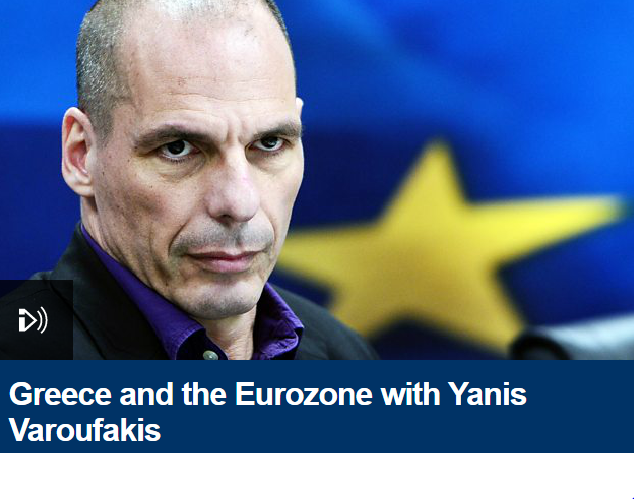
This Monday's Start the Weekwas centred around the most famous Greek since Zorba: Yanis Varoufakis - the famously unsuccessful leftist former Greek finance minister.
Yanis was plugging his new book and Andrew Marr was duly swooning over him.
It must be that that Yanis Varoufakis is never anything less than entertaining to listen to and he talked a good talk about the failings of the EU and the global elites and what he thinks are the historical reasons why we've ended up where we are. I found myself falling for it.
His plausibility was somewhat undermined though by his bold statement that Scotland has its own pound pegged 1-to-1 with sterling....
....and then by his even bolder correction of Andrew Marr over the Brenner Pass.
Andy was striking a wistful note (as impartial BBC types are wont to do) about Austria reimposing border controls with Italy at the Brenner Pass in order to stem the flood of migrants, and said that this seems to take us back to the era of World War Two.
Yanis intervened to say it actually takes us back to the days of the Austro-Hungarian Empire....
....except that Yanis was wrong. It doesn't do any such thing.
The Brenner Pass wasn't the border between Austria-Hungary and Italy. The pass sat right at the heart of the Austrian Tyrol back then. It was only after the First World War that Italy took the South Tyrol and the Brenner Pass arrived at the newly-created border between Austria and Italy. Yanis was (as they say in Athens) 'bullshitting' here.
Still, Yanis Varoufakis was highly entertaining and sounded sensible on the EU as it now is - though Lord knows if I should actually believe him about anything any more.
Then, after all his scathing criticism of the EU, Yanis swung around and implored us in the UK not to Brexit. If we do, the EU's disintegration will be massively accelerated and the Four Horsemen of the Apocalypse will ride over Europe and into the UK (which is not much of an exaggeration of what he said here on my part). Oh Yanis!
For 'BBC balance', Start the Week had a pro-Brexit advisor to Boris and a pro-EU former senior EU economist (from Sweden), plus a left-wing historian and a left-wing academic. The right-wing British Brexiteer stood out like a sore thumb.
Well, that's BBC Radio 4 for you!
******
Darn it! That bouquet ended up as yet another brickbat. If I'm not going to be a 'negative nelly', I'd better put the brickbats away in the cupboard for a while, and lock the cupboard.
******
Monday also brought us the first in a new series of David Mitchell's The Unbelievable Truth, now on its 16th series.
Unlike The Now Show, The Unbelievable Truth does make me laugh out loud (or LOL, as Winifred Robinson might say) - especially when Henning Wehn is on.
Henning Wehn is funny, as only a German can be.
If you don't know the show, it features comedians telling untruths about a given subject. Five true facts are smuggled into their talks and need spotting. See if you can spot the five 'truths' about tattoos in Henning's 'lecture' (and everyone on The Unbelievable Truth did, so this is an easy one):
I know all there is to know about tattoos seeing I've got loads of them, mostly hyper-realistic illustrations of skin and moles, and my life motto, 'Westphalia is not an option'.
Tattoos were invented by Jesus, who on his knuckles had 'mum', 'dad' and 'other dad'.
Other things that have tattoos include sharks in South East Asia and piranhas in South America.
Most zoos tattoo their zebras when they begin to fade with age and the macaques on the Rock of Gibraltar are also tattooed so police know which ones are most likely to be nicking stuff from cars.
In Roman times runaway slaves would be tattooed with the letters FUG for 'fugitive' on their forehead, though I can't tell you why they used the English word for 'fugitive'.
Once upon a time in Japan it was the fashion for girls to have a moustache tattooed above their upper lip. They was so they didn't have to waive off unsavoury businessmen trying to buy their used underpants. Before this they had tried having 'My underpants are nit for sale' tattooed on their foreheads but many of them came to regret this in later life when they wanted to sell their underpants.
Even Winston Churchill had the tattoo of an anchor, a spitfire and a view of Blenheim Palace in the snow.
Sadly the decision to have a tattoo is irreversible once you've committed to it, much like membership of the Eurozone.
One person who is almost certainly consumed by self-loathing is Simply Red's Mick Hucknell, and not just because of his music. Hucknell has the European Union flag tattooed on his arm. He might be required to remove his arm by law in the event of a Brexit.
From a blog about BBC bias's point of view, what was interesting here was the final choice of topic: Vladimir Putin.
The mere mention of Vlad's name drew a surprisingly loud intake of breath from the BBC studio audience and the subsequent gibes at the Russian leader drew plenty of laughter. What's the betting Donald Trump will be a topic before long?
[Answers: (1) Macaques on Gibraltar are tattooed; (2) In Roman times runaway slaves would be tattooed with the letters FUG for 'fugitive' on their forehead; (3) Once upon a time in Japan it was the fashion for girls to have a moustache tattooed above their upper lip; (4) Winston Churchill had a tattoo of an anchor; (5) Mick Hucknell has a tattoo of the EU flag on his arm].
******
The ingloriously-titled Inglorious Isolation: A European's History of Britainwas full of fascinating stuff and intelligent commentary. I learned a lot of surprising facts about British and European history from it, such as Gladstone's paramount importance in Italian history (no British person has had more of an impact, before or since) and Konrad Adenauer's disillusionment with Winston Churchill.
However...my friend Negative Nelly tells me that I'm perfectly justified in saying that the series made too much use of background music - including some of my favourite pieces of classical music. When I'm hearing a favourite piece of music playing I find it hard not to listen to it, which makes listening to what's being said a lot harder. If someone's playing Berlioz I tend to listen. If someone's talking over Berlioz I still tend to listen to Berlioz and then have to stop the iPlayer and listen again to catch what was actually said. A 'luxury' soundtrack to a Radio 4 documentary may strike Radio 4 documentary makers as a good idea but it isn't if the listener really likes the pieces being used. The music then becomes intrusive and infernally distracting.
No, I'm not a negative nelly at all. Obviously.
And to prove it, allow me to be shallow and point to the opening of the series where the ever-charming Francesco da Mosto played us a Rolling Stones song ('As Tears Go By') in Italian ('Con le mie lacrime') and said that was the moment he realised we Brits love his country.
By coincidence, I'm drinking some Chianti at this very moment and am loving Italy too. Salute!
******
Hmm, A long (TL;DR) post like this might be the perfect place to bury an apology.
I owe Radio 4's Word of Mouth an apology, and my apology is long overdue.
I did twoposts in 2014 slagging it off. My accusation was that it was full of left-wing bias, but I've been raiding the Word of Moutharchive in recent months and found that such episodes are few and far between.
What went wrong? Well, two things I think:
Firstly, I just happened - because I'm a blogger about BBC bias - to home in instinctively on the rare exceptions. Spotting their titles and blurbs, I zoomed in, heard the bias and thought I'd got a total handle on Word of Mouth's far-left bias as a result.
And, secondly, Michael Rosen's Trotskyism, Israel-bashing and unpleasant political actions undoubtedly prejudiced me against him and his Radio 4 programme.
And yet, it actually turns out that Word of Mouth really is one of the absolute gems of BBC broadcasting, and Michael Rosen turns out to be a very engaging presenter of it. On most editions, his political views remain invisible. His sidekick, Dr Laura Wright, is equally engaging.
This week's edition centred around an interview with the wonderful Steven Pinker. It was fascinating from start to finish.
Even now, with my political hat on, I still expected Michael Rosen (as a Trot) to have a pop at Prof. Pinker for his views on nature v nurture. It didn't happen.
Exploring the Word of Mouth archive in the past few months has been a joy. I've learned so much from it.
If you fancy doing the same, avoid the 'rare exceptions'. They are easy to spot.
No negative nellyism there!
******
Straight after Word of Mouth came Great Liveswith Matthew Parris - another Radio 4 programme with a fabulous archive of 366 episodes (and counting).
Strange man. Genius. Great films (except for the final ones).
Matthew Parris is, er, a somewhat idiosyncratic presenter, but his idiosyncratic presentation works for me.
******
Another of the gems of Radio is Soul Music- a series about particular pieces of music and what they mean to people. It's also got a glorious archive.
This week's episode was about Bring Him Home from Les Miserables - not a piece I particularly cared about before I heard the programme, even though I knew it.
I cared about it a bit however because my nephew-in-law got me to watch Les Miserables on video a year of so ago while the womenfolk went out to a show and we menfolk were left holding the babies (literally). I enjoyed the experience but the music didn't strike me as being my kind of thing or particularly memorable - except for Bring Him Home, which was the musical's obvious stand-out number. I then forgot it.
Now I can see why it means so much to some people and Jeremy Summerly's explanation of why it works and how it fits into the French tradition (including the French classical tradition) was very interesting and persuasive.
Listening to Alfie Boe and Rebecca Caine describing the audience's reactions to their performances of it also made me think. They both treasure the memory of audience members crying as a result of their performances of Bring Him Home.
Music can be like that, though - music obsessive though I am - it's rarely does that for me, however much it moves me. Only Wotan's Farewell from Wagner's Die Walküre has made me cry my eyes out (for some reason) - though I remember once exercising whilst listening to Radio 3's Building a Library on Puccini's Madame Butterfly and sobbing at a clip from One Fine Day.
After listening to this Soul Music I might start crying at Bring Him Home (which is more Puccini than Wagner) the next time I hear it.
******
And, given that I've been too busy this week to listen to much of the BBC's output, that is all I've got to say...
As I was listening, it suddenly struck me - in a Chippendale-like revelatory flash - that I must surely be listening to exactly the kind of rarefied, politically-correct conversation that goes on prior to some logic-defying, self-righteous, right-on, Right-baiting pronouncement of the kind beloved of local councils, student bodies, arts councils, BBC committees, etc - i.e. just the sort of thing that Richard Littlejohn keeps telling us we couldn't possibly make up.
The title of the episode pretty much says it all: Ebola: How should we talk about it?
Michael Rosen, playing the part of the po-faced presenter, steered his guests to condemn insufficiently right-on media headlines and comments: It's wrong to say this, as it implies Western superiority; it's wrong to say that as it implies African guilt. We shouldn't say this, we shouldn't say that, etc.
If you didn't know better you'd think he was some sort of bossy, censorious Trotskyist extremist rather than a loveable children's author and BBC presenter.
Actually, it's a strange thing, when you come to think of it. One day I'm driving home listening to Michael Rosen and his left-wing, almost invariably politically-tinged take on language, the next I'm driving home listening to Laurie Taylor and his left-wing sociological chums and their left-wing, almost invariably politically-tinged takes on everything else under the sun. All courtesy of BBC Radio 4.
Radio 4's Word of Mouth, like Laurie Taylor's Thinking Allowed, is hosted by a man who's rarely afraid to express his strong left-wing beliefs - namely the children's author and socialist activist Michael Rosen.
As a result, it's hardly surprising to find those views reflected in Word of Mouth.
This week's edition, for example, which discussed 'Journalese', paused midway for a piece of Victorian journalism which, as I was listening to it, I guessed was by either Marx or Engels. We weren't told who wrote it though, so it probably wasn't by either of those illustrious figures.
It was an earnest attack on the way corporations oppress the poor that was interesting in itself but clearly intended, I believe, to prompt Michael Rosen's guests (and listeners) to draw the desired conclusions and reflect on the malign behaviour of big corporations today (which his guests obligingly did).
It's another case of 'just one of those things', isn't it? Just Michael Rosen being Michael Rosen. Like it or lump it.
And talking of Michael Rosen being Michael Rosen....
He's penned (a poison pen letter) an open letter to the new culture secretary, Sajid Javid, in today's Guardian - a remarkably spiteful piece that's making much of the Guardian's own readership recoil in horror.
It begins like this:
Dear Mr Javid,
We've never met, but that's because I work in "culture" and you have spent most of your adult life so far in banking.
and ends like this:
No matter you are of working-class origin and your cultural background is a million miles from the Etonian toffs, you are now part of the class (yes) that runs the ludicrous world of the mega-rich gamblers who have caused millions of people across the world to lose their jobs and welfare.
So I'm not holding out any hopes.
Yours,
Michael Rosen
and it doesn't get much better in between.
It's not really surprising that Michael Rosen has never met a banker, even though he lives in London (where there are a lot of them about). He's safe inside his BBC/Guardian-sponsored ivory tower, protected from having to deal with mere tradesmen like them.
No connection between bankers and culture, eh? No Medici? No modern philanthropists? No T.S. Eliot?
T.S. Eliot worked in the foreign transactions department at Lloyd’s bank from 1917 until 1925. While there he wrote The Waste Land (1922), among other things. He earned £500 at the time.
Phlebas the Phoenician, a fortnight dead,
Forgot the cry of gulls, and the deep seas swell
And the profit and loss.
A current under sea
Picked his bones in whispers. As he rose and fell
He passed the stages of his age and youth
Entering the whirlpool.
Gentile or Jew
O you who turn the wheel and look to windward,
Consider Phlebas, who was once handsome and tall as you.
One of the guests on this week's Word of Mouth, Professor Robert Hutton, is the leading 'expert' in this field, having written a book called Romps, Tots and Boffinsfrom which the following definitions are taken:
Acolytes - supporters of someone with whom we disagree. Arcane rules - ones we can't be bothered to explain. Draconian - the Government is proposing something with which we disagree. Foul-mouthed tirade - someone has said a Bad Word. This event is always "extraordinary" or "astonishing" to newspapers, whose staff are well known for their delicate sensibilities. Page-turner – compelling dross. Rapped - In March 2013, several outlets including the BBC offered the headline: "Police chief rapped over Hillsborough", conjuring the image of some kind of appalling duet with Jay-Z. Rushed - the only way anyone gets to hospital, typically after ambulances raced to the scene. Tome – of course I haven’t read it. Westminster source – the reporter at the desk next to me. Westminster sources – the barman has heard it too.