Showing posts with label Anna Holligan. Show all posts

Tuesday, 29 March 2016

Messages


Anna Holligan

There's something I heard on Radio 4 the other day that's been worrying me.

I'm not a foreign reporter and I can only guess how foreign reporters might feel when confronted with something harrowing, but I've also become deeply cynical when a BBC reporter seems to be using something harrowing to make a point. 

I was listening to this week's Sunday on Radio 4 and heard BBC reporter Anna Holligan being interviewed about the terrorist attacks in Brussels. As the discussion neared its close she began spontaneously talking about an experience she'd had this past week. 

She'd interviewed a distraught mother who didn't know whether her daughter had survived the attack on the airport, and it turned out that the young woman hadn't survived it. 

That must be distressing for a reporter, but...

Anna - who must have subsequently checked social media sites for the murdered woman - then recounted how the murdered daughter had made a comment on Facebook following last November's Islamist atrocities in Paris. She said she'd found what the daughter wrote to be "so poignant".

What the poor young woman had written, which Anna chose to highlight, was (in its entirety):
The ignorant spreading of anti-Muslim sentiment and propaganda does nothing but benefit ISIS. 
I'm pretty sure Anna Holligan meant us to take that as a reason not to engage in "anti-Muslim sentiment and propaganda" but, instead, I took it as, alas, proving that however good-hearted, liberal-minded, trusting and well-disposed towards Muslims you might be (whether you're a random victim of terrorism or a BBC reporter), your good will (or naivety) still won't protect you against the kind of people you seek to 'understand' - the fanatically-religious Muslim terrorist.

Whatever way you look at it, that is poignant.

Saturday, 12 September 2015

Beyond reporting


BBC reporters appear to be crossing the line between reporting and advocating policy policies with ever more frequency at the moment. 

Not content with painting a dismal scene of conditions at a migrant site in Hungary on this morning's Today programme, the BBC's Anna Holligan ended with a clear personal opinion:
At the moment the Hungarian government's response seems to be to increase the law and order as opposed to the humanitarian aid - which, just looking around this site, is just what these people need right now.

Friday, 11 September 2015

Anna Holligan on Twitter


Talking about Anna Holligan, she's a prolific BBC tweeter. 

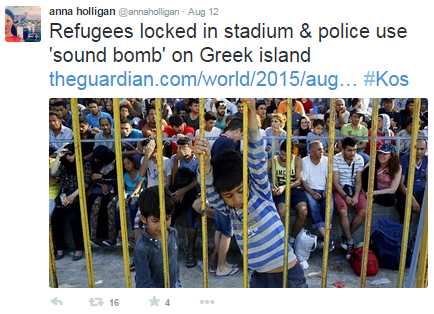
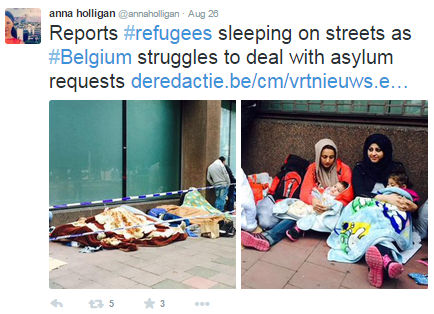
Here are all the tweets she posted about the migrant crisis from 2-26 August (before she began actively reporting on the issue for the BBC).

I think they reflect her present reporting:

Selected images


As Melanie Phillips point out in the article Sue links to (above),  the UN estimates that 70 per cent of the incoming tide of migrants and refugees are the moment are young men. 

As we've note before though, this isn't the impression a BBC viewer would get from many BBC reports. 

Take the report on tonight's BBC One News at Six. I've screengrabbed every 'scene' depicting migrants. 

Firstly, here are the three scenes from the sections where Anna Holligan was reporting either 'live' or 'as live' (the second one comes when the camera panned towards her as she began to speak. You can see his back walking out of the frame again in the third image):


Then there are the shot of groups of migrants, viewed (indistinctly) at a distance:


Then there are the close-ups:


As you can see, the chosen close-ups for Anna Holligan's report are (with one rather indistinct exception) all of women, children, and families with children, though we also see a women with a man in a wheelchair and an elderly man too - i.e. those viewers will regard (rightly) as the most vulnerable.

The close-ups of young men are few are far between.

Emotionally-affecting as they may be they aren't an accurate representation of what's happening and risk seriously distorting the public's understanding of the crisis, don't they?

Sunday, 20 October 2013

Jeremy Bowen in court


Jeremy Bowen

The BBC's Middle East editor, Jeremy Bowen, has been in court in recent days. He's been at The Hague, giving evidence at the trial of the Bosnian Serb military leader Ratko Mladic. 

An 'impartial' BBC journalist giving evidence at a war crimes tribunal might raise a few eyebrows; indeed, as Jeremy Bowen's Twitter feed shows, it has raised a few eyebrows. 

Still, Jeremy firmly believes that he's doing the right thing: 
 Jeremy Bowen ‏@BowenBBC 17 Oct

In answer to a few tweets. Some journos believe testimony compromises journalistic impartiality. But I testify what I reported at the time
 Jeremy Bowen ‏@BowenBBC 17 Oct

I've done it because only justification for reporting terrible human suffering on war is bearing witness, and this comes under that heading
 Jeremy Bowen ‏@BowenBBC 17 Oct

This is the 4th time I've testified for the prosecution at the former Yugo war crimes tribunal. Some journos won't.
The ethics of his actions were touched upon during today's The World This Weekend. Jeremy was interviewed by his BBC colleague, Anna Holligan - the corporation's Netherlands correspondent. 

Before coming to that, however, here's a vignette from that interview: Mladic has a tendency, apparently, to try to stare people out while they are giving evidence. Jeremy Bowen said that he tried to get Mladic to make eye contact with him, but Mladic failed to oblige. Both Jeremy and Anna noted, however, that Mladic was trying to stare Anna out, even though she wasn't giving evidence. [Having seen what Anna looks like I suspect he might have had other reasons for staring at her. A clue follows].

Anna Holligan

Here's a transcript of part of that World This Weekend interview, dealing with the main issue:
Anna: Do you feel its the duty of journalists to bring that to court?
Jeremy: I do. I do actually, because I think that the only justification for what we do, entering peoples' lives at their worst moments, or in some cases their final moments, the only justification for that is to create a record, to be a witness, to bear witness.
Anna: Were you aware at the time, when you were reporting, of how your reports may be used in a war crimes tribunal like this?
Jeremy: Absolutely not. I thought they wouldn't be able to arrest people. I thought they wouldn't be able to get people into a trial. I didn't think there'd be the determination. For me, I'm glad that I've come here to talk about it and to testify because, you know, this sounds a bit corny but I really think I owe it to all those people whose deaths and injuries and disasters that I covered back then. You know, it enormously affected me. It sort of took over my life. And so I'm satisfied that I've done the right thing. 
Anna: There are other journalists who've witness similar things who don't do this, who won't do this on principle, and others who say coming to testify in court could potentially make other journalists targets in the field.
Jeremy: We're targets anyway. In the time that I've been a foreign correspondent, which is getting on for thirty years now, we've gone from being people who at times were accepted as non-combatants. I remember going to my first war in El Salvador in 1989. I remember if we wanted to cross the street we'd shout out in Spanish 'journalist' - 'Periodista! Periodista!'. We'd have white flags and we'd wave them and we would walk very slowly across the street and it seemed the two sides would even cease fire for a while. We're not seen as non-combatants any more. We are much more in the firing line.