Showing posts with label David Sedgwick. Show all posts

Monday, 15 August 2022

Is That True Or Did You Hear It On The BBC?


One of the things that justifies blogs like this - unless the blog gets deleted - is that it provides a permanent, searchable record for those interested in researching the BBC's claims to nigh-perfect impartiality. 

We hope it helps.

Sue's better than me at standing back and drawing things into an overarching overview, as I tend to just record endless individual instances of bias, but a book-length overview of the past few years of BBC bias has been urgently needed, and David Sedgwick's latest book has filled that gap wonderfully. 

It's called Is That True Or Did You Hear It On The BBC? 

I swallowed it down virtually whole in just over a day, and then re-read it much more slowly. It's clearly laid out, much more forensic than Sir Keir Starmer and ought to be damaging, maybe even devastating, for the BBC. 

Some of the instances examined in its chapters will be familiar to readers of this blog, but David retells them with comprehensive gusto and brings them to a conclusion, often pursuing them further than we did down the rabbit hole of the BBC's complaints system. 

On which theme, the book proves that the bottommost part of this complaints system - which might be called 'Wonderland, namely the supposedly semi-distant ECU - even when it concedes a few things is forever engaged in bottom-covering manoeuvres on behalf of the BBC, of which it is a part. 

There's the 'Christian convert' Liverpool bomber who 'wouldn't hurt a fly'; and the 'Nigel Farage has blood on his hands' 'Brexit-related murder', which was no such thing; and the Oxford Street antisemitic incident with the 'anti-Muslim slurs'; and the assault on the Eric Gill statue outside Broadcasting House 'by QAnon'; and the BBC's skewed slagging-off of Israel over Covid vaccines for Palestinians. 

It's hard to choose a favourite chapter but I'd go for one that we only touched on here - and mainly did so thanks to you, our ITBB family, on the open threads: the BBC's absolutely atrocious misreporting of Brexit-backing 'prominent Conservative supporter' [not] James Dyson. The BBC behaved badly at every stage of the way as far as this story goes. It's fascinating seeing it all laid out and demonstrated. 

And, as a bonus, I'd go for the one where the BBC falsely claimed 'the director of a large NHS trust has contacted the BBC', which is a tour-de-force of what used to be called 'fisking'. All I'll say is that every single word of 'the director of a large NHS trust has contacted the BBC' was false. The man in question wasn't the director of an NHS trust, there was no large NHS trust involved, and he didn't contact the BBC [the BBC contacted him], and the attempted BBC cover-up that followed shows BBC kneejerk defensiveness at its typical worst. 

Other chapters [including that 'NHS trust' piece I've just mentioned] deal with matters we've been reluctant to touch on - namely Covid/lockdown and Russia/Ukraine. I took a different attitude to Covid/lockdown to David [though I've been rethinking that for a while] and take a different attitude to Russia-Ukraine too [though I'm growing less sure about that too], but you don't have to agree on such things to see that his demolition of case after case of BBC misreporting holds water. He proves most of them beyond reasonable doubt, and got me seriously thinking on the rest. 

It may be cherry-picking, but these are huge cherries of no small importance and he's right to pick them, chop them up and lay them out before us. I was taken back, again and again, by the sheer inaccuracy of the BBC's reporting, often clearly ideologically-motivated. Some of the grossest examples, naturally, spring out of the corporation's hostile reporting of Donald Trump, but others clearly go beyond such simple partisanship. The BBC, David argues, pushes a much broader agenda - a globalist agenda. 

One of the recurring figures in the book is the BBC's latest 'flavour of the month', Ros Atkins. David takes quite a few of his much-praised fact checks apart. I must admit to being rather uncomfortable about Ros's 'aggressive impartiality', as the BBC calls it, and took exception to my longest exposure to him when he presented an episode of The Media Show and played the part of the BBC's Little Mr Perfect defender rather too passionately

If there's one group of journalists - or as David calls them 'activists' - at the BBC that need closely watching and fact-checking it's the BBC's growing legion of disinformation specialists and reality checkers. The watchers, as ever, need watching - especially when they often appear so one-sided in who they watch. 

Saturday, 15 February 2020

Tales from the Factory Floor


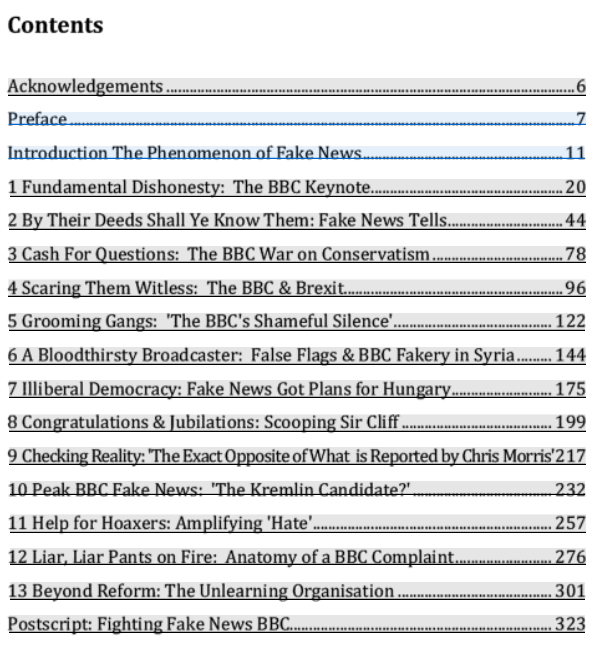
David Sedgwick's The Fake News Factory is a book that needed writing. 

For us, it might feel like a strange trip down Memory Lane at times, as David revisits many of the stop-off points of BBC bias that we've also recorded over the years, but - along with plenty of other examples - he gathers everything together in a juggernaut of hard evidence that is absolutely crushing.

The thing about a blog like this is that is provides endless instances - snapshots - of BBC bias in action but it's the threading of a thousand blogposts into a single tapestry that allows you to properly stand back and gasp at just how bad the BBC has become. 

Take one example: 

Chapter Two brings us to David's list of 'tells' - ways to spot the BBC getting up to mischief. The first 'tell' concerns how the BBC treats wrongdoers and whistle-blowers. 

Here David recounts the remarkable tale of how two BBC whistle-blowers - Meirion Jones and the late Liz MacKean - were slyly hounded out by the BBC in the wake of the Jimmy Savile scandal.
A senior press officer who vowed to 'drip poison' about Jones was later promoted. 'I will throw shit at him [Jones]' promised another senior BBC staff member. It was made clear to BBC staff attempting to establish the truth that should they continue to dig it would spell the end of their careers. 'When the Savile scandal broke,' recalled MacKean, 'the BBC tried to smear my reputation.'
I remember Liz MacKean. She once replied directly to a complaint of mine, and did so to my satisfaction. 

This was a shameful episode in the BBC's history and merits close attention. 

And what of the BBC 'wrongdoers' who got away with it, despite those pesky rulings against them? 

What about anti-Trump BBC dirt-disher Paul Wood, who helped lose the BBC a libel case brought by a former Ukrainian president but who's carrying on regardless at the BBC? 

And what about Dan Johnson, who was criticised by a judge over his involvement in the Sir Cliff Richard and is still a high-profile BBC correspondent? Or the BBC higher-ups judged untrusty and evasive in their testimony by the same judge? 

Or Jasmine Lawrence, the BBC News Channel editor pulled from local election duties in 2014 after ranting against UKIP on Twitter, subsequently promoted to be a Deputy News Editor on the Channel?

Or Emily Maitlis, rebuked by the BBC over her unfair treatment of Rod Liddle and now their award-winning golden (bronzed) girl? 

Or Jeremy Bowen, a man with a deeply personal grudge against Israel, continuing as the BBC's Middle East Editor despite the BBC itself ruling against him for violating guidelines on impartiality and accuracy in 2009? 

Saturday, 8 February 2020

Ever fancied publishing a book critical of the BBC?


Talking about David Sedgwick's new book The Fake News Factory: Tales from BBC-land, I think you'll find this seriously alarming:


David's piece begins:
When I heard through a third-party that the BBC was planning, and I quote, 'to sink' my new book about them I wasn't that surprised. After all, the theme of 'The Fake News Factory: Tales from BBC-land,' is BBC dishonesty. Indeed, it made perfect sense. Although friends scoffed at the idea, I have since discovered that this was no idle threat.
Now read on...

Right-thinkers, wrong-thinkers and the BBC


Yum, yum?

In his new book The FakeNews Factory: Tales from BBC-land David Sedgwick writes:
One of the most pervasive fake news tells of all manifests in the very different treatment meted out to those who agree with the BBC agenda (right-thinkers) and those who disagree with it (wrong-thinkers). An impartial organisation meanwhile would of course treat individuals fairly and equitably in spite of political affiliations.
I read that after listening to Mishal Husain interviewing Liam Halligan and Vicky Pryce on Today this morning. Liam Halligan is the 'wrong-thinker' on Brexit and Vicky Pryce is the 'right-thinker' on the subject of Brexit and, yes, they were treated in very different ways. Mishal interrupted, and challenged, and contradicted, and laughed at pro-Brexit Liam Halligan, and lobbed some pre-prepared, anti-Brexit 'ambush points' at him for good measure. In stark contrast, anti-Brexit Vicky Pryce got a completely free ride. In what possible way could this be considered impartial interviewing? 

Still, we did learn that Liam Halligan likes cuttlefish, so that's something at least. 

Monday, 3 February 2020

Advertisement


What is happening to the BBC? As of 2020, fewer people than ever trust the 'British' Broadcasting Corporation to tell the truth. Accusations of bias and fake news reverberate inside and outside of social media tarnishing the name of this once respected brand. Every minute of every day the BBC production line is hard at work. A finely-tuned machine, Britain's publicly-funded state broadcaster pumps out an enormous amount of content much of which attempts to mislead, unnerve and inflame the audience. Encompassing its coverage of Trump, Brexit, climate change, Syria and everything in between, there is nothing spontaneous about BBC propaganda. It is constructed to achieve specific goals. The Fake News Factory promises to blow the lid off what has become a radical, political agenda. Unable to modify its playbook by a single degree however, the corporation faces an existential crisis. More hated than loved, the BBC unravels in front of our eyes. Audiences deserting in record numbers just how does the BBC manage to retain its pre-eminent position within the UK media landscape? Using myriad examples of unethical practice in this sequel to his acclaimed BBC: Brainwashing Britain? David Sedgwick takes the reader on a disturbing journey into the very heart of dishonesty.
 

Wednesday, 5 June 2019

BBC Tending


Here's a little social media activity from this very afternoon, featuring the aforementioned Mike Wendling of BBC Trending:

  • BBC Trending: Last week journalist Carlos Maza (@gaywonk) from Vox News posted a video about the anti-gay and racist abuse he was receiving from rival video-maker Steven Crowder on YouTube. Now YouTube says anti-gay slurs do not break its rules.
  • DB: I see Mike Wendling & his BBC Trending team of SJWs are joining the left-wing media's attempt to shut down @scrowder's very popular YouTube channel. (Note the @BBCTrending tweet doesn't include [Steven] Crowder's twitter handle.)
  • Iconoclast: For info: Maza's bio: "I write Strikethrough for @voxdotcom. Marxist pig. Tucker Carlson is a white supremacist." Nice huh? Vox is a far left fake news outfit, so support from BBC Trending & Alt-left hunter Mike Wendling not altogether surprising I guess.
  • Mike Wendling, BBC: Confused. Did you read the story? Is there factual inaccuracy? (Also, why so angry?) 

It all relates to this BBC News website article


For the purposes of this blog, the question is more 'Is it biased?' 

Well, the choice of subject is 'very BBC' (identity politics, bad social media, right-wingers 'in the wrong'), but the story is the story. And the BBC could be reporting it fairly. 

Look though at the opening paragraph:
YouTube is one of many companies that has given its logo a rainbow-themed makeover to show support for LGBT rights - but, underneath the colourful veneer, a row has erupted over how the video-sharing site enforces its own hate-speech policies.
And then look at the closing paragraph:
With LGBT Pride Month just kicking off, it will be interesting to see how many other organisations will adopt rainbows across their brands, without necessarily backing the queer communities they are desperately marketing themselves to.
Though the first paragraph comes from the by-line-free main part of the report, the last comes from the closing 'Analysis' by the BBC's LGBT correspondent (oh yes, that really is his job title) Ben Hunte, and the narrative arc of the article is as perfect as a rainbow.

As DB and Iconoclast say, YouTube is surely being pressured by the BBC here to follow their favoured agenda here, don't you think?

That whole closing 'Analysis' from LGBT BBC Ben runs as follows:
Many professional LGBT video-makers will be familiar with uploading material online and instantly being tormented by certain audiences, solely because of their sexuality.  
YouTube's take on this will disappoint the LGBT community.  
It will surprise them that hurtful things considered hate speech and punishable by law in real life can simply be labelled "debate" online, and not require any repercussions.  
With LGBT Pride Month just kicking off, it will be interesting to see how many other organisations will adopt rainbows across their brands, without necessarily backing the queer communities they are desperately marketing themselves to.
You might defend Ben here with 'The Katya Adler Defence'. Just as Katya is tasked with reporting what the EU says, so Ben is surely only reporting what the LGBT community are saying? Unfortunately, he lets himself (and the BBC down) with that word "desperately" in the final paragraph. It betrays his feelings.

As Mike Wendling might say, 'Also why so angry, Ben?'

Friday, 5 April 2019

And there's more...


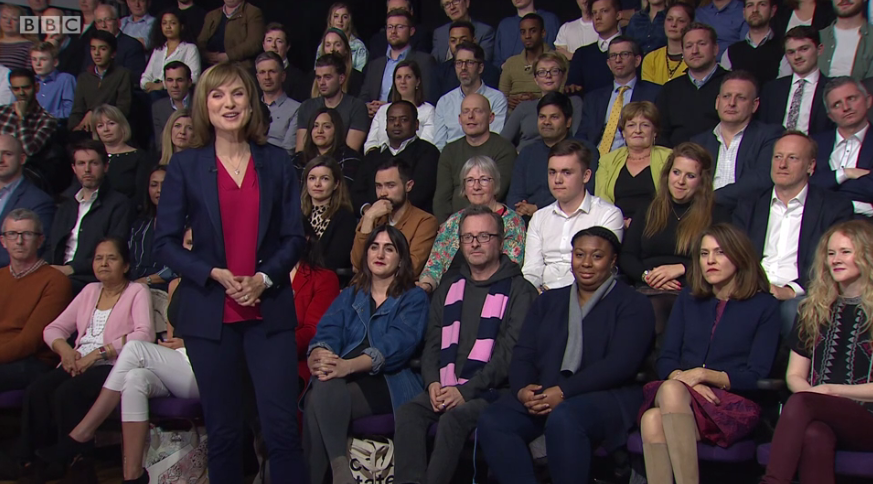
Further to an earlier post, the BBC tweeted the following in response to Charles Moore:


Comments most certainly could be going better for the BBC. Among them is this little list from David Sedgwick of BBC: Brainwashing Britain? fame:


The BBC's tweet drew this comment from journalist Marcus Stead:
Can you provide a single example of a Question Time programme in the last three years where there has been a majority of Leave supporters on the panel? No, you can't. Don't insult the intelligence of your audience with absurd tweets like this. 
Now, interestingly, Fiona Bruce herself provided the very "single example" that Marcus asked for in reply to Mr. Moore last night. 

She said, "Last week we had three people who take the Leave position and two people who took the Remain position". 

The panel last week consisted of: Damian Hinds, Jenny Chapman, Simon Wolfson, Merryn Somerset Webb and Yanis Varoufakis, so Fiona is counting either Damian Hinds, Jenny Chapman or Yanis Varoufakis as Leavers in order to give her that balance.

Saturday, 15 December 2018

All very BBC


Dear readers. If you want a Christmas present for yourself, I'd recommend treating yourself to David Sedgwick's BBC: Brainwashing Britain? (hot off the presses).

I'm just a few pages away from the end of a first read-through and I've enjoyed every page of it.

It's the book about BBC bias that I've been waiting for, and I wish I'd written it myself.

It covers a lot of ground (from Antifa to Israel, from Grenfell Tower to Owen Jones), with a good deal on the BBC's biased Brexit coverage, though its recurring focus is on the BBC's hostile coverage of the Trump presidency.

And I think it absolutely nails the BBC, again and again and again.

(I'll be bringing you endless highlights from it over the coming weeks).

Admirers of Monkey Brains' fabulous Festive Fifty will also find fascinating examples of various 'bias by...' types detailed therein.

And, pausing to listen to tonight's PM on Radio 4, I now hear it through David's book:

First, as the BBC presenter put it, "no one said that saving the planet would be easy". Yes, it was global warming, and an interview with the right kind of BBC guest for this issue: the intensely activist former Tory minister John Gummer (Lord Deben). He wants the present (centre-right) Australian government chucked out because of its policies on climate change. The BBC presenter didn't defend the Australian government or challenge His Lordship.

Second, delaying Brexit and that 'second referendum', and an interview with Brexit-disliking Stephen Bush of The New Statesman, who very much talked the BBC talk on the matter and was treated as if he were an impartial sage.

Third, the Yellow vests protest in France, and a BBC reporter (Hugh Schofield) giving BBC favourite President Macron a French kiss, saying that he "has diffused this", and that "it's on a classic trajectory, this protest movement. It's dying down. And I think he can be satisfied he's not going to see it up again for a while". (Carry on Emmanuel!)

Fourth, one of the BBC's main present bogey countries, Myanmar, and an interview with a critic of the BBC's fallen heroine Aung San Suu Kyi over the imprisonment of two journalists there. The BBC really do have a bee in their bonnet about Burma.

And, fifth, the usual BBC race thing, featuring an interview with a black sports reporter from the Daily Mirror who reinforced claims that racism in football is as bad as it ever was and that the media is partly responsible for that. 'Discuss?' Hardly. Just repeat and amplify instead.

All very BBC.