Showing posts with label IEA. Show all posts

Saturday, 25 June 2022

Amol Rajan v The Guardian


Friendly fire time for the BBC as The Observer loads up this Sunday headline: 

BBC’s Amol Rajan criticised for using phrase ‘pro-life’ in Roe v Wade interview. Pro-choice campaigners say hearing the term, seen as partisan, on Today programme was ‘disappointing’.

The Observer 'reports': 
One of the BBC’s most high-profile presenters has been criticised for using the term “pro-life” to describe anti-abortion campaigners in a discussion about the US supreme court’s overturning of Roe v Wade.

The term, which is considered partisan, was used twice by Amol Rajan during Saturday morning’s Today programme on Radio 4, in segments about the landmark ruling ending Americans’ constitutional right to abortion.

The BBC News style guide advises journalists to “use anti-abortion rather than pro-life, except where it is part of the title of a group’s name”.

Now, a BBC reporter using the term 'pro-life' in the context of abortion is not what I'd expect, given the BBC's pronounced social-liberal bias, but Christopher Snowden of the free-market think tank the IEA makes an interesting point in response:

Both sides picked a name that makes their cause sound more appealing (pro-choice/pro-life) and everyone understands that. Unless this guy called the pro-choice people “pro-death”, I don’t see the problem.

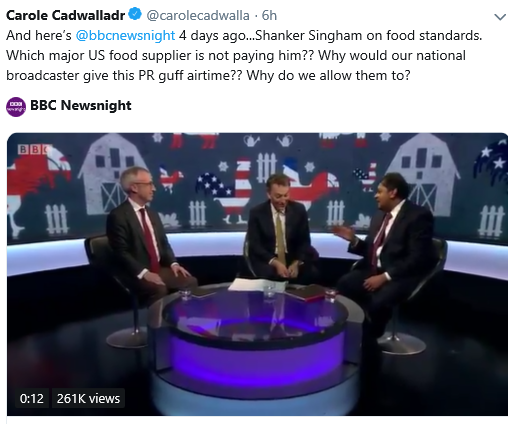
And Christopher points out that the Guardian/Observer is mired in this language slough as well. See the image at the top of this very post for that tweet and his proof of that.

It's an interesting one. Though 'pro-abortion' and 'anti-abortion' aren't perfect terms, especially for some 'pro-abortion' people, they are understandable and not quite as loaded as 'pro-life' or 'pro-choice'. Maybe the BBC should stick to those?

From my own perspective, which I suppose I ought to put on record, I think our British compromise on the issue gets it about right - as BBC editors appearing on the BBC's Newswatch would say.

Update (Sunday): To expand on Christopher Snowden's point, here's BBC Washington correspondent Nomia Iqbal yesterday evening on the BBC News Channel:

It is day two of those protests, not as many numbers as they were yesterday when that ruling came through but there are hundreds of protesters. I would say they are a largely pro-choice group. Earlier, there were anti-abortion protesters as well and there was a slight stand-off between them where you had pro-choice groups surrounding those anti-abortion ones and shouting, my body, my choice.

Labelling the IEA


There's another interesting new ruling by the BBC's Editorial Complaints Unit (ECU). 

The right-leaning Institute of Economic Affairs (IEA) is a bogeyman for left-leaning types on Twitter. 'Who funds you?' is their repeated cry whenever someone from the IEA pops up, and they don't like it when IEA people appear on the BBC at all. 

Someone complained that The Papers on the BBC News Channel “repeatedly failed to provide an adequate description of the IEA”. I'm guessing they would like the BBC to label them with something negative. 

Anyhow, the BBC upheld their complaint and will oblige them from now on by making sure its presenters make “particular reference” to the IEA's “free market orientation”.

From what I can see, these instances relate to some rare appearances by Annabel Denham, Director of Communications at the IEA, alongside broadcaster John Stapleton. The latest ones, on 7 June, saw the IEA labelled as a “free-market think tank” each time she was introduced.

It will be most interesting to test again how consistent the BBC are with their labels, especially given that 'bias by labelling' is always a risk. Will they treat outfits from other parts of the political spectrum this way too?

I see, from a preliminary scan of TV Eyes, that the likes of the Resolution Foundation are being labelled “independent” or “a think tank that focuses on people of lower incomes” and Demos is “cross-party”. 

Saturday, 6 November 2021

Twitter banter


There's another Yorkshire Cricket Club headline 'racism' story on the BBC News Website's home page. Meanwhile, here's a Twitter discussion that echoes the chat on the open thread and I suspect reflects the public mood better than the BBC:

  • The Yorkshire Cricket Club situation is hardly top news. Why is it being made such a major issue? Who really cares what players say to each other in the dressing room? What are the real motives?
  • Number One rule: What happens in changing room stays in changing room. Thought everybody knew that. It’s all about trust. We have a situation here where somebody decided years later they were offended. Oddity is that Ballance's honesty has resulted in him bring crucified by the BBC.
  • 2 Days - Wall to wall on every channel. And it's going to go on + on to sustain the victim racism narrative + try to pretend the UK is an institutionally racist country.
  • The media love stirring up racism in the guise of condemning it.
  • Ah well, it's all about how they frame "the news". Every night it is just about Diversity or Climate Change. Each news item chosen is based on which of those two topics it falls into. If news is particularly slow then just send your top reporter to a drought or a flood & job done.
  • BBC covered up Saville for years yet drop Vaughan for a unverified comment 12 years ago??
  • I’ve had the BBC in the background and had to switch it off due to constant racial news, there is an agenda here, is it divide and rule I don’t know but surely I’m not the only one feeling this way.
  • I really hope Michael Vaughan sues the BBC for unfair dismissal and wins. Utterly ludicrous decision. Another nail in the coffin of the BBC.

And a variation on the theme comes from Mark Littlewood of the Institute of Economic Affairs:

The coverage of BBC News today, which I have followed, has chosen to headline the following stories: 1. A cricket club in Yorkshire claims not to be racist 2. A cricketer won’t be fronting a BBC radio programme tomorrow 3. A teenager from Sweden believes COP26 is a failure.

Saturday, 14 September 2019

Hair he is again!


Who's behind the beard?

Christopher Snowden of the IEA ('who funds them?') tweeted the following yesterday:
If you’re tweeting about Tommy Robinson’s release from prison today, be sure to mention that he was born Stephen Yaxley-Lennon because apparently this owns him in some way.
The BBC's Dominic Casciani - a man who grew a beard a couple of years or so back and whose stage name is 'BBC DomC' - must have read Christopher's tweet and taken his advice to heart. Here were the BBC man's three tweets on the subject yesterday:
  1. Stephen Yaxley-Lennon, the anti-Muslim/Islam campaigner who goes by the stage name Tommy Robinson, is out of jail and apparently looking for a hairdresser to sort out his barnet before he goes back to the microphone.
  2. His 9-week sentence appears short - but is in actual fact the halfway point of a nine-month term served in two parts (he was initially locked up for contempt of court in May 2018).
  3. Once he's paid for a haircut, he needs some change for his whopping legal bills (see pic of the Attorney General's costs). He's asking fans to help pay that plus £84k for an appeal.
Do I detect a mocking tone there from BBC DomC (aka Dominic Casciani)? Surely not, from someone so impartial! 

Saturday, 8 June 2019

"Mad cat woman, Karol Kodswallop"


This Twitter thread from the influential Orwell Prize-winning Observer journalist Carole Cadwalladr (the one Andrew Neil famously described as a "mad cat women, Karol Kodswallop") is a classic case of Beeb-bashing from 'the other side'...

...and further evidence of the weakness of the 'complaints from both sides' argument.

She began it yesterday and continued with it today.

It's an attack on the BBC for 'platforming' the free-market think tank the Institute of Economic Affairs (IEA), especially one of her favourite targets, the IEA's associate director Kate Andrews. 

Let's begin at the beginning:


Of course, Carole has already got Kate's name wrong. She calls her 'Edwards', not 'Andrews'. (Probably not the best start!)


And then came this gem: 


The actual video, if you watch it, shows Kate talking about the NHS today - in "2018". Why? Because the video was broadcast on Newsnight in 2018, not this week! It was part of the programme's Viewsnight series. (I remember watching it at the time). 

And, no, Newsnight didn't repeat it this week either.

So Orwell Prize-winning Carole obviously (a) hadn't watched the video and seen/heard the date mentioned in it and (b) hadn't even checked to see if Newsnight really did report it this week (which they didn't). She was merely asserting something factually wrong.

Yet on she went:


Guess what? This wasn't broadcast on Newsnight this week either! It was broadcast in March. (March 14th, to be precise).

Seriously, what kind of journalism is this? 

And for her next example, oh, it's those chaps again!:


This one caused a good deal of hilarity on Twitter because, as you can see, this the same video she's used before. It wasn't Sky News, it was Newsnight and 'SHE' (Kate Andrews) is nowhere to be seen!

Of course, this one is just a mix-up, not an egregious error (unlike the others). 

That said, why Carole is citing Sky anyhow in connection with her grouse about the number of IEA appearances on the BBC? (A mystery surely only the most mysterious of cats could fathom!)

At which point Carole turns to religion: 


This, of course, really is Sky News!! Victoria Hewson of the IEA was on Sky, not the BBC!

And, no, you're not really, Carole. The only think you're 'up to' is 'making it up' - and getting it wrong!

And for her final flourish:


Maybe they don't take you as seriously as you like because of this kind of thing, Carole?

*******

Actually, far be it from me to do what Orwell Prize-winning journalist Carole Cadwalladr should have done, but I have done it. By a complete fluke, her total of 5 proves to be right (even though she included one from 2018 and one from March) - though it's over 5 days not 3 days. 

Mark Littlewood, Today, June 7
Kate Andrews, Newsnight, June 6
Kate Andrews, Politics Live, June 6
Kate Andrews, The Papers, June 4
Kate Andrews, Start the Week, June 3

If she wasn't so influential (and the likes of Nick Cohen, for example, think she's the cat's whiskers), this would just be funny. But her ridiculous complaints of BBC bias are taken seriously by the BBC - and others. 

Sunday, 7 October 2018

BBC Brexit report based on dubious maths


Catching up with things...

Newsnight's policy editor Chris Cook took on one of those right-wing think tanks so hated by left-leaning, pro-EU #FBPE types on Twitter - namely, the Institute of Economic Affairs.

The article's original headline was IEA Brexit report based on dubious maths. It began:
Much has been written in the past few months about the Institute of Economic Affairs, the right-wing think tank. But there is one element of its work that could do with more scrutiny: its maths. 
Unfortunately for Chris, he also got his maths wrong!

I'm guessing he was attempting to play to the #FBPE gallery but he got some figures mixed up and his fingers burnt. 

So what happened next? 

Well, I read his original would-be hatchet job on the BBC News website. 

And then I saw him insert a very short correction grudgingly admitting to mathematical mistakes on his part, but doing so in two throwaway sentences in the middle of the piece [placed in square parentheses]. The headline by this time had changed to IEA Brexit report pulls up a few questions about methodology

Then he got the BBC to delete the whole post [and they've done such a thorough job that even the Wayback Machine can't retrieve it]...


Now you see it. Now you don't.

... and published a fresh piece headed 'Mea Culpa' (beginning "I am not, it transpires, infallible....") which reads as a considerably-less-than-entirely-apologetic mixture of admission and defiance.

Surprisingly, unlike in that short correction to the original piece, he didn't make it clear what his mistake had been - i.e. that he'd messed up the maths. 

And in a short piece of just 126 words I count four (possibly five) fresh digs at the IEA. 

So it's a very 'BBC' apology. 

I've got some things spectacularly wrong myself over the years. I think the thing to do when that happens is to properly apologise and give yourself a good Medieval-style self-scourging. Don't keep lashing out. 

And I learn from a loyal reader that Chris Cook has actually been blocking people on Twitter who have taken him to task over his half-apology. 

Also very 'BBC'...(well, for the time being anyhow). 

Sunday, 1 May 2016

Institutional bias at the BBC


The free-market think thank the Institute for Economic Affairs has produced a new report calling for the BBC to be privatised

Part of the report looks at the subject matter of this very blog: BBC bias. Ryan Bourne analyses the date (pp 67-97) and Stephen Davies considers why the BBC might be biased (pp 100-112). 

Both are subtle and nuanced takes, emphasising how difficult bias can be to nail down and how it isn't as simple as just 'left-wing bias' or 'right-wing' bias. They argue that the BBC's bias doesn't result from a conspiracy. They say it's institutional, arising from things like the composition of the BBC’s staff, its internal culture and certain structural features of the BBC. They say it's also partly produced by the world-view of the kind of person who chooses to work at the BBC, "combined with the consensual views of the political class, which has come to have an ever-closer connection to all the mass media". The BBC's "commitment to and focus on a received or conventional wisdom that is not the settled view of the population as a whole (to the very small extent that such a thing ever exists) means that certain views are marginalised and either misrepresented or even ignored" - a tendency intensified by the modern media's obsession with seeing political and intellectual divisions "in binary terms".

On the issue of 'complaints from both sides', Ryan Bourne has this to say:
Unsurprisingly, the BBC itself is extremely defensive about all of these ‘accusations’. It seizes on reports that dismiss accusations of ‘left-of-centre’ bias and uses the fact that it gets criticised from left and right to robustly defend itself against charges of political or ideological favouritism. Yet, few suggest that the BBC is overtly and deliberately biased at all times, particularly towards or against a political party. It is more that an institutional worldview sometimes appears to shape coverage, whether through decisions on what to cover, what to include in a story or what to admit. Just because figures on the left and right sometimes moan about the effects of this world-view does not implicitly make the BBC ‘neutral’.
The data in the report (courtesy of David Keighley & Co. at News-watch) is interesting in its own right. 

From reading other pieces about the report (such as Toby Young at the Spectator and Iain Martin at CapX) it's clear that the figures on Radio 4's Thought For The Day have caught people's attention. They certainly caught mine. Of course, they show that John Bell, Giles Fraser and the rest of the TFTD gang are, on the whole, as left-wing as we already knew them to be, but it's the sheer scale of the anti-capitalist bias across the spot's output that's so striking. Negative commentaries about business outnumbered positive portrayals by a factor of more than eight to one.

The bigger study of Today's EU coverage is even more damning though. In contrast to British public opinion which has long had either a substantial minority or a small majority wanting us to get out of the EU, Today has persistently under-represented such voices:
Fresh News-watch analysis commissioned for this chapter has sought to combine all News-watch survey sample data on Radio 4’s Today programme between March 2004 and June 2015. In the monitored sample, the Today programme included 4,275 guest speakers on EU themes. Just 132 of these (3.2 per cent) were identifiably in favour of Britain’s withdrawal from the EU. Furthermore, 72 per cent of withdrawalist speakers were representatives of the UK Independence Party (UKIP), and over a third (37 per cent) of all withdrawalist contributions were from Nigel Farage alone. Left-leaning withdrawalist voices have accounted for just 0.07 per cent of all EU speakers over this period (three appearances from Labour Party supporters and one representative from the Socialist Labour Party). 
One thing that can be said in favour of the BBC during this present EU referendum period is that they have redressed this staggering imbalance somewhat, most strikingly by featuring Labour Party withdrawalists (Kate Hoey and Gisela Stuart especially) much more often. I myself have been looking out to see if that's happened - and it has.

Going off at a tangent, maybe, but in the section on 'health warnings', there's a chart showing how certain think tanks are described by the BBC. It got me thinking about that most 'influential' of 'independent' think tanks, the Institute for Fiscal Studies (IFS). It is often given such labels by the BBC (along with 'respected'). As the IEA report says, such adjectives constitute "a powerful, positive signal that the viewpoint should be taken seriously and is untainted by political biases." When someone from the IFS passes judgement on, say, the Budget or what a Brexit might mean economically or on mass immigration's benefits and costs, it is automatically given considerable weight and status. Does it deserve to be so exalted by the BBC? Is it always right? Is its track record so impeccable? Why does no one ever seem to ask that, or check that?

As I say though, that's just an aside arising from the report.