As a would-be blog of record about BBC bias, we ought to record the maybe-related fact (noted by Anon on the open thread) that the BBC has apparently admitted that both Fiona Bruce and their business editor Simon Jack were "potentially in breach of its guidelines" by agreeing to speak at "a lucrative engagement for a firm accused of inadvertently helping criminals to obtain passports". Both Fiona and Simon pulled out of the event after the Daily Mail "revealed the potential breach of BBC rules".
Showing posts with label editorial guidelines. Show all posts
Showing posts with label editorial guidelines. Show all posts
Sunday, 21 July 2019

Saturday, 20 July 2019
"Not only is tanker heading in wrong direction, but Iran policy generally - and just as Britain is about to change PM"
On the open thread MB wonders whether Jon Sopel failed to read Fran Unsworth's warning not to engage in political tweeting that compromises the BBC's claimed "impartiality" because "Here Our Jon moans that our Iran policy is heading in the wrong direction. Couldn't be more partial...":
Not only is tanker heading in wrong direction, but Iran policy generally - and just as Britain is about to change PM https://t.co/rdEhfcYp9A— Jon Sopel (@BBCJonSopel) July 19, 2019
We did learn recently that the BBC has relaxed its rules, but this still doesn't get Jon off the hook. He's still bound by the rules:
Under the revised editorial guidelines, published last week, the corporation still bans news and current affairs presenters from making their political views known on social media, or taking a stance on a ‘controversial subject’.
But the rules say the ‘risk is lower’ where the presenter is talking about a subject unrelated to their field, giving as an example ‘a sports or science presenter expressing views on politics or the arts’.
Saturday, 15 June 2019
Vans and lorries
As Sue noted on Wednesday, it looks as if we'll be seeing and hearing even more about "van attacks" and "lorry attackers" from the BBC in the wake of their latest editorial guidelines (to be published later this month).
The Daily Mail says that BBC reporters will be told to avoid using the word "terror" to describe any terror attack, "unless they are quoting someone else".
The paper goes on, "Instead, they will refer to terror attacks by naming specific details, such as the location and the method of slaughter used":
The controversial edict means that the BBC will no longer use the phrase 'terror attack' to describe the massacres at London Bridge or Manchester Arena, as the corporation did when the atrocities occurred.
Reporters would describe them as the London Bridge van attack or the Manchester Arena bomb attack instead.
Now, of course, this is nothing new. It's merely a ratcheting-up of something the BBC has been doing already with increasing frequency.
What is particularly striking here though is the bizarre thinking behind it:
According to well-placed BBC sources, bosses are eager to report terror attacks consistently, regardless of the terrorists' political ideology. But instead of branding them all as terror attacks and risk accusations of bias, it wants to avoid the word altogether.
A senior news source said: 'It boils down to that phrase, 'One man's terrorist is another man's freedom fighter'.
It will be interesting to see the exact wording when the new editorial guidelines are published.'Our question is, 'Is Darren Osborne [who was behind the Finsbury Park terror attack] a terrorist?' He is being motivated by far-Right thinking, in the same way as the guys in the attack on London Bridge. Consistency will be the key.'
Thursday, 25 October 2018
Yet again
 |
| No badge for Majd |
BBC Watch has captured yet another example of a BBC journalist falling foul of the BBC's social media guidelines after posting something partisan on Twitter (and Hadar lays out the case beautifully).
After the Kingdom of Jordan announced a downscaling of parts of its peace treaty with Israel, Majd Yousef - Online Editor at BBC World Services and a YouTube Editor at BBC Arabic - tweeted her "Happiness".
The offending journalist's Twitter feed has now been deleted.
Monday, 18 June 2018
Has Anthony finally gone beserk?
 |
| Note the irrelevant disclaimer. |
Long-term BBC watchers may recall the former Head of the BBC Multimedia Newsroom Mary Hockaday sending out an email to BBC staff in 2014:

Helen Boaden, then Head of BBC News, had sent out something similar in 2010:
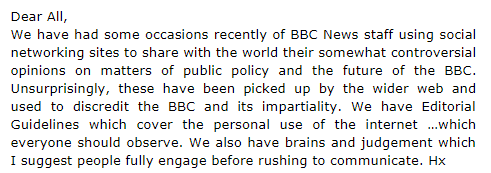
Do these emails from BBC high-ups come in four-year cycles? If so, we're due another this year - especially as more and more high-profile BBC journalists are saying things that brazenly compromise their impartiality.
For example, when I saw that Donald Trump had tweeted the following...

...I just knew that senior BBC US reporter Anthony Zurcher would "rush to communicate" his views on the matter on Twitter and tweet something that very sailed close to the wind, impartiality-wise. It turns out that I was actually only half-right. Anthony didn't just sail close to the wind, impartiality-wise, he crossed the line into outright sounding-off:

He sounds angry, doesn't he?.
He certainly doesn't sound impartial.
The current Head of BBC News is Fran Unsworth. How long will it be before she sends out that email again?
Sunday, 21 May 2017

Saturday, 2 April 2016
Thugs

One on the complainants on this week's Newswatch raised a similar point to one made by someone at ITBB a few days back.
It concerned the reporting of Damian Grammaticas from a far-right protest in Brussels, including this passage from one of his pieces:
Police reinforcements arrived. Officers here are overstretched already by the terror alerts. The riot squad moved in. There were cheers. The thugs beat a hasty retreat.
The point made by the Newswatch viewer was:
Your correspondent describes the protesters as 'thugs', which shows a bias and opinion that should not be expressed by a neutral news provider. The protesters may have a view not shared by the majority, but this terminology does the BBC no favours when reporting what should be a factual account of events.
The point made here was:
Interesting use of words by Damian Grammaticus on BBC News. Several times he referred to "thugs" from the far right coming to disrupt commemoration in Brussels. I've no problem with that description, given their behaviour was thuggish. But when has he or any other BBC reporter referred to Islamists or Leftists involved in similar scenes as "thugs". Never I think. In fact the BBC has a problem with even uttering the word terrorist a lot of the time - preferring "gunman", "militant" or "guerilla". There was a far worse event in Pakistan today - in which scores of mostly Christian children were deliberately murdered by Islamist butchers, but no such epithets were cast their way.
And that is surely the point. It's all very well for Damian Grammaticas to call white, right-wing thugs "thugs", but you won't hear him call Islamists or Leftists names like that.
More broadly, why is it acceptable for a BBC reporter to describe far-right Belgian protesters (if that's what they all were) with such a "pejorative" term when, famously, (a) the BBC opposes calling terrorists "terrorists" because it contains a non-neutral "value judgement", and (b) when Lord Hall refuses to allow the BBC to call Islamic State 'DAESH' on the grounds that it's a "pejorative name" and that, by seeing to take sides against IS, it "would not preserve the BBC's impartiality"?
In the words of that Jacobean play, It's A Mad World, My Masters, isn't it?
Wednesday, 24 February 2016
Another own goal for the BBC
Guido Fawkes adds another one to the collection...


Go back to Prime Minister's Questions on February 10th. Jeremy Corbyn's opening question went as follows:
I have a question on housing. I've got an email from Rosie. She's in her 20s and she says: "I work incredibly hard at my job yet I'm still having to live at home with my parents." The lack of housing options, Mr Speaker, are forcing her to consider moving, even leaving the country. She asks the Prime Minister what action he's going to take to help young people and families suffering from unrealistic house prices and uncapped rents to get somewhere safe and secure to live.
In response to Mr Cameron's reply, Mr Corbyn continued:
Mr Speaker, I'm very pleased that the Prime Minister wants to help deliver decent housing for Rosie. She lives and works in London and, as the Prime Minister knows, London is very, very expensive.
'Rosie' herself later took to Facebook to give her response:
Where I work staff are regularly warned that what we put on Facebook must not bring any discredit to our company. We can be disciplined, even dismissed, for serious breaches.
The place where Rosie works - the BBC -

- has a similar policy:
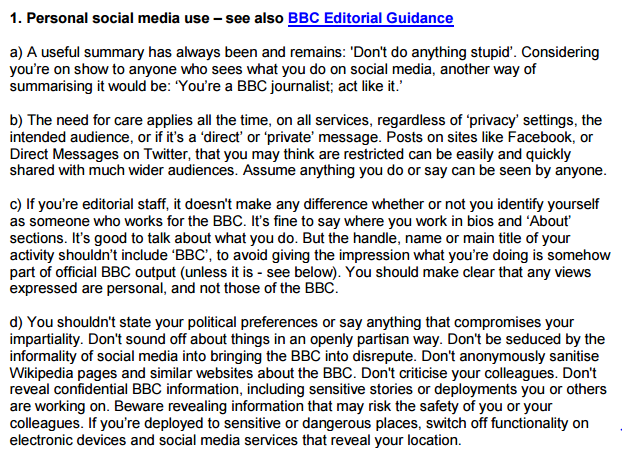
1. Personal social media use(d) You shouldn't state your political preferences or say anything that compromises yourimpartiality. Don't sound off about things in an openly partisan way. Don't be seduced by the informality of social media into bringing the BBC into disrepute.
...and yet, having emailed Mr Corbyn, she then went onto Facebook and sounded off.
If you go public on Facebook, having already engaged in a high-profile partisan political gesture, you run the risk of being exposed by the myriad eyes of zealous partisans across the internet...
...and it's doubly risky for you to do if you're supposed to be an impartial BBC editorial assistant but are behaving like a zealous partisan yourself!
The highest-rated comment at Order Order noticed something else too:
If you go public on Facebook, having already engaged in a high-profile partisan political gesture, you run the risk of being exposed by the myriad eyes of zealous partisans across the internet...
...and it's doubly risky for you to do if you're supposed to be an impartial BBC editorial assistant but are behaving like a zealous partisan yourself!
******
Tuesday, 9 February 2016
Jeremy Bowen criticises Emily Maitlis
Everyone's a critic. Including Jeremy Bowen.
Here he is, twittering, on the subject of last night's Newsnight, criticising Emily Maitlis for failing to challenge her guests (feminist Nomiki Konst and Time's Joe Klein):

Jeremy must have forgotten the bit in the BBC's own 'Social Media Guidance for Staff' where it says: "Don't criticise your colleagues."
Thursday, 14 January 2016
Free to campaign?
Talking of the BBC's editorial guidelines on Impartiality...
It looks as if there have been some recent changes to them.
Last September we posted a piece, via DB, that quoted - and linked to - the BBC editorial guideline on Campaigns and Impartiality:

That link no longer works, and if you read through the BBC's editorial guidelines now, from 4.4.1 through to 4.4.31, you'll notice a sudden leap from 4.4.19 to 4.4.22.
In other words, two sections of the BBC's editorial guidelines - including the one on Campaigns - have gone missing:

Why has that happened?
"I think they've got a point today..."

And, with another h/t to DB,...
Here's BBC World Service presenter/producer Kerry Alexandra demonstrating her absolute commitment to BBC impartiality on Twitter:

**********
Just as a reminder, here's the BBC own's editorial guidelines for BBC staff regarding their own personal social media accounts such as Twitter and Facebook (published March 2015):

Saturday, 14 November 2015
"Gunmen"

Just as a reminder...
This is what the updated BBC Editorial Guidelines say about reporting terrorism (including not calling terrorists 'terrorists'):
Terror
We must report acts of terror quickly, accurately, fully and responsibly. Our credibility is undermined by the careless use of words which carry emotional or value judgements. The word "terrorist" itself can be a barrier rather than an aid to understanding. We should try to avoid the term, without attribution. We should let other people characterise while we report the facts as we know them.
We should not adopt other people's language as our own. It is also usually inappropriate to use words like "liberate", "court martial" or "execute" in the absence of a clear judicial process. We should convey to our audience the full consequences of the act by describing what happened. We should use words which specifically describe the perpetrator such as "bomber", "attacker", "gunman", "kidnapper", "insurgent, and "militant". Our responsibility is to remain objective and report in ways that enable our audiences to make their own assessments about who is doing what to whom.
The BBC's Europe correspondent Chris Morris certainly avoided using the word "terrorists" on tonight's PM, doggedly using "gunmen", "attackers" and "bomber" instead.
He did, however, go against one of the BBC's guidelines here - the only one I actually agree with: namely the one which says 'It is also usually inappropriate to use words like "liberate", "court martial" or "execute" in the absence of a clear judicial process':
More than a thousand people were inside, about to watch a rock concert when four attackers - one of them reports suggest may have been a woman - strolled inside. There was chaos, carnage, systematic executions.
People commandos stormed the building but not before at least 80 people were executed.
No, they were not executed. They were murdered by terrorists.
The BBC is seriously wrong-headed at times, and this kind of nonsense proves it.
Friday, 20 February 2015
"...the Islamic State terrorist group"
The BBC article in the previous post does something you don't expect a BBC article to do (pace those infamous BBC guidelines on the use of the word 'terrorism'). It uses the word 'terrorist' in its opening paragraph:
Three east London schoolgirls have flown to Turkey and there are fears they may cross the Syrian border and join the Islamic State terrorist group.
This is progress.
Hopefully Hamas and Hezbollah will be getting the same treatment from now on. (Yeah, right!)
Monday, 26 January 2015
Another loaded term
Following on from the last post, the introduction to the section of the BBC Editorial Guidelines on the BBC's use of language regarding terrorism ends with the following passage:
For similar reasons, it is also usually inappropriate to use, without attribution, terms such as "liberate", "court martial" or "execute" in the absence of a clear judicial process.
So Hugh Sykes was clearly in breach of the BBC's editorial guidelines when he said the following during his recent Roubaix report:
I had to shelter from wild wind and rain and chose a cafe on the Grand Place, opposite the tall, elegant Hotel de Ville, Roubaix town hall. The Charlie Hebdo executions are still a shock here. Disbelief takes time to retreat.
Will Mr Kafala be having a word with him?
Loaded words

So, Tarik Kafala, the head of BBC Arabic, believes the word "terrorist" is too "loaded" a word to use about the terrorists who carried out the recent terrorist atrocities in Paris.
We try to avoid describing anyone as a terrorist or an act as being terrorist. What we try to do is to say that ‘two men killed 12 people in an attack on the office of a satirical magazine’. That’s enough, we know what that means and what it is.
Terrorism is such a loaded word. The UN has been struggling for more than a decade to define the word and they can’t. It is very difficult to. We know what political violence is, we know what murder, bombings and shootings are and we describe them. That’s much more revealing, we believe, than using a word like terrorist which people will see as value-laden.
We avoid the word terrorists. It’s a terrorist attack, anti-terrorist police are deployed on the streets of Paris. Clearly all the officials and commentators are using the word so obviously we broadcast that.As the Independent notes, however, Mr Kafala is only following the BBC's own editorial guidelines there.
Unfortunately, there is no agreed or universal consensus on what constitutes a terrorist, or a terrorist attack. Dictionaries may offer definitions but the United Nations has again just failed to reach agreement. The obvious reason is that terrorism is regarded through a political prism.
We must report acts of terror quickly, accurately, fully and responsibly. Terrorism is a difficult and emotive subject with significant political overtones and care is required in the use of language that carries value judgements. We try to avoid the use of the term "terrorist" without attribution. When we do use the term we should strive to do so with consistency in the stories we report across all our services and in a way that does not undermine our reputation for objectivity and accuracy.
The word "terrorist" itself can be a barrier rather than an aid to understanding. We should convey to our audience the full consequences of the act by describing what happened. We should use words which specifically describe the perpetrator such as "bomber", "attacker", "gunman", "kidnapper", "insurgent", and "militant". We should not adopt other people's language as our own; our responsibility is to remain objective and report in ways that enable our audiences to make their own assessments about who is doing what to whom.
Of course, most people will think that all of this is a load of old nonsense. We have a widely-shared rule-of-thumb definition of what a "terrorist" is - "a non-state actor who uses murderous violence to achieve political ends" - and trying to hide behind alleged confusion at the UN is silly.
Yes, the UN (and others) may disagree about who should be called a terrorist in certain circumstances, but it's really not very difficult to agree that some people unquestionably do meet the common definition of the term - people like the men who did what they did in Paris. Deliberately avoiding calling them "terrorists" seems like absurd hand-wringing.
This is where we get into the familiar debate about where BBC 'impartiality' should begin and end again. Should the BBC's commitment to 'impartiality' be to an 'absolute' idea of 'impartiality'? Or should it only be impartial towards everyone who isn't an enemy of democracy? Should there never be any "value-laden" language from the BBC? Should no one be subject to adverse value judgements and "loaded" terminology from the BBC?
Mr Kafala doesn't think that the killers of Paris should be subject to "loaded", "value-laden" terminology, but plenty of BBC staff seem be get away with using all manner of other "loaded, value-laded" terms. You'll doubtless be able to think of plenty of examples, but I'll just mention one - the growing use of the deeply loaded term "Islamophobic", which many BBC reporters are now using without inverted commas. When will that term be 'advised against' by the BBC editorial guidelines?
At the risk of sounding like the BBC's new favourite, the Pub Landlord, a little bit of common sense is needed at the BBC. They are looking completely out-of-touch, ridiculous and ethically dubious over this. They need to think how bad this looks to people beyond BBC Arabic, especially to BBC licence fee payers.
Saturday, 17 January 2015
An old question answered
I almost forgot to mention...
When the BBC's since-hastily-changed Editorial Guidelines banning any depiction of "the Prophet Mohammed" became widely-known just over a week ago, I found (in passing) the answer to a question I've vaguely wondered about for years.
I once did a major study of a BBC Education correspondents reports, ploughing through scores and scores of them.
Given that most of her articles had accompanying images, I began to notice that a large proportion of them used stock photos of school pupils and university students.
What was interesting about them was that they tended to feature an ethnically diverse range of children; indeed, they did so so often that I assumed there had to be an official BBC guideline stipulating that it must be done.
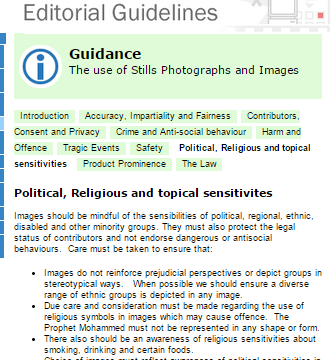
Well, as you can see from that now-deleted (but still cached) BBC Editorial Guidelines page, there was indeed such an editorial guideline:
When possible we should ensure a diverse range of ethnic groups is depicted in any image.
Wonder if that's been deleted too (baby with bathwater)?
Subscribe to:
Posts (Atom)