Friday, 18 October 2019

Kirsty v Paul


Though Emily Maitlis continues to regularly retweet her ex-Newsnight colleague Paul Mason (as if they are still besties), there doesn't seem to be a huge amount of warmth now between the ex-Newsnight far-left extremist and another of his former Newsnight colleagues, namely Kirsty Wark - at least if tonight's Newsnight is anything to go by. This snippy exchange was even chillier in the flesh than it appears on the page:
Kirsty Wark: Joining me tonight we have Salma Shah, who was a special advisor at the Home Office until earlier this year, The Sun's political editor Tom Newton Dunn, author and Labour activist... 
Paul Mason: (interrupting): Journalist. 
Kirsty Wark: ...author, journalist and activist Paul Mason, and Westminster Correspondent for the Yorkshire Post, Geraldine Scott. 
Actually, Kirsty was right first time.

Haste thee nymph, and bring with thee Jest and Legal Jollity


Jolyon Maugham QC may be a figure best known to those of us who spend far too much time on Twitter, but his various high-profile legal attacks on Brexit have hit the news and featured in many a BBC report

Not today though. I can't find a mention anywhere on the BBC of the Scottish courts rejecting his latest major anti-Brexit foray - a bid to use the Scottish courts to declare Boris's deal "void" and, thus, scupper it. (Can you?)

The Scottish judge, on chucking his case out, said of Jolyon, "the petitioner does not have a prima facie case. In the first place, the petition is of very doubtful competency." He also called his petition "misconceived and unjustified" and "weak". (Ouch!)

Of course, the BBC's failure to report his latest humiliation may - in the parallel universe the famous QC inhabits - be because the BBC doesn't like him and want to make him blush by completely sparing his blushes, or something.

After all, he accused the BBC of outrageous bias after a BBC cameraman focused more on Joanna Cherry of the SNP than him during their joint statement to the media after a previous anti-Brexit court case, despite the BBC broadcasting their joint statement to the media live and in full on the BBC News Channel.

I've tweeted him this evening, in a helpful spirit, and said:
It never surprises, @BBCPolitics, does it? First, they failed to feature you in every shot with Joanna Cherry a while back and now they're failing to report your abject failure in the Scottish court and the judge's ruling on your petition being of "very doubtful competency", and his calling it "misconceived and unjustified" and "weak".
Wonder if I'll get a pile-on? (If only!)

Radio 4 listeners II


...And talking of 'just your average Radio 4 listener', Feedback is running a feature at the moment which aims to 'take Radio 4 listeners out of their comfort zones'.

Every week the two chosen listeners give their own 3 Desert Island Disc choices of Radio 4 programmes.

So far this series every one - male, female, young or old, posh or even posher - has included Woman's Hour in their personal Top 3s.

Even the old chap today who first named Farming Today and Just a Minute then rounded off his list with Woman's Hour.

How Radio 4 is that!

Hilariously Roger Bolton took them 'out of their comfort zone' by asking them to listen to Trending on the BBC World Service. Trending is as Radio 4-like a programme as you could ever wish to hear, frequently 'woke', regularly obsessing about race.

It may have surprised Roger but it didn't surprise me that they'd love it and didn't feel remotely 'out of their comfort zones'. (They sounded the type - no offence)! 

The subject of the programme was "Can an algorhythm be racist?" 

And Roger Bolton himself loved it. He even said so:
And, so, do you think it was a good subject? I mean, from my point of view I hadn't really thought about algorithms being racist so - and it's a terribly important issue - so I was impressed by the choice of subject.
That didn't surprise me either.

Radio 4 listeners I


The main story on tonight's Feedback was the BBC''s coverage of Extinction Rebellion. 

If the range of voices chosen by Feedback was representative then Feedback's complaint bag is bulging with pro-XR people griping that the BBC isn't covering their rebellion anywhere near enough. 

I did rather admire the listener who complained that Radio 4 had ignored the Met's clearing of the protests on Monday evening. She'd obviously monitored the stations output during Monday night and through most of Tuesday. She said The World Tonight hadn't reported it, the following morning's Today hadn't reported it, nor had The World at One. PM reported it in its headlines, and Radio 4's Six O'Clock News reported it 20 minutes in. I checked TV Eyes to see if she was faking it, but she wasn't. She was right in every respect.

Such complainants could, of course, be activists writing in as part of a campaign or just your average Radio 4 listener. We'll probably never know for sure.

Anyhow, Roger talked to an ex-BBC journalist turned academic, who was largely sympathetic to the XR-friendly listeners' complaints - as, indeed, sounded Roger himself.

It's an odd programme at times. I still think Newswatch does it better. 

No mea culpa from Katya


  • 3/10 Katya Adler: "The chances of getting a deal now, between now and the EU leader's summit is zero, let's be honest."
  • 10/10 Chris Mason: "Katya, you were saying, last week I think it was, I may not be quoting you entirely verbatim, but the essence of it was you thought that there was a vanishingly small likelihood of a deal...It's still vanishingly small."
  • 10/10 Katy Adler: "It's not going to happen." 

So, on last night's Brexitcast, did Katya & Co. do the decent thing and admit that they got it wrong? 

Of course not. 

In other news...


Of course there was big Brexit news yesterday, but Dame Louise Ellman's resignation from the Labour Party that she's been a member of for 55 years was a big story too. 

She'd had enough of the antisemitism and the bullying and the Corbyn leadership's tolerance of it. 

So how did BBC One's main news bulletins cover it? 

Wednesday evening's News at Ten gave it 26 seconds. Thursday lunchtime's News at One gave it 2 minutes and 20 seconds and Thursday evening's News at Six gave it 16 seconds. Thursday night's News at Ten didn't cover the story. 

Here's how Thursday evening's News at Six reported it, in full:
Jeremy Corbyn says Labour does not tolerate anti-Semitism after a female Jewish Labour MP quit the party over her concerns. The Labour leader paid tribute to Dame Louise Ellman, who has been the MP for Liverpool Riverside for over 20 years, and said he was opposed to any form of racism. 
That doesn't seem adequate, does it?

Map


This is quite interesting. The Turkish one seems apt:

Thursday, 17 October 2019

Impartial, free and fair?


Language Evan!


Let us talk to a couple of MPs: Conservative MP Andrew Bridgen - a Brexiteer, voted against Theresa May's deal three times...I think we call you 'a Spartan', don't we, Andrew?...and the Labour MP Peter Kyle, who is very keen to have a confirmatory referendum.
He's certainly trying - "I think we call you 'a Spartan', don't we, Andrew?" - but the phrase "a confirmatory referendum" didn't come with audible quotation marks, as it should have done.

Then came Evan's question to James Forsyth of The Spectator tonight:
How many of the hardline, so-called Spartans - the ERG, the people who really have always voted against the offers cos they've involved too much compromise - how many of them do you think will remain stubbornly against this?
It was good of him to put quotation marks about "Spartans", but how about putting them around "hardline" too? And what's with the editorially-loaded word "stubbornly"? 

The lad seems to be trying to do the right thing but his language keeps on betraying him.

But...


That said, Evan is being overly free tonight with the word "confirmatory" in connection with a second vote/referendum. He's used it twice so far without implying quotation marks around the word.

"Confirmatory" is not a neutral word in this context. 

"Us"


Evan Davis, on tonight's PM, has done the decent thing and admitted that he (and, presumably, his BBC colleagues) got it wrong: 
Boris Johnson got a deal that many of us thought was impossible. The EU did move, contrary to its own assertions, to those of many experts and to the assumptions of many of us in the media. 
Well done Evan!

Tonight...


I can't wait for the mea culpas from Katya & Co:

Mystic Katya


Fans of useless BBC punditry may especially relish this exchange from last week's Brexitcast on BBC One:
Chris Mason: Katya, you were saying, last week I think it was, I may not be quoting you entirely verbatim, but the essence of it was you thought that there was a vanishingly small likelihood of a deal. And for all of the noise and the talk of, you know, the clouds and now, maybe, a little ray of sunshine, it is still vanishingly unlikely in the current timeframe, isn't it? I mean, I know it's important to keep the diplomatic channels open and keep talking and regardless of what happens there are going to have to be conversations between Dublin and London and all that, but getting a deal so the UK can leave by the end of October, which is three weeks today, and the ratification that's necessary for that and all the rest of it, still seems vanishingly small. 

Katya Adler: I think if Harrison the Brexit baby forgives me, we are really in a situation where nobody wants to be left holding the baby. Nobody wants to be the one that says it's not going to happen. But it's not going to happen. Maybe, maybe, there is a 0.0000-0.3% chance that it will happen.  
Chris Mason: It was 0.2 this morning!  
Katya Adler: But nobody, nobody, nobody wants to be the one to say it. 
So two of the BBC's very own top Brexit brains were repeatedly telling each other - and us - only last Thursday that "there was a vanishingly small likelihood of a deal", with Katya Adler going so far as to put a figure of 0.0-0.3% per cent on its likelihood.

Just one week later....


Indeed, on the previous week's episode Katya had said (to murmurs of agreement from the fellow BBC Brexitcasters):
The current proposals on the table are not acceptable to the EU, full stop. Let's be honest about that. The chances of getting a deal now, between now and the EU leader's summit is zero, let's be honest. 
Can Chris and Katya ever be taken seriously again?

P.S. Here's Laura Kuenssberg on 8 October's BBC One News at Six being slightly more cautious:
Politics has been strange in the last two years. Never say never. A deal is not completely and entirely off the table in time. But it seems vanishingly unlikely that we are actually going to get into that position with the time left. It is only a matter of days since the Prime Minister put his new proposals on the table in Brussels and quite clearly they are simply not changing hearts and minds and they are simply not on course to be able to get to a conclusion. 

News about the BBC


The BBC could be made to scrap the TV licence and charge a Netflix-style fee, the culture secretary has suggested.  
Nicky Morgan has opened the door to the BBC becoming a subscription service, saying she was “open-minded” about a change if it would raise enough revenue for the corporation. Giving evidence to the Commons digital, culture, media and sport select committee, Ms Morgan was asked by the Tory MP Julian Knight: “The BBC moving to a subscription service is being floated as a potential policy for the next Conservative manifesto. What is your view?” She replied: “I would need to understand what that would do to their income. I think that the BBC is a very important institution, it’s an enormous part of our soft power around the world, but undoubtedly the sector is changing. We all know from streaming services and the way the younger generation consume services, it is going to change.  
She added: “I am open-minded and I will listen to evidence on all sides.”

Hmm. She actually sounds rather non-committal, doesn't she? 

Meanwhile, also as per The Times, the BBC has scrapped its virtual reality project (and, no, that doesn't mean Reality Check!):

The national broadcaster confirmed the closure this week of its VR hub team, responsible for the production and commissioning of films.  
The unit was founded in 2017 after Facebook launched the Oculus Rift headset, when companies were convinced of the technology’s potential.  
It released well-reviewed experiences including 1943 Berlin Blitz, a recreation of a Second World War bombing raid. The films are believed to have attracted tiny audiences, however, compared with other BBC content.  
The BBC declined to disclose how much was spent on VR projects. Members of the team will be moved to other work. A spokeswoman said: “It has been an important part of our charter commitment to promote technological innovation and maintain a leading role in research and development which benefits the whole industry.”

"The BBC declined to disclose how much was spent on VR projects." Very BBC!

Usual business


Toby Young is disappointed:
I tuned into Newsnight to see how close we are to the deal and am none the wiser. The usual adversarial format, with backbench Conservative MPs doing their best to to defend the govt from the BBC’s prosecuting council, is neither informative nor entertaining.
That does seem to be the standard format these days.

As does the unbalanced panel, stacked against Brexit supporters.

Wednesday, 16 October 2019

No, they haven't


One of the top three headlines on the BBC News website this morning is Have UK voters changed their minds on Brexit? 

It's a piece by Sir John Curtice and, reading it, the answer he gives is 'No, they haven't':

...very few voters on either side of the argument have changed their minds about whether the UK should leave the EU. The country appears to be just as divided as it was three years ago. 
On average, during the last month, polls that ask people how they would vote in another referendum suggest that 88% of those who backed Remain would do so again. Among those who voted Leave, 86% have not changed their minds. 
These figures have changed very little during the last two years. 
True, most polls suggest - and have done so for some time - that the balance of opinion might be tilted narrowly in favour of remaining a member of the EU. On average, this is by 53% to 47%. 
However, this lead for Remain rests primarily on the views expressed by those who did not vote three years ago - and perhaps might not do so again. 
In truth, nobody can be sure what would happen if there were to be another referendum.

Very interestingly, the main question - 'Which of these scenarios do you favour the most? - results in the three 'Leave' options getting 46% and the 'Remain' option getting 34%.

Also intriguing is Sir John's finding that how you word the question in a poll really does influence the outcome (not that that's really a huge surprise):
When people are asked about a "public vote" they are more likely to show support for another ballot than when asked about a "referendum" on the UK's membership of the EU.
...which is why the BBC needs to be very careful about the language it uses - specially when it talks about a 'public/confirmatory vote' rather than 'another/a second referendum'.

It will be interesting to see how the BBC itself covers (or spins) these findings. 

Jon Sopel reports


It is striking just how far Jon Sopel goes these days in turning his reports for BBC News into out-and-out anti-Trump editorials. 

He was so focused on pinning the blame on Donald Trump on last night's BBC News at Ten that he failed to spot a 'misspeak' by Mike Pence. (Mr Pence meant 'Syrian Democratic Forces' ).

Here's a transcript:

BBC Newsreader: Turkey is continuing its military offensive in northern Syria - aiming to defeat Kurdish forces, whom they regard as terrorists, and to create a buffer zone to resettle millions of Syrian refugees presently in Turkey. The conflict erupted after Donald Trump withdrew US forces, creating a vacuum in Kurdish-controlled areas - into which Turkey stepped. Today, Syrian government forces - supported by Russia - continued to move to areas once occupied by the Kurds, whom they've now agreed to support. President Trump's action has been widely condemned for altering the balance of power in the region. Tomorrow, Vice-President Mike Pence will travel to Turkey for talks. Our North America Editor, Jon Sopel, reports from Washington.  
Jon Sopel: The extraordinary American retreat, in one selfie video. A Russian wearing a New York Yankees cap playfully shows us around a newly abandoned US military base in northern Syria. The Russians are gratefully filling a vacuum. And as if to underline this major power shift in the Middle East, just look at the welcome the United Arab Emirates were laying on this morning for the Russian leader, Vladimir Putin, as they gave him the red - well, blue - carpet treatment. But it's a very different picture on the ground in northern Syria, where the Turks continue their bombardment. And don't think it's just Kurdish fighters that are the target. If you strike residential areas, then children who know nothing of this conflict will be its victims too. The fighting has prompted the UK to join some other European nations in suspending arms sales to Turkey. In Washington, the President has faced a barrage of criticism, and there are signs the pressure is beginning to tell, with tougher sanctions being imposed against Turkey. 
Donald Trump: We want to bring our soldiers back home. And we're being very tough on Turkey and a lot of others. We're asking for a ceasefire. We've put the strongest sanctions that you can imagine, but we have a lot in store if they don't have an impact. 
And the result of the pressure can be seen by comparing the difference in tone between Donald Trump last week and the vice-president, Mike Pence, last night:
Mike Pence: Syrian Defence Forces have been a strong ally of the United States.  
Donald Trump: They didn't help us in the Second World War, they didn't help us with Normandy, as an example... 
Mike Pence: Well, the United States of America did not give a green light to Turkey to invade Syria.  
Donald Trump: But he said, "I want to go in, I want to go in," but he's been telling me that for two and a half years.  
Mike Pence: The President is very concerned about instability in the region.  
Donald Trump: They're there, and we're here - we're many miles away. 
The ledger on Donald Trump for these past ten days is pretty harsh. He stands accused of betraying America's Kurdish allies, of allowing Islamic State to regroup, of creating a humanitarian disaster, of giving Russia, Syria and Iran a major strategic victory. On the upside, he is bringing 1,000 US troops out of Syria. But they're not coming home. They're being redeployed to Iraq. A week of artillery fire, bombing and fighting has claimed the lives of many civilians, and prompted at least 160,000 to flee their homes. All a result of one phone call between President Erdogan and Donald Trump. Jon Sopel, BBC News, Washington. 

Tuesday, 15 October 2019

Rigging their reports?


The Government's plans to tackle voter fraud by introducing a legal requirement for voters to show photographic identification before they are allowed to vote in an election - the 'Voter ID proposal' - are certainly riling some people and exciting others - at least if my social media feeds are anything to go by (which, as ever, they possibly aren't).

For the purposes of this blog, I'll just point out that the BBC News website's two pieces about this (via a 'search') have borne the following headlines respectively: Voting: Could ID checks affect who participates in elections? and Corbyn: Voter ID plans discriminate against ethnic minorities

Now, the BBC could have borne alternative headlines, such as: Voting: Could ID checks eliminate electoral fraud? and Government: Voter ID plans will increase public confidence in the integrity of our democratic system, but they obviously weren't minded to do such a thing.

Both of these BBC reports - one a BBC-stamped Reality Check - make evident the BBC's belief (as it very much appears to be) that (a) electoral fraud is actually at an almost negligably low level in the UK and that (b), as the proposal's critics say, the racially discriminatory potential of introducing ID checks is clear and will be harmful to social cohesion.

(Note: The BBC's 'Corbyn' report has just one reinforcing sub-headline: 'Marginalised'.)

I'm slightly torn on the issue myself but, from this, I don't think the BBC is. They seem decided on the matter.

XR very much alive on the BBC


XR's Zion Lights (whose date with Andrew Neil didn't go too well. Maybe she should have tried Andrew Marr?)

Though complaining the other day that they were being excluded from the BBC's airwaves - despite prominent members appearing on Question Time, Politics Live and The Andrew Neil Show within the space of just one week (last week) - I'm still seeing supporters of the supposedly-silenced Extinction Rebellion on the BBC. 

There were two of them, for example, on this morning's Victoria Derbyshire show, discussing whether the Met police were right to ban them from the streets of London.

Both being supporters, they both agreed the police were wrong.

The other side of the argument was supplied by...er...no one. 

Oddly, using TV Eyes to further check on the BBC's coverage of this story, I see that, though it has been a major headline throughout much of the day, the BBC News Channel hasn't actually interviewed many people about it.

In fact, the only non-VD Show interview today (so far at least) has been with Green MEP Ellie Chowns [Alexander, from the previous post, will approve!]. She supports XR and was arrested last night during the police clear-out while questioning the police's actions. 

Surely even St. George Monbiot wouldn't think that this provides evidence of anti-XR BBC bias, would he?

All in an afternoon's work


The fox that set the #FBPEs flapping and squawking today

The BBC's Editor of Live Political Programmes, one Rob Burley (have I mentioned him before?), has been busy again this afternoon


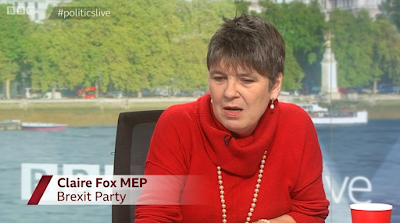
Rob Burley: (1) On the Brexit Party and why they have more MEPs on Politics Live than other parties: The BP polled first in the European elections in May with over 30% of the vote. They enjoyed considerable electoral support and 29 MEPs and as a new party have yet to fight a Gen election.
(2) Under the electoral system they may well not get any or many MPs when they do stand in Gen Election (see UKIP) but they did win significant support in May and are polling at 13% or so still. Politics Live is a Westminster based show and relies on MPs.
(3) ) So for those parties with a significant number of MPs, they will be our first port of call. But the Brexit Party got 5.2m votes in May, so they will come on from time to time because of their electoral support. but that will inevitably mean we draw on MEPs not MPs.
(4) I understand the argument that some make, that we should hear more from MEPs in general, but this is a separate argument as to whether, given their support and the nature of their politicians, we should draw largely on BP'S 29 MEPs.

Jorvik #RevoleArt50,#RemainerNow: Did other residents of 55 TUFTON STREET also perform well over the last 3 years Rob because they have been on there more times than any Liberal Democrat?
Rob Burley: Let me know the names of the 55 Tufton St "residents" who have been on Politics Live? The closest you will get is the IEA (you can look up address) who have been on a handful times. They've not been on anything like as often as the Lib Dems, let alone more.

Alexander Louis Sallons: What about Green MEPs, Rob? We went from 3 to 7 and I don't think we've had any of them on PL since May?
Rob Burley: Not the case. We have had Molly Scott Cato but, obvs, also Caroline Lucas as well as others like Sian Berry.
Alexander Louis Sallons: So that's one Green MEP since May. Don't get me wrong I'm not a conspiracy nut. But one Green MEP compared to all the Brexit MEPs that seem to be on. You'll never get a balanced argument about how the EU works/operates if you only ever bring on MEPs who are from the Brexit Party.
Rob Burley: Different argument about whether we should have more MEPs on - from all parties - rather than MPs from those with them and MEPs from those without. That's fair enough but I can't argue all aspects right here. I'm just explaining why BP have MEPs on more.
Alexander Louis Sallons: Because they're the biggest party and they won the Euros, that's fair enough, I can understand that. But there are 39 ProEU MEPs. Most MPs won't be able to provide the same perspective of the EU that an MEP can, most will only be able to provide a UK only view.

Craig - I can see Alexander's point about the paucity of MEPs from across the full range of parties. It might be interesting to expand the range of guests  - though, as Rob pointed out, as far as the Greens go they also get invites for non-UK/non-EU parliamentary figures like Sian Berry. 

Briefcase Michael: For the sake of transparency Jo Coburn should have told viewers that James Harding is the former Head of BBC News, and before that Editor of The Times.
Rob Burley: For the sake of transparency, he was introduced as being from Tortoise, then Jo Coburn told viewers he used to work at the BBC and, in that discussion, he mentioned he'd previously worked for the Times.
Orla #EngineOfHope #GTTO (to Briefcase Michael): Absolutely. It looks like ex-BBC politics dept at Tortoise Media have a weekly seat on Politics Live. We see you Rob Burley.
Rob Burley: "We see you" . . .Tortoise have been on the show a grand total of twice in a show that's been running five shows a week since September 2018. Is that a weekly seat?
Orla #EngineOfHope #GTTO: Twice in the last month. Tortoise staff all seem to be ex-BBC news & politics, so far. Again BBC promoting its own singular Tory bias. Its the only way they can win elections. Look at the rotating door between BBC - #CCHQ - No10. Go well :)

Craig - Orla, you won't be suprised to here, is a self-proclaimed 'Corbyn outrider'.

A devoted sister


Is it important to know that Cordelia Rowlatt, the sister of the BBC's new Chief Environment Correspondent Justin Rowlatt, is an active campaigner with Extinction Rebellion or that she faces trial in January for "a public offence" during climate protests in April? Or does this have no bearing on him or his work for the BBC?

I have a little list


Fans of lists might be interested in reading the following - a list of those appearing on BBC One's State Opening of Parliament special yesterday. This interview list is nothing if not Remain-heavy:

  • Dame Margaret Beckett 
  • Lord Fowler 
  • Bronwyn Maddox, Institute for Government 
  • Robert Hardman, Daily Mail 
  • Dominic Grieve 
  • Andrew Bowie, Conservative; Ed Davey, Lib Dems; Jenny Chapman, Labour; Joanna Cherry, SNP (the four mainstays of the programme in the studio) 
  • Liz Saville Roberts, Plaid Cymru 
  • Caroline Lucas, Greens

Why indeed


Why should Boris kowtow to biased BBC presenters who say that he's a 'dictator'?
That, of course, refers specifically to Nick Robinson, who said on Sunday of Boris Facebook 'People's PMQs', "And they say that’s democracy. It ain’t democracy. It is a form of propaganda used by dictators down the ages."

The Telegraph piece by Robin Aitken puts Nick's "jibe" down to "pique": 
Johnson has found a way to communicate with voters without subjecting himself to interrogation by the likes of Robinson and his ilk and they can't stand it. 
He continues:
If Mr Johnson had agreed to all the interview requests the BBC has made in recent weeks what would have been achieved? Would any of us be much clearer about the government's intentions? Would the country be any more united behind what the government is proposing? I think I can confidently answer all those questions in the negative. 
What we would have been treated to would have been a series of hostile interviews in which Robinson – or some other tribune of the people – would have tried to embarrass the Prime Minister and trip him up. He would have been pressed over and over with questions impossible to answer. 
A few weeks ago, for instance, Today presenters repeatedly challenged government ministers by saying that the EU had ruled out any possibility of re-opening negotiations on the terms of our departure, therefore why was the government proposing changes? The EU's position was stated as an unchallengeable matter of fact to which there could be no adequate answer. Ministers facing this question sounded either evasive or stupid, and yet, here we are a few weeks later, having that very renegotiation.
 Fair points, I'd say.

Numbers


Talking of the BBC's Middle East editor, this is interesting from BBC Watch. 

They cite a Media Masters interview with Jeremy Bowen where Jeremy says:  
“I would say that the conflict, it looms with real weight and damage on the shoulders of many Palestinians, because they are weaker and don’t have the resources and many of them live under occupation. That’s the key thing, if you live under occupation, life becomes way, way more difficult.”  
“…plenty of Palestinians feel very threatened by settlers, armed settlers, by soldiers, by raids in the middle of the night, by helicopters, you name it. And many Israelis have been hurt by and continue to be worried about attacks by Palestinians, though there haven’t been all that many in recent years.”
BBC Watch says:
What Bowen means by “recent years” is not entirely clear but in 2015 there were 2,398 terror attacks in Israel (of which the BBC reported 3.2%). In 2016 there were 1,415 attacks (of which the BBC covered 2.8%), in 2017 there were 1,516 attacks – less then one percent of which were reported by the BBC – and in 2018 the BBC covered at most 30.2% of the 3,006 attacks launched. During the first nine months of 2019 the BBC reported 23.6% of the 1,709 attacks which took place. 

Obviously the BBC’s ongoing failure to adequately report the scale of terror attacks against Israelis serves its Middle East editor just as badly as it does the corporation’s audiences. 

Twitter bantz


Nick Bryant, BBCIf you were wondering what’s on the mind of the President of the United States this morning....
Donald Trump: Vote for good guy Sean Spicer tonight on Dancing With The Stars. He has always been there for us!

A chain of events


Jeremy Bowen's latest column for the BBC News website is a dramatic read. It begins:
It has taken a week to reshape the map of the Syrian war, in the seven days since President Donald Trump used what he called his "great and unmatched wisdom" to order the withdrawal of US troops from northern Syria. 
He set off a chain of events that betrayed America's ally, the Syrian Kurds, and opened a cornucopia of opportunities for Turkey, the Syrian regime of President Bashar al-Assad, its backers, Russia and Iran, and the jihadist extremists of Islamic State (IS).
It's receiving praise on Twitter:
Thank you for letting a little justified anger creep into the analysis - it’s all too easy for the media to write cold, detached, commentaries on a devastating war that has been shamefully prolonged by self-serving external forces. This was a needed corrective. Trump should read.

Monday, 14 October 2019

Nick Robinson speaks


Nick Robinson, speaking at The Times and The Sunday Times Cheltenham Literary Festival, has expressed his disapproval of LBC for giving a party leader, Nigel Farage, a two-hour radio show. He calls it a "great danger".

He also disapproves of Boris Johnson using Facebook for his People's PMQs to "broadcast directly" to the public. “And they say that’s democracy. It ain’t democracy. It is a form of propaganda used by dictators down the ages”.

And as for political types who pen official complaints to the BBC he says, “It is lunatic that people that are politically motivated, who are trying to alter the agenda of the BBC, can use our complaints process. And believe me they do. To try and bully the BBC into saying and doing the things they want us to be saying and doing.”

If he reads the comments below the article on the Times website, he'll find plenty more complaints about the BBC and an awful lot of democracy. They could be going better for him.

Sunday, 13 October 2019

Connect 4


Ah now, this is what you've all been wating for. Me, banging on about Mark Mardell again. So enjoy!...

With my bias-focused glasses on, and in a pseudo-professorial mood, I listened to today's The World This Weekend and found Mark Mardell's report from St. Albans - a Remain-voting constituency with a pro-Brexit MP, Anne Main - to be pleasingly fair in the wide range of voices it provided. 

But the programme's introduction was not fair. It chose to feature two voices from that report, both of whom were anti-Mrs Main.

(Mrs Main might want to put in a complaint.)

As the programme's main theme was 'Boris potentially throwing Conservative MPs in Remain seats "under a bus"', I'm presuming this one-sided choice of illustrative voices was meant to reinforce the programme's chosen theme. 

And then, straight after the report, came a discussion on the subject featuring two pro-Remain journalists: Anne McElvoy of The Economist and Stephen Bush of The New Statesman

Why two known pro-Remain journalists?

Well, the clue came in the final feature: a segment on Cardinal John Henry Newman featuring one of his sermons which, as Mark put it, "we though sounded rather apt and up-to-date".

"Something strange is passing over this land...a national commotion almost without parallel...it threatens worse still, or at least gives no sure prospect of alleviation..."

Mark quipped that he wasn't talking "about that" but about the restoration of Catholic bishops in England, but - from his own lips - we now know that Mark and The World This Weekend team were talking "about that" in their take on the canonisation of Cardinal Newman. 

'I can't see why you're laughing'-gate


Is Andrew laughing now?

I see that 'I can't see why you're laughing'-gate has gathered momentum throughout the day as more and more people react against Andrew Marr's unjust telling off of Priti Patel for "laughing"

As I wrote this morning, she wasn't laughing. 

I watched and re-watched it before posting that, and she just wasn't doing what Andrew accused her of.

So what was she doing that so irked Andrew Marr into verbally manslapping a woman of colour? 

Well, as I also wrote this morning, she was just doing that thing she often does with her face while not talking. Is it a smirk, as her opponents claim, or a nervous thing, or just something she's always done and the natural resting place of her face while listening and politely engaging with people? 

(Whatever it is, I like it. I think it makes her look cute...Should I say that? Probably not.)

Still, it roused Andrew Marr to enough anger to say what he said to her in such a sharp, condemnatory tone. 

Others on Twitter are saying that it showed gross bias on Mr Marr's part in that she was the only one he seriously interrupted and was huffy towards. 

Well, yes, Priti Patel most certainly did get the toughest treatment today. Neither Becky Long-Bailey nor Nikki Sturgeon received such forceful treatment.

But, as ever, such things need to be balanced over time. Just because Priti Patel got the toughest treatment today doesn't prove bias.

Anyhow, I see that both Andrew and Rob Burley are (so far) maintaining radio silence on Twitter about it. Are they both thinking that Andrew got it badly wrong?

I hope so (as he did), and that they'll apologise to her.

It's the right thing for them to do.

Blurring the boundaries


The boundaries between reporting and campaigning at the BBC are getting ever more blurred. 

Earlier today I cited the BBC's Quentin Somerville (a brave reporter) reporting the plight of orphaned children of dead IS parents caught up in dangerous camps in Syria and calling our failure to give them sanctuary "a disgrace". 

He's been doing his absolute best today to get three orphaned young children returned to London. 

Now, he himself says that it's been "particularly hard" reporting their "traumatic testimony". And that's perfectly understandable. They are very young, their situation is awful and all the fault was with their dead parents. Rescuing children in peril is a powerful and wonderful instinct, and Quentin can't be blamed for being overwhelmed by the feeling to do so. 

But it raises all manner of questions about BBC impartiality. 

He's going further and further in expressing contentious opinions on the matter. 

His reporting of the Shamima Begum and Jack Letts cases left me in little doubt that he was wanting them returned to the UK too, and a  tweet from him this afternoon further confirms that:
The SDF repeatedly told Britain to take back the likes of Shamima Begum and Jack Letts. Instead the UK stripped them of their citizenship. It was never a sustainable policy in the long term.
Has he overstepped the bounds, impartiality-wise? And, if he has, is he right to do so? 

Discuss (if you wish).