Showing posts with label Afghanistan. Show all posts

Tuesday, 7 December 2021

“The details of this story are pretty astonishing”


“The details of this story are pretty astonishing”, tweeted Jess Brammar, editor of the BBC's news channels, this morning. 

She was referring to a BBC News website report by James Landale, the BBC's diplomatic correspondent: Afghanistan: Foreign Office chaotic during Kabul evacuation - whistleblower

Reading it myself and then reading other accounts astonished me too. 

The headline in The Times shows where that paper's emphasis lies: Work-from-home culture fuelled Kabul chaos, leaving Afghan refugees in danger, says whistleblower

The Daily Mail agrees. In its account, the whistleblower's main point is that the UK's Afghan rescue effort was hampered by a 'work from home' culture in the Foreign Office. 

That, however, doesn't even get a mention in the BBCs report. It's not listed under ifs 'Key issues flagged' flagged section. It must be a key point, however, as the Guardian lists it as a key point under the sub-headline FCDO ‘working culture’

The public service 'working culture' at the FCDO sounds rather similar to that at the BBC. Is that why the BBC hasn't reported this part of the story, either because it made they weren't interested in it or felt uncomfortable reporting it? The ''chaos'' outlined in the BBC piece is about everything but that.

Update: As others are noting, the name 'Joe Biden' is missing from that long report about the chaos of the withdrawal from Afghanistan, despite him being ultimately responsible for it. 

Saturday, 18 September 2021

Different president, different reporting


Even since the Biden administration's bungled withdrawal from Afghanistan climaxed in the deaths of 13 US marines and some 200 others at Kabul airport at the hands of Islamic State's Afghan offshoot and the US quickly retaliated, claiming to have successfully struck two ISIS-K targets, doubts have been expressed about those targets. Were they really terrorists? 

We'll probably never know if those killed in the first, surprisingly swift strike were really senior IS commanders, as was claimed at the time, or were merely low-level IS members, or just unlucky locals killed by mistake, because the US has refused to provide any details. It happened out in the Afghan countryside, far from journalists' eyes.

The doubts about the second ''righteous strike'' [Mark Milley, US chairman of the Joint Chiefs of Staff] surfaced straightaway. I saw photos of the children killed in the attack within hours and some media organisations were on the case straightaway too saying that an innocent family had been hit, not IS-KP terrorists. From the first hours it looked to me as if the US had struck the wrong people. But the bullish Biden administration/Pentagon officials stuck to their line that it was IS terrorists on their way to attack the airport again who had been vaporised. Finally, the US has now admitted that they did indeed strike the wrong target. They actually hit an aid worker and a translator and another ally, and seven children. What the US military thought were weapons were actually water bottles.

Watching BBC News at Ten's brief coverage of the US admission last night and reading the BBC News website's report on the story, featuring 'analysis' from Barbara Plett-Usher, I was struck by how little they were tying the Biden administration to the story. It's as if they were downplaying the Biden administration's responsibility. No mention of Mark Milley. Just a passing somewhat positive reference in the online piece to Joe Biden.  [''The last US soldier left Afghanistan on 31 August - the deadline President Joe Biden had set for the US withdrawal.'']. And quotes from the US Defence Secretary being added to the online piece 9 hours later.

I think blog favourite Adrian Hilton sums it up well:
Adrian Hilton: If this appalling tragedy had occurred under Donald Trump, I'm sure UK media (esp. BBC News and Channel 4 News) would have apportioned blame directly at his feet, and given it hours of negative coverage. But under Joe Biden it's excusable; not newsworthy...'collateral damage'.
To put it another way: Just imagine what would have happened if Donald Trump had carried out the strikes, and seven children had been killed in a botched response to a terror attack which killed 13 Americans as a result of bottlenecking caused by the chaotic withdrawal from Kabul airport, accompanied by images of people falling from the wheel wells of aeroplanes. 

It speaks of biased reporting. 

And scanning the BBC's TV channels today for 'Biden', he's only being mentioned in connection with a pro-Trump/pro-Capitol protesters rally coming up this weekend and the French withdrawing their ambassadors to the US and Australia over Aukus.


UpdateNomia Iqbal's report on the BBC News Channel this morning ended by focusing on ''the US military'', not the Biden administration:
This awful mistake further dents the US military's reputation, that has already been damaged by its chaotic withdrawal from Afghanistan.

Sunday, 5 September 2021

Don't be beastly to the Pakistanis!


There was a fascinating interview overnight on the BBC featuring Professor C. Christine Fair. Unfortunately it also got a bit feisty when the BBC began to panic over Professor Fair's analysis and Philippa Thomas rallied to Pakistan's defence. Professor Fair was soon being talked over and eventually faded out and cut off. Here, unredacted, is the full interview, preserved for posterity: 

Philippa Thomas: Right, let's speak now to Christine Fair, Professor of Security Studies at Georgetown University in Washington. Professor Fair, thank you very much for being with us. What you make of Faiz Hameed's visit to Kabul?
Christine Fair: First of all, thank you for having me. So I don't really make anything special out of this. I think for those of us that have been watching these affairs and Afghanistan evolve, not in the last 10 or 20 years, but actually the last, I mean, going back to 1973, this has been Pakistan's project. Without Pakistan the Taliban would be a nuisance, it wouldn't be the competent and capable terrorist organisation that is. So this is, in some ways for Pakistan, sealing the deal. You know, there are a lot of fissions across the different shuras of the Taliban, but the most important shura is the shura in Rawalpindi.
Philippa Thomas: Pakistan, of course, denies that it has created the Taliban or it supports it militarily behind the scenes in anyway. 
Christine Fair: Yeah, well, Pakistan gets away with lying largely because most people don't confront them. You know, various foreign ministers, various Pakistan army chiefs, presidents, prime ministers have come and gone before various shows like your own and they make these outrageous statements and most people are just too polite to question them. And then this just becomes part of their ossified fiction. But I've written an entire book on the Pakistan army using primary sources. And, you know, the Pakistanis first began the jihad in 1973. It didn't happen after the Soviets invaded Afghanistan, as is popularly believed. It actually began under Zulfikar Ali Bhutto. And even though the Pakistanis will make those claims, there's also those who very forthrightly admit it. MALIA LODI [spelling?], who has long been the amanuensis of the ISI with lipstick, you know, she'll very forthrightly say that the Taliban have long been supported by the Pakistanis...
Philippa Thomas: [interrupting] So...what...
Christine Fair: The Pakistanis...
Philippa Thomas[interrupting] What...what then do you think is the interest of the Pakistan government, and the intelligence agencies, when it comes to IS fighters, when it comes to al-Qaeda? Do they have a joint interest maybe with the Taliban in suppressing these other groups? 
Christine Fair: So, first of all, I think one just has to understand what Pakistan's interest in Afghanistan is writ large, and Pakistan inherited this notion of strategic depth from the British. The Pakistan army is a product of the British army in India, and so from the earliest months of the Pakistani state it has had a continuation of interests in Afghanistan. And the Afghans themselves did not help their own position by denouncing the Durand  Line, by interfering in Pakistan's restive Baluchistan province, so we cannot see this is something new. It is really important that we understand that this is part of...it's in Pakistan's strategic culture. So...
Philippa Thomas[interrupting] So I just want to...
Christine Fair: So the question that you have, the question that you have posed about Islamic State and Al-Qaeda. Right? 
Philippa Thomas: Yeah.
Christine Fair: So this is a complicated question because part of those organisations also advance Pakistan's interest. I think there's a lot of misunderstanding about the Islamic State - Khorasan Province that somehow it's joined tightly at the hips of the organisation that al-Baghdadi built, and that really isn't true. There were some early communications between them, but the differences...
Philippa Thomas[interrupting] OK, sorry, I want in the time that we have I also want to say, so you have a great deal of historic knowledge of what has happened, and Pakistan and Afghanistan. Given where we are now presumably it's in Pakistan's interest that there is stability, that there is not continued fighting in Afghanistan, or do you see that differently?
Christine Fair: No, no, this is also another myth. What Pakistan has objected to over the last 20 years is the emergence of a stable Afghanistan that is opposed to Pakistan...
Philippa Thomas[interrupting] But an unstable Afghanistan...
Christine Fair: ...and is friendly to India.
Philippa Thomas[interrupting]...surely means more refugees trying to get across the border to Pakistan. How is that in Pakistan's interests? 
Christine Fair: Yeah, right, so this is also a myth that I think Pakistan is very good at peddling. What Pakistan wants more than anything is an instability that it can manage, and also Pakistan will use the refugee story as a part of its usual rent-seeking strategy. You see, Pakistan likes to be thought of as the fire brigade when Pakistan is in fact the arsonist.
Philippa Thomas[interrupting] And Pakistan...
Christine Fair: Pakistan will monetise this. 
Philippa Thomas[interrupting]...of course would absolutely deny that, 
Christine Fair: How do you...how do you...
Philippa Thomas: And I want to come back to your phrase...let me come back to your phrase...
Christine Fair: Yes.
Philippa Thomas: ...''an instability that it can manage''.
Christine Fair: Correct.
Philippa Thomas: Even if, even if...if that is the case that is an immensely risky strategy?
Christine Fair: Pakistan has always been risk-acceptant. There has never been a risk-averse Pakistan, whether you're looking at incredibly outrageous terror attacks in India or whether you are looking at the support for the Taliban in the 1990s and all that that brought about. Look, even the fact that Pakistan harbours virtual petting zoos of terrorists in its own country, with the hope that they will only...
Philippa Thomas[interrupting] Christine, Christine Fair...
Christine Fair: ...only kill their neighbours is a risky strategy.
Philippa Thomas: As we cannot, as we cannot...We don't have a Pakistani diplomat or official to speak with us now, I'm going to say again...
Christine Fair[interrupting] Well, thank goodness you don't...
Philippa Thomas: No, I'm going to say again....
Christine Fair[interrupting] ...because he would pedal this fiction.
Philippa Thomas: ...that I know they firmly, they firmly deny that they have created the Taliban, and that they are the prime mover behind the Taliban...
Christine Fair[interrupting] To be fair, to be fair...
Philippa Thomas: ...and we have given you space to put your point of view, and we are going to leave it now, but thank you for being with us and for putting your point of view...
Christine Fair[interrupting] You are doing their propaganda...[faded out and cut off by the BBC]
Philippa Thomas: And there you go, and there is much more on what is happening in Afghanistan and the region and everything around that, on the BBC website of course.

Saturday, 4 September 2021

Who are the militants in Afghanistan [and India]?


BBC World News, broadcast overnight on BBC One, looks to be recognising the new Taliban regime, even if the UK government hasn't yet.

Here BBC newsreader Karin Giannone describes the people opposing the Taliban as 'militants':
Now there are reports of from Afghanistan of heavy fighting between Taliban forces and militants who oppose the Islamist takeover around the Panjshir Valley.

The Daily Express today has it the other way round, with the Taliban remaining ''the militants'' and the forces of former vice-president Amrullah Saleh and Ahmad Massoud in the Panjshir Valley being ''resistance fighters'':

The Taliban have clashed with a group of resistance fighters in Afghanistan's Panjshir province as the final stronghold against the militants hangs in the balance. 

---------------- 

On a possibly related theme, this glowing headline following the death of a leading pro-Pakistan, Islamist Kashmiri separatist hasn't gone down well in India, where he's a highly controversial figure - understandably so given his pronouncements about Osama bin Laden and the Mumbai attackers:

The introductory paragraph goes on to say: 

Kashmir's top separatist leader Syed Ali Shah Geelani, who spearheaded the resistance movement against Indian rule, has died, aged 92. 

This is the language of approval. 

Here's a flavour of the reaction:

  • As expected, the BBC turns Syed Ali Shah Geelani into a freedom fighter when even Al Jazeera refers to him as "separatist". Is the BBC completely tone deaf when it comes to reporting? What's the reason behind this sustained anti-India stance? What kind of biased journalism is this?
  • Geelani fought to make Kashmir a totalitarian Islamist hellhole. He was partially responsible for massacres and ethnic cleansing of Kashmiri Hindus. He was an enemy of freedom. BBC's headline is unbelievable but reflects their anti-India and anti-Hindu bias.
  • If Geelani was a Hindu, the tone of the article would have been very different. 
  • Interesting. BBC News calls a Talibani-style terrorist Geelani a freedom fighter. The way it is BBC will stitch a burqa for the British queen. 

Sunday, 29 August 2021

John's View


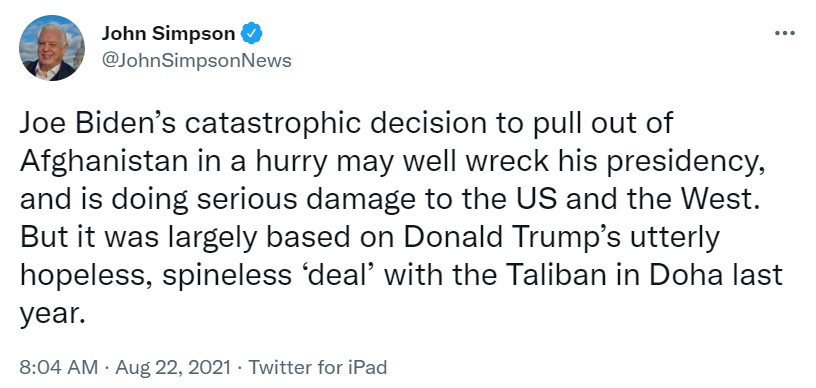
John Simpson, the BBC's impartial yet highly opinionated World Affairs Editor, having previously spoken his brains and splurged his spleen on Twitter against the Biden administration's withdrawal from nation-building in Afghanistan, has today posted a piece on the BBC News website saying the same at greater length.

The piece's headline doesn't bother to disguise its author's opinion - or his name. 

John Simpson on Afghanistan: A country abandoned 

And in it the famous John Simpson of the BBC gives a full-bodied defence of The West's 'liberal interventionalist' intervention in Afghanistan. 

To summarise: Our intervention was a good thing and it achieved even more than we think it did, and we could have kept on keeping on there. 

And he then gives a cry from the heart about the horrible consequences of our withdrawal.

I don't think Tony Blair himself would demur from a single word of it.

John Simpson may or may not be right, but it still fascinates me how he's allowed to be so bold with his opinions on a highly controversial matter at the impartial BBC whilst holding the surely impartiality-bound role of BBC World Affairs Editor. 

Swift Update

And the big guy's back on Twitter now with news of his Radio 4 report tonight featuring ''a leading UK diplomat'' who, you won't be surprised to hear, agrees with him 100%:
John Simpson: Just reported for the 6pm BBC Radio News on Britain's and America's serious defeat in Afghanistan - including the judgement of a leading UK diplomat: the withdrawal from Afghanistan is ‘a thoroughgoing abdication of everything we stand for.’
What are the chances of that happening? John Simpson finding ''a leading UK diplomat'' who says exactly what John believes and John then popping him into his impartial Radio 4 report? 

There can only be one explanation. It's a miracle of BBC impartiality.

Sunday, 15 August 2021

Rumours


'Breaking news' this morning...


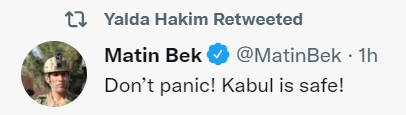
At the very same time that tweet was sent, BBC reporter Yalda Hakim was sending out the following tweets...


Saturday, 7 August 2021

John Simpson on Afghanistan


Afghanistan from space

What more do you want on a soggy Saturday than to read a transcription of a 'liberal interventionist' John Simpson Twitter thread on Afghanistan?:

John Simpson - Amazing how fast people forget.  Afghanistan, left to rot by the outside world in 1990, was taken over by Islamist extremism & the whole 9/11 plot was organised from there - with results that still affect us all. Now we’re bored with Afghanistan, & the process can begin again.

Fillip Jar - How much destruction was caused by the US invasion? How does that make 9/11 less likely to be repeated? Why was / is there a lack of international law on countries being able to start random wars?

John Simpson - There was no US invasion of Afghanistan.  The Afghan Northern Alliance, with the backing of US air power, drove out the Taliban in 2001.

Gary Smyth - But let’s not forget that the extremists were supported & funded by the West (principally US & UK) after the Russian invasion, in a catastrophic case of ‘my enemy’s enemy is my friend’. Therefore the answer to the monumental tragedy of Afghanistan CAN NEVER involve US/UK/Russia.

John Simpson - It’s true that the US was suckered by Pakistan into sending some money & weapons to Hekmatyar, Gary, but it was the far more moderate Northern Alliance & the hugely impressive Ahmad Shah Masoud who got just about all UK & most US cash & support.

Saturday, 8 August 2015

Crying wolf, Newsnight-style


Just to further an earlier point (one I made four days ago, using sticky back plastic)...

Ian Katz's Newsnight seems to be becoming somewhat obsessive in labelling its features as "exclusives". 

I speculated the other day that this is probably because of the Savile/McAlpine fiascos and that Newsnight is now desperately trying to justify its existence by boasting as loudly as it can about every new 'scoop' that comes its way - however tenuous those claims to a 'scoop' may be.

Last night's Newsnight added the QED to that speculative point (or so I reckon).

It began with the increasingly familiar words:
Tonight, a Newsnight exclusive...
The 'exclusive' in question concerned an interview with a former British soldier who served in Afghanistan.

Kirsty Wark's opening presentation outlined what the ex-soldier had told Newsnight: that British forces in Afghanistan became "increasingly despairing that Taliban detainees were let go simply because there was nowhere to hold them".

This, however, is a story I've heard before - even on the BBC.

Rules of engagement imposed upon the British army (by the previous Labour government?) meant that rules had to be followed, even regarding murderous Taliban captives. Many a Taliban killer had to be given over to the Afghan authorities after a strictly limited period of time. The Afghan authorities then, apparently, let many of them go. 

That bit, however valuable, didn't seem particularly 'exclusive' to me.

The one bit that truly did seem new and genuinely 'exclusive'...and I feel a bit sorry for Mark Urban for having been dragged into Ian Katz's 'exclusive' obsession here...was that the former British soldier then made an allegation that the Taliban terrorist who laid the bomb which killed a female British soldier had been released by the British army as a goodwill gesture towards the locals during a Muslim festival and, thus, was now at large. 

Now, that does seem plausible I have to say, but the present government, as Mark Urban made clear, very strongly denies the ex-soldier's' version of events, saying that the Taliban fighter was handed over to the Afghan authorities and then convicted and given a gaol sentence.

As a result I was none the wiser as to which version of events (both credible) was correct. 

Shouldn't Newsnight have dug a good deal deeper here and attempted to find out who was closer to the truth before broadcasting this?...

...especially as the former British soldier (as Mark noted) is presently in dispute with the MoD over financial compensation for a bomb-related injury and post-traumatic stress...

...(which might not make him entirely impartial). 

Nothing that Mark Urban (as scrupulous as ever) said in his following studio chat with Kirsty Wark dispelled my impression that Newsnight was trying to make a lot more of this than was in any way justified by the facts. 

Was this really the exclusive Newsnight claimed it to be? Or just a very interesting interview with a former British soldier in Afghanistan that firmly reiterated some previously-reported things about the absurdities of the UK's 'respectful' rules of engagement, whilst merely adding a strongly denied claim about one specific incident?

I'm very much inclining towards the latter here (as you may have guessed) and am also re-making the point that Ian Katz and Newsnight ought to be much more cautious about engaging in hyperbole (about their reporting) on a daily basis. 

Hyperbole, after all, is closely related to the idea of 'crying wolf'. And we all know what happened to the (BBC) boy who did that.

Wednesday, 29 May 2013

Camp Bastion


As the previous post suggests, the BBC has been leading all day with the story of the Afghan 'insurgents' being detained by British forces at Camp Bastion, our largest base in Afghanistan. 

The BBC began the day by saying it had "seen legal documents" which lawyers acting for the detainees claim "could amount to unlawful detention", and which those self-same lawyers have been trying to compare to Guantanamo Bay. 

I could be wrong but the use of the passive tense by the BBC suggests to me that the corporation "saw" those legal documents thanks to those very lawyers giving them to them. The lawyers in question are are campaigning to free several dozen Afghans, all of whom are suspected of being of being actively involved with the Taleban and, thus, of posing a very real danger to our troops; some, indeed, of being directly responsible to the killing of British soldiers). Were it to be the case that the BBC "obtained" these legal documents from those lawyers it would show the corporation being extremely helpful to a campaign, especially were they to report it heavily.

And report it heavily they most certainly did. 

It was the main story on Today, whose angle on the story tallied closely with that of the lawyers:
Documents obtained by the BBC suggest British forces are detaining Afghan nationals at Camp Bastion in what could amount to unlawful detention.
Likewise, 5Live has been running with it heavily too:

  • BBC Radio 5 live / 29 May 2013
    The Defence Secretary says he hopes as many as 90 Afghan detainees, being held without charge at CampBastion, will be passed on to Afghan authorities…
  • BBC Radio 5 live / 29 May 2013
    Lawyers say more than 80 Afghan nationals are being unlawfully held without charge at Britain's CampBastion. Peter speaks to Dr Mohammed Daud…
  • BBC Radio 5 live / 29 May 2013
    Secretary Philip Hammond denies claims Britain is illegally holding dozens of Afghan prisoners in a secret detention centre at Camp Bastion. Ranulph…

The BBC World Service has also been 'airing our dirty washing in public' (so to speak) to the entire world:


...and the BBC News website has been full of items on the story today:

29 May 2013

You may say this is a scoop for the BBC, and they are right to go with it. 

That may well be, though it wouldn't be much of a scoop, would it, if it has merely been handed to them on a plate by some campaigning lawyers; indeed, that would look pretty bad. It would look as if they were acting as a mouthpiece for these campaigning lawyers. I would not be happy with that - were it to turn out to be the case. 

The main report on the website, by Dominic Casciani and Clive Coleman, was - most usually - open for comments. Unfortunately for the BBC, the comments didn't go their way, and after a mere seven comments they 'closed' them down.

I think you can see why: 

  • 7.

     
    Phil Shiner, lawyer for eight of the men needs to use his time in a more patriotic manner.

    There are thousands of cases of injustice in the UK he could otherwise devote his time to.

    Maybe reward has something to do with it?

    IMO he should be made personally responsible for any subsequent 'terrorist' actions by his 'clients' if they were prematurely released due to his involvement.
  • +1

    Comment number6.

     
    here we go again the BBC strike again gutter news i wouldn`t be surprised if its all a pack of lies.i will never again watch any BBC tv channel.like has been said who needs enemies when we have the good old BBC who only report what they want or the government tell them to.
  • +3

    Comment number5.

     
    So what if they are, they're obviously being held for a reason, contrary to what 'extremists' think we don't kill/capture innocent women and children, it's men of 'fighting age' who have been caught in the act we detain.
  • +3

    Comment number4.

     
    With friends like the BBC who needs enemies!? Honestly, with all the tensions around at the moment you open this story up to HYS. Ludicrous. Here's a better suggestion (from your very own website!) for a story to get people talking positively:

    http://www.bbc.co.uk/news/uk-england-york-north-yorkshire-22689552

    Guess this isn't sensationalist to open up for conversation.
  • +3

    Comment number3.

     
    Why does the media and our Government give such public news!? Much of the unrest in our country and the world are due to the media and governments. Just shut up!!!!
  • +4

    Comment number2.

     
    who needs enemies within..... we've got the BBC.

    One day you might report on what the enemy is doing to our boys!
  • -1

    Comment number1.

     
    Imprisonment by foreigners on your own land. To be forced to leave your wife and baby at 20 years old. These are the tragic yet deserved consequences of killing innocents and people seeking peace. I say "peace" with caution, as there exist two types of western forces in Afghanistan and countries similar to it: those who kill to spread peace in the long run, and those who kill for the hell of it.
Except for the first comment there, those comments reflect what I suspect many a BBC reader, viewer and listener must have been thinking today. 

They suggest a number of things that bother many critics of the BBC - the idea that the BBC is unpatriotic, that it undermines our troops and our war effort, that it gives an over-sympathetic ear to our enemies, that it is over-sensitive to the rights of Muslim terrorists and the views of left-wing campaigners and, above all, that it doesn't care anywhere near enough for the safety of British soldiers - many of whose lives may be endangered by these very men after their release and who might now be facing a savage backlash as a result of today's negative reporting (and we're all now painfully aware how real that danger is). 

The BBC that broadcast Frankie’s Story and The Undercover Soldier to the horror of many in the army, has form here, some might well say. 

The question you sometimes see on websites, summing this up, is "Whose side is the BBC on?" 

The BBC would surely say it's trying to be on no one's side, merely to report the news impartially. 

Many people are uncomfortable with the BBC adopting such a position when British forces are involved in an armed conflict. 

If you've not been following the story, the MoD has argued that the number of detainees is higher than usual only because of difficulties in handed them over to the Afghan authorities and that the number is usually closer to 20 people. Fears for the mistreatment of prisoners by the Afghan authorities led to the transfer process being put on hold. The MoD also rubbishes the lawyers' claim that Camp Bastion is a "secret facility". The Defence Secretary had already informed parliament about the detentions. He has also reaffirmed they were vital to the protection of our troops.

The New York Times provides a noticeably more sympathetic account of the British position than the British Broadcasting Corporation's account, noting in the light of Philip Hammond's comments:
That is a similar point posed by American officials involved in long negotiations with the Afghan government over the transfer of Afghan detainees out of the American detention center at the Bagram Air Base, north of Kabul. The issue became a major sticking point in recent months after several failed attempts to hand over control of the prison, with Mr. Karzai demanding immediate and full Afghan sovereignty over the prison and American officials seeking to ensure that hardened militant leaders would not be immediately released back onto the battlefield.
The BBC article features, on the other hand, contains such things as this:
One, a teenager, has been held for 14 months, while the other, a 20-year-old father, has been held for 12 months.
Was the word "father" really necessary in that sentence? Why was it included? To show "the humanity of the Taleban" (as Lyse Doucet might say) and tug at the heart-strings a little?

I haven't listened closely to today's coverage on Radio 4 yet. That will have to wait for another day.