Showing posts with label Barbara Plett-Usher. Show all posts

Saturday, 18 September 2021

Different president, different reporting


Even since the Biden administration's bungled withdrawal from Afghanistan climaxed in the deaths of 13 US marines and some 200 others at Kabul airport at the hands of Islamic State's Afghan offshoot and the US quickly retaliated, claiming to have successfully struck two ISIS-K targets, doubts have been expressed about those targets. Were they really terrorists? 

We'll probably never know if those killed in the first, surprisingly swift strike were really senior IS commanders, as was claimed at the time, or were merely low-level IS members, or just unlucky locals killed by mistake, because the US has refused to provide any details. It happened out in the Afghan countryside, far from journalists' eyes.

The doubts about the second ''righteous strike'' [Mark Milley, US chairman of the Joint Chiefs of Staff] surfaced straightaway. I saw photos of the children killed in the attack within hours and some media organisations were on the case straightaway too saying that an innocent family had been hit, not IS-KP terrorists. From the first hours it looked to me as if the US had struck the wrong people. But the bullish Biden administration/Pentagon officials stuck to their line that it was IS terrorists on their way to attack the airport again who had been vaporised. Finally, the US has now admitted that they did indeed strike the wrong target. They actually hit an aid worker and a translator and another ally, and seven children. What the US military thought were weapons were actually water bottles.

Watching BBC News at Ten's brief coverage of the US admission last night and reading the BBC News website's report on the story, featuring 'analysis' from Barbara Plett-Usher, I was struck by how little they were tying the Biden administration to the story. It's as if they were downplaying the Biden administration's responsibility. No mention of Mark Milley. Just a passing somewhat positive reference in the online piece to Joe Biden.  [''The last US soldier left Afghanistan on 31 August - the deadline President Joe Biden had set for the US withdrawal.'']. And quotes from the US Defence Secretary being added to the online piece 9 hours later.

I think blog favourite Adrian Hilton sums it up well:
Adrian Hilton: If this appalling tragedy had occurred under Donald Trump, I'm sure UK media (esp. BBC News and Channel 4 News) would have apportioned blame directly at his feet, and given it hours of negative coverage. But under Joe Biden it's excusable; not newsworthy...'collateral damage'.
To put it another way: Just imagine what would have happened if Donald Trump had carried out the strikes, and seven children had been killed in a botched response to a terror attack which killed 13 Americans as a result of bottlenecking caused by the chaotic withdrawal from Kabul airport, accompanied by images of people falling from the wheel wells of aeroplanes. 

It speaks of biased reporting. 

And scanning the BBC's TV channels today for 'Biden', he's only being mentioned in connection with a pro-Trump/pro-Capitol protesters rally coming up this weekend and the French withdrawing their ambassadors to the US and Australia over Aukus.


UpdateNomia Iqbal's report on the BBC News Channel this morning ended by focusing on ''the US military'', not the Biden administration:
This awful mistake further dents the US military's reputation, that has already been damaged by its chaotic withdrawal from Afghanistan.

Tuesday, 15 September 2020

Unhappy bunnies


So Jeremy Bowen has said something about the Bahrain-Israel peace deal after all, and it's characteristically negative. 

He quoted a tweet from Aaron David Miller:

27 years ago today, I sat on White House South Lawn watching Clinton, Rabin, Arafat famous handshake - foolishly thinking we had reached an irreversible moment in peacemaking. Memo to current/ future peacemakers: don’t hype and over claim. It’s never as good as you think it is.

And then added his own take:

Two years later in 1995 when I left the Bosnian war to become a correspondent based in Jerusalem one eminent colleague said to me “are you crazy? The story’s over in the Middle East. They’re making peace...

But I think even Eeyore-like Jeremy is outdone by Barbara Plett Usher, who doesn't sound at all happy with the latest turn of events in the Middle East. 

  • The Bahrain-Israel agreement is the second case of an Arab state breaking ranks with the longstanding consensus to hold off on peace with Israel until it makes peace with the Palestinians.
  • Bahrain & UAE are tiny Arab monarchies w/o the clout of regional heavyweight Saudi Arabia. Riyadh has held the line on Palestinian statehood deal before it normalizes relations w/ Israel. Nevertheless, it has tacitly accepted the moves of its Arab neighbours.
  • The Bahrain-Israel agreement is another setback for the Palestinians. The Arab commitment to refuse normalization with Israel until the end of occupation was one of the few cards the Palestinians held in negotiations for an independent state. 
  • The Arab League did not back the Palestinian request to condemn Arab states ready to normalize with Israel. The League was ready to condemn the Trump peace plan as too pro-Israel. But not other Arab states.  
  • The Bahrain-Israel agreement is a diplomatic win for Trump and Kushner, who’ve been pressing to integrate Israel into the region regardless of a Palestinian settlement. And for Israel, which has always preferred to deal separately with Arab states. 
  • White House talking points suggest how Trump will be framing his intl deal maker credentials for the election campaign: as a harbinger of MidEast peace & prosperity, w/ more Arab & Muslim countries coming on board to normalize relations w/ Israel.
  • The Bahrain-Israel deal (& UAE) will allow Trump to deflect attention from the “Deal of the Century” that he didn’t achieve: Israeli Palestinian peace. That project was widely criticized as heavily slanted in Israel’s favour and rejected by the Palestinians.
  • Focusing outward is the Trump administration’s way of telling the Palestinians they can no longer dictate the region’s relations with Israel.
  • Amn Jewish Peace group: Normalizing relations with distant Arab states that have never fought wars with Israel is fine, but should not be used as a tool to normalize the occupation of Palestinians in Israel’s backyard.

Sunday, 29 December 2019

A Christmas BBC tradition continues


I meant to point this out yesterday, but life intervened - and, anyway, BBC Watch in on the case

Yes, yesterday's From Our Own Correspondent featured a little bit of festive Israel-bashing and a complementary article has appeared on the BBC News website too.

BBC Watch has been forensic about it. I'll confine myself to summing it up like this: There are shepherds abiding in the fields and a pregnant Mary-like villager, and they're unhappy, and it's all (Herod's) Israel's fault.

This is nothing new. Here's me in 2015:
Some Christmas traditions - decking the halls with boughs of holly; singing old carols; eating, drinking and being merry; complaining that Christmas has become too commercialised; watching The Queen and Morecambe and Wise, etc - have been around for many a long year now. Others are more recent, such as BBC Middle East correspondent Yolande Knell's pre-Christmas piece from Bethlehem where she uses the Christmas story to paint Israel as the modern-day Herod.
And here's me in 2017:
One of the BBC's hallowed Christmas Eve traditions is their now yearly piece from Bethlehem about how hard-done-by those poor Palestinian shepherds abiding in the fields (or in concrete buildings) are thanks to those horrible Herod-like Israelis.
The BBC chap responsible year is one Jeremy Bristow. In recent years, as noted above, it's largely been Yolande Knell's job to do the 'Shepherds abiding/Israel's to blame' story, but she's away on maternity leave thus Christmas (h/t Hadar at BBC Watch). So that's why Barbara Plett Usher did the Bethlehem gig this year

Thursday, 26 December 2019

Back to the Future


Babs is back in town

Poor Lyse Doucet. People have been confusing her with Barbara Plett Usher for nigh on twenty years. And now comes this:
David Collier: Dear BBC News, you managed to run a whole segment on Christians in Bethlehem at Christmas without once telling viewers Christian numbers have fallen because of Islamist persecution. In fact, you even blamed the Jews. Well done (🤮). A bonus earned for Lyse Doucet. David.

Lyce Doucet: Thanks David. I am not in Bethlehem nor reporting on it. Best wishes of the season to you.
Yes, even the great David Collier mixes them up. And with Barbara Plett Usher back in Israel after a seven-year break covering the UN in New York, poor Lyse is likely to get lots more misdirected flak for some time to come.

For those who don't remember her, Barbara Plett - as she was then - was the one who was eventually rebuked by the BBC for reporting that she wept when Yasser Arafat died. 

Anyhow, here's what David's talking about - a report that appeared (with various tweaks) throughout Christmas Eve...

It's proper early-2000s-style BBC reporting on Israel of the kind that originally provoked the commissioning of the Balen Report (think also Orla Guerin):

She blames Israel for all woes. Hamas and other Islamists don't get a mention.

She uses vox pops in the most lopsided manner imaginable, making one side look like idiots.

She uses dismissive language about Israel's claims about its security barrier and persists herself in calling it "the wall" when talking to the tourists, against post-Balen official BBC advise on the matter.

And she piles on the emotion with that heavily-patterned style of phrasing that was commonplace in BBC Israel reporting a decade or so ago.

Yes, it's like being taken back in time to, say, 2004.

P.S. Where's Yolande Knell gone? She usually does the Bethlehem Christmas Eve gig.

good tourist
bad tourist

Here's a transcript:
BBC newsreaderFew cities are in the spotlight more over Christmas than Bethlehem - the Biblical place revered as the birthplace of Jesus Christ. But tourism has been hit hard for the last 20 years. It's a Palestinian city in the Israeli-occupied West Bank and because of restricted movement out of the city by the Israeli government, its Christian community has dwindled - a move that Palestinians say harms their freedom and economic prospects. Barbara Plett Usher reports.  
Barbara Plett Usher: This is Bethlehem's time of year. Dressed up in Christmas finery, it invites the world to celebrate the story of a humble birth that changed history. Tourism here is a bright spot, despite dark times for the Palestinian economy. For Bethlehem's Christians, there is a special gift from the Vatican, a splinter of wood believed to be from Jesus' manger. It's small but a big boost for a community decimated by waves of emigration, and an inspiration to priests like Father Emad, who provide aid to local Christians, trying to anchor them here.
Barbara Plett Usher: This year's different?
Father Emad KamilThis year is different because we remember the manger, so we must think more, our hearts must be the real manger to receive Jesus. 
Barbara Plett UsherYour hearts must be the real manger to receive Jesus? 
Father Emad Kamil: I hope. I am working for that.
Tourists roll in past what Israel calls its security barrier. The wall, as residents call it, is squeezing Bethlehem into an ever shrinking space. That doesn't stop the tide of visitors, but many know more about the past than the present. 
Barbara Plett UsherWhat about the politics, you know, between..? 
Visitor 1: I don't know much about it, all I know is my saviour, Jesus Christ. That's all I know, that's all I care about. I just want to learn more about him. 

Visitor 2: I mean, this is where our Lord and Saviour was born and, oh, my goodness, this is where everything started. 

Barbara Plett UsherWhat about the politics, you know? The Israelis and Palestinians? Did you hear anything about that, think anything about that? 
Visitor 2: Yeah, you know, it's definitely concerning, I guess. 
Barbara Plett UsherWhat did you think of the wall when you came in? 
Visitor 2: Oh, that was substantial, of course, and you can tell that people that lived in old time, how protected they felt by the big wall and how amazing it is today. 
Barbara Plett UsherIt's a new wall, but anyway... 
Visitor 2: It's a new wall? Yeah. Oh OK. 
Barbara Plett UsherThe new wall, then? 
Visitor 2: That too, it's about the future as well. 
You can't avoid politics in the nearby refugee camp of Dehaisha. Quite the reverse. Ahmed wants to show foreigners how Palestinians here live. He's renting a room to adventurous tourists, advertising on the internet. It was just the kind of alternative holiday Klara was looking for. 
Klara Sirovnik, Slovenian tourist: In the end of the day, you see that you really think in the same way, but you come from two different places in the world. 
That's the connection Ahmed is seeking. 
Ahmed Farargam, Dehaisha Refugee Camp: You know, the people here are not... Most of them are not allowed to go outside, and especially to the outside world. And they see the outside world in your eyes. 
Business is booming this year, but who knows? Next year could be a bust. When you don't control your own space, the situation is very fragile. I suppose the only constant thing is faith. The faith of things hoped for...if not yet seen. Barbara Plett Usher, BBC News, Jerusalem. 

Sunday, 24 November 2019

Fact-checking


As BBC Watch points out, the BBC's Barbara Plett Usher - recently relocated from the UN to Jerusalem - isn't wholly in command of the facts. 

A lot will depend on senior members of Mr Netanyahu's Likud party. Until now they have maintained their tribal loyalty to the prime minister, but he is facing a possible challenge from within. 
The education minister, Gideon Saar, has called for party primaries to replace him. There may well yet be others.
As BBC Watch says, 
Gideon Sa’ar has not been the Minister of Education for over six years. He held that post between March 31st 2009 and March 18th 2013 and since then there have been three other ministers.

Where's Chris Morris when you need him?

Saturday, 16 November 2019

A change?


It's not too long ago that any conflict between Israel and the terrorists of Gaza would have received heavy coverage on BBC One's main news bulletins, with BBC reporters rushing to the scene. Except for overnight, when BBC One broadcasts the rolling news channel, this past week's BBC One news bulletins have totally ignored the latest goings-on there. I don't know whether this is a good or a bad thing, but they used to have an obsession with the story - and that wasn't good. Maybe the war in Syria has finally put things into perspective for them?

Even the BBC News Channel hasn't devoted much time to reporting the latest violence, with nearly all the coverage being broadcast overnight. Here, for the record, is the BBC's daytime reporting of the story. It all occured on Tuesday:


12 November 2019 1:38pm
Newsreader: Fresh fighting has broken out between Israel and militants in the Gaza Strip, with dozens of rockets fired into Israel and air strikes being carried out against sites in Gaza. It follows Israel's killing of a commander of a Palestinian militant group. Tom Bateman is near the Israeli border with Gaza. This was a man that Israel said was responsible for hundreds of attacks on its territory?
Tom Bateman: Yes, he was the senior commander for Palestinian Islamic Jihad in the north of the Gaza Strip. He controlled hundreds of fighters, but had ncreasingly been seen as acting independently outside of the control of the dominant militant force in Gaza, that is Hamas. I'll just give you a sense of where we are. This is the Israeli town of Sderot, which is a couple of miles from the Gaza Strip. Behind me here is a warehouse. These firefighters have been trying to douse the flames for well over two hours now. It took a direct hit from a rocket fired from the Gaza Strip. As we showed up we heard three extremely loud blasts which appeared to be interception by Israel's anti-missile system shooting down another barrage of rockets. The trigger for all of that is the predawn air strike by Israel of Abu al-Ata this this morning in which they said that he needed, in their view, to be killed because he posed an imminent threat to Israel. The Prime Minister Benjamin Netanyahu described him as "a ticking bomb", and the significance of that is this is something that Israel has not done in this way for a very long time, targeted killings of senior militant figures. We have not had that for around five years, this kind of level. As for militants in Gaza, well, they said this was "a red line ", that they would respond. We have seen now waves of air strikes by the Israelis on militant targets in the Gaza Strip and Palestinian media are saying that in addition to Abu al-Ata and his wife, who was killed, there have now been the deaths of another two Palestinian militants. 


12 November 2019 7:20 pm
Newsreaders: Fresh fighting has broken out between Israel and militants in the Gaza Strip. It follows Israel's killing of a senior commander of the Palestinian militant group, Islamic Jihad. Baha Abu al-Ata was killed along with his wife when a missile hit their home. At least 150 rockets have since been fired at Israel from Gaza in response, injuring more than a dozen people. More airstrikes are being carried out on sites in Gaza too. The Hamas-run health ministry says two Palestinians have been killed. Israel's Prime Minister, Benjamin Netanyahu, is warning of prolonged tensions in Gaza while the Palestinian presidency has called for international pressure to stop Israel's attacks. Let's speak to our Middle East correspondent, Barbara Plett Usher, who's in Jerusalem for us. Barbara, if I can go back a bit, what can you tell us about this top Gaza leader that's been killed, and how this operation, how long it was in the planning? 
Barbara Plett UsherHe is the head of Palestinian Islamic Jihad, the commander of the northern Gaza region, and he has been in the Israeli news and in the Israeli Defence Force's discussion for quite some time as a person who is quite aggressive and operates independently and has been responsible for many of the recent rocket attacks in Israel, and they say he was planning more to come and that he would even challenge the main Islamist movement in Gaza, Hamas, which had taken a more moderate approach. So there was a rocket attack in September in which the Israeli Prime Minister had to run for cover and, since then, there has been discussion in the security cabinet about his fate, and we understand that ten days ago they decided to kill him and they had been waiting for the moment, they said, when they could do it in a surgical way with as few casualties as possible, and so they said today that was the day. 
Newsreaders: And more rockets today from Gaza, Barbara, but it's interesting that the Israelis are putting the focus very much on Islamic Jihad and not on Hamas. Seemingly..,It looks as if they are trying to give them an off ramp here. 
Barbara Plett UsherIt is interesting, because the past three Gaza wars have been between Israel and Hamas, which is the governing body in Gaza and the main Islamist movemen. But the Israelis have been sending quite clear messaging that their confrontation is with Islamic jihad. They have been attacking Palestinian Islamic Jihad sites not Hamas targets, which they've done in the past. They've also said that they are not planning to resume their policy of assassinating militant leaders. They haven't done this for five years. It's the first time they've carried out a so-called targeted killing in five years, and I think the message behind that is they are saying to the Hamas leaders, we are not coming after you, this is about this particular leader of Islamic Jihad. Now, Hamas has so far joined together with Islamic Jihad in a statement saying that Israel has crossed all red lines and it's going to be responsible for the consequences, but it's not clear what action it' going to take. 
Newsreaders: Barbara we're going to have to leave it there. And some context: This comes as Israel is in deadlock after a second election this year didn't produce a government. That escalation of violence there likely to have a knock-on effect. 


12 November 2019 9.15 pm
Ros Atkins: There's been intense fighting in the Gaza Strip after Israel carried out a missile strike against his man. He's called - or was called - Baha Abu al-Ata, a senior commander of the Palestinian militant group, Islamic Jihad. And we have these pictures which show the aftermath of that missile strike. It destroyed a whole floor of his home. Authorities in Gaza say five people died - and two other missiles strikes elsewhere in Gaza killed three people. Well, in return militants based in Gaza fired around 150 rockets into Israel. This is footage of one of them striking a motorway, and you can see how close it came to hitting some motorists as they drove along near to the city of Ashdod. So far, more than 20 people in Israel have been injuredl Well, Benjamin Netanyahu, the Israeli Prime Minister, says Israel is not interested in an escalation, but he has said. "We will do everything required to protect ourselves..." And he's added, "This could take time". Well, let's here from the BBC's Barbara Plett Usher is in Jerusalem. 
Barbara Plett UsherThis is a serious escalation because this is the first time the Israelis have carried out a so targeted killing against a militant leader in Gaza in five years, and in the past that has lead to wider conflict. But the Israelis have very much been stressing that this is about this man, it's about these circumstances, they say that he is responsible for most of the rocket attacks in recent months from Gaza into Israel and that he was planning more attacks, and so they had to act. They say they are not looking for further escalation but they are prepared for it should it happen. Now whether this goes on for just a few more days or whether it continues for much longer than that depends on the number of casualties. So for around 20 or so Israelis have been slightly injured, and that includes people who suffered from shock or who hurt themselves as they are running for shelter. Seven Palestinians have been reported dead. It also depends on the position of Hamas, the main Islamist movement that governs Gaza. And it has a different strategy than Islamic Jihad. It has been involved in tacit truce arrangements with Israel, trying to alleviate the economic and humanitarian suffering in Gaza. And Islamic Jihad has been challenging that with these rocket attacks. Now, the Israelis have been signalling pretty strongly that they want Hamas to stay out of this fight, that this is about a confrontation with Islamic Jihad only. They've been targeting Islamic Jihad sites, not Hamas targets. And they've also said they don't plan to resume their policy of assassinating militant leaders. In other words Hamas leaders don't need to worry about whether they might get hit. So far the group has joined together with Islamic Jihad and put out a statement saying Israel has crossed all the red lines and that it will suffer the consequences, but it's not clear what sort of action it plans to take. 

Saturday, 12 May 2018

"But it isn't looking good Caroline"


Barbara Plett Usher

 Here's the very start of BBC Radio 4's PM on Tuesday:
Carolyn Quinn: Will America stick with the Iran nuclear deal? In two hours time we'll find out from President Trump. Reporting live from Washington, Barbara Plett-Usher: 
Barbara Plett UsherWe don't know exactly what the President is going to say, but it isn't looking good Caroline. The latest reports say he's told the French president he'll withdraw from the accord.
"...but it isn't looking good Caroline (sic)" isn't looking particularly impartial either, is it?

Friday, 7 April 2017

Going down well (so far)


I haven't seen much of the BBC's coverage of the Trump administration's military strike on a Syrian regime airbase but I'm getting a strong sense from the Twitter feeds of many familiar BBC reporter that the US military action is going down well with the (duly impartial) BBC.

Here's a small selection, beginning with the the BBC's Washington bureau chief, Paul Danahar:


...a point that Newsnight presenter James O'Brien has already taken on board: 


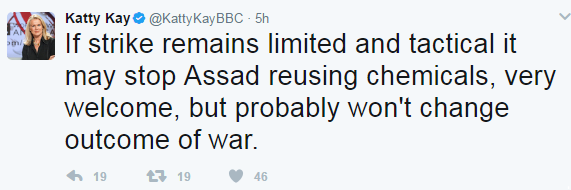
Even Katty Kay is positive about the strikes:


And for the first time ever, I've actually seen BBC reporters re-tweeting criticism of Stop The War types opposed to US military action - including Hugh Sykes:


...and John Sweeney:


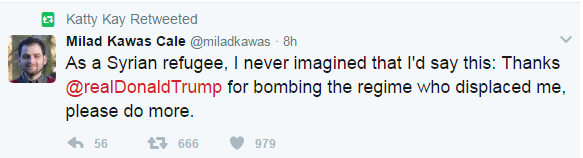
John Sweeney is also among those BBC reporters re-tweeting Arab appreciation for President Trump's actions (and not - for once - re-tweeting Arab criticism):


...as is Katty Kay:


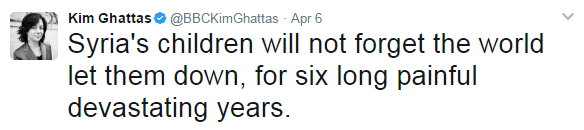
Others, like Kim Ghattas, are following their earlier tweets criticising the lack of action (by persons unspecified) over the last few years:


...with attacks on those critical of last night's strike:


Others are tweeting about editorials that back the action (and not tweeting about editorials which criticise the action), such as Ian Pannell


...while others are placing a positive gloss on the politics of the military strike, such as Barbara Plett:


Others are even hoping that President Trump might go even further and do something even better, such as Laura Bicker:


The BBC's Middle East editor, Jeremy Bowen, has tweeted nothing about the strikes yet. Nor has the BBC's World Affairs editor John Simpson.

How much of any of this is feeding into the BBC's actual reporting I can't yet say (as I've not had time to check it out), but a definite BBC point of view is emerging on Twitter. 

There are also, naturally, plenty of digs at Donald Trump for his past flat-out refusal to back military action in Syria, though even here - as with Quentin Somerville - there are surprising defences of Trump:


As for my Twitter feed in general, it's been fascinating seeing nearly all the anti-Trump types backing the strikes and nearly all the pro-Trump types opposing them - and Trump. 

It's all gone topsy-turvy today.

Monday, 26 December 2016

Tearful reminders


Barbara Plett-Usher, this week

I didn't realise, until BBC Watch pointed it out today, that the BBC News website still features (in full) a transcript of Barbara Plett's infamous 'tears for Arafat' broadcast. 

That's the one where she said, "Yet when the helicopter carrying the frail old man [Yasser Arafat] rose above his ruined compound, I started to cry... without warning", and which - after a struggle - even the BBC governors had to admit went too far and breached the BBC's impartiality guidelines. 

Reading the piece in full (it was originally broadcast on From Our Own Correspondent) shows that she went a good deal further than that in her identification with the dying PLO leader and it makes for a remarkable read. For starters, she shared his feelings of being under siege from Israel.

The BBC's own write-up of the ruling against Mrs Plett-Usher (as she is now) strikingly shows that it was only a partial ruling. It was the 'I started to cry' bit that did for her. The rest of the piece - where she personally identified with Arafat - seems to have got away with it, with the BBC write-up citing that "It said Ms Plett's report was balanced by references to Mr Arafat's "obvious failings"....well, read it for yourselves and see if those passing "references" really "balanced" her report. (I think it's a very clear 'no' to that). 

The interesting point that Hadar raises at BBC Watch is, other than an "opaquely-worded addendum" at the bottom of the original BBC News website piece, nothing else much seems to have come of that BBC ruling. 

When the UN Security Council ruled against Israel, with President Obama's blessing, recently, who was it who delivered the news and gave 'analysis' on the BBC website? Barbara Plett-Usher. Her analysis began:
The resolution reflects an international consensus that the growth of Israeli settlement-building has come to threaten the viability of a Palestinian state in any future peace deal.
It is a view strongly shared by the Obama administration, and for that reason the US reversed its policy of vetoing any UN Security Council criticism of Israel.
It is a decision that was taken after months of debate within the administration about whether and how President Obama might be able to define his position on a two-state solution before leaving office.
But his successor Donald Trump has made clear he intends to strongly support Israeli government positions, even making a highly unorthodox intervention before the vote by publicly urging Mr Obama to veto the resolution.
Now, yes, she had her own cruel, personal tragedies since that ruling - and I don't envy her any of that and wish her well - but I think the BBC owes it to her and to us to keep her away from such stories. 

Many people's sense that the BBC's Middle East editor, Jeremy Bowen, is still too angry at Israel for the accidental death of his 'fixer' (and is still broadcasting about his continuing sense of anger) and that he's been denounced by pro-Israelis and praised by anti-Israelis ever since for his less-than-friendly reporting of Israel (to put it mildly) ever since. A return to reporting from his beloved Wales is long overdue.