Showing posts with label Lyse Doucet. Show all posts

Saturday, 5 March 2022

The BBC and the Russian invasion of Ukraine [and an EXCLUSIVE behind-the-scenes glimpse of an ITBB discussion]


Craig: The BBC is being praised to the skies for its war coverage, and not only by itself and the usual suspects. Not that I've seen any BBC coverage, so I can't say if it's deserved or not, but lots of surprising people are singing its praises. It seems to be having a good war.

Sue: Well, I was half thinking that the BBC is ‘having a good war’, too. But with all its resources and long-standing infrastructure it would be surprising if it wasn’t. 

I haven’t watched it very much though, but sometimes the ad breaks on other channels drive one BBC-wards. I haven’t seen any of the Beeb’s opinion stuff, only the Myrie/Doucet reporting. I must say Lyse is getting more emotional than usual (and Clive is okay. A bit drained obvs.) 

I saw Konstantin Kisin's performance on Question Time (excerpts on YouTube.) It’s weird to see him on the dreaded BBC, especially when he’d only just said he’d stopped appearing on GB News because he felt he was being expected/required to opine on things he didn’t particularly know enough about. 


This unexpected invitation from the QT team must be partly to do with the new ‘impartiality’ pledges. 

Speaking of which I dread to think why they’ve let Jeremy Bowen loose on Ukraine. He will inevitably make comparisons with the M.E., (how he sees it - The bully against the oppressed, the brave Ukrainian-Pally resistance, the almighty Russian-Israeli aggressive warmongering.) 

I think I actually heard him make a reference to the M.E. in an aside on the Today prog, though I couldn’t find it when I searched. Can you imagine how the BBC’s new impartiality regulators let someone like Jez go to Ukraine with all that baggage? 

Craig: I've tracked down that Jeremy Bowen bit:
The Chinese strategist Sun Tzu talked about building your opponent a golden bridge to retreat across. In the Cuban Missile Crisis - the closest the world has come to nuclear disaster in 1961 - the deal there after the Soviets put missiles into Cuba was that the US move missiles out of Turkey. Now, of course, the things are not...you know, you can't directly transfer the idea, but the point is, there needs to be in all these crises, to finish them, a face saving deal. Otherwise, the two sides tend to fight until one side wins or both are exhausted, which is a catastrophe for the countries affected by that, as we've seen in the Middle East extensively.

BBC reporters like Lyse being more emotional than usual was one of the topic on Samira Ahmed's Newswatch this week, asking: How new is it? Does it help or hinder the viewer's understanding? 

The fact that it featured a particularly toe-curling example of heart-tugging purple prose from Fergal Keane [‘On platform 6, a father's farewell to his infant son. What cannot be held must be let go. Until another day’] shows where that kind of thing probably began at the BBC, with the likes of him and Orla Guerin - and Jezza Bowen, with his endlessly-repeated, embittered, personalised memories of a particular moment involving Israel and his unfortunate friend. 

Even John Simpson cried recently - though he told Samira Ahmed that he's not proud of doing so and it won't happen again. 

So, as you can see, I've actually watched a BBC programme now. 

Monday, 3 January 2022

A united front


Sticking with Radio 4's Correspondents Look Ahead and the BBC World Service's BBC Correspondents Look Ahead, I noted Lyse Doucet talking on the former about the "fear" that the Iran nuclear deal would collapse and talking on the latter about how "while it wasn't perfect...it was certainly better than it is now". 

That takes me back to February last year when the BBC's Middle East Editor Jeremy Bowen took to From Our Own Correspondent and sang the praises of the Iran nuclear deal and sounded off on how wrong it was that Donald Trump took the US out of it, telling Joe Biden what he needed to do: 
President Biden's big Middle Eastern challenge is to amend some of the damage done when Donald Trump pulled America out of the agreement to restrict Iran's nuclear activities. Iran has always denied that it wants a bomb but since President Trump made his move the Iranians have intensified their enrichment of uranium and are now closer to being able to create a weapon. He needs to avoid repeating the terrible mistakes of the last 30 years and that starts with restoring the agreement with Iran. It was far from perfect but it stopped a slide towards another Middle East war. Nobody wants one, but it's a possibility if the problem is left to fester. 
 I said at the time, "This is advocacy journalism, isn't it?"

John Simpson also took to Today in 2018 to outline his opposition to Donald Trump taking the US out of the deal.

All three of them think the same way about it, and have the opportunity to give their shared point of view from the BBC's bully pulpit , unchallenged.

This blog has several fine pieces from Sue putting the other side of the argument - that the Iran nuclear deal was worse that just 'not perfect' and that it was a bad and dangerous deal that Donald Trump was right to take the US out of:

The BBC's worldview


UnHerd's Peter Frankin has a piece today about how Radio 4's Correspondents Look Ahead reflects the BBC's worldview to perfection. 

The BBC may say it hasn't got a worldview but it certainly has, on subject after subject. 

He gives some examples, including:
There was also a preachy little section on “global vaccine inequality”. Noting the low levels of vaccination in many developing countries, the question asked for 2022 was “will the West do better?” No consideration was given to the performance of developing world governments or to local levels of vaccine hesitancy. That’s not to absolve the West of its responsibilities in this matter, just to point out that yet again the discussion was one-sided.
When I listened to it on New Year's Eve I made the following note for this section: 
St. Gordon of Brown - vaccine inequality - “a moral issue” [Lyse Doucet] - GB's “stain on our global soul” mentioned twice - “No one is safe until everyone is safe”.

Over on the BBC World Service's equivalent programme the BBC's Africa correspondent Andrew Harding went even further. This is how he rather hotly characterised it: 

Andrew Harding, BBC - The last two years, it's clear, have been about apartheid, if you like. It's been a systemic failure of the international community. Those with their stockpiles, those democracies looking after their own people first. And you mentioned earlier that idea of no one's being safe until everyone's safe, completely ignoring that basic fact and, despite plenty of promises, denying Africa its fair share of vaccines. 

Going back to the Radio 4 one, Peter also notes how they didn't ask why the biggest economic story of 2021 — the global supply chain crisis” happened:

Perhaps that’s because one of main causes of the crisis — the surge in demand created by the American government’s excessive stimulus program — doesn’t fit the “Trump bad, Biden good” narrative. Similarly when contemplating America’s continuing political polarisation, the Republican delusion about a stolen election was highlighted, but not the doctrinaire woke politics of the other side. For instance, the campaign to “defund the police” at a time of surging crime rates might have been worth a mention.

One thing they did discuss, of course, was the Capitol riot on 6 January. Indeed, from Sunday to Pick of the Year, that's been the US event every BBC journalist seems to want to talk about above all else. 

Peter gives another example:

The partiality of BBC’s analysis doesn’t just apply to American politics. Inevitably it also applies to Brexit. Attempting to explain continuing UK-EU tensions, the BBC’s Europe editor Katya Adler repeated the EU line that the British government is playing to a domestic audience. The idea that the gratuitous Brit-bashing of the French government might be similarly motivated went entirely unspoken.

It did indeed. My note on the night for that bit ran as follows: 

Katya on EU/UK. Brussels perspective given. UK side presented cynically. Usual language about Tory Brexiteers - ''hard wing'', ''hard''. Brussels perspective. Brussels perspective.

Indeed, no one countered Katya's Brussels perspective with an attempt at presenting the UK perspective in similar terms. 

Katya also talked of the rise of “illiberal democracies” like Poland and Hungary, characterising that rise as “extremely dangerous”. 

Peter Frankin concludes by noting that, whatever the BBC says, BBC correspondents “do have opinions”, as shown by this programme, and though “in itself that’s not a problem,...the issue is viewpoint diversity and the lack of it.” He ends

Instead of maintaining a semblance of neutrality, I’d much rather the BBC allowed and encouraged its journalists to examine the great issues of our time from a variety of different ideological perspectives. We might just get a clearer view of the future if they did.

He can hope. 

Saturday, 1 January 2022

“We're not supposed to have opinions, but...”


I listened to Correspondents Look Ahead - Looking Ahead to 2022 on Radio 4 last night. What I didn't know is that the BBC World Service has an equivalent called BBC Correspondents Look Ahead. A parallel section from each programme got be thinking again about BBC groupthink. 

Here's the passage from the Radio 4 programme:
KATYA ADLERI'm going to try and be positive and say that there is more environmental awareness. I like the fact that...we're not supposed to have opinions, but I do like the fact that it was young people that put the environment on the political agenda. Kicking and screaming might I add from the political class. They don't want to know. It costs money. It's difficult. It means making difficult political decisions they don't want to take. And I don't have great faith in any big decisions being taken by those who should really not waste any more time in the coming year. But I think this idea of people power. younger people pushing forward, that has to give us some hope. So it's a struggle, really, to be watched. And I think we should all have our fingers and toes crossed that, you know. We're in a pandemic but this is a literally burning problem that is creeping up on us. It's causing mental health problems amongst those who are worried about it and the planet is being destroyed. So let's hope 2022 is moving towards more action.
And here's its equivalent on the World Service:
RAZIA IQBAL - I just gonna throw one positive thought out. A final one. Young people are my positive thought. In 2021 we saw the likes of Greta Thunberg really galvanise people on the issue of climate change. She may be disappointed by COP26 and the outcome of that, but I still believe that there are hundreds if not thousands of Greta Thunbergs, Malala Yousafzais, all over the world - young women in particular - who really feel...To me they bring me encouragement. They are so heartening, that they are committed and dedicated to being agents of change. So I feel very, very encouraged by that.
LYSE DOUCET - Hear, hear. Hear, hear. 
Now, if you watch GB News or listen to talkRADIO or read websites like this you'll tend not hear such enthusiasm for the Greta Thunbergs and Malala Yousafzais of this world. [I refer you to Sue's posts about Malala for starters]. 'We' tend to think differently to 'them' at the BBC. But it's their views that are publicly-funded. 

Thursday, 30 December 2021

Looking Ahead and Back


This year's Correspondents' Look Ahead will be broadcast on BBC Radio 4 at 8pm on New Year's Eve. 

In anticipation of that, here's a review of last year's edition when BBC correspondents Lyse Doucet, Aleem Maqbool, Dharshini David, Gabriel Gatehouse, Justin Rowlatt and Katya Adler gathered on New Year's Day this very year to look ahead to 2021.

It's a remarkable listen, showing the BBC echo chamber in full cry  - or, perhaps more accurately, full echo. 

I've never attended an Observer-sponsored round table conference for journalists, left-wing activists and campaign groups, but I imagine this is what it might be like. 

For starters

Just consider this, for starters: from Lyse Doucet's introduction as she looked back to 2020 and said that, “as always”, there was “some good” amid “so much bad” in 2020. These are the two things she put on 2020's 'plus' side:
The Black Lives Matter movement put injustice and diversity on the agenda as never before and the pandemic focused minds on saving not just lives but our planet in our climate emergency.

Hm. I rolled my eyes at that! The BBC's Chief International Correspondent was signalling her very BBC views there.

Dharshini David opines and predicts

The programme's powers of prediction haven't greatly improved over the years. The first substantial contribution came from BBC economics reporter Dharshini David. Having nailed her colours to the usual BBC 'spend, spend, spend' mast by openly praising the Bank of England and Chancellor Rishi for pumping money into the furlough scheme - a “financial vaccination” she called it, describing it as both “good” and “good news” - she went on to make predictions for the UK economy in 2021. She said a double-dip recession “is pretty much a given, Lyse. I think that ship has really sailed. Well, we're 12 months on and it's still not sailed quite yet. She also predicted unemployment “continuing to grow for some time”, which again didn't happen this year. Bias and inaccurate predictions - a cracking start!

My eyes kept on rolling, but they needed to calm down as we were only in the foothills and they needed to brace themselves to follow my eyebrows as they rose up ever higher... 

Familiar fare 

Katya Adler then, predictably, painted a rosy view of Mrs Merkel's Germany.

Left wing round table chat

Lyse then discussed protests and coronavirus in the US in terms of how the pandemic had exposed inequality in its disproportionate effect on African-Americans, Hispanics and Latinos and Aleem Maqbool drew the comparisons with how much better white Americans were doing in a context-free, BLM-style fashion.

Lyse then discussed with Justin Rowlatt the issue of “less privileged” countries not receiving their fair share of vaccines and Justin criticised the “unseemly behaviour” of the developed world. He held out hopes though for Bill Gates and the WHO riding to the rescue and getting a project going. 

Do you take my point about it being like eavesdropping on a left-leaning convention?

Box-tickers to watch

Moving on to a regular feature, the next section was the BBC correspondents' traditional 'persons to watch' bit. Those for this year were:

[1] Alexey Navalny, who Gabriel Gatehouse predicted would “make waves” if he went back to Russia - which he did in January before being imprisoned in February and dropping out of the headlines.

[2] Deb Haaland, a Biden appointee who Aleem Maqbool discussed in identity politics terms as being “the first native American to lead the Department of the Interior...with its history of oppression against native American people”. It was all about identity politics. 

[3] Janet Yellen, a Biden appointee who Dharshini David also discussed in identity politics terms as the the first woman Treasury Secretary. “The US have beaten us...we've had none...” here in the UK in the top financial jobs, she said. It was all about identity politics. 

[4] Alok Sharma, who Justin Rowlatt chose for his role in the “crucial”, “terribly important”, “very important” and “crucial” COP26.

[5] Crown Prince Mohammed bin Salman, who Lyse Doucet predicted would become Saudi king in 2021, which didn't happen. She also predicted he'd become more powerful. Except for taking over Newcastle United FC, he didn't really feature on BBC News very much this year.

[6] “The ever growing shadow behind Angela Merkel”, which Katya Adler also discussed in terms of identity politics, talking of the “three slightly aging, middle-aged white men” of the CDU fighting to succeed Mutti and “probably” win the September election - which none of them actually did as the CDU failed to win. 

Besides the inaccurate predictions, it really is quite something how much identity politics informed this part of the conversation. It continued from the earlier discussion. And it continued. 

It was the 'post-BLM' edition of Correspondents' Look Ahead.

The man who tweeted too much

US politics - the change from Trump to Biden - was next for discussion.

I had to chuckle on hearing Lyse Doucet begin it by sticking to focusing on The Most Important Thing For The Likes of the BBC for the Entirety of the Trump Presidency  - Donald Trump's tweets - saying he's “still certain to unleash tweets from his own account”. Well, she got that wrong as the censors at Twitter swiftly banned him. 

Aleem Maqbool goes full CNN

Aleem Maqbool then talked about inequality, and the plight of women and minorities, and the polarisation that “won't go away” even after the “figurehead” [Donald Trump] has been removed - thus presenting the polarisation in a rather one-sided fashion himself. 

And - of course - Aleem talked about race, which he very much filtered through a BLM lens, saying:

The race issues. So much protest happened, so many people took to the streets. There's been very little in terms of structural change on race and policing over the last year.

Aleem predicted a lot of political violence in 2021. I suspect the events at the Capitol in January will be dwelt on and cited as a successful prediction in this Friday's programme. He also predicted the return of mass shootings. 

Aleem then talked of fixing immigration and asylum and “reuniting children who were separated from their parents under that system under Donald Trump” - which [a] was a very BBC focus on the needs of immigrants rather than numbers or the problems caused to the host community and [b] repeated the falsehood that the child separation issue arose under Donald Trump when it actually arose under Barack Obama and his VP Joe Biden. [As we now know, because of the Biden administration's policies, there's been chaos on the southern UK border this year]. 

As for Joe Biden, Aleem Maqbool said he's playing the card of “a uniter” - “and he's playing it relatively well so far”. [Well, that didn't last long]. 

More good news

Then “Good news” from Day 1 was predicted by Lyse and Justin for the Biden administration's climate change actions for what Lyse called the “climate emergency”. She also worried about people she called “climate deniers”. Quick as a flash, Aleem replied “But at least there won't be one in the White House”, said Aleem. 

Are you feeling the impartiality? 

Lyse pulls the rug from under Aleem

One amusing moment came when Aleem employed the 'some say' strategy beloved of BBC reporters trying to make a point through other people's mouths, talking of “a lot of.. as many people see it” regarding “the damage done” by Donald Trump's environmental policies. He later added an “as they see it”, referring to Trump critics' claims of damage, thus putting further 'fake impartiality' distance between him and them. And then Lyse Doucet went and ruined it all by giving her opinion and dropping him in it too, saying “As Aleem says, a lot of the damage has been done”. Haha!

Justin sings 'For Xi's a jolly good fellow'

On the same theme, Justin Rowlatt found President Xi's climate pledges “enormously optimistic”, which he seems to believe. Green energy is “the cheapest”. he said. [Fact check?]

Places to watch [or not]

For flashpoints/places to watch: 

Gabriel chose Taiwan [a very safe bet that it would remain a worrying issue in 2021].

Aleem chose Venezuela for a looming humanitarian crisis moving towards a flashpoint [well, it didn't really reach that point].

Dharshini chose Dover [for possible Brexit problems].

Justin chose Denmark [for a company that's transitioned from being an oil company to a renewables company and that might become a giant].

Katya chose Italy [to wonder how it would cope in 2021. I wonder how many reports she did about it in 2021 as I've heard very little about it?].

And Lyse, inevitably, chose Afghanistan, predicting that the Taliban might come close to power or achieve power either through negotiation or the battlefield. [She didn't predict the disastrous handling of it by the Biden administration which gifted the country and billions of dollars of US equipment to them].

OMG, Brexit!

The final segment seems 'very a year ago', as Lyse asked whether there would be a Brexit trade deal between the EU and the UK - then still in doubt in a 'final hours of diplomacy' kind of way. 

This was a classic BBC discussion:

Darshini said there should be if economic sense is followed but 2020 suggests that if we've learned anything it's that “Brexit isn't about the economics” and there'll be “a fudge”. 

Gloomy Katya said “the thing that's really going to hit us in 2021 is that even if there is a deal it's a very narrow deal because this is at best a hard Brexit and at worst a no-deal Brexit” and piled on the negatives about both, including worrying about whether you'd be able to take “Boris the dog” to Europe if you're blind and need your guide-dog - a stark reminder of the remarkable negativity and negative language about Brexit that assailed us on a daily basis back then. 

Justin said he “agreed” with both Darshini and Katya [of course he did because they were in an echo chamber] and thought “a very, very narrow deal” would be “sneaked over the line”, predicting “a very, very uncomfortable New Year for the UK”. 

And Gabriel, continuing to be cautious, sensibly said he'd “duck the question”. 

Are you still feeling the impartiality? 

Looking ahead

Friday's panellists looking ahead to 2022 will be Faisal Islam, Gabriel Gatehouse, Katya Adler, Laura Trevelyan and Nick Eardley. It looks as if there's a greater focus on UK politics from the presence of Laura and Nick, but we'll see. I expect it will be blander. I wanted Aleem Maqbool, Darshini David and Justin Rowlatt back. Still at least Lyse Doucet's still in the chair. 

Saturday, 11 January 2020

Col Richard Kemp and Lyse Doucet


At least Lyse replies (and does so politely):
Lyse Doucet (on Today): It is true that this major international crisis is not just of Iran's making.
Col. Richard Kemp (on Twitter): Speaking this morning of Iran shooting down Ukrainian plane BBC correspondent Lyse Doucet asserts as fact: “this international crisis is not of Iran’s making alone”. Actually it is. Who else is to blame for Iran’s aggression?
Lyse Doucet (on Twitter): Morning Richard...meant in the sense of many actors involved in this global crisis..but ultimate responsibility in this disaster lies with Iran.

Saturday, 4 January 2020

Are we very, very lucky to have James O'Brien?


In the wake of the US's killing of General Soleimani, LBC's James O'Brien issued this effusive tweet in praise of the BBC:
Probably a good moment to remind ourselves that with journalists like John Simpson, Jeremy Bowen and Lise Doucet, we are very, very lucky to have the BBC.
(Yes, he spelt Lyse's name wrong). 

You won't be surprised to learn that Jeremy Bowen and John Simpson both put their retweet functions to good use. They do like being praised. 

Even if JO'B had copied in Lyse Doucet, I doubt she'd have retweeted it. She doesn't seem the type.

Thursday, 26 December 2019

Back to the Future


Babs is back in town

Poor Lyse Doucet. People have been confusing her with Barbara Plett Usher for nigh on twenty years. And now comes this:
David Collier: Dear BBC News, you managed to run a whole segment on Christians in Bethlehem at Christmas without once telling viewers Christian numbers have fallen because of Islamist persecution. In fact, you even blamed the Jews. Well done (🤮). A bonus earned for Lyse Doucet. David.

Lyce Doucet: Thanks David. I am not in Bethlehem nor reporting on it. Best wishes of the season to you.
Yes, even the great David Collier mixes them up. And with Barbara Plett Usher back in Israel after a seven-year break covering the UN in New York, poor Lyse is likely to get lots more misdirected flak for some time to come.

For those who don't remember her, Barbara Plett - as she was then - was the one who was eventually rebuked by the BBC for reporting that she wept when Yasser Arafat died. 

Anyhow, here's what David's talking about - a report that appeared (with various tweaks) throughout Christmas Eve...

It's proper early-2000s-style BBC reporting on Israel of the kind that originally provoked the commissioning of the Balen Report (think also Orla Guerin):

She blames Israel for all woes. Hamas and other Islamists don't get a mention.

She uses vox pops in the most lopsided manner imaginable, making one side look like idiots.

She uses dismissive language about Israel's claims about its security barrier and persists herself in calling it "the wall" when talking to the tourists, against post-Balen official BBC advise on the matter.

And she piles on the emotion with that heavily-patterned style of phrasing that was commonplace in BBC Israel reporting a decade or so ago.

Yes, it's like being taken back in time to, say, 2004.

P.S. Where's Yolande Knell gone? She usually does the Bethlehem Christmas Eve gig.

good tourist
bad tourist

Here's a transcript:
BBC newsreaderFew cities are in the spotlight more over Christmas than Bethlehem - the Biblical place revered as the birthplace of Jesus Christ. But tourism has been hit hard for the last 20 years. It's a Palestinian city in the Israeli-occupied West Bank and because of restricted movement out of the city by the Israeli government, its Christian community has dwindled - a move that Palestinians say harms their freedom and economic prospects. Barbara Plett Usher reports.  
Barbara Plett Usher: This is Bethlehem's time of year. Dressed up in Christmas finery, it invites the world to celebrate the story of a humble birth that changed history. Tourism here is a bright spot, despite dark times for the Palestinian economy. For Bethlehem's Christians, there is a special gift from the Vatican, a splinter of wood believed to be from Jesus' manger. It's small but a big boost for a community decimated by waves of emigration, and an inspiration to priests like Father Emad, who provide aid to local Christians, trying to anchor them here.
Barbara Plett Usher: This year's different?
Father Emad KamilThis year is different because we remember the manger, so we must think more, our hearts must be the real manger to receive Jesus. 
Barbara Plett UsherYour hearts must be the real manger to receive Jesus? 
Father Emad Kamil: I hope. I am working for that.
Tourists roll in past what Israel calls its security barrier. The wall, as residents call it, is squeezing Bethlehem into an ever shrinking space. That doesn't stop the tide of visitors, but many know more about the past than the present. 
Barbara Plett UsherWhat about the politics, you know, between..? 
Visitor 1: I don't know much about it, all I know is my saviour, Jesus Christ. That's all I know, that's all I care about. I just want to learn more about him. 

Visitor 2: I mean, this is where our Lord and Saviour was born and, oh, my goodness, this is where everything started. 

Barbara Plett UsherWhat about the politics, you know? The Israelis and Palestinians? Did you hear anything about that, think anything about that? 
Visitor 2: Yeah, you know, it's definitely concerning, I guess. 
Barbara Plett UsherWhat did you think of the wall when you came in? 
Visitor 2: Oh, that was substantial, of course, and you can tell that people that lived in old time, how protected they felt by the big wall and how amazing it is today. 
Barbara Plett UsherIt's a new wall, but anyway... 
Visitor 2: It's a new wall? Yeah. Oh OK. 
Barbara Plett UsherThe new wall, then? 
Visitor 2: That too, it's about the future as well. 
You can't avoid politics in the nearby refugee camp of Dehaisha. Quite the reverse. Ahmed wants to show foreigners how Palestinians here live. He's renting a room to adventurous tourists, advertising on the internet. It was just the kind of alternative holiday Klara was looking for. 
Klara Sirovnik, Slovenian tourist: In the end of the day, you see that you really think in the same way, but you come from two different places in the world. 
That's the connection Ahmed is seeking. 
Ahmed Farargam, Dehaisha Refugee Camp: You know, the people here are not... Most of them are not allowed to go outside, and especially to the outside world. And they see the outside world in your eyes. 
Business is booming this year, but who knows? Next year could be a bust. When you don't control your own space, the situation is very fragile. I suppose the only constant thing is faith. The faith of things hoped for...if not yet seen. Barbara Plett Usher, BBC News, Jerusalem. 

Wednesday, 15 May 2019

Lost in translation

Forgive me for going back to One Day in Gaza. I’m no Mastermind, but this topic covers both my specialist subjects.

1) The BBC’s bias against Israel,
2) The psychological manipulation of emotions through film.

This is also covered on David Collier’s blog, in the Jewish press and over on Harry’s Place, where Marc Goldberg focuses on the controversial translation of the (audio) “Yehud” to “Israeli”. 


This is not the first time the BBC has sanctioned this translation. In Lyse Doucet’s Children of Gaza’ film,:
“Israel is massacring us” says a boy, according to the subtitles, but what we heard the boy actually saying was “yahud”  -  ‘Jews,’ not Israel.
Lyse was persuaded that when the people of Gaza say “yahud” they really mean Israelis; the truth is being disingenuously massaged to make the message more acceptable.

What did I mean?

Lyse defended this practice because she says that when Palestinians use the term “Yehud” they effectively mean “Israelis”. 

Why is this even an issue?

Because it exposes the inherent Jew-hate behind the religion-based rejection of the Jewish state. It is, after all, enshrined in their holy book, and is the very thing that fuelled the original war against Israel, which according to the BBC “Broke Out” when Israel was established in 1948 The BBC is loath to confront even that, and even more loath to admit that Islam-rooted Jew-hate is the real obstacle to “peace” in the Middle East.

The three stages of the current topsy-turvy practice of Gaslighting. Definition: manipulate (someone) by psychological means into doubting their own sanity. Not sanity, exactly, but doubting their own decency and integrity.

The Israel /Palestinian version of Gaslighting goes something like this:

1) Islamic Arab world rejects the establishment of the Jewish state: immediately declares war of annihilation.
2) Jewish state defends itself; defeats Arabs.
3) Arab states employ massive Gaslighting; blame victim, persuade world that “Israel is to blame”.

That’s it. The mother of all Gaslighting.


Lyse Doucet was right. The waters have been well and truly muddied and the decidedly shaky claim that criticism of Israel - criticism of Israel’s policies - of its government etc., etc - is not antisemitic is thus cemented with just about enough shifty disingenuousness to set it off - hard and permanent.

I stand by my instinctive response to the psychological devices in the film, which I cited in my previous post. These are tell-tale signs of the BBC’s not so subtle anti-Jew approach. Their sentimental, quasi-romantic, emotional relationship with “the most hospitable people on earth” versus their Shylock, Fagin, Brian Sewell perception of the greedy Jew.

Epitomised by poignant portraits of traditionally dressed bereaved mothers, movingly, nay, heartrendingly filmed as they talk of their departed loved ones in the past tense, contrasted with the Israeli military spokesmen’s cold, dispassionate, hard-hearted rationalisation of the fog-of-war accident. 

The filmmaker’s tacit innuendo appeared to be that these shootings were carried out ‘accidentally on purpose’,  accentuated by the “straight to camera” filming  technique with its distancing effect and its between-the-lines message, roughly, that the Palestinian ‘David’ (armed only with ramshackle, homemade slingshots) was (and always is) hopelessly pitted against a heavily armed ‘Goliath’ that delights in taking indiscriminate pot-shots at random women and children.

Of course, this has resonance with the current issue that the BBC mentioned this morning.
“The definition from the all-party parliamentary group on British Muslims is: “Islamophobia is rooted in racism and is a type of racism that targets expressions of Muslimness or perceived Muslimness.”

It’s a typical example of the drive to apply (false) equivalence to antisemitism and Islamophobia. 

I very much doubt that the Labour Party’s antisemitism is connected in any way to their intimate knowledge of the Jewish religion. No, I’m afraid it’s simply “Jewishness” that offends them. In other words “It’s racism, stupid.” 

Islamophobia, to coin a phrase, is largely based on the fear of the ideology of Islam, and “Muslimness" is one signal that the practitioner, or the wearer of the Islamic uniform, adheres to those principles. 

“It’s the ideology, stupid."

Update:
For a detailed and substantive account of the film's bias, go the BBC Watch.

Here is a rather generous analysis of the film. The problem (as I see it) with Honest Reporting’s generosity is that the plus points he cites would resonate with open-minded audiences who happen to be viewing the film in an informed and objective environment.

But for the audience in Britain, hostile, ill-informed and already in no mood to empathise with Israel’s position, many viewers will have made their minds up already, and despite the film (at long last) acknowledging the violence, people believe it’s justified by “What Israel is doing to the Palestinians”.

As for the ‘gassing’, leaving the innuendo in the air, without any clarification was a grave misjudgement by the filmmakers. 

Saturday, 29 December 2018

Jon Sopel and Katya Adler on Brexit


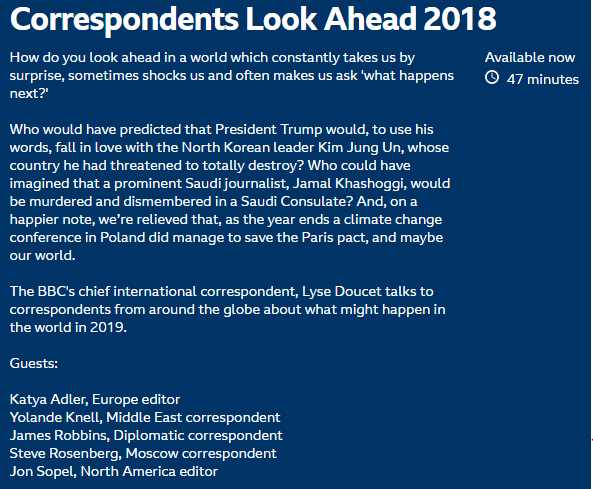
Correspondents Look Ahead 2018 turned briefly to Brexit. This is what was said:

Lyse Doucet: Let's stay on Europe. We've managed to talk for quite some time without mentioning that B word, Brexit, and who can possibly predict a Brexit? Does anyone want to give a punt on this and be prepared to face up to the consequences next year? What about you, Jon Sopel? 
Jon Sopel: I think that as someone who spent ten years covering politics at Westminster during the dog years of John Major, all the struggle that he was having with the Maastricht Treaty, that was as nothing. There is total collective nervous political breakdown in the UK. Nothing has a majority. The only thing that commands a majority is to say no to something. We don't want that. We don't want this. We don't want something else. And I don't see if you can't get a majority how you either avoid one of two conclusions: One is you park Article 50 and say, OK, we're not ready for that to implement and, therefore, we won't go on March 29, or we have to put the question back to the people with seismic consequences, I think, for faith in British politics, for all sorts of other things as well. 
Lyse Doucet: Katya, how does it look from Brussels? What do you think? 
Katya Adler: The huge outpouring of European emotion the day after the UK voted to leave has given way to dispassion. You know, there's a dispassionate viewpoint now. Brexit either happens or it doesn't happen. They hope we'll change our mind. They hope that they've made this process hideous enough that the UK will change their mind. And if they don't the UK will leave and can forget any special deals as a former member. The UK becomes officially what's known as a 'third country'. which in EUspeak means 'an outsider'. And that means it will be treated as such. It's not about punishment, as it's so often viewed from the United Kingdom. It is about the EU, which on the world trading stage is a feared player that sets the rules. It is a rule setter. And the UK is going to end up being a rule taker. Whether it stays very close to the EU or has a more distant relationship with the EU, the EU will set those regulations. And the public in the United Kingdom was never given to understand that when it was time to vote.

"And on a happier note, we're relieved that..."


The blurb for this year's Correspondents Look Ahead provided the opening words spoken by Lyse Doucet herself. You'll note that she openly speaks for the BBC on the matter of the climate change conference in Paris here:

Saturday, 8 September 2018

From Their Own Correspondent


I first began listening to From Our Own Correspondent in my late teens, back in the '80s, and I rarely missed it for years.

I liked the stories, from places familiar and unfamiliar, and I liked the way the BBC's storytellers told their stories, and I also liked learning facts about places, and the history and politics of those places, and FOOC was useful for that. 

I wasn't much troubled by questions of bias back then. 

Nowadays, however, I'm a much less frequent listener and questions of bias are (as you probably know) somewhat less far from my mind, so I have to ask - if any of you have an opinion on the matter - if you think the programme has changed as much as I think it's changed in recent years? Or is it me that's changed? 

Take today's edition, for example. 

Standing back and looking at it as objectively as I can, I can see that it still features BBC journalists who can certainly tell a good story in a stylish fashion. Today's programme included three such people: Lyse Doucet, Nick Thorpe (a master of prose) and Gabriel Gatehouse. 

Lyse Doucet's piece concerned the silent Yazidi villages of Iraq. It was powerful stuff, full of compassion, and it made me feel for the Yazidis (though, that said, I've long been sympathetic to them ever since Islamic State being persecuting them and have believed from the very start that they are the sort of refugees we should be protecting and giving refuge to). Its authoritative staccato style of delivery felt very familiar too, following (as it does) in a long FOOC tradition of that kind of delivery. (Perhaps cynically, it brought to mind Chris Morris's On the Hour/The Day Today and its satire of the language and style of war reporting). Maybe, however it was more emotive than FOOC pieces of old and less fact-focused.

Then came the rest of the pieces - a piece about Catholic sexual abuse in Chile which pretty much gave, in passing, a free pass to (liberal favourite) Pope Francis (Linda Pressly); a feminist piece about India (Vivienne Nunis); a piece from Colombia which somehow turned into a piece about indigenous peoples being spot-on about climate change (Nick Thorpe); and a piece from Sweden which equated the trolls of Scandinavian legend with supporters of the Sweden Democrats and racism (Gabriel Gatehouse) - and I just groaned.

It's like being repeatedly hit over the head with a very biased wet haddock.

Has this kind of agenda-pushing always been a part of FOOC or is it a recent thing?

Wednesday, 16 May 2018

Transcript: BBC News at Ten, Tuesday 16th May 2018


Newsreader: Tonight at Ten: More funerals in Gaza for the Palestinians killed in the deadliest day of violence there since 2014. As the burials go ahead for those shot dead by Israeli forces, the UN condemns what it calls the "appalling deadly" events. We report on the hospitals under pressure in Gaza, as the international community calls for an end to the violence. 
Jeremy Bowen: Politicians and diplomats abroad call for peace but real peace talks ended - failed - a long time ago. 
We'll have the latest from Gaza, and on today's emergency meeting of the UN Security Council. 

Newsreader: Good evening. More funerals have taken place for the Palestinians killed by Israeli troops in Gaza yesterday. An emergency session of the UN Security Council has heard condemnation of both Israel and the militant group, Hamas. Today marks the 70th anniversary of what Palestinians call the Catastrophe, when hundreds of thousands of people fled, or were expelled from their homes, when the State of Israel was established. Our Middle East editor, Jeremy Bowen, sent this report from Gaza. His report contains some distressing images.


Jeremy Bowen: On the border the soundtrack was anti-Israeli songs, not gunfire. 24 hours after the killing, the big protests have stopped, but tyres were burning and Palestinians looked warily towards the Israeli positions. Enterprising traders brought refreshments. So what's next? The Israelis deal with the international political fallout; the Palestinians have 60 dead. Politicians and diplomats abroad call for peace, but real peace talks ended - failed - a long time ago, and with the current generation of Palestinian and Israeli leaders, there is no chance of them being revived. The Israelis started firing tear gas. The crowd by then, including many families, was getting too big. And the young men were getting too close to the border wire. On the other side, the Israelis say they're in the right. 
Jonathan Conricus, IDF: We are not here looking to create casualties of Palestinians, that is not our aim. We are simply here to defend what is ours. We are defending our sovereignty, our civilians that live in close proximity, against an onslaught, led by a terrorist organisation that is using civilians in order to penetrate into Israel. 
Much of Gaza's rage is born in places like Beach Camp, still a home for refugees 70 years after more than 700,000 Palestinians fled or were forced out of their homes by newly independent Israel. Palestinians call it "Nakba" - catastrophe. 70% of Palestinians in Gaza are refugees, stuck fast in history. At the Al-Farooq mosque, Yazan Tobasi's funeral was much quieter than his death - shot through the eye during the protests. His body was wrapped in the Hamas flag. He was 23 and his friends were there to bury him. There were tender moments. Israel says it told them to stay away from the border and Hamas is responsible for what happened. His friend Mohamed El Bahrawy said Yazan had worked at the hospital, without pay, because of Gaza's collapsing economy. Poverty and grief breed anger. And so do the deaths of children. A family gathered for another funeral. It was for Leyla Al-Ghandour, who was eight months old. She had a weak heart and when she inhaled tear gas, she died, her family said. Children make up half of Gaza's population. Six were killed on Monday, according to the Ministry of Health. Her mother Mariam was in a pit of grief. At Shifa, the main hospital, wounded men were being transferred to Egypt for surgery. Inside, they were still treating casualties from the protest. This boy is 16. All day, I've been asking Palestinians if Hamas forced them to risk their lives at the protests. No one said yes. "I did it because Jerusalem is Palestinian," said Qadir Arras, unemployed, 24-years-old. This is the busiest time at the hospital since the 2014 war. 
Dr Ayman Sahbani, Director of Emergency Services, al-Shifa Hospital: As a human being, I speak, it is horrible to think about. If you saw it yesterday, that situation, it is horrible. Crying, bloody, pain, painful... What's happening? 
After the protests, it seems that many people are hoping for some kind of turning point. But the fundamentals of this conflict don't change. Jeremy Bowen, BBC News, Gaza.
Newsreader: Jeremy was focusing there on the hostility between Israel and the Palestinians, which has long centred on the land and the borders created following that war that led the establishment of Israel back in 1948 . Our chief international correspondent, Lyse Doucet, takes a closer look now at the history of the continuing struggle. 


Lyse Doucet: A history of the people on the run time and again. 1948, the Arab-Israeli war and the creation of Israel. Tens of thousands of Palestinians fled to Gaza, many forced from their homes. A narrow sliver of land became known as the Gaza Strip. Its borders defined by the positions of Egyptian and Israeli forces, separate from the West Bank when the 1948 ceasefire was declared. And for the next 70 years, Gaza's future would be shaped by its neighbours - most of all, the State of Israel. In 1967, in the Six Day War, Israel occupied Gaza and the West Bank, started building Jewish settlements on the best land, including along the Mediterranean. And then, decades later, a promise of land for peace. The last settlers and soldiers would leave in 2005, proclaiming the end of Israeli occupation, but Israel kept control of all borders, land, air and sea. Gazans called it 'the world's biggest prison'. But Palestinian politics played its part, too. The next year elections brought the militant group Hamas to power, pushing out Fatah, the main Palestinian faction. It pushed Gaza towards a growing confrontation with Israel, and a tightening blockade which created a growing humanitarian crisis. In the last ten years, three wars, and in between, efforts to ease Gaza's blockade, But never enough. And never enough aid. At the UN Security Council today, this same calls for restraint, and the US stood by its ally: 
Nikki Haley, US ambassador to the UN: I ask my colleagues here on the Security Council, who among us would accept this kind of activity on your border? No one would. No country in this chamber would act with more restraint than Israel has. 
And the same calls to return to peace talks: 
Karen Pierce, UK ambassador to the UNWe see negotiations towards the two state solution is the best way to end the occupation and to meet the national aspirations of the Jewish and Palestinian peoples. 
Gaza's fate has been sealed, literary, by its borders. The only route to a better future, through negotiations. But that's now further away than ever. Lyse Doucet, BBC News.
Newsreader: Lyse Doucet, our chief international correspondent, on the continuing hostility between Israel and the Palestinians. 

Sunday, 29 April 2018

Admiration, admiration, admiration


From this morning's paper review on The Andrew Marr Show...

ANDREW MARR: Let's turn to someone who probably won't be turned away by Immigration when he arrives. Donald Trump is coming to visit the country in July.  
LYSE DOUCET: Yes he will, and I think a lot of people in Britain are asking about that so-called 'special relationship', when they saw another relationship on show this week. "Bromance" was very much in the world headlines last week, and in The Observer they are showing what they're calling "dandruff diplomacy"... 
ANDREW MARR: Oh dear! 
LYSE DOUCET...as President Trump flicks away a speck of dandruff, and he says, "There now. You're perfect". And judging from the images coming out of Washington, all the pomp and circumstance, Emmanuel Macron wanted to shake hands with President Trump more than Melania Trump did! But there is serious intent to all this. Emmanuel Macron has really weaponised in diplomacy the bear hug because, after days of hugging and hand-holding, he went to Congress then and ripped into many of President Trump's signature policies. A great line, he said "There is no planet B". Now for those of you who still hold onto that special relationship - I'm not sure you still do - there is a letter in The Sun that "there is no greater alliance than you and us"..."you and the US" and "we need it even more" - the Ambassador looking ahead to the visit by Donald Trump. It's now been confirmed for July 13th.  And we already know from the property mogul, Donald Trump says "I'm not going to cut the ribbon at that embassy. It's in Nine Elms?! You should never have moved from Grosvenor Square. Location, location, location!".  
ANDREW MARR: Nine Elms is a little bit south of the river for the Donald. 
LYSE DOUCET: Even Donald Trump. He's a property man.  
ANDREW PIERCE: Did you see. There's a great cartoon in The Sunday Times again on Trump and M. Macron. There's Donald Trump saying to Mr. Macron, clutching their hand very tightly, "Boy, you're hot!" to which Mr Macron says "That'll be global warming", because he was out there of course to talk about ...get him to stick to the Paris climate change. 
ANDREW MARR: An interesting balance between really kind of cosying up to the Donald on the one hand and then hammering him on the policies. A very, very acute piece of diplomacy there. 
LYSE DOUCET: It's an interesting new tactic.  
ANDREW MARR: Nice in person, but... 
LYSE DOUCET: President Macron is called "the Trump whisperer". I think Theresa May wanted to have that kind of a role. Let's see...She held hands as well if you remember when she went to see President Trump. She was the first world leader to go and visit him.  
ANDREW PIERCE: And she's been criticised for it ever since, of course. 

Sunday, 29 January 2017

Echo chamber


This morning's Sunday began with an intra-BBC discussion of the Trump executive order between the BBC's new religious affairs correspondent Martin Bashir and the BBC's chief international correspondent Lyse Doucet.

Of course, they didn't give anything approaching a disinterested, hands-off, neutral, impartial take on the story. 

They both made their disapproval very plain indeed, and piled on argument after argument against the presidential move. 

Mr Bashir, in particular, appears not to have entirely broken free from his old 'MSNBC opinionated host' practices. ("Lyse, the seven nations chosen by Trump appear to be less than carefully selected"),

And I had to smile (grimly) at Lyse, without batting an eyelid, citing the internet to fuel damaging conspiracy theories about Mr Trump's motivations. 

Again, the whole thing is worth transcribing for posterity:


Martin Bashir: At a signing ceremony in the White House on Friday President Donald Trump's signed an executive order temporarily suspending immigration from seven Muslim-majority countries and blocking all refugees from entering the United States for 120 days. Mr Trump said the ban was necessary to protect the United States from terrorists. Yesterday, civil rights organisations issued lawsuits to release several individuals being held at US airports and last night a federal judge issued an emergency ruling to prevent the deportation of any travellers from those seven Muslim-majority countries who'd already entered the United States. Around the world allies and critics have voiced concern about what the new American policy could mean. Mr Trump told reporters yesterday that the policy was "working out very nicely". Just before coming on air I asked the BBC's Chief International Correspondent Lyse Doucet what reaction there'd been from Islamic Nations.
Lyse Doucet: I'm in Saudi Arabia where that the leaders are the custodians of the holiest shrines - the two holy shrines in Islam - Mecca and Medina, and talking to people here some say, well, that the right of the United States but other are very, very critical. They say it's racist, it's illegal and it's a huge black mark on the United States. So, and I think, as more and more stories continue to come out of people stopped at the airport, people whose lives will be torn apart. The stories you're hearing now are heartbreaking. People have waited years and years for their green card or to be accepted as refugees now literally been turned back.
Martin Bashir: Iran's Ministry of Foreign Affairs called the executive order, and I'm quoting a statement, "a clear insult to the Islamic world and a great gift to extremists and their supporters."


Lyse Doucet: Many said that, those who study groups like this so called Islamic state and Al Qaeda, who have long seen their mission to make the West to turn against Islam, so that this would provide fodder for recruitment, it would give more fuel to the fire - and, literally, they are fires in the Middle East caused by the so-called Islamic State fighters and this proves their point. So it is a very, very dangerous, a very potent weapon, in the hands of a so-called Islamic state. And I think the distinction has to be that former president Clinton, former President Barack Obama, Western leaders, have talked about about the need to fight against those elements who used Islam, the religion of Islam, for violence, for political reasons, But it is not the same thing as condemning a whole religion on the basis of religion. But we've seen now, not just in the United States but across Europe as well, far-right leaders, populist leaders, using this as a political weapon to tarnish an entire religion because of actions carried out by those...and those who know the faith well say that it is a distortion of of the religion.
Martin Bashir: Lyse, the seven nations chosen by Trump appear to be less than carefully selected, given that many of the 9/11 hijackers came from Saudi Arabia, not on the list, and Pakistan, which is known to have been the location for the training of hundreds of terrorists and also housed Bin Laden for ten years, also not on the list.
Lyse Doucet: And Afghanistan. I've been speaking to Afghans since this order was issued and they're surprised and relieved that they're not on the list, because some of the attacks that have been carried out in the United States have been carried out by people with links to Afghanistan - second generation immigrants to the country. And, of course, Pakistan - the tribal areas of Pakistan -  are said to be Al Qaeda Central. And I'm in Saudi Arabia. 15 of the 19 hijackers in 9/11 came from Saudi Arabia, which had led the cynics to say - and you can find now on the internet the maps which show the countries which had been banned and the ones which haven't, and some other countries like Saudi Arabia, United Arab Emirates, Turkey, are places where Donald Trump does business. I visit places like Syria and Iraq. We see what groups like so-called Islamic State has done. But the reaction is not to ban everyone on the basis of their religion, to condemn an entire religion, because the United States and other countries have to work with Muslim leaders worldwide to try to counter this extremist threat
Martin Bashir: Lyse Doucet.

Saturday, 24 September 2016

Compassion


Today's From Our Own Correspondent began with Lyse Doucet recounting a story you've probably heard about before, especially as it's been widely reported on the BBC and in the press: the story of her own tearful, joyful surprise reunion with a Syrian refugee family, newly emigrated to Lyse's native Canada. 

If you didn't see it, Lyse runs towards the Syrians, embraces them all, cries with joy, and says, "Welcome to Canada!"

Lyse exulted again here on FOOC. It was a story to gladden the heart, she suggested.

And, yes, particularly from the way she told the story. it was impossible not to feel a good deal of sympathy for the Sabbagh family,  now safe and happily unveiled in Canada.

That said, what Lyse herself calls 'compassionate reporting' can feel highly manipulative, especially if the reporter and her media organisation makes a lot of it (as the BBC has been doing with this story).  

It's no stretch, I think, to suggest that Lyse's reporting here makes the 'welcoming' policy of Canada's Liberal government sound like 'the decent thing to do', regardless of the risks. 

And that, of course, has more general implications. 

Sunday, 20 September 2015

Hearts


Yes, I really wasn't thinking clearly enough yesterday when I transcribed that Lyse Doucet interview (with Sarah Montague) and failed to highlight the obvious bias in the following passage from it:
...these are people who we should be opening our hearts and homes too, but in the race to the front there's always the risk that those without the means or without the ability to move in this way will get lost again.
As David wrote in the comments, "This is beyond considering the humanity of one's subject and has become advocacy".

Talking about hearts...

Tonight at the northern end of the border several thousand more are setting out to join them on the march towards Slovenia and the Schengen Zone - the hopeful and the desperate, all testing the boundaries of Europe, the limits of its politics, its values and its hearts.
Unusually, that report didn't end with an image of a child but with a man painfully limping along a road.  

Saturday, 19 September 2015

Lyse Doucet: "Where are you from?"


Just following on from Sue's post, here's a transcription of what Lyse Doucet said on this morning's Today:


Sarah Montague: So what is the answer? How should EU countries respond to migrants? Surely that must depend on whether they are refugees needing asylum or economic migrants just looking for a better life. The European Union's official statistics agency says that of the 213,000 people who arrived in the three months to June, only a fifth of them (that's 44,000) were from Syria. Our chief international correspondent Lyse Doucet is only the border between Serbia and Croatia and joins us from there now. And Lyse, can you tell us about the people you have come across in your travels there?
Lyse Doucet: Well, it's interesting Sarah that you use the figures for June - that is before this crisis reached an unprecedented peak over the summer. And what we're seeing is that this is changing literally by the day across the region. It is still predominantly Syrian, but more and more we're seeing people coming from all parts of the world - from war-torn Afghanistan, from war-torn Iraq, from Pakistan, which is failing its people in many ways in some parts of the country, people from Somalia...but also people from West Africa - from Nigeria, from Ghana - and this is starting to create some tension because people are asking, "What is this? It is a humanitarian wave of people seeking refuge from war in Syria or is it an opportunity for people from many places to try to seek a better life?" And sadly the world doesn't divide into neat categories - refugees versus economic migrants. And just watching the scene around midnight yesterday at the Serbian-Croatian border a huge crush of people to get on to one of many buses, but not enough buses and a Syrian standing by vented his anger to me: 
Migrant: "You know something. There is a lot of people from Pakistan and Afghanistan. They say they are Syrian, but they aren't. They have fake IDs."
Lyse Doucet: "Are the Syrian people getting angry? Are the Syrian people getting angry because there's so many people coming now, you may not get a space?"
Migrant: "Yes, they are getting angry, angry at the Pakistani and the Indian people and the Afghanistan people".
Lyse Doucet: "Afghanistan is a country at war."
Migrant: "Yes, we know that. But it's not the war we're talking about like in Syria. You know, in Syria there is a big war."
Sarah Montague: And Lyse that question...When you ask that question, "Where are you from?" is it invariably the answer "Syria"?
Lyse Doucet: That is the question. You could describe this whole mass movement as being, "Where are you from?" Yes, day in day out when you ask people, as you speak to people, "Where are you from?", we think predominantly...this is what the United Nations says as well...people are from Syria. But you mentioned the word "chance" in your introduction. This is a game of chance. It's like one big lottery. People finally realise that at last Europe is opening up its doors, giving refuge to so many people in Syria who do need refuge. It is the war of our time. But as this goes on more and more Syrians are coming through. Within the last two weeks I've noticed Syrians coming from relatively safe parts of Damascus - even though no part of Syria is untouched by war. Wealthier Syrians. I've seen Syrians coming from Dubai, from Cyprus, Syrians working in Turkey and I think, "Why are you coming to Europe?" And they say, "Well, I want a better life". When you ask the United Nations they say, "Well, everyone in Syria is someone who's fleeing war", but the great tragedy in this tragedy would be that the people who need it the most...when you travel through Syria and you see people who are absolutely destitute and fearing for their lives, in the camps across Syria or the refugee camps in the neighbouring states, these are people who we should be opening our hearts and homes too, but in the race to the front there's always the risk that those without the means or without the ability to move in this way will get lost again.
That was characteristically interesting stuff from Lyse Doucet, showing that she at least is thinking about such questions and asking others (even if Today itself was probably jolted - or 'forced' - into discussing the subject of how many of those "Syrian refugees" really are Syrian refugees by those widely-reported Eurostat figures). 

Strangely though, she stuck to the belief that the present influx "is still predominantly Syrian" - despite those Eurostat's figures which appear to disprove that. I found that puzzling.

Still, as Sue says, it's progress that the BBC is now starting to discuss something that very few BBC reporters have previously touched and all credit to Lyse Doucet for glimpsing the light.