Showing posts with label Allegra Stratton. Show all posts

Wednesday, 8 December 2021

Nick has HIS say


Here's Nick Robinson saying something nice about former BBC colleague/Newnight political editor Allegra Stratton in her hour of need:


Of course, he's also saying that as a transparent sneer about Boris Johnson's 'apology' in the Commons today. 

All in all, he's, as ever, being quite free with his opinions today on Twitter. Here's another:
“Never apologise. Never explain” has long been Boris Johnson ’s watchword. He has now apologised & he has explained … that it was all someone else fault. He’s threatened those who work for him with disciplinary action. Those who trash their staff often live to regret it. 

I think he's right, but I don't he should be saying it as an impartial BBC reporter. But, as we know, that ship has already sailed for good, like the Titanic.

Saturday, 10 October 2015

Thursday


Vladimir Putin's intervention in Syria was first up on Thursday night's Newsnight

As a blogger about BBC bias I'm supposed to check for any patterns of bias and point them out to you (our readers) if I find any. 

Well, see if you can spot a pattern here: 

The main 'talking head' in Mark Urban's opening report was (anti-Putin) Ukrainian president Petro Poroshenko. Then came an interview with the head of NATO, Jens Stoltenberg  (also no friend of Putin), Then came a studio discussion between former UN ambassador Sir Jeremy Greenstock (who is critical of Mr Putin) and the FT's foreign editor Roula Khalaf (also no admirer of Mr Putin). 

I'm nervous about making OTT statements, so I won't make the claim that whereas Russia Today can rightly be considered a pro-Putin mouthpiece then Newsnight, on this evidence, ought to be considered an anti-Putin mouthpiece (whether acting for the British government or merely acting for left-liberal BBC received opinion).

So I won't make that claim at all,...and maybe I'll just stick with saying that Newsnight's coverage certainly wasn't sympathetic towards the Russian leader at all, to put it mildly.

The next segment began with Emily saying, "The former prime minister Gordon Brown said the European Union could be put at risk if those who want to leave are allowed to pose as what he called 'the sole defenders of Britain'".

That was the prelude to a chat with Allegra about the launch of the pro-Brexit 'Vote Leave' campaign the following day. A clip from their campaign video and a short clip from an interview with their media spokesman Robert Oxley was framed by Allegra and Emily's conversation. 

Was there any bias here (in any direction)? Well, nothing I can quote, though the tone struck me as somewhat unconsciously revealing - a slight sighing scepticism of tone followed by laughter and quips (of a slightly mocking kind) at the upbeat campaign video.


Then Allegra made the following statement: 
British public opinion on Europe is a bit like a Christmas cracker. You have 30% on the end that believe we should leave come what may. You have 30% in the middle that are undecided. And at the other end you have 30% that is quite keen on remaining.
That was a striking image. 

Naturally, I immediately totted up the percentages and wondered about the missing 10%. Was that an example of a BBC reporter being innumerate? 

Also, when someone presents one 'end' as "believing" we should leave "come what may" (i.e. as reckless fanatics) and the other 'end' as being "quite keen on remaining" (i.e. positive, reasonable and open-minded) my bias detectors start seriously twitching. I think I can guess which way Allegra will be voting - what with her being so positive, reasonable and open-minded.

Next came a discussion about presenting budgets (and the EU referendum), presented by Newsnight's (former FT) policy editor Chris Cook, with Lord Lawson (Conservative) and Alistair Darling (Labour). It was almost light relief and I couldn't find much bias in it, though I suspected Chris of trying to fish out some uncomplimentary comments from his guests (especially Mr Darling) about the new Labour leader.

Next up a story about how a bunch of prisoners in the US beat a set of Harvard scholars in a debate.

My first thought was: Aha! a Guardian-type story about elitism in the US being 'done one over' on by the underclass!


As the story was being introduced, however, I noticed (BBC Three racism hunters take note!) that all of the Harvard losers appeared white while three out of four of the winning prisoners were black. Was Newsnight about to obsess about race angle again? 

Well, no. Wrong!...

Then Emily outlined the motion of the debate: "The children of illegal immigrants should be denied access to free schooling".

Here I stopped in my tracks. Surely the Harvard types would oppose such a motion. (I imagine Harvard types to be overwhelmingly liberal). So would Newsnight actually be defying my expectations of them and celebrating the victory of a team that argued that the children of illegal immigrants should be denied access to free schooling? Really?

Of course, it was more complicated than that. On Googling around it transpires that the inmates were indeed backing that unexpected position, but they were doing so despite personally opposing it - i.e. they were brilliantly playing devil's advocate (so no harm done as they didn't believe it). A safe story for Newsnight after all then.

Further checking online, this story has been a big story (for three days) at...the Guardian. I've checked quite thoroughly and the Guardian does seem to have been the only UK media to make a lot of this...other than Newsnight

So, yes, after all, it was a case of "Aha! a Guardian-type story about elitism in the US being 'done one over' on by the underclass!" Presumably Ian Katz read it in his old paper and thought, "Great story. Let's do that!"

And if you thought that reeked of BBC/Guardianista sensibilities then the final item absolutely stunk of them. 

Yes, it was all about the latest BBC/Guardianista obsession: transsexuals and transitioning gender - and normalising transexuality. 

(Apparently, from what I've read elsewhere, BBC One's Eastenders is being used to push this angle too.)


This Newsnight report by Cat McShane (complete with emotional music) was wholly sympathetic and one-sided (and featured an attack on a Murdoch paper for being unsympathetic), propagandist even...

...and here I get into a moral quandary because I'm as liberal as anyone at the BBC about such things. I understand. I sympathise. I wish them well...

...but this report had such an agenda, such a palpable design on its viewers, that my hackles were somewhat raised by it - particularly by Cat's ostentatiously virtue-signalling commentary. 

Checking Cat out, I can't say I was too surprised to read:
I’ve presented for the World Service, and written for Vice, The Observer, New Statesman and blogged for the Huffington Post.
Of course she has. And of course Ian Katz is a fan. (If it turned out she'd written for Breitbart I'd probably have had a heart attack from sheer shock!)

Wednesday


I'm groping in the dark a bit with Wednesday's Newsnight. It all seemed a bit odd.

Instead of leading with David Cameron's big speech at the Tory Party conference it led with the previous night's Panorama...

...which might seem somewhat incestuous ("BBC shall speak peace unto BBC"), except that Newsnight's Nick Hopkins's report seemed to be more a case of sibling rivalry than incest (thank goodness!).

Nick Hopkins himself has pursued angles on the self-same story that Panorama was trying hard to discredit, so it's probably not much of a puzzle as to why he would want to cast such a quizzical eye over Panorama's latest edition.

Then came a strange interview with Mark Watts, the head of Exaro News - the media organisation that Panorama aired so many doubts out.

Evan Davis gave him a bit of a grilling but never seemed to go for the jugular. I thought that Mr Watts came rather well out of it.

The one thing I now about Exaro News, however, is that Newsnight has worked with them on several occasions in the past.

Was that why Exaro's chief was given such a prominent platform to defend his organisation at the start of this edition of Newsnight?

If it was, that puts the issue of 'incestuous behaviour' by Newsnight firmly back on the agenda.

And talking of 'incestuous behaviour' by Newsnight, this edition ended with a celebration of another BBC programme, The Great British Bake Off.


And further talking of 'incestuous behaviour' by Newsnight...

The programme's editor Ian Katz is, famously, a former deputy editor of The Guardian. The first report came from former Guardian ace investigative reporter Nick Hopkins. The second report came from former Guardian political correspondent Allegra Stratton. The pundit discussion featured Polly Toynbee of the Guardian (alongside Philip Collins of The Times and Tim Montgomerie). And the closing GBBO discussion had just one interviewee - Yotam Ottolenghi, a long-standing Guardian cookery columnist. Oh my God, the Guard i an!

The report from Allegra on David Cameron's big speech sounded quite enthusiastic. DC had shown that those who featured a lurch to the Right were wrong. DC has lurched to "the centre-left", she said - though he was still "hardline" on some things, like tackling FGM and terrorism. And as for those tax-credit changes, don't even go there sister!

The odd bit here was the pundit panel afterwards. Why were there two pro-Labour panellists (Philip Collins and Polly Toynbee) and only one pro-Conservative panellist (Tim Montgomerie)?

[For fans of Polly, she placed David Cameron close to the far-right of the political spectrum but put Jeremy Corbyn closer to the political centre].

The remaining feature on Newsnight came courtesy of the BBC's everywhere correspondent, the omnipresent Gabriel Gatehouse. I've joked before about how he pops up everywhere, always sounding authoritative, whichever country he's reporting from. Here he was in Saxony in eastern Germany reporting on the "other side" of the German reaction to the arrival of massed numbers of migrants.


Like a number of other such BBC reports, Gabriel was careful to say that not all the anti-migrant/anti-Islamisation protestors protesting there are far-right, but his language was sufficiently clever to ensure that we took away from his report the fact that (a) some of these people are far-right and (b) that those who aren't "primarily" protesting for far-right reasons might be in danger of swelling the far-right.

Thus, Newsnight viewers might have been led to think that those objecting to the mass influx of migrants into Germany are mostly, to varying degrees, linked to the far-right....which is unlikely to be true.

Plus a Saxon security official was encouraged/allowed to say that if countries like the UK took their fair share of these migrants such feelings might not be arising...

...which arose in me the thought that if Germany hadn't invited in hundreds upon hundreds of 'refugees from Syria' en masse in the first place then Germany and the rest of Europe wouldn't be where they/we are today....not that Gabriel put that very obvious point to the official - or his BBC audience - at any stage in his report.

P.S. ...and is this is as good a place to post this as anywhere...

Talking of Philip Collins of The Times, this appealed to my sense of humour, so I thought I'd share:

Tuesday


Tuesday night's edition began with more coverage of the Conservative Party conference.

Feelings of déjà swept across me. The focus was on Europe and potential Tory splits - as seems to have been the focus (on and off) for the past quarter of a century.

My memory is failing me here but I'm pretty sure I read recently that someone big at the BBC had admitted that the BBC spent too much time concentrating on Tory splits during the Major years and had paid too little attention to discussing the substantive issue of Britain's membership of the EU itself. (Can anyone help with a source here?) My memory is telling me that the implication of that was the BBC would strike a better balance now.

[Update: Thank to David Keighley, I now 'remember' where I saw it. (David's memory is clearly much better than mine.)

It came from Roger Mosey, former head of BBC Television News, and still remains a striking read here: 
http://new.spectator.co.uk/2015/06/roger-mosey-and-the-questions-you-dont-ask-at-the-bbc].

Well, we'll see! Starting with this edition of Newsnight...

Yes, began Evan, the Tories are feeling chipper at the moment but they aren't masters of all they survey and "now have to walk across a mine-infested field called Europe". "The divisive issue could still split the party apart", he continued. Ah.

Then Allegra reported from the conference. "The Tory Party is right now obsessed about the EU referendum", she said at the start.  If David Cameron doesn't bring back significant concessions from Europe "a heck of a lot" of Conservatives will stop backing him. she said at the close. Ah.

As for other events, Theresa May's speech was, said Allegra, her "hardest line" yet on immigration. "She shocked people outside the hall by talking in very hard line terms on immigration", she added. Mrs May was out to "woo and wow" the Tory faithful, she explained.

Evan then interviewed a pro-European Conservative MP, Damian Green, and a Eurosceptic Conservative MP, Anne-Marie Trevelyan. Evan didn't forget to explore the 'Tory splits' issue:
Damian Green, as I look at the two of you standing their so friendly to each other, very peacefully, there's is no way, is there, you're going to be on the same side in any EU referendum.

Incidentally, the remainder of that question to Mr Green ran as follows:
I mean the Prime Minister's never going to get what Anne-Marie Trevelyan's asking for. She's asking the Germans and French to dismantle the EU basically.
As Damian began answering, Anne-Marie pulled a face and said, "No" (as if she felt Evan was misrepresenting her position). 

And Evan's closing question was: 
Anne-Marie Trevelyan, do you think the Prime Minister, just in a couple of sentences, do you think he can keep the party together with any kind of realistic deal. Come on!
So it was 'Tory splits' to the very end, wasn't it? 

And I'd bet the BBC's coverage will stay like that, just as in the Major years. Nothing will change.

Then Newsnight moved on, very briefly, to another big issue (from 'Tory splits' to 'Tory cutz'), though again hinting at a possible 'Tory split' here too (or at least that's how I heard it):
Meanwhile the other thing causing problems at the Conservative conference is the impending cut in tax credit entitlements for millions of low income families. working families of the kind the party says it now sees itself as the party for. Boris Johnson in his speech put himself on the side of those families today. 
A very short comment from Newsnight reporter Chris Cook followed before Allegra Stratton and Evan speculated about David Cameron's leader's speech the following day: 
It's going to be, I'm afraid to say, it's another bid for the centre ground. It's another bid for middle England.

And so (as she's been given an advanced copy of the speech) it turned out to be. (Why "I'm afraid to say" though?)

Then it was onto President Putin and Syria. 

Mark Urban's report used two talking heads: (1) U.S political analyst Cliff Kupchan on the Eurasia Group, who talked of Putin's "brass knuckles foreign policy". He said the Russian leader doesn't have an endgame and has "bought off a lot" (which I presume means "bitten off more than he can chew"); and (2) Dr Alex Pravda of Oxford University, who said that polls show 69% of Russians don't want to send troops to Syrian and there's even a 40/40 split on the issue of whether to send arms to Assad, 

An interview followed with former Obama advisor Dr Philip Gordon. Evan asked him what he thought Putin was up to. Mr Gordon said Putin is supporting Assad because of (a) his opposition to regime change nearer to home and (b) his fear of what would follow Assad's fall. Evan then said that Western policy is "in tatters, isn't it?" Mr Gordon said. yes, it is has pretty much "failed" and that we need to think again. He seemed open to working with Russia if Russia could help de-escalate the conflict.

Was there any bias here? All of the chosen experts sounded measured, though none sounded anything other than sceptical about President Putin's chances of success, or his motives in doing what he's doing.

Then it was onto the film that has got the left-liberal parts of chattering classes chattering (and if they're chattering then Newsnight is bound to be chattering too): Suffragette


Katie Razzall talked to the film's director Sarah Gavron and writer Abi Morgan about why its story of the struggle for equality "is still current". Abi said that "basic pay inequality, appalling work conditions, sexual abuse and violence at home and at work, parental custodial rights" are "21st Century issues" - though Katie concentrated on more urgent matters, such as only one-fifth of the films being shown at the London Film Festival were directed by women. "In their industry equality is still a long way off," said Katie. 

And to end came an interview with Wikipedia founder Jimmy Wales. When I closely monitored Newsnight for a few months a year or two ago I found that Newsnight was unusually keen on technology and social media stories, so an interview with Mr Wales was par for the course (and he's always interesting).

This appearance, however, was more in support of a cause he's strongly campaigning for at the moment - the campaign to free Saudi pro-free speech blogger Raif Badawi, whose brutal public flogging by the Saudi regime has appalled many. 

Mr Wales was very critical of Saudi Arabia - and the West's "complicity" with it. He said that our horror at the brutality of the 'so-called Islamic State' should be matched by our horror at the brutality of the Saudis, who are at least as bad as ISIS in his view. 

Given that the final edition of Newsnight this week also dwelt on the human rights failings of the Saudis (and all the controversy over its recent coverage of Saudi 'war crimes' in Yemen), it's interesting that this edition pushed a similar point. Newsnight definitely seems to be on something of a mission to critically investigate Saudi Arabia at the moment. 

All power to Newsnight in that, I'd say - if their motives are honourable. Saudi Arabia deserves to be investigated by the world's media. (Hopefully they'll be taking on the Iranian regime next).

Monday


Monday night's Newsnight came from the Conservative Party conference in  Manchester...

...though its initial focus was more on Jeremy Corbyn and the protesters outside the conference than the Conservatives conferencing within.

"The most remarkable thing of the day" was Mr Corbyn turning up to protest in person, said Evan Davis. For Evan, this was "a sign of just how different and just how divided politics is at the moment", a "culture clash that's now so evident in British politics".

He spoke to some of the anti-Tory protesters, who said that very few of them were spitting or throwing eggs. (Evan called some of the protests "vicious").

Then came "the star", Jeremy Corbyn, turning up and speaking outside another party's conference. "It shows just how hot the political argument's getting in this country", said Evan.

I have to say I do wonder about that. The Corbynistas may be getting hot and Labour politics may be divided and different, but are the general public in any different place (or mood) from where they were at the election? Is Evan still trapped inside his BBC/Westminster/Twitter bubble?

Next, however, was a pre-recorded interview with David Cameron - his first with Newsnight since that election win. 

Evan began by asking him if there's anything he likes about the new Corbyn leadership. Isn't he [Jeremy Corbyn] more "straightforward" than other politicians? 


Next came a whole string of questions on the cuts to tax credits. Evan grow lively at this point and gave the PM a hard time, repeatedly interrupting him and challenging him on the detail (using the IFS against him) and focusing on whether he had been straightforward about the issue during the election, arguing that he hadn't been straightforward at all, building up to this moment:
This is the sort of thing that has given politics a bad name. Just not answering the question, obfuscation, obfuscation, and then after the election suddenly here's the 12 billion...
It doesn't seem like it was a terribly straightforward approach and I put it to you again that this is the kind of thing that gives politics a bad name.
Of course Evan may very well be right about that - especially in this instance. I think he showed that the Conservatives had been economical with the truth before the election on the issue of tax credits and the PM did seem (to me) to be obfuscating. 

The "new politics" angle continued in the next section...and Evan had just used that term when David Cameron interrupted him to mock the idea, saying that Jeremy Corbyn is "very old politics".

Anyhow, Evan's next subject was old Etonians in front line Conservative politics. The selection of old Etonian Zak Goldsmith to as the Conservatives London mayoral candidate risked showing the Tories as "very out of touch", suggested Evan. "You've done it again, haven't you?", he asked. There are 20 Tory MPs from Eton, he continued. "Shouldn't the next leader come from a state school?", "Do you send your own son to Eton?"


So, the interview lasted just under 15 minutes and three subjects were chosen by Newsnight for discussion, with the overall theme of 'straightforwardness' (contrasting Jeremy Corbyn with David Cameron) running throughout. 

If you like stats, the interview breaks down like this:
Jeremy Corbyn - 13.7%
Cuts to tax credits - 67.2%
Old Etonians in the Tory Party - 19.1%
Was this biased? And if it was, how? 

Do you have to be a right-leaning voter (sympathetic to the Conservatives) to find the choice of subjects - the straightforwardness of Jeremy Corbyn as contrasted to the obfuscation of David Cameron, the Tory cuts to tax credits and the class war issue about old Etonians in high Tory places - strongly biased against the Tories? 

Or was it right that those cuts to tax credits was made the main issue by Newsnight, largely to the exclusion of everything else, because that is (some think) the most contentious domestic issue at the moment (and, frankly, they seem seriously misguided to me too)? As isn't the strange power of that school over British politics astonishing and disturbing? 

I didn't check out any of the Twitter reaction to this interview. Surely not even the most determined or demented left-winger on Twitter could possibly have found this interview pro-Tory/pro-government. That's one bias that can absolutely be ruled out here.


After a short bit on George Osborne's conference speech, featuring Newsnight's policy editor Chris Cook talking about the Chancellor's planned reforms of local government finance (fairly outlining the pros and cons) and Newsnight's political editor Allegra Stratton talking about "any blots on the landscape, any clouds on the horizon"....

Allegra talked about the tax credit changes. "It's really sticky", she said. "The bigger, blonder blot, however," she continued, "is Boris Johnson". Boris is also against those tax credit changes, she added. "My view is it's a question of when not if they move to soften the blow", she predicted.

Then Newsnight got on with speculating about the leadership question - something they, like many 'Westminster Bubble' types, just love doing. Obviously, what with all that 'new politics', they felt embarrassed enough to hold up a Conservative Home newsletter also speculating about the leadership, with Evan saying "Unless you think it's just us, by the way...".

Yeah right, like Newsnight would ever pass up the chance to gossip about who's up and who's down in the main Westminster political parties! Even if there hadn't been a Conservative Home news letter, they'd still have been at it!

Cue Allegra, wandering around the conference, encouraging people to gossip about it. She also felt the need to start by saying, "It's no some media parlour game, dreamed up by jaded journalists....the Prime Minister started it". Yeah, sure! So that's your cue to keep on about it, Newsnight - just like you would have done if he hadn't said he was retiring towards the end of this parliament.

Cue Boris:
Boris: Can I just say something very seriously actually. You're babbling on about these vanishingly trivial subjects...
Allegra:  That's what I'm paid to do, Boris Johnson!
Boris: ...that doesn't become relevant for four years...
Well said, Boris - though in fairness to Allegra Stratton, she wasn't wrong either!


[Update: I wasn't alone in thinking this. Samira Ahmed's Newswatch featured the same Boris-Allegra clip and the following complaint from BBC viewer, John O'Mahony:
This is boring, wasteful and gets in the way of proper political journalism. I sense awareness on the part of your journalists that they know they are going on about it too much.
On Newsnight, journalists were going out of their way to make out this was something that interested delegates to the conference and was not just a media obsession. Their insistence on this merely confirmed the opposite.
I couldn't agree more John.]

Next, should the Conservative turn to the radical right or move to the centre?

Evan went walkabout, talking to the delegates and former MPs. People seemed to reject the premise of his question.  "I think that was me learning that there's a problem with binary questions in a non-binary world", he said afterwards before pursuing exactly the same question (!) with Mrs Thatcher's biographer Charles Moore, Rachel Sylvester of the Times and Andrew Rawnsley of the Observer.

As a panel they were quite balanced between the centre-right (Charles Moore), the centre-left (Andrew Rawnsley) and the sort-of Cameroon/Blairite middle (Rachel Sylvester).

This edition ended with a tribute to Denis Healey. Newsnight often pays tribute to fallen heroes of the Left, and this was a handsome tribute. 

Newsnight has been to his Sussex home "many times" over the years, said the programme's Lewis Goodall.


(Incidental fact: Lewis used to be a researcher at the centre-left think tank the IPPR before joining the BBC. He's never worked for the Guardian though, which is something!).

Evan had already assured us that Denis Healey never said "We'll tax the rich till the pips squeak" and, less surprisingly, never said "Silly Billy!" either (until after Mike Yarwood used it in his impersonations of him).

Today, of course, we learn that - by a curious twist of fate - the target of one of Lord Healey's most famous barbs has died, namely Lord Howe.

Denis Healey, of course, said that being attacked by Sir Geoffrey was ''like being savaged by a dead sheep.'' Less famously, Sir Geoffrey gave a very delayed (and good-humoured) riposte that's quite funny too. When the Labour man congratulated him on becoming Foreign Secretary in the late 1980s, Sir Geoffrey described the experience as ''like being nuzzled by an old ram.'' (By all accounts they became friends in their later years). 

Thursday, 1 October 2015

More on Corbyn


It could be because I've barely slept for three weeks or that I've barely watched (or listened to) any BBC coverage of the news, but I've got a horrible feeling that I'm really losing the plot.

For starters: I really don't know what to make of the BBC's coverage of Jeremy Corbyn. (Do you?)

I've seen countless assertions on Twitter that the BBC has been heavily biased against Mr Corbyn (often accompanied by claims that the BBC is pro-Tory), but I've also seen the exact opposite assertion (on other blogs) that the BBC is actually flying the red flag for Jeremy Corbyn. 

So is the BBC biased against Mr Corbyn, or in favour of Mr Corbyn? Or is it unbiased?

As so often in such cases, the BBC is so huge that one sleep-deprived blogger sitting in front of a laptop is never going to answer that question to anyone's satisfaction, but that's never stopped a blogger before, and it's not going to stop this one now!...

...so, deep breath!!...

*****

The one test I set myself to judge this question was to look at how the BBC's three 10 pm news programmes covered Jeremy Corbyn's speech at the Labour Party conferenzzzzzz.....

...namely Tuesday night's BBC One News at Ten, BBC Two's Snoozenight and Radio 4's (supposedly insomnia-busting) The World Tonight. 


News at Ten (no longer available to watch again) featured a report from the BBC's political editor Laura Kuenssberg, a piece featuring 'vox pops' from Bedworth, North Warwickshire from Sian Lloyd, and a chat between the aforementioned Laura and Huw Edwards. 

Laura K's main report offered quite a few clips from the new Labour leader's speech, before saying:
There were huge roars of applause from Labour's growing crowds. What they didn't know was that nostalgic message had been written long ago for former Labour leaders.
That was a reference, of course, to the much-reported fact that quite a lot of Mr Corbyn's speech was lifted from a piece by someone who had sent the same speech to previous Labour leaders (including Ed Miliband) and had always, previously, been rebuffed. So I wouldn't put that down as being pro-Corbyn.

Sian Lloyd's piece was a classic of BBC impartiality, as it's 'meant' to be. Five 'vox pops' were heard from. Two said things in favour of Jeremy Corbyn (that he's "proper Labour" and a "breath of fresh air", and that his plans to renationalise the railways are a good thing), two said things against Jeremy Corbyn (that JC "doesn't get" that people have got to pay for his plans, and that JC hasn't answered the question: Where's the money coming from?) and the fifth said something in favour and something against Jeremy Corbyn (that he's "personable", but how is he going to pay for it all?) 

As so often with scrupulously 'balanced' vox pops, what exactly did they prove? How representative were they? What was the point of them?

Then came Laura to Huw, summing things up:
This was campaigner Corbyn. A political phenomenon, yes, but comfort zone Corbyn too. And there's not much concrete sign yet that this is a leader at this stage who's ready to find a way to talk to those millions of voters in the middle. And the political rules he's trying to disprove suggest it's still those votes that win general elections.
Now, I'm not classing that as 'pro-Corbyn'!


Here came a report from the progamme's political editor Allegra Stratton, followed by an interview with pro-Corbyn union leader Len McCluskey, and then a three-way discussion between three Labour sympathisers: Peter Kellner of YouGov, Jonathan Freedland of the Guardian and (pro-Corbyn) Ellie Mae O'Hagan of the Guardian. 

The spread of guests between formerly-mainstream Labour and pro-Corbyn Labour was 'fair'. Presumably next week's speech by David Cameron will have a four-way Tory divide for balance...and two right-wing columnists from the Telegraph or Spectator.


As for Allegra's reporting, here are her most personal bits:
But was this all authentic Corbyn? It emerged afterwards that sections had been written by a Labour supporter sent in four years earlier for Ed Miliband but rejected by the then Labour leader.
Jeremy Corbyn there, gloriously unplugged. I thought he would trim his message a little bit for the audience outside the hall, but not a bit of it. Instead he took the audience on a tour of all the issues he's care about over a lifetime. It wasn't, however, mainstream politics and it wasn't a platform for government.
Many thought the man himself would today move to broaden his appeal. In the end the 66 year old returned to a happy place.
Again, I'm not classing that as 'pro-Corbyn'! 


Clips of Mr Corbyn speaking were followed by a series of reactions gathered by BBC reporter Paul Moss. 

Here's my two-days'-late 'live blogging' of Paul's report:

Paul sounded oddly sceptical, saying that the audience "certainly seemed happy, euphoric even", and that they "insisted they really were delighted by what their leader said". One such Labour activist then appeared, saying (in her own words) that he was "inspiring". Paul asked her if that was "the danger": that he says "what you want to hear but he doesn't necessarily say what's going to win you elections"...

...at which point I spotted something you might also have spotted: three BBC reporters (Laura K, Allegra S and Paul M) on three different BBC programmes (News at Ten, Newsnight and The World Tonight) all posing exactly the same question/making exactly the same point: that Jeremy Corbyn made a speech that went down well with his audience at the conference but didn't speak to the mainstream electorate.

A second pro-Corbyn activist said it was the socialist speech people had been waiting for "for the last twenty years." Paul pointed out that he had a beard and asked him if he was pleased that JC praised beard-wearers.


Then Paul interviewed former "New Labour personified" minister Geoffrey Robinson, looking "less happy" (according to Paul) said he hadn't been won over by Mr C. but that it's "our" job to win Jeremy Corbyn over and show him how to do it.

Then Paul focused on a MORI fringe conference that seemed to thown "a bucket of cold water" over the faces of the Labour audience. The polls didn't look good. Gideon Skinner of MORI said that JC's speech "added almost othing" to Labour's electability - though his "considered" tone went down well. 

Then Paul featured a clip and an interview with Daily Telegraph columnist and former Labour activist Dan Hodges who pursued Paul's earlier point that Jeremy Corbyn's speech was just speaking to the hall, not the electorate at large. Dan dismissed his attempts to play the "patriotic" route.

Paul then went outside the conference hall, to Brighton Pier, to discuss that patriotism point. His first vox pop said Jeremy Corbyn wasn't being patriotic by being disrespectful to the Queen. His second vox pop said he should "bend a bit" and "follow a few rules", especially towards the Queen. 

No, I wouldn't class that as pro-Corbyn reporting either! Would you?

Then came an interview with a pro-Corbyn Labour activist and her anti-Corbyn retired Labour councillor dad. She was enthusiastic about Jeremy Corbyn. He wasn't.

Then came a section focusing on that part of JC's speech which dealt with the Labour leader's criticisms of Saudi Arabia. 

This featured an interview with Conservative MP Nadhim Zahawi who strongly criticised Mr Corbyn, accusing him of playing party politics over Saudi Arabia (whilst, even to my sleep-deprived ears, pretty blatantly playing party politics himself over the same issue). Presenter Ritula Shah pressed the Conservative MP pretty hard on this issue.

And that was that, as I heard it. 

Good night.

Thursday, 21 May 2015

"It is within our guidelines for experienced correspondents to give their honest opinion, provided this is approached without any preconceived view"


Here's a complaint that was sent to the BBC nearly a month ago:
Please can you explain why it's acceptable for a senior BBC reporter to tweet praise for a party leader during a general election? Allegra Stratton, tweeting as @BBCAllegra, said on April 24th that Leanne Wood of Plaid Cymru was "a very admirably modest politician". That endorsement from the BBC cannot but help Plaid. Are BBC reporters who use the BBC's name in their Twitter handle allowed to say things like this? Are tweets governed by BBC editorial guidelines on impartiality? 

The BBC's reply came today:
Thank you for contacting us.
I understand you were concerned by a tweet sent by Allegra Stratton and that you felt this showed a bias.
I apologise for the delay in replying. We know our correspondents appreciate a quick response and are sorry you’ve had to wait on this occasion.
There is no area of broadcasting where the BBC's commitment to due impartiality is more closely scrutinised than in reporting election campaigns and this is a commitment we take seriously.
Allegra’s reference to Leanne Wood was her honest take on an aspect of her personality from her experience of interviewing her. It is within our guidelines for experienced correspondents to give their honest opinion, provided this is approached without any preconceived view.
Thank you for taking the time to contact us with your concerns.
Kind regards
BBC Complaints
www.bbc.co.uk/complaints

Saturday, 25 April 2015

Who does the BBC's Allegra say is "a very admirably modest politician"?


A tweet from Newsnight's political editor last night...

...drew the following response this morning from the author of 'The Welfare State We're In':

Saturday, 21 March 2015

A Tale of Two Parties on 'Newsnight'


I suspect that supporters of the Labour Party would have been much happier watching last night's Newsnight than UKIP supporters.

A speech by Labour's Tristram Hunt was giving top billing, a report by Chris Cook and an interview by Evan Davis. 

Chris Cook's report gave Mr Hunt's ideas a respectful airing and Evan Davis then gave him an interruption-free interview - though Evan did preface their discussion with a comment about an (unnamed) education blogger having described Tristram's speech as "cliche-ridden".

Tristram's interview with Evan was certainly cliche-ridden. Given his past as a BBC documentary presenter, you'd have thought he might have made his ideas sound interesting (especially as they are interesting). But he didn't. It was professional politician's management-speak all the way. Chris Cook made a far better fist of it than him.

The ideas Tristram Hunt are proposing are those that Sarah Montague looked into for her fascinating Radio 4 series, My Teacher is an App - the idea that teaching remains stubbornly old-fashioned in its approach to new technology, that here's a huge wealth of innovative online learning programmes out there which schools are very nervous about introducing into their classrooms. It's still pretty much a teacher and a blackboard (or whiteboard).

After that came the bit on UKIP: Three new scandals for the party and Allegra Stratton popping down to Thurrock and ostentatiously pointing out that the UKIP candidate there was very willing to talk to Newsnight last time they were down, but this time doesn't want to talk to them. Then Evan Davis followed this up by saying that they'd inviting several top UKIP figures to appear but they had all declined Newsnight's invitation.

From a tweet by Douglas Carswell, I think it's possible to see why UKIP declined that invitation:

Sunday, 15 March 2015

'The (BBC) women journalists asking the hard questions'


Here's some of the (impartial) wit and wisdom of the BBC's female presenters/reporters, as shared with the Observer


Emily Maitlis, Newsnight presenter:
Are there any topics you dread coming up in interviews? I have a slight shutters-down on personal finance and pensions.
What’s your reaction to voter apathy? I think it’s appalling and if I was in charge I’d actually make it illegal not to vote. I can’t bear people saying all politicians are the same and there’s no point. That’s just being a lazy git. 

Allegra Stratton, Newsnight political editor:
Which topics interest you personally? Wages haven’t gone up since the mid-2000s. I want to know how people are going to make a living and which skills they’ll need.

Kirsty Wark, Newsnight presenter:
Which topics interest you personally? It’s a big step to decide to leave Europe. My father would be horrified at the idea after what he fought for in the Second World War.
What’s the best way to phrase a question to a politician? You want a one-two – a question that requires a second clarification. I asked Mrs Thatcher: “Do you understand why people in Scotland find you so patronising?” If the answer is yes, then why the hell are you patronising them? If it’s no, then why don’t you understand them?
What is your reaction to voter apathy, Russell Brand-style? We should involve under-18s in debates. You can marry and have a baby at 16 but not vote. What responsibility does that foster? 

Tina Daheley, Radio 1 Newsbeat presenter:
Which topics interest you personally? Subjects that aren’t really covered elsewhere – things like revenge porn, self-harm, bullying, transgender issues, trust in the police.
Are there any topics you dread coming up? I don’t think there’s anything I dread, because as journalists the job is completely unpredictable and you deal with different things all the time. But explaining complicated issues to our audience, so taxation, for example, is challenging. Why do we have to pay tax when rich people get away with paying little or no tax and politicians and companies help them do that? 
*****

I think it's fair to say that the biggest potential stooshie here, bias-wise, comes courtesy of Kirsty Wark's, "It’s a big step to decide to leave Europe. My father would be horrified at the idea after what he fought for in the Second World War." 

It's pretty safe to guess where she's coming from on the subject of the EU (not that we couldn't have guessed)...

...and her support for the lowering of the voting age to 16 (as proposed by Labour) makes her position on that issue pretty plain too.

Saturday, 20 September 2014

The 'Newsnight' after the night before


Closer to an 11% than a 10% margin, the thumping decisiveness of the outcome of the Scottish independence referendum probably played no small part in the shock decision of Alex Salmond to step down. Waking up to this morning's Today I thought he must have died as well overnight, given the speak-well-of-the-dead tone of the coverage. It was like listening to an actual obituary rather than just a 'political obituary'.

I watched last night's Newsnight too. It had the cream of its Scottish team on display - Kirsty Wark, Laura Kuenssberg, Andrew Neil and Allan Little - plus a smattering of English ones. 

It began with a Laura K report from Glasgow - one of the few places in Scotland to vote against the union. It focused on  the depression and bemusement felt by the Yessers, but gave the 'No' reaction in between before ending with the seemingly sectarian scuffles in central Glasgow yesterday evening. Laura made the statement that "we know now that the vast majority of people who said 'No' made their minds up more than a year ago and simply didn't budge", which made me wonder why on earth the combined brains of the BBC couldn't have worked that out beforehand and told us. 

Next came a short interview with Allan Little about Alex Salmond's resignation. Allan Little paid Alex Salmond a glowing tribute, and suggested with Nicola Sturgeon may "come on leaps and bounds now" Kirsty Wark agreed that Ms Sturgeon is "ready". (Allan Little, incidentally, is the only BBC reporter I've seen who's received plenty of bouquets from the cybernats on Twitter for his reporting.)

This was followed by the West Lothian Question and an interview with the man who first asked it, former Labour MP Tam Dalyell. Mr Dalyell is now 82 and Kirsty Wark conducted her interview with him as if he were 102, smiling at him encouragingly all the time. It's a wonder she didn't keep stopping the interview to ask if he wanted a cup of tea or needed a blanket or something. Mr Dalyell was typically forthright, not sparing either Ed Miliband or Gordon Brown in his contempt for the panicky concessions 'the three main UK parties' made after that (especially) duff opinion poll a week or so back. Tam Dalyell remains a robust defender of the union and constitutional fairness. If the Gordon Brown proposals are put in place in Scotland then, Mr Dalyell said, 'English votes for English laws' is the only fair solution. If Labour were unable to enact a lot of legislation in England thereafter as a result, that would only be fair. It's a matter of principle for him rather than party advantage.


Next up was a report from Allegra Stratton (she of 'the Westminster Bubble') on Westminster-based political class's response. She began by stating that David Cameron had made his 'English votes for English laws' pitch as a political manoeuvre to scupper Labour (calling it "a dawn raid on Ed Miliband"). Of course, she might very well be right that Mr Cameron was playing party politics here rather than being principled in the way of a Tam Dalyell and seeing no alternative to such a move on grounds of fairness if Scotland were to be given 'Devo Max'. Still, she certainly wasn't letting the Newsnight audience make its own mind up about that - and it's an accusation that Labour have been making too. 

We heard during Allegra's report from Conservative MP Graham Brady (the one who looks a little like Prince Andrew) calling for an English parliament (which, given what seems to be coming in Scotland, is something we in England should have in my opinion), and from Labour's Lord Falconer rejecting the idea of an English parliament on the grounds that it would leave a "hollowed-out UK parliament" (neatly side-stepping the fact that devolution in Scotland and Wales has already done some of that hollowing-out, and that 'Devo Max' would do much more - ie side-stepping the West Lothian Question). Allegra Stratton added her own scepticism while introducing Lord Falconer ("But in a two-tier parliament a Tory administration would be more likely on English-only days an Labour administrations on UK days. Which one is more important is unclear.") The Conservative MP Owen Paterson then appeared to say that devolution shouldn't be rushed until the question of taxation and spending is settled as, as the moment, devolved politicians can "get a free hit" by promising all manner of things without being fully accountable for them.

Andrew Neil was next, with a complaint on behalf of Newsnight
Now that the Tories' plan for more devolution involves running a coach and horses through the rest of our constitution in a matter of weeks, or at least months, we thought they might like to come on the programme to discuss what they're doing, but they declined. Well, it's only a thousand year old constitution! Anyway...
Anyway, he interviewed Labour's Chuka Ummuna instead, concentrating on the issue of 'English votes from English laws'. I think it's fair to say that Andrew Neil well and truly skewered Mr Ummuna here - a task made easier by Mr Ummuna's incompetent evasiveness (aka 'waffling'). He just wouldn't answer a direct question, and Andrew Neil's not one to stand for that. Therefore, Ian Katz's lovely vision of nicer interviews where politicians are more open and interviewers give them more time as a result was conspicuous by its absence here. 


It was great theatre though, resulting in one of those 'ouch!' moments from Chuka. Fans of The Thick of It will love this:
Andrew Neil:...If [Scottish Labour] is not run by a bunch of nonentities, could...other than the Scottish Labour leader...could you name three members of the Labour shadow cabinet?
Chuka Ummuna: Of our shadow cabinet?
Andrew Neil: Yes, the Labour shadow...in Scotland?
Chuka Ummuna: Well, you've got Johann Lamont...
Andrew Neil: No, other than her!
Chuka Ummuna: You've got Kezia Dugdale..
Andrew Neil: What does she do?
Chuka Ummuna: I'm not totally sure of the exact portfolio she...
Andrew Neil: She's Education. 
Chuka Ummuna: But the point is...
Andrew Neil:  Could you name any more?
Chuka Ummuna: Er...not off  the top of my head, no, but I mean your point...I'm not a Scottish...
Andrew Neil: You don't know who your shadow cabinet in Scotland is?  
Chuka UmmunaI'm not a Scottish MP and I'm not a member of the Scottish shadow cabinet...
Andrew Neil: We have to leave it there.
Then Andrew interviewed Conservative peer Lord Heseltine, beginning by asking him about the West Lothian Question and whether he believes it should be answered with 'English votes for English Laws'. Lord Hezza's reply was simply, "Yes." They got into something of a scrap over definitions of 'decentralisation' and 'devolution' - a scrap which, through forcibly refusing to be 'moved along', Lord H rather defeated Andrew Neil over (and, if they're right about something and not being evasive, politicians should stand their ground).


The West Lothian Question continued to hold centre stage during the following report by Newsnight's Chris Cook. After outlining what that questions means, he outlined three alternatives: 
(1) An English parliament along the lines of the existing Scottish parliament, Welsh Assembly and Stormont, possibly in a Northern city. (Lancaster, anyone?) This, he said, would involve the cost of the new parliament and the creation of a new capital city for England. (Lancaster, anyone?) The UK parliament would run parallel to them all, doing 'federal stuff'. 
(2) 'English votes for English laws' - having the existing MPs for English seats meet on their own without the other MPs to debate and discuss English matters. This would entail having a new executive [akin to the ones in Wales, Northern Ireland and Scotland] answerable to English MPs, but how would that work if England didn't have its own first minister? Who would stand up for England, say, if there were a dispute between the constituent devolved governments of the UK? As English MPs dominate the UK parliament, couldn't they grant special favours to this English first minister?
(3) As English MPs dominate the UK parliament, wouldn't they be too dominant within the union? (Similarly, an English parliament). To counteract that, we could follow the U.S. example (ie the Senate) and, say, give each of the four countries of the United Kingdom an equal number of peers. That's not very democratic, but it would be a reasonable check and balance.
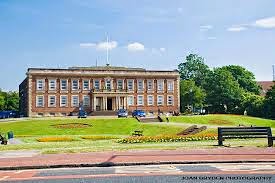
I'll have an English parliament (in Lancaster) elected by PR, a first minister (based in Morecambe town hall, pictured above) chosen by that parliament, a federal UK parliament (at Westminster!) with a House of Commons elected by first-past-the-post (as now, but with far fewer members and larger, fairer constituency sizes) plus a beefed-up House of Lords that, as suggested above, acted as an appointed answer to the U.S. Senate (with equal number of peers appointed from each of the four parts of the UK) but which somehow tried to reserve space for non-politicians and the great, good and wise. And, of course, H.M. the Queen. Simple, eh?

Kirsty Wark then interviewed another Conservative MP - former Attorney General Dominic Grieve. Mr Grieve took a fairly cautious but potentially radical approach, arguing against rushing but wanting a whole package to answer the West Lothian Question rather than bits and bats. "We've got to answer the West Lothian Question or, quite frankly, England will go 'Bang!' at some point", he said. He also thinks the "cack-handed" Welsh devolution legislation needs looking at. "At the moment we have a Welsh devolution settlement where, as I know from my time as Attorney General, nobody actually knows what the paper means", he said. He doesn't want an English parliament though. Kirsty thanked him for "being so candid".


It was then back to Andrew Neil for a chat with a couple of journalists: Beth Rigby of the Financial Times and Steve Richards of the Independent. Beth admired David Cameron's strategy while Steve spun it in the other direction.

Finally, it was back to Scotland and what the result means for Scottish politics. A report from David Grossman (isn't he Newsnight's technology correspondent now?), featuring Salmond biographer David Torrence (author of Salmond - Against the Odds) and Dr Alan Convery of Edinburgh University, looked (rather generously) at Alex Salmond's political successes -  David Grossman even compared him to Barack Obama at one point in his attention-grabbing hopey-changey message - and then looked at where Scottish nationalism is going next, including the speculation that this has been its high-water point:
And there is a school of thought that suggests the stars will never again be as perfectly aligned for nationalism, not least having an old Etonian Conservative prime minister pushing through a programme of austerity.
The programme closed with a panel discussion on these matters, chaired by Kirsty Wark. The panel consisted of: (1) The BBC's Allan Little, (2) historian (and 'Yes' voter) Sir Tom Devine, (3) historian (and unionist) William Dalrymple, (4) journalist (and 'Yes' voter) Lesley Riddoch, and (5) Times columnist (and unionist) Magnus Linklater. That's a balanced panel, for sure, and there was plenty of disagreement, but it did seem rather more biased than it ought to have done, perhaps, due to Allan Little's contributions, especially his glowing presentation of the 'Yes' side in the referendum debate. His remarks had Tom Devine and Lesley Riddoch smiling, nodding and agreeing.

A very interesting edition of Newsnight on the whole, with only a few smatterings of bias here and there.

Friday, 30 August 2013

No!


Last night's historic parliamentary vote against the UK's military involvement in the impending attacks on the Syrian regime broke just as Newsnight was going on air. 

The sense of the importance - and the sheer drama - of the moment certainly came across, as Jeremy Paxman, Mark Urban and Allegra Stratton reacted as they reported, seeming almost as stunned as anyone else to begin with (well, perhaps not Mark Urban, who's a cool customer at all times.)

Allegra floundered rather badly, it has to be said, reporting in an increasingly breathless manner and fixing too narrowly on her special area of concern (what it all means for David Cameron), but both Mark and Jeremy put in creditable performances, with informative commentaries from the ever-adept Mark Urban and well-judged interviews with the robotic Douglas Alexander and the clearly-deflated-but-keeping-his-chin-up Philip Hammond.

There remains a puzzle. The opening of the programme promised Senator John McCain (leading proponent of military action in Syria) but Sen McCain never appeared, and no explanation was given for that. Surely he wasn't bumped, as his reaction (doubtless an angry one), would have been a scoop for the programme. So did he storm off, on hearing the breaking news? 

Monday, 15 July 2013

Running orders


Following on from the last pair of posts, here's another way of looking at the BBC's unique set of news priorities today - simply by comparing the list of stories covered by BBC One's News at Six with that covered by ITV's News at 6.30. 

What stories were covered? In what order? And how long was spent on each story?


BBC News at Six

1. The benefit cap (over 4 minutes)
2. The Resolution Foundation's report on high rents (well over 3 minutes)
3. The benefit cap, again (over a minute)
4. The soldiers who died while training in Wales (over 2 minutes)
5. More charges against "former TV presenter" Stuart Hall (22 seconds)
6. A man kills the neighbour of a paedophile (20 seconds)
7. Liverpool Care Pathway (end of life care) is to be phased out (over two minutes)
8. A mother accused of starving and murdering her son (one and a half minutes)
9. Fuel - oil drilling in the U.S. & the fears of environmentalists (over 3 minutes)
10. The woman who died swimming the English Channel (2 minutes)
11. The hot weather (3 minutes)


ITV News at 6.30

1. The new NHS report into high death rates and unacceptable standards (over 4 minutes)
2. The soldiers who died while training in Wales (just under 3 minutes)
3. The woman who died swimming the English Channel (2 minutes)
4. More charges against "former BBC presenter" Stuart Hall (18 seconds)
5. A man kills the neighbour of a paedophile (15 seconds)
6. A mother accused of starving and murdering her son (over 2 minutes)
7. Liverpool Care Pathway (end of life care) is to be phased out (two and a half minutes)
8. The benefit cap (18 seconds)
9. The top athletes who failed a drugs test (15 seconds)
10. The Traynor Martin-George Zimmerman case (two and a half minutes)
11. The demise of the telegram (one and a half minutes) 


As you can see, ITV led with the big story about the Keogh report into thousands of 'needless' deaths in the NHS - the same story the BBC were avoiding until late yesterday evening after every other media organisation had been reporting it for hours (as a major story). The BBC's News at Six completely failed to mention it. In other words, the BBC ignored ITV's lead story completely. 

The BBC will have to come to terms with it when the report is officially launched tomorrow. Not even the BBC will be able to avoid it or downplay it then. (Or will they?)

ITV didn't totally ignore the BBC's lead story - the benefits cap - but they placed it well down their running order and spent a mere 18 seconds on it. The BBC not only led with it but, alongside the Resolution Foundation report (with which it was again tied), spent almost ten minutes (a third) of the whole programme discussing it. [ITV didn't mention the Resolution Foundation report at all.]

Why haven't the rest of the media been leading with the same story as the BBC?

Well, the benefit cap will affect some 40,000 households. There were 26.3 million households in the UK in 2011. By my calculation that makes those affected a mere 0.15% of all UK households - which, by my other calculation, that means that 99.85% of all UK households weren't affected by today's changes....

....and yet the BBC made this its main story of the day, and has been making such an enormous song and dance about it from dawn till dusk! 

Isn't that truly extraordinary when you think about it?

Yes, surely the Today programme should have been dragging Andy Burnham into the studio for an 8.10 grilling by John Humphrys instead of Iain Duncan Smith this morning? Ah well, maybe tomorrow, maybe tomorrow...

Away from that angle, I did smile though at the BBC describing convicted paedophile Stuart Hall merely as a "former TV presenter" whilst ITV called him a "former BBC presenter". You could have seen that coming a mile off!

************

Update 9.30pm: It's getting late on Monday evening.

Sky News is going big with the NHS report story. Their website has it as the lead story:

Report Slams High Death Rate NHS Hospital


Sky News can reveal exclusive access to a shocking report detailing a catalogue of failures at an NHS hospital.

The ITV News website also has the report as one of its top two stories:
'Hit-squads' to help failing trusts
Specialist teams are to be sent in to help up to 10 failing hospital trusts on the orders of the Health Secretary. The move will be announced tomorrow after a report by NHS England Medical Director Sir Bruce Keogh into trusts with high-death rates.
What of our reluctant-seeming friends at the BBC? Well, the BBC News website's home page, remains completely free of any mention of the story.

Their time for hiding away from this story is almost up though. The report will be published tomorrow.


Further updates: Ah, at least my local BBC news programme North West Tonight reported the story this evening, though not at any great length. We've got three of the offending NHS hospitals in our area.

10.00pm: And so it begins....

The World Tonight is discussing the story, interviewing Professor Brian Jarman, an advisor to the report's author. Ritula Shah is talking about "ministers" ignoring things (not naming any names, or parties, leaving listeners to make their own, possibly wrong assumptions). She's now interviewing Labour's Lord Hunt (defending the NHS, repeatedly attacking the Conservative Party) and Lib Dem free-marketeer Mark Littlewood (questioning the NHS, not engaging in party politics). Ritula is not raising Labour's record with the highly party political Lord Hunt, despite him continuing to attack the present government over and over again, without interruption. Is this the pattern of things to come?

10.30pm: Well, not necessarily, if Newsnight is anything to go by.

It's leading with the story and giving much of the programme over to it. Science Editor Susan Watts is presenting a report providing the background to the story and presenting some grim personal stories about treatment at one of the NHS hospitals. Questions for the CQC are being raised. The story of Joshua Titcombe, the baby who died so needlessly at Furness hospital, is being retold. Joshua's father, James, was Professor Jarman in the studio with Kirsty Wark.


Kirsty is now talking to Newsnight's Political Editor Allegra Stratton. The latter is angling the political aspect of the story as being about the Conservatives being "shocked" that no mud is sticking to the last Labour government. Their allegation is that Andy Burham "ignored" 1,500 warnings. Mr Burnham, who has been "dragged" into this, is denying the allegation. Why are the Conservatives so "desperate to land a glove" on him, asks Kirsty. It matters to the Conservatives because "they're never going to get the lead on the NHS", and yet "nothing has stuck to the Labour Party", replies Allegra. So it's all about the Conservatives wanting to sling mud at Andy Burnham for party political advantage, it seems. Poor Mr Burnham! This was a rather Guardian-like political commentary - and the bit that had the strongest whiff of bias about it.

James Titcombe and Professor Jarman were joined on the panel by Camilla Cavendish of the CQC board, former Conservative minister Stephen Dorrell, shadow health minister Andrew Gwynne and senior consultant Bernadette Garrihy. This was a panel full of people with deep concerns about the NHS - and, I think, a well-judged panel. A very interesting set of insights came from all the non-politicians. Kirsty hardly pushed Labour's Mr Gwynne very hard or for very long over Andy Burnham (and he defended his boss with vigour), but she did push him a bit and invited both Mr Titcombe and Professor Jarman to comment on Labour's record too. Stephen Dorrell didn't make any party political points.

Fraser Nelson of the Spectator then joined the discussion to talk about the economics of funding the NHS as time goes on - the "funding pressure". Whether this is the night for such a discussion might be questioned. Fraser didn't get to say very much at all on this, and hardly much more on the next question: What of Danny Boyle's NHS celebration at the Olympics? Do we romanticise the NHS? The non-politician panellists quickly returned the discussion to more practical matters.

So the story is unfolding now on the BBC....though, unbelievably, still not on the BBC News website!!


Final update (6.30am, 16 July): The eagle finally landed on the BBC News website during the early hours of this morning. Health correspondent Nick Triggle's article, Report focuses on high death rates at NHS hospital trusts, appeared at 01.24. As of 6.00am, it is leading the BBC News website (and leading the Today programme):
Standards of care at 14 hospital trusts with the worst death rates in England are to be laid bare in a report later.
An investigation was launched earlier this year after the public inquiry into the Stafford Hospital scandal.
The trusts all had higher-than-expected death rates from 2010-11 to 2011-12.
The probe, led by NHS medical director Professor Sir Bruce Keogh, has focused on whether the figures are indicative of sustained failings in the quality of care and treatment at the trusts.
Interesting use of dates there. Most other news sites have been talking about deaths "from 2005" or "from 2005-2010" - dates which have been making it all look quite bad for Labour. Nick Triggle's report only uses the dates "2010-11 and 2011-12", dates from after Labour's loss of power. Does this suggest that the pre-spin from the rest of the media has been biased (perhaps resulting from careful government leaks)? Or is Nick Triggle spinning now? We'll see when the report comes out I suppose.

At exactly the same time James Chapman was posting an article at Mail Online, '20,000 extra NHS deaths' on Labour's watch amid calls for on-site inspectors at struggling hospital, based on what looks like a scoop. The paper has "seen" an e-mail sent to Andy Burham by Professor Jarman in April 2010, warning of very high death rates in 25 NHS hospitals (especially in 2007-08):
In a reply to his letter, sent in April 2010 as the parties prepared for a general election the following month, a junior health minister, Baroness Thornton, told him [Professor Jarman] it would be more appropriate to take up his concerns with the Care Quality Commission.