Showing posts with label Duncan Kennedy. Show all posts

Saturday, 9 May 2020

Getting things into perspective


Cosham, a suburb of Portsmouth, has been trending on Twitter today - and not in a good way. 

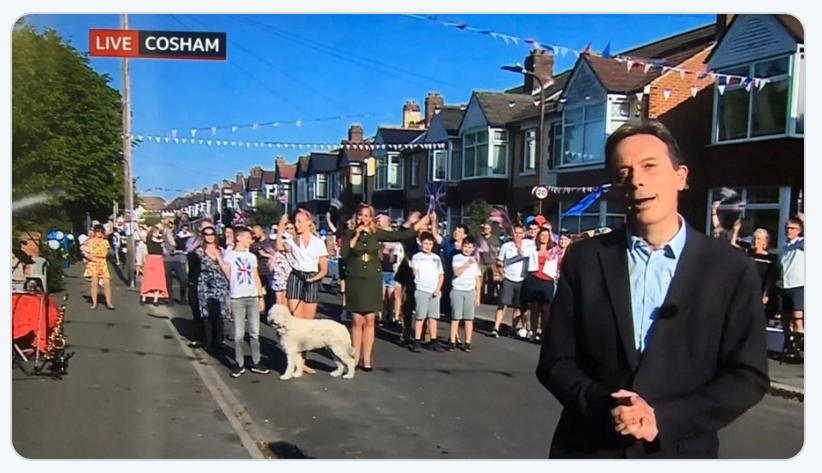
It came about after a live report on last night's BBC One News at Six, a report from Duncan Kennedy showing the inhabitants of one of Cosham's UK-flag-festooned avenues enjoying their VE Day street party, and singing war-time songs, and getting it together - at a safe distance. 

I saw wine glasses on walls, and sunshine, and families having fun, and a woman celebrating her 75th birthday that very day.  

But soon metaphorical clouds arrived like frowns, all thanks to the unforgiving medium of Twitter. 

Yes, a backlash was brewing.

A screenshot was shared far and wide. It showed the patriotic street partiers standing behind the BBC's Duncan Kennedy and waving and cheering.

Now, it must be said that they did look rather close together, so...

...Cue uproar on Twitter.

Uproar, of course, quickly translated into the usual mass outpouring of bile, bordering on hatred, all directed against the happy people of Cosham - and also against the BBC for promoting such flagrant disregard for the lockdown guidance. 

Golden rule: Never just believe what you see on Twitter. 

I looked into it (via TV Eyes) and saw the report. The BBC newsreader and the BBC reporter went out of their respective ways to say that everyone in the report was obeying the social-distancing rules - it was said three times in fact - and other camera angles showed precisely that: family groups keeping apart while coming together to mark VE Day and to pose for the BBC's  cameras. 

So, to put it simply, that controversial screenshot was simply a trick of perspective. The whole Twitterstorm wasn't even worth calling a storm in a teacup. It was a fake storm.

As you'd expect from Twitter, not everyone was unaware of that, but, nonetheless, some of the critics who evidently knew as much still carried on regardless - something I put down to them enjoying their latest two-minute hate far too much to just let it go.

Examining the critical tweets, it's clear that many were criticising the folk of Cosham on Piers-Morganite grounds. They'd seen the screengrab, read the outraged tweets, failed to step back and think, and leapt on the bandwagon brandishing their pitchforks against the lockdown deniers. But a large minority went further and displayed an Emily Thornberry-style snobbery, with some even piling in with violent wishes against people they seem to regard with total contempt.

I know next to nothing about the suburbs of Portsmouth, so I looked. Cosham is a Conservative/UKIP/Brexit-Party-voting suburb of the city. I suspect many of the nastier elements commenting on Twitter didn't even check, just assumed from the flags, and the patriotic songs, and the working class voices that these were lockdown-breaking, knuckle-dragging, Brexit-supporting creatures. Hence the added ferocity of their pile-on.

But, as couldn't be clearer these days, Twitter isn't the UK, and I suspect that the vast majority of those watching the actual BBC bulletin, and seeing the footage, and hearing the words, and taking in the point from the BBC newsreader and the BBC reporter that everyone on the street was observing social distancing guidelines, will have taken the people featured in it for what they actually are - people who like their country and their neighbours - and liked them too.

Saturday, 13 February 2016

A Storm of Complaints


This week's Newswatch (with Samira Ahmed) did a bit of 'on the one hand' and 'on the other hand' vis-à-vis 'complaints from both sides' over the BBC's coverage of the junior doctors' strike...

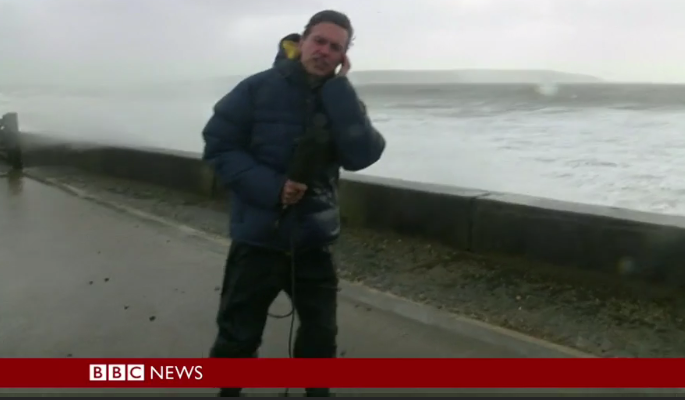
...but the bulk of the programme was taken up with discussing BBC reporters 'braving' the "extreme weather" - specifically a live report from the seaside on BBC One's News at One where experienced BBC reporter Duncan Kennedy stood next to the sea fighting against a heavy buffeting from the wind and sea-spray during Storm Imogen whilst at the very same time telling BBC viewers that the authorities had warned people to "batten down the hatches" and "don't come out and fight it". 

Viewers had written in saying that the BBC reporter looked as if he was in danger (even if he wasn't) and that the BBC was countering the official message by seeming to behave so recklessly.

Now, this may not strike you as being quite the burning issue these viewers felt it to be but Samira's interview with Richard Burgess, UK News Editor for BBC News is well worth watching nonetheless.


The BBC editor was rather woeful I felt, endlessly repeating himself and failing to properly get to grips with some of the points being put to him by Samira Ahmed. 

It was something of a car crash.

Samira herself didn't seem overly impressed either by his apparent inability to fully understand and answer her questions.

Oh dear!


Oh, and if you were wondering, Mr Burgess of the BBC felt that the BBC had got it about right.

Saturday, 31 October 2015

Tara's Theme


I didn't really want to go anywhere near this one, but as it seems like a clear example of BBC bias here goes after all...


Another story featured on yesterday's BBC One News at Six concerned the transgender prisoner Tara Hudson's legal bid to be moved to an all-female prison. Tara (previously Aaron) Hudson had been jailed for headbutting a barman in Bristol. 

It's a story that's been widely reported and widely discussed, and one interesting element is that pretty much all of the mainstream UK media, from the Daily Mail to the Guardian and the BBC,  is now entirely in tune with one of the key demands of transgender campaigners: that transgender people should be accepted as belonging to the sex (gender) they believe themselves to belong to and that reporting about them should reflect that.

On yesterday evening's BBC news bulletin, both Clive Myrie and Duncan Kennedy showed themselves to be fully on board with this. Both the BBC newsreader and BBC reporter used exclusively female pronouns and possessive adjectives in relation to Tara Hudson - thus suggesting to me that the BBC has recently issued editorial guidance on the issue:
..."has been granted her wish", "has lived as a woman all her adult life", "she lost an appeal", "has lived as a woman all her life", "She's gone through 6 years of gender reconstruction", "For the past week she's been in an all-male prison", "She's been subject she says to hours of abuse", "Speaking before her conviction for assault, she told the BBC...", "tried to get her sentence changed...", etc.
Though I'm thoroughly liberal (and libertarian) on this this matter myself, I know there are plenty of people - from Germaine Greer to Kathy Gyngell - who do not accept that 'transgenderism' is real or that its promotion is desirable - and they refuse to be browbeaten into using words like 'she' and 'her' in relation to someone born as a man, however much that infuriates the easily-infuriated on Twitter or on university campuses.

On the above evidence, the licence-fee-funded BBC quite clearly does not agree with them. It has taken the campaigners' side (as I shall also do in what follows).


On this particular story the issue is whether a young transgender woman, convicted of a violent crime, should be housed in an all-male prison or an all-female prison. Her birth certificate and passport say she's a male but she believes herself to be a female, looks like a female and, unquestionably, would be very likely to have a particularly uncomfortable time in an all-male prison.

The question I expected Duncan Kennedy's report to raise was, 'What's the right thing to do?', and then for contrasting point of views to be aired.

That's not what happened though. The whole thrust of his report tended towards the position that Tara Hudson should be moved to an all-female prison. All of the people who appeared in his report supported that position - including her mum and one of her transgender friends. The other person who appeared was Tara herself.

And then came the really odd thing. Duncan Kennedy called Tara Hudson "Tara" in his BBC report.

That's very unusual in a news report about someone imprisoned for committing a violent crime, isn't it? Violent criminals are usually referred to by their surnames. So why call this violent criminal "Tara" here? [Even the Guardian calls her "Hudson" in its reporting of the story.]

I think the answer to that is that Duncan was obviously on her side, and seeking to put us on her side too.

His whole report felt far too much like campaigning I think. And there's far too much of that going on the BBC at the moment.