You may think that Carole Cadwalladr's Observer 'scoop' today doesn't amount to much, but opinionated BBC business correspondent Joe Lynam begs to differ:
Showing posts with label Joe Lynam. Show all posts
Sunday, 24 June 2018
Sunday, 22 October 2017
Feathers flying and ad homs
News-watch has two new reports out today, and the Sunday Telegraph has reported their findings...
...and, my goodness, the BBC is not happy (to put it mildly).
News-watch's main findings are:
- that the BBC invited a third more pro-EU than Eurosceptic speakers to appear during the election campaign.
- that the BBC, during this period, has placed a heavy one-sided emphasis on the difficulties of withdrawing from the EU.
- that left-wing voices in favour of withdrawal from the EU were ignored for years by the BBC (of the 5,037 guests speakers on EU matters on Today between 2002 and 2015, only five were left-wing advocates of Brexit - 0.1% of the total speakers on the subject).
The BBC's response has been aggressive (to put it just as mildly):
We do not recognise the allegations made by News-watch and to describe this as a 'report' would be a gross overstatement for what is a defective and loaded piece of work which wouldn't pass basic academic scrutiny.
Across the election campaign we heard from a range of voices, provided our audiences with clear and balanced analysis and rigorously scrutinised the issues and this is quite simply as an obvious attempt by a lobby group to discredit the BBC when all we are doing is holding all politicians, no matter their view, to account.
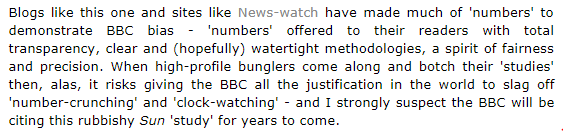
I see that response as a ratcheting-up of the BBC's usual stonewalling whenever reports of this (unwelcome) kind come out - a ratcheting-up made all the easier by that absolutely dreadful Sun 'analysis' of 'BBC bias' on the Marr show and The Sunday Politics. As I wrote at the time:
The 'tally-ho' that went up from the BBC after that Sun survey also went up today. BBC types have been piling in on Twitter to rubbish the findings, despite not having read the reports in full - reports which News-watch will doubtless post in the coming days (as they always do).
If you want to get the full flavour of the BBC's response today please explore the following Twitter thread, launched by blog favourite Rob Burley:
The "evidence" Rob has for asserting that News-watch's research is "unreliable" comes from one chap on Twitter who attempts to give it an impromptu fisking.
Peter the Would-Be Fisker initially goes for the ad hom approach (as did the BBC spokesman quoted above), checking out News-watch's website, putting two and two together and claiming it's partisan.
Peter then picks one report and claims it lacks a methodology - even though the said report did have a clear methodology (on page 5) which Peter clearly failed to spot, probably in his headlong eagerness to quickly debunk News-watch.
Peter then says, "As far as I can see, none of these reports have methods section" - even though they actually all have clearly outlined methodologies. (Please check them for yourselves and you'll doubtless all manage to "see" a good deal further than Peter here!).
Others, like the BBC's business reporter Joe Lynam, took a different ad hom route in trying to debunk News-watch today:
The snag with this one is that it's a very clever ad hom approach. It 'works'.
As many BBC defenders on Twitter have said today, people who commission polls tend to get the results they want, or why commission the poll in the first place? The mere fact that pro-Leave, BBC-bashing MPs have commissioned this and got a result which proves them to be completely right about the BBC must mean that there's no smoke without fire. Monitoring groups can't be unbiased if they are commissioned. It stands to reason, surely?
Well, the obvious answer to that is that, no, it doesn't stand to reason at all. Not at all.
The 'ad hominem' fallacy is, well, precisely that: a fallacy. The fact that a monitoring organisation (a pollster, an academic group, an independent monitoring unit) carries out a study on someone's behalf doesn't in itself invalidate anything. All that matters is the the quality and robustness of the evidence. If the evidence is offered transparently and holds up to scrutiny then all the 'ad homs' in the world will fail to refute it because the evidence is (or ought to be) independently verifiable (or refutable).
Moreover, Joe Lynam & Co. invite another obvious riposte: The BBC's recent landmark impartiality studies, which largely 'proved' the BBC to be impartial, were commissioned by....guess who?...yes, by the BBC.
Aha! Does that invalidate the findings of all of those major BBC impartiality studies which found the BBC to be broadly impartial? By Joe's logic, yes, yes it does.
And when the BBC commissions a bunch of ex-BBC types and pro-EU leftists and far-left activists at Cardiff University to review its entire output for impartiality and when they 'find' that the BBC has a bit of a right-wing, anti-EU bias but is basically sound and impartial, what's to stop people from 'the other side' playing exactly the same 'ad hom' card and rubbishing their findings on the 'no smoke without fire' principle that no-one-but-no-one puts aside their biases when publishing studies like this - least of all pro-BBC, pro-EU leftists commissioned by the BBC?
What's good for the pro-BBC goose is good for the anti-BBC gander, isn't it?
Now at this point a bit of necessary self-reflection is urgently needed because people on 'this side' are as guilty as anyone else of playing precisely the same game that Joe Lynam and the BBC spokesman quoted by the Telegraph have been playing here. We do it again and again.
And by that I also mean me. I partly rubbished that Cardiff University report (and others from Cardiff Uni) on exactly the same lines, so I'm no better than anyone else in that respect - except for the (blessed!) caveat mentioned below. (But, worse, that's far from the only time I've done it too).
So we all do it, and I don't blame Joe Lynam for trying it on here. We don't like or trust some statistic findings so we busily dig around and find 'Gotcha!' evidence that those responsible for those figures strongly hold a particular point of view and claim, abracadabra!, that their statistics must therefore be unreliable.
It's so much easier to do that than to drill into the statistics themselves and, with an open mind, try to verify or refute them.
Now in fairness to myself, I did also criticise the Cardiff survey on its merits too, condemning the extreme narrowness and randomness of its focus on just one week's output from two different years, and comparing it to much better kinds of analysis, so my doubts about that Cardiff report remain.
And that's what the BBC defenders ought to do here too, if they can. Do News-watch's findings stand up to scrutiny?
The fact that it's so much easier to take the 'ad hom' approach and try and find out who the researchers are, what their politics are, who backs them, who funds them, etc, and thus 'discredit' them, means, alas, that the 'ad hom' approach will always remain the first port of call for most people.
It's just the way it is (as Bruce Hornsby might put it).
Sunday, 23 July 2017
BBC journalists rush in...
Oh dear, how easily BBC types fall for fake news about Donald Trump!
This is supposedly part of a transcript of a New York Times interview between President Trump and Maggie Haberman, and it's apparently 'gone viral' on Twitter:
I spotted it because Rob Burley, editor of The Andrew Marr Show, tweeted about it, advising us to consider it as a Trump quote worth reading - and the balloon stuff certainly sounded like something worth 'filing for future reference': A US president asking, "How does a balloon even stay in the air? Nobody knows". The snag is that it's fake.
Rob has now deleted his tweet, given that he must have done exactly what I did and started Googling around only to find it wasn't true. For, yes, Donald Trump did not start talking about balloons at the Bastille Day parade (though he did call the parade 'super-duper'). It's a fake transcript. (The real transcript is here).
Other BBC types weren't as sharp-eyed as Rob, however. BBC business reporter Joe Lynam rushed straight in there (where angels fear to tread):
Oh dear.
Saturday, 18 February 2017
"Surely a badge of honour"
That was literally tweeted just a minute ago (at the time of typing).
Meanwhile, just a few minutes earlier, Joe was alluding to Brexit on BBC One's Weekend News bulletin and tying it to the word "problem":
So, Joe, what are Peugeot hoping to get from the Prime Minister? Quite simply, they will be hoping to get at least as good a deal as Nissan acquired from the Prime Minister last autumn. Back then, the Prime Minister promised Nissan that they would get investment in electric cars and local components, as well as free and unencumbered access to European markets. The problem for Theresa May and Vauxhall is that Britain is leaving the single market, and probably the customs union, which means tariffs might be applied to British made cars sold on continental Europe.
Sunday, 1 May 2016
Keeping tabs on BBC One's News at Six - Update
If you were wondering what's happened to ITBB's survey of BBC One's main evening news bulletin (News at Six on weekdays, the early evening news bulletins at weekends) and its EU referendum coverage (since the referendum's official launch in mid-April), well, here's a month-end update.
If you remember, three things are being counted.
******
The first measure is a simple comparison of the amount of time given to direct quotes from each side [actually clips of people speaking]. This has worked out as follows (with 'n/a' signalling no EU referendum-related feature or no direct speech):
30/4 = n/a29/4 = 0s Remain, 28s Leave28/4 = 81s Remain, 12s Leave27/4 = n/a26/4 = n/a25/4 = 35s Remain, 24s Leave24/4 = n/a23/4 = 51s Remain, 0s Leave22/4 = 99s Remain, 21s Leave21/4 = n/a21/4 = n/a19/4 = 23s Remain, 67s Leave18/4 = 96s Remain, 70s Leave17/4 = 21s Remain, 39s Leave16/4 = 23s Remain, 21s Leave15/4 - 58s Remain, 31s Leave
That works out at:
Remain: 8 minutes 7 secondsLeave: 5 minutes 13 seconds
i.e. nearly 3 minutes more for the Remain side - a startling imbalance.
Caveats are, however, needed. This (intentionally) ignores the content on what was being said. So if, say, Nigel Farage was slagging off other Leave campaigners rather than making a point in favour of Brexit or Barack Obama was telling the youth of Britain to remain outward-looking as regards the rest of the world without being completely explicit that he was meaning 'vote Remain', or if Mrs May was sending out mixed signals in a speech on security, well, it still all goes into those figures.
******
The second measure is whether the opening headlines favour one side or the other, That's been trickier to keep an eye on because quite a lot of the above (a) have featured in the headlines and (b) some of the headlines have done the 'someone says....but critics have reacted by saying' kind thing. So this have been refined to which side's angle comes first in either the headlines or the whole bulletin. Here's what's happened so far:
15/4 Remain [George Osborne warns that mortgage rates could go up if the UK votes to leave]16/4 Leave [Boris tells Barack Obama to keep his nose out]17/4 Remain [A French government minister saying Britain would have a much weaker hand when negotiating trade deals if it voted to leave the EU]18/4 Remain [The United Kingdom will be permanently poorer, says George Osborne, if voters decide to leave the EU]19/4 Leave [Michael Gove accuses the Remain side of scaremongering and using patronising arguments]20/4 Remain [20/4 Eight former U.S. Treasury Secretaries have signed an article in the Times warning of the risk of Britain leaving the European Union]22/4 Remain [Barack Obama's big 'back of the queue' warning]23/4 Remain [Barack Obama implores the young not to pull back from the rest of the world]25/4 Remain [Theresa May says we should vote to stay in EU for security but leave the ECHR]28/4 Remain [David Cameron campaigning alongside former TUC boss Brendan Barber and calling for Jeremy Corbyn to join him]29/4 Leave [Nigel Farage criticises other Leave campaigners saying they aren't the right people to talk about the EU and immigration]
That works out as:
Remain - 8Leave - 3
...another striking imbalance.
Two further things need adding to this though.
Firstly, the above list didn't feature another item which perhaps ought to have been included. The 30/4 bulletin featured a report from Joe Lynam on the sharp cut to mobile phone roaming charges in the EU. The move was shown as being (understandably) very popular with all the report's vox pops.The European Commission was credited as being responsible for this popular move. (Interestingly, this report was a toned-down version of one that had been running on the BBC's lunchtime bulletin where Joe Lynam had said "These price caps will only apply for a year. After that roaming charges will be scrapped entirely. But that applies to EU member states only. So it Britain votes to leave UK mobile phone companies could reimpose higher fees, unless, of course, the government put in place its own ceilings".) And that followed the 29/4 bulletin's focus on how the EU's deal with Turkey seems to be working with 0 migrants arriving on Lesbos that day.
Secondly, the above list shows that the BBC has been focusing on substantial points and warnings from the Remain side about what a Brexit might mean while, in contrast, focusing pretty much exclusively on the Leave side's personal criticisms of others (of Obama, the Remain campaign and their own side!).
The final measure we've been looking at involves counting up the number of debunkings (eg. from Reality Check) included in each bulletin. This has proved surprisingly easy as only two bulletins have included such a feature! The first was the 15/4 bulletin which debunked the Leave claim that we'd have an extra £350 million a week to spend on the NHS if we left the EU. The second was the 25/4 bulletin which looked at EU migration figures. This was less clear-cut as to who it favoured, though (to my mind) it was very much tilted against the Leave side as well.
Here's a transcript of it for you to make up your own minds (with a little colour-coding from me to 'help you mind your decision'!):
George Aligiah: So Britain's ability to control immigration is one of the big themes being talked about today. Our Home Affairs correspondent Daniel Sandford is here with me. Let's get this right. First, what's the position now. What are the numbers?Daniel Sandford: Well, George, there's no doubt that the European Union freedom of movement rules have made a significant contribution to the numbers of foreign citizens choosing to come and live in the UK. They're not quite as big a proportion as you might expect. If you take British citizens out of the equation, then net migration into the UK was 363,000 in the year to September - that's the number arriving minus the number leaving. Both the Remain and the Leave camps agree that we can do nothing at the moment to control the number of EU citizens coming to live here, though we still do have border controls. We can still check on people arriving and also under EU rules we do have the power to expel people on security grounds, for example.George Aligiah: All right, let's just look at the EU migration. What's the difference likely to be between a vote to Remain and a vote to Leave?Daniel Sandford: Well, if the UK left the EU then in theory migration from the European Union could be completely stopped. However, presumably at the moment of leaving we'd want to do a trade deal with EU and when Switzerland, for example, did a trade deal with the EU they had to accept some of the EU freedom of movement rules. Now they have a much higher proportion of EU citizens living in Switzerland than we do, for example, of non-British EU citizens living the UK. They're trying to get out of that agreement at the moment but to do that they might have to abandon their trade deal. Also, would we actually say that no EU citizens - no German doctors, no Hungarian economists, no Lithuanian farm workers - could come at all to the UK? Presumably not. If the economy stayed strong then even if we left the EU presumably there would be some EU citizens still coming to the UK. On the other hand, if we remain in the UK then the freedom of movement rules will certainly stay, and with other countries like Turkey and Albania potentially joining the EU further down the line the pool of people who might want to come here could actually go up - unless we change the rules of course about new countries joining.
Very arguably then, the Debunkings tally is now:
Of Leave claims: 2Of Remain claims: 0
******
All three measures then have suggested the same bias: Pro-Remain voices have been heard significantly more than pro-Leave voices and pro-Remain angles have led most of the coverage (and been more helpful to them); and the 'debunkings' have also tilted in the same direction.
All in all then, this does add up to quite a dramatic picture of BBC pro-Remain bias in action, doesn't it?
Subscribe to:
Posts (Atom)