Showing posts sorted by date for query Raja Shehadeh. Sort by relevance Show all posts

Friday, 28 February 2020

Compendium For The Day


There was an iconic ‘60s TV drama featuring a young Judi Dench, called ‘Talking to a Stranger. 
An early black and white ‘kitchen sink’ production, its USP was that the same event over one weekend was seen, over four episodes,  from each of the four characters’ very different viewpoints. It’s on YouTube, but weirdly, the fourth (rather crucial) episode is missing.

In addition to the novelty of seeing a youthful Judi Dench, the accents (and the smoking) give it a quaint, retro air, but the revival of 60s nostalgia (the Christine Keeler and Jeremy Thorpe docudramas) might inspire someone to resurrect this one, you never know. It seemed ahead of its time in that the writing was perceptive enough to make the viewer identify with (and empathise with) each character, as the narrative evolved.

It reminded me of the BBC’s presentation of anything connected with Israel. We get it from the Palestinian perspective, which we’re encouraged to empathise and identify with, but seventy years on, we’re still waiting for another perspective. 

********

The BBC’s anti-Israel bias isn’t necessarily at the top of every bias-watchers’ priorities.  In the hierarchy of biases, although many people are aware of the anti-Israel one, they see other biases  as more relevant to them personally.  For example, default left-wingery, disproportionate obsession with diversity, LGBT issues, youth and the mindless pursuit of ‘controversy’ for the sake of it. Gotchas. Islamophillia.

I’m not going to cite ‘First they came for the Jews’ here, but I will say that biased (fake) news is ultimately a threat to everyone. As for the BBC’s bias against Israel, it ‘gets away with it’ because they have a habit of shrouding it in a passive-aggressive smokescreen designed to make you believe it’s your own paranoia that makes you ‘take it that way’. Gaslighting, it’s called.

Seek and you will find. The bias is there, ‘hiding in plain sight’, but as with the Easter-egg hunt, you have to assume something exists before making the effort to unearth it. Why else would you bother to go scrabbling about in the undergrowth?

Anyway, the BBC pays just enough lip service to ‘the other side’ to provide the complaints department with a few wisps of straw to clutch at.

*************
The other day virusgate shared the headlines on Radio 4’s early morning news bulletin with a story about another outbreak; hostilities involving the IDF. The bulletin included a brief Beebsplanation of what had happened. “That led to this, and this led to that and then this occurred”.

According to the BBC, 'it all started when a Palestinian militant was shot dead by the IDF - and, to add insult to injury, the Israelis recovered the corpse by means of a mechanical shovel.  This infuriated the Palestinians who set off a barrage of rockets from Gaza after which the IDF retaliated with attacks against Islamic Jihad and targets in Syria.'

More information appeared in the online report where the affectionate term “Palestinian militant” had been clarified to read: “Islamic Jihad member”.  BBCWatch adds more information.
“The hostilities began on Sunday morning, when Israel said it killed an Islamic Jihad member along its border fence with the Gaza Strip.
The inbuilt cynicism within the “Israel said” formulation is covertly passive-aggressive (or is that what we now call microaggression?)  It sows doubts. They only said it; we don’t have to treat it as gospel. 

The alleged provocation (planting a bomb) wasn’t included at all in the original radio bulletin, but it does appear in the online report, along with another “said”,
“Israel’s military said the the [sic] man was attempting to plant an explosive device.”
where the absence (in the bulletin) of even that mealy-mouthed (incompetent “man” didn’t even manage to plant a bomb) hint at the fact that the shooting was provoked, left the impression that Israel shoots innocent Palestinians for nothing. (In Israel they murder people a great deal as the Guardian's Michael White once said)
“A video shared widely on social media showed an Israeli bulldozer scooping up the body of the man, provoking anger among Palestinians.”
The grisly detail was bound to ignite revulsion, so no wonder it was widely shared on the internet; less popular was the video of the men (more than one) actually trying to plant their bomb. (Why did the Israelis want to recover the body? I understand as part of a quid pro quo ‘corpse exchange’. The bodies of two deceased Israelis are being held by Hamas.)

 **********
That example of ‘bias hidden in plain sight’ was nothing out of the ordinary. Just routine for the  BBC. The third iteration of the house-in-a-cage story that Tom Bateman has made a meal (banquet) out of provides another example. BBC Watch also revisited the story.

This story relies on the viewer’s ignorance of relevant local history; of previous court rulings, of the questionable legality of Jordan’s pre-1967 situation, and utter dependence on the edifice built on sand commonly known as ‘international law”. (BBC Watch provides links to the missing information.)
It’s not only the viewer who’s ignorant of the relevant facts. Tom Bateman and the BBC Middle East contingent seem to be equally ignorant and quite content to remain so. 

Tom Bateman’s report in all its incarnations is an example of serious bias, and ‘because it can’, the BBC calls the shots by supplying or withholding facts to suit their brand of pro-Palestinian partisanship. The BBC is wilfully as blind to the religiously-rooted antisemitism, notoriously imbibed ‘from cradle-to-grave’ / with the ‘mother’s milk’ as it is to its own, left-wing anti-Israel bias.   
  
Palestinians who subconsciously realise that they’d really and truly benefit from peace with Israel are obliged to continue their eternal Jihad. Encouraged and egged on by activists in the west, including the BBC who kindle the flames with false hope and unachievable aspirations.

**********
A novel is being serialised on Radio 4. Apeirogon by Colum McCann. Actually, it’s not a novel, but a novelised true story based on the friendship between two bereaved fathers, an Israeli and a Palestinian, both of whose young daughters were  killed by ‘the other side.’ 

I only stumbled upon this broadcast belatedly, at episode 3. In order to get a perspective on it, I scoured the internet to see what various critics had made of the book. The Guardian thought it was terrific, but my doubts about the reviewer’s objectivity were sealed when I spotted the words: “Trigger-happy soldier”. The Times reviewer was less keen on the novel, but the negativity was based on the writing style itself, rather than the thrust of the message.

A synopsis indicated that neither man could claim to be truly representative of their ‘tribe’, although the Palestinian’s uniqueness (he found the Holocaust rather moving) seemed more of a one-off than his friend’s (an Israeli who is ‘against the occupation’ ) i.e., not very unique at all. 

I must emphasise that I have not read the book and have only listened to a small part of the serialisation; I’m not tempted to listen to any more. In this case I’m simply reminded that compassion for victims of the Holocaust isn’t an effective smokescreen.  It can’t hide prejudice and it doesn't prove anything.

Just as I was about to post this compendium-for-the-day, I realised that BBC Watch has tackled this book with more authority than I am able to muster. The reference to the political activist Raja Shehadeh I can help with, though.

I know this is another ‘long read’. Please don’t dismiss it as tl;dr until you’ve given it a chance. I allowed myself to lump together what could have been several separate posts, (hence the *******s) but I chose not to. 

Tuesday, 13 August 2019

The giant rusty key and other stories


I’ve been thinking about this for a while now. I haven’t written about it for two main reasons.

One, it would have made me look meaner and even more of a fanatical polemicist that I already do, and two, the subject is more nuanced, subjective and infused with a good deal more shades of grey than the traditional fifty. It’s also firmly embedded in emotional and a-historical folk-weavery than I can ever presume to tackle alone.

This is not the first time that we’ve featured this author here. The ITBB search engine reveals that he is no stranger to a particular brand of sentimental Palestinian folklore; saccharine, emotional heartstring-tugging - the Disneyfied narrative of the Palestinian Nakba and the complete absence within that narrative of accountability for their own ‘plight’.

Realistically I have to accept that something of this is entrenched in the national psyche, but what I find incomprehensible is the way that swathes of intelligent people have swallowed it whole - hook, line and giant rusty key.

‘It’s not just me saying it’ as every political advocate currently says to bolster whatever case they’re advocating. BBC Watch addresses the matter with the gusto and rigour that I cannot adequately muster. Shehadeh’s memoir popped up on Radio 4’s Sunday Morning with…(Scottish edition)

“Raja Shehadeh and Penny Johnson live in Ramallah in the occupied West Bank. They’re both writers and campaign for Palestinian civil and political rights. They talk to Sally about their writing and their life together.” 


 Shehadeh’s allegations of ‘land grabs’ and “building more and more settlements” – along with a subsequent claim that Israel makes “attempts at making [Palestinian] people leave” – are patently false. 
Magnusson however again failed to make any effort whatsoever to challenge those blatant falsehoods and closed the item shortly afterwards with yet another misleading reference to “fifty years of occupation”. 
In short, BBC Radio Scotland audiences heard twelve minutes of entirely predictable yet totally unquestioned political propaganda which not only failed to “help people understand” the subject matter but actively hindered that BBC obligation.

It may be the Scottish version, but it’s still the BBC. So what else can we expect?

This has something to do with the way the BBC has started to use ‘inclusive’ language to make  Islamic culture as cosy and familiar as our own. The throw-away term “Friday Prayers’ is now used as fondly as “Sunday Lunch” and the term ‘Eid’ has become Eid al-Adha’ and we are confronted by BBC anchors like Jane Hill using the full-on Arabic pronunciation. Mona Siddiqui’s TFTD hammered the nail home firmly on this morning's Today Programme. (1:46:53)

But worse. Perhaps in the same spirit in which the Spectator brought in Julie Bindel to counteract Melanie McDonagh’s critique of Lauren Laverne’s approach to Desert Island Discs  - presumably “for balance” - our last remaining refuge from creeping left-wing journalism has published a glowing review of Shehadeh’s latest work of fiction.

Going Home: A Walk Through Fifty Years of Occupation
Raja Shehadeh
Claire Kohda Hazelton

On a rainy day in 1955, four-year-old Raja Shehadeh left school without putting his coat on. ‘I will soon be home, I thought, trailing the coat as it became heavy with rain.’ The walk was longer than he expected, or the rain heavier. He arrived back soaked through and fell ill with pneumonia. The journey home, without protection from the weather, could have killed him.
Should have put his coat on then?

Throughout his life in Palestine, Shehadeh has been buffeted by events that have seemed as uncontrollable as the weather. He was a very young child when his family were forced out of Jaffa by Israeli soldiers and moved to Ramallah, and 16 during the Israeli invasion of the city. 
For nearly 30 years, Shehadeh — a lawyer, activist and writer — has taken a walk every year on the anniversary of the 1967 war and occupation of Palestine by Israel. The year of this book is 2017 —the 50th anniversary — and Shehadeh is 66, plagued by a recurring dream in which he is lost and can’t find his home.

Has he forgotten who started the ’67 war “and occupation of Palestine”? which by the way, was an intended war of annihilation.

Thankfully the below the line comments restore a modicum of common sense.

avi15 • 4 days ago • edited
This article is the usual drivel. It gives the same misleading impression as the eastern European lady in my local high street, who sits on the pavement looking all pathetic and begging; and then, when she thinks no-one is looking she nips into the post office to send all her winnings back to eastern Europe and at the end of the day, she jumps into a not that old Toyota Auris parked round the corner. 
Do we really have to fall for all of this guff? There are a million reasons why houses are demolished: normally, it has to do with not bothering with things like planning permission. If the Palestinian leaders wanted to make a deal and sort out their dispute with Israel, they easily could - they just don't want to. They're clearly making far too much money begging, looking all pathetic and hoping that one day the world will let them grab all of Israel and kill or expel all of its Jewish inhabitants. 
Don't fall for this rubbish - which only serves to perpetuate the rule of fascist, anti-Semitic criminals - which is what both Palestinian regimes currently amount to. 
And by the way, no-one "stole the Palestinians' land'. That's another lie they repeat to anyone gullible enough to listen, but which is used to justify any and every crime of violence, however heinous, that they commit. 

This whole topic is one big confidence trick. A scam, really. It’s like that ad for equity release that features the most annoying elderly couple in the whole wide world saying “this nice young man has offered us twopence ha’penny for our house, so we took it straight away.”

Or, the most mind-boggling example of human gullibility on the planet in which the police took the testimony of that palpably raving psychopath and transparently delusional man Beech and used it to vilify and destroy people who found themselves defenceless and broken in the most Kafkaesque way imaginable.

Sunday, 29 July 2018

Radical chic at the BBC


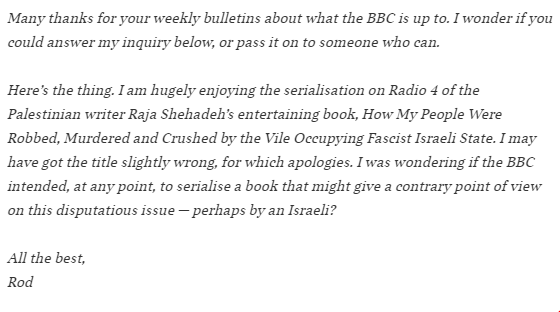
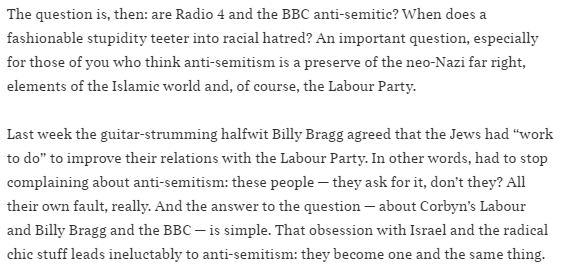
Rod Liddle is on fine form in The Sunday Times this morning, accusing the BBC of "radical chic attitudinising" for broadcasting Raja Shehadeh's Where the Line is Drawn as Radio 4's Book of the Week this past week.

Sue described the same Book of the Week earlier this week as "unadulterated pro-Palestinian propaganda in the form of the creepiest passive-aggressive grievance-mongering" and having heard it myself now I know she's got it spot-on.  

Responding to the chap at the BBC Press Office who sends out a weekly bulletin about what the BBC's up to, Rod replied:


The BBC responded with "a two-line reply" stating that its coverage is "impartial". (What a surprise!)

Rod's point isn't that Raja's "lamentations" shouldn't have been broadcast, it's that "the other side will simply not be put". This one-sided Book of the Week will never be balanced by an opposite point of view. There will never be a  pro-Israel Book of the Week giving the Israeli side of the Israeli-Palestinian conflict.

The 'radical chic' BBC are, Rod says: 
...naive middle-class liberals who believe the Palestinian cause is unequivocally just and there is no real argument about that. Which is why, when Hamas rains 200 rockets and mortars down upon Israel, you hear nothing on the BBC. You hear about it only when Israel responds. 
Rod's piece ends with a powerful question and a powerful answer:


It's well worth reading in full (if you can, as there's a paywall). 

Saturday, 21 July 2018

Some sort of agenda

Don’t you just hate hearing people saying would when they “really meant” wouldn’t.
Ditto, people saying anti-Semitist when they “really meant” anti-anti-semitist  (or something). 


That’s pretty silly stuff, with a distinctly humorous tinge. Far less amusing is the BBC‘s crass insensitivity (!) in choosing to broadcast unadulterated pro-Palestinian propaganda in the form of the creepiest passive-aggressive grievance-mongering from: 
Raja Shehadeh, the award winning Palestinian writer, lawyer, and founder of the human rights organisation, Al Haq recollects a humiliating experience on his way home to Ramallah. Read by Peter Polycarpou.

What timing. Why, anyone would think whoever commissioned this virtually unlistenable drivel for this week's  Book of the Week (BBC Radio 4) had some sort of agenda.

********

The only reason I subscribe to the Times these days is that I can see the comments below articles such as  Daniel Finkelstein’s. (£)
Complacently, I had always assumed that what happened to my parents couldn’t happen to me or my children. There were too many liberal, progressive people who wouldn’t allow it. I no longer believe this with the same confidence. (I found it really painful to write those words. I deleted the last sentence twice, but I left it in because, sadly, it’s true.)
It’s less the antisemitism itself that has induced this fear. It is the denial of it. The reaction I expect on the left to the rise of antisemitism — concern, determination to combat it, sympathy — is not the one I’ve encountered, at least not from supporters of the leadership. Instead there is aggression, anger at the accusation, suggestions that the Jews and zionists are plotting against Jeremy Corbyn.

Even though a few notable Jewish figures have started expressing similar concerns to the ones outlined above, their ambivalence vis-à-vis “the case for Israel” shines through. Maybe it’s partly a fear of falling foul of ‘rule 1a’, (dual loyalty) but I think it’s much more likely that it's down to pure ignorance, or (in other words) a lifetime of being under/ill-informed by biased reporting.

Looking quickly through the comments, I spotted Ian Hislop’s name. Not that the views of smug arbiters of moral righteousness through the medium of satire particularly interest me, but Hislop leaps straight to the Nation-State law, and cites Daniel Barenboim’s dodgy Guardian op ed, to boot.

One ambivalent asaJew refers to “incessant land-grabs by Israeli settlers.”  Incessant land grabs? Now, there’s a typical example of the effect of absorbing a listening-lifetime of selective, misleading, partial and agenda-driven journalism.

Friday, 1 August 2014

World inverted

You can see an example of the Palestinian approach to public relations in this video over at Elder of Ziyon. (wait for second video) Blunt questioning from a canny interviewer from ABC in Australia turned her interview with Mustafa Barghouti into a farce. Barghouti was dumbfounded by her forthright questioning. “When will Hamas stop firing rockets and inviting the wrath of Israel upon the Palestinian people? All he could do was splutter: “You’re asking the wrong question.”

We’ve heard the  same tactic,  (deflect, parry, attack the Israelis) so many times that you have to ask why the media bothers to invite these fellows to contribute. 

At least it shows what they’re like, but sadly people who support them can’t see it or won’t admit it.


This morning Justin Webb spoke to Dore Gold who focused, in a largely positive manner, on the rehabilitation of the Palestinians in Gaza and the way forward in general. Justin mentioned the siege. Siege? No, it’s not a siege, said Dore Gold. (definition of siege) Goods get through to Gaza. Food, medicine etc; not equipment for terror or Iranian weapons, he said.


Raja Shehadeh, a recent guest on the BBC’s Desert island Discs, (15th June) spoke to Justin from Edinburgh. I expect he was at the festival promoting a book - one came out last April - and possibly helping to boycott the Israeli theatre company that the organisers felt they couldn’t afford to provide adequate security for. Because they were Israelis.

Shehadeh began, trudging a tediously familiar path. Turning everything backwards. Gaza is fully occupied, he asserted. The siege. The threat to the Palestinians.  
Justin asked him repeatedly what he thinks is the way forward, but all he could say is that the Israelis are bad. He also made several questionable allegations, such as ‘when Israel pulled out of Gaza, the greenhouses were not smashed up, they were operational, but the Israelis stopped exports of the produce. 

Everything Justin ventured Shehadeh turned the other way round. The Israeli government doesn’t want peace. “Fact” he said.
Wouldn’t the Palestinians be better off if they managed to persuade Hamas to accept Israel’s right to exist? wondered Justin.
In 2002 the entire Arab World agreed to recognise Israel, asserted Shehadeh and continued furiously defending Hamas.
What about the Charter? Hamas wants to kill civilians said Justin.
Hamas reacted to intolerable situation replied Shehadeh. Gaza is a Big Prison. The tunnels were only a pipeline.

I watched al Jazeera for a while to find out what was being said about the ceasefire and perhaps hear what they would say about the news that an Israeli soldier has been kidnapped. 


Hamas spokesman and fantasist Osama Hamdan was being interviewed, I thought rather adversarially. He was the subject of HardTalk on July 10th. Zeinab Badawi asked a straightforward opening question: “Why doesn’t Hamas stop firing rockets at the Israelis?”
 “The question you should be asking” he answered, “Is why don’t the Israelis stop attacking the Palestinians?” 
There’s a pattern there I’d say. Hamdan was as evasive, even when addressing a broadly sympathetic audience on Al Jazeera. He pretended not to know about the Israeli soldier and accused Israel of violating the ceasefire. He also claimed that Hamas had not agreed to the conditions of the ceasefire.

The Al Jazeera anchor recounted events that led to the kidnap - a suicide bomber came from a tunnel that Israeli soldiers were in the process of decommissioning, and detonated. While the Israelis were attending to the injured more fighters emerged and made off with the soldier.


I turned to Sky. Adam Boulton was speaking to Manuel Hassassian, Palestinian Ambassador. He has the demeanour of someone in a permanent state of repressed fury.
He did exactly the same thing as all the other Palestinian spokespersons. Every question put to him was turned on its head. Israeli aggression was his preferred topic. Boulton seemed bemused. What can you do when someone is making statements that you know are patently - let’s say - the opposite of the actualité.


If the audience doesn’t see a pattern here I despair. I fear they won’t, and I do.


Monday, 16 June 2014

Left standing.

Returning from a short spell away from the BBC and the internet I thought I detected a slight, but perfectly formed shift in the atmosphere.

I looked online at Sky news to see what was being said about the kidnapping of the three Israeli teenagers. The BBC was slow to report this story.

I looked on the Sky website and read the comments under the report of the incident. The discussion had strayed to the shooting dead of two Palestinian teenagers during a nakba-day demonstration. Two ‘teenage’ incidents with an implied comparison between the relative fuss over the “missing” Israelis and an ‘all in a day’s work‘ approach to the “murdered” Palestinians. 

The number of Palestinian casualties resulting from the Israel/Palestine conflict all but renders another couple of Palestinian deaths unexceptional, almost routine, and the mainstream media’s default, cut-and-dried, reflexive blaming and condemnation of Israel equally so. 

However, the very ‘ordinariness’, or predictability of the media’s automatic, unquestioning accusations against Israel are in the spotlight, because in this case there is something fishy about these particular shootings. There is an element of suspected Pallywoodesque tampering; the Al Durah factor. The IDF’s clearly defined use of rubber bullets. The pristine ‘live’ bullet found in the backpack. The odd way the victim fell. Discrepancies in various film clips. These anomalies have thrown doubts  into an already volatile mix. Not so long ago any such doubts would have been dismissed out of hand by most people, whose minds were firmly set in anti-Israel mode. 

Is something prompting people to pause before automatically blaming and condemning Israel for everything bad that happens?  The surprising thing is that below the line, all the comments were supportive of Israel.  When has that happened before? 

That is, even though it might appear that two possibly ‘innocent’ Palestinian teenagers have lost their lives, and the shooter could have been an IDF soldier, and even though the three kidnapped Israelis have been well and truly labelled ‘settlers’, the below the line comments were still making points sympathetic to the Israeli point of view. So is that significant?

Has the Trojan Horse, combined with rapidly expanding worldwide Islamist warmongering rung some alarm bells ? Has it sparked a connection, caused penny to drop, struck a chord?   If so, all the BBC’s efforts to play down the more absurd and the more violent manifestations of the ROP will be a complete waste of their time, simply because the audience might decide it aint having any of it.

Here’s more. 
Look at the thread on Harry’s Place which tackles the same issue. It focuses on a gloating Tweet from a contributor to Electronic Intifada expressing delight at the kidnapping. Her remarks didn’t go down quite as well as she hoped.
The comments section is the jewel in H/P’s crown, and some commenters have also noticed a slight shift in attitudes. In regard to yesterday’s The Big Questions. 

Commenter Kreplach says:
“Please try and catch a recording of The Big Question. Watch around 25 minutes a radical Muslim arsehole attack Jews in front of a woman Rabbi. He asks Nawaz to condemn the Jews because the same texts about stoning are in the Old Testament. She eventually replies, visibly upset.Later refers to the anti-Semitism against her.”

(The arsehole is Adnan Rashid)

Sarah AB (mod) replies:
“It was utterly appalling. I knew he was awful, but he was much worse than I thought he'd be (in public). It was quite shocking. Maajid and the rabbi were excellent. He seemed ignorant, and indeed plain stupid, as well as hateful. Ugh.”
Shazza observes:
“For too long now Islam has been given a free pass. He was attempting to deflect blame, attack being the best form of defence but today it backfired. I think he was expecting support, the usual sick applause when Israel is being denigrated - today it was not forthcoming.As for hateful, I would say that represents the understatement of his attack. I also think that Douglas Murray together with Maajid and the rabbi were excellent.Has anyone else noticed that lately there seems to be more open and truthful discussion re Islam being allowed on the MSM?”

I did watch the Big Questions by the way, as well as Craig and some of the H/P commentariat. As soon as I spotted the familiar characters sitting on the front row I knew some turbulent viewing would ensue. “Should Britain stop tolerating intolerance?” was Sunday’s one and only BIG question.

 Douglas Murray, Daniel Hannan, Peter Hitchens, Rabbi Laura Janner-Klausner, Maajid Nawaz, Ajmal Masroor of the MCB (who believes Christianity is becoming obsolete in the East end of London because, unlike Islam, it fails to offer a clear coherent message about God) Myriam Francoise-Cerrah, Kevin Friery, “psychologist and Hampshire Skeptics” and Adnan Rashid.

Nicky didn’t want to talk about the Trojan Horse issue, but everyone else  couldn’t resist doing so. “Gove” came in for the usual character assassination. The contents of the Trojan Horse letter was discredited in Ajmal Masroor’s eyes because the document was merely a hoax. 

Don't call me a convert!

The shrill Muslim ‘revert’ Myriam got all hot under the hijab because someone called her a ‘convert’. “Don’t call me a convert” she demanded angrily during a brief hiatus in the constant barrage of interruptions she foisted upon other speakers as opinionated Muslim spokespersons are wont to do, thus ruining the prospect of any kind of reasoned debate. When things didn’t go her way, she contorted her handsome face into a supercilious smirk, as if to say these fools are so exasperatingly wrong-headed that all I can do is laugh at y’all.

Ajmal Masroor wondered why “we don’t question the Jewish community’s separatist school system.” 

Peter Hitchens put his bellowing voice and his own supercilious expression to good use while Douglas Murray argued calmly, with, I thought, a touch of resignation.  Daniel Hannan spoke up for English Values with passion and authority, the Rabbi countered with conviction when Adnan Rashid made unpleasant insinuations about “the Jews” to an almost palpable girding of loins. Daniel Hannan said that Rashid’s attempt to redefine Muslims as the new Jews -  (everything the Muslims believe in, the Jews believe in too) was something he never thought he’d hear in Britain, adding that found remarks about “The Jews” offensive, after which Ajmal Masroor  suddenly objected to people referring to “The Muslims.” 

Maajid Nawaz, perhaps with his Lib Dem aspirations in mind, is expressing some increasingly secular concepts in public lately . One wonders what actually separates him from out-and-out secularism, or dare I say, straightforward apostasy, apart from losing his asaMuslim credentials.

I often watch this programme. It’s got a populist appeal. But then, I sometimes watch “Goggle Box’ too, which, with the voice-over by Caroline Aherne, must surely be a spoof. Can real people really, really be that ridiculous?  

Anyway, some time ago, when The Big Questions first started on the BBC, or rather before it found its feet, it was a shambles. It was what’s commonly referred to as ‘car-crash ‘ television. The wrong people, including inarticulate members of the the audience, were allowed too much time to speak and others allowed too little. The featured participants were fairly low calibre and the whole thing appeared ideologically pro Muslim and stultifyingly politically correct. They seemed to be trying to boost the viewing figures by gratuitously sensationalising  the subject matter, whatever they happened to tackle, and they somehow managed to make the actual Big Questions unanswerable by using obscure and loaded phrasing.  

Nowadays Nicky Campbell appears to have got the hang of it. He is able to shut people up when necessary and manages not to alienate them whilst doing so. Also, he seems to have more of a grasp of the public’s mood than he did initially. When one remembers the Immigration Row debate on Channel 5 hosted by Anne Diamond and Nick Ferrari, one has to acknowledge the comparative genius of Nicky Campbell.

The unexpected reactions of certain commenters on the Sky website haven’t prevented Sky News from reverting to type sad to say.

Let’s end this by mentioning the BBC’s recent cluster of rampant pro-Palestinianism.


As Craig mentioned below, an edition of Desert Island Discs had Kirsty Young sympathetically  drawing out a life story tinged with bitterness from the castaway, Palestinian writer and lawyer Raja Shehadeh, whose passive aggressive account of his personal experiences was almost trumped by Ed Stourton’s sorrowfully recounted, selective list of Palestinian grievances on the World this Weekend through its one-sided report on the Middle East situation.


The BBC is destined to be ‘the last man standing’ while the rest of us look and listen as the Trojan Horse rumbles on and Islamist uprisings rapidly spread throughout the planet. With 90% of all news being Islam-related the reality of what lies behind the Palestinians' rejectionist attitude to Israel and ‘peace’ is slowly dawning on some of us, but it obstinately remains a mystery to the pundits at the BBC.  

Update:


Two substantial reasons why choosing Raja Shehadeh as a castaway was effectively a political statement.  
First, his background of anti-semitic anti-Israel advocacy tinged with revisionist and “remarkably a-historical” assertions. (H/T 'Wild' @ B-BBC)

Second, Kirsty Young’s intentional or unintentional sycophancy oozing with unspoken yet profoundly sinister empathy. (H/T BBC Watch)

Sunday, 15 June 2014

Catching up, falling behind


As you may have noticed, this hasn't been a particularly busy week of blogging here at Is the BBC biased?. It's not that there's been nothing to write about, rather the reverse: There's been far too much to write about. 

For starters, there's the news from Iraq, where a small band of medieval-minded Muslim fanatics have attempted to seize control of the Iraqi Midlands, and there's the news from England, where a small band of medieval-minded Muslim fanatics have attempted to seize control of the country's second city. 


On the Iraq story, I'm not going to be disingenuous here. I think the range and quality of the BBC's coverage has been impressive. So many interesting experts have been invited into the BBC's studios this week that I actually feel properly informed for once  - though, of course, I'm not expert enough to tell whether they really are right  or merely if they sounded right). 

Also, having listened to and watched a lot of BBC coverage this week, I know what I've heard and I really have heard a dazzling variety of voices - defenders and critics of the al-Maliki government, defenders and critics of President Obama, defenders and critics of George W. Bush, defenders and critics of Tony Blair, pro-and-anti-Saudi voices, pro-and-anti-Iranian voices, etc. 

As for 'angles', well, yes, some programmes have 'pushed' one particular angle at me (such as this morning's Broadcasting House which concentrated its criticism on President Bush and Mr al-Maliki), but those have been balanced by other programmes which either (a) 'pushed' a contrasting angle at me (such as today's The World This Weekend where President Obama's policy came under fire) or (b) 'pushed' a variety of contrasting angles at me (as on last week's editions of Newsnight, where various experts, two U.S. Republicans, two U.S. Democrats, a former UK ambassador to Iraq, a former head of the U.N., a Conservative MP, a Blair advisor, an ex-Labour left-winger, an Iraqi government supporter, an Iraqi government critic (and former PM), and an FT journalist were all brought in to give their widely differing views). 

In all honesty, I really cannot fault it. Can you? (Please say if you disagree).


On the 'Trojan Horse' story though, I believe that Monday's BBC News at Six coverage was deeply biased (especially Reeta Chakrabarti's report) - and argued so in an earlier post.

Then, blow me down with a feather, on the following night's News at Six the BBC didn't just not bury the story, no, they actually took it forward, reporting that the claims of an Islamic plot (confirmed by Ofsted), were supported by evidence that something similar has been happening in schools in Bradford. [Alan at Biased BBC spotted this too, joking that it showed that the BBC "has started its own Islamophobic witch hunt".] 

Newsnight's coverage was, I believe, rather too mired in BBC (PC?) caution on the one hand [with Chris Cook's reports continuing to resolutely downplay the story] and sensationalism on the other [with Emily Maitlis getting carried away with the programme's 'scoop' in getting Sir Michael Wilshaw of Ofsted to criticise Michael Gove then refusing to be straightforward when reporting Sir Michael's retraction of those criticisms - despite her BBC colleague, Jon Manel, unearthing for The World at One what seemed to me conclusive prove that Michael rather than Sir Michael was remembering events correctly] - both trajectories tending toward taking the story away from its main focus and onto 'Westminster Bubble' matters instead. 

As we've written here before, the BBC's 'Trojan Horse' coverage has been a real curate's egg. They've done some decent investigations of their own on this, and they've done some serious downplaying and deflection too. You might take that as a sign of their impartiality, or  that they are beginning to see the light. I suspect it's also a sign of their utter confusion. 


Most unusually for me, I even watched part of this morning's The Big Questions, which asked "Should the British stop tolerating intolerance?" 

The guest list was largely familiar, predictable even, but it can't be faulted for variety. It included Ajmal Mansoor, Adnan Rashid and Myriam Francois-Cerrah [see-no-evil-hear-no-evil Muslims], Maajid Nawaz [a see-some-evil-hear-see-evil Muslim], Kevin Friery [an atheist], Peter Hitchens [a right-wing contrarian who takes an indulgent line on Islamic extremism], Douglas Murray [a right-wing contrarian who doesn't take an indulgent line on Islamic extremism], Rabbi Laura Janner-Klausner [a liberal Jew] and Daniel Hannan [a liberty-loving Tory MEP], among others. 

I also watched The Andrew Marr Show all the way though. A Middle East expert critical of Tony Blair and the editor of The Sun reviewed the papers. [I was shocked to learn that I didn't know who the editor of The Sun is. Victoria Newton was a new name to me]. Then came John Reid (Blairite ex-minister), actress Kathleen Turner, Tony Blair (Blairite ex-prime minister) and Sajid Javid (Conservative). 

The world of Twitter exploded in rage at the mere presence of Tony Blair. Some also moaned about the BBC inviting a Murdoch Empire editor on. Accusations of bias inevitably poured in: Andrew Marr was too soft on Tony Blair. Andrew Marr was too soft on John Reid. Andrew Marr was too soft on Sajid Javid. Well, frankly, the Andrew Marr of today is not the Andrew Marr of five years ago. He's a kinder and gentler interviewer these days. He's soft on everyone...


....which at least gives us a chance to hear the views being expressed. I much prefer this way of interviewing, generally-speaking - unless the interviewee is being blatantly evasive [or if I really dislike the interviewee!]. It's much preferable to the relentless attack-attack-attack style of interviewing that too often topples over into being too unthinking and inflexible. [Mishal Husain's interviews on Today this past week have occasionally fallen into that trap].

What's next? Well there's also been Desert Island Discs with "Palestinian author and human rights activist" Raja Shehadeh and Kirsty Young making sympathetic noises as he told his passive-aggressive, embittered account of his personal experiences [h/t Sue] followed by Edward Stourton on The World This Weekend being oh-so-impartial in giving half of his report to the Israelis and half to the Palestinians but giving the 'woes' of the Palestinians a noticeably more sympathetic hearing, and the final word. If I may quote my friend Sue here:
So, even as the Trojan Horse rumbles on and the Islamist uprising rapidly spreads throughout the entire planet, the reality of the Palestinians' rejectionist attitude to peace with Israel remains a mystery to the pundits at the BBC.  
In other news tonight, the Islamists of ISIS in Iraq have posted photos of what they say are huge numbers of massacred soldiers, the Islamists of Hamas are in the frame for kidnapping three teenage boys, at least nine people have been killed in an Islamist suicide bombing in Baghdad, Islamist suicide bombers have attacked checkpoints in Benghazi in Libya, the Islamist regime in Sudan has been accused by America of bombing schools and hospitals in two of its states, Islamists have attacked a coastal town in Kenya, Somali Islamists have rounded up 100 women and ordered them to comply with Islamic dress code or risk being whipped, a Christian teacher in Egypt has been jailed for six months for insulting Islam, al-Qaeda has released a video calling for jihad against India, etc, etc.

Well, that's me caught up then. Good night.