Showing posts with label Bias. Show all posts

Saturday, 23 December 2017

Guest Post: THE BBC's OFFICIAL FESTIVE FIFTY BIAS TECHNIQUES...


Courtesy of Monkey Brains in the comments, here's MB's John Peel-style Festive Fifty which observers of BBC bias everywhere may enjoy this pre-Christmas weekend. 

So raise your mulled wine glasses please, ladies and gentlemen, and let the countdown begin...

(Be warned though. The Undertones won't be at Number One).


A seasonal message from Lord Hall, Director General of the BBC: 

In this era of fake news, Russian subversion of referenda to produce incorrect results and the installation of a fascist dictatorship in the USA, I thought it apposite and timely, to publish a list of our 50 top Bias Techniques, lest anyone should think we were being complacent about the challenges facing us in the contemporary media world. This list will act as a helpful guide for our staff but I hope it will also reassure the public at large that we have their best interests at heart. 

1. Bias by News Agenda Choice. The biggie. If we don’t report it, it’s not news. And we don’t like to report things like the Synagogue attack in Stockholm, no go areas in the UK or the New Year’s Eve events in Cologne a while back. 

2. Bias by News Prioritising. OK, sometimes we can’t avoid reporting something but we can certainly give it very low priority. It only needs to appear for a nanosecond for us to be able to say that we have done our journalistic duty. 

3. Bias in Perpetuity. If we like a story…”Tories racist says report”…we might leave it up on our website for months to make sure just about everyone gets to see it, even though we are allegedly a “news” organisation. Likewise we will return obsessively to stories we love like Grenfell Tower.

4. Bias by Burying. If we don’t like a story we will bury it away somewhere like “News from Leicester” which you get to by navigating four or five pages on our website. In terms of broadcasting you will have to live in the East Midlands to be informed of what happened. I am not going to say what happened, because that would defeat the objective of this particular technique. 

5. Bias by Headline Creep. Sometimes we know a story hasn’t really got legs but by using the headline ruse we can make it sound a lot better. So “Boris “racism” claim” on the front page of the website becomes…”Boris claims government is acting on racism”….becomes “Boris has rejected a UN report claiming that racism in the UK is rising at an alarming rate”.

6. Bias by Interruption. An old time favourite…if you don’t like what the interviewer is saying, interrupt them to hell and back, so that they can’t get their points across. Some right wing obsessives on the internet try to expose this bias by recording the number of such interruptions and comparing that number with interruptions of favoured guests, but such statistical exposure of this technique can be dismissed by a vague, airy “Notwithstanding this particular interview, we consider the programme, taken in the round, was balanced and impartial”. 

7. Bias by Misrepresentation. It’s important that we at the BBC control debate by ensuring we get to mispresent viewpoints. Under this approach, being worried about hardly ever hearing the English language spoken in your neighbourhood (a perfectly legitimate concern) obviously becomes “racist attitudes to migrants”. Of course we don’t simply assert that – to do so would be crass and far too obvious. Instead we imply it via other bias techniques e.g. “Bias by Question and Some Say”. 

8. Bias by Concept Merge. Sometimes it pays to be pedantically precise about definitions (a favourite of both Dimblebys on occasion). But with this technique, it is important to be vague and overlap differing concepts until the viewer or listener is taught, in Pavlovian fashion, to associate “Member of Conservative Party” with “Far Right Nut”. Thus we merge “Neo-Nazi” into “Far Right”, which in turn merges into “Right Wing” which then merges into “Nationalist” (as in “Bad Nationalist” – obviously does not apply to SNP, Sinn Fein and Plaid Cymru) and further blends with “Tory” and “Conservative”. By constant mixing and association Neo Nazis, Nationalists and Tories all become part of a dangerous amorphous group that like to persecute minorities. We find this approach very effective at the BBC.

9. Bias by Mirroring. Under this ruse we call extreme radicals like Iranian Mullahs or Chinese Communists “Conservatives” so as to make toxic the whole “conservative” brand. You have to admire our cheek in doing so! But the useless Tories never make any effective protests about this.

10. Bias by Intimidation. We tell our audience that we will report them to their employer or school if they voice opinions of which we disapprove. This can be more effective than you might think. Of course we have combined this with a sustained attack on the Have Your Say function on our website and also by turning the Feedback programme into a meaningless “complaints from both sides” exercise now stuffed full of disguised adverts for BBC programmes.

11. Bias by Mockery. The mockery is not just something for “comedy” panel shows or the Now Show. News presenters can also join in the mockery of anything the BBC doesn’t like. Eddie Mair and Jonny Diamond have I think done some excellent work in this area. But woe betide anyone who mocked say Stella Creasy or Chukka Umuna!!! (not that that would ever happen under my watch!) - that would be sexist and racist and would lead to instant dismissal. We of course produce an in-house list of who to mock and who not. Currently Boris Johnson and Michael Gove are top of the list. But such lists can of course change and staff should keep up with developments. 

12. Bias by Complaint Dismissal. As long as we keep batting away complaints in the face of the truth and the facts, we can maintain our absurd formal claim of impartiality. It is therefore important that the programmes we claim allow the viewer or listener a voice should be tightly controlled. I have of course instructed all editors and producers to hold the line and deny bias by claiming complaints from both sides and if they cannot defend something, claim a broader overall balance across the piece. 

13. Bias by Propaganda Tentacle. The BBC has a long reach. Our correspondents can use Twitter to voice more extreme anti-democratic, pro-Antifa opinions through re-tweeting. We are now going into schools as well to brainwash children with our “Fake News” agenda. Our tentacles can basically reach anywhere. 

14. Bias by Question Selection. What questions get asked is vital. If you think we pull the QT questions out of a hat then you are very, very naïve. 

15. Bias by Simple Fact Denial or Avoidance. For instance we will not admit even the possibility that the housing crisis might have something to do with mass immigration. It’s rather like that loose thread in a pullover. If you start pulling on it before long the whole thing will unravel. So we have to maintain “Complete Fact Denial” in those very sensitive areas touching on the central tenets of our PC Multiculturalist doctrine. 

16. Bias by Expert. We choose the experts. Our experts are guaranteed to support our views. That’s how and why we select them! 

17. Bias by Org-Labelling. For instance, that think tank is “right wing”, this think tank (the one we like) is “respected”! It’s not so difficult once you get the hang of it. 

18. Bias by Person Labelling. That person (someone standing up for beliefs that were uncontroversial 50 years ago) is “far right”, this person (a Marxist totalitarian) is the “conscience of the left” or a “revered academic and commentator”.

19. Bias by Tone of Voice. So important! When we are children we listen to our parents’ tone of voice before we understand the meaning of their words. Are our parents angry or pleased with us? We know this and so we play on these very human weaknesses. Our presenters sound surprised if a right wing person does a nice thing or somehow escapes justice when we have been looking forward to their downfall. Equally they make it sound like their mother has died if the PC Multicultarist liberal-left suffer a reversal, however minor. 

20. Bias by Atypical Person Choice. It may be true that most female followers of Islam in Bradford may wear a Hijab and rarely go outside the family home but we have the resources at our disposal to find one who doesn’t wear a head covering, uses make up, wears tight jeans and has set up her own business. Once we have found her we are going to give her the full PR treatment on your shows, eventually giving her her own series.

21. Bias by Drama and Soap. I can’t overemphasise the importance of this bias technique. This is how we really buttress the news and indoctrination agenda. We use drama and soap to signal approval or disapproval and to identify what issues the public should think are important. 

22. Bias by Lifestyle Show. We can make frightening things appear comforting all by the magic of lifestyle TV. Of course this has to be managed. It can be an area requiring sensitive handling. We didn’t show a Hijab for years. Big beard presenters are still out and the Burka is I am afraid still a big no-no. But this is a Long March we are on. Eventually we will be able to de-sensitive the backward segment of the British public on such matters by associating such features with nice things like baking, cooking, shopping and home décor. 

23. Bias by Over-representation of Minorities. You see a lot of this on TV adverts of course and we have to take our hat off to our commercial colleagues in that regard. The message of course is “resistance is useless”. It is supposed to deliver a jolt and acclimatise people to further volcanic demographic change. We are of course doing everything we can at the BBC to ensure that minorities (officially only 13% of the population) are over-represented in a number of key areas like news presentation. When it comes to drama, we are quite happy to provide misleading representations of classics from the Victorian period now, sacrificing accuracy to our PC Multiculturalist principles. Of course when we talk about ethnic minority representation we mean generally African-Caribbean, African and South Asian. At the BBC we don’t much care about how many Poles, Arabs, Romanians, Chinese, French or Latin Americans are on our screens despite there being very large communities from those ethnic groups in our country. I hope at some point to explain why that is but sadly time is limited and I must press on. (Ahem). 

24. Bias by Slow Information Release. We wouldn’t want you to run away with the idea there’s just been a terrorist incident carried out by an IS operative migrant who shouted Allahu Akbar…so we will slowly drip feed the news and then disappear the story altogether. Often we will use the “mental ill health” ploy to justify this. 

25. Bias by Local News as National News. Local news is a good way of extending the bias especially in areas where there are lots of Labour MPs and we can call on them to provide a steady drumbeat of public expenditure propaganda . We always favour local news with a national flavour…so expect lots of NHS cuts and not much about the County Show. 

26. Bias by Survey. Our opinion polls are frequently wrong. But they always seem to favour the left for some reason. Sometimes our levels of bias are off the scale as was the case with the Newsnight panel of “ordinary voters” that voted 9-1 to remain. BBC Staff should not be embarrassed by this, rather they should see polls as weapons in our hand not instruments of science. 

27. Bias by Decree. Here, the likes of John Simpson or David Dimbleby - once respected as cutting edge journalists - trot out the BBC narrative without appearing to have thought about what they are saying first. In our BBC world of bias, if they say so, it must be true. You might call this the “Hillary Good, Trump Bad” approach. 

28. Bias by Obfuscation. David Dimbleby is of the view that if he poses a smugly sceptical or irrelevant question "But we don't know that was an official Mosque letter, do we?" (irrelevant - it was clearly being handed out at the Mosque in full view) or "But do you have an example of the BBC saying "despite Brexit"? " (Answer: Guido Fawkes website had plenty of examples the next day!), he has neutralised the critique. Obviously he hasn’t genuinely neutralised the critique, but at the BBC we feel it is “the moment” that counts. As long as he appears to have raised legitimate doubts that is enough. It is my view this is an effective Bias technique as Dimbleby is sly enough to time his semi-rhetorical questions at just the right point so they don't get or can't be answered. They therefore serve our purpose. 

29. Bias by Yawn. Sadly this is a rare example of a technique that has been tried but proved unsuccessful. It was attempted in the run up to and during the early part of the EU Referendum campaign as we got nearly all our TV and radio presenters to imply that everyone was bored with the Referendum debate even though we now all know the opposite was true: family and friends often ended up having passionate debates on the subject (some are still continuing to this date!). But we at the BBC were trying to reduce the interest in the campaign, as we knew that was important in ensuring the anti-EU vote did not get mobilised. Frankly, we failed. Though we cannot be blamed for the decision to have a Referendum (we strongly opposed that), we were wrong to pursue that ineffective technique. We should have been much more pro-Remain from the outset. Eventually we realised the yawn technique was proving ineffective: the pretend yawns stopped and it was then we desperately tried "educating" everyone to vote remain. But sadly, it was too late. Personally I feel the Government should have given us more leeway to support the Remain campaign, even though we did our best to back their arguments and rubbish the Leave campaign. Clearly it wasn’t enough. 

30. Bias by False Friend. This is one we have been using a lot recently in relation to events in the US: "So let's go over to Washington to discuss Trump's latest tweet. We have leader of the Democrats in the House of Representatives and the Republican Governor for Wyoming..." Our audience thinks this sounds balanced since it’s one Democrat and one Republican. But of course, we know something they don’t – this particular Republican Governor hates Trump as much as the Democrat. We see similar set ups with our domestic politics "Here to discuss the Government's proposals are Chukka Umuna, Labour MP and Ken Clarke, Conservative..." only Clarke is going bash the proposals almost as much as Chukka.

31. Bias by Herd Instinct. Human beings have a tendency to follow the herd or the “troop” (since we are primates!)…so we at the BBC do our best to create bandwagons for the campaigns we favour. Biased BBC Trending do a lot of good work in this area. 

32. Bias by Recruitment. This is what we at the BBC call the “Guardian readers only need apply” ploy. Don’t worry – I am a Guardian Reader!!! lol This is really a very important and self-fulfilling bias category. 

33. Bias by Vocabulary Choice. This is of course a huge area of bias. The “bread and butter” of bias you might call it. It covers many things but among my favourites are right wing think tanks "claim", "assert", things whereas left wing think tanks "point out", "conclude", "find evidence"...During the EU Referendum campaign pro-Remain agencies were always concluding, calculating, pointing our and finding...or projecting, predicting (never guessing!)...When Remain claims were criticised by the Leave side, we at the BBC always used the language of emotion and violence instead of cool consideration: the Leave side "angrily denied", "lashed out", "slammed" etc 

34. Bias by Paragraphing. We often leave the key information to the penultimate para of a long article (not the final paragraph because people sometimes skip to that). You can hope the punters have got bored by then and miss it...thinking the perpetrator was simply a "man" with known "mental health issues" not someone who visited Afghanistan last year and was carrying an IS flag.

35. Bias by Mandy Rice Davies. The point of this technique is to make the denial sound as thin as possible. I think Norman Smith is quite good at this. Norman is adept at telling us the unfavoured have "denied" something...but does so in a "well wouldn't you too if you'd been found out" sort of way...It's normally the right who get this treatment of course but there was a phase when the BBC when we were gunning for Corbyn and we gave him the same treatment (this was when we at the BBC thought Corbyn was a vote-loser who would keep the Tories in power for the next 20 years - now of course it's all Christmas jumpers with Jezza's face on it! – he’s forgiven, for the time being).

36. Bias by Uneven Standards. Of course at the BBC we believe in high standards, we just don’t believe in applying them consistently around the world. For instance we hold Israel to a much high standard than Saudi Arabia (which doesn’t even allow people to profess Christianity). We report obsessively about their “illegal occupation” of Arab land. But illegal occupation of land is a rather flexible concept. We never, or only very rarely, give Russia and China any grief about their huge empires and their occupation of territories against the people's will. We don’t ask representatives of countries like Australia, Brazil, Canada and Argentina about eradication of indigenous peoples. Romania's occupation of Magyar lands is of no interest to us at the BBC. Likewise, while we show an inordinate interest in civilian killings in the US by gunfire we have no interest in such killings in Mexico or Brazil, and absolutely no interest in the murder of thousands of white farmers in South Africa. While we at the BBC are willing to shed tears over a few thousand Palestinian Arabs losing their homes and being "forced" to flee some 70 years ago, we have no interest in the many millions of Europeans, Jews, Hindus and Christians forced to flee from the Middle East and South Asia and in reality not much interest in all the displaced persons in Sub-Saharan Africa.

37. Bias by Photo Choice. A picture tells a thousand words and picture bias tells a million. We can choose a nice one of Jeremy looking either messianic or avuncular, surrounded by happy smiling people, or we can choose one of Theresa looking very anxious (as though she's about to try swallowing something on I'm Celebrity) and isolated, with a dark sombre background. We had a nice example on the BBC News website recently: May looking worried and pensive, her frame apparently being squeezed between two EU flags that dominated the photo...and then there's Nicola Sturgeon smiling, looking very businesslike with one of her ministers carrying lots of impressive looking files...Chance choice? Of course not. Nothing happens by chance at the BBC! Photo bias is one of the easiest techniques to spot if you look for it but because people tend to take images on trust they rarely identify or comment on the bias. 

38. Bias by Placard Placement. I rather like this one. I used to use it a lot myself back in the day. We at the BBC know we are not going to get away with a newsreader saying "The Tory fascists have decided to dismantle the NHS." But there's nothing to stop us showing a placard in a protest that says something like that: "Tory fascist scum will kill the NHS". Nothing to stop the cameraman zooming in on that as a lingering image to underline a report. When , rarely, we cover right wing protests, the placards get far less prominence, unless of course we think we've found one that is an own goal. We are quite happy to feature old eccentric people covered in Union Jacks opposing the EU in robust terms. That’s an image we like to cultivate. 

39. Bias by Soft Interview. This is a technique I think is sometimes underestimate but all staff should appreciate its importance. We particularly make use of this technique when we want to put rocket boosters on a political position we approve of. So we saw recently Blair being given the softest (and longest) of rides by Mardell because Blair was proposing one of our favourites: a Brexit Reversal Policy. We can counter accusations of bias, by claiming these are serious, in-depth, “mission to explain” style interviews though we hardly ever accord such access to viewpoints we oppose. 

40. Bias by Celebrity Endorsement. No! This doesn’t refer to the celebrity endorsing a product but the BBC endorsing some celebrities over others. So Jim Davidson and Cliff Richard get the cold shoulder despite being very popular. People like Lily Allen know that BBC endorsement can be vital to prolonging their career lives way beyond their natural span and the we at the BBC know it is useful to have people like Lily Allen around to endorse otherwise somewhat difficult policies like "no borders". 

41. Bias by Reality Checking. We brought in BBC Reality Check to create a kind of alternative universe where matters of policy can be judged objectively by reference to "facts". Of course this universe does not exist in any shape or form but it is useful to our purposes to pretend it does and that we at the BBC (alone in the UK – butt out ITV and Sky!) can objectively arbtitrate such matters. Anyone who looks at BBC Reality Check can see instantly it has nothing to do with "reality" and everything to do with our policy preferences. This can be seen by (a) its choice of subject matter (Reality Check never investigate the dodgy social studies from groups like the Joseph Rowntree Trust we are so fond of quoting) (b) its concentration on "future outcomes" which by definition have not happened yet and cannot therefore form part of our "reality" and (c) its disregard for the initial starting question (you will often find the conclusion has little to do with the question!) (4) its frequent recourse to "argument from authority" - quoting their favoured sources. So, please staff, don’t think that Reality Check is going undermine your reports – you can rely on it as a solid backer of everything we at the BBC are trying to achieve. We just need to give it a spurious veneer of independence and objectivity – nothing to be scared of! 

42. Bias by Absent or Abbreviated Nomenclature. At the BBC we pride ourselves that Trump is more often Trump than President Trump whereas President Obama was nearly always President Obama, certainly for his first term - just as Thatcher was more often Thatcher than Lady Thatcher. Use of the "criminal" surname is often reserved for those perceived as "right wing" Tories. Jeremy Corbyn is much more likely to have the cosy "Jeremy" attached. Also by a kind of reverse law, titles are much inflated when the BBC wants to make use of them: so you get stuff like “Lord Shyster of Plain-Wrong, the ex Lord Chamberlain of High Office and current Chairman of the Lords Select Committee on Matters of Great Import has denounced the treatment of Calais migrants as "callous"...” Don’t worry, while we are ideological egalitarians, when it comes to pushing the agenda, a bit of peasant-like deference is on offer if it means we can push our ideas more effectively. 

43. Bias by Emotional Response. This is where we ensure the BBC acts as emotional gatekeeper to the nation. You can cry about your factory closing down but not about your neighbourhood being changed out of all recognition by mass immigration. If you are the victim of Islamic terrorism we prefer smiling defiance to tears. But other forms of terrorism may be treated differently depending on context.

44. Bias by Views as News. This is something we have always practised but these days we have expanded it into all areas. A classic recent example was James Cook's take on Trump (he doesn't like him - what a surprise!) - a virtually 100% opinion piece appearing under the BBC News banner. Of course a lot of our BBC bias involves smuggling views into news but this refers to those blatant examples where a piece should be labelled "A Personal View" if appropriate at all (doubtful).

45. Bias by Vox Pop. Never underestimate the Vox Pop. They are a really important bias tool which you will find used in nearly every national and local news programme. They can really put a nice spin on a story. And then there are the visuals which can add yet another layer of bias: we at the BBC are always very happy to have a pro-Brexit vox pop on our screen if it is delivered by an old pot-bellied bloke on a mobility scooter with a fag hanging out of his mouth, with the betting shop visible in the background. If we can encourage him to have a go at “migrants” all the better!

46. Bias by Newspaper Review. This is a specific technique we use to build a kind of Potemkin village of opinion out of MSM news. By using left-liberal reviewers, a left-liberal presenter and a selection of stories biased to the left-liberal view of the world, we are able create the erroneous impression that the BBC’s agenda is very much in line with that of the rest of the MSM. Where necessary the Review can be used to chastise heretical opinions deemed as offensive to PC Multiculturalist beliefs. 

47. Bias by Some-say. Let’s be honest, it is rare for an hour to go by without a BBC presenter or reporter having recourse to that well known family "The Somes". "But some say this belief in fundamental biologically-based differences between men and women is just petty-minded fascistic prejudice which will soon be consigned to the dustbin of history." The Somes come in very useful to us at the BBC when we want to advance the "progressive agenda" but realise we are on tricky ground. A non-specific "some" is a nice way of suggesting support is building for a "progressive" idea. It sounds a lot better than "that mad columnist from the Guardian". Given we live in a nation of nearly 70 million people, if you say "some" then most fair-minded people will think you mean a few hundred thousand or a few million at least, if not yet a majority, whereas it might only be that mad columnist from the Guardian, 12 people in Hampstead and five in Islington.

48. Bias by History. The past is not such a foreign country to us at the BBC. In order for the PC Multiculturalist Fantasy to be realised in the modern world the past needs to be tweaked or, worse, given the full Harvey Weinstein treatment. So, looking back at the past through our BBC-PC Telescope we see that slavery was something that was visited on Africans only by Europeans. Arabs did not enslave Africans in their millions and if they did, it wasn’t really slavery. Likewise only West Europeans have engaged in imperialism. Chinese imperialism is really of no note at all. Russian imperialism likewise of virtually no importance since the end of the Cold War. Through the PC lens of history we see that Islam is a universally benign and progressive force that invented the scientific method and brought the benefits of progress to Europe, India, Africa and elsewhere. The BBC History guide can’t help but be a little obsessive. So the history of the Levant 1917-1967 (no other time) is of great and enduring interest to all of us at the BBC. It is of course the time of the unjust creation and expansion of Israel as far as we are concerned. The history of Asia Minor during that same period is however of virtually no interest whatsoever to us! We have also to accept that the BBC’s history can be very sentimental when we want it to be. As far as the BBC are concerned Native Americans always lived on the Plains hunting buffalo on their horses. Likewise, the Zulus of South Africa never exterminated and drove out the San people of the area in the 1600s. Weirdly although we at the BBC have this highly “romantic” approach to history elsewhere, when it comes to the UK have absolutely no time for any romanticised version of “our island story”. No, then we cast a cold, callous, indifferent eye over the history of our forebears. Actually, I don’t think I should say “forebears” but you know what I mean. 

49. Bias by Counterintuitive Injury Reporting. At the BBC we use this mostly in the context of domestic or American demonstrations. So “An EDL march took place in Rotherham today [Note – don’t mention about what!]. The march was condemned by the local Mayor who said “This Far Right rally has nothing to with our community which is peaceful and harmonious.” There were 7 injuries and 5 arrests.” The set up makes the audience think the EDL caused the injuries and that EDL supporters were arrested, when the truth is the counter-demo mob caused the injuries and were the source of the arrests. Classic result! Just what we want!! This technique can also be used with terrorism in faraway places. “Terror attack – two Palestinians dead.” No – not an attack on Palestinians by Far Right Israelis…two Palestinian terrorists shot dead while trying to carry out a terror attack. “ Likewise “70 Muslim worshippers killed in Mosque attack” might make you think the religion of Islam was yet again being persecuted by Christians or Hindus. The fact’s it’s a Sunni-Shia thing is nicely obscured. 

50. Bias by Absorption. There are many cultural events or phenomena which we seek to make our own. Glastonbury, Turner Prize, MOBOs, Chelsea Flower Show, Women’s Football...we are like some giant amoeba, absorbing chunks of other DNA safe in the knowledge that it can replicate inside us and produce a yet more bloated version of the BBC itself. I think it’s what I would call cultural synergy. By absorbing these other cultural phenomena we make ourselves stronger and better project our cultural aims. 

I hope you have enjoyed our Festive Fifty and that you now understand better how we operate. The BBC believes in transparency and connecting with its staff and the public at large. Besides we think that you are so brainwashed by now you are probably quite happy that we are so biased. 

Seasonal greetings and a Happy New Year whatever calendar you choose, 

Yours ever, 

Tony

Monday, 17 April 2017

Another introspective post...plus Hugh Sykes on Turkey


Going introspective again for a few minutes...

It is certainly true that impartiality can be hard to achieve, as Sue has always reminded me (in reaction to my far more rigid views on the matter). It's true because we humans aren't robots and because impartiality is a slippery concept and, as a result, it's far from unlikely that the BBC will keep on failing in that regard, even if they were always trying to behave themselves (which they most certainly aren't always trying to do!)...

...and it's also true that a broad, cross-BBC bias might inevitably come about (as it has!) if BBC employees tend to come from much the same demographic and mindset (as they do, often via the Guardian's recruitment page!).

[Ed - That's enough exclamation marks for now, Craig.]

Here's a question though: Should the BBC actually be actively biased, with all of our blessing, in favour of 'good' rather than 'evil', say? Or in favour of 'democracy' rather than 'anti-democracy'? 

(Of course, that depends on what people think is 'good' and 'evil', or 'democratic' and 'anti-democratic', as cultural relativists might put it. I think cultural relativism is very over-rated though).

I was wondering about all this in light of what I've heard of the BBC's Erdogan coverage in recent days - and especially after Mark Mardell and Hugh Sykes's latest discussion on today's The World at One. 

Now, Hugh Sykes certainly got himself wound up this lunchtime in bizarrely contrived comparisons with Brexit (springing, no doubt, from his own views on Brexit) and only just managed to save himself by adding "possibly snobbishly" to his closing, loaded remarks about the Turkish referendum result being a case of "the educated for No against the uneducated for Yes" (and where have we heard that one before?)....

....but the really fascinating thing about this World at One discussion was Hugh's tone. I've never heard him sound so flustered on air before. He was babbling (eloquently of course) in a highly excited fashion at times and was so strongly inflecting his phrases with heavy tones of (unhappy) incredulity that his true feelings about events in Turkey could hardly have come across any louder or clearer - including his obvious view that what has happened in Turkey has been shabby, undemocratic and, all in all, a very, very bad thing. 

And the thing is, from my point of view, that he's obviously dead right about that. It is a very, very bad thing, and he's absolutely right to be so upset (and biased) about it. (Erdogan supporters would naturally disagree about that).

So was Hugh being biased against 'evil' and in favour of 'good' here? If so, good on Hugh! 

And if Hugh and the rest of the BBC were consistent in being biased in favour of 'good' against 'evil', and in favour of 'democracy' against 'anti-democracy', who on earth could object to them being so? 

If they didn't engage in false equivalences between democracies (shall we say Israel perhaps?) and their totalitarian, terrorist enemies (shall we say Hamas perhaps?), wouldn't that always be the right thing for the BBC to do?

And what could be sillier than Lord Hall, say, telling us (as he notoriously did) that the BBC can't call Islamic State 'Daesh' because that's a "pejorative" term used about them by their opponents and, thus, that using it would mean the BBC taking sides? 

Once again, I'm thinking on my feet here (though actually sitting down): Shouldn't the BBC be biased against President Erdogan if most people can agree that he's 'evil' and 'anti-democratic'? 

Or would that give the BBC a blank cheque to pile on the opprobrium even more against anyone and everyone they consider undesirably 'populist' (from Trump supporters to Brexit supporters) - something that most people in the UK might not agree with the BBC about? 

And, given how they already behave, wouldn't they keep on cashing that blank cheque day in and day out, making their bias even worse (if you can imagine that)?

As ever, your thoughts would be greatly appreciated.


Anyhow, here's a transcript of that World at One discussion:

Mark Mardell: Within the past few minutes the Organisation for Security and Co-operation in Europe, which has monitored the fairness of a referendum, has described it as being conducted in an "uneven" way, with a misuse of government resources. Our correspondent Hugh Sykes is in Istanbul. You've been out and about this morning, Hugh. What's happening?

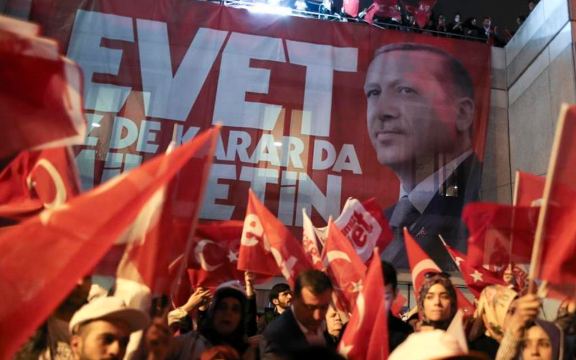
Hugh Sykes: Not a lot. Very little triumphalism. There was a bit of that last night, people roaring around in their the cars setting off fireworks. A lot of subdued despondency. I think the reality of this is only just sinking in. It's a bit like the day after the EU referendum in Britain last year. Brexit suddenly came into focus the next day. So people are being thoughtful and quite quiet. But the No side are furious. I mean, that description "uneven" is to put it mildly, from their point of view. They say that Yes played so dirty that they should have won an enormous margin. The Yes campaign got massive support from the government and from television. Imagine the government in Britain only supporting the Leave campaign and marginalising all the people who wanted to stay in the European referendum. It was very comparable to what that would have been like here. And the president is supposed to be above the party here. He certainly wasn't.  His face was on huge banners and billboards alongside that the word 'Yes' in Turkey 'Evet', and the No campaign got hardly any television airtime. There were few, if any, No political broadcasts and dozens for Yes. And to cap it all...They must...they really were desperate at the end. They thought they were going to lose, the Yes side. The prime minister tried to smear No voters by saying that voting No would be tantamount to supporting terrorism. "You're with us or you're with the terrorist." That remind you of anybody?

Mark Mardell: But given that sense of powerlessness from the opposition. do they stand any chance of stopping that, even with the sort of support of the OSCE?

Hugh Sykes: Well, it's a moot point, isn't it? They are going to appeal to the Supreme Court. Will the Supreme court by the time they appeal have been stuffed with Erdogan supporters, and that it doesn't stand a chance? But the appeal would be about the the ballot form decision, this very strange (at the very least) decision by the Electoral Commission last night...said in the middle of the count that they'd accept ballots with no official stamp on them...they are supposed to be stamped, every single ballot...and ballots in unsealed envelopes...every ballot's supposed to be an envelope that's sealed. otherwise it's fishy, and if it's not actual fraud there's plenty of opportunity for it. There's a really bad cloud of doubt hanging over such a tight result. The leader of the Republican People's Party (CHP), Kemal Kılıçdaroğlu, commented above all this, "You can't change the rules of the game in the middle of a match".

Mark Mardell: Doesn't sound much chance of a very divided society coming together?

Hugh Sykes: No, it's completely split down the middle. I mean, 51-49. It's not exactly a resounding victory for Yes. And if you look at the map there's a stark colour difference between the Yes places - Istanbul - sorry, I beg your pardon - beneath the No places - Istanbul, Ankara and prosperous industrial and tourism centres along the coast, the south coast and the west coast like Izmir - against the people of the hinterland, against Anatolia, characterised by some, possibly snobbishly, as "the educated for No against the uneducated for Yes."

Mark Mardell: Hugh, thanks very much indeed.

Saturday, 25 April 2015

Proving BBC bias - a case study (Paul Lewis on 'Money Box')


If there's one BBC presenter that everyone seems to like, it's Paul Lewis from Radio 4's Money Box.

Few people have a bad word to say about him, and he's someone who rarely, if ever, gets criticised for bias. He's a wonderful presenter, and a great credit to the BBC, and...

Evan Davis (interrupting): There's a 'but' coming, isn't there? What is it with you Paddington-hating bloggers and your hate-filled 'but's? Surely it's patriotic to be uncritical of the BBC? 

Shut it, Evan! 

But, yes, you're right for once. There is a 'but' coming, because Paul Lewis's interview with UKIP's economics spokesman Mark Hughes today provoked a certain amount of shock from UKIP supporters, both on Twitter (using the #bbcbias hashtag) and on BBC-bias-monitoring blogs. 

Here's a representative exchange on the subject from Biased-BBC:

MartinWW
Radio 4 – Moneybox. 25 April. Paul Lewis interviewed UKIP’s pensions spokesman at midday. One might have expected Lewis to have been his usual forensically-probing, but polite and even-voiced self. But, no. He was sharp-voiced, carping, hostile and argumentative and, furthermore, accused the spokesman of constructing policies to assist in his business. Lewis was more interested in finding fault than providing a fair platform for UKIP. Before this episode, I had considerable regard for Lewis, and it is sad that he reverted to the standard BBC stance towards UKIP.

  • Rob in Cheshire
    I must agree. Paul Lewis has always struck me as a decent and fair financial journalist, but his attitude towards the Ukip spokesman was terrible, the sort of constant interruption and clear bias one has grown to expect from Evan Davis and the like. A big fail for Money Box I’m afraid.

Is this just sour grapes from UKIP-supporting commenters, or is there something in their complaints about Paul Lewis's behaviour today? 

Well, it did seem to me to be an unusually sharp-toned interview from the Money Box presenter, though I have to say that I found it fascinating, and unusual - unusual in that it's extremely rare to hear a BBC interview that actually focuses on, and takes seriously, UKIP's policies, and is prepared to spend time digging into them.

********

All this is a preamble to a stocktaking piece about how we can actually prove BBC bias. 

A complaint based on the tone of a BBC interviewer tends to get nowhere, as the BBC will simply argue that judgements about tone are highly subjective and that the BBC interviewer in question's tone will have struck many others as just fine and dandy.

Plus they'd tell the complainant to check out that BBC interviewer's other (comparable) interviews, because (the BBC would say) they would show that the BBC interviewer in question either treats everyone like that or shifts his or her tone to match that of the interviewee (especially if the interviewee isn't answering the interviewer's questions).

The complainant could then trawl through all the recent episodes on the BBC i-Player and listen to them, noting the differences of tone. 

In the case of Paul Lewis's previous election interviews - with Danny Alexander of the Lib Dems, Stewart Hosie of the SNP and Labour's Ed Balls - that complainant might well find (as I did) that they were all splendid interviews but that none of them was as sharp and combative as the interview today with UKIP's Mark Hughes.

Would saying so in a complaint to the BBC get them to 'fess up to BBC bias? Not a chance of it. It's still all subjective, they'd reply.

Here then, perhaps, is where statistics might come in. 

A few years back (as old hands here will already know) I did a detailed study of over a thousand BBC political interviews, counting interruptions and then dividing the total by the length of the interview (as 11 interruptions in a 2-minute interview is, obviously, something very different to 11 interruptions in a 25-minute interview). The basis idea was: the higher the resultant figure (the 'interruption coefficient') the tougher, all things being equal, the interview. 

Putting that old idea back into practice on these Paul Lewis interviews produces the following results:

Mark Hughes, UKIP (25/4) - length: 9m 34s, 19 interruptions = I.C. of 2.0

Danny Alexander, Lib Dems (4/4)- length: [9m 59s, 14 interruptions = I.C. of 1.5

Ed Balls, Labour (18/4) - length: 12m 23s, 13 interruptions = I.C. of 1.1

Stewart Hosie, SNP (11/4) - length: 9m 44s, 6 interruptions = I.C. of 0.6 

That shows, if nothing else, that UKIP's Mark Hughes was interrupted almost twice as much, proportional to the length of the interview, as Labour's Ed Balls. And Stewart Hosie seemed to strike it lucky.

Now, the BBC would reply that all this proves is that the UKIP man was interrupted more than the Labour man. They would say (and I know this from personal experience) that this doesn't prove bias. 

They'd also advise you to take context into account: Was Mr Hughes being more evasive than Mr Balls? Was Mr Hughes trying to drag his answers out more than Mr Balls? 

You might, if you're fanatical enough, try to cancel out that 'context' cop-out by monitoring over a thousand interviews and deriving averages for each political party.

By so doing you could derive, as I did for some eight months from 2009-10, a list showing (a) party, (b) the number of interviews monitored and (c) the resultant average 'interruption coefficient'.

In descending order, from highest (toughest) to lowest (softest) the following list duly appeared, showing UKIP and the Conservatives to have been interrupted much more than Labour, Lib Dem or Green politicians. (UKIP, you will note, fared worst of all at the hands of BBC interviewers, interruption-wise):

UKIP (30) - 1.01
Conservatives (619) - 0.85
English Democrats (1) - 0.80
SNP (70) - 0.76
Sinn Fein (9) - 0.71
BNP (4) - 0.65
Plaid Cymru (11) - 0.65
DUP (10) - 0.62
Labour (1054) - 0.59
Liberal Democrats (333) - 0.44
Greens (16) - 0.26
TUV (2) 0.25
SDLP (3) - 0.20
UUP (2) - 0.15
Alliance (6) - 0.03
Respect (1) - 0 

Of course, it was entirely possible that BBC Complaints would still refuse to accept interruptions as a credible measure to monitor bias. They could do so - and did - by the simple act of denying they are a credible measure. 

I still think it is a highly suggestive and, if properly presented for checking, credible. (I posted details of every month's list on my old website). Maybe it should be brought back.

What counting interruptions lacks as a way of monitoring BBC bias, among other things (like a way of quantifying 'context'), is a set of complimentary measures. 

Inspired by David Keighley (of News-watch fame), what if a second measure might be found in working out how much of the interview the BBC interviewer talks for and comparing it with the amount of time the interviewed politician speaks for? 

Obviously, all things being equal, the more the BBC interview talks the less time his or her interviewee gets to talk and that, all things also being equal, would suggest that the BBC interviewer is seeking to dominate that interview - and, thus, that it's a tougher interview. 

That would be easy to do, readily re-checkable and hard to get wrong. And it would be very hard for the BBC to bring 'subjectivity' into it. 

(Plus, if you're a political animal who loves listening to interviews, it would be no hardship. And it would give those interviews an extra, personal edge).

How would that work with Paul Lewis's interviews so far then?

Well, here are the results of my analysis. The smaller the margin between the two scores for the interviewer and the interviewee (unless the former talks more than the interviewee!!), the tougher (all things being equal) the interview:
Mark Hughes, UKIP
PL= 203s (36.7%)
MH=350s (63.3%)
553s
Margin=26.6%
Ed Balls, Labour
PL=213s (28.7%)
EB=530s (71.3%)
743s
Margin=42.6%
Stewart Hosie, SNP
PL=185s (31.1%)
SH=409s (68.9%)
594s
Margin=37.8%
Danny Alexander, Lib Dem
PL=175s (29.1%)
DA=426s (70.1%)
601s
Margin=41%
That, as you'll doubtless have spotted, shows that Mark Hughes of UKIP got the 'toughest' interview and Ed Balls of Labour the 'softest' interview.

It also gives an extra edge to the relatively high 'interruption coefficient' for Danny Alexander, by showing that, in terms of the amount of time he got to talk, he didn't do too badly after all. 

By those two measures - counting interruptions (and dividing them by the length of the interview) and working out the balance of dominance in the interview by measuring the length of time the two protagonists spoke for - UKIP's Mr Hughes unquestionably came out worst on both counts. 

Add that to the 'subjective' sense of certain listeners that Paul Lewis's tone was unusually hostile to the UKIP spokesman, and you might - just might - have an argument the BBC will struggle to deal with.

Just one problem though: The BBC's online complaints form has a character limit. That makes explaining all of this and adding all the evidence frankly impossible. 

********

There's a fly in my ointment though - actually a whopping great bluebottle. 

Radio 4's excellent The Human Zoo, with Michael Blastland, did an election special a few weeks back. It examined how rational people really are, and how all manner of unconscious biases can make us impervious to reason yet prone to being influenced by all manner of non-logical things.

One of the programme's points was that people are staggeringly capable of ignoring or dismissing any stats they don't want to agree with - however watertight those stats may be.

And, worse, what might influence people where statistics fail are...anecdotes. People respond to anecdotes much more than they respond to statistics (if they don't like what those statistics are telling them).

So maybe it's better after all to stick with saying: "Paul Lewis is usually a credit to the BBC, but even he's not immune to BBC group-think, as shown by his much more hostile treatment of UKIP today. His interview with Mark Hughes proves the BBC are biased to the core against UKIP." 

Plus, that would have made for a much shorter post.

Tuesday, 2 April 2013

Tipping the balance


The BBC insists it receives as many complaints about pro-Israel bias as anti. I found that claim hard to believe because I couldn’t understand what the haters of Israel have to complain about.

We have to accept the BBC’s word that someone counts up the tally of complaints received over time, finds an equal amount from both sides, and concludes that the BBC must be “getting it right”. 

I think I now see what’s happening. Complaints about pro-Israel bias must come from the kind of people who feel insulted at the mere sight of Mark Regev on their television screens; folk who pen furious letters the instant he manages to make his voice heard above the interviewer’s sneers. Appearances on BBC television by Israeli spokespersons are usually confined to times of conflict, when Israel’s retaliatory activities, which many people think shouldn’t be permitted to happen, have caught the attention of Makers of the News. 

I quite believe the BBC does receive complaints about pro-Israel reporting, but I wouldn’t call them complaints about bias.

I’m reliably informed that during Operation Cast Lead the BBC received more than twice as many complaints about bias towards Israel from pro Palestinian activists as complaints from Israel’s supporters, citing examples of bias against Israel. 

However, the substance of the ‘pro-Israel bias’ complaints baffles me. It’s hardly  surprising that the *BBC-educated* audience would have complained during Operation Cast Lead. Bear in mind that Israel has been cast as the epitome of evil, and vast numbers of people were furious at the very thought of Israeli spokespersons like Mark Regev or Avital Leibovich being given any air time at all.

Much of this anti-Israel activity has been engendered by the BBC’s biased reporting, and many anti-Israel activists make a fuss as soon as Israel is mentioned in anything other than wholly condemnatory terms, and in times of heightened violence between Israelis and Palestinians the higher death toll amongst Palestinians enables the BBC to use the ill-conceived excuse ‘disproportionality’ to justify its outright condemnation of Israel, yet even while it is doing so, complaints about pro Israel bias seem to pour in. 

In quieter times a pure diet of overt condemnation would contravene the BBC impartiality obligations. So even when there’s “no news” the BBC finds a story that can be angled against Israel, and even then the pro-Palestinian activists aren’t satisfied. They still find something trivial, imaginary or mischievous to pit against genuine complaints, and in this uneven fashion the numbers apparently even out. 

If the BBC equates spurious complaints about bias towards Israel with with  substantive complaints about bias against, and disregards the quality of those complaints, it looks like a convenient way of masking an inconvenient truth, which is that the BBC has taken a very definite political stance, which has coloured the views of its own journalists and reporters as well as those of its vast audience, and in a circular, self perpetuating manner has created a monumental mire.

Moreover, it fits in with the automaton-like policy of not making ‘value judgements’ in the name of impartiality, another smoke-screen that fails to conceal the BBC’s obsessive interest in ferreting out stories that can be spun as yet another of Israel’s misdemeanors together with a conspicuous lack of interest in her benevolence, humanitarianism and other inspirational qualities. This all adds up to bias. No two ways about it. 


Monday, 29 October 2012

A response to a response


Thank you, Sue, for your kind words. I'm looking forward to reading all your thoughts on the reporting of Jon, Jeremy, Yolande, Kevin, Wyre & Co. - and much else besides - in the months to come. 

You raise a lot of interesting points there, not all of which I entirely agree with. (I know you'll be genuinely relieved to hear that!)

I must admit to a certain Gradgrind-like obsession with "Facts, facts, facts" and I've not exactly taken a great deal of time to reflect on the conceptual problems underlying terms like 'bias' and 'impartiality' and such questions as "What hidden assumptions and misunderstandings might I be labouring under?" So your thought-provoking response tells me it's now clearly time to do so!

Is bias inevitable? If it is then the title of this blog, 'Is the BBC biased?' , becomes rather beside the point as it can only ever truthfully have one answer: "Yes." Maybe it should be titled 'What biases does the BBC have, and which ones matter?' instead. (Less snappy though!) 

I would be interested in hearing the case for for the undesirability of scrupulous impartiality and arguments for the inevitability of bias, as I may be missing something important here.

OK, time for a speech on 'What I think about bias and impartiality'!


Regarding the concept of 'impartiality', I would say that it simply means not taking sides (whether for or against) and being fair and balanced. I want my BBC to be impartial in that sense. Using Sunday's  treatment of the various shades of Catholic opinion as a yardstick, I don't want the programme to be either on the side of conservative Catholics or liberal Catholics. Of course journalists are only human and come to their work (like the rest of us) with their own opinions and prejudices, but if they are going to do justice to the depth and breadth of the news or to particular issues they will have to put most (if not all) of those opinions and prejudices aside, however hard it may be for them to do at times. That's the only thing they can do if they are truly aiming at impartiality. If they have personal reasons to dislike, say, the Catholic Church or Israel or if they object in principle to conservative Catholic attitudes towards gay marriage or to a particular Israeli government policy they should never allow that attitude to influence their reporting or interviewing.   The aim of journalism is surely to increase our understanding of the world and if a journalist fails to explain and give voice to the interests, opinions and motivations of a diverse range of parties to a subject or to a particular news item (even if they believe some of those parties to be wrong or mad, bad and dangerous to know) they are failing to report the story properly and do it justice, with potentially dangerous results. People in conflict with each other need to understand each others point of view and impartial reporters should always seek to help their audience to share that multi-faceted understanding too. 

What this would mean in practice is that the Sunday should provide balance, not just in terms of opinions but also in terms of the issues it covers. It should not fixate on particular stories. It should offer a wide - as opposed to a narrow - range of opinions (so not only 'The Tablet' but also 'The Catholic Herald'). It should seek to examine conflicting points of view and it should take strong steps to ensure that no important shade of opinion is either under-represented (e.g. conservative Catholicism) or over-represented (e.g. liberal Catholicism).  

Obviously, the balance sought doesn't mean that every edition of Sunday must feature every important shade of opinion on a particular topic and it is, of course, perfectly fine to feature just one shade of opinion on a single edition. If over time, however, one shade of opinion on a particular topic comes to dominate over the others, then the programme is not being impartial. The greater the predominance of one strain over all the others the greater the bias.

What does the BBC itself say about impartiality? 

Well, at the heart of the contract between the BBC and its licence-fee payers - according to the BBC Charter - is the public service commitment to be impartial. That commitment, as stated in its Editorial Guidelines, ranges across all its output (including magazine-like shows such as Sunday) and involves being "inclusive" and offering a broad range of views on matters on matters of public policy and political controversy. The BBC also says that it commits itself (above and beyond its original charter) to applying that concept of 'due impartiality' to all subjects. It defines 'due' as meaning "that the impartiality must be adequate and appropriate to the output, taking account of the subject and nature of the content, the likely audience expectation and any signposting that may influence that expectation". This, it states, is more than merely balancing opposing viewpoints. There is, however, some wriggle-room: "Equally, it does not require absolute neutrality on every issue or detachment from fundamental democratic principles."


If it truly has "points of view", such as a bias towards liberal Catholics and against conservative Catholics, then the BBC is surely breaching its own editorial guidelines. Which would be wrong, regardless of how we ourselves feel about the groups in question. 

I like this concept of 'impartiality' too much to give it up or downgrade it, however unrealistic some may consider this to be. I want it to be The Ideal towards which the BBC always seeks to strive. I don't want it to be dropped - unless and until the licence fee is dropped. I want the BBC to live up to its charter and its overall commitment and keep its wriggle-room to a bare minimum. Yes, it doubtless is impossible for the BBC to be truly impartial and  totally free from bias - just as it is for us as individuals to be perfect - but I think the BBC should always be trying as hard as possible to fight against the inevitable and strive towards the impossible here. This may sound old-fashioned, but I see this as a parallel with what I think individuals should (ideally) also keep trying to do - strive towards understanding and appreciating views other than our own, with a view to arriving at the truth, even when those views conflict with our own wishes and biases (though we aren't bound by a charter so to do, nor do we charge anyone a compulsory fee (or tax)  to fund our so doing!)

To continue with the classic argument (regardless of whether bias is inevitable or not)...The BBC is unique. Unlike its rivals, it is funded by a licence-fee. Newspapers, like the Guardian or the Daily Telegraph, can be as biased as they like as we don't have to pay a penny towards them. People who object to their biases can have nothing to do with them. Anyone who watches T.V. in the United Kingdom is legally required to fund the BBC, even if they fundamentally disagree with its "points of view".  If it truly has "points of view", such as a bias towards liberal Catholics and against conservative Catholics, it is surely doing a disservice to a significant proportion of licence payers.  We may ourselves share the BBC's bias against them, but does that make it right? I don't think so. (There are democratic reasons for strongly disapproving of this too). 

That is, as you say, often the criticism blogs (like this, and several others) which allege BBC bias receive - that we aren't against BBC bias per se, we are only against biases that don't suit us and are only interested in alleging bias when it's something we feel strongly about ourselves. If the BBC were against ideological opinions, religious beliefs, foreign governments, countries, political parties, and social attitudes of which we also personally disapprove, would we care and would we blog? Do we really want a BBC that is, say conservative in outlook and/or pro-Israel - our brand of bias?  I have to say that I think you're right to say that there's some truth in that, unfortunately. 


I will try to fight against my own biases (I'm not Catholic, or religious for that matter, and I'm socially liberal but I can still point out bias against socially conservative Catholics if I find any - which I do!), but do I only try to fight against the biases I don't feel too strongly about? If I found evidence that a BBC programme was strongly biased against the Labour Party, Palestinians and the European Union would I report it? I hope I would, but I'm not kidding myself that I wouldn't do so through gritted teeth and probably with a spectacular lack of enthusiasm. I don't doubt my prejudices will inevitably show through here on 'Is?' and I'll find myself blinded by them from time to time. If I'm going to criticise the BBC for such things I ought to keep a close eye on myself to and try to put some of my affection for the concept of 'impartiality' into practice. I would really hate to think that all I'm doing is trying to reshape the BBC in my own image.

I also see the force of your point about our not wanting the BBC to be so scrupulous in its striving for impartiality (if it really is still striving for impartiality, of course) as to end up in a moral relativistic quagmire where the accidental, unintended deaths of children in an Israeli air-strike intended to take out identified terrorist targets is reported as if it were morally equivalent  to the deliberate firing of missiles from Gaza into Israel (by those self-same terrorists) with the specific intention of killing civilians or to the bombing of an Israeli school bus. I see that, and yet I still don't want the BBC to force me into any moral reactions. I feel that they are trying to force me at times and I object to it. I want BBC reporters to report fairly, fully and accurately and let the fairness, fullness and accuracy of their reporting speak for itself. Then I'll form my own opinions. I don't want them to tell me or to steer me towards 'seeing' what's right or wrong, or evil or righteous. "I'll assess the facts you present, thank you very much Mr. Donnison, and make up my own mind - but please try to present them accurately, fairly and without trying to tug at my heart-strings."  

Of course, much of this has been giving the BBC the benefit of the doubt that it really is striving to be impartial. It's very much the issue at hand as to whether this is actually the case. Some people (and we've read their comments assiduously for several years) think it isn't striving to be impartial at all. (We've thought this ourselves from time to time). Others say that parts of it are trying, other parts of it aren't. Another point of view is that it is striving to be impartial, but failing! Of course, it may be striving and, by and large, not failing - 'On the whole, we think we got it about right', as BBC editors like to say. I've thought that the BBC has serious failings in this respect for years and - on two other blogs (Biased BBC and the embarrassingly-titled Beeb Bias Craig) - have, I hope, provided some stand-up evidence to back this up. However, my contributions were always based on the underlying, largely unexamined assumption that the question 'Is the BBC biased?' was pretty much equivalent to the question 'Is the Pope a Catholic?' (and 'Do bears shit in the woods?') and I didn't feel that its bias was either a good thing or necessarily an inevitable one. I want to challenge myself here to research a subject so thoroughly and in as 'impartial' a spirit as I can muster so that I can test whether I've been correct about the extent and seriousness of the bias all along, or not as the case may be. 

I know I've probably not thought everything through properly here and am open to having my eyes opened.