Showing posts with label Chris Buckler. Show all posts

Sunday, 28 July 2019

Great rats, small rats, lean rats, brawny rats, brown rats, black rats, grey rats, tawny rats


Earlier today I was reading a review in The Sunday Times by ex-BBC man Misha Glenny of 'This Is Not Propaganda: Adventures in the War Against Reality' by anti-Putin, anti-Trump journalist Peter Pomerantsev.

Around the same time I was reading a BBC online report and listening to Radio 4 bulletins telling me that Donald Trump has been accused of racism again for attacking a black Congressman and saying something about rats in black-majority Baltimore. Apparently, he meant 'black people' when he wrote 'rats'.

Here's the headline from Radio 4's 7am bulletin this morning:

President Trump is facing further allegations of racism after criticising an African-American congressman.

Naturally, I checked the actual tweets from the US president:

Rep. Elijah Cummings has been a brutal bully, shouting and screaming at the great men & women of Border Patrol about conditions at the Southern Border, when actually his Baltimore district is FAR WORSE and more dangerous. His district is considered the Worst in the USA. As proven last week during a Congressional tour, the Border is clean, efficient & well run, just very crowded. Cumming District is a disgusting, rat and rodent infested mess. If he spent more time in Baltimore, maybe he could help clean up this very dangerous & filthy place.

Now, from that it seems clear to me that Donald Trump meant 'rats' rather than 'black people' when he called Rep. Cummings's district "a disgusting, rat and rodent infested mess", but if Nancy Pelosi and The Squad and the BBC say otherwise I might be missing something.

One of the things that immediately struck me though from the Radio 4 bulletins was how - yet again - certain words got dropped.

When Donald Trump last got accused of racism for saying 'go back' the BBC repeatedly failed to quote the 'then come back' words later in the very same tweet.

And here today was the BBC's Chris Buckler:

In a series of posts on Twitter President Trump struck back, accusing Mr. Cummings been a bully, and said he should concentrate on cleaning up the district he represents in Baltimore, describing it as "a dangerous, filthy and rat-infested mess".

Now, as you can see, that wasn't quite the exact direct quote it sounded like. What, for example, happened to the word 'rodent' - an added word that might have made it even plainer to Radio 4 listeners that Mr Trump was talking about literal rats and rodents rather than black people? 

Checking online to see if Baltimore is known for its rat problem, I find (again and again) that it is. Baltimore is a 'top rat city' in poll after poll and a recent highly-acclaimed US film about rats and race in Baltimore by a black Baltimore film maker was titled 'Rat Film'. Even The Washington Post had a long-read article a few years back headlined 'Oh, rats. There's one aspect of Baltimore she can't get used to'.

Seriously, do blogs like this really have to do this kind of research?

So yet another fake news twisting of the facts by the MSM, with the BBC following suit like  Trump-hating, Democrat groupies?

Well, the BBC website report, headlined 'Trump’s ‘rat-infested’ attack on lawmaker was racist, says Pelosi', was the BBC site's second story this morning, but is now gone from its home page. (Have the BBC yet again realised that they leapt too soon and then abruptly dropped the story?)

Nonetheless, Newssniffer tells an interesting tale, catching the BBC in the act of toning down their reporting. 

One version says:

The episode has echoes of the racially-charged rhetoric Mr Trump used in tweets lambasting four Democratic congresswomen of colour earlier this month.

The next version tones it down slightly (partly by recourse to a variant on the BBC's trusty 'some people say' formula') to this:
The episode has echoes of the rhetoric Mr Trump used in tweets lambasting four Democratic congresswomen of colour earlier this month. That was also widely criticised as racist. 
[P.S. Note how the BBC now slavishly parrots the US identity politics-led 'woke' formulation 'women of colour']. 

What do you make of this? Am I right or am I wrong? Does it matter?

Friday, 26 April 2019

Geography


And not just the voice!

I don't think Mark Littlewood of the IEA is impressed with the BBC here:


What Chris Buckler said was:
What is worrying the White House and why Donald Trump is aware that Joe Biden could be a really significant competitor for him, is that he does appeal to some of those places in the midwest, in the likes of Pennsylvania for instance when Joe Biden was launching his campaign today. 
The midwest

Pennsylvania

Saturday, 1 September 2018

"Even as the service has been taking place, he's been tweeting about trade deals and travelling to one of his golf courses"


Tonight's BBC One News at Ten contained glowing tributes to Sen. John McCain but also featured barbed comments about President Donald Trump...

...and that was just the BBC reporter!

This was the headline:
NEWSREADER: Past Presidents from both sides of the political divide pay tribute to the American Senator John McCain. It was an emotional memorial service, and one that also saw implicit criticism of President Trump, who was not invited.
MEGHAN MCCAIN: America does not boast because it has no need to. The America of John McCain has no need to be made great again because America was always great. 
And this was the coverage proper: 
NEWSREADER: Good evening. A memorial service has been held for Senator John McCain in Washington, with two former Presidents - Barack Obama and George W Bush - leading the tributes. His daughter appeared to criticise President Trump, who wasn't invited to the service, saying her father was "the real thing, not cheap rhetoric". The Vietnam War hero, who was one of America's most high-profile politicians, died a week ago from brain cancer, at the age of 81. Our Washington correspondent, Chris Buckler, reports. 
CHRIS BUCKLER: For almost four decades, John McCain served inside the Capitol building. Today, his body was carried from it to begin a final journey through Washington. The cortege paused at the Vietnam Memorial. A moment for his family to pay tribute to Senator McCain's military, as well as his political, service. During the Vietnam War, John McCain was shot down as he flew over Hanoi. For years, he was held prisoner, and periods of torture and interrogation were to leave him with lasting injuries, as well as a sense of duty. When he returned to America, he rose through the ranks of the Republican Party, eventually becoming its Presidential candidate. He may have failed in that attempt, but his daughter said that his core values marked him out as a true American.
MEGHAN MCCAIN: The America of John McCain is generous and welcoming and bold. America does not boast because she has no need to. The America of John McCain has no need to be made great again because America was always great. (APPLAUSE) 
Donald Trump might not have been mentioned by name, but there was no attempt to hide the pointed references to a President who once mocked and derided Senator McCain. Mr Trump's daughter and son-in-law attended the service, but he was specifically not invited. Donald Trump seems to have made a point of publicly ignoring what's happening inside the cathedral behind me. Even as the service has been taking place, he's been tweeting about trade deals and travelling to one of his golf courses. However, past Presidents were here to pay tribute to a man who was both a political rival and a friend.
GEORGE W. BUSH: Back in the day, he could frustrate me. And I know he'd say the same thing about me. In the end, I got to enjoy one of life's great gifts, the friendship of John McCain, and I'll miss it.
BARACK OBAMA: But for all our differences, for all the times we sparked, I never tried to hide, and I think John came to understand, the long-standing admiration that I have for him. 
John McCain always believed that it was important to reach out to both sides of America's political divide. During this Presidency, finding a middle way has become much more difficult and the personal politics of this man who never became President feel of a long-gone, less polarised era. There is always a danger of romanticising somebody's life after their death and certainly John McCain had his faults and flaws that he recognised. He could be stubborn, he did frustrate politicians from the left and the right, but if you listened to the tributes today, there was a core theme than ran throughout them: concern about how America's politics have evolved in the decade since he ran for President. And if you look back at the Presidential debates from then certainly the rhetoric seems a little less angry, the differences a little less stack. John McCain was always a patriot who never changed, but perhaps the country that he loved has.
NEWSREADER: Chris, thank you. 

Sunday, 26 August 2018

"Ultimately, he was to lose to History in the form of Barack Obama"


It must be said that the BBC is paying handsome tribute to Sen. John McCain today.

Here is Nick Bryant, the BBC's New York correspondent:


(Wonder who he's hinting at there?)

And here is BBC Washington correspondent Chris Buckler's obituary for Sen. John McCain, broadcast today across BBC TV and radio:

John McCain was a politician of principle. A patriot, who believed in his country, and fought for it at tremendous cost to himself. As a young Navy pilot, he was shot down over Hanoi, interrogated and tortured. His captors saw a potential propaganda coup, when his father became the commander of US forces in Vietnam and offered him release. But John McCain refused, despite the many beatings he had suffered. On his return, he was hailed as a war hero and entered politics and would eventually spend 35 years representing Republicans inside Congress. But he was fiercely independent and often spoke out against the party, notably challenging the influence of big money on American politics. 
John McCain: The party establishment will have to finish me off anywhere. 
Reporter: Why is that? 
John McCain: Because I will break the iron triangle in Washington of money, lobbying and legislation and they know that would be very, very disruptive, financially, to a lot of people's lives. 
He may have challenged Washington, but he was respected here, too. And in 2008, he was selected as a Republican presidential candidate. But his campaign was not without mistakes and he was criticised for choosing Sarah Palin as his running mate. Ultimately, he was to lose to History in the form of Barack Obama. 
John McCain: I wish the outcome had been different, my friends. The road was a difficult one from the outset. But your support and friendship never wavered. 
In the divisive and aggressive world of American politics, there was always respect shown between President Obama and John McCain. But Donald Trump didn't always show McCain such courtesy. 
Donald Trump: He's not a war hero. He is a war hero, because he was captured. I like people that weren't captured, OK? I hate to tell you. He was a war hero because he was captured!? 
His influence was still obvious in the twilight of his career. After brain surgery, he walked into the Senate and stopped Donald Trump's attempts to get rid of the Obamacare health reforms. With a grand gesture, he turned his thumb down. John McCain was a fighter till the end. He lived longer than expected after being diagnosed with an aggressive form of brain cancer. His family said it was with his usual strength of will that he chose to stop receiving medical treatment, but he was a man who never gave up hope in politics, or in his own personal battles. 
John McCain: I'm going home for a while to treat my illness. I have every intention of returning here and giving many of you cause to regret all the nice things you said about me. And I hope to impress on you again that it is an honour to serve the American people in your company. Thank you, fellow Senators, Mr President. (APPLAUSE).

And here's the shorter version broadcast on Radio 4's news bulletins:

As a young Navy pilot John McCain was shot down over Hanoi during the Vietnam War. He was tortured, interrogated and kept prisoner for five and a half years. It was an experience that left him with lasting injuries. When he eventually returned to the United States he was treated as a war hero. He eventually enter politics and spent more than three decades as a Republican representing the state of Arizona in Congress. But John McCain was, in his own way, fiercely independent and always prepared to criticise and challenge the party's policies if he felt it was needed. Yet despite that reputation as a maverick in 2008 he was selected to run as a Republican candidate for President. It was a contest he lost to Barack Obama. Although the two men had a clear respect for each other the same couldn't be said for the relationship between Mr. McCain and Donald Trump. He was one of the current President's fiercest critics. Mr. Trump never forgive him for thwarting his attempts to repeal Obamacare health reforms. 

I think we can summarise the BBC's position here: Mr. McCain was a brave, decent patriot who made mistakes (principally in choosing Sarah Palin as his running mate) but, ultimately, was a true giant of US politics - a man who stands in sharp contrast to Donald Trump.

Tuesday, 28 June 2016

"I think maybe now it was the wrong decision"


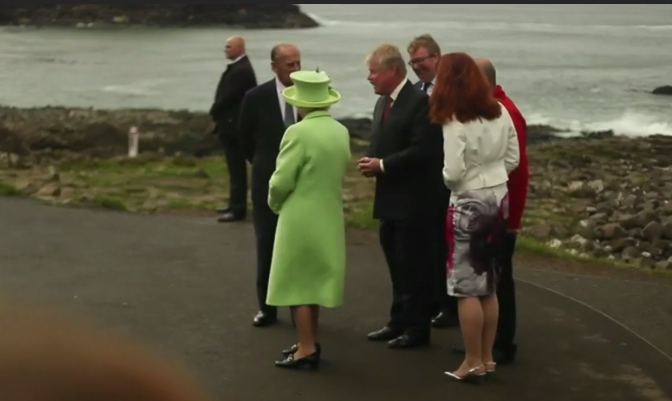
BBC One's News at Six may not have mentioned President Obama's upbeat remarks about post-Brexit Britain but it did include a piece about the Queen visiting Northern Ireland - HM's first official engagement since the Leave vote from well over 17 million of her loyal subjects. 

As soon as I heard it announced I braced myself. 'What doom-mongering angle will the BBC go for now?', I thought, expecting the worst (given much of the rest of the BBC's post-referendum reporting).

'BBC Ireland correspondent' Chris Buckler, adopting a glum tone of voice throughout, was quick to talk about how un-United the Queen's Kingdom is now in the wake of the referendum. The vote, he said, has "led to uncertainty for the whole UK",

But, he continued, even some Unionists who supported "waving goodbye to Europe" are now feeling full of "worry".

[Of course, those Unionist probably supported 'waving goodbye to the EU' rather than 'Europe', but that's BBC reporting for you at the moment!] 

We heard from one such worried Unionist (worrying about the break-up of the UK), and then from a Unionist Leave voter, challenged by Chris Buckler in the following fashion:
Chris Buckler: But you voted Leave, so you're responsible for that!

Leave voter: Yeah, I know, I know, I know. I voted Leave. I know I voted Leave, Yes. I know, I know, I know. I think maybe now it was the wrong decision.
The "good-natured meeting" between the Queen and Martin McGuinness of Sinn Fein was said to show "how much things have changed" over the course of the Queen's reign, Chris continued, before saying, "But, politically, these are turbulent times", Northern Ireland "as a whole" voted Remain. 

And then it was onto what Sinn Fein and nationalists want - to stay in the EU and to unite Ireland. Here both 'vox pops' were of the same (pro-EU, pro-united Ireland) frame of mind. 

I've seen quite a lot of Chris Buckler in recent days. (He even featured in an image I used to 'show' how gloomy BBC reporters were looking on Friday morning). I believed I've summarised his report fairly. Was this 'impartial' reporting from him?

It certainly didn't seem like it to me.

And this piece of anti-Brexit gloom-mongering was projected to a wide audience on BBC One's widely-watched main evening news bulletin.

What is getting into the BBC at the moment?