Showing posts with label Radio 4. Show all posts

Sunday, 10 July 2022

What the Thunderer Said


In praising a new dramatic version of T.S. Eliot's The Wasteland to be broadcast tonight on Radio 3, and Radio 3 drama more generally, the Sunday Times's Patricia Nicol takes a passing shot at Radio 4 drama:
[Radio 3] only has one drama to produce weekly, but it often seems a more invigorating listen than so many of the tediously worthy, issue-led dramas found next door on Radio 4.
“Tediously worthy” and “issue-led” will also do for Radio 4 more generally.

Monday, 13 June 2022

Decline and Fall


Here's a tweet that puts it well:
Emily Kate: In the space of about 25 years, R4 has gone from a radio station full of sparkling, brilliant people you'd feel incredibly privileged to meet, to a radio station full of the most boring people at the most boring gathering you have ever been to in your life. I know I'm always tweeting about how awful R4 is now, but I just cannot get over what has happened to it. I will never stop being shocked at its total collapse, its descent from the dizzying heights of an enlightened elite broadcaster to dreary third-rate university podcast.

Saturday, 19 February 2022

Genital Power


The New Statesman is enthusing over a new BBC Radio 4 programme:
A delightful mix of science, history and feminism, BBC Radio 4’s Political Animals explores what animal sexuality reveals about the female libido. This show is all about “celebrating stories of females in the natural world that defy sexist stereotypes”.
The blub on the programme's website summarises it like this:
Lucy Cooke meets the female animals - and pioneering scientists - moving evolutionary biology beyond the male-centric Darwinian narrative.

Lucy Cooke meets females from the animal world that smash the ‘dominant male’ stereotype. 

How 'Radio 4' is that!

Episodes include: Sex, Monkeys and the 'Coy Female' Myth; Mole Rat Queens and Genital Power; and, of course for the trans, Sex-Switching Fish and Non-Binary Brains.

Talking of science, one experiment The New Statesman has tried today is to put out an internet poll on the matter. The results so far point to a predictable conclusion: that internet polls often go 'the wrong way':

Saturday, 15 January 2022

The lunatics have taken over the asylum


Further to an earlier post, recently departed Quote...Unquote host Nigel Rees has been taking to spiked, giving us further glimpses into the mentality holding sway at BBC Radio 4 - a mentality he calls "systemic wokery".

Her describes his frustration at the BBC's interference with his programme's guest selection, saying it  "used to be a gender thing" but "in the past few years, it became about minorities – particularly people of colour": 
During the recording of the last series, I was told that there should never be an all-white panel on panel games or quizzes.

He was also told there had to be disabled representation on the panel:

A talent agent had complained to the BBC and specifically said that we did not have disabled people on the show. So this imposition was put on the programme.

It was completely unnecessary. I just wanted people who could do the programme. There was no need to tick boxes. But this is now everywhere in the BBC.
There's also "the other side of the wokery...which had been going on for rather longer than the representation and diversity aspects". 

Besides banning a line from Mad Dogs and Englishmen by Noël Coward "because the song represents colonial attitudes" (which it doesn't), the BBC refused to allow a quotation from Chattanooga Choo Choo: 
They said no, you cannot refer to that song because it is racist (at the beginning, there is a black porter). This is now a well-known, established forbidden area – you cannot do Chattanooga Choo Choo. 
He says he "doesn't know who, upstairs at the BBC, has pushed this forward – but it is now part of the way things are done", and gives this explanation: 
One of the reasons is that a lot of activists have joined the BBC and they push it. Once upon a time, BBC producers and executives were very straight and balanced. But now you have got activists in production and research and they try to enforce their viewpoint. 

Anyhow, in tribute to Nigel Rees, here's an account of the first usage of the phrase 'the lunatics have taken over the asylum':

The term appears to have been first used in 1919, when the four most powerful figures in the American film industry—Charlie Chaplin, Douglas Fairbanks, Mary Pickford, and D.W. Griffith—decided to found their own distribution company, called United Artists. In response the producer Richard Rowland remarked, “The lunatics have taken over the asylum.” The remark got wide publicity and entered the language, subsequently applied to many other situations of a comparable nature and becoming a cliché. 

Sunday, 9 January 2022

Mad Dogs and BBC Managers


“To every thing there is a season, and a time to every purpose under the heaven”, said the Preacher in Ecclesiastes, continuing that there's “a time to be born, and a time to die; a time to present a Radio 4 programme, and a time to stop presenting a Radio 4 programme”.

Meanwhile, L. Frank Baum in The Marvelous Land of Oz said, somewhat less poetically, “Everything has to come to an end, sometime”.

And so it is with Nigel Rees's 46 year run as host of Radio 4's Quote...Unquote. I listened to it as a teenager, which shows just how long ago it started. But the season has turned, and Nigel has finally left.

Though his “revels now are ended”, it's not true that they “leave not a rack behind” because he's made a few telling criticisms of the BBC on leaving.

The Sunday Times reports him saying:
There was nothing the BBC could say to persuade me to change my mind. It had reached crunch point. don’t want to sound like an ‘anti-woke’ backbench Tory MP (which I am far from being), but . . . ‘cultural issues’ were among the several factors that had contributed to my pulling the plug.
He tells the papers that a “prescriptive climate” at the BBC meant that “this [last] series was more unpleasant to do than the previous ones”.

For example, Radio 4 bosses apparently told him that “Reader of the Quotations” Charlotte Green couldn't deliver a line in a Yorkshire accent for fear of causing offence. And this sounds like Radio 4 wokery at its maddest:
For the 500th edition he wanted to include a round of “detached lyrics” in which the panel has to identify an excerpt from a lyric, including a quotation from Noël Coward’s 1932 comic song Mad Dogs and Englishmen. “I was pressured to remove the lines, ‘In Bengal/ to move at all/ is seldom if ever done,’” he says. “I was told that it ‘reflected colonial attitudes’ and so the woke police leant heavily on me to choose something else. This misses the whole point of the song, that it is the English colonials who are being mocked, not the natives.”
And, of course, prescriptive requirements were laid on the programme regarding diversity in its choice of guests, which sounds like being the straw that finally broke the camel's back [origin obscure].
...it must be said that these impositions have reached almost ludicrous proportions across the BBC. However well-meaning — or at least understandable — such measures may be, I just feel that they have been taken too far.
The Sunday Times emphasises how diplomatic he's being and how grateful he remains towards the BBC, but a BBC spokesman is on hand to add a characteristically sour and high-handed response:
We want our output to be representative of the UK and we want contributors on our comedy shows to be wonderfully engaging and funny. These two ambitions are not mutually exclusive and it would be highly condescending to suggest otherwise. We have creative, editorial discussion around every production and they are very much standard practice.

 Aren't they gracious?

Saturday, 1 January 2022

Pick of the Year


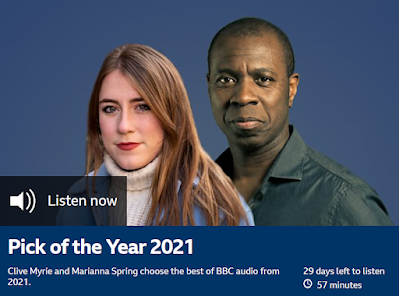
I wonder if Lord Blunkett and Libby Purves and Michael Buerk listened to today's Pick of the Year on BBC Radio 4. I think they'd have been appalled.

If anything show's the station's sharp turn towards 'woke' this is surely it. It used to be a showcase for the width and depth of Radio 4's output across the year, intended to make you laugh and cry and think. This year it was almost entirely political, earnest and preachy. They weren't going to let us think for ourselves either.

It was presented by Clive Myrie and Marianna Spring. They played Radio 4 highlights from across the year that dealt with these subjects [in the order they dealt with them]:
[a] The Capitol “attempted coup”, QAnon, Trump and conspiracy theories
[b] misinformation and vaccine hesitancy
[c] misinformation and climate change
[d] how Facebook is failing to tackle misinformation
[e] feet
[f] climate change and wildfires
[g] migrants and refugees
[h] Afghanistan
[i]'Internet shaming' of women
[j] women's fears about their safety following the murder of Sarah Everard
[k] online hate/racism
[l] racism in sport
[m] taking the knee against racism
[n] Mondays.

It really was as fun as it sounds.

If you recall a comment I quoted a month ago today that said ''I can't help myself, and I know it's silly, but whenever I switch on radio 4 I listen to the first 10 words I hear. Invariably they are about race, gender or climate. Try it.'' If that person had have tuned in to Pick of the Year it would have been an instant 'Bingo!'

Tuesday, 7 December 2021

Crystal balls


It's that time of year when humorists in the newspaper write next year's news today. Craig Brown has already got the ball rolling in the Daily Mail writing the future for Nick Clegg, Michael Portillo and others - and for BBC Radio 4: 
February  
The head of BBC Radio 4 issues new guidelines ensuring that from now on every programme must include at least four references to mental health. In future, each castaway on Desert Island Discs will be obliged to answer the question: 'And how's your mental health?' — before being permitted to introduce their first record.

Sunday, 5 December 2021

One of Our Episodes of The Moral Maze is Missing


I just saw a tweet from the redoubtable Jane Kelly: 
The Moral Maze on Wednesday not available. About immigration, replaced with an anodyne repeat from a previous series & taken down from BBC Sounds. Perhaps Michael Buerk was right about a growing intolerance of free speech at the BBC?

Update: Ah, it was 'technical issues' on the night apparently.

Thursday, 2 December 2021

Even Michael Buerk is slamming Radio 4


After Lord Blunkett and Libby Purves, now BBC veteran and Moral Maze host Michael Buerk is joining the chorus of concern about Radio 4's turn towards 'woke'. The Times quotes comments he makes in the Radio Times:
“It survives, even prospers, despite the temper of the times,” Buerk, 75, said of The Moral Maze. “In the wider world — and in some parts of the BBC — more and more is being put off limits, things that cannot be said. Freedom of speech is seriously under threat.” 
However, the presenter said that show does feel this strain and he admitted that the programme was a “bit less abrasive” than it used to be. 
Buerk praised the BBC for sticking with the programme, however, even if he sometimes worries about “how long that will last”. 
He claimed that Radio 4’s “yearning to connect with yoof” and “increasingly woke” editorial choices put it at odds with listeners. 
He said: “Half the audience may feel like drowning themselves in their cornflakes after a typical Today programme, but touch one hair of Nick Robinson’s head (yes, all right, but you know what I mean) and the world would fall in.”
The BBC gives a typical 'BBC' response: 
We’re proud of the huge range of quality programming, which is as rigorous and curious as it has ever been, that caters for and represents a wider range of listeners.
I think there will be many who think, 'No it isn't, and no it doesn't'.

Update:  The Daily Telegraph is also reporting this and adds Michael Buerk's word “voguish” to his description of Radio 4's “increasingly woke-sounding board”.

Wednesday, 1 December 2021

Even Libby Purves is slamming Radio 4


Even former Radio 4 stalwart, ex-Midweek presenter and self-declared ''life-long loyalist and listener'' Libby Purves - though in many ways as 'BBC as can be' in her outlook - sees that David Blunkett has a point about her favourite channel BBC Radio 4. 

In her latest Times column she says that the BBC shouldn't ignore him, and although she thinks it's ''not all the way there yet'' she obviously thinks it's a lot of way there when she agrees with him that ''if [Radio 4] starts thinking that its mission to educate is largely moral and progressive, that information should be skewed towards this and entertainment come a poor third, it is in trouble.''

It's a problem, she says, when ''fine issues...overwhelm the casual, accidentally met joys and surprises of the schedule, drag guilt into comedy and make drama predictable and drear''...which sums up the problem pretty well.

''Radio 4’s screechingly left comedy grates often'', she adds, and new Radio 4 dramas are usually ''dismal''. 

She concludes, ''David Blunkett, I feel your pain.''

It's bad enough for the BBC when a serious Labour 'big-hitter' like Lord Blunkett expresses the concerns we've been expressing over the years, but when Libby Purves - of all people - comes out in support of him then the BBC ought to take heed.

Dropping 'below the line', the highest-rated comment below Libby's piece says, ''I used to say Radio 4 was worth the licence fee on its own. No more. I have switched it off. I am fed up with having propaganda rammed in my ears''. And this is at The Times.

The second-highest-rated comment said, ''I can't help myself, and I know it's silly, but whenever I switch on radio 4 I listen to the first 10 words I hear. Invariably they are about race, gender or climate. Try it.'' 

It's the kind of experiment I like, so I tried it around 9.06pm tonight and didn't hear anything about those three things in the first 10 words, though in the first 20 words I heard ''ash dieback'', which is similarly depressing. But the phrase ''climate change'' duly arrived just over a minute later, so I'm giving that to the Times's second-highest-rated commenter as being near enough to be considered a bullseye.

A taste of Christmas Day on Radio 4


As Christmas is about bringing joy to the world I was happy to see a tweet from an author the BBC has commissioned to write a short story for BBC Radio 4 on Christmas Day. He's genuinely cock-a-hoop about it. My inner Scrooge does make me wonder, however, if his invitation is connected in any way with the channel's absolute obsession with woke identity politics?

Tuesday, 30 November 2021

BBC navel-gazing and metropolitan elitism


Here's a little Tuesday morning reading from the newspapers, starting with Anita Singh in the Daily Telegraph:

There is navel-gazing, and then there is the sight in The Princes and the Press (BBC Two) of BBC presenter Amol Rajan reporting on media editor Amol Rajan reporting on the Royal family criticising the BBC. Absurd doesn’t cover it.

After the second and final episode of a series that has caused so much controversy, what have we learned? That there was rivalry between the Royal households. That Harry hates the press, and Meghan got terrible headlines. That Palace sources, whose job it is to secure favourable press coverage for their royals, may have briefed certain journalists in the hope of doing exactly that. Any and all of this information has been available to read in the newspapers for several years. Recycling it for television has achieved nothing, except to sour relations between the BBC and the Royal family.

And David Blunkett is back on the subject of 'woke' BBC Radio 4, this time writing a piece for the Daily Mail. He says:

Radio 4 has become so determined to address multicultural diversity, gender issues and identity politics that it forgets about all-embracing inclusion. People who live outside a narrow class of well-off professionals with rigidly right-on opinions, almost all of them in London, no longer feel included by the station. If you’re not part of the self-proclaimed metropolitan elite, you are unlikely to hear your views reflected. The BBC seems to ignore the obvious fact that ‘B’ stands for British — and its remit is to broadcast to the whole country, not just a few fashionable streets around Islington.

Meanwhile, The Times has a piece by Jawad Iqbal headlined The BBC has a blind spot over the bias of its Covid expert Susan Michie. It begins...and ends:

The BBC is guilty of a grave disservice to its audiences in continuing to give prominent airtime to a communist-supporting scientist as one of its go-to experts on pandemic restrictions, without any real attempt to contextualise or counterbalance her criticisms. Professor Susan Michie, of University College London, a super-rich longstanding member of the Communist Party of Britain, was lined up as a main expert to pass judgment on the prime minister’s announcement of measures to tackle the new Omicron variant....Michie’s revolutionary views — she is said to be dedicated to establishing a socialist order in the UK — are surely relevant when evaluating her critique of pandemic policies. The BBC, which prattles on endlessly about the importance of impartiality and objectivity, seems to have a blind spot when it comes to Michie. Its first duty must be to its audiences, who have a right to be told much more about the experts given valuable airtime.  

On which theme, by the way, I noted down the names of the first four interviewees on the BBC News Channel immediately following Boris's press conference the other day. All were what might be called 'lockdown hawks'. In order of appearance they were: Professor Susan Michie, University College London; Alex Norris MP, Shadow Health Minister; Professor Devi Sridhar, Chair of Global Public Health at the University of Edinburgh; and Dr Sarah Pitt, University of Brighton.

Monday, 29 November 2021

''This is the way you should do it''


Trying to do my blogger's duty and following up on David Blunkett's claims about Radio 4's The Food Programme, where His Lordship said that the programme had “lost its connection with the ordinary cook” by focusing on the “interests of those making the programme, rather than those of the wider public,” I listened to last week's edition...

...at least for as long as I could stand it. 

It marked the moment when the winners of the BBC Food and Farming Awards 2021 were announced at a ceremony at London's Broadcasting House.

I made notes, but soon realised it was pointless. The agenda was openly stated. The programme was selecting winners who would be ''models for others'' [their words]. 

Social responsibility, BBC-style, was one key factor. The other was helping radically transform the means of food production in favour of things like farming cooperatives, organic farming, sustainability, local-sourcing - and lowering the amount of meat-eating.

For a 'food' programme it was strikingly 'political'.

A classic line from presenter Sheila Dillon came when one prize went to a small-scale, local-focused butcher who wants us all to each smaller amounts of meat:  ''We [the judges] concluded that meat is such a controversial thing right now, but if you're going to eat meat this is the way you should do it''. 

There's quite a lot of agenda in that one sentence.


UPDATE,  29/11: And here's Lord Blunkett again, expanding on his criticism of the programme in the Daily Mail:
Every aspect of the station now seems obsessed with preaching at me. Even The Food Programme devotes most of its slot to criticising British tastebuds for being too staid and monocultural. If Radio 4 thinks that the very food on my plate must be co-opted into the culture wars, I almost wonder why I bother switching on at all. Increasingly, when I do, the station gives me another reason to grumble.

Afternoon tea, and a chat about the BBC


Here's a Twitter chat that might be of interest to you:

Emily Kate: The politicisation of R4's output is quite mind-boggling. There seems to be no programme left without some political issue being dragged in (eg, today - migrants). I listen in quite rarely these days, but even when I do, just for an hour, it is very noticeable. Is this what media was like under communism? How does one of the greatest radio stations in the world, loved at home, envied around the world, descend to this level of patronising student agitprop in such a short space of time?
Ben Cobley: On Radio 4. I used to listen almost religiously. Now: I never listen.
Graeme Archer: I stopped listening years ago (an early de-adopter). The R4 of my entire life was suddenly consumed by a sickness of preaching that rendered it unbearable. First they came for the 6.30pm comedy, then they took everything else. Switch it off. They can’t ruin music.
Graham Applin: I’m afraid it’s getting like that with Radio 3.
Graeme Archer: Agree. I’ve also (very sadly) deleted it. Sometimes I look up ‘soundz’ and pick a concert (and do the same with plays, those made pre-2010). But - this applies to every radio station actually - you’ve still got to sit through the news bulletins. The ones who use Sky are the worst.
Graham Applin: It’s their promotion of obscure 19th century female composers purely on the basis of forced diversity which particularly irritates.
Ben Cobley: The way the BBC has voluntarily butchered itself is a national tragedy.
Amanda: I’m sensing some recognition from within the BBC. Some attempt to redress. Such as The Nolan Podcast on Stonewall, Woman’s Hour trying to regain its voice for female listeners. I agree much of the once great parts are unrecoverable.
Emily Kate: I think the trans issue is a bit of an outlier, which is why the BBC (eventually) felt brave enough to represent the other side. So many people 'on their own side' felt very angry about this. I don't think the balance will be replicated on other issues, I'm afraid. It was incredible how Woman's Hour, for eg, ignored or danced around this issue for years until other people had done all the hard work and made it 'OK' to talk about.
Ben Cobley: Yes, we have similar thoughts. I think this is down to the relative weakness of the trans lobby (whose political successes have been remarkably swift but largely built on sand). On racial and other forms of identity ideology, it's full steam ahead within the BBC.
Jacqueline Benson: I stopped watching TV about 3 years ago as the social re-engineering agenda was very clear. The only BBC radio programme I listen to is 'In our Time'. Sadly, even Radio 3 has fallen victim to their agenda-driven programming.
Amanda: Yes. I find it ironic that BBC Sounds - which was developed at enormous expense to target the “podcast” digital generations (millennials/Zoomers) - is what enables me to pick at the bones of the BBC for decent content.
Pirate Prentice: On Radio 4. I couldn't agree more, I've turned it into a game, where I turn it on randomly during the day and then see how long until they squeeze an agenda in. It's sometimes literally seconds before you hear it. I think my record is 1 second.
Emily Kate: My experience is very similar. It's a shame. R4 in particular was the soundtrack to my life. I had it on all day long, and much of the evening too. Not anymore,

Sunday, 28 November 2021

And is if to prove David Blunkett right...


Lord Blunkett's claim that BBC Radio 4 is “playing into the hands of its critics by becoming almost the caricature its opponents think it is” certainly rings true with regards to Radio 4's Sunday. 

Today's programme (a) discussed the West's culpability regarding vaccine inequality in Africa [sample question from presenter Emily Buchanan to a South African bishop:  “Do you have any message for leaders here about the fact that there is this inequality in availability and people here in Europe are having their third jab?”], (b) dealt with the migrant crisis by avoiding the word 'migrant', (c)  told “a refugee story with a happy ending”' about Afghan girl footballers arriving in the UK [from Pakistan], (d) talked about domestic abuse in connection to faith whilst being vague about specifics, (e) looked at the problems faced by deaf people in churches, and (f) returned to the migrant crisis by talking of “Britain's obligations” towards unattended children and the shortage of Muslim foster parents, before ending by (g) interviewing the former Archbishop of York John Sentamu in the context of him being “the first person of African descent to head Christian Aid” [i.e. the 'identity' angle]. 

P.S. Here are two social media reactions to one moment in the closing interview: 
(1) There seemed to be note of alarm or panic in voice of Emily Buchanan as Archbishop Sentamu threatened to go off script suggesting asylum seekers might actually be grateful for receiving sanctuary.  
(2) I note the presenter moved rapidly on when he suggested Muslim asylum seekers should not prioritise maintaining their Islamic faith but should instead be first concerned about just being safe in whatever foster home, Christian or otherwise, they found themselves placed in.

“Friendly fire” from David Blunkett


‘Right-on’ Radio 4 is a turn-off, complains Blunkett runs a headline in today's Sunday Times.
 
Though as a BBC supporter, the former Labour home secretary David Blunkett wants BBC Radio 4 to “stop taking its core audience for granted”.

He also argues that it's “playing into the hands of its critics by becoming almost the caricature its opponents think it is”. He says it's “not adapting and becoming less metropolitan” but “playing up to that perception.” 

He also claims “there’s too much focus on what its contributors and presenters are doing, rather than on being informative” and asks that the station should “think about what matters in the wider sphere” - eg. that Today should cover a wider range of subjects.

As for Radio 4’s dramas he says, “I fear that good, easy-listening drama that doesn’t have to lecture us or ensure we are ‘right-on’ has gone for some time. Misery and a constant reference to identity politics are not what people want.” 

And The Food Programme, he says, has “lost its connection with the ordinary cook” by focusing on the “interests of those making the programme, rather than those of the wider public.” 

He blames complacency, saying of Radio 4's producers. “They think they have a captive audience”.

I agree with Lord Blunkett.

Saturday, 6 March 2021

Clarification Time (again)


Aficionados of the BBC's Corrections and Clarifications page have been treated to five new specimens this week. 

The oddest one is the Andrew Marr correction at the bottom of this post. Why on earth did it take 11 months to correct that?

The most striking one is the George Floyd one, because it's a lapse in journalistic accuracy that they've made before, for it's not the first time that the BBC's been forced into 'correcting and clarifying' that the police officers involved in his death weren't all white. (Two out of four were non-white). This is surely a classic case of BBC groupthink in action, leading to false and inaccurate reporting. 

News at Six
BBC One and BBC News Channel, Friday 26 February 2021
We reported Alex Salmond had said Nicola Sturgeon had broken the ministerial code and that he thought she should resign in his evidence to a Scottish Parliament Inquiry. 
In fact Mr Salmond did not say that the First Minister should resign; he told the Inquiry “I've got no doubt that Nicola has broken the ministerial code but it’s not for me to suggest what the consequences should be”. 
03/03/2021 

World at One, Tuesday 2 February 2021
We said Israel had vaccinated 5 million people with the Pfizer jab and that a million of these had had two doses. 
In fact, more than 5 million doses of vaccine had been given to Israeli citizens. Over 3 million people had received the first dose of the vaccine at that point and over 2 million the second. 
01/03/2021 

Midday Bulletin
BBC Radio 4, 6 February 2021
We reported that it was the 70th anniversary of the Queen’s accession to the throne. As the Queen acceded the throne in 1952, this was in fact the 69th anniversary.
01/03/2021

BBC News Channel, Friday 23 July 2020 
We referred to George Floyd’s death as occurring during an encounter with white police officers. The officer who knelt on his neck is white, but two of the other three involved are not. 
01/03/2021

Andrew Marr 
BBC One, 19 April 2020 
We referred to the Black Death, which it’s estimated killed millions of people in medieval times, as a virus. In fact it was a bacterial infection. 
01/03/2021

Saturday, 26 December 2020

Boxing Day matters


Hope you had a lovely Christmas Day. Thank you for keeping the blog so well-fed with comments. There's been a lot going on, hasn't there?

*******

1. Yes, BBC newsreaders on BBC Radio 4 really are repeatedly saying "France has confirmed its first case of the new variant of coronavirus which originated in the UK" this morning - which is poorly-worded at best, and 'fake news' at worst. The BBC has previously acknowledged that the variant may well have originated outside the UK and merely been detected here first by our well-equipped scientists. At least they're not calling it "the English virus"...yet.

2. Watching the BBC Reality Check correspondent Chris Morris making countless appearance on the BBC News Channel on Christmas Eve made me think of 'Why the long face?' jokes, usually made about horses. Chris had a long face on all day. After all his endless scaremongering 'on behalf of reality' over the years, here was the thing he had been so relentless down on for years coming to fruition, against all his gloomy predictions. Never was a long face more easily explained. His misery later got translated into a very negative piece on the BBC News website containing plenty more gloom. He's still carrying on regardless, and will be allowed to do so by the BBC.

3. I read recently that June Sarpong OBE, the BBC's part-time diversity chief, has recently been made a trustee of the Donmar Warehouse. Her irresistible, seemingly limitless rise continues. Despite that she's talking about "the unfairness baked into our system" in Daily Telegraph today and using the highly divisive phrase "white privilege": 

I don’t for a single second say that all white people are privileged. Of course not. But there are benefits even if you come from a low income and you’re white. You’re never judged on your race. You may be discriminated against because of class, you may be discriminated against because of your age, you may be discriminated against because of gender, size, etc, but you will never be discriminated against because of your race and that in itself feeds into the concept of white privilege.

Bring on the satirists! 

4. Lewis Hamilton is guest-editing Radio 4's Today today. and talking 'race' as much as 'races'. Even former ITN stalwart Alastair Stewart, a massive fan of Lewis, has his reservations though:
On the big issue of black history, I'd have preferred to hear Lewis Hamilton challenged by a critic, than in conversation with the like minded David Olusoga. He could easily have dealt with it. 

5. Returning to the theme of an earlier post which listed the recent questions put by BBC Politics reporters at the Downing Street press conferences and found that they were remarkably consistent in the pushing the 'The Government is not acting fast enough or hard enough' line over coronavirus, well, the last one before Christmas brought a double dose of that from BBC political correspondent Leila Nathoo. This is what she asked Matt Hancock & Co:

23 Dec: LEILA NATHOO, BBC: You've just said when it comes to coronavirus that it's better to act sooner but the Prime Minister said on Saturday that the new strain was present across the country, your chief scientific advisor said on Monday that it wasn't possible to stop it spreading beyond the South East. and you're only announcing today the widening of Tier 4 within the South East and East of England and only from Boxing Day. Haven't you wasted valuable time in trying to get ahead of the new strain of the virus? And if I may to Dr Harries, you talked about yet another more transmissible strain being identified from South Africa. How confident are you that the new four-tier system is strong enough to tackle that?

Wonder how many tiers would satisfy the BBC? 

Friday, 11 September 2020

Wildfire


Though still a staunch defender of the BBC, OMG The Daily Mail quotes former Radio 4 boss Mark Damazer saying that "the social media thing has been out of control" for a while now:

Clearly, some of the things that BBC news presenters and others have done on social media would not be acceptable to me and I'm happy to say that on the record.

I'd like him to give specific examples "on the record". He's a lot to chose from. 

Mark doesn't accept that the Corporation has allowed its output to become too woke though:

The notion that it's paralysed by wokeness in all its output I simply don't accept.

Has he stopped listening to his former station then? I'm assuming he must have. Anyone listening to Radio 4 these days must surely acknowledge how different it now feels to the station it was back in his day. (He left in 2010). Especially since Mohit Bakaya took over last year, wokeness has spread like wildfire throughout the entire station.

Saturday, 15 February 2020

Hard work


A typical Radio 4 listener

The Daily Mail today tells us about a briefing document to BBC producers from BBC bosses saying that Radio 4 "does not all have to be hard work" and that the station needs to do more to "bring joy and optimism" to its audience.

Ha! Even the BBC seems to have noticed that Radio 4 has turned into a sludge of well-meaning, serious, worthy, politically-correct, socially-liberal, soggy-left, preachy programmes, many of which could have come straight out of the Guardian's features pages, leavened by identikit left-wing comedy shows.