Showing posts with label Michael Grade. Show all posts

Saturday, 26 March 2022

John Simpson, Lord Grade and Ofcom


As discussed on the open thread, the news that Michael Grade - previously controller of BBC1, chief executive of Channel 4, chairman of the BBC and executive chairman of ITV, now a Conservative peer - is to become the new Ofcom chairman prompted a snarky response from senior BBC journalist John Simpson. 

To expand on this, here are all his tweets on the matter, some in response to various left-wing, pro-EU followers [his Twitter fan base by the looks of it]:
John Simpson: Congratulations to Michael Grade on becoming the head of the media regulator, Ofcom. I’m sure his recent criticisms of the BBC licence fee & BBC political coverage had nothing to do with the decision.
Ant: Naughty, Mr. Simpson.
John Simpson: I’m a stirrer by nature…
Parmenion62: No freedom of speech at the BBC now then. All will have to follow the Tory party line. Real shame that we are about to lose something so precious as the BBC.
John Simpson: I can promise you that nothing you’ve said here is true.
John Simpson: Actually I think a lot of people will be greatly relieved that Michael Grade has got the job. He was a good and supportive BBC chairman. And remember the government originally seemed to want Paul Dacre as the head of Ofcom.
Nick Morrell: Not the old trick of making an extreme candidate look less so by first suggesting an ultra-extreme candidate?
John Simpson: No, he’s not in any sense an extreme candidate. And real life isn’t about conspiracies like that.
Nick Morrell: Fairly unserious comment - seems to me the push for Dacre was serious - but still makes it easier to accept a highly-partisan anti-BBC candidate if you've had to face the prospect of a frothing at the mouth alternative.
John Simpson: I understand completely, but Grade isn’t a frother. He just couldn’t resist making the kind of criticisms of the BBC which he knew would help him get the job.

Is John Simpson correct that Lord Grade has been making BBC-critical noises just to get the government's backing for his appointment and that the BBC doesn't really have anything to fear from him?

Saturday, 11 December 2021

Lord Grade criticises the BBC


The BBC is still keeping its mouth shut firmer than a member of the clam mafia but the pressure on the corporation over the Oxford Street antisemitic bus incident continues to grow. Now former BBC chairman Lord [Michael] Grade has joined the chorus of criticism, saying: 
Given the available evidence, or rather lack of it, it is worrying that the BBC has so far defended its report that there were ‘clearly’ anti-Muslim shouts from the bus, while the antisemitic gestures were only ‘alleged’. They need to provide the evidence to support their defence or rethink and issue an urgent correction and apology.

Someone senior at the BBC is surely going to have to say something sometime about this, you'd have thought?

Saturday, 8 February 2020

"The BBC hides, when it's under criticism, it hides."


I did smile at this week's Newswatch (also discussed by John on the open thread). The programme played a clip of Lord Grade slamming BBC heads for "hiding" from criticism and then Samira Ahmed, in her most headmistress-like tone of disapproval, stated, "Well, we asked the BBC for an interview to explain the decision did not broadcast the statement. But they refused". Ouch!
Samira Ahmed: The main complaint about Friday's coverage of Brexit night was to do with the Prime Minister's statement and the BBC's decision not to broadcast the footage. Usually in these kind of situations, a national broadcaster, either the BBC, ITN, or Sky News, would be invited into Downing Street, to record the Prime Minister's words. Instead, the statement was recorded by Boris Johnson's team and distributed via Facebook and Twitter. The BBC decided not to broadcast it. Instead, using a graphic with a quote spoken by the presenter. Many viewers complained about this decision and so did the former chairman of the BBC, Lord Grade, who voiced his concerns on the Today programme on Thursday.  
Lord Grade: I'm very critical of the BBC not defending decisions it makes editorially. The most recent one, not running the Prime Minister's Brexit speech. Fine, that's a decision the Director-General or the Head of News and Current Affairs should be up front, defending that decision. Or not, as the case may be. The BBC hides, when it's under criticism, it hides. And I'm very critical of the BBC for that. And that's completely wrong, because they expect everybody else to come on and be accountable to the BBC's journalists when they are enquiring.  
Samira Ahmed: Well, we asked the BBC for an interview to explain the decision did not broadcast the statement. But they refused, instead, giving us this explanation.
And this was 'the explanation':
There is a process for recording statements by the Prime Minister, under which one broadcaster records it and shares the footage with other broadcasters. BBC News was given advance notice of the news-worthy aspect of the video message and reported that in our coverage throughout the day. In line with our usual editorial practise we did not run the video. It was available elsewhere, including on the Prime Minister's social media. 

Someone who did come on was viewer Nigel Bonson, who did splendidly, giving excellent answers to Samira's questions. Good man!:
Samira: Well, I'm joined now by Nigel Bonson, who is one of the viewers who contacted us about this and he is in our Sheffield studio. Nigel, why were you unhappy with the BBC's decision not to broadcast the video? 
Nigel: Well, I'd sat waiting for it, as many people would have done I'm sure. I waited for the interview to be broadcast and it just didn't happen. I didn't see any apology or any explanation until later. What you just mentioned about that explanation might involve internal politics between the normal process of the BBC and others going into Number Ten, but as far as the public's concerned, and as far as I was concerned, that just didn't matter. I don't think the public care how it's done, they wanted to hear the Prime Minister's address. 
Samira: So, the BBC might say they did report what he said, including reporting in advance all day what he was going to say and that audiences did get informed on the news content. 
Nigel: Well, I certainly wasn't informed. But as far as I'm concerned what they reported in short, snappy bits during the day is irrelevant. I, and I'm sure others, wanted to hear the Prime Minister at 10pm, as had been widely suggested we would do.
Samira: ITN didn't put the footage out either, which is interesting. And you'll be aware that Number Ten increasingly seem be using social media instead of speaking to national broadcasters, which is usual practice on recording a statement like this. I suppose the BBC and some viewers might feel that there is a potentially dangerous precedent. Do you have any concerns about that at all?
Nigel: No, I don't. What ITN chose to do isn't relevant I think. The BBC, as a national broadcaster, should broadcast these things. And, again, the average member of the public wouldn't be aware of how it's done. To be honest, I think it's rather petty and to do with internal politics, rather than meeting the needs of the nation. 
Samira: Just to be clear, you'd feel the same, whoever was Prime Minister, if this was how they chose to release their statements? 
Nigel: Absolutely, and that's central to my argument and I hope that's not being missed. 
Samira: Journalists are definitely concerned that there is an attempt to control the press, to limit how his message is got across, which might, ultimately, I suppose broadcasters would say, be to the detriment of the public and public service to hold the government to account on behalf of voters. Do you think at any stage there might be a point of principle around the Prime Minister's use of social media as his main way of getting out his message? 
Nigel: Well, I think social media, nowadays, is just as important as national TV. I would clearly be concerned, as I'm sure with others, if that was being managed too much. My view is that had the BBC got into Number Ten to record it, there wouldn't have been any questions and answers anyway, so it wouldn't have held the Prime Minister to account. 
Samira: So if you had a message to give to BBC executives, given that they made this decision, what would you say they should do?
Nigel: I would say put the public and the viewers first and, as would normally happen, if the Prime Minister wants to address the nation, he should be able to. I would just draw the analogy of a general election after two months campaign, a decision that affects the next five years of the country, then that would have been covered. Yet this has been a four-year campaign and something that will affect the nation for perhaps generations and yet the Prime Minister wasn't heard on the night.

Saturday, 7 December 2019

"Sounding hysterical"


David Elstein, the former BBC editor who launched Channel 5, criticised broadcasters’ sense of entitlement and “generalised hostility” to politicians. 
“I don’t think Andrew Neil helped himself by putting out such a public challenge because he made it inevitable that it would be turned down,” he told The Times. He described the Channel 4 News decision to replace Mr Johnson and Nigel Farage with ice sculptures as “regrettable, foolish and childish”. 
Lord Grade of Yarmouth, the former BBC and ITV chairman, said that broadcasters were sounding hysterical and urged Ofcom to review rules around empty chairing. He said that Neil’s monologue on Thursday was “pretty close to the edge”. 
“What’s coming through is an arrogance on the part of the journalists in the media, which I think is unwarranted, unnecessary and unseemly,” Lord Grade, a Conservative peer, said.

Wednesday, 5 July 2017

Michael Grade on the BBC's Israel coverage


It's not every day that a former Chairman of the BBC castigates the BBC over its coverage of Israel, but today was that day:

Wednesday, 9 March 2016

Lords on BDS

See-saw, Marjorie Daw went the up and down mini debates in the House of Lords, which have been triggered by the government’s plans to prevent local authorities from participating in the Boycott, Divestment and Sanctions (BDS) Movement against Israel. 

NHS trusts, councils, universities, student unions, and other public bodies will be prevented from boycotting foods and products from Israel.
The government believes that councils and similar bodies should be attending to local issues, not taking it upon themselves to play politics.

A good number of MPs in both houses of parliament are fundamentally hostile to Israel.  
  “To ask Her majesty’s Government whether they plan to recognise Palestine as a state”
The see-saw of a debate went up and down, up and down; having began on ‘down’, it eventually crept up.  A contribution from Lord Polak (Con) included:

Lord Polak (Con)
Does the Minister agree that, instead of political point-scoring, Members of this House—I draw the attention of the House to my non-financial interests—could use their influence with the leadership of the Palestinian Authority to encourage them to stop inciting their young people, and really help the Palestinian people by encouraging them to return to the negotiating table without delay?

So it’s not all completely hopeless, then. Despite the BBC's continuing silence on the matter, they’ve heard of  Palestinian incitement. This is probably due to a presentation that was given to a delegation of MPs by Palestinian Media Watch during a recent fact-finding and trade mission to the region.

Along comes Lord Grocott (Lab) to put a damper on things again.

Lord Grocott (Lab)

“.......Israel, which for more than 50 years has violated international law by the occupation of a neighbouring country, by the building of a wall and by the continuing illegal occupation that makes a two-state solution nearly impossible? Is it not time that we had a more robust response to these flagrant breaches of international law?”


Later, the thrust wends its way upward once more, by way of  Lord Pannick (CB)
Lord Pannick (CB)


“My Lords, did the Minister see the report in the Times last week that two Palestinian journalists in Gaza had been arrested and tortured by Hamas because they had written newspaper articles critical of that administration? Can she assure the House that there is no question of recognising a Palestinian state associated with Hamas until basic civil rights are respected?”


So; that was on the 1st of February 2016. 

On 23rd February 2016 a ‘short’ debate was instigated by Lord Grade of Yarmouth aka Michael Grade, formerly of the BBC. He spoke against the BDS movement. 
This debate was not very well attended, but it at least it was tentatively sympathetic to Israel. I won’t even snigger at Lord Rotherwick’s “infitada” -  a tasty dish perhaps. 

There was a palpable degree of sympathy with Israel’s plight, despite the requisite reservations about the policies of the present Israeli administration. There was even some cautious criticism of Hamas. So are things looking up?

Not exactly.

“To ask Her Majesty’s Government what advice they have given to local authorities and other public bodies concerning boycotts of goods and services from the Israeli settlements in the West Bank.”

Well, you can guess what ensued. “It’s not an Israel-specific policy” came the response from the minister tasked with defending what many people regard as indefensible.

At the heart of the matter is the fact that the Palestinians have successfully established the dubious concept that ‘settlements‘ are “the obstacle to peace”. Mahmoud Abbas got away with constructing a simplistic misconception from a highly complex and widely misunderstood situation, even managing to wangle preconditions around it.  They convinced their sympathisers that all construction work (for Jews) in certain areas constituted intolerable belligerence on Israel’s part, while their own blatant acts of belligerence, terrorism and aggression were facts of life. 

But there it is.  Now much of the world regards all settlements as ‘illegal under international law’ even though they don’t really know what constitutes an illegal settlement or an international law. All they know is that ‘settlements’ equal evil incarnate.

Here, a different set of Lords occupied the vast empty chamber. The anti-Israel bunch. 
Lord Grocott again:
“Has the Minister had a chance to check what the Prime Minister said yesterday in answer to a Question about settlements? He said that,“the first time I visited Jerusalem … and saw what has happened with the effective encirclement of East Jerusalem—occupied East Jerusalem—I found it genuinely shocking”.—”
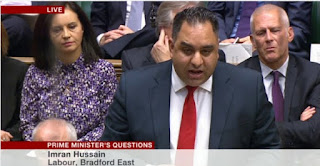
That was, of course, David Cameron’s answer to a question put by the Labour member for Bradford East, Imran Hussain.
“Last week, together with several of my hon. Friends, I visited Palestine, where we went to the home of Nora and her family, who have lived in the old city of East Jerusalem since 1953. Israeli settlers, however, are now trying to force Nora from her home of over 60 years. There are many other cases like that. Does the Prime Minister agree with me that illegal settlements and constructions are a major roadblock that hinder peaceful negotiations? What are this Government doing to help prevent these infringements into Palestinian lives and land?”

But it’s not all bad. There are one or two encouraging signs, e.g:
Lord Hamilton of Epsom (Con): 
My Lords, I was in Israel last week as a guest of the Israeli Government when my right honourable friend Matt Hancock announced this guidance that he was giving to local authorities. As both Israel and the United Kingdom are members of the WTO, surely it is illegal to impose these boycotts. They would actually be against the law.

Other noble Lords begged to differ. Conclusion?

Lord Bridges of Headley: 
My Lords, I just wish to repeat what I am saying all along: this guidance is not about Israel per se. While what my noble friend says may have validity, (the settlements are a contravention of international law, that we deplore them and that they should not be there,) I would say that boycotts are counter-productive and should not be taken by local authorities unless there is already a government action in place.


Much of the hostility towards Israel that can be found in the general public, in academia, in the press and among the political classes can be attributed to the BBC’s lack of thorough, even-handed and honest reporting, not to mention the heavy-handed pandering to Islamic religious sensitivities that plays a major role in all this - in addition to the old fashioned Arabist element that still exists in certain quarters.