Showing posts with label global warming. Show all posts

Saturday, 30 July 2022

Roger, Over and Out


Roger Harrabin is no longer the BBC's environment [activist] analyst. It was his final day this week.

Earlier today, he tweeted:
I've finally left BBC after 35 years on the environment. Thanks everyone for the tributes. Many brought me to tears. The one I like best was from UN's Nick Nuttall: "BBC without Roger is like solar power without sun, gin without tonic, the Muppets without Kermit."
Among the tributes he received this one stood out for me from green campaigner Jonathon Porritt:
You’ve been a total star, Roger - thank God the idiotic BBC didn’t know what you were up to during all those dark days of them insisting on ‘balance’ in their climate coverage! 
Roger replied, "Thanks".

I think it's fair to say that even if "the idiotic BBC didn't know" plenty of people on blogs like this were well aware of "what [he was] up to".

Talking of which, I've lost count of the number of times I've recycled that 'the BBC's environment [activist] analyst' crack over the years - a crack it's now time to finally retire and turn into regenerative compost. 

Saturday, 16 July 2022

Is this the right time to try it? Part 2


The BBC has spoken. Marco Silva, the corporation's Climate Change Disinformation Specialist, has ruled that claims on social media and from “various right-wing US and UK outlets that green policies” - in the form of the Rajapaksa government's 2021 seven-month ban on imports of chemical fertilisers, pesticides and herbicides - caused the collapse of the Sri Lankan economy are FALSE

If put like that, it's obviously false. Lots of factors contributed to the collapse. The question is did this move to promote organic farming play its significant part too?

It's a peculiar article. As well as its line-up of experts, claiming it wasn't a sincere policy and that the problem with it was that it was brought in too quickly, you get those little words like 'just' doing their work of nudging:
The government dropped the policy, just seven months after introducing it, following widespread protests.
But seven months of a complete ban on the imports of chemical fertilisers, pesticides and herbicides is hardly a short period of time for such a drastic policy, is it? And note the use of the word 'old' here:
But this week, as the presidential palace was stormed, many were quick to blame this old policy.
It's not that old. It ended just over half a year ago and had a major impact on the entire growing season in 2021. And half way through you get this:
And while banning chemical fertilisers indisputably hurt the economy, experts say several other factors contributed.
So if the ban indisputably hurt the economy and was a factor that contributed to the collapse, then how much did it contribute?

Isn't this Reality Check a spot of BBC greenwashing?

Here's what the BBC wrote about it in May under the headline Sri Lanka: Why is the country in an economic crisis?:

Friday, 15 July 2022

Red-shifting


Whatever's been happening with the weather, something's certainly been happening with the reporting of it.

You can confirm this for yourselves by looking up YouTube videos of BBC weather reports during the 2003 heatwave when 37°C was hit and seeing how the same temperatures which 19 years ago were shown in shades of yellows and light orange have now been been ramped up into flaming oranges and dangerous deep reds.

This fine tweet from Jamie Jenkins, a stats guy who has previously worked for both the ONS and the BBC, encapsulates the spin perfectly:


Whether you think it's justified or not, there's some serious 'nudging' - aka 'manipulation' - going on here, isn't there?

Sunday, 19 June 2022

Of one mind


A couple of tweets on my Twitter feed reminded me of Radio 4's The World This Weekend, which I've long thought took itself far too seriously and fell into bias with great regularity as a result.
Austin Williams, director of Future Cities: First ten minutes of The World This Weekend is an uncritical stage for an environmental lobbyist.
Repeat ad nauseum.
Does anyone at the BBC worry about journalistic standards and open enquiry? Clearly Jonny Dymond doesn't, but anyone?
Tim Montgomerie, pundit: Just listened to R4’s World This Weekend and struck again at the self-loathing running through BBC News. Yes, The West has polluted too much, but that same industrialisation road has given the whole world the medicine, tech, wealth etc that makes solutions and progress possible.
I've given it a listen myself now and I can see what they mean.

The opening headlines quoted two women reacting to the outcome of the latest Bonn climate climate conference. The first quote said:
It really feels like the richer world has decided to abandon those who are facing devastation to deal with thing on their own.
The second quote then reinforced the first quote:
The world's economy is very dislocated, on the back of Covid, on the back of an inflation crisis, and so can we continue to negotiate the things that have to happen from a climate perspective? That's the big test. Can we walk and chew gum at the same time?
Those quotes came from people interviewed later, and when the main segment of the programme came we heard from three likeminded people in total: the UN's climate change chief, Patricia Espinosa; someone the programme introduced as 'an environmental lawyer' but which Wikipedia also calls a 'climate activist', Farhana Yamin; and an academic and climate change negotiator who sounded no less of a climate activist, Rachel Kyte.

This is typical of BBC bias on subjects of this kind, where everyone says the same thing - including the presenter.

Tim Montgomerie's point holds up too. Here are two comments/questions from presenter Jonny Dymond that show what Tim calls 'the self-loathing running through BBC News':
But Bonn broke up without the agreement the countries most vulnerable to climate change had hoped for, for assistance from the rich world - which has, after all, fed the fires of global warming - in dealing with the rising seas, floods and droughts that now batter those most vulnerable countries ever more regularly and fiercely.
How big a deal is it? I mean, is it a more important deal, to be brutal about it, that poor countries get shafted? - which is probably something we've known about for decades now.

The BBC certainly knows how to hector. Why can't it just report the news and keep its opinions to itself?

Saturday, 18 June 2022

Fact-checking the BBC


Former ONS statistician Jamie Jenkins was watching a scary BBC report on climate change then took to Twitter:

Where are the BBC's own fact-checkers?

Sunday, 12 June 2022

A Look Back


As you've been recording on the open thread, it's been quite a few weeks for the BBC.

I

The one that puzzled me was the Antony Gormley story. Reeta Chakrabarti, with earnestness all over her face and eyebrows raised, read out this 'news' last Saturday evening:
One of Britain's most acclaimed artists, the sculptor Sir Antony Gormley, who created The Angel of the North, is to become a German citizen. Sir Antony said he was giving up his British passport because of the UK's decision leave the European Union. He described the move as "embarrassing" and says he has plans for new sculptures that reflect this view.
Three days later the BBC posted the following on its Corrections and Clarifications page:
BBC One, 4 June 2022, 10.30pm

We reported that the acclaimed British sculptor Sir Antony Gormley is to become a German citizen. We said he was giving up his British passport because of the UK’s decision to leave the European Union and that he had described the move as embarrassing and had plans for new sculptures that would reflect his view.

In fact Sir Antony Gormley is not giving up his British nationality and has asked us to make clear the circumstances behind his application for a German passport.

Sir Antony holds dual nationality as a result of having a German mother and has decided to apply for a German passport, which he will hold alongside his British one.

In a statement he says he remains a proud British citizen and is grateful for the extraordinary support he has received from so many people and institutions across the UK but he is also keen to retain his links with and continue to show his work in Europe.

We apologise for the mistake.

07/06/2022

How did this happen? As far as I can see, the BBC simply picked the story up from their Sunday house journal The Observer and misread it.  

Nowhere in the Observer article did Sir Antony say he was giving up his British passport [and I've checked the Wayback Machine to see if the Observer did say it but then changed it].

So were the BBC 'projecting', seeing what they wanted to see in the story rather than what it actually said?

It certainly looks like it.

II

Meanwhile, following a number of apologies for 'errors' made by the BBC's climate editor Justin Rowlatt - who's far clumsier than the departing Roger Harrabin - there's a new report out by Paul Homewood detailing a dozen corrections/apologies the BBC's had to make in recent years for false claims. 

Justin, who first rose to fame as Newsnight's 'Ethical Man', is now up to three strikes [BBC ECU rulings against him], though naturally he's not 'out' at the BBC:

In 2021 he falsely claimed that the offshore wind industry was now 'virtually subsidy free'.

In 2022 he falsely claimed that the death toll from climate change is rising.

In 2022 he falsely claimed that the recent drought in Madagascar was 'the world's first climate-induced famine'.

I was particularly intrigued by the passages about the BBC's complaints process, including this concerning the false claim about the death toll rising:

A complaint to the BBC was fobbed off with the risible excuse that Panorama was referring to the cumulative death toll, which will obviously rise every year.

I wish I could say that was 'a nice try' by the BBC, but it's so disingenuous as to be anything but. 

As the press release accompanying the report notes, the BBC has a team of reality checkers, including a 'Climate Misinformation' section.  

Yet none of these teams of fact checkers noticed or addressed the long list of false news stories that were only corrected by the BBC after lengthy and protracted complaint procedures.

Those BBC reality checkers are very selective in the 'facts' they choose to 'check'. 

III

Worst of all was the BBC's editing of an online report to change a rape victim's words - replacing 'he' and 'him' with 'they' and 'them' in order not to offend the trans person accused of raping the woman - a truly staggering editorial intervention.

Wednesday, 22 December 2021

It's Beginning to Look a Lot Like Christmas


If you're not already in the Christmas spirit, here's a 'very BBC' tweet [and re-tweet]:
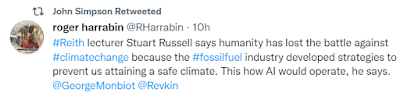
So this year's Reith lecturer says something that chimes with the BBC's departing environment activist that in turn chimes with the BBC's highly opinionated world affairs editor, naturally copying in George Moonbat.

Now which of Private Frazer from Dad's Army's catchphrases to use: "We're doomed!" or "Rubbish!"? 

Saturday, 6 November 2021

Another trick


Talking of The Spectator, Ross Clark has a piece there headlined ‘Climategate’ still matters – but not how the BBC thinks it does. In the piece he says that the story of 'Climategate' “won’t go away”, not least because the BBC has just put out two programmes on the subject: a TV drama called The Trick, and a Radio 4 documentary called The Hack That Changed the World”, continuing: 
Both try to establish the same narrative: that the scientists whose emails were leaked were victims of a crime — a massive data theft — and that these brilliant, honest people were then unfairly dragged through the mire as their integrity was questioned, when the world should really have been asking: who are the evil hackers and why are they trying to discredit climate science? 
Why it still matters, he argues, is “because in treating Climategate as pure data theft story, you bury what it revealed about the practices of some climate scientists” and while “it is true that some sceptics over-egged the scandal”, that “doesn’t detract from serious questions over the science which was revealed by leak”, including reasonable “objections” to what the scientists did. Among other things, he continues, “sceptics are right to be sceptical”, including about the scientists' use of graphs.
 
He concludes: 
That is not to question, of course, that global temperatures – as measured from thermometers – have risen over the past century. No, Climategate didn’t ‘disprove’ global warming or show that it was a scam. What is did confirm is that climate scientists are using highly questionable methods to construct a record of historic temperatures. Moreover, it showed the lengths to which some climate scientists would go to try to silence colleagues with whom they disagreed – in one case threatening to try to remove an editor from an academic journal. Theft or no theft, Climategate revealed important matters of public interest – especially given the extent to which we are now being asked to adjust our lifestyles to reduce carbon emissions – and the BBC is quite wrong to try to dismiss the public interest side and present it merely as some dark and dastardly crime.

Saturday, 2 October 2021

blah blah blah


'Officials from developing countries' are 'demanding' something, according to the BBC:


This is presently the second story on the BBC News website.

If you're wondering how many paragraphs you'll have to scroll through to till you reach even a passing mention of [the massively polluting People's Republic of] China, you'll find it tucked away in Paragraph 18.  

And the 'Analysis' by BBC science correspondent Victoria Gill uncritically plugs Greta Thunberg. 

Students and activists in Milan formed a human wall to 'protect' her, BBC Victoria says - ever-so-analytically. 

Friday, 17 September 2021

Out with Brexit, in with Climate


There's been an intriguing change to the BBC News website.

At the start of this year the BBC added "Brexit" to the category banner on its homepage:

  
The BBC has now removed it and replaced it with "Climate":


Leo Hickman, director/editor of Carbon Brief, is pleased
Significant development...BBC News has just added "climate" to the category banner on its homepage - and second only to coronavirus. The move came after it published the first article in its new "Life at 50C" series. A reminder that BBC News is one of the most read/watched – and, crucially, most respected and trusted – news organisation in the *world*, not just the UK. That's why this is so significant.

Monday, 10 February 2020

Not satire


The BBC announced today that its Science Unit is teaming up with Greta Thunberg for a new series about climate change. Rob Liddell, BBC Studios Executive Producer, says:
Climate change is probably the most important issue of our lives so it feels timely to make an authoritative series that explores the facts and science behind this complex subject. To be able to do this with Greta is an extraordinary privilege, getting an inside view on what it’s like being a global icon and one of the most famous faces on the planet.

Wednesday, 8 January 2020

How dare they?


Man at work

Though blaming climate change for the wildfires in Australia, the BBC has nevertheless dispatched Clive Myrie to cover the story, despite already having two correspondents in the country (Shaimaa Khalil and Phil Mercer). I'm guessing Clive travelled there by plane rather than paddling by canoe.

Update: I see I'm not the only one who spotted this:
Kathy Gyngell: Clive Myrie reporting from Australia on BBC News at 10 tonight. Why has he been flown all the way there - bear in mind the major carbon footprint - when there’s a bureau on the ground?

Friday, 3 January 2020

Preaching? (2)


Further to the previous post, nothing stops the BBC's agenda-pushing juggernaut when it's cruising at top speed: 

BBC Breakfast's main story this morning concerns the Australian wildfires. After covering this they moved on to their second story, the Met Office on record temperatures over the past decade and climate change. Then five minutes into the hour came their third story, the US's killing of Gen. Qasem Soleimani, head of the Iranian Revolutionary Guards' elite Quds Force and overseer of Iran's proxy wars abroad. Clearly, even the killing of the effective No.2 in the Iranian regime wasn't going to stop the BBC putting a Met Office statement about climate change nearer the top of its news reporting on BBC Breakfast this morning.

Thursday, 2 January 2020

Preaching?


Charles Moore told Nick Robiuson last Saturday that what he particularly objected to was the BBC "preaching". 

Am I wrong in thinking that, in the wake of Greta Thunberg's guest-editorship of Today on Monday, BBC Radio is taking its "preaching" on climate change to new levels of intensity? 

Three out of the five headlines on tonight's Radio 4 Six O'Clock News related to climate change (Australia, Indonesia, Norway) with a fourth story appearing unannounced, courtesy of the BBC's environment (activist) analyst Roger Harrabin. 

Add that to Today's ongoing focus on the issue (Zambia today), plus programmes throughout the day on how climate change is creating "a boom town for rats" and "our psychological relationship with the climate crisis" - and tonight's In Business ended by telling us that next week's programme would look at how Zimbabwean farmers "are struggling to adapt to climate change", then I do think that there seems to be a sharp ratcheting-up on the BBC's focus on 'the climate crisis'. 

If so, and if it continues, Greta and Extinction Rebellion will be proud of them.

Sunday, 29 December 2019

Matt Ridley v Nick Robinson ('Today', 28 December - Transcript)


(With gratitude here and here for making finishing this transcription so much quicker)


Nick Robinson: Climate change should not be presented as an emergency and, indeed, it - like all alarmist claims - should be open to debate. That's the view of our guest editor today, Charles Moore, the Telegraph columnist and biographer of Margaret Thatcher. He sits on the board of trustees of the Global Warming Policy Foundation, which describes itself as, quotes, "open-minded on the contested science of global warming". One of those who've written for the Foundation is the science writer and Conservative peer Matt Ridley. Lord Ridley joins us in the studio. Good morning to you.
Matt Ridley: Good to you.
Nick Robinson: The risks you've argued in the past have been greatly exaggerated but, I imagine, the simple question for many people is 'why listen to you rather than the climate change global, international, scientific consensus?
Matt Ridley: Well, the consensus says that there's going to be a range of outcomes, anything from 1 to 4 degrees. 1 is harmless. 4 is very harmful. So, actually, the consensus says there's going to be a range. Now the problem is the BBC, for example, and a lot of other media have decided to let themselves be bullied by climate activists into dividing this into goodies who believe in climate change and baddies who don't, which is actually very inaccurate because of all these people at the Lukewarmer end of the spectrum where I sit, and where proper climate scientist, like Judith Curry, also sit...
Nick Robinson: (interrupting) To be clear though that one and half degrees is described by governments, not by climate change activists. by governments, including the UK Conservative government. as very serious for the globe. So that's not a question of bullying, it's international policy.
Matt Ridley: Well, that's a policy question. But at the other end of the spectrum you've got people who are effectively doomsday cultists now who say that we're gonna have 6 billion people dead in a few short decades. That's Roger Hallam of Extinction Rebellion. Or Kevin Anderson, the scientist on whom Greta Thunberg, your next guest editor, heavily relies, and he says we are going to see 4 degrees by 2050. No responsible scientist agrees with that and yet those people are given a hearing on the BBC whereas the Lukewarmers are denied a place on the BBC. People like me are not allowed on...
Nick Robinson(interrupting) 'Lukewarmers' in your description of yourself.
Matt Ridley:  Exactly. We're not allowed on the BBC... 
Nick Robinson(interrupting) Well, here you are, being allowed on the BBC!
Matt Ridley: But only because Charles Moore is the guest editor....
Nick Robinson(interrupting) Well, not only because Charles Moore. In fact...because you've been on the programme before. In fact, I know I've interviewed you before. Just to focus, though, on the scientific debate, one and a half degrees - not 4 - is the international consensus for very serious global harm...
Matt Ridley(interrupting) No, no, that's not true, Nick.
Nick Robinson: ... adopted, forgive me, just finish finish the thought, and therefore why shouldn't that be taken seriously, on what is often referred to as the Precautionary Principle? We can't be certain, it could be very bad, so we act, with care.
Matt Ridley: Well, one of the reasons for being careful about not overreacting to climate change - and I'm not saying we shouldn't...we should do nothing, I'm saying we should do things...but I think we should be careful not to overreact and not to shut down civilisation. One of the reasons for that is because some of the measures we're taking are doing real harm already. We're denying fossil fuels to Africa, so as a result they're burning wood to feed themselves. That's killing their children. It's also destroying forests. And another example is the diesel scandal, which came directly out of climate change policy - and I know you've got Sir David King on later, and he was Chief Scientific Advisor at the time, when they pushed for switching to diesel because it had lower carbon dioxide emissions, even though it had other huge air pollution problems.
Nick Robinson: Now, I know the focus of your argument is largely about policies that you think are counter-productive at best and maybe positively bad at worst...isn't your thinking, though, underlain by the fact that you're a Conservative, like many of the people on this Foundation, you're a free-marketer, and your real fear is that socialists have grabbed hold of the green agenda and they are managing to get support for things that you are fundamentally opposed to, on a new basis? That's your worry, that's your..
Matt Ridley: (interrupting) That's not true about the Foundation. The Chairman is Lord Donoughue. He's a Labour peer. So this...there are LibDems on the Foundation, there are bishops on the Foundation, this is not a Conservative thing. I think - quite the reverse, actually, that most of the people who are worried about what we're doing in the name of climate change are worried about the effect it's having on poor people. It's costing nearly 9 or 10 billion pounds a year to the British consumer and most of that is going from poor people to rich people. Conservatives love this stuff, because they get to build wind farms.
Nick Robinson(interrupting) I say Conservatives, of course, because there's you, there's Charles Moore, there's Nigel Lawson, who are prominent, in terms of having a voice on this subject. Just briefly, if you would, you say you're concerned about hitting the poor, and you say you do want to do something. Briefly - we'll have you back and then you can tell us more - what "something" would you do?
Matt Ridley: Well, first of all, open up the debate more. And I think it's a problem that the BBC and people like Roger Harrabin, your Environment Editor, talks much more closely and takes his instructions from the environment lobbies...
Nick Robinson(interrupting) He doesn't take his instructions from anybody. I know Roger Harrabin. He's a journalist. You're a journalist, he's a journalist, he reports what he thinks is true.
Matt Ridley: Well, his Twitter account very strongly reflects that.
Nick RobinsonFine, you disagree with it. Doesn't mean he takes instructions.
Matt Ridley: But the other thing is that a lot of what the BBC and other media tell us to do, like stopping eating meat, wouldn't make a blind bit of difference...
Nick Robinson (interrupting) He's never told anybody to stop eating meat, Matt Ridley, I mean this is preposterous!
Matt Ridley: No, it's not preposterous...
Nick Robinson: We report people who say that you shouldn't eat meat and we interview people who say you should. We're not telling people to do anything!
Matt Ridley: What we need is an insurance policy against this problem, and we shouldn't pay more in a premium than the risk we're running.
Nick Robinson: A more open debate, that's what we've had, and thank you for helping us have it. Matt Ridley, Lord Ridley, thank you for coming on.

Saturday, 12 October 2019

The BBC's very first Chief Environment Correspondent


Justin Rowlatt

There were 'complaints from both sides' about the BBC's coverage of the Extinction Rebellion campaign on this week's Newswatch

One viewer demanded said there's far too much coverage, another said there's far too little. One viewer said that the BBC is failing to challenge the doom-mongerers, another said that the BBC is failing to bring the issue to the forefront on a daily basis.

I can well imagine that this fairly reflects the Newswatch postbag (though, as ever, I'd love to know the balance and whether campaign groups were involved in complaining).

These viewer criticisms were followed by an interview with the newly-promoted Justin Rowlatt.

He was previously a Newsnight reporter (you may remember him as their 'Ethical Man') and then the BBC's Dehli correspondent. Now he's the BBC's very first Chief Environment Correspondent.

(Yes, another new BBC role.)

He sounded very upbeat about his new job and talked a good talk. What do you make of it?

Here's a transcript:


Samira Ahmed: I asked him what he would be doing in the role which existing environment correspondents and analysts aren't already doing. 
Justin Rowlatt: I think the idea is that I'll complement what they do already, and do additional stuff. So we've got a great team - we've always had a great team in science and environment - and they cover all the big stories around the world. The idea is this is a huge and important issue, it's going to effect all of our lives, it's going to change the way we live, so let's have some more coverage really.  I think it's additional, adding to what we already do. 
Samira Ahmed: You were the BBC's Delhi correspondent for four years, and you broadcast about how the air pollution was affecting your family's health. I remember hearing that. How is that experience shaping the way you will do this job? 
Justin Rowlatt: I mean, that is a perfect example of how intimately connected we all are with our environment. In Delhi, you have this terrible problem of air pollution, actually all year round, but really acutely at this time of year. In the autumn, you get these terrible smogs. It effect all our lives. Anyone who lives in Dehli is terribly effected by it. So that really brings home the importance of reporting these issues, tracking down what's causing the problem and looking at solutions. 

Samira Ahmed: The BBC's position now seems to be that the scientific consensus lies with man-made climate change being a major threat. Does it mean, as some viewers are concerned, that there is no space anymore for people who disagree? 
Justin Rowlatt: There is a huge debate over climate change, not necessarily about the climate change science. I mean, the BBC's judgment is that the referee has spoken, is the word from within the BBC. The referee has spoken, the science is clear. There is an association between man's activities and climate change. But after that, there is a massive debate about how the effects will roll out in the world and what we do about them. So there is a huge, huge area still to discuss, it's very open, with massively varying opinions. Some people say, look, don't do anything, you know, we just need to adapt to the changes and move on, and other people say we've got to bear down on the emissions and tackle the problem at root. 
Samira AhmedWell, I want to ask about that. To the viewers who say, if it's as great a crisis as you seem to be saying, as many people seem to be saying, then these stories should be on much more, they should be on on a daily basis, I wonder where your hit rate of stories might fit into giving it the prominence it perhaps then should need? 
Justin RowlattI think if you look across the round, the BBC has for a long time been reporting climate change as a huge and important issue. We are reporting really regularly. I mean, it has been on the bulletins - the last couple of weeks have been an exceptionally busy time in enviroment. But, of course, we are...
Samira Ahmed: (interrupting) But would you like to see it everyday on bulletins? 
Justin Rowlatt: I'm not sure you need it every day. You should do it on merit, as with other news stories. You shouldn't be shoehorning in issues if they don't deserve it, up against the other important news stories that our teams report. 
Samira AhmedGreta Thunberg, who you were just about to mention there, some viewers say interviews with her essentially treat her like a saint, you don't challenge her analysis that we fundamentally need to change our lifestyles. Can you imagine anyone really challenging her and her views? 
Justin RowlattI met Greta before she sailed to America. We had the only proper sit-down interview with her. We met her on that amazing boat, which she sailed across the Atlantic on, and I did. I had a really tough interview with her, you know, really tough questions. I said what you're doing is meaningless if nobody else does anything. I said you're trying to make us feel guilty. Question after question. You talk about the problem you never talk about solutions. Surely, if you raise these issues, if the house is on fire, as she says, tell us how to douse the flames, tell us how to put it out. I asked all of that stuff, to the extent I produced a list of questions and showed it to my producer and he was like, 'Are you really going to ask her all of that stuff? Greta. Remember, she's child.' And I said, look, she's really, really well-versed in these issues and obviously I will ask her politely, but she can take this kind of questioning. And indeed she could. She was really good on all the issues. She had answers for everything. Soo we did a very forceful interview with her. 
Samira Ahmed: And I know you can take this kind of question because it's one that's thrown at environmental reporters and it can seem unfair, but will you be travelling a lot by plane and does it matter? 
Justin RowlattYes, I will, and yes, it does. I'll be travelling by plane not for leisure but for work and I think it's really important in my job as an environment correspondent that I do travel around the world and see how the world's changing and bring home to the audiences the BBC has around the world what those changes mean. So if you want to know, over the next couple of months I'm going to India, Ethiopia and to Antarctica, which means going to New Zealand. So huge journeys around the world, but I would say they're justified because we have to report this crucial subject, and if I do it all from the UK, it simply isn't going to have the impact that it would if I didn't. But should we all worry a bit about our aviation emissions? Yes, alongside everything else we do, we should be very concerned. Aviation is a huge source of growing emissions for the world, and we should be careful about the pollution we put into the atmosphere. 
Samira AhmedJustin Rowlatt, thank you so much. 
Justin Rowlatt: Cheers. Thank you.
Samira AhmedJustin Rowlatt speaking to me earlier. 

Saturday, 14 September 2019

John Simpson stands up to be counted


Simpy McSimpface

Besides his BBC journalism, John Simpson (the BBC's World Affairs Editor) also has his Twitter feed. 

And now he was a podcast (which he's promoting this weekend on Twitter). 

Here are transcripts of some of his answers to question from the latest, climate-change-based episode:


[On Donald Trump's opposition towards action to tackle climate change]
I think it's insane, actually. And I think it's really, really stupid. And it flies in the face of everything.  
And, you know, when he's talked about it, when people like him talk about it, they say, oh, it's only a few years since all the scientists were saying we were going to enter a new ice age and now, you know, last year was the hottest in human history, you just think, Come on! Don't be so pathetic! Realise the problem and do something about it!
The short-termism - and it's particularly a problem for democracies - is killing us, and we've got to force our governments to do something about it. 
I'm not very, very enthusiastic usually about all the direct action stuff, and going to the houses of government ministers and screaming at them and so on, because I think, you know, it gets out of hand quite fast that kind of thing. But I really do sympathise with the people that say this is too late for ordinary methods, we've got to do something and we've got to do it now, and the only way we can reasonably do that is by demonstrating in the streets. 

[On whether he'd get involved with political demonstrations]
I haven't in the past because my contract with the BBC says I'm not allowed to get involved in these things. 
But, again, I think that with something this important, you know, I don't think my contract ought to stand in the way of that. 
I didn't go to the anti-Iraq demonstrations, huge one...well I did go to it, but as reporter. I didn't take part in it in 2003. I felt the same as the demonstrators, and I think we've all been proven very, very much right about that. 
But I just think you've got to put pressure on the people who are, at the moment, saying, oh well, my political position, our political position, is the most important thing and we'll sort out the future of the planet afterwards. 
There ain't gonna be an 'afterwards' if we're not careful.

[On not being a Trump fan]
I'll tell you. This is something which really gets to the heart of a lot of things.  
I don't like ignorance. I don't like deliberate lying. I don't like falsehoods of that kind. 
Of course, to say that one President of the US, that one Prime Minister of Britain, is better than another and maybe I should just shut up about it...but I do feel that we're living in different times and I often think about journalists who were in Germany in the early 1930s.  
Now, I do not want to present my argument as being that Trump=Nazism, because that isn't the case at all and it's stupid and it's ignorant, but there are similarities between various types of populism and the populism in Germany in 1930, 1931, through to the victory of the National Socialist Party in the January 1933 election in Germany. 
That period often stays with me, and I've written...of course, I wasn't even alive then, but I've written quite a lot about it and I've studied it quite a lot, and there were journalists, foreign journalists, who were quite outspoken about it. There were British diplomats who were very outspoken in private to their bosses back in London. 
But it didn't somehow effect the way that the general public saw these things. 
And I don't want to be one of those kinds of journalist that just says, oh well, forget the big picture, let's look at the day-to-day stuff. 
I think you have to think about the big picture. 
And I don't want people to come along and find my work in 20-30 years time (assuming they would and that it hasn't just disappeared) and think, oh that Simpson, he was just another one of these useless characters that didn't make...they'll probably think that anyway and they'd be right but...who didn't stand up for anything. 
And I feel that when things are as clear as they are with Donald Trump, with other people, that you have to stand up and be counted. 

Monday, 26 August 2019

"You may ungobsmack yourself"


'Dirty old river' no longer

Yesterday's The World This Weekend was "a special climate edition". 

It featured a report from a BBC journalist embedded with Greenpeace (containing an interview with a Greenpeace campaigner) before moving onto interviewers with an Extinction Rebellion leader and former UN climate change head Christiana Figueres. 

If that was rather too many climate activists for you to stomach before Sunday lunch, then the programme ended with a good news story, about the cleaning up of the Thames, which I enjoyed.

It led, however, to a complaint from ex-Lib Dem MEP Sarah Ludford (now in the Lords as Baroness Ludford):
Gobsmacked that Jonny Dymond report on the BBC's World at One about clean-up of the Thames fails to mention that it results wholly from EU enforcement action (including the #SuperSewer - aka ‘Sarah’s tunnel' - following my 2005 petition, when a London MEP, about raw sewage discharges).
Jonny Dymond replied:  
The Thames clean up started in the 60s. That had nothing to do with the EU. The EU was important later on. But recovery began before EU enforcement. You may ungobsmack yourself.
Her Ladyship wasn't buying it:
So why did you not even mention EU law since the 1990s? The #Supersewer - which you cited - would not be being built if the EU had not taken action. I will stay gobsmacked, thanks very much.
This polite spat led me to look into the matter and introduced me the great British man mainly responsible for the clean-up and the return of salmon to the Thames: the splendidly-named Sir Hugh Fish

His obituaries make for fascinating reading. The one in The New York Times was headlined:

Hugh Fish, 76, Who Made Thames So Clean the Salmon Came Back

His role points to the point that Lib Dem Baroness Sarah couldn't have been more wrong in claiming the rebirth of the Thames as being "wholly" the result of EU enforcement action.

(Let's be charitable and blame it on her rampant over-enthusiasm for the EU rather than ignorance or dishonesty or anti-British bias.)

In the 1950s the National History Museum declared the river "biologically dead". But the British government took action and pressed industry and local authorities to stop polluting and by the mid-60's the river was fit again for eels.

In the late 60s and the 70s, Hugh Fish used the UK regulatory bodies set up to make further progress to bring about the return of other fish species, with 80 returning under his stewardship.

But it was the iconic salmon he made the benchmark for success and relentlessly strove to bring about. Early promises of success led within a decade to anglers landed their first Thames salmon for decades.

It's a fascinating story about what one man - and one country - can achieve. The BBC should commission a documentary about him (but, for quite a few reasons, probably won't).

Friday, 19 April 2019

'The Facts'


Well, for posterity's sake on this fine, sunny Good Friday, I've posted a transcript below of the Sir David Attenborough-presented campaigning documentary Climate Change - The Facts  as I suspect it will be of interest to at least some of you and that you might want to peruse it (or even use it) at your leisure. 

AC/DC's classic Back in Black sprang to mind as former BBC science and environment reporter Richard Black made yet another post-BBC appearance as an expert with very strong views. 

From my social media reading, I think it's fair to say that the programme has divided opinion - or, as the BBC might put it, proved divisive. 

And I think it's also safe to say that those with strong views on either side of the matter didn't budge one micrometre after seeing it (sceptical critics have already posted lengthy rebuttals).  

But did the viewing public (which I suspect was fairly small) find Sir David, Richard Black & Co. persuasive? 

Transcript: 'Climate Change - The Facts', BBC One, 18 Apr 2019


David Attenborough: Right now, we are facing our greatest threat in thousands of years. Climate change. 
- For a long time, climate change was something that scientists were predicting that would happen in the future. But that's no longer the case. - What we're doing right now is we're so rapidly changing the climate, for the first time in the world's history, people can see the impact of climate change. - Greater storms, greater floods, greater heat waves, extreme sea level rises. All of this is happening far faster than many of us thought possible. 
Scientists across the globe are in no doubt that at the current rate of warming, we risk a devastating future. 
- It's difficult to see how the population of the world will actually feed itself. - It's happening in your world. It's happening in my world. - Time is very short. - There's still time but there isn't much time left. 
The science is now clear that urgent action is needed. 
- We're at a tipping point. We can change history. Right now! 
What happens now, and in these next few years, will profoundly affect the next few thousand years. What can be done to avert disaster and ensure the survival of our civilisations and the natural world upon which we depend? 
- It's our future. We can't just let it slip away from us. 
Standing here in the English countryside, it may not seem obvious but we are facing a man-made disaster on a global scale. In the 20 years since I first started talking about the impact of climate change on our world, conditions have changed far faster than I ever imagined. It may sound frightening, but the scientific evidence is that if we have not taken dramatic action within the next decade, we could face irreversible damage to the natural world and the collapse of our societies. We're running out of time, but there is still hope. I believe that if we better understand the threat we face, the more likely it is that we can avoid such a catastrophic future. Our climate is changing because of one simple fact. Our world is getting hotter. 
Prof. Peter Stott, Met Office & University of Exeter: We have temperature records going back over 100 years. There are dips and troughs. There are so many years that are not as warm as other years. But what we've seen is this steady and unremitting temperature trend. 20 of the warmest years on record have all occurred in the last 22 years. 
It's not just Met Office records that are showing this trend. Data from the US Climate Centre, NOAA, the Japanese Met Office and NASA all show the same sharp rise in temperatures. When scientists first became concerned about these increasing temperatures, nobody could be sure exactly what was driving them. Four decades of research later, on land, at sea, and in the far reaches of our atmosphere, the evidence is now unequivocal. 
Prof. Peter Stott: What's striking is that warming trend cannot be explained by natural factors but is caused by human activities. In particular, by use of fossil fuels. Prof. Naomi Oreskes, Science Historian, Harvard University: The problem is that everything we do, our entire economy, from the moment you wake up in the morning and turn on the light, or look at your cellphone, to the moment you go to bed at night, and even then because your cellphone is still drawing power at night, I mean, we're all using energy all the time. And in the industrialised world, that energy is almost entirely fossil fuels. Prof. Peter Stott: When you burn fossil fuels, coal, gas and oil, to power our energy generation, to heat our homes, to drive our factories, to power our cars and our trains, and travel around the world. Prof. Naomi Oreskes: When we burn fossil fuels, it produces carbon dioxide as a waste product. Dr. James Hansen, Former Director, NASA Goddard Institute for Space Science: Carbon dioxide acts like a blanket. It absorbs the heat radiation from the Earth's surface and that keeps the surface warmer than it would be otherwise. Richard Black, Director, Energy & Climate Intelligence Unit: The problem is what we're doing now is we're adding extra carbon dioxide and other greenhouse gases. So we're increasing the thickness of this blanket. Dr. James Hansen
We have pumped so much carbon dioxide into our atmosphere that our world is now around one degree Celsius hotter than it was in pre-industrial times. This warming is enough to bring about the raft of effects we call climate change. 
Prof. Peter Stott: One degree Celsius global warming may not sound like much, but it's having a dramatic effect on our weather. Prof. Michael Mann, Climate Scientist, Penn State University: You warm up the planet, of course you're going to get more intense and more frequent heat waves. You're going to dry out the soils. You're going to get worse drought. Prof. Peter Stott: We're seeing extreme heat in southern Africa, Japan, North America, in the UK as well. Richard BlackOften, the question is, did climate change cause a certain event? You can never really answer that question. But what scientists do is to look at whether climate change made a certain event more or less likely, or more or less intense. Prof. Peter Stott: Last year, we had a heat wave that was actually the joint warmest on record, alongside 1976. And we have been analysing this here at the Met Office. What that showed us was that the chances of that heat wave had increased by about 30 times. So it's now about 30 times more likely that we had that heat wave than we would have had without climate change. So it doesn't mean to say that every single weather event is due to climate change. But what climate change does mean is that with the baseline climate having changed, then the frequency of the extreme temperatures is increasing. And that has a substantial effect. 
In November last year, when temperatures in Cairns, Australia, hit 42 degrees, even creatures specifically adapted to heat were unable to survive. 
Various voices (unnamed): They're just... everywhere. When we got here in the morning, it was the first time really we saw it. There were just dead bats as far as the eye could see. There was a deafening sound of babies crying. You just don't know where to start. So we just started finding babies, basically. There's a little baby attached to its dead mum. 
Like all species, flying foxes have ways of dealing with the conditions of their environment. But it seems their usual cooling methods are no longer enough for the kind of temperatures Australia is now facing. Last year, temperature records were broken across the country. 
Prof. Peter Stott: Scientists have shown that it's simply inconceivable that you would see these temperatures without the fact of climate change. Rebecca Koller, Conservationist: We saved about 350. The rest are dead. Over 11,000 died from that colony. And if you have two more events like we had, the species is gone. Man's voice: This is climate change in action. We need to wake up. 
I've seen for myself that in addition to the many other threats they face, animals of all kinds are now struggling to adapt to rapidly changing conditions. 
Prof. Catherine Mitchell, Energy Policy, University of Exeter: Think of the equator. As climate change occurs, that central part of the world becomes increasingly uninhabitable. Dr. James Hansen: If climate change is too fast, we're pushing them off the planet, in effect. We're causing extinction of species already. And that's irreversible. 
Scientists believe that 8% of species are now at threat of extinction solely due to climate change. This isn't just about losing wonders of nature. With the loss of even the smallest organisms, we destabilise and ultimately risk collapsing the world's ecosystems - the networks that support the whole of life on Earth. 
Prof. Peter Stott: What's been happening in recent years is really showing us what one degree Celsius really means. Not just for wildlife, but for people, for their safety, for their livelihoods and for their futures. 
As temperatures rise, the threats we face multiply. Last year saw record-breaking wildfires take hold across the globe. 
Prof. Michael MannWe've seen wildfires break out in Greece, even in the Arctic. We've seen a tripling in the extent of wildfire in the western US, California. 
The fires that swept through California last year caused $24 billion worth of damage. 106 people lost their lives. 
Prof. Naomi Oreskes: We're not just talking about an inconvenience. We're talking about people's lives, their livelihoods and their communities being damaged. Prof. Peter Stott: The wildfires need an ignition source. What? Maybe cigarette butts, or lightning, and then you need the weather conditions that are conducive to that fire spreading. Research has shown that the chances of having these very hot, dry conditions has increased as a result of climate change. Justin Bilton: It was a dead end road, so we knew it was our only option to drive forward. And all sides of the road just completely engulfed in flames. Charles Bilton: He's going, "Dad, Dad, we're going to die!" And I said, "No, we're going to be fine, you know." I stayed calm. I think being a father, you're trying to keep your son calm too at that point. Justin BiltonWe could hear trees literally exploding. Falling all around us. Charles Bilton: A large branch went right over the top of the car. The whole top of the roof was burning and we didn't realise it. There was a tree down. Justin Bilton: That was the moment when I really thought that we might die. I decided to put the car in reverse. I had to drive backwards through everything we had already passed through to the lake shore. Charles Bilton: This one little boat was down there watching the fire. And we were able to wave them in to help us get out of there. That, to me, was just a miracle. 
But it's not just through extreme heat events that climate change is having an effect. It's changing our weather systems in other ways. 
Prof. Peter Stott: This is a basic result of physics. With a degree Celsius of warming, there's more moisture evaporating off the oceans. Prof. Michael Mann: When there's more moisture in the air, you're going to get more rainfall. You're going to get super storms and force flooding events. We are seeing the impacts of climate change now play out in real time. They're no longer subtle. Sunita Narain, Director General, Center for Science and Environment: You have had the worst rain in China, in Japan. You have had a deluge in Kerala. 
Whilst they can't all be attributed to climate change, last year's extreme weather events meant that millions of people needed humanitarian aid. 
Sunita NarainJoin the dots. It's happening. It's happening in your world, it's happening in my world. And let's be very clear about this - it is going to get much worse. 
Climate change goes far beyond the weather. Thousands of miles away and out of sight of most of us, another threat is building. Earth's ice, frozen for millennia, is melting. 
Prof. Andrew Shepherd, Climate Scientist, University of Leeds: Earth's temperature has risen by what most people would think is a small amount over the past century. One degree Centigrade. That's too much for Earth's ice to withstand. In the last year, we've had a global assessment of ice losses from Antarctica and from Greenland. And they tell us that things are worse than we'd expected. The Greenland ice sheet is melting. It's lost four trillion tonnes of ice, and it's losing five times as much ice today as it was 25 years ago. If you go to the southern hemisphere, in the past, most of the models predicted that Antarctica would grow. That's not the case. Antarctica's losing three times as much ice today as it was 25 years ago. In Antarctica, really small changes in ocean temperature in particular melt a lot of ice. The ocean is only about half a degree centigrade warmer than it should be. But that's melting colossal amounts of ice from enormous glaciers. The water that melts from the ice sheets ends up in one place, and that's the oceans. And that's when it starts to affect people around the rest of the planet. Dr. James Hansen: Sea level has been stable for several thousand years. But if the ice sheets lose icebergs faster and faster to the ocean, the sea level goes up. Prof. Andrew ShepherdWe know that sea level has already risen by about 20 centimetres in the last 100 years. 
Rising seas are displacing hundreds of thousands of people from already vulnerable coastal areas in the South Pacific, Indonesia, Bangladesh. 
Colette Pichon Battle, Executive Director, Gulf Coast Center for Law & Policy: The impact on families is going to be something that I don't think we could ever prepare for. In the United States, Louisiana's on the front line of this climate crisis. It's losing land at one of the fastest rates on the planet, at about the rate of a football field every 45 minutes. 
The Isle de Jean Charles was once home to 400 people. But subsidence caused by oil and gas extraction, and now rising seas, means that in the last six decades much of it has disappeared. 
Chief Albert Naquin: Before, this was all land. But due to sea-level rise, slowly but surely it's washing away. What we're looking at here is where I was born and raised, in 1946. It's sad. Very, very sad to see what happened to my mom and dad's home, and where they raised us at. I want to finish my life, as well, over here. Colette Pichon BattleFor the people on Isle de Jean Charles, they're running out of options. And now what we see is just 10% of what used to be there. We have been working with the state to move an entire community. This is the first time the federal government of the United States has offered dollars for the relocation of folks due to climate change. Chris Brunet: When it comes to relocation, this is the only place I've ever known as home. I don't want to abandon it, I don't want to forget it. Juliette Brunet: A lot of people say that this land that we're living on won't be here in 20 years from now. That's kind of hard to think about, where you grew up isn't going to be here any more. Colette Pichon Battle: The residents of Isle de Jean Charles have been labelled as the first climate refugees in the United States. And that may be true. But what we know for sure is that they won't be the last. 
Sea levels are not only increased by melting ice. The world's oceans are expanding because they're getting warmer. Over 90% of the increased heat trapped in our atmosphere has been stored in the oceans. I've witnessed the devastating effect this is having. In the last three years, repeated heat stress has caused a third of the world's corals to first bleach and then die. 
Prof. Michael Mann: Our generation is going to be responsible for the loss of one of the most majestic ecosystems on the face of the Earth. We're literally watching the death of this natural wonder. 
In many ways, what's happening now across the world doesn't come as a surprise. Much of what we're now experiencing, scientists warned about over 30 years ago. 
Dr. James Hansen: What we're seeing at the moment is exactly what we predicted. In the summer of 1988, I testified to Congress. I said I was 99% confident that this was a real, physical effect of the increasing carbon dioxide.  Richard Black: James Hansen was absolutely a pioneer in trying to reach the public and politicians. He played a major role, there's no doubt, in putting climate change on the international agenda. Dr. James Hansen: The short-term response was pretty good. The politicians were saying the right things, that we should avoid dangerous human-made changes to climate. It's just that the policies needed to achieve that were never adopted. Prof. Naomi Oreskes: There are many reasons we haven't acted on climate change. Science is definitely part of the story. The science is complicated. Richard Black: Economists had to look at, "OK, what are the costs are going to be?" And then technologists had to work out, "Well, what actually can we do about it?" And that's one of the reasons why it took a long time for governments really to put policies in place. However, there was also resistance. Let's be honest about this. There are incumbent industries that then, they knew about climate change, but they didn't really want anything to happen. Prof. Naomi Oreskes: The organisations that had the most to lose by acting on climate change were the fossil fuel companies. The most profitable industry possibly in the history of mankind, making huge profits. They wanted to continue that. Prof. Richard Lazarus, Professor of Law, Harvard University: Many of those industries, basically the oil and gas industry, the fossil fuel industry, they undertook a quite concerted campaign to confuse the science and confuse the message. Richard Black: This is industry-funded and industry-driven. Fossil fuel companies engaged PR consultants who used exactly the same tactics that have been used by the tobacco companies, and there's ample documentation. Prof. Naomi Oreskes: The basic strategy is to cast doubt on the science to promote the message that we don't really know, there isn't a consensus and it will be too expensive to fix anyway. The cycle of denial has worked. And even today, the President of the United States says that it's not true. Richard Black: In the UK, we have the Climate Change Act from 2008, which was the first law anywhere in the world to make a legally binding target for reducing greenhouse gas emissions. But what we've also seen here is a number of people in politics who've decided really to campaign against action on climate change. [Clip of Lord Lawson, saying "There's plenty of evidence that warming will bring benefits as well as maybe disadvantages"]. The arguments have been, well, climate change is happening but it may not be that serious. [Clip of Lord Lawson, saying "There are huge benefits from a warming planet. In the IPCC's own report, there's fewer deaths from cold-related diseases"]. They say we should just adapt to it rather than try to reduce greenhouse gas emissions. And of course that's very attractive to politicians. Because to decide not to do something is much more comfortable. Prof. Naomi Oreskes: I think that many of us were willing to hear that message because we too depend upon fossil fuels for our lifestyle. So we're all implicated in this economic system, but it's not like we're all equally responsible, right? Richard Black: There's no doubt that that seeding of doubt has slowed the transition to a clean-energy economy. Dr. James Hansen: We haven't entirely wasted the 30 years but it would have been so easy to solve the problem if we had started gradually to make fossil fuels more expensive and develop the technologies to replace them. But we didn't do that. And now there are consequences. 
Greenhouse gas emissions have continued to rise and the problem is getting harder to solve. The world's great forests play a vital role in determining the balance of carbon dioxide in our atmosphere. Trees and plants absorb carbon dioxide, using it to build their leaves, stems and roots. In this process of photosynthesis, they have sucked up and stored nearly a third of our emissions. 
Prof. Matthew Hansen, Remote Sensing Scientist, University of Maryland: The main driver of climate change is greenhouse gas emissions. Forests are one of our ways out. They are like the lungs of the planet. They are big climate regulators at a global scale. My work has always been about monitoring the land surface and forest. Since 1972 till now, Landsat has been tracking and taking pictures of the Earth's surface. In 2008, the US government says it's open free of charge and accessible over the internet. Millions of images, automatically. It's just this huge leap in capability. It was only then where we saw the whole planet. And when you see the whole, it was a bit of a revelation. And, yeah, the alarm bells go off. These warm orangey tones, that's forest disturbance, that means forest was removed. We didn't know that was going on. Colombia, Peru, Paraguay, Bolivia. We can go anywhere and see actual forest be cleared. It usually starts with logging. Rainforests are cleared and burned. They then replace it with soybeans, rubber, pasture for cattle. But one of the big drivers is palm oil. Palm oil is like a magical fruit. We all have palm oil in our houses right now. Prof. Mark Maslin, Climate Scientist, University College London: It's found in almost every good you can think about. It's in soaps, it's in shampoo. It's in chocolate, it's in bread. It's even in crisps. What we're doing, accidentally and inadvertently, is actually causing deforestation in other countries because of our demand for this product. Prof. Matthew HansenThat means the natural system is not working. Habitats are disappearing. But also when these high carbon stock forests, that are centuries old, are cleared and burned, CO2 is added to the atmosphere. Those emissions go up and warm the planet. When you look at our maps, our results are showing that it's accelerating. It almost looks like a contagion. You know, it looks like a disease across the planet. I mean, the ever-increasing pattern. If we continue this level of deforestation, we'll take it all. And our ability to mitigate climate change and turn the story around becomes really vanishingly small. 
Trees are now being cut down and burnt at such a rate, that nearly a third of our carbon dioxide emissions are caused by deforestation. 
Prof. Matthew Hansen: It sucks. I'm a pretty light-hearted, optimistic guy. But just looking at this data, you just look at the stories, I'd like to see some evidence of a really strong, strong kind of unified political response that was more than an aspiration on a kind of piece of paper, right? That would be cool. 
Looking ahead to the future, we know that if we continue releasing carbon dioxide into our atmosphere, temperatures will keep rising and the consequences will get progressively worse. But do we know how much worse? 
Prof. Mark MaslinThere are thousands of scientists around the world, in almost every single country, working to understand what will happen in the future if we don't act, we don't do more. So we use really powerful climate models, which are numerical representations of the whole of the Earth system. The oceans, the land, the atmosphere and the ice on the planet. And then we drive it with increased carbon dioxide, based on predictions of the future and then we see what the model does. They predict that if we carry on as we are now, where CO2 continues to increase, we would hit 1.5 degrees global warming by between 2040 and 2050. Prof. Mike Berners-Lee, Lancaster University: We're on course to go through 1.5 degrees in just a few decades' time, and the models differ slightly as to exactly when. And not long after that, we're on a trajectory to go through two degrees. 
Whilst we don't know exactly what a two degree warmer world will look like, there's growing evidence about the consequences of crossing this threshold. 
Prof. Mark Maslin: We know that with increased storms, increased floods, droughts and heat waves, production of food will be more problematic. Prof. Peter Stott: It really becomes difficult to see at such levels of warming how we're going to maintain our agriculture, such that the population of the world can actually feed itself. Prof. Mark Maslin: Ensuring people have access to clean, safe drinking water will become much more difficult.Sunita Narain; Developing countries are at the front line of this battle. Prof. Richard LazarusThose parts of the globe which will suffer the most and the soonest are not those parts of the globe which have actually loaded all those carbon dioxides into the atmosphere in the first instance. Sunita Narain; But you have to understand, this is also a crisis for the world. The fact is that if the poor are suffering today, then the rich will also suffer tomorrow. 
As we look further into the future, predicting how our climate system might behave becomes more complex. 
Prof. Tim Lenton, Climate Scientist, University of Exeter: There's uncertainty in climate projection, not least because we don't know what our generation when we're older is going to be doing and what the future generations are going to be doing. 
But based on our current trajectory, the various models predict that by the end of the century, our planet will be somewhere between three and six degrees hotter. 
Prof. Mark Maslin: Even if we are looking at the bottom end of predictions, that's still really bad.
Over 600 million people live in coastal areas that are less than ten metres above sea level. 
Prof. Mark Maslin: Some models predict if we don't do anything to curb climate change, then we could be looking at 80 centimetres to a metre of sea level rise by the end of the century. Prof. Peter Stott: So sea level is dangerous for us in the UK, as indeed elsewhere. The main impacts of what might seem a gradual rise of sea level is the risk from storms, surges of sea that we've never seen before. Dr. James Hansen: If we lose all our coastal cities, we've got a different planet and we've got a economic situation which is out of control. 
While there's a lot we understand about what the future might hold, the big fear is that there may be other, more extreme dangers lurking beyond those we already know about. Scientists call these tipping points. 
Prof. Tim LentonA tipping point is where in a part of the climate system, just a little bit of extra warming could nudge it into a different state, an irreversible change. 
At the moment, it is our ongoing emissions that are driving global temperatures up. But if we cross tipping points, that could spiral beyond our control. 
Prof. Tim Lenton: If we imagine a map of the world, it turns out that there are climate tipping points dotted all around it. Greenland and West Antarctica could be tipped into irreversible meltdown. There are major ecosystems that we could tip into an alternative state. For example, triggering a climate-induced dieback of the rainforest, turning it into a savannah. Prof. Mike Berners-LeeOnce you've crossed a tipping point, that's it. You've triggered a catastrophic change. It's going to carry on getting even hotter, because you've triggered something that you can't undo. 
One of the potential tipping points scientists have identified involves a greenhouse gas locked underground. 
Prof. Mark Maslin: We know that there's large amounts of methane stored in the permafrost in the Arctic, and we're worried that as that permafrost starts to actually unfreeze, the methane trapped underneath will start to bubble up. Dr. Katey Walter Anthony, Ecologist, University of Alaska Fairbanks: Few bubbles down in there. When we look down into the ice, we see white pockets of gas. We can see that there are bubbles in the surface layer and then there's a whole column of bubbles that stacks up. When this ice sheet melts, the gases are released into the atmosphere and you can actually hear the gases coming out. [GAS HISSES] So look. These flares that we're doing demonstrate that the bubbles contain methane. It's a very potent greenhouse gas. Prof. Mark Maslin: Methane is 21 times more powerful as a greenhouse gas than CO2. So you can imagine a large amount of gas burping out of the permafrost actually causing the acceleration in the global warming that we see already happening. Dr. Katey Walter AnthonyYou look out across the millions of lakes in the Arctic, you start to wonder just how much methane all of these lakes could release. 
The future looks alarming indeed, but it's not without hope. There is still time, if we act now with determination and urgency. What do governments, industries, nations and we, as individuals, need to do to change our course? At the 2015 United Nations climate summit in Paris, for the first time ever, nearly every country in the world came to an agreement. It set an objective to hold temperatures below two degrees and try to limit warming to 1.5. 
Prof. Mark Maslin: If we want to try and keep the global climate to 1.5 degrees, we have to half our carbon emissions by 2030 and then hit zero carbon emissions globally by 2050. 
This poses a huge challenge, as emissions must be cut from almost every part of the economy. But 25% come from how we produce electricity and heat, and alternatives are already within our grasp. 
Prof. Naomi Oreskes: It's actually not that complicated. We need to shift our energy system away from fossil fuels that produce greenhouse gases and towards renewable energies that don't. Prof. Catherine MitchellEvery country has got a different resource. In Norway, you've got an awful lot of hydro power. If you're in India or Morocco, there's lots and lots of sun. The problem was that renewables were much more expensive than fossil fuels. Richard Black: But what's happened recently is rapid falls in the price of renewable energy. 
Solar power has led the way with this. 
Chris Stark, Chief Executive, Committee on Climate Change: Germany went first with of many of the key technologies in solar, and China really picked up the baton. Prof. Naomi Oreskes: There's tremendous technological innovation taking place around the world. Solar power is now the cheapest form of newly installed electricity in more than 60 countries. Prof. Michael Mann: We're seeing a huge growth in renewable energy. Despite entrenched fossil fuel interests, they've been unable to stop that transition. And we've got to do even more. Chris Stark: In the UK, for a long time, we've been considering future energy sources. It used to be ten, 20 years ago that nuclear power offered a relatively cheap way through. And one really good advantage of nuclear is that it doesn't produce emissions. But what's become clearer recently is that some technologies are performing better than others. And increasingly, that's been about wind. 
Here in the UK, we are building some of the biggest offshore wind turbines in the world. The bigger the turbine, the more wind can be captured. Just one revolution of these blades can power a house for a day. 
Chris Stark: With the increased capacity, wind resource is about to become as cheap and much cheaper in the future, than fossil fuels. 
So far, around 30% of the UK's electricity comes from renewable sources. If that is to continue to grow, we'll need to develop parallel systems to keep our energy reliable and store what we produce. 
Chris Stark: The bit that comes next, that means that we have to decarbonise industry and we've got to decarbonise the transport sector. And that means using things like electric vehicles, battery-powered vehicles, potentially even hydrogen-powered vehicles. Prof. Catherine Mitchell: We know what we have to do. We really have to get on and do it. Chris Stark: And this is the political decision and the brave decision that needs be taken. Do we incur a small cost now, not insignificant cost, let's be clear on it, or do we wait and see the need to adapt? And the economics is really clear on this, that the costs of action are dwarfed by the costs of inaction. 
If we take this path now, we could potentially buy ourselves time to crack some of the most challenging sources of emissions, like aviation. 
Sarabpai Bhatai: One of the major barriers to obtaining electric flight is the power that we can get from batteries today. But we are seeing strides being made and seeing a reduction in the weight of these batteries. 
Recently, the world's first fully electric plane made it across the Channel. 
Sarabpai Bhatai: This was a single-passenger 60 kilowatt power jet. Now we're trying to retrofit a 20 tonne aircraft and get it flying. We'll be replacing one of the engines with an electric motor driving the fan. We're going to take these hybrid electric systems and test them in the air, test them in flight at different altitudes and different temperatures. And this is going to give us the key to understand how we might integrate these systems for future aircraft designs. 
To limit warming to 1.5 degrees, as well as reducing the amount of carbon dioxide we release into the atmosphere, we need to find ways to reduce the vast amount that's already there. 
Chris Stark: There's a great deal of interest in the kind of technologies that we might have that could actually remove carbon dioxide from the atmosphere. Now, the first thing to say is we already have these technologies and they're called trees. Prof. Mark Maslin: If we reforest and rewild vast areas of the world, then we can lock up huge amounts of carbon that is currently in the atmosphere. Chris Stark: In the future, there are other technologies that might work. Like direct air capture. Dr. Bergur Sigfusson, Geochemist, Reykjavik Energy: This is one of the world's first carbon collectors. Air is sucked into the collector. Inside there is a filter unit that absorbs CO2. The CO2 sticks to the filter. And then it's dissolved in water. And under high pressure, we pump it down to 1,800 metres. It's the same as the depth of the Grand Canyon. And there it enters the bedrock. Dr. Sandra Osk Snaebjornsdottir, Geochemist, Reykjavik EnergyThis is a core taken from deep within the ground at the site where we injected our CO2. It's basalt. The water just flows through these pores and reacts with the rock. So the white that we see here is the CO2 turned into stone. So it's not affecting our atmosphere. 
Technologies like this may be able to help us in the future, but to meet emission targets, action is needed now. Can what we do as individuals make a difference? 
Prof. Mike Berners-LeeSo the average UK person has got a carbon footprint of roughly 13 tonnes of carbon dioxide equivalent, per person, per year. And that's everything that they buy and do, traced right back down the supply chain. And we can pick a few things to start with that will make a really significant difference. Prof. Catherine Mitchell: We should be making our homes as energy efficient as possible. Richard Black: That can be as simple as getting your house insulated so you waste less energy, which by the way, will save you money. Prof. Mike Berners-Lee: Everything that we buy, even if we can't see it, has a carbon footprint. From smartphones, to clothes, to furniture. Prof. Catherine Mitchell: We've all become completely used to buying things produced using fossil fuels. A lot of the time we really don't know that. Prof. Mike Berners-Lee: Take a washing machine, mainly made out of metal and that starts off with a mine. Ore is going to be taken to the blast furnace to extract the metal. An enormous amount of fossil fuel is going to be used. And then parts are turned into components, more emissions again. Lastly, it's shipped all over the world to arrive at your local shop. So we need to think about buying less physical products. When we do so, buy higher quality and then make it last. Prof. Richard Lazarus: We've been such a wasteful world, especially in the more developed parts of the world. You actually can be far less wasteful and not affect the quality of your life at all. Prof. Mike Berners-Lee: Food is about a quarter of our carbon footprint in the UK. If we take three steps, then we can cut that in half. First step, just to eat everything that we buy. In the UK, we waste an enormous proportion of our food. And second, avoid air freighted food which is about 100 times as impactful as putting it on a boat, and suddenly becomes a carbon disaster. Lastly, the most important thing to do is to reduce our meat and dairy consumption, especially beef and lamb. Chris Stark: The problem is not traditional farming techniques. The problem is with intensive farming. Prof. Mike Berners-Lee: It takes a lot of resources to rear an animal, and cows and sheep are especially high impact because they ruminate, which means they burp up methane. And the science on this is absolutely clear cut. Our studies have shown that if we take these three steps, we could knock perhaps even two tonnes off the average UK person's carbon footprint. Chris Stark: These things really do matter. They only get you part of the way. But again, if we don't have them, we won't make the final target. 
What happens next is up to us all. I truly believe that together we can bring about the transformative change that is needed. 
Prof. Mike Berners-Lee: Where your influence really kicks in is the way that you push for the cultural change that we need to see and the political change that we need to see. Prof. Catherine Mitchell: People being able to make their voice heard really matters. Prof. Richard Lazarus: You should not underestimate your own power or underestimate your own significance to change people's minds and change people's behaviour. Greta Thunberg: When I was younger, I had lots of plans of becoming different things, everything from an actor to a scientist. But then my teachers in school told me about climate change. That was sort of an eye opener to me. The more I read about it, the more I understood how dangerous it was for everyone. I stopped going to school. I stopped talking because I was just so sad. And then... that made me very concerned. One day, I decided that this was enough. I wasn't going to accept this any more. My future and everyone else's future is at risk and nothing is being done. No-one is doing anything. So I have to do something. So I sat myself down on the ground outside the Swedish parliament and I decided that I wasn't going to go to school. The first day I sat all alone. Then the second day, people started joining me. I wouldn't have imagined in my wildest dreams that this would happen. It happened so fast. It is amazing that tens of thousands of children all around the world have done the same thing as I did... ..saying that why should we go to school, if there's no future? And why should we learn facts when the most important facts don't matter? I've learned that you are never too small to make a difference. And if a few children can get headlines all over the world, just by not going to school, then imagine what we could all do together if we really wanted to. Change is coming, whether you like it or not. We still have time to turn everything around, to pull the emergency brake and to take action. But that short period of time isn't going to last for long. 
There's a message for all of us in the voices of these young people. It is after all their generation who will inherit this dangerous legacy. We now stand at a unique point in our planet's history, one where we must all share responsibility both for our present wellbeing and for the future of life on Earth. Every one of us has the power to make changes and make them now. Our wonderful natural world and the lives of our children and grandchildren, and all those who follow them, depend upon us doing so.