Showing posts with label NHS. Show all posts

Tuesday, 14 December 2021

The Curious Case of the Vanishing Welsh NHS Logo


This is a bit odd...

There was a report by BBC health correspondent on the BBC's News at One yesterday which contained the following section:
Dominic Hughes, BBC: And in hospitals, where staff are already under pressure, there is real anxiety over what the next few weeks may bring, particularly for patients that need high levels of care.
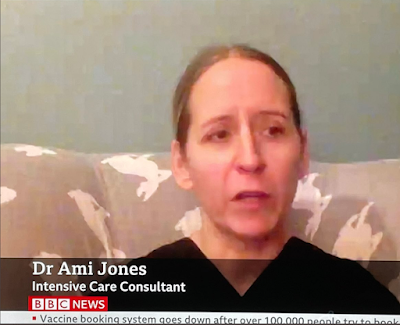
Dr Ami Ross, intensive care consultant: It's awful, you feel like you are giving them a Third World service.
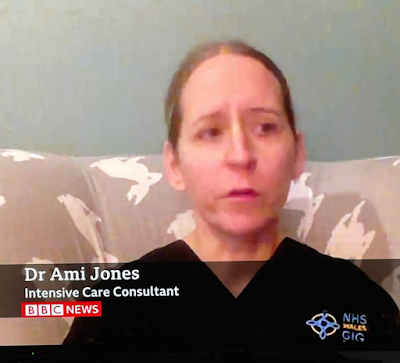
The report was re-broadcast every hour during the afternoon, but someone on Twitter spotted a slight change between the report as broadcast at 1:05pm and the report broadcast at 2:05pm and later and took to Twitter about it:
Sam Lowry: Spot the difference - Dr Ami Jones on BBC News at 1pm, saying how terrible things are with intensive care wards, then again on BBC News at 2pm when they’ve realised this reflects badly on Keir Starmer & have edited out the fact this is happening in the Labour-run NHS Wales!!
Here's the screengrab Sam took at 1:05pm:
And here's her 2:05pm screengrab:
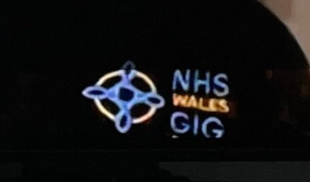
As you'll have spotted, what disappeared was this:
Now, I never just trust screengrabs posted on the internet so I checked TV Eyes to see if this really did happen. 

And it did. 

The report was otherwise identical.

So what do you make of this? 

Why did they crop it? Was it because the BBC was removing something inconvenient for Labour? Or did they remove the 'NHS Wales GIG' logo because it was advertising, even though it was only adverting the public sector Welsh NHS [so not a commercial brand]?

[Note: 'GIG' is the Welsh acronym for 'National Health Service' - 'Gwasanaeth Iechyd Genedlaethol'.]

Sunday, 3 November 2019

Clearly


Good old Mark Mardell. He made me laugh today. 

He was doing his report from Worcester about voters' views on the NHS in light of the election and eventually got round to the putative Brexit Party candidate. 

Mark's narration ran as follows:
The Brexit Party came top in the European elections here, and if they stand in the general their candidate will be Martin Potter. Clearly, it's not their big issue, but where do they stand? 
He then played in the clip, recorded earlier, of Martin Potter replying to his earlier (unheard) question: 
The Health Service is a big issue for the party. It is a big issue for the country, and always has been, so I'm not sure why you're asking the question. 
The tone of the following conversation sounded distinctly cold. 

The fact that Martin had already told him that the NHS is a big issue for the Brexit Party (in his opinion) evidently didn't stop Mark from asserting "Clearly, it's not their big issue" while recording his later narration and teeing up that earlier clip. 

Isn't that a bit rum? 

Sunday, 17 June 2018

Brexit dividend


Jonathan Blake

Wonder if Lord Adonis and Alastair Campbell will be retweeting Guido Fawkes today?  The latter writes, "Have to say the Number 10 press team have played a blinder this morning. First they got Marr to agree to an easy pre-record interview rather than a live. Then they got the BBC to lead all morning on the Brexit dividend rather than the fact that the money is actually coming from tax rises".

Is it fair to say that the BBC has acted as Mrs May's lapdog over this? Well, here's an example of how they've been reporting it - a BBC-on-BBC interview on Breakfast: 
Sally Nugent: We're joined now by our political correspondent Jonathan Blake. Jonathan, so we're hearing about this kind of...it's being framed as money as a result of Brexit, but it's really not as straightforward as that, is it?
Jonathan Blake: No. Things in politics are rarely as simple as the politicians might like to point out. And when the Prime Minister talks about the Brexit dividend, that is something which a lot of people argue doesn't really exist. The UK will stop paying into the EU budget after we leave the EU, but that money may well be accounted for elsewhere if the government wants to keep funding sectors such as agriculture which get funding back from the EU as a result. There is also the rebate that the UK gets back every year as well from its contributions. And the government's own spending watchdog, the Office for Budgetary Responsibility, has said that tax revenues will fall overall as a result of Brexit. The government has accepted that so we'll have less money to spend in general. Nevertheless, that's the detail. It's the message that matters for the government and for the Prime Minister to come out and clearly link the money she apparently thinks the UK will save as a result of leaving the EU to NHS funding is a very powerful thing for her to be able to do. It will please a lot of Brexiteers within her own party and beyond. It's not quite as much as many NHS leaders and campaigners had wanted.  And, as you heard just there, Labour are saying that the government has left the NHS in crisis and it will cost billions to recoup the amount they will have to borrow as a result of spending cuts. And even if we take into account the so-called Brexit dividend, the Prime Minister writing in the Mail on Sunday this morning, saying that alone will not be enough and we as a country will have to contribute a bit more. To translate that Prime Ministerial-speak for you: Taxes will have to go up to pay for this. 
Even Lord Adonis and Alastair Campbell would surely struggle to pretend that that was pro-government, pro-Brexit BBC reporting!

Incidentally, more than one person hereabouts said that the BBC News website completely ignored the the PM's "Brexit dividend" claim last night. Checking Newsniffer, the first version of the BBC's main online report on the story was published at 22:40 and, indeed, didn't mention the "Brexit dividend". It was only at 23:55 that the phrase began appearing in the online report. (Thereafter it's been all over the BBC of course). Checking TV Eyes to see if the TV coverage was any quicker it turns out that Hugh Pym did use it at 22:18 on BBC One's main news bulletin. Make of that what you will!

Saturday, 6 January 2018

The elephant in the ward


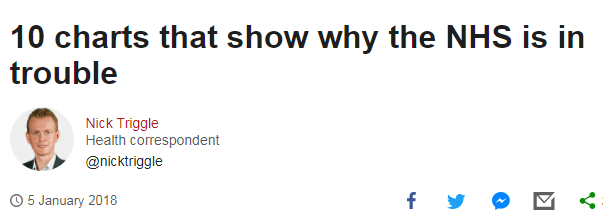
The BBC News website has a new 'explainer':


Now, there's no prize for guessing what doesn't get a mention in the entire article. Yes, immigration. (h/t Not a Sheep). 

According to Migration Watch, immigration has had a major impact on NHS demand. As an indication of the scale of the possible impact, they write: "In 2015/2016 there were almost 745,000 new migrant GP registrations in England, Wales and Northern Ireland – that is more than one every minute and the highest number on record."  

It's a familiar complaint on blogs hereabouts that the BBC invariably sweeps this particular elephant under the carpet whenever it discusses 'why the NHS is in trouble', but familiarity doesn't make the complaint any less true. 

Tuesday, 7 November 2017

Mustn't forget


In amidst all their 'Paradise Papers' stuff,/ their race-obsessed arts guff,/ and their self-promoting puff/ (over their new George Orwell statue), tonight's BBC News at Six did manage to find space for a bit of full-on negativity about Brexit. 

Now, from reading other (non-BBC) reports about the claims from NHS Providers today it's clear that the BBC was reflecting their negativity about Brexit too. But still, this felt like pretty unremitting stuff from Hugh Pym here:
Newsreader: Staff shortfalls are now the biggest single risk facing NHS hospitals in England. The group representing health trusts says recruitment and retention of NHS staff is lagging behind patient demand and is leaving existing workers on what it calls "the edge of safety." The Government insists it's launched the biggest ever training programme for doctors and nurses. Our health editor, Hugh Pym, reports. Hugh Pym: Intolerable pressures on front-line NHS staff and severe workforce shortages, that's life on the front-line, according to the group representing hospitals and other Trusts in England. Saffron Cordery, NHS Providers: I think they are now working on the edge of safe services. We are seeing so much pressure on the front-line. So what we've got to do is make sure that we can really manage that demand, but also increase the workforce. Hugh Pym: And here at Kingston Hospital, in south-west London, they say uncertainty over what Brexit means for EU staff has added to the workforce problem. Kelvin Cheatle, Director of Workforce, Kingston Hospital: So the worry is the turnover of staff, the loss of the skilled, experienced people we have, but also the supply lines for the future of making sure we can recruit people, therapists, nurses, doctors from the EU. Can we attract them in, in this very unstable environment? Hugh Pym: Including nurses, doctors and support staff, Kingston Hospital employs 3,000 people. Last year, 460 staff were EU nationals. This year, that's fallen to 384, though the Trust says it's managed to fill the gap from elsewhere. I met some members of staff at the hospital affected in different ways by Brexit. Female hospital staff member: I've had colleagues in tears... Hugh Pym: They believe they haven't so far had strong enough assurances to make them feel secure about their status. Giuseppe Pichierri, Consultant, Kingston Hospital: I'm concerned about how things are going to develop, how things are going to be decided in the future, what the deadline is going to be in order to apply for settled status. So, yes, there are lots of questions still hanging around at the moment. And, yes, I am concerned. I'm concerned for the rest of my family. Hugh Pym: The Department of Health said nurse and doctor training was being increased and the future of EU nationals was a top priority in the Brexit talks, so their valued contribution to the NHS could continue. Hugh Pym, BBC News. 
Whatever, I don't think Lord Adonis will be complaining about that one!

Saturday, 11 February 2017

Hugh Pym says the BBC got it about right


For fans of transcripts everywhere and an interesting, bias-related discussion on this week's Newswatch....


SAMIRA AHMED: Hello, and welcome to Newswatch with me, Samira Ahmed. Vital insight or just demoralising coverage? The BBC's special NHS reporting is in the spotlight....Reports about the National Health Service have been especially frequent on television news bulletins over the last few weeks of winter, but this week more so than ever. The BBC was running a week of special programmes and reports, which they branded as Health Check, about the state of the NHS, including Monday's Panorama and lengthy items on the 6pm and 10pm bulletins on Monday, Tuesday, Wednesday and Thursday. 

ALISON HOLT, BBC: Seven years ago this council spent about a third of its budget providing care and support to people who are older and disabled. 888 But now the cost of adult social care is heading towards half of its budget, with demand still increasing and that is at the heart of the problems they are wrestling with today. ED THOMAS, BBC: Inside the Royal Blackburn Hospital. The BBC was given unrestricted access to witness the pressures facing the NHS. SURGEON: We have had patients here for 6-9 hours and we cannot find a bed for them. PATIENT: We were in the corridor for five hours. It isn't what you expect from a country like ours. HUGH PYM, BBC: Hospitals like this one are running at 95% capacity which means they are nearly full so with more emergency cases coming in and difficulty discharging some patients back into the community some of those needing surgery are having to wait longer. 

SAMIRA AHMED: The BBC;s health editor and special correspondent and social affairs correspondent there. No question about the comprehensive nature of the coverage but some viewers told us by telephone and webcam that they were concerned about the effect of that coverage and that the BBC had an axe to grind.

VIEWER 1 (Dave Cocks): Every night this week we have seen the BBC 6pm and 10pm news leading with the story on the current state of the NHS. We all know there are many problems in the NHS, and there are many reasons for this including bed blocking, immigration, lifestyles, health tourism, waste, bad procurement, trivial A&Es visits, etc, etc. And yet BBC news would rather have us believe the problems are all due to so-called Tory cuts and that throwing more money at the problem will solve everything. Please, BBC, get your house in order and start reporting the news and not making it. This biased campaign should have been reserved for a Panorama programme, not the main news. 

VIEWER 2 (Grace): Hi. My name is Grace. I understand there are serious strains in the NHS and I understand that things have got worse by some measures, however, BBC News seems to be trying to make us feel angry. We have better NHS care than most people on the planet. Please try and help us to feel grateful for what we have and try to help make things better rather than constantly telling us it is a disaster. 

VIEWER 3 (John Carson): Dear NewsWatch, I am not newsworthy because I am one of the thousands of people who have received treatment from the NHS over the last few months who have nothing to complain about but only have praise for the dedicated, professional staff who have carried out treatment on their behalf. This week we have been bombarded by the news on all channels telling us what is wrong with our National Health Service. It is broken. What you have as the BBC is a responsibility in terms of making sure we do not demoralise the staff any more than they are. I asked a nurse if she was impacted by the adverse publicity seen on the news this week. She looked at me as if it was a silly question. 

VIEWER 4 (Andrew Millar): The BBC has spent the last week with intensive wall-to-wall coverage of pretty bad news about the NHS and some important things that needed saying, about waiting times, and waiting on trolleys is a real issue for a lot of people. However, the effect of that is to produce a downwards spiral of gloom and despondency for staff and patients alike. So, come on BBC! It's not that we don't need to know about these bad things and they do need addressing, but I think that the benefit of the NHS and our appreciation of it we should hear some of the good news too. 


SAMIRA AHMED: Well, the health editor for BBC News, Hugh Pym, has been on the news for much of this week and joins me now. Hugh, viewers, as you've sensed from looking at those clips, have felt there's been so much coverage focused on all the negative things - the A&E waiting times, the cancellations - they wonder whether the BBC is hyping up a sense of crisis? 
HUGH PYM: Well, first of all there have been several strong newslines which we would want to cover as part of our BBC News output. We did some research on waiting times, patients who were waiting longer than 18 weeks in England to get surgery. That is the target. They should be seen for a routine surgery, within 18 weeks, and the number is up 163%. We discovered from our data that nine out of ten hospitals are running at levels that are deemed to be above what is normally safe. We've had the Institute for Fiscal Studies has saying that health spending in England has gone up but per person will start falling. And on Thursday, extremely bleak figures from NHS England on how A&E performance in December was the worst since records began and looked likely to get worse in January after documents that were leaked to us. I think it is our job to report on facts and figures about the performance of the NHS. In terms of staff morale, I take on board what people were saying there about staff feeling a bit downtrodden because of this. Equally we have had contact, e-mails and calls, from quite a few staff who said it's really good the BBC is focusing on what is really going on, from senior consultants to more junior doctors, to nurses, saying this is precisely what the BBC should be doing and it hasn't done enough often the past. 
SAMIRA AHMED: I suppose it's finding that balance. There was one viewer there saying they felt the coverage ended up being like a downward spiral of gloom and despondency and that that's so overwhelming that perhaps it needs to be balanced with some coverage that shows what is being...more positive.
HUGH PYM: Yes, I think there has been quite a lot of positive coverage as it happens. On the Victoria Derbyshire programme there was a big debate on health involving patients and staff and other health experts, including some patient testimony on the positives that they found with the NHS. We've had coverage on The World at One throughout the week on different aspects of how GPs are coming to terms with the different challenges. The News Channel has had reports, including one from Airedale, on innovative schemes to link up care homes with GP practices, using technology and so on. So we have tried to emphasise the positives. In a piece I did we had a Yeovil Hospital scheme that aims to look after older patients in their own bespoke facility away from A&E. So tried hard to talk about the positives and possible solutions, but equally stating the facts. which are pretty straightforward. It's a tricky balance but ultimately we are holding an important institution to account, and that institution really should be about providing the best possible patient care and for government making sure it is funded adequately and, equally, it's making efficient use of taxpayers' money. 
SAMIRA AHMED: Some complaints have been that it's felt the BBC has been politically campaigning and saying this is all about more funding for the NHS. 
HUGH PYM: Well, there is a groundswell of opinion that the NHS should have more funding, that health spending in the UK as a whole as a share of national income is below France and Germany, has fallen. The IFS during the week have made clear that spending will fall in a way it has never done before in terms of spending per head of the population. We have taken those arguments and put them forward. We've been accused in the past of not addressing lack of funding. We haven't been politicising it. We've stated what the facts are, and there is actually a cross-party move now campaigning for more funding. Equally, we have been very clear that there are some who feel the NHS could make more efficient use of its resources and we have reflected that argument, that it's not just about money, it's about better ways of joining up care, better ways of spending money. But it is an important debate and I think it's only right to address the issue of funding throughout the week. 
SAMIRA AHMED: Hugh Pym, thank you.
Sunday, 14 July 2013

'Up To 13,000 Needless Deaths' In NHS Hospitals


Talking of the BBC's unique news priorities, the second story for ITV News at the moment is 13,000 'needless' NHS deaths: 
Some 13,000 patients may have died needlessly at hospitals since 2005, a report by the NHS medical director released next week will say. Sir Bruce Keogh will expose failings in the 14 worst trusts in England.
This is the story which the Daily Telegraph is leading on: 
13,000 died needlessly at 14 worst NHS trusts
The needless deaths of thousands of NHS patients will be exposed in a report this week.
The NHS’s medical director will spell out the failings of 14 trusts in England, which between them have been responsible for up to 13,000 “excess deaths” since 2005.
Prof Sir Bruce Keogh will describe how each hospital let its patients down badly through poor care, medical errors and failures of management, and will show that the scandal of Stafford Hospital, where up to 1,200 patients died needlessly, was not a one-off.
The report will also pile pressure on Labour over its handling of the NHS, with the Conservatives likely to seize on it to attack Andy Burnham, the shadow health secretary who was in charge of the NHS in England from June 2009 until May 2010. 
Sky News is also making it a main story:
The scandal of sub-standard care in parts of the NHS is set to deepen when a damning report is released in the coming days.
The Mail also considers it a story of importance for its readers:
Doomed to die by the NHS: Devastating report to reveal thousands dying needlessly as 21 hospitals probed in scandal that eclipses Mid Staffs horror
Look for it on the BBC's home page, however, and you will find nothing about this. Yes, nothing. Look for it on their Health page, and you will also find nothing. 

A story that matters to most members of the public doesn't seem an urgent priority for the BBC to report. 

The BBC doubtless will report it in time, but why isn't it reporting the story now? Is it its alleged pro-NHS bias coming through again?


Update 18.00: Amazingly, it's still not a story that's registering on the BBC News website's radar - though, as B-BBC's Alan notes, BBC website readers could just about see the story (if they squinted, and borrowed a neighbour's binoculars) late this afternoon in a link to the Daily Telegraph on the site's Elsewhere on the Web section. It really isn't good enough, is it?

Sunday, 23 December 2012

Whose Bias Is It Anyway?


Is this an example of bias, or am I guilty of confirmation bias here? As they say on all the best entertainment shows, 'You decide!':

When I used to blog about Radio 4's Broadcasting House I would point out some of presenter Paddy O'Connell's little biases (as I saw them), including the way his obvious love for the N.H.S. would seep into some of his BBC work. Here's an example:
Sunday, 29 November 2009

Broadcasting House today was not without its laughs and presenter Paddy O'Connell was mostly on fine form - and it read out in full Shelley's wonderful Oxymandias. It was not beyond criticism however. (Sorry Paddy, I may be feeling benign today, but there are limits!).

During his benign interview with Labour health minister Mike O'Brien, in the wake of Dr Foster's report on poor hospital standards, Paddy intervened to proclaim the glory of our beloved National Health Service (may it live forever): "Absolutely. And let me go further than you have. Millions of treatments are carried out with great skill, professionalism, and people are very happy. And our listener will want us to say that." Another ritual proclamation of love for the divinely-inspired NHS. The NHS may do great things, and I have experienced a few of them, but I've also recently heard a few horror stories from my friends in recent weeks that suggest that rank incompetence and rudeness are surprisingly common within the organisation and causing considerable distress. So Paddy, don't presume to speak for your listener.
Paddy's love for our national health service manifests itself from time to time on Twitter too:

From Jan 2012:
Dear NHS thank you for fabulous care and star nurses for a very old man at William Harvey Hospital Ashford

From Sept 2011:
After years of surgery, chemo, surgery and chemo, a friend is now cancer-free! Thank you nhs 

The news today about the appalling abuse of patients at an NHS hospital in Worcestershire is the latest story to show the other, worrying side of the NHS - the side they didn't show during the Olympic Opening Ceremony. 

Since writing the post above (three years ago), I seem to have been hearing story after story of rude, cold, neglectful or less-than-competent-sounding NHS treatment from relatives, friends and colleagues at work, some of them (or some of their nearest and dearest) facing serious illnesses. Not one of those people has (as far as I'm aware) complained officially about their or their loved one's treatment at the hands of NHS staff, so they won't be showing up on any official NHS figures.

How typical is this? My local NHS trust has been in the news over the last couple of years for some serious lapses in its quality of service, so this may be partly region-specific. (My "region-specific"!) Still, it is surely a concern. 

Having heard the story on Radio 4's 8 o'clock news bulletin, it crossed my mind that Paddy O'Connell might try to smooth the story over if he covered it (an hour or so later) on Broadcasting House. It crossed my mind because I knew that I would be listening to Broadcasting House today and because I have long been of the opinion that Paddy (charming as he is) is just the sort of impartial BBC presenter who allows his biases to influence how he does his job as a BBC presenter.

That's a bias of mine. It means I think things like that when I should, perhaps, be thinking more about the story itself. That troubles me. 

Every report I've seen about the Worcestershire NHS trust story (from the Guardian to the BBC News website) mentions the acronym "NHS" in its coverage of events at the Worcestershire Acute NHS Hospital Trust. Not once - from the introduction through to the programme's paper review take on the story - did Paddy O'Connell say "NHS" as he covered it (deliberately?)....that is until Paddy's three paper reviewers offered their own, occasionally painful experiences of under-par NHS hospital treatment, mingling them with more positive takes. Given the negative turn of the conversation as it proceeded, Paddy then intervened to pick up on one of those more positive takes:
"Is it possible that what we heard from Brian, both can be true. You can have people who believe that the NHS has saved their life, has been fabulous with very caring nurses and you can have stories of abuse - exceptions! It's possible in something this large for both to be true at the same time, I imagine."
Quite true, though how exceptional are those "exceptions"? Note also that Paddy's language in describing what those who are grateful to the NHS closely matches his own. 

So, is this BBC bias? Or blogger bias? Please take a listen and decide for yourselves if Paddy was sticking up for the NHS, and sticking up for it for reasons of personal bias, or if I really, really, really need to stop myself from interpreting everything in terms of BBC bias.

P.S. Talking of confirmation bias, here (hot off the presses) is a truly confirmation bias-soaked comment from Biased BBC on the subject:

Note the bBBC’s none-too-subtle attempt to link the present Health Secretary to the failings of Worcestershire NHS under the Labour government. Compare and contrast the first line of the reports:
bBBC (http://www.bbc.co.uk/news/uk-england-hereford-worcester-20830020) Health Secretary Jeremy Hunt has said he is “disgusted and appalled” at accounts of patient neglect at a hospital in Worcestershire.
ITV News (http://www.itv.com/news/central/2012-12-23/hospital-trust-apologises-to-families-for-appalling-care/): A hospital trust will apologise to the families of 38 people who suffered what human rights lawyers have called “appalling” failures of care, following successful legal action.
Even the Grauniad (http://www.guardian.co.uk/society/2012/dec/23/hospital-trust-apologises-neglect) didn’t stoop as low as the bBBC: A hospital trust will apologise to the families of 38 people who suffered what human rights lawyers have called “appalling” failures of care, following successful legal action.

So "Health Secretary Jeremy Hunt has said he is “disgusted and appalled” at accounts of patient neglect at a hospital in Worcestershire" is a "bBBC" attempt to smear a minister in the Conservative-led coalition government? Only on Planet Confirmation Bias!