Tuesday, 16 October 2018

Extremes


Cologne railway station

Kaiser at Biased BBC linked to two reports of the same event (a violent hostage-taking incident in Cologne) and observed that "one of these days does not seem to agree with the other". 


The Breitbart report sharply amplifies the 'radical Islamic terrorism' angle while the BBC report suppresses it.

They are the two extremes. If you then turn, say, to Deutsche Welle you'll find a report which sits somewhere between them.

So in the Breitbart report we get the headline Cologne: ‘Islamic State Sympathiser’ Takes Hostage, Sets Fires, plus "The suspect is reported to have spoken in Arabic about the Islamic State" and "German magazine Focus reports sources who claim that...the suspect is indeed a sympathiser of the Islamic State" and a paragraph mentioning the Cologne sex attacks by migrants at New Year 2015/16, though there's also a paragraph saying "There is presently no indication of the identity of the hostage taker, nor motive".

In contrast, the BBC, whose headline is Hostage safe after Cologne railway station drama, makes no mention whatsoever of Islamic State or Arabic speech. The closest it comes to mentioning a possible terrorism aspect is to cast doubt on it: "Local media say the incident does not appear to have been terror-related."

As for DW, whose headline is German police search for clues in Cologne hostage-taking, it says "Authorities believe with "high probability" that the suspect is a Syrian man with a German residency visa", "During their search, [police] discovered the identity documents for a 55-year-old Syrian migrant with a German residence visa valid until 2021", "Authorities have yet to clarify the suspect's motive. 'The investigation is considering all possibilities and we are not ruling out terrorism,' said Cologne deputy police chief Miriam Brauns" and "Witnesses have reportedly described the man as professing allegiance to the "Islamic State" militant group while committing the attack. But police have not independently verified such testimony."

When you read the DW report you can see just how far the BBC has gone to downplay any possible Muslim terrorism angle. And they are even more brazen in their agenda-pushing than Breitbart as Breitbart at least have the decency to add that bit saying "There is presently no indication of the identity of the hostage taker, nor motive".

Incidentally, Newssniffer shows that the BBC actually edited their report to make it even less about terrorism. An earlier version said "It is not clear whether there is any terror link. No details have emerged yet about the hostage-taker or any potential motive". This was removed and ""Local media say the incident does not appear to have been terror-related" added.

Returning to Biased BBC, after Kaiser pointing out the 'worlds apart' nature of the Breitbart and BBC reports, Roland Deschain observed:
Well, I guess they both have their agenda and report accordingly. However one charges me £150 before I can watch any other channel on condition of its impartiality, whilst the other does not.
Quite.

Oooof


Here was an exchange the other day on the Open Thread:

Craig, 14 October 2018
Talking of Anthony Zurcher, this tweet is typical Zurch:
If you watch the actual video you find that Trump was actually praising the head of the Union army General Ulysses S. Grant - a native of Ohio: 

Monkey Brains, 14 October 2018
Yes, that was a classic Zurcher attack! Truncate the text...link to something irrelevant...and hope for the best (ie the worst for Trump). Zurcher is the gnat biting the rhino's hide a thousand times a day. Annoying but the rhino is not brought down.

Well, there's an update to this now:


Shouldn't that have been "CORRECTION: Oooof", Anthony?

Sunday, 14 October 2018

A New Pinter Play


Did you hear the newly-rediscovered Harold Pinter sketch on today's The World This Weekend

(Pause)

They performed it in full. 

(Pause)

Yes, on a news programme!
Even some of the resident lefties on Twitter didn't think that was right.

(Long pause)

Written in 2008, and obviously mocking George W. Bush, they got Jon Culshaw from Dead Ringers to perform it in the voice of (Alec Baldwin) Donald Trump. 

(Pause)

The joke is that the US president is so stupid that he orders a nuclear attack on London when he meant to launch it on Paris. Why? Because he thought London was in France because he's stupid. D'oh! And then, because he's stupid, he puts things right by nuking Paris. 

(Pause)

Even some of the resident lefties on Twitter didn't think it was funny. 

(Pause)

And it wasn't funny. It was a sketch even the producers of Dead Ringers would have rejected as being too obvious and juvenile and leaden.

(Pause)

 And yet here it was. 

(Pause)

And here was President Donald Trump being mocked on BBC Radio 4.

(Pause)

And 'arold's widow, Milady Antonia Fraser, was on hand to pronounce that it made her laugh every time she heard it. 
Well, I must try out some of my jokes on her. She's obviously easily amused. 

(Long pause. Enter tumbleweed)

Well, at least it's got us talking. (Aside) About how rubbish it was. 

(Curtain).

Loaded Language


Ah yes...


As for the article itself, I really can't put it better than Sir Tohham:

Sir Topham Hatt14 October 2018 at 13:08 
Roger Harrabin has written an article about eating less meat to save the planet.  
He doesn’t address whether he will eat less meat himself but instead goes after the climate minister, Claire Perry, with loaded language. 
‘She would not even say whether she herself would eat less meat.’ 
‘Ms Perry refused even to say whether she agreed with scientists' conclusions that meat consumption needed to fall.’ 
‘She said instead of cutting down on meat, we could use (hugely expensive) equipment that sucks CO2 out of the atmosphere.‘ 
I’m assuming Harrabin added ‘hugely expensive’ and used ‘even’ to discredit Claire Perry and to accentuate his case.  
He is the worst type of BBC journalist, always pushing an agenda, using words to deliberately set a tone and forever lecturing on what we should do.

Quite.

Even the opening line of the article is loaded: "Just a week after scientists said huge cuts in carbon emissions were needed to protect the climate, a UK minister has shown just how hard that will be."

He means that she's part of the problem.

Brickbat and Bouquet


'Badley Church, Suffolk' by Harold Steggles (1936)

Well, I woke up early this morning, put on my 'I love Pope Francis' badge (Ed Stourton lent me one of his spares) and switched on to the radio equivalent of the liberal Catholic magazine The Tablet - namely Radio 4's Sunday, hosted by Tablet trustee Ed Stourton. 

Today's topics included: (a) the raising to sainthood of the murdered El Salvadorean liberation theology-sympathetic Cardinal Oscar Romero, discussed with a Catholic charity worker (which cast conservatives in a bad light); (b) a report by a Catholic group on the need for prison reform, discussed with a Lib Dem peer (who denounced "penal populism"); and (c) a discussion of  a resignation in the US Catholic Church over sex abuse, where both guest and presenter (Ed) cast the present Pope and his unfortunate cardinal in the best possible light. 

Also discussed were: (d) the UN's World Food Day, plugged with a participating charity; (e) Anglican "institutional homophobia", discussed with an aggrieved married gay Anglican cleric; and (f) the 50th anniversary of the Olympic black power protest, discussed with one of the black power saluters. 

The two other items were BBC-on-BBC interviews on (g) the gay cake case and (h) the released pastor and his prayer for President Trump. 

All very 'Sunday'!

Still, one of the featured BBC reporters, Mark Simpson (the BBC's Northern Ireland correspondent) showed afterwards how to be charming on Twitter. The estimable Jane Kelly was criticising his comments on the 'gay cake' case, and he responded:

Jane Kelly: Your reporter Mark Simpson declared, 'There are no winners in this case,' the winner was free-speech. You could also remind him that he is supposed to be a 'reporter.'
Mark Simpson: The question was asked in the context of the personal toll that the 230 week case has taken on the participants.
Jane Kelly: I see, that explains your sympathy for the man who lost, saying he 'looked devastated.' For me that was because he just assumed he would win.
Mark Simpson: Jane, Jane, Jane. That’s simply not true. But, hey, you’re entitled your view. I admire your work. Always have. And I respect your right to call it as you see it. Free speech. Enjoy the rest of your weekend. And next time you’re in NI, I’ll buy the coffee.
Jane Kelly: Thank you very much, you are very gracious. I used to visit NI a lot, a truly fascinating place. I have changed sides a bit though, now see the Protestants as a tribe in danger of extinction.
Mark Simpson: I look forward to hear your reasoning. Keep in touch.

Saturday, 13 October 2018

The back with two beasts


Below you'll find two transcripts concerning the BBC's editorial policy regarding climate change. 

I'll use this post then to shove in my tuppenceworth. 

I've said before that I find that BBC TV's Newswatch and Radio 4's Feedback are different beasts. You're more likely to hear complaints of the kind we make on Newswatch than you are on Feedback. And Newswatch tries to project a more impartial style than Feedback, with Samira Ahmed taking more care to appear even-handed than Roger Bolton. And Feedback does seem to me to be more agenda-driven than Newswatch

So here you'll see that Newswatch features viewers' opinions from both sides of the climate debate while Feedback features just one side. And you'll see Samira Ahmed put questions from both sides too (albeit rather half-heartedly from the 'deniers' side') while Roger Bolton is relentlessly one-sided in his questions. And Feedback has been banging this one-sided drum for a long time now, leading the charge against 'deniers' being allowed on the station for at least a couple of years. 

That said, it was Roger Bolton who really made the BBC boss squirm this week. You'll note that both James Stephenson and Richard Burgess (one of whom said much the same as the other!) were reluctant to admit that the BBC got it wrong despite the BBC itself already having said that they got it wrong, with Mr Stephenson wriggling in particularly awkward ways and Roger calling him out on his use of weasel words and then embarrassing him even further by pointing out to listeners that he didn't look comfortable answering a particular question. All credit to Roger Bolton for not being a lickspittle there. 

And credit to Feedback too for highlighting the scientific ignorance of BBC Radio 4 journalists - bulletin writers and senior presenters, including Feedback bete noire John Humphrys and Sarah Montague. (That was the thing James Stephenson got particularly uptight about). It was a serious lapse in accuracy on Radio 4's part - and if both John and Sarah were involved that didn't mean it was simply a problem with one programme. It must have been both Today and The World at One. 

To end: One thing that unites both Feedback and Newswatch is their consistent use of 'denier', without inverted commas. This old term of abuse is evidently now an acceptable description for BBC presenters and editors to use. You'll see that in both transcripts. Why is that acceptable?

Transcript: 'Feedback' 12/10/2018, James Stephenson on the BBC's climate change coverage


James Stephenson

Roger Bolton: Hello. We're back for our Autumn run. If this is Autumn. The weather is behaving very strangely - sunshine here, floods in Majorca. And is there any real doubt about the cause? 
Newsreader: Climate scientists have issued what's being described as the most comprehensive statement yet on the dangers of rising global temperatures.
The BBC admits it has got climate change coverage wrong in the past. Is it getting it right now? 
Listener: I think BBC News and in particular the generalist reporters and producers and editors are struggling and often get things wrong.
I'll be talking false equivalence with a senior BBC news executive...So let's get on with the show and we begin with a BBC mea culpa:
Climate change has been a difficult subject for the BBC and we get coverage of it wrong too often.
That's a direct quote from an editorial policy note distributed to BBC staff last month. The note goes on to say to:
To achieve impartiality you do not need to include outright 'deniers' of climate change in BBC coverage, in the same way you wouldn't have someone denying that Manchester United won 2-0 last Saturday. The referee has spoken.
BBC staff are also being encouraged to enrol on a course detailing the do's and don'ts of covering climate change. All of which is rather timely since on Monday the UN's IPCC - the Intergovernmental Panel on Climate Change - published a stark warning that urgent action was needed to avoid a global catastrophe. Cue a steady stream of politicians and scientists filling the BBC airwaves with their take on the significance of the report and what actions need to be taken - with no deniers anywhere, on radio at least. Some listeners and green campaigners see that as a distinct change in tone from the BBC, compared with previous times when the issue has been in the news, and they welcome it.
Listener 1: My name is Rachel Platt and I'm from Winchester. I think it is a very positive development and I've noticed the change already. I thought Monday's coverage of the IPCC report was clear and decisive, I felt, in a very, very new and refreshing way.
Listener 2: Wanda Lubneck. I usually avoid BBC news but stumbled into it this morning. They're talking climate change with two people up, both saying it would be disastrous. No deniers. What's going on?
Listener 3: My name's Dr Matt Prescott. I'm a zoologist and I work as an independent environmental consultant. I think it's patchy. I think generalist reporters and producers and editors are struggling. I think it is extremely welcome that the BBC's offering climate training to journalists. There are thousands of scientists working on different facets of climate change and no journalist can be expected to understand everything, or to know it all, just like I would struggle if you ask me about opera.
I'm now joined by James Stephenson, the News Editor for BBC News and Current Affairs. So are listeners right in detecting a change of editorial policy in climate change coverage? Your position, your starting position, now is the argument is over?
James Stephenson: No, I don't think they're right in detecting a change of policy. I mean, it's obviously in the ear of the listener to determine whether they are hearing different tone or whatever, but in terms of policy we've had a policy for a long time that the science on climate change is well established, and that our output should proceed from that point of view.
Roger Bolton: Well, I mentioned there were no climate change deniers on BBC radio but on Newsnight there was Myron Ebell, who's a former environmental adviser to Donald Trump who's known for depicting global warming as a hoax. Why was he given air time?
James Stephenson: Well, I think, I'm glad you asked me that because I think that touches on a very important dimension of this. While the climate science is a settled matter - although you know there are people who dispute that, but they're to the margins of the overwhelming scientific opinion - the same can't really be said of climate change policy, and the the question of what governments around the world are going to do about it. And,obviously, America is a huge player in all of this and, you know, it's no secret that the Trump administration takes a very different view of climate change. And so we wanted to interview someone who was head of the transition team for the Trump administration in this area, so we thought it was important, the programme thought it was important, to have him on because the science only takes you so far. The question of government action, particularly by the biggest polluters, is the crucial next dimension of this, and that was an important thing to interrogate on the programme, as Evan did on on Monday night. We're not in a position where we're saying that people are out-and-out excluded from our output, and we don't think that would be the right thing to do. What we do think is important is to identify why we're speaking to people, and to make sure that is editorially justified, and if it's editorially justified to do it in a rigorous and robust and challenging manner.
Roger Bolton: Does that mean that you will never put on a climate denier when you're talking specifically about climate science?
James Stephenson: We will not have the kind of discussions that you've heard occasionally in the past, where you have someone who is outlining the scientific position on man-made climate change and someone else who says that's not the case. We've moved away from that and beyond that, on the basis that while they're entitled to their opinion, and those opinions definitely still exist, they are to the margins of the scientific consensus, and we don't want to be giving the audience the impression that it's a sort of 50/50 arm-wrestle between those two positions.
Roger Bolton: Can we move on then from the policy you've announced to the way in which you're trying to make sure that your journalists understand it? How widespread is this going to be? Is every journalist in the BBC now going to have to take. as it were, an examination on this issue?
James Stephenson: No, no. We expect all our journalists to be prepared for the work they're doing and we're offering a training course for journalistic staff in this area, so...
Roger Bolton: (interrupting) Presumably you want all your journalists to understand these issues, so you want them all to be educated in this? 
James Stephenson: We certainly want all our journalists who will be handling this editorial subject matter to be familiar with it, and overwhelmingly to be confident in doing what is and important, and likely to be an increasingly important, part of our editorial agenda. It's a complex area, it's a scientific area. Many of our staff don't have that sort of a scientific background. They need the tools to do the job, and this is just one of the ways in which we provide our staff with the tools to do the job.
Roger Bolton: And you accept, well the BBC does formally accept, that it does accept, that you got this wrong in the past? And your own director of news, I noticed, talking to staff accepts this... you got it wrong in the past?
James Stephenson: There are occasions on which we haven't got things quite right and that's...
Roger Bolton: (interrupting) Not just that. Badly wrong.
James Stephenson: Well, that's the spirit in which we're approaching this. This is a difficult area. We've got a lot of journalists and producers who we want to encourage to be confident in this area. We're trying to provide them with the tools to be confident in the future.
Roger Bolton: We have talked about producers, but some would say presenters need to be educated as well. A number of listeners picked up on the fact that John Humphrys and Sarah Montague seem to get confused between percentages and degrees centigrade. Here, for example, is Professor Martin Parry. He's a former co-chair of the IPCC. He emailed us to say this:
Well, I was listening to the BBC's reporting and stunned, on four occasions I think it was, to hear this misread by newsreaders and presenters not as a 1.5 degree increase but 1.5% increase - which is totally different.
John Humphrys: The report by the intergovernmental panel of scientists says we must stop global warming rising to more than 1.5% above pre-industrial levels...
Sarah Montague: It says if world temperatures go up by one-and-a-half percent then we are dicing with the survival of mankind.
It's not sort of nerdy and trivial this. It's pretty important, because it seems to me to represent just a complete misunderstanding and, in a way, ignorance of the issue.
Roger Bolton: Do you accept that was wrong, and are you worried that your presenters got it wrong?
James Stephenson: Well, it clearly wasn't accurate but it speaks to my point...
Roger Bolton: (interrupting) It was wrong. It was wrong. 
James Stephenson: It was wrong, and we've clarified that and corrected it and apologised for the error. It speaks to my point though that this is an area where we need people to be aware of the material that they're working with, and that's the spirit in which we've made this course available. And in both those cases, the bulletins made clear that it was one and a half degrees Celsius above pre-industrial levels, so I think the audiences would have recognised that it was a slip and not something...
Roger Bolton: (interrupting) A slip by two presenters? Maybe a slip by one, but two of them?
James Stephenson: Well...
Roger Bolton: You're looking not that comfortable about answering that question, I have to say.
James Stephenson: Well, I wasn't quite clear that it was a question but...
Roger Bolton: (interrupting) Well, it is a question. You know, it's one thing to get a bulletin, written presumably, perhaps by a young producer, and have two senior presenters look at it and both not spot the problem.
James Stephenson: We've apologised for the error. I not sure I can add...keep adding more to that.
Roger Bolton: Some people would say that what that illustrates is that in this extraordinary complex area, and generalist interviewers are always going to be liable, if you like, to make a mistake, and what you need is really expert ones. And Dr Matt Prescott has a suggestion. He says he thinks the BBC needs a small team of internal experts available 24/7 who have the time and the availability to help all BBC programmes, not just news. Is that something you would consider?
James Stephenson: We do have a small team of experts. We have a science editor, David Shukman, and we have a team who work in this area. So we do have that expertise, and we bring that expertise to bear on the coverage we do in this area. And that's the way we think that this is best handled.
Roger Bolton: James Stephenson, News Editor for BBC News and Current Affairs, thank you very much. 

Transcript: 'Newswatch' 12/10/2018, Richard Burgess on the BBC's climate change coverage


Richard Burgess 

Samira Ahmed: Hello and welcome to Newswatch, with me Samira Ahmed. Is BBC News denying a voice to climate change deniers, or are they getting too much air time? Monday's report from the Intergovernmental Panel on Climate Change was the latest in a series of warnings about the risks of rising global temperatures, reflecting the scientific consensus on this controversial issue. Among the guests discussing the panel's findings on that evening's Newsnight was Myron Ebell. who used to be Donald Trump's environmental advisor and now runs a think tank which campaigns on behalf of the US energy industry. He was questioned by Evan Davis. 
Evan Davis: Do you think the scientists, who reviewed these 6,000 papers to produce this latest publication - 86 lead writers - do you literally think they don't believe what they have said? Is that your contention?
Myron Ebell: They're climate campaigners first, at the highest level, rather....
Evan Davis: (interrupting) Wow!...
Myron Ebell: ...than objective scientists...
Evan Davis: (interrupting) But you're a climate campaigner more than they are. They're not even paid, these guys. You're paid. They're not paid. It's absolutely... Go on.
Myron Ebell: Look, look...The study says that we've had about one degree of warming already. They don't consider the tremendous benefits that have flowed to humanity....
Evan Davis: (interrupting) But again..Sorry! Again, you're trying to show you know more about the science than the scientists! 
Some viewers thought Myron Ebell had no place as a guest on the programme, with Dr Mike Ward writing: 
I'm simply appalled that Newsnight and the BBC generally still find it necessary to have a climate science denier on whenever they report the latest findings on global warming. The BBC don't have moon-landing deniers on whenever they report on space flights, or flat-earthers on when they report on a round-the-world yacht race, so what's the deal with climate science?
And the author Philip Pullman tweeted his agreement:
This is an appalling misjudgement. By giving time to climate-change deniers, you make it harder for politicians to make good policy.
The editor of Newsnight, Esme Wren, took to Twitter before the programme aired to say:
As part of our coverage we currently plan to discuss the politics of climate change, and the mindset of the current US administration. In this section it is relevant to hear from those who have advised President Trump. The issue of false equivalence is only in play when discussing the science of climate change. This point is entirely recognised and adhered to by the programme.
That charge of false equivalence refers to the BBC's perceived practice in the past of balancing the views of the majority of scientists, that significant, man-made climate change exists, with the minority who challenge that analysis. But achieving a balance of that kind is not now the BBC's policy, as was made clear by an internal briefing memo, sent to news staff last month, which found its way into the newspapers. One passage said:
Climate change has been a difficult subject for the BBC, and we get coverage of it wrong too often. Man-made climate change exists. You do not need a 'denier' to balance the debate.
But that advice and Monday's coverage did not go down well with everyone:
Eoin McMahon: I watched in exasperation but not surprise at your naked bias all day. No guests who did not agree with the consensus were interviewed. I has been aware of the recent edict wherein your news staff have been directed that they are no longer required to be even-handed, and provide balance on the issue of climate change. But the bias across your news platforms was nothing compared to that which Evan Davis subjected Myron Ebell to on Newsnight.  
And Nigel Burn-Murdoch seconded that:
On the Breakfast programme there were three 'experts' who presented the IPCC report as fact, and there was no one present to advance a contrary view. Please do your duty and present both sides of a disputed area.
Well, let's discuss how BBC News handles this contentious issue with Richard Burgess, its UK news editor. Thank you for coming to Newswatch. Can you just sum up what exactly is the policy on giving airtime to climate change deniers now? 
Richard Burgess: Well, I think the policy is clear: that the science is settled on climate change, it exists, there is no debate around that. So we're not going to create a false balance or a false equivalence by getting a scientist on and then always getting a denier on. But that doesn't mean that we won't occasionally hear from dissenting voices within this debate, because there's debate beyond the actual science, there's debate around the intensity of climate change and then what to do about climate change. 
Samira Ahmed: Just to be clear - BBC News regularly did have on more climate change deniers in the supposed interests of balance. Are you now admitting that you'd got that wrong? 
Richard Burgess: No, I think what we're saying is that the science is really clear and that we do not need to get on a denier just to give some kind of, what we would describe as false equivalence. So the science is clear, we report the science, but there will be occasions where we get dissenting voices on. We're not going to shut out all viewpoints. 
Samira Ahmed: Because there is some dissent on the science and that Newsnight programme that viewers were commenting on, the moment you have a denier on - even though it's supposed to be about policy - it always ends up being a debate about the science. So the question comes down to, should the BBC be giving climate change deniers any air time any more? 
Richard Burgess: Because I think that was really interesting, that interview, because actually I think it really was interesting around the policy and the politics of the Trump administration, which is important in the whole climate change debate. And Evan asked him, "Actually, is there anything the scientists can say that will change the opinion of the Trump administration?" And he was really clear - "No." And when he tried to get into the scientific debate, Evan closed him down really quickly, and was, "You're not a scientist so we're not going to discuss that." So I think we really did gain some insight and some interesting perspective from that interview. 
Samira Ahmed: I mean, the trouble is, of course, some viewers are frustrated because - some of them contacted Newswatch - they feel there is scientific doubt and they are unhappy at the assumptions made in the BBC's climate change reporting. They were unhappy with the way Evan Davis was pressing. Can you satisfy them? 
Richard Burgess: I think the point is, is that the vast majority of scientific... The science is settled over this, the vast majority of scientific opinion admits that climate change is happening, it's a man-made phenomenon. But can we satisfy everybody? No, but are we going to shut out dissenting voices? Equally, no. But we're not going to create some kind of false equivalence between them. 
Samira Ahmed: You say there's a scientific consensus and we're not going to have a debate about that, but because the effects of it are still being discussed as something that will happen and not something that has happened, necessarily, there are people and there are viewers who say, I'm sorry, I think there's still a legitimate debate about the science. And I just wonder if the BBC can ever win this? 
Richard Burgess: I think, look, we have to reflect the debate around what we're going to do about this and the intensity of it, but when you have the overwhelming majority of scientific opinion being really clear that man-made climate change exists, then I think it's important we reflect that. 
Samira Ahmed: As we said at the beginning, the BBC has now put out a new memo and there is training guidance happening for news staff. So can you explain what that involves and what difference viewers might see and read in their coverage? 
Richard Burgess: Look, I think it's an attempt to explain to staff some of the changes in policy, research, science and to try and counteract some of the misconceptions that can be made around global warming and climate change. So we have offered some guidance, there's some training, as well, and it's just to make sure our staff are making informed decisions on this important issue. 
Samira Ahmed: But would it include things like "these people are not to be booked"? 
Richard Burgess: No, no. As I said before, we're not excluding viewpoints from this discussion, but what we're also not doing is creating this false balance that I've been talking about. 
Samira Ahmed: Richard Burgess, thank you very much. 

Dynasty


Yet more about Charlotte Moore, albeit in passing...

In her Steve Hewlett Memorial Lecture this week, she described the new three-part BBC Two series A Dangerous Dynasty: House of Assad as a "must-see" programme. So, being an obedient soul, I obeyed and watched the first episode. And it really is excellent.

The opening programme took us up to 2003, three years after the death of the Don Corleone of the family, Hafez al-Assad, and the assumption of power by his Michael Corleone-like second son Bashar. 

Old Hafez, a skull with a moustache, always struck me as a wrong 'un, but I didn't know that "at his military parades, soldiers were forced to kill puppies in front of him" and "female soldiers were made to bite off the heads of snakes". And lest I didn't want to believe that, there was the grainy black-and-white footage to prove it. (And I don't think I'll forget that for a while). He was also the sort of socialist dictator who would spent over a billion dollars creating a family palace. 

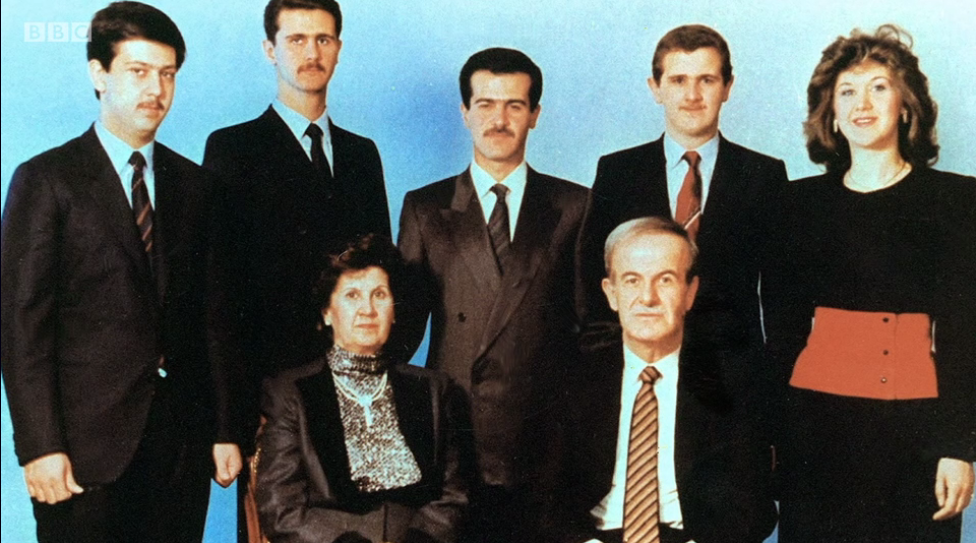
His eldest son, Bassel (middle of the back row in the photo above), was meant to be his successor. As a clue to his character we were told that he was a champion horse rider but, in 1993, one of his rivals beat him in a competition. Bassel had him arrested and put in prison. Anyhow, he also loved fast cars and died after crashing one in heavy fog.  

Who should Hafez chose next? Not his brutal treacherous brother Rifaat, who tried staging a coup against him after he had a heart attack in 1987. Not his preferred choice, his forceful daughter Bushra, because, well, she was a woman. Not the third son Majid, because he was mentally ill. Nor the youngest son Maher, because he was too young and hot-headed. So there was only one choice left - bashful Bashar, the softly lisping ophthalmologist. He was fast-tracked through the army and given a crash course in how to be a dictator. 

The series is also closely following his British banker wife Asma, who it's portraying as someone who wanted to be a a princess in a fairy tale and who was delighted when Tony Blair, after 9/11, invited her and her husband to meet HM the Queen. 


Old Hafez was the master of 'the hamburger trick'. This involves a hamburger sandwich seller. When the customer takes the bread, he finds that the seller has withdrawn the hamburger and he's eating just bread. The dictator used it on six US presidents, always giving them the hope that he'd be their ally in the Middle East but, at the last minute, not delivering. And we saw Bashar using it on Tony Blair. The British Prime Minister went to Syria, received the full charm of Bashar and private promises of support for the West in the War on Terror as the Iraq War neared. At the final press conference Tony Blair strongly welcomed President Assad's support and President Assad...well, President Assad pulled the rug from under the British PM and said that he didn't support the war at all, leaving Mr Blair looking on in severe bemusement - a remarkable scene. 

And this brings me to the most thought-provoking idea in the programme:
Narrator: At this point [the Iraq War], Bashar does something that will change history. He secretly releases Islamic fundamentalists from his prisons, arms them and sends them over the border to fight the Americans. The Muslim prisoners that Bashar released and sent over the border are a major reason that America and Britain get bogged down in Iraq. 
Sir John Sawers, head of MI6 2009-2014: There's no doubt that the fundamental security problems arose because extremists sympathetic to Al-Qaeda were fuelled with weapons, ammunition and support from Syria. So the task of stabilising, especially the west and north of Iraq, became vastly more difficult because of the actions of the Syrian regime.
The West usually gets the blame for the massive destabilisation of the region and the worldwide Islamist terrorism that followed the Iraq War, but what if it wasn't the West that made the big difference but Bashar al-Assad? If he hadn't released and armed those jihadists and sent them into Iraq and caused so much chaos, would the world be a very different place now? (There's a counterfactual for you!). Of course, in a few years' time, the Muslim fundamentalists that Bashar released would cross the border back into Syria.and try to set up an Islamic State there. But they are now (almost) gone and he's still there. 

Hate site

Oh dear, more on the topic of Tommy Robinson, Sammy Woodhouse, Gerard Batten plus a couple of wider questions.
 a) should the BBC and Sky (and any other broadcaster) get away with editing footage to misrepresent an interviewee ‘just because they can’?
and b) must we all be held accountable for the stupidity of our own so-called supporters?

A comment from stewgreen led me to Sammy Woodhouse’s twitter thread


It seems that the edited version of her interview with Gabriel Gatehouse placed undue emphasis on her remark - very likely in answer to a leading question -  that paedophiles can also be ‘white’.  She says she never meant to deny that grooming gangs were (and are) predominantly Pakistani Muslims. 

The Beeb’s manipulative editing has caused unnecessary trouble for her. Several of her twitter interlocutors challenged her, assuming that she too is now joining the authorities in denying the very things that they felt obliged to deny for fear of being condemned as racists.

Not only that, but her remarks about Tommy Robinson ‘jumping on a bandwagon’ drew indignant and malicious comments from some of Tommy Robinson’s most unhinged supporters. So who does deserve the most credit for exposing the grooming gang phenomenon? In my humble opinion, that entire matter is a complete distraction. There was an admirable amount of bravery on all sides in the battle against the conspiracy of denial. There needn’t be any competition between ‘the brave girls’ and the ‘Tommy Robinson army’ over that irrelevant accolade. The media (and people like Nesrine Malik) should drop that one. 

As for Gerard Batten, the jury’s still out. (My jury) His resilience in the face of Jo Coburn’s onslaught was - dare I say it, reminiscent of Nigel Farage’s - in the early days of his rise and rise to infamy. Hat’s off to him. Isn’t it sad that there’s so much conflict between all the figures who should be ‘on the same side’? They all seem to hate each other. Why can’t they get together to form a formidable opposition party and iron out their differences in private?

We all (anyone who raises their head above the parapet) get so-called supporters who effectively discredit us. (e.g. Anders Brevik / Melanie Phillips, and, say, Tommy Robinson / Darren Osbourne.) 
To some extent, I concede that this applies in varying degrees to Jeremy Corbyn.  (But he really is an antisemite)
On a smaller scale, this happens a lot on websites such as this one. When Craig and I try to be nuanced and reasonable we’re still regarded by people who disagree with us as fascists and ITBB as something of a hate site. A right-wing one at that. To me that is bonkers.

More on Ms Moore


Talking of Charlotte Moore, and her use of 'woke' language, and BBC agenda-pushing, here's the Press Association's Craig Simpson:


(Not so sure about the need for "return to" there!)

Following his link to The Times and, yes, it's our Charlotte again saying that the BBC will "wake up" audiences to "one of the biggest environmental crises of our times".

Wakey, wakey!


Charlotte Moore (or less)

Incidentally, another senior BBC boss, Charlotte Moore, head of content, has used 'woke' language to say that the BBC has "woken up" to the need to amend “huge historical failings” in its treatment of women:
There’s a whole generation of female stories, perspectives and experiences that’s coming to the surface. It’s our responsibility to make that generation heard - and help them inspire a new generation in turn. 
They bring with them a promise of a society that is fairer, better, and more equal than ever before.
Agenda? What agenda?

That would be a heteronormative matter


James Purnell (not as young as he used to be, but then are any of us?)

The dividing line between those who think that identity politics is a good thing and those who think it's a bad thing is very sharp and, often, highly political (though it doesn't always sit neatly on the traditional left-right axis). 

And the BBC places itself very firmly in the camp that favours and promotes identity politics, thus taking sides on a matter of controversy.


There will be network of "straight allies" (to be identified with badges!), and "non-binary language" will be encouraged. There were even be "unconscious bias training" (re-education classes) to ensure that staff do not cause accidental offence. 

That "heteronormative" phrase, if you were wondering, comes from James Purnell, director of radio and education at the BBC  - and a former Blairite minister. 

Here are a couple of startled reactions to it from (the left-wing end of) my Twitter feed:
Claire Fox, Institute of Ideas: Assumed this was BBC WIA-style satire; sadly not. Expect full gamut of womxn-style bollxxx, linguistic policing, unconscious bias training for those who refuse to wear demeaning "straight ally" badge!  
Ben Cobley, author of 'The Tribe': This is remarkable. Exactly along the lines I describe in The Tribe, but still remarkable in the extent to which the BBC as an organisation is outsourcing authority to favoured group representatives, who will minister to identity group members. I don't think I've ever seen such a complete example as this. And to top it off it's being overseen by a former Labour MP as director of BBC radio and 'education' (we might say 'political education' in the same sense that Labour has political education officers).

Has the BBC fact-checked this?


John Pienaar (no relation to Peter from the Richard Hannay books)

John Pienaar's report on last night's BBC One News at Six began: 
The picture's building, and it's not pretty. Of course it may never happen, but Brexit with no deal could mean disruption to travel, trade, business. Warning notices are pouring out of Government now - 106 and counting. The latest? Could we see this in Northern Ireland? There would have to be action to protect energy supplies, keep the lights on, if EU rules suddenly fall away. Could the Eurostar keep running? International rail services run on EU wide agreements. They would have to be replaced, maybe quickly. And what about trade, not just with the EU but the 40-odd countries Britain buys and sells to and from as part of the union? No deal with them could mean new tariffs and checks on business covering around 12% of UK trade around the world. The Brexit Secretary is looking on the bright side. 
If the Brexit Secretary was looking on the bright side, then the Minister for Trade and Investment seems to have been looking at a TV screen, watching John Pienaar's report and not liking it. He then tweeted the following:


If Mr Hands is correct, then John Pienaar got his facts spectacularly wrong there. 

And, Googling around, it turns out that Mr Hands is indeed correct about it being "40 deals with 70 countries", not the "40-odd countries" the BBC's deputy political editor talks of. (Every non-BBC report I've come across has eported this correctly.)

On the second point - the "12% of UK trade" point - there's more confusion. Other outlets are also saying that 12% of "total" UK trade could be put at risk. So who's right here?

More on Jo Coburn v Gerard Batten


Here's that interview in full:


And some Twitter debate about it involving UKIP and the BBC's head of live political programmes:

Gerard Batten: Who came out on top in my ‘interview’ i.e ambush on Politics Live? [Poll result currently 84% for Gerard and 16% for Jo].
Rob Burley: It wasn't an ambush. We've checked the email correspondence. We said we'd ask about Robinson and Islam and didn't mention Brexit. Worth noting that UKIP tweeted yesterday promoting the appearance and saying Robinson would be on the agenda.
*****
Patrick O'Flynn: How can you not ask the leader of the party that won the European elections on a Brexit ticket about Brexit at a time like this? How can you justify excluding UKIP, of all parties, from the Brexit debate?
Rob Burley: I would say that the UKIP leader has made Islam and Tommy Robinson big issues for your party. We don't exclude UKIP from the Brexit debate but you are a small party so not on as much as the bigger ones. In any case, as you know I did invite YOU on and hope will happen before long,
Patrick O'Flynn: Er... Check back and you will see you did the same to Henry Bolton when you had him on. Never asked about Brexit. Profound bias Rob.
Rob Burley: Er, Henry had some other issues at the time.
Patrick O'Flynn: Not at that time he didn't. When you have UKIP on you don't ask about Brexit.  Why not?
Rob Burley: What was he asked about then?

UKIP is deeply unhappy with the BBC, calling the interview:
A textbook example of why the abolition of the BBC licence fee is in the new UKIP manifesto.
#BBCSwitchoff
And here's a striking response to a tweet from Jo Coburn from the MP for Telford: 
Jo Coburn: My full interview with UKIP leader Gerard Batten MEP from Friday's  Politics Live.
Lucy Allan MP: Disappointed to see BBC Politics attacking those who speak out about Councils and Police who let down CSE victims of grooming gangs - it’s hard enough speaking out about these horrific crimes without the BBC suggesting it is racist to do so.

Friday, 12 October 2018

Chorus of hooters required

Gabriel Gatehouse, which probably is his real name, would undoubtedly call himself a journalist. Tommy Robinson, who apparently also calls himself a journalist, is actually a scoundrel who goes by the name of Stephen Yaxley Lennon. The BBC constantly sees fit to remind us of this.  I seem to recall expanding on that not so long ago. 

I’d be the first to admit that I don’t want the kind of mindless impartiality from the media whereby the Devil incarnate gets equal billing to .. who shall we cite… I don’t know, the antithesis of all evil; the epitome of goodness and apple-pie.

No. I want my broadcast media to show a little distinction between the two. However, a problem arises with our old friend ‘value judgement’. However many times we’re told that the BBC advises employees to steer clear of making any, it’s abundantly clear that they can’t.  
Those stern, schoolmarmish tones and that irritable, rude, aggressive manner always gives the game away.

Gabriel Gatehouse has been concerning himself with even-handedness recently. He has written and spoken about bias and so on as if he alone is able to take a disinterested and distanced view. But he plainly can’t.

In the short film he produced for last night’s Newsnight he was clearly trying to be even-handed and non-judgemental. I think. But sadly the usual signs and signals crept in. He reiterated one of his recent observations, which is that the far-right doesn’t like the media. We saw a similar example in an earlier film of his, where a Dutch-speaking protester wasn’t keen to engage with “The BBC”, which seemed to baffle Gatehouse.

Former “grooming gang’ victim Sammy Woodhouse spoke eloquently about being raped and mentally and physically abused at the age of fourteen by a perpetrator who is now in prison. She was let down by the authorities and branded a ‘slag’ by some of the social services and the police, whose fear of being thought ‘racist’ prevented them from intervening. “Instead of protecting me, they helped the abuser,” she said.

Gatehouse let this criticism speak for itself, but we soon arrived at the real message he wanted to extract from the conversation. He tells us that Sammy Woodhouse considered Robinson ‘selective’ and that she condemns him for not protesting about white paedophiles. “They should be talking about it as a whole, and not just by Pakistani Muslims”. 

Of course, she can’t be expected to sympathise with the fact that Tommy Robinson isn’t solely concerned with the crime that she has endured and survived. It is completely understandable that her primary focus is the extreme sexual abuse of underage white girls. Certainly, Tommy Robinson has alighted on the issue, which serves as an unassailable example of Islam’s incompatibility with “British values’. Certainly, the phenomenon has provided him with more than a little ammunition, which he has exploited to bolster his wider fight against Islamisation.  

“The majority of paedophiles in this country are white men,” says Gatehouse, repeating a statement of Ms Woodhouse’s. Well, there is a majority of white men in this country, would be the obvious retort. 
“Go to any Tommy Robinson rally and you’ll get the impression that child abuse is somehow linked to Islam,” says Gatehouse, “and that narrative is being perpetuated by…”   and so to a clip of Gerard Batten MEP, the current leader of UKIP, speaking into a microphone at a rally.

Speaking on behalf of working-class critics and ex-admires of Tommy Robinson was the aptly named Ivan Humble. He blamed the media’s inappropriate over-exposure of Anjem Choudary for labelling (and thereby unfairly vilifying), Islam.  Our voices aren’t being heard, he explained, citing “Undercover Mosque”, and stating: “when we say it, it’s racist but when the media says it, it’s ok.
William Baldet, Prevent Strategy Coordinator, was consulted. I have to assume that there was a lot more footage of this interview than was included in the final film, because (for me) his message was incoherent.

Back to Sammy Woodhouse. The BBC has certainly used her observations as a springboard to promote their case against Tommy Robinson.  She thinks that Tommy Robinson is taking credit for exposing the grooming gang phenomenon, when in reality it was courageous people like herself, “survivors”,  who were the real heroes. She thinks Tommy Robinson is exploiting the situation to further his own career - “for his own ends” as she put it. But I suggest the BBC is exploiting her in a similar fashion, and, correct me if I’m wrong, I’m not sure that Tommy Robinson himself claims to have ‘exposed’ the scandal, merely raised awareness of it. If you take a look at today’s Politics Live, which I’m coming to in a minute, you might see what I mean.


The rest of the Newsnight item featured a discussion between a ‘fashion-victim-clad' Kirsty Wark, (what is that green thing?) Guardian columnist Nesrine Malik and Danny Lockwood, publisher of the Press, a newspaper from Yorkshire. Kirsty couldn’t pronounce Anjem Choudary’s name no matter how many times she attempted it. “An-jram Chowdy" was her best effort. 

Lockwood was rather good, despite giving Gatehouse’s film a little more praise than it was due. Malik was Malik. “Tommy Robinson is an opportunist” she asserted with not a jot of self-awareness. The gist of her argument was that Tommy Robinson shouldn’t have been given a platform. He does it merely to “further his career,” she opined disparagingly, unaware of the possibility that she was doing the very same thing.


Politics Live took up the same theme and ran with it.  They plucked relevant bits from Gatehouse’s interview with Sammy Woodhouse to emphasise similar points. Then they brought in Gerard Batten, and Jo Coburn was so rude to him that it positively cried out for a chorus of hooters blaring out “Value-Judgement!” “Value Judgement” raucously, like on Q.I. 

Jo Coburn kept on reminding us, with a mixture of indignation and outrage, that Islam is “A religion” rather than an ideology, sounding like Lady Bracknell enunciating “A handbag” but with overstated awe rather than exaggerated disdain. She got herself extremely rattled and accused Batten of the heinous crime of “condemning all Muslims.”  

None of the other guests had a good word to say about ‘convicted criminal’ Tommy Robinson. Not even Toby Young nor James Bloodworth. The word “Islamophobia” was bandied about as if sufferers from this destructive affliction were collectively abominable, contemptible and far and beyond the pale and when you come to think of it, not a million miles from (the heinous crime of) “condemning all Muslims”.

Sunday, 7 October 2018

Open Thread


Thank you so much for your comments. 

And here's Lord 'Of The Rings' Hall, by special invitation, to welcome you to our humble blog:

The BBC and Shaun Bailey: Part Two


Continuing on from the previous post (split for reasons of length and readability)....

Jonny Dymond

And it gets worse. Pugnazious continues
I first heard the story on WATO and I was astonished at the sheer unpleasantness of a quite blatant attack on Bailey by the BBC which quoted a Labour MP calling Bailey the ‘token black ghetto boy’. Why would the BBC use that quote? It wasn’t needed, it’s irrelevant to the story…except for the BBC it isn’t because that is their whole narrative…Bailey is only a candidate because he is black, nothing to do with talent and ability. What an insult, a racist insult. This from the BBC that tell us how hideously white Britain is and how we must give preferential treatment to Bame people suddenly decides quotas are a bad thing…but of course Bailey isn’t there as part of a tick-box exercise….he’s there on merit and has been an assembly member since 2016. 
The WATO presenter demanded, absolutely demanded, to know if Bailey ‘should be allowed to stay’ as candidate because of his ‘controversial’ comments which apparently ‘blamed Muslims and Hindus for creating crime’…his words ‘will alienate people in the very diverse city of London’. 
Bailey did not blame Muslims and Hindus and his words will not alienate the people of London because he didn’t say what the BBC says he said. 
Quite.

If you listen to the programme, Jonny Dymond does indeed say:
Mr. Bailey, nicknamed 'the Tories' token ghetto boy' by a Labour MP back in 2010.
Jonny Dymond also said that Mr Bailey "waded into controversial waters...when he gets to multiculturalism" before taking to a "disgusted" ex-Tory female Muslim candidate, Shazia Awan-Scully, who left the party and has since being accusing it of 'Islamophobia'. Jonny stirred the pot, and then talked to James Cleverly MP.

This was one of the worst interviews I've ever heard from a BBC presenter. Mr Cleverly patiently tried to set him straight but, frankly, he'd have been far better banging his head against the Great Wall of China. Jonny wasn't for seeing it at all. It was stunningly blinkered interviewing and Mr Cleverly was remarkably patient with him.

Look out in particular for Jonny apparently directly quoting Shaun Bailey but in fact grossly misquoting him:
Jonny Dymond: (interrupting) He said, "When community ended as a result of Hindu and Muslims being around"...
A transcript is needed, though it won't capture Jonny Dymond's aggressive tone. Read it and weep:

James Cleverly MP

Jonny Dymond: Hello. You're a friend of Shaun Bailey's, aren't you? In light of these comments that have emerged, do you stand by him being the best person to be London mayor?
James Cleverly: When you say "emerged" it's as if there's some kind of mystery around this. It was a policy paper that was published, that was put in the public domain. I remember it came out and I remember reading elements of it when it came out 12 years ago and I've reminded myself of the sections that we're talking about just recently. So these were things that Sean, who at the time was a youth worker dealing with young people who have been involved in criminal behaviour, often violent criminal behaviour, every single day of the week, and what he was expressing was the fact that a lot of people have found themselves in situations where they don't have the community anchor, they don't have a sense of community, they don't feel they have a place where they belong, and that drives criminal behaviour. This is absolutely mainstream thinking now. What Shaun did wrong was he could and should have been better at explaining that he wasn't blaming anyone. It was just an observation that when you have communities that are...when you have people that don't feel a sense of community they are more likely to drift into crime.
Jonny Dymond: To end up as "a cesspit of crime".
James Cleverly: Well, the point he said is that when people don't have a sense of community...
Jonny Dymond: (interrupting) He said, "When community ended as a result of Hindu and Muslims being around"...
James Cleverly:  No. No.
Jonny Dymond: (crosstalk) I mean, that, no, that is, that is....he said, he said...
James Cleverly: (crosstalk) No, that's not, that's not, sorry...
Jonny Dymond: (crosstalk) ...he said, "People are going to school..."
James Cleverly: (crosstalk) That is not correct. Sorry.
Jonny Dymond: "...and learning more about Diwali than they are about Christmas" and when...and then he followed on immediately and said "When communities disappear. Without community you end up with a cesspit of crime". He connected the two.
James Cleverly: No, you're connecting the two....
Jonny Dymond: (interrupting) It's in the same paragraph, sir.
James Cleverly: He made the point...He made the point that when you have young people - he was dealing predominantly with black boys of Christian heritage in West London - and when they weren't themselves feeling part of a community, when they were learning about things that they personally had no ethnic or religious connection but not about their own ethnicity or their own religion or their own society, they were left without a community. And it was that lack of community that was a driver. He absolutely was not  blaming other ethnicities or religions. In fact, quite the opposite...
Jonny Dymond: (interrupting) He did name them. He did name Hindus and Mudlims (sic) under the title 'Multiculturalism'. It looked pretty blunt when I read it. Of course it's online and our audience are freely available to go and look at it online as well.
James Cleverly: I have to say I admire...Your interpretation it is the opposite of what he was saying. He was saying that what the boys he was working with we're not learning about was their own tradition, their own community, their own society, and that vacuum was what was driving them to criminality. He was absolutely not linking the two. Now he would concede, I'm quite sure, that he should and could have been much clearer at separating the two elements but he was absolutely not suggesting the fault of any community. In fact it was a lack of community he was saying which was driving boys towards criminality. And that as I say is mainstream thinking...
Jonny Dymond: (interrupting) OK, he also said, he also said "We've now got a nation of people who wouldn't do anything for the country. They wouldn't fight for their country. Why would they? Their nation has done nothing for them, as far as they're concerned. They are not aware that it has clothed, educated and housed them." No one doubts his vantage point and I think very few people would quibble with his astonishing story as well - a very tough life. He has succeeded where many others haven't or couldn't. But these words will alienate people rather than bring them onside in a very diverse city that he aims to lead for the Conservatives.
James Cleverly: No. But again you're making an assumption that my reading of that, and in the context of what he wrote, was that if society doesn't show young people that they are part of the team, that society is doing something for them, it shouldn't be a surprise if they feel less affinity towards society as a whole, and that's why they often feel more affinity with criminal gangs. And Sean worked on making sure these boys in West London didn't get involved in criminal gangs. And the point he was making is if the criminal gangs provide a sense of community, that sense of family, that sense of belonging and the country doesn't then it's unsurprising that the cohort of young boys that he was dealing with on a day-to-day basis have more affinity to those criminal gangs than they have to the country that housed them, clothed them and protected them.
Jonny Dymond: Very, very briefly Mr. Cleverly. You stand by your candidate? He will lead the Conservatives into the mayoral election? 
James Cleverly: Absolutely. You've gone through his history. I thought it was absolutely ridiculous to suggest that he was selected on anything other than quality. This guy is the living embodiment of the opportunities that London provides. He's got a fantastic track record and he will be our candidate.
Jonny Dymond: James Cleverly. Thank you very much for your time this afternoon.