Sunday, 4 November 2018

Doctoring


Confession time. 

I've been a massive Doctor Who fan since my youngest days. 

I even remember - I really do - first seeing Invasion of the Dinosaurs (from 1974), with its famously unsteady-on-its-feet T-Rex rampaging very, very slowly through London under the concerned eye of Jon Pertwee, when I was five. 

I actually think that might even be my earliest vivid TV memory. (God help me!)

'Doctor Who', 1974

And I'm still watching. 

And I've watched tonight's episode too. 

And I'm being very serious here when I say that tonight's episode was the worst I've ever seen.

And I've seen nearly all of them. (Some are lost).

There's a problem here perhaps, because this blog might be seen as a blindly anti-BBC blog.

I don't think we're any such thing - far from it in fact - but I'm sure that's how we might be seen by some passing dunderheads (no offence). 

But even so, if I - as a lifelong Doctor Who fan -  now say that tonight's episode was the clunkiest, stupidest, most banal, most obvious, most badly-written, most tick-box-obsessed-in-terms-of-multicultural-casting piece of Dalek waste product I've ever seen, I might still be seen as being just some Beeb-bashing obsessive bashing the Beeb. 

'Doctor Who', 2018

But no. Whatever issues I have with the BBC I'll still watch Doctor Who. 

And this latest episode really was the clunkiest, stupidest, most banal, most obvious, most badly-written, most tick-box-obsessed-in-terms-of-multicultural-casting piece of Dalek waste product I've ever seen. 

The PC ticks were a Gallifreyan mile high (and Gallifreyan miles are big!). 

Lord Hall and James Purnell might well be high-fiving themselves tonight as a result - if they watched it. 

Which they almost certainly didn't, but just as long as the multiculturally-diverse boxes are ticked I suspect Lord and James will be happy.

It was still quite entertaining though. And non-bus-end Doctor Jodie is fun to watch. 


Coda: Even the the usually-supportive comments at the Guardian are heavily trending towards calling this episode "drivel" and "garbage".

And P.S. I forgot to mention that tonight's episode made a lot of a man giving birth. I kid ye not.

Whistling dogs


Today's The World This Weekend appeared to have grounded its globetrotter-in-chief Mark Mardell.

Thankfully, BBC Radio 4 as-a-whole's globetrotter-in-chief-for-life James Naughtie was on hand, touring the mountains of West Virginia in advance of the US elections, and attending a Trump rally. 

He poured out his usual rich, creamy prose, and turned on his ever-so-impartial irony/sarcasm:
It was very interesting being in that crowd. He was talking about coalmines reopening in West Virginia - which is true to an extent, although a big one has just closed - but what they were waiting for from him was to get onto the really gutsy stuff, you know, immigration, Mexican rapists and murderers coming over, this Honduran caravan - still a thousand miles away incidentally, which, you know, necessitates troops being sent to the border to guard the very soul of America. Now, I mean, how many Honduran migrants are there in West Virginia? I would hazard a guess, you know, single figures, if at all. And yet they sound as if it's an alien invasion coming in a spacecraft from Mars. And he loves it. He whips it up.
 And Jim whips it up for the Radio 4 audience too.

In brief


I will say no more about this morning's Sunday programme on Radio 4 ("the most undiluted liberal bias to be found anywhere on the BBC") other than to note that it had a section specifically included to mark Intersex Solidarity Day. I kid ye not.

And there's more


Robert von Peston

Briefly, a few final thoughts on this morning The Andrew Marr Show (which I enjoyed):


1. If the German Ambassador to the UK, Peter Wittig, ruffled his hair a bit and made his clothes look as if they've just been chucked on, he'd be a dead ringer for Robert Peston. 

2. Andrew declared his belief that Gershwin's Porgy and Bess is "possibly the greatest musical ever written" in anticipation of a gorgeous performance of Summertime by Nadine Benjamin. Is it nit-picking to remind him that it's actually an opera? (Probably). The gentle close was drowned out by someone on the production bellowing out a 'Wayyyy!' like an outsized foghorn. (Had Rob Burley sneaked in?)

3. Today's luvvie-kissie film director (etc) Steve McQueen got the usual invite to remoan about Brexit and told an absolute towering inferno of a tale:
Andrew Marr: And you've chosen to live and bring your family up in Amsterdam - so you've also got an interesting perspective on Brexit, and you've talked about the difference an atmosphere in Amsterdam. 
Steve McQueen: I'll tell you a story. So, I was bringing my son to school, and it was the day of Brexit, the morning of Brexit. And a friend of mine came up to me, and was crying. And I thought, what's going on? He said Steve, look, this Brexit thing. I don't want our sons to go to war. I really don't. This is the starting of something...
4. Andrew got a laugh from the ladies on the sofa for his quip about the Mail on Sunday's headline concerning Mrs May's fallout with the BBC over the Budget: 
The Mail on Sunday has a story about a row between Number Ten and the BBC, I have to say that after 40 years or thereabouts in the business this is less news than a fact of daily life. 
5. I do like Andrew's lead-ins to the weather, as he's endlessly inventive with them. Today's, however, might see him get banned from the BBC. He could be the new Lord Lawson or Quentin Letts, cast out into Siberia:
And so to the weather. The weather news, as reported this week, was that global warming is propelling us into an era of more extreme weather. It hasn't felt like that, this week, at least. Dullish and rainy, then brightish and fresher. It is exactly what we would expect at the beginning of November. I wonder what the outlook is for Firework Night tomorrow? 
And, as per a comment earlier today, what's with 'Firework Night' there? Why not Guy Fawkes Night? Or Bonfire Night? Is this something new, something Winterval-like? Or is it a Scottish thing?

Don't Curb Rob's Enthusiasm


My favourite BBC editor Rob Burley - nice chap, not a fan of Queen's fabulous Fat Bottomed Girls though (or Tommy Robinson) - has been having quite a weekend. 

As I've been following his travails (including some truly repulsive abuse from far-leftist Twitterers) and his stout defences of the BBC - especially of The Andrew Marr Show for giving airtime to Arron Banks (and quite right too) - I've kept imagining the theme tune to Larry David's Curb Your Enthusiasm creeping in.

Part of the reason for that is that I've been bingeing on YouTube Curb Your Enthusiasm clips. It's one of the best TV comedies ever, on a par with Seinfeld (which the BBC parked in the BBC Two dead zone after Newsnight on Tuesday nights, even in its glory days). 

Our Rob had a great 'Larry' moment today when an anti-Brexit Tweeter (and licence fee payer?) missed the C and hit the V whilst complaining, "The interviewer [Andrew Marr] was utterly clueless. Invapable of asking questions with any direction and didn't have a clue where he was going with his questions". Rob joked in response, "You can’t spell “incapable” which I only point out cos it’s a bit funny. Sorry".

And then in piled all the people saying it was poorly judged, that he was sneering, that if it was meant as a a joke it wasn't funny, that he's arrogant and the BBC is arrogant, that some people are dyslexic and he should be ashamed of himself, that he's childish and puerile, that he should have said 'because' rather than 'cos', that he's a disgrace, etc.

Altogether now: Bom bom bom. Laaah-di-da, di dahdada. Laaah-di-da, di dweeeIp. Bom!

And then came this glorious exchange of views between him and a Labour MP (from which Our Rob appears to have now bailed)...


Before the Arron interview:
Stephen Doughty MP: Perhaps Rob Burley can explain why @BBCPolitics deleted first tweet today about Aaron Banks/Marr which linked to LeaveEU - and replaced it with the second 20 mins later, worded differently? Can he also explain last time he gave i/v slot to someone under live NCA investigation?
Rob Burley: On your question about the tweet, simply that Twitter automatically included the LeaveEu link because we referenced them. We didn't want to link to them so redid the tweet. Anything else covered in the short statement we have made about why we are doing the interview.
Stephen Doughty MP: I've read the statement and it doesn’t answer my second question. How did the first thing happen? Do you not exercise any editorial checks before tweeting out on controversial subjects? You essentially accidentally advertised an organisation under investigation to nearly half million followers. Not a good look...
Rob Burley: It's an automatic - and annoying - Twitter feature. It was up for a very short time. But, yes, we made a tiny mistake and I'm sorry.
Stephen Doughty MP: Ok... You haven’t answered my second question. I would be genuinely interested if there is any precedent for this? And who will provide the balance?
Stephen Doughty MP: You still haven’t answered my question - when did Andrew Marr last interview someone under investigation by NCA? Genuinely want to know precedent.
After the Arron interview:
Rob Burley[to the world in general] Funnily enough most of those insisting we shouldn’t “platform” Banks are invested in pretending he wasn’t rigorously questioned by Andrew Marr. People will judge his answers for themselves.
Stephen Doughty MP: Funnily enough those most invested - like Rob Burley - in the Banks interview are claiming he was rigorously questioned by Andrew Marr. People will indeed judge that and his answers for themselves. And you still haven’t answered my question...
Stephen Doughty MP: Also Rob Burley, @BBCPolitics, yesterday you told me you made a “mistake” providing the link to LeaveEU in your tweets which effectively promoted them to half million followers - but you’ve just done it again... 

Mr Doughty isn't wrong, alas. I wish I could say he was. The @BBCPolitics did again today make just the same "very tiny mistake" that Rob apologised for yesterday.

Again, altogether now: Bom bom bom. Laaah-di-da, di dahdada. Laaah-di-da, di dweeeIp. Bom!

Just for poor Rob then:

Unimpeachable


Here's another factoid about this morning's The Andrew Marr Show: The Arron Banks interview in the middle of the programme lasted 15m 37s while the interview with government minister James Brokenshire at the end of the programme lasted 7m 01s - i.e. less than half the time. 

Poor Mr Brokenshire!

And to add insult to injury, Andrew did that thing BBC interviewers keep doing - making sure they get the last word:

AM: A bit of a row at the moment between the BBC and the government over Budget coverage. Can I ask you directly: In terms of the poorest people in the country, the bottom 10%, and the richest people in the country, the top 10%, who is getting the most cash benefit from the Budget?
JB: Well, proportionately those...
AM: (interrupting) Cash benefit?
JB: ...proportionately those on the lower end have actually gained the most from this Budget in terms of lowering thresholds over taxation but also...
AM: (interrupting) And in cash terms?
JB: ...increasing the actual numbers that are there in terms of, for example, the national living wag. So the benefit proportionately is very firmly there.
AM: Proportionately. But in cash terms?
JB: I don't think you actually measure this in cash terms...
AM: (interrupting) Well, the IFS has. The IFS, unimpeachable, not a left-wing source or anything like that, says "Our estimate is that the poorest 10% of people gained £50 per annum from this Budget while the richest 10% gained £280 from the Budget. So in cash terms, the richest 10% do get more than the poorest 10%.
JB: But that's why...
AM: (interrupting) By quite a large margin.
JB: That's why I come back to the point about proportion, the different proportions in terms of where you start off, and, therefore, the benefit and impact of what people receive, which is why I do make the point as to how this was a Budget for those on low incomes, the benefit that will provide and, actually, the real support through taxation, through the national living wage and, therefore, this very firmly being a Budget for those on low incomes.
AM: The British people are less concerned with proportions than cash I suspect James Brokenshire. But thank you very much indeed for talking to us. 

Incidentally, following on from yesterday's post quoting Charles Moore slamming the BBC for treating the Institute for Fiscal Studies (IFS) as if it was wholly free from bias and "the court of final appeal as to whether this is a good or bad Budget", did you spot Andrew Marr there calling the IFS "unimpeachable"?

Vital statistics


Here's something more about today's The Andrew Marr Show....

There were 3 paper reviewers this morning, all women. The BBC doesn't count, of course (yeah, right!), but I do (as you may have noticed). So for stats fans everywhere, here are some figures: 

Since the show returned from its summer break there have been 22 ladies reviewing the papers (some twice) and just 6 gentlemen. 
Tracy Brabin MP, Julia Hartley-Brewer, Dr Leslie Vinjamuri, Michelle Dewberry, Helen Lewis, Amanda Platell, Shakira Martin, Sarah Vine, Sian Berry, Sarah Smith, Polly Toynbee, Kate McCann, Laura Parker, Camilla Tominey, Rachel Shabi, Sarah Baxter, Amanda Platell, Gisela Stuart, Gina Miller, Julia Hartley-Brewer, Faiza Shaheen, Jo Coburn.
Kamal Ahmed, Tony Connelly, John Nicolson, Henry Newman, Tom Swarbrick, Sam Coates. 
Rob Burley's bound to be pleased.

Below the belt


Well, if you missed Andrew Marr v Arron Banks this morning, let's just say it got rather heated. Here it is at its hottest, with Mr Banks taking a very personal pop at the BBC presenter:
AM: This is all getting too complicated. Eight...
AB: Yeah, it will be now because you just want to smear me.
AM: No, I don't want to smear you...
AB: Yeah, you do. 
AM: I want to know, £8 million,  biggest donation in British political history, came from companies involved with you into Leave.EU. Where did the money originally come from? 
AB: Andrew. Andrew. It's not like I'm using a super-injunction to try to hide my affairs here...
AM: Where did the money originally come from?
AB: I'm telling you. It came from a UK company...

Drivel squared


For those who enjoy a spot of Twitter hurly-burly on a Sunday morning, here's Andrew Neil taking on critics of The Andrew Marr Show's decision to interview Arron Banks today:

Caroline Lucas: Appalling misjudgement to give platform to Arron Banks on BBC tomorrow. Please do make your own complaint.
Andrew Neil: Thank god the future of the free press is not in your hands - or there would be no free press. You should be ashamed of yourself.
Terry: Bollocks, Banks is under criminal investigation, the BBC should not be giving him air time.
Andrew Neil: Bollocks to you. Unless the person has been charged and so the matter is sub judice, the BBC can interview whoever it likes. It's called freedom of the press.
Ian Pollock: Being charged is not the only criteria, numpty.
Andrew Neil: In terms of the law, it is, numpty squared.
Alex Cornes: Right with you Andrew Neil on the value and importance of free speech, so how about giving Jeremy Corbyn some airtime and a chance to respond to the comments often aimed at him from BBC political shows?
Andrew Neil: He has an open invitation to come on to my shows any day, any time. For as long as he wants. Perhaps you could put a word in for me. But I don't hold my breath.
The Saboteur #FBPE: Andrew Marr is hardly the Spanish Inquisition. This will be a far-right platform to fit a "narrative" dreamed up by news editors, with some soft balls tossed in return for some soundbites. Why not step in yourself? I would trust a Paxman or Neil grilling over a Marr love-in.
Andrew Neil: I don't really get the chance to interview anybody of great substance/importance these days. Probably my own fault. I'm sure my namesake will do a sterling job. The idea Mr Marr provides a "far right platform" is beyond parody.
Simon Wain: Yes but as the BBC does not have access to all the material which underpins the (potential) case against Mr Banks, how can there be a proper interview? The whole exercise is pointless grandstanding for both parties.
Andrew Neil: Drivel squared. Do shut up.

War!


Theresa May, picking a tank to take to Salford

Downing Street has made a furious complaint to the broadcaster after it led its Radio 4 bulletins with claims from a Left-leaning think-tank that the measures unveiled by Chancellor Philip Hammond would mainly benefit the rich. One aide described the report on Tuesday’s Today programme as ‘the most biased bulletin in history’. 
The row erupted after the flagship news show highlighted research by the Resolution Foundation without revealing that its director, Torsten Bell, was head of policy for former Labour leader Ed Miliband.
It continues:
The 7am bulletin declared that ‘an independent analysis of the Budget has said that despite moves to end austerity, low and middle income families face a continued squeeze’. 
It repeated the claim in its 8am bulletin – but minus the word ‘independent’
Of course "the BBC refused to apologise for its coverage", saying that the research was "the first detailed analysis of the Budget" and that it was "clearly attributed to the Resolution Foundation".

The headlines in question ran as follows:
It's 7 o'clock on Tuesday 30th October. The headlines. An independent analysis of the Budget has said that, despite moves to end austerity, low and middle income families face a continued squeeze. 
It's 8 o'clock on Tuesday 30th October. The headlines. An analysis of the Budget, which was billed as the beginning of the end of austerity, has suggested low and middle income families won't feel much of a benefit.
Both bulletins did, however, go on to describe the Resolution Foundation as "left-leaning",which is an improvement on how they used to describe it (or, more accurately, not describe it). I used to write a lot about their failure to give such context to Resolution Foundation reports (which they are unusually keen on), so that's good. 

Anyhow, with Mrs May "going to war" with them, the BBC must be trembling in its leather formal chukka boots.

Inside the Papers (Revisited)


Just a brief update on an ongoing ITBB survey (inspired by our very own Monkey Brains)...

Here are the latest newspaper reviewers on Newsnight's 'Inside the Papers' feature (not every day had one):
2/11 Sherelle Jacobs, Daily Telegraph
31/10 Max Strasser, New York Times
29/10 Owen Jones, Guardian & Dia Chakravarty, Daily Telegraph
26/10 Rachel Johnson, The New European & Finbarr O'Reilly, author, 'Shooting Ghosts'
25/10 Claire Cohen, Daily Telegraph
24/10 Rachel Cunliffe, City A.M.
23/10 Lucy Fisher, The Times
22/10 Anne McElvoy, The Economist
Polly Toynbee of the Guardian and George Osborne of the Evening Standard were also on this week but didn't review the papers. 

By my reckoning that's two Leavers (Sherelle Jacobs and Dia Chakravarty) and at least four Remainers (Owen Jones, Rachel Johnson, Rachel Cunliffe and Anne McElvoy).

Trouble at t'mill


“It’s like having a building where you keep the façade, but you knock down everything behind it and replace it with something enormously inferior.” 

So says a BBC 'source', as reported by The Sunday Times, about the plan to merge Newshour on the BBC World Service with Radio 4's The World Tonight

BBC 'insiders':
...fear that The World Tonight will lose its domestic nuance and “wouldn’t reflect the British perspective at all”.
Oh well.

Church-bells beyond the stars heard


The Mail on Sunday has more on the BBC's decision to drop Something Understood under the headline Anglican bishops' fury after BBC axes series on religion. I must say though that I'm with the commenter who calls himself (or herself, or whatever) The Voice of Sense: "Listen to it every Sunday and never gave it a thought that it was a religious programme. Just thought it was thought-provoking." #MeToo

Brazil nut


Well, the new 'far-right' President of Brazil strikes me as being "a bit much", but then again so did this week's Profile of him on Radio 4 by Mr. Edward Stourton.

It was critical voice after critical voice for the first eight minutes or so before 'BBC balance' arrived, first in the shape of a declared admirer who then proceeding to slag off Mr Bolsonaro (thus sounding more like a critic than an admirer) and then with a voter who said something nice about him (for a few, short seconds).

Incidentally, the tool I use to help transcribe things - TV Eyes - isn't brilliant at capturing radio programmes. Its brave attempt to render the name 'Jair Bolsonaro', for example, came out as 'Jail above scenario', which is nice.

Saturday, 3 November 2018

Green cake and other stories


The BBC’s relentless pandering to the Palestinian ‘cause’ (eliminating Israel)  is encapsulated on this page. 

They’ve highlighted a vignette, first featured in Simon Reeve’s Mediterranean travels  - no, not Israel’s fantastic desalination plant - but some gushing propaganda about  “Green Cake” -  also noted here.


It’s a display of the BBC’s unadulterated anti-Israel emoting, side by side with various similarly themed items. 

The one about Palestinian forces torturing critics is unusually critical of something ‘Palestinian’, but unless you click on the link and follow through you might be misled by the scare quotes around ‘torturing critics’, not to mention the scare quotes surrounding ‘killed planting a bomb’ in another title.

These short video items clearly illustrate the BBC’s accelerated journey towards dumbed-down land.

There’s never been a fag paper between us. Updated

Diane Abbott spoke passionately, almost eloquently, on the Today Programme yesterday about the police’s somewhat confusing approach to hate speech and hate crime following Sara Thornton’s and Cressida Dick’s much-lauded announcement about the subject. ”Focus on violent crimes rather than misogyny.”   -  and, oddly “there’s never been a fag paper between us.”

When you’ve erased that image from your brain let’s consider what the much-maligned Diane was trying to explain. 

At one point she defined 'hate crime', to John Humphrys’s obvious consternation, as “being shouted at in the street!” 

“So police should divert resources - when somebody is shouted at in the street - when there might be somebody being stabbed around the corner?”  said Humph with exaggerated incredulity

“You know we live in an increasingly dangerous environment (sic) society and people feeling free to abuse people in the street and send them abusive emails and letters, that is part of that hatefulness and violence,” countered Abbott. You could see what she meant though.

But all that seemed somewhat at odds with Diane Abbott’s approach to antisemitism,  especially in the light of the story which occupied BBC News for one whole here-today-gone-tomorrow’s worth of headlines. 


Update

From a different political spectrum and to show that this blog is fair and open minded, I give you this from the New Statesman:


Of course, I could person-splain my partially-sympathetic-to-Diane-Abbott position away with the ‘even a stopped clock’ manoeuvre, but I ‘m not going to do that right now. 

Abbott is unarguably weird, inconsistent, hypocritical and, it seems, I’m afraid, ’unnecessarily’ antisemitic, but she wouldn’t have got where she is today without a particular type of verbal or mental agility/acuity.

Anyway, here, against Humph she shows resilience and tenacity; and then she (and the New Statesman) goes and spoils it all by forgetting something stupid like antisemitism in the Labour Party. (and her own cloth-eared nonsense about smearing Corbers.)

A bet on the Geegees.

What is the BBC saying about Saudi Arabia, arms sales and the grizzly murder of the man they call a 'dissident journalist' who we eventually discovered was a member of the Muslim Brotherhood.


(How do you pronounce Khashoggi?- Is it hard ‘K” or soft ‘H’  - aitch not haitch - and is there supposed to be a hard ‘G’ followed by a soft ‘g’ rather than two soft gees? It’s quite a difficult word to enunciate effortlessly, but hat’s off to the announcers that have mastered a smooth 'Hashog-jee.'

From a position of sheer ignorance, I instinctively feel that’s the best bet (and good luck with Vichai Srivaddhanaprabha.) 

I can’t help seeing parallels between the media's apparent advocacy of an immediate cease-fire and/or an embargo on arms sales to Saudi Arabia because of, a) the murder of Khashoggi and, b) the humanitarian crisis in Yemen and the same media’s attitude to various Hamas/ Gaza/ Israel wars. Immediate cease-fires may not always produce the best outcome, arguably.

I know next to nothing about the Houthi insurgency and I can’t see much information about it in Paul Adam’s ‘explanation’. I understand that Paul Adams is far from impartial in this (or any other) area.

The BBC does provide some info here - circa 2015. Judging from the fact that the Houthis are (or were) known as Ansar Allah (Partisans of God), that they seem to be a spin-off of al-Shabab, and are backed by Iran, one might reasonably wonder if an immediate cease-fire would prolong the suffering of the unfortunate Yemeni population rather than bring it to a decisive end. 

I speak from a position of near total ignorance, rather like various panellists and pundits I’ve heard vehemently opining on the Beeb.

Fetishising Palestinian extremists

I’ve been out of the country, and have missed most of the last couple of week’s domestic news. However, one morning on internet radio I caught a Palestinian speaker decrying the “Israelisation of Palestine”, and perpetuating the falsehood that “The Jews” are interlopers on “our land”.  Unchallenged, of course, by the interviewer. I can’t be bothered to go off in the pointless pursuit of a link, but it reminded of the Tamimi clan’s extensive publicity tour, where they’re busily perpetuating the same “our land”  theme.  

Ignorance of history is so widespread that one is resigned to the fact that the battle for hearts and minds is truly lost. The BBC’s role in the public’s ignorance about Israel was highlighted the other day by Col. Richard Kemp on this BBC related clip.  H/T EoZ


Talking of ‘Ahed Tamimi the icon’, the BBC has fallen for another cynical Pallywood stunt and perpetuated it in a sickeningly partis pris manner. BBC Trending picked it up and featured it, fanboy fashion, online with the headline: Gaza protest image likened to famous Delacroix painting.


Elder of Ziyon had a laugh about it, and BBC Watch dissects it more seriously here, but the most pertinent response to it that I’ve seen is by Stephen Daisley in the Spectator.
“As a live Palestinian, Amro, who was snapped mid-rampage on Monday, will not have the same impact on low-information media consumers. He has, however, stirred that morbid romanticism which draws Western progressives to the Palestinians, ever since Laleh Khalili, a professor at SOAS, tweeted the photograph and the words ‘Holy shit what an image’ on Tuesday. Khalili’s tweet has been retweeted 48,000 times and liked 124,000 times. 
Newsweek gushed of ‘the now-iconic photo’ that ‘some [are] suggesting the image is reminiscent of the Biblical story of David and Goliath’. The New Zealand Herald wrote it up under the headline ‘Palestinian goes viral while leading the people’ and told its readers the image had ‘drawn comparisons with the iconic French Revolution painting, Liberty Leading the People, by Eugene Delacroix’. It topped The Guardian’s best photos of the day gallery and The Atlantic’s photos of the week list. Social media is awash with the picture and there is scarcely an anti-Israel agitator who has not tweeted, Facebooked or Instagrammed it. A student dorm room poster has been born.”
So it’s not only the BBC. But the BBC should have higher standards. Some hopes.

Despite Israel


Monkey Brains, writing on the Open Thread, has spotted an absolute BBC 'classic' - a BBC video report posted on the BBC News website about a plucky female Palestinian entrepreneur in a hijab making the best of it, despite those pesky Israelis:
There are some stories that tick all the boxes, and then there are some stories that tick all the boxes AND give the BBC an orgasm. This is one such:  
- Female TICK
- Female entrepreneur TICK
- Ethnic minority TICK
- Islam TICK
- Hijab TICK
- Palestinian TICK
- Israel as warmonger TICK
- Israel blockading Gaza TICK
- Gaza TICK
- Destruction of poor persecuted Gaza TICK
- Recycling TICK
- Global warming TICK
He added:
Also I think this is Fake News, folks, it really is... 
Why?  
Because they claim the woman "invented" this recycling technique. When I just googled there were loads of very similar techniques involving recycling rubble...there doesn't seem anything special about this one.
That BBC reporters in pursuit of stories like this wouldn't google around and check such a thing for themselves wouldn't be in the least bit surprising to me.

Anyhow...

What is it with the BBC News website and 'Palestinian cause-promoting' video reports like this?

Why are there so many of these kind of reports and so few reports that reflect well on Israel?


Answers on a postcard please to Lord Hall and Jeremy Bowen. 

Rats deserting the sinking ship?


Rob's next line-up for Politics Live?

"The sewer of social media, when a reporter merely reports that police have launched a criminal inquiry into allegations of anti-Semitic hate crimes among Labour Party members". 

So tweeted the BBC's Chris Mason yesterday.

(I like Chris. Nerdy and nice - and there's nothing wrong with that).

The tweet from the Corbyn supporter which provoked Chris's Twitter outburst (it contained an insult, sweary language and a wildly conspiratorial assertion in less than 140 characters) did indeed arise from the sewer, with half a dozen rats holding their whiskery noses and looking away as it did so. 

Such behaviour towards BBC reporters is totally reprehensible and the chap in question should be thoroughly ashamed of himself. 

Richard, an anti-Brexit 48%-er, then tweeted Chris to commiserate and say, "Social media, I fear, is killing civilised, intelligent debate. Abuse seems to be the new normal. Never has quality journalism been so important". 

"I agree Richard", replied Chris

Hmm. What exactly was Chris agreeing with there? If he was embracing the whole of Richard's point, as he seemed to be doing, then that's far, far too sweeping. 

But such sweeping sentiments do seem to becoming the starting point for a strongly emerging BBC theme at the moment: Social media bad; old-style media outlets like the BBC good. 

I'm starting to see that all over the place, across the BBC, from the BBC.

The BBC does get like this from time to time. They used to go after Rupert Murdoch, News UK, Sky, etc. Now it's the social media companies and social media in general, plus Netflix & Co.

As Katty Lette might say, am I right girls? 

Is 'Beyond Today' tomorrow? (Probably not)


Having written about it last weekend I thought I ought to at least sample Beyond Today - the podcast offshoot of the Today programme aimed at a younger, newer audience. So I tried Thursday's edition 'What's up with WhatsApp?', presented by Matthew Price. 

Was it something new and exciting? Well, except for Matthew going for that younger audience by speaking slower and asking some stupid-sounding questions which he obviously already knew the answer to (won't da youth find that a bit patronising?), it didn't seem that much different to the rest of the BBC's current affairs output. 

And Matthew talked exclusively to other BBC reporters - namely Juliana Gragnani from BBC News Brasil and Kim Gittleson in New York. (Maybe Kim covers for Nick Bryant when he's in Washington - which he always seem to be?). 

I had to rewind during Kim Gittleson's bits though to check that she was a BBC reporter as she sounded highly opinionated. (Maybe she's a Katty Kay understudy?). 

And the subject was ‘fake news’. (Yes, so early on in the series). 

The BBC, of course, were the defenders of 'true news' here against the big, bad social media companies (who just happen to be their commercial rivals).

The starting point was the contention that misogynistic, homophobic, racist Jair Bolsonaro won in Brazil because of WhatsApp's role in spreading 'fake news', and there was a passing suggestion that hate speech and political violence might have risen because of Donald Trump. 

Lots of smoke, little fire.

Is Beyond Today going to catch on? 

I have to say I can't - on the strength of this episode - see how it will appeal to people who aren't already Radio 4 listeners. It just sounded exactly like Radio 4. 

If existing Radio 4 listeners start liking podcasts it might survive, for a while at least. 

Other episodes in its first week dealt with 'middle class drug abuse' (how Radio 4 is that!) and Instagram (is it "dangerous"? - which sounds much the same as the episode I heard!), and there was an extended interview with Amol Rajan, the BBC's Media Editor and regular Radio 4 presenter (oooh!). 

Maybe I'm not its target audience though and am wrong. Or maybe I'm its wrong target audience and am right. You're as free as this blog is to read to listen for yourselves and decide. 

For IFS's Sake


All through Tuesday, the BBC led with the news that the Institute for Fiscal Studies — ‘expert’, ‘independent’, ‘respected’ etc etc — thought Philip Hammond’s Budget was ‘a bit of a gamble’. One has nothing much against the IFS, but why is this news? Why is it not treated the same way as the Institute of Economic Affairs on the free-market right or of the Institute for Public Policy Research on the Blairite left — as a body whose views are probably worth hearing, but only as one among many? Behind the IFS’s exaggerated prominence is a false idea that it is objective and the others are biased. They are all biased — or rather, coming from a particular political point of view — and there is nothing wrong with that, so long as it is stated. The IFS is a centrist, anti-Brexit outfit of the usual Whitehall-ish goody-goodies. It is not the court of final appeal as to whether this is a good or bad Budget.
He's not wrong about the BBC leading with the news all day. Here's how BBC One's three main news bulletins began on Tuesday:
BBC News at One: The big winner of the budget is the NHS - says a leading think tank - but warns yesterday's budget may be a bit of a gamble with the public finances. The Insitute for Fiscal Studies also says that more than 2 million families on Universal credit - the new flagship benefit - will be hundreds of pounds better off a year but some public services will continue feeling the squeeze.  
BBC News at Six: The Chancellor is accused of taking a gamble with his Budget despite an uncertain economic future. The Institute for Fiscal Studies suggests Philip Hammond may have to increase borrowing and says many public services haven't benefited. 
BBC News at Ten: Tonight at Ten, the Budget was a gamble with the public finances - the independent verdict of a leading research organisation. 

Lord Adonis isn't happy


Hmm. The BBC is getting a lot of flak for inviting Arron Banks onto The Andrew Marr Show tomorrow. So much so that's they've already issued a press statement:


Lord Adonis, meanwhile, has written to Lord Hall to complain:


Imagine His Lordship's horror when he learns (as Dave Dimbleby announced on Thursday) that Mr Banks has received an invitation to appear on Question Time the week after next. Smelling salts for Lord Adonis please, I think!

Year of Beliefs


Are you looking forward to 2019? It's the BBC's "Year of Beliefs". (So wake me up in 2020).

"It's a simple calculation. Fear is a more potent weapon than hope"


Here's a transcript of Thursday night's Jon Sopel report on BBC One's News at Ten, as discussed on an earlier thread

Is it reporting? Is it editorialising? (Are these merely rhetorical questions?)

Jon Sopel: It feels as though America is going on to a war footing. Thousands of troops are being mobilised. Destination - the southern border. The enemy - men, women and children winding their way up through Mexico. 15,000 soldiers are being deployed to stop immigrants on foot from entering the United States - illegally, says the President. And with five days to go until crucial congressional elections, this issue has taken on a deeply political hue.
Donald Trump: At this very moment, large well-organised caravans of migrants are marching towards our southern border. Some people call it an invasion. It's like an invasion. They have violently overrun the Mexican border. You saw that two days ago. These are tough people in many cases. A lot of young men, strong men, and a lot of men that maybe we don't want in our country. But, again, we'll find that out through the legal process. 
There have been allegations from the President and his surrogates that this straggling caravan of people from Central America have members of Islamic State among them, that they're violent criminals, that they're carrying diseases which will infect other Americans. No evidence of any of these things has been provided. But the overriding narrative, be very, very afraid, this is an invasion. And Donald Trump has put out this video which his opponents say is racist, with its implication that all immigrants, like the central character in this ad, are criminals.
(Clip of advert)
The ad has brought a chorus of criticism, much of it from prominent Republicans. But fear of immigration among many Americans is real and the President is tapping into that.
Donald Trump: Democrats want open borders and they want to invite caravan after caravan into our country which brings crime upon crime. 
Donald Trump is spending next to no time at the White House at the moment. He's on the road attending rallies every day between now and the midterms. He's got a positive message to tell on the economy. But among his supporters it's nothing like as effective as his message on immigration. It's a simple calculation. Fear is a more potent weapon than hope. Jon Sopel, BBC News, Washington. 

Kamal's New Thing: 'Explaining Journalism'


The Saturday transcript is fast becoming a weekend tradition here at Is the BBC biased?, so please draw up a chair, put on your fez and dressing gown, set aside your copy of 'In Defence of Political Correctness' by Yasmin Alibhai Brown, pour yourself a large glass of port, take out your finest cigar, and we'll begin....
Samira Ahmed: This week's Budget was the last for Kamal Ahmed as the BBC's Economics Editor. On Thursday he started a new job as Editorial Director for BBC News and he is with me now. Welcome to Newswatch in your dual capacity! Let's start with the criticism. Are you offering opinion rather than facts when you're covering economics and being too negative?
Kamal Ahmed: No, we don't offer opinion. I don't. My opinion doesn't matter. We look at what the data say [ed - sic, or not as the case may be]. We try and explain to our audiences what the figures are showing, what the Government is attempting to do. I said in the News at Ten...I did the News at Ten for Budget Night...I said that the public finances were in a lot better shape than expected, that borrowing was a lot lower. So we were showing what the good parts of the Government's economic story was. But also I think it is important for us to set out the risks, set out some of the criticisms. As economics editor, my opinion doesn't matter, but I do make judgments on what the data is telling us about how the economy is performing.
Samira Ahmed: What's interesting is that, unlike most science, where there's usually a consensus [ed- not so sure about that Samira!], economists...I know it's social science...often disagree or, as in the case of the 2008 crash, didn't really seem to know what was going on, is it fair to say viewers are right to feel wary of the experts the BBC wheels on?
Kamal Ahmed: I think it's important to understand what economics is and what a forecast is. It's a spread of possibilities and there is a central possibility, but there are outlying possibilities. And, as you say, it's not like a pure science, not like gravity, if you drop a ball it goes down. It doesn't mean the viewer should think I shouldn't listen to experts. These are people who look at how economies work, how they respond to interest rate rises or trade disputes... 
Samira Ahmed: There are ideologies, aren't there, too in how they approach economics? 
Kamal Ahmed: There could be political effects on how some people approach economics but that's not how we approach, how we look at the facts and the figures. We look at the models put together by the Bank of England, by the London School of Economics, by the International Monetary Fund, by the OECD, and we try and explain what those models are saying to our viewers and our audiences. And tell them that this is a possible path. It's not a definite. And I think that has been the issue around forecasts. Politicians do try and use some forecasts to say this will definitely happen. That is not what forecasts are for. 
Samira Ahmed: Often you're dealing with macroeconomics - you know, the big numbers, GDP, and viewers often feel the coverage doesn't focus enough on the human scale and the human impact?
Kamal Ahmed: When we did the tenth anniversary of the financial crisis, we deliberately started it off with a young single father from Manchester and what had happened to his income over the last ten years. And so we do very deliberately try and tell a lot of those big macro stories, like how our incomes have been affected by the financial crisis through individual stories. I think you're absolutely right, we need to get out there, we need to talk to real people about their experiences, and we have pushed ourselves to do that.
Samira Ahmed: More generally, you spoke publicly about areas of BBC news coverage that you think might benefit from a fresh approach and. For example, you said of confrontational debate, "studio ding-dongs don't explain the news". How big a concern is that?
Kamal Ahmed: It wasn't a direct criticism of the BBC at all. I was just saying that some news coverage in general can be driven by the controversy, by A versus B, by this idea there are two sides and they're in battle. Sometimes it will be the role of journalist and the BBC as an organisation to explain that there are nuances to these arguments, that not everything is a complete controversy. And also part of my new job is going to be about promoting the idea of 'explaining journalism'. So the BBC reports the news but also explains the news. It gives context, it gives background and it gives depth. And that's an important part of news reporting. Because we get a lot of evidence from our audience research that the news makes people feel anxious, and that's all it make them feel. There's no solutions Everything is a huge polarised row. We want to change some of that tone.
Samira Ahmed: Well, you have just started a new managerial job, as Editorial Director of News. Given that there's a Controller of Editorial Policy, David Jordan, another a number of other senior editorial managers in news, Newswatch viewers might wonder what you'll be doing. 
Kamal Ahmed: Well, they might! So my new job is going to be about two or three things. First, the big challenge for the BBC - the BBC is an organisation built around the big, great news programmes - News at Ten, News at Six, the Today programme, Radio 5 News, Newsbeat, you know, all those things - but they are 'appointment to view' moments. You have to tune in at ten o'clock. How does the BBC change in three to five years when our audiences want the news on their phone, want it on their tablet, want it when they want it on the go? And that's a big change for this organisation. So I'm going to be looking at the challenges of that. There's the day-to-day role of helping us choose the type of stories that engage our audiences, maybe avoid some of the complaints you get on this programme. That's going to be part of my job. Then, interestingly, there's also an internal bit of it as well, which is about the culture of the BBC. Are we the best place to work? Are we promoting the best talent through the organisation -  the next generation who will run the BBC when I'm long gone?
Samira Ahmed: Briefly, it does feel like the BBC News editorial decision-making is constantly under attack at the moment, as never before, for example how the BBC reports Brexit. How do you think the BBC should deal with that?
Kamal Ahmed: You say we are more than ever before. Well, I think a function of that is that there are more platforms on which to attack the BBC rather than more people are cross with the BBC. And the fact is we have a huge amount of output, we have thousands of journalists, we have loads and loads of great products and, of course, people don't like everything we do - and that's absolutely reasonable. We'll listen. We'll react when it's of substance. But we won't be overwhelmed by it. The BBC does an amazing job every day producing news and current affairs, and my new job is just to help us think about the future, new audiences, younger audiences in particular. But also to help us make the right decisions day-by-day. 
Samira Ahmed: Kamal Ahmed, thank you.

********

What with Kamal telling Samira that part of his new job will be to "maybe avoid some of the complaints you get on this programme", and saying "We'll listen. We'll react when it's of substance", I'm guessing he's going to be making more appearances on Newswatch. I'm not sure the bit when Samira puts a criticism he made of "studio ding-dongs don't explain the news" and he scrambled into 'Protect the BBC' mode instantly bodes particularly well though. But hope springs eternal!

********

P.S. As Bill at trading as wdr says (h/t Peter):
The BBC's Kamal Ahmed has given his first interview to Newswatch under his [very-soon-to-be] new title, Editorial Director. 
He may learn that listing things creates sins of omission. "The BBC is an organisation built around the big, great news programmes, News at Ten, News at Six, the Today programme, Radio 5Live news, Newsbeat, all those things".  This has potential to create anxieties, real or imagined amongst editors and staff of programmes and services not mentioned. Make your own list. 
As I transcribed this interview the word 'Newsnight' did immediately cross my mind. 

For Mash gets smash


So Susan Calman made a political remark on The News Quiz back in June accusing Mrs May of being "a coward" over abortion rights in Northern Ireland. Comedians are, of course, always making political remarks (or ranting) on The News Quiz, usually just as one-sidedly as Susan, but this one - to some surprise - actually earned the programme a rap on the knuckles from the BBC's Editorial Complaints Unit. 

The ECU found against the programme on the grounds of bias against the Conservatives.

Wonder if Susan Calman's wife was puzzled about that? After all, most BBC comedy shows with a political slant must surely be flouting the 'due impartiality' rules on a very regular basis, and yet they don't get into trouble, do they? 

Take The Mash Report on BBC Two, for example, where presenter Nish Kumar delivers a Guardian editorial each week. How's that allowed? 

Incidentally, I thought this summed that programme up pretty well: "The Mash Report - a show so bad that even the canned laughter sounds halfhearted".

Smirk


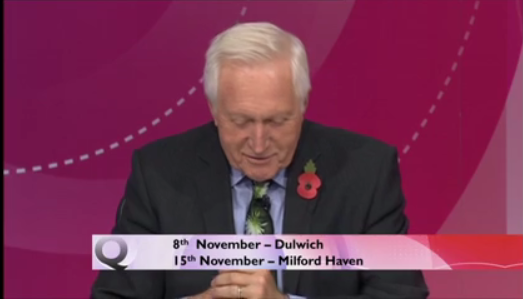
Yesterday During QT, whilst announcing the list of panelists for the next programme Dimbleby, with the usual dimbebyesque smirk described Jordan Peterson as the Professor of piffle. Of course he qualified it with standard BBC “some say”, but I have never in all the years I have watched QT heard a guest disrespected in such a blatant manner. I am by no means an uncritical supporter of Peterson. I agree with a lot of what he has to say, but certainly not all. I also find the cultish nature of his following a bit disturbing, but from the BBC this is beneath unprofessional. Who does Dimbleby think he is? He is not even a proper journalist.
And here are the very words of David Dimbleby: 
Next Thursday we're going to be in Dulwich in south London, and there we're going to be joined by a man who's been described as "the most influential public intellectual in the Western world" and equally as a "Professor of piffle" [small ripple of audience laughter] - the campaigner against political correctness, Jordan Peterson.
And here he is smirking during that 'small ripple of audience laughter':


On the subject of Prof. Peterson, here's a short Twitter exchange that might be of interest:
Damian Counsell: Jordan Peterson writes some daft things, but they're far less batshit than much written by non-scientific academics. Also unlike them, *millions* of people not only read what he has to say, but act on it. No wonder he infuriates them. Ditto why he infuriates journalists. Including some otherwise-sensible ones. One I admire declared Peterson a "maniac" on the strength of a video of the man expressing enthusiasm for his faddish meat-based diet. Won't somebody call the Perspective Police?
Kit Marsden: I honestly despise the expression 'giving [x] a platform'…
Damian Counsell: Yup. It just means "Get someone I disagree with off my telly!". If more TV interviewers did their bloody homework and spent more of their downtime with smart people who disagreed with their politics, then they'd fare better when interrogating populists.

A Question and Two Answers


You may have noticed that BBC radio is now called BBC Sounds. But why? Well...
Jenny Eclair: What is BBC Sounds please and how does it differ from BBC radio?
Hugh Bonneville: It’s a good question, Jenny, and we’re glad you’ve asked it. Part of our More of Less initiative, BBC Sounds is a condensation of BBC Radio and BBC Noise, which in 2020 will be repurposed as BBC Echo - a great big empty hall, probably in Kidderminster.
Liz Kershaw: So this is the thing Jenny. The thing is it's a rebrand to clarify the offer to the end user focusing on the product rather than the platform. 
I think Liz in particular must have been eavesdropping on James Purnell.

Something Cancelled


Over the past couple of years I've rather fallen out of love with BBC Radio 4. 

Before then I could usually find a few programmes each day, amongst all the tediously worthy stuff, to arouse my interest, but the tediously worthy stuff has spread like ash dieback and there's less and less I want to listen to.

At least there's still Something Understood on Sunday morning son Radio 4. 

I've blogged several times before about how much I enjoy this programme - a thoughtful mix of music, poetry, prose and occasional interviews on a given theme, often presented by Mark Tully. 

As long as Radio 4 has Something Understood then I'll stick with it.

Meanwhile, let's pour the milk on the cornflakes and see what's in the Daily Telegraph...

Oooh, there's a headline about the BBC here. What does it say? 'BBC scraps Radio 4 religious programme Something Understood due to budget cuts'....

A selfie (just taken)

Oh great! It will be replaced by repeats. 

Couldn't Radio have made better "tough choices" and stopped The Listening Project or pensioned off Woman's Hour or Saturday Live?

So what's left for me at BBC Radio 4? Well, In Our Time. But is that it?