Showing posts sorted by relevance for query Yahud. Sort by date Show all posts

Monday, 27 April 2015

One for Nigel Farage to keep note of...


This exchange at Biased-BBC needs sharing:

AsISeeIt
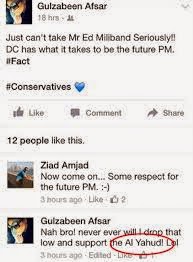
A Conservative local election candidate who said she could never support “the Jew” Ed Miliband has been suspended.
Nasty, nasty, xenophobic Tories!!!!!
Blimey, they’re getting as bad as the UKIP – I bet this was some typical stuffy old ex-colonel from the shires in a blazer…
‘Gulzabeen Afsar, a council candidate in Derby, made the comment on Facebook. In a post, she said: “Just can’t take Mr Ed Miliband seriously!” and later said “Never ever will I drop that low and support the Al Yahud!”. Al Yahud is Arabic for “the Jew”.’

Roland Deschain
Strange. I read about that story yesterday, yet it seems that only now has it made it to the BBC website. I say “seems” because had the link not been provided above, I’d still be blissfully unaware it was on the BBC as it isn’t given any link on the main news or indeed election pages.
Now had it been a UKIP candidate, we all know things would have been a lot different.

Here, to prove Roland Deschain's point, are screengrabs of the BBC News website homepage and the election page, taken (by me) a couple of hours or so after he made that comment:


As you can see (if you look closely enough), that story of Conservative councillor Gulzabeen Afsar making what sounds for all the world like an anti-Semitic remark doesn't feature on either of the BBC's main online news portals reporting the general election. You will only find it if you click on the 'England' sub-section of the General Election page. 

The BBC certainly seems to be downplaying this story, doesn't it? 

Why though? 

Is it because, as Nigel Farage says, the BBC (and others) tends to be much more interested in reporting such stories if they involve UKIP, and tends to gave the other parties a much easier ride (or ignore them)?

Or given that the BBC isn't usually particularly shy about reporting racism when it comes to the Tories either, could it be that highlighting a story about a Muslim councillor making an anti-Jewish crack might not be good (in the BBC's eyes) for 'community cohesion'? Could that be the reason why they aren't giving the story as much attention as you would normally expect them to do?

Given that stories about sausage rolls and 'breaking Godwin's Law' during an election hustings can make the main BBC online headlines, why isn't this story considered important enough to do so? Why is it being relegated to the online equivalent of the inside pages (somewhere around page 14!)?

Update: Snap! 

Thursday, 23 January 2020

75th anniversary of the liberation of Auschwitz


Holocaust Remembrance; 75th anniversary of the liberation of Auschwitz.
 The Russia v Poland debacleBackstage drama.
“Polish President Andrzej Duda is furious that he was not invited to speak at the gathering”
Everyone who is anyone will be there. Prince Charles* will be there to represent the UK.
Apparently, the Poles and the Russians portray each other as collaborators and appeasers and President Duda thinks Putin is being given carte blanche to virtue-signal, whereas he is not. Of course, there’s more to it than that.


“Andrzej Duda is staying away in protest at not being invited to speak unlike his Russian counterpart Vladimir Putin, who he has accused of distorting the history of the Holocaust and the war to attack Poland.”
and
“His decision has threatened to overshadow the event which will bristle with world leaders and bring parts of Jerusalem to a standstill.

*Kay Wilson (the British born Israeli who was attacked and left for dead by two Palestinians who attempted to murder her, and succeeded in murdering her friend Kristine Luken,) wrote to the British authorities requesting a meeting with Prince Charles “for a few minutes during his four-day visit”  -but they said they are ”not interested.”

The BBC traditionally covers Holocaust Commemorations, deriving whatever fitting amount of ‘misery memoir’ material out of the occasion they deem appropriate. (Wringing it out till the pips squeak.) 

As Israel thrives and flourishes, sympathy for Jews drains away and the media’s mawkish quest for pathos alights on Gaza and the Palestinians who, as is their wont, capitalise on this interest so cannily that the media over-shoots with sufficient chutzpah to equate “the plight of the Palestinians” to the Holocaust.

Just as one can’t mention antisemitism these days without Islamophobia and all forms of racism tagging along for the ride, the BBC can’t commemorate the Holocaust without someone trying to play down the enormity of the attempted extermination of the Jews by bringing up “Israel” and “the occupation” as a kind of mitigating factor.  


“The State of Israel is now a regional power. For decades it has occupied Palestinian territories. But some here will always see their nation through the prism of persecution and survival.”

Just for clarification, and for anyone less geeky than Craig and me, here’s an easy to remember wimmin-only digest of the BBC’s Middle East correspondents:

Orla Geurin is the Irish voice of doom who has form when it comes to Israel. 
Barbara Plett (or Plett-Usher) is the one who wept at Yasser Arafat’s dramatic air-lift from his compound. 
Not to be confused with
Lyse Doucet, who oversaw the conveniently mistranslated substitution of the word ‘Yahud” for “Israeli”  in her Children of Gaza film. "Everyone knows they (Palestinians) mean ‘Israeli’ when they say ‘Yahud’ (Jew)" she argues. The I/P conflict in a nutshell, really. Palestinian Arabs reject Israel. … is it ’cos they is Ya…hu?
(Lyse  doesn’t like being confused with Plett.) 
Yolande Knell is on maternity leave.
Update:
Stephen Pollard: The BBC Has shamed itself.


Monday, 10 August 2015

Actions speak louder than words

Ever since Plebgate, Golliwog-gate and Swarm-gate I’ve been ambivalent over exaggerated frenzies about the intent behind the meaning of a particular word. 

Even Jeremy Corbyn’s infamous use of the term ‘friends‘ for Hamas and Hezbollah seems far less important than his actions, namely befriending terrorist organisations with the explanation that you need to talk to the likes of Hamas and Hezbollah in order to secure ‘peace.‘ 

Stephen Sizer meets Nabil Kaouk, a top Hezbollah official and militant commander, in Lebanon

k
I wonder if this principle also applies to ISIS?  

Corbyn’s inability to acknowledge that as far as Islamic fundamentalism is concerned you can talk till you’re blue in the face, but the outcome is never going to be ‘peace’, at least not in the accepted definition of the term. 
I suppose we ought also to clarify what Corbyn actually means when he uses the term ‘peace’.  Submission, perhaps?

Talking of Jeremy Corbyn and  his friends, Stephen Sizer’s ban must be up by now. I wonder if he’ll make use of his newfound freedom to resume his anti-Israel campaigning, and if so, whether his friendship will help or hinder Corbyn’s leadership prospects. 

The BBC’s lack of interest in Corbyn’s habit of cosying up to undesirables is conspicuous by its absence. The nearest thing I’ve seen is Krishnan Gur-Murthy’s unsatisfactory ‘Friends’ themed Paxo-attack, and that wasn’t even on the BBC.
 
friends

The Daily Mail might be a bit too hyperbolic for most of us, but you have to admit that Stephen Sizer’s interview with Dr. Duncan McPherson, author and theologian, or as I like to think of him, ‘hissing Sid’, (viz: "SSimon of Cyrene carrying the cross of Jesusss") whose tremendous feat of turning-reality-on-its-head must be seen to be believed, is deeply creepy.  


The video was uploaded to YouTube in Jan 2015, just before Bishop Andrew Watson imposed his six-month banning order on Sizer’s anti-Zionist activities. Why it is entitled “Enlightenment - Escaping Auschwitz”  escapes me. 

Stephen Sizer’s gentle manner is like a really evil dentist - 'it won’t hurt'. But it bloody does.
 “Did you know that the Zionists are seeking to claim these historic sites - using the Arabic term “Haram al-Sharif” -  for themselves?” 
Stephen Sizer asks Duncan, smiling sweetly.
 “One of the reasons for having Yad Vashem on stolen Palestinian land rather than having it in Germany where it ought to be, or in Poland, is to bring before people’s minds a foundational myth for the State of Israel.” 
hisses Duncan unctuously as he delegitimises Israel with one fell swoop.

Oh you naughty Christians! Did you not know that Christians aren’t supposed to lie?   
The Anglican church should be ashamed of itself for allowing Sizer to represent them
 
"Enlightenment"


Talking of semantics, the BBC’s policy of translating ‘Yahud‘ into ‘Israeli’ reveals a kind of editorial meddling that we could do without. Their earnest explanation is that “When they say ‘Yahud’ they really mean ‘Israeli’ “. 

Actually, the BBC would like that to be the case, but of course it’s not strictly true. If they left it alone and translated it truthfully as ‘Jew’, which any fule kno is correct, people might think the Palestinians were racists, which, sadly they’re brought up to be, but that wouldn’t suit the BBC’s Bambification of the Palestinians.

Jeremy Corbyn might like to try talking the Palestinians out of their hatred of “Israelis”. That might work. Then he could go to Syria and have a go with the warring factions there, then, who knows, Iran and the Ayatollahs might be open to persuasion. Worth a try. He could go under the auspices of one of Sizer’s pilgrimages.

Wednesday, 15 May 2019

Lost in translation

Forgive me for going back to One Day in Gaza. I’m no Mastermind, but this topic covers both my specialist subjects.

1) The BBC’s bias against Israel,
2) The psychological manipulation of emotions through film.

This is also covered on David Collier’s blog, in the Jewish press and over on Harry’s Place, where Marc Goldberg focuses on the controversial translation of the (audio) “Yehud” to “Israeli”. 


This is not the first time the BBC has sanctioned this translation. In Lyse Doucet’s Children of Gaza’ film,:
“Israel is massacring us” says a boy, according to the subtitles, but what we heard the boy actually saying was “yahud”  -  ‘Jews,’ not Israel.
Lyse was persuaded that when the people of Gaza say “yahud” they really mean Israelis; the truth is being disingenuously massaged to make the message more acceptable.

What did I mean?

Lyse defended this practice because she says that when Palestinians use the term “Yehud” they effectively mean “Israelis”. 

Why is this even an issue?

Because it exposes the inherent Jew-hate behind the religion-based rejection of the Jewish state. It is, after all, enshrined in their holy book, and is the very thing that fuelled the original war against Israel, which according to the BBC “Broke Out” when Israel was established in 1948 The BBC is loath to confront even that, and even more loath to admit that Islam-rooted Jew-hate is the real obstacle to “peace” in the Middle East.

The three stages of the current topsy-turvy practice of Gaslighting. Definition: manipulate (someone) by psychological means into doubting their own sanity. Not sanity, exactly, but doubting their own decency and integrity.

The Israel /Palestinian version of Gaslighting goes something like this:

1) Islamic Arab world rejects the establishment of the Jewish state: immediately declares war of annihilation.
2) Jewish state defends itself; defeats Arabs.
3) Arab states employ massive Gaslighting; blame victim, persuade world that “Israel is to blame”.

That’s it. The mother of all Gaslighting.


Lyse Doucet was right. The waters have been well and truly muddied and the decidedly shaky claim that criticism of Israel - criticism of Israel’s policies - of its government etc., etc - is not antisemitic is thus cemented with just about enough shifty disingenuousness to set it off - hard and permanent.

I stand by my instinctive response to the psychological devices in the film, which I cited in my previous post. These are tell-tale signs of the BBC’s not so subtle anti-Jew approach. Their sentimental, quasi-romantic, emotional relationship with “the most hospitable people on earth” versus their Shylock, Fagin, Brian Sewell perception of the greedy Jew.

Epitomised by poignant portraits of traditionally dressed bereaved mothers, movingly, nay, heartrendingly filmed as they talk of their departed loved ones in the past tense, contrasted with the Israeli military spokesmen’s cold, dispassionate, hard-hearted rationalisation of the fog-of-war accident. 

The filmmaker’s tacit innuendo appeared to be that these shootings were carried out ‘accidentally on purpose’,  accentuated by the “straight to camera” filming  technique with its distancing effect and its between-the-lines message, roughly, that the Palestinian ‘David’ (armed only with ramshackle, homemade slingshots) was (and always is) hopelessly pitted against a heavily armed ‘Goliath’ that delights in taking indiscriminate pot-shots at random women and children.

Of course, this has resonance with the current issue that the BBC mentioned this morning.
“The definition from the all-party parliamentary group on British Muslims is: “Islamophobia is rooted in racism and is a type of racism that targets expressions of Muslimness or perceived Muslimness.”

It’s a typical example of the drive to apply (false) equivalence to antisemitism and Islamophobia. 

I very much doubt that the Labour Party’s antisemitism is connected in any way to their intimate knowledge of the Jewish religion. No, I’m afraid it’s simply “Jewishness” that offends them. In other words “It’s racism, stupid.” 

Islamophobia, to coin a phrase, is largely based on the fear of the ideology of Islam, and “Muslimness" is one signal that the practitioner, or the wearer of the Islamic uniform, adheres to those principles. 

“It’s the ideology, stupid."

Update:
For a detailed and substantive account of the film's bias, go the BBC Watch.

Here is a rather generous analysis of the film. The problem (as I see it) with Honest Reporting’s generosity is that the plus points he cites would resonate with open-minded audiences who happen to be viewing the film in an informed and objective environment.

But for the audience in Britain, hostile, ill-informed and already in no mood to empathise with Israel’s position, many viewers will have made their minds up already, and despite the film (at long last) acknowledging the violence, people believe it’s justified by “What Israel is doing to the Palestinians”.

As for the ‘gassing’, leaving the innuendo in the air, without any clarification was a grave misjudgement by the filmmakers. 

Friday, 10 July 2015

Put your feelings aside

We get caught up in semantics, such as 'what should we call Islamic State if we don’t want to look as if we’re legitimising the aspirations of a bunch of savages or allowing them to be perceived as representatives of Islam for fear of alienating The Muslims?'
One argument posits that there can be no confusion about what is meant by ‘Islamic State’, since that is what the movement calls itself. The suggested alternatives don’t resolve those issues because they retain the offending words ‘Islamic’ and ‘State’ save the one that is an acronym for 'Islamic State' in Arabic.
I couldn’t give a stuff. Call it whatevah. Call it ‘everyone hates us and we don’t care’ if you like.

Semantics which are of more interest concern the ‘Jew or Israeli’ contretemps, closely related to the ‘anti-Zionism’ or ‘antisemitism’  dispute. 
We all know that covert or ‘in denial’ antisemites try to launder the fundamentally antisemitic memes they spout by claiming their criticisms are dispassionately formulated, not at all racist and would equally apply to any other entity, government or culture.  
Concealing racism beneath a cloak of reason and logic can fool anyone, including the perpetrator who always sees him/herself as a good person.
With criticism of Israel in particular, intent is all, and people will lie about that, because they can. 
Criticism of anything, no matter what, should pass a basic test. Would it hold up if directed at an equivalent target? With Israel, we need to take into account where the critic is ‘coming from’ in order to distinguish whether a criticism is valid and perhaps well-intentioned or just antisemitic.


An episode of HardTalk might illustrate this. It’s with Stephen Sackur and William Schabas, the former head of UNRCC of Inquiry into events in Gaza in 2014. Schabas stepped down after pressure from many directions. Objections were on the grounds of his well-known bias against Israel. 
Near the beginning of the interview he claims that he is not biased, but even if he was, he is perfectly capable of putting his feelings aside and acting professionally, as journalists do all the time.  
“Journalists have opinions, Journalists have made public statements, some of them have been involved in politics, and they put them aside to do their job in an professional impartial and objective manner.”
His appearance, a kind of hang-dog chubbiness, did not lend credibility to what I believe is a somewhat far fetched assertion. 
For once I thought Stephen Sackur did a good job. He seemed well briefed.
With this business of the BBC’s decision to translate ‘Yahud’ to ‘Israeli’ rather than its literal meaning ‘Jew’, there is a clear attempt to airbrush away the racist element of Palestinian (Islamic) hatred and Arab rejectionist politics.

The child in Lyse Doucet’s film who said he wished all Israelis were dead does really mean Jews; he probably doesn’t wish the same for Israeli Arabs. The Islamic clerics and religious leaders are quite clear who they see as their enemy. Jews. Hamas may have learned to use the term Israeli when addressing their western friends in the media. They know which way their bread is buttered. 

But for the BBC to collude in that masquerade is truly objectionable, and the decision to adopt “Israeli” for “Yahud” as a suitable translation cannot be a morally justifiable interpretation of their editorial powers. 

Sunday, 10 December 2017

In other news


News this week that you may have missed if you were only paying attention to BBC News...

In London, outside the US embassy, a crowd of 'anti-Zionists' shouts "Khaybar Khaybar, ya yahud, Jaish Muhammad, sa yahud" ("Jews, remember Khaybar the army of Muhammad is returning"). 

In Malmö, Sweden a crowd of 'anti-Zionists' shouts "Vi har utlyst intifada frÃ¥n Malmö. Vi vill ha vÃ¥r frihet tillbaka, och vi ska skjuta judarna" ("We have announced the intifada from Malmö. We want our freedom back, and we will shoot the Jews.")

In the Netherlands a 29-year-old man waving a Palestinian flag smashes multiple windows of a Jewish restaurant in southern Amsterdam.

In Gothenburg, Sweden a gang of masked men firebombs a synagogue, forcing Jewish students to hide in the basement until the security forces arrive. 

The final story there is being carried by several of the UK's tabloids today (Mirror, Express, Mail). It's yet to make the BBC News website though. 

Thursday, 9 July 2015

Massaging the message

On the surface many viewers will have concluded that Lyse Doucet’s film “Children of the Gaza War” was even handed. Superficially she went some way towards ticking some of those 'for balance' boxes. The footage of Israeli children looking worried will have been enough to convince determinedly anti-Israel viewers that the film was ‘pro-Israel’. But of course, the people she’s  actually treating as the ‘children of the Gaza war’ are us. We are being led like lambs, and what good will that do?

Earlier yesterday evening I watched the tail end of Jon Snow’s latest Back to Gaza film on Channel Four News, and in comparison Lyse Doucet’s effort seemed almost fair. But I say that in the spirit of trying to relieve a toothache by hitting oneself on the head with a hammer.
Jon Snow’s piece was unadulterated rubble rousing. There was no attempt to be anything other than inflammatory, and I think it included a few seriously libellous misrepresentations as well.

Lyse’s message, on the other hand was much more subtle. She went through the motions of appearing balanced by juxtaposing traumatised 10 and 12 year olds from Gaza and from Sderot in Israel. 


“She said she was determined to tell the story from the perspective of children.” it says in a press release. Therein lies a problem.
Steering clear of the politics, which are the driving force behind this never-ending war might have seemed like a noble idea conceived in good faith, but omitting to explain that Israel’s attacks were retaliatory and implemented only after many months of unprovoked aggression and increased tunnelling activity by Hamas was bound to give the impression that the conflict was an inexplicable tit for tat “I hate you and you hate me” affair. 

Obviously the physical damage inflicted by the tat was much more visible than the fallout from the tit. The devastation in human loss of life and buildings in Gaza was vast and shocking; pitted next to a couple of holes in a roof and a pock-marked wall in a leafy suburb with neither context nor comment was a statement in itself, not an honest representation of the reality. No bigger picture. It played into the hands of the Israel-hating mob who will always rely on the ‘disproportionate‘ argument. This Lyse and her editors must have realised. The audience was tricked out of understanding that the entire conflict comes from the same religious hatred that motivates violence throughout the whole world. 

The fact that the children she featured were quite different, and differently affected, would also have reinforced some of the stereotypically negative  misconceptions about Israelis. The Israeli children were comparatively cool, calm and collected. The wise little girl with the American accent and her resigned, philosophical attitude contrasted harshly with the unhappy, deeply traumatised Gazan boys and girls who had seen death, lost siblings and parents. 
Taken at face value, the inequality of the apparent suffering by either side was Lyse’s statement. Her motherly pat on the shoulder of a distressed young Gazan boy was understandable. Anyone would have done the same; but was it a good thing to keep it on the film? Or a subtle example of passive aggressive emoting

 Apart from a brief sequence showing a rush to a safe room in the Sderot house, there was little attempt to convey the constant fear of living with a14 second warning no matter what time of day or night, or the horrifying knowledge that gunmen might come up out of the ground to kill you.  
The suburban surroundings, the swings and outdoor play furniture, the lawns were another way of emphasising the stark contrast between Israel and the concrete wreckage of Shuja'iyya in Gaza and the beach strewn with debris. Without context, which group was going to elicit the audience’s sympathy?


” We didn’t know the beach was dangerous” said the boy whose brother and cousins were killed. Anyone familiar with the story of the ‘boys on the beach‘ will know that there is controversy surrounding the incident. 
Lyse kept uttering “Israel says’, which gives the Israeli side of the story and casts doubt upon it at the same time.
We were actually shown footage of Hamas fighters, whose absence from most of the contemporaneous on-the-spot war reportage was conspicuous. A military training camp for teenagers and children was also shown, and we were given a glimpse of the resilience of Hamas and the resistance, and the never-ending supply of hate-filled brainwashed young boys and men queueing up to be martyrs and desperate to avenge the death of their compatriots.  

Another problem, mentioned  in the Jewish Chronicle was the manipulation in the translation. 

“Israel is massacring us” says a boy, according to the subtitles, but what we heard the boy actually saying was “yahud”  -  ‘Jews,’ not Israel. 
Lyse was persuaded that when the people of Gaza say “yahud” they really mean Israelis; the truth being disingenuously massaged to make the message more acceptable.

Which is exactly what this film did. 

Tuesday, 21 July 2015

Panorama. The Train that Divides Jerusalem

Does anyone still  make a point of tuning in to Panorama as we used to in the past? I don’t think so. Last night, for want of anything better to do I switched on the telly just in time to catch someone, in their most doleful Will Self accent, regretfully decrying their sadness that  their grandparents’ dream of a utopian Israel was now kaput. 

As the closing credits rolled up the screen, with heavy heart I turned to iPlayer to see what I’d just missed. While I waited for it to be uploaded (or whatever was causing the delay) I turned to Twitter, as one does these days, to check out the craic.

Adam Wishart “I am a proud Jew” was magnanimously engaging with his critics. Seriously, he appeared genuinely willing to listen to their criticisms. Listen, but not hear, if you know what I mean.

The criticisms fell into several camps  - if that’s not too emotive a word. There were, of course one or two of the usual Israel-hating trolls who can’t bear to come across anything marginally less antisemitic than Electronic Intifada, but the messages that had substance cited some specific examples of Wishart’s ‘default BBC’ agenda.

One particular issue that kept cropping up was the portrayal of Mohammed Abu Khedir, the Palestinian youth who was brutally murdered by Israelis. The Palestinian Khedir family was portrayed sympathetically and at length, whereas there was but a fleeting reference to the three Israeli boys who were kidnapped and murdered, and seemingly no attempt to include their distressed families in the film, or to emphasise that the latter atrocity took place before the former. 

Other issues came up too. Selective use of Israeli voices - all those featured expressed stereotypical right-wing views of the kind that fuel a specific type of Israel-bashing that’s rife these days.
Lack of context, insufficient emphasis on the security reasons for the barrier - a mistranslation of ‘Yahud’ to ‘soldier’ - misleading allusions to a racist element that allegedly surrounds the the train’s existence.

Anyhow, by this time the iPlayer was fully functioning so with girded loins and gritted teeth I pressed play. 


The first thing I saw, (I would, wouldn’t I?) was Adam polishing his as-a-Jew credentials. That’s a bad sign. 
Actually, it wasn’t the very first thing. What struck me in the first instant was the way the narrator’s voice stretched the vowels. “and the train itself has become a ta-a-a-rget for vi-i-i-i-lence”  
“I’m Adam Wishart, a British Jew” he announced, just in case we thought the voice we were hearing belonged to Will Self. “And I’m going to ri-i-i-ide Jerusalem’s new train to the heart of a city which feels more divi-i-i-ded than ever.”

Accompanying - or immediately after - the Mayor’s assurance that the light railway was ‘open to all,’ there was a brief shot of passengers disembarking, and nary an Arab to be seen.

It’s the kind of thing that’s done in the editing suite; done to convey a quasi-subliminal message, while the filmmakers indignantly protest the opposite with their Sally Bercow-style innocent faces. 

The Temple Mount issue was clumsily handled. It was over-simplified to the extent that it was made to appear to be yet another dastardly Jewish plot to trample all over Arab holy places. 
When Yahuda Glick was shot I looked into the situation a little bit, and I’d say that Adam’s portrayal of the situation was very unfair. Obviously “it’s complicated”. 

“Rivka Shimon is part of the new Temple movement” droned ‘Will’. That is why we’ve decided to feature her in this unbiased documentary. Look at all those Jews stampeding into Arab holy places as if they hadn’t a care in the world! 

Rivka says they’ve a ‘right’ to be here!

At least Rivka has a sense of humour. She looked suitably amused at the ludicrous appearance of a heavily veiled Arab ‘Muslima’ violently using a plastic garden chair as a drum in protest at the impudent Jewish invasion.   “What are they like? her half smile quite rightly implied. 


“Within minutes of Rivka’s group arriving” narrated Mr. ‘Self’, "there are protests'. There certainly are. Great burly veiled figures in long black burkas (men, surely?) striding along shreiking “AllahuAckbar” and banging chairs on the ground.

“They do pray, in silence, which they shouldn’t be doin’ in there” asserts a devout Muslim woman indignantly. “Gosh. How awful” I’m thinkin’,  Islamophobically.

One of the problems with Rivka, apart from the fact that she probably represents a minority, albeit a vocal minority, of religious Israeli activists, is that her use of the English language lacks nuance. When she says: 
”And when we are sure what we are doing is right, no-one can be against us, and God will ‘elp us, and it will come, and it will be good for the Muslim world not to be against us - because if they will be against us - they will suffer” 
it sounds a bit sinister, but it is open to interpretation in so many ways. It could sound like a threat. It could indicate exactly the opposite, but because of her lack of vocabulary and her demeanour, it had an unfortunate effect. Just what doctor BBC ordered. 

‘’...........then in 1967 Israel occupied the eastern areas” Adam was suddenly saying, as if that had happened by supernatural means. Well, Rivka did say Israel winning that war was a miracle.
“Every day the train passes, they are butchering me” worded the subtitles, to the spoken Arabic from an aggrieved Palestinian man. “every day they are killing me” repeated Adam “this is what the train means to us” he continued.
Waled Abu Khedir is showing me what used to be his land until it was taken to build this train station”
Where have I heard that name before - hmm. 
“He refused compensation because the seizure of land fits into a wider picture”. Hmm. A good reason to refuse compensation? Or not.
  
Arieh King is an evil Jewish property developer, buying up Palestinian land for Jews. He’ll go down well in my documentary, thinks Adam. Arieh King is a one-man, Arab-hating Israeli expansionist explosion. 
The Palestinian refugee camp is grim. It’s a slum. “In my teenage Zionist education course” intones Adam “They didn’t introduce us to any Palestinians”. Oh dear. That’s Jewish brainwashing for you.

“Israel says the barrier that surrounds this part of the city was built to protect Israelis from attack” he says. “But it seems to me that it serves another purpose as well. To cordon off the squalor and deprivation.”

Nir Barkat, Mayor of Jerusalem has a lot to answer for. Adam confronts him: “In the Shuafat refugee camp, it’s part of the municipality, there’s rubbish all over the street, sporadic water.”

Barkat attempts to make a profound point.:
“There are no Jewish refugees. Not one. We take them home and help them. It’s very unfortunate that there are Arab refugees. That with all the wealth of the Arab world, they haven’t found the time and the capital to help the refugees out.”
The point is lost on Adam as well as the film’s editors, who have superimposed footage of the aforementioned deprivation over the Mayor’s voice. 
“They may be refugees” says Adam, “but they’re residents of Jerusalem, aren’t they?” 
He puts that to the Mayor. 
“I agree, and I do everything I can, however its a problem that the municipality cannot solve on its own”
Adam voices the rest of the interview with Nir Barkat on the his behalf:
 “The municipality spends a lot, but would like to provide more services, he says, but its staff are subjected to physical and verbal abuse.” 
he recounts, adding:
” I can’t help feeling that the state of this place and the lawlessness  and the barrier make this part of Jerusalem a tinderbox waiting to ignite.”
Back to the tubby Palestinian man who says:
 “it’s difficult to be a child born into an environment of occupation and racism. Nobody’s born a violent person, but the segregation and disparities lead to war and violence.” 
He spoke in Arabic, so this was a translation. There are so many holes in that statement that I feel would have been countered if Adam had been treating both sides equally. He might have started “I can’t help feeling...” and continued to point out that the racism is far more prevalent on the Arab side, that children are born into a culture of antisemitism and anti-Zionism, and that these are the prime factors that ‘lead to’ occupation, segregation, disparities and violence. 
But Adam didn’t say that, or probably even think that.

Then the little boy whose words were mistranslated. Yahud to ‘soldiers’. “God bless them” he said of the stone-throwers.
“Most of the firing was from fireworks” says Adam “The ammunition of the powerless.” 

A brief shot - ‘that shot’ - of a Palestinian car driving along the platform, ploughing into waiting passengers. 
“Palestinians have targeted the rail line, driving ca-a-a-ars into waiting passengers, killing three adults and a baby” 
narrated Adam. A statement that took as long to state as it took to read that sentence. 
This was the content that Adam was Tweeting in answer to Tweeted accusations that he didn’t focus on Palestinian-on-Israeli violence. Three nameless adults and a nameless baby.  
Immediately the subject is changed:
“16 year old Mohammed Abu Khedir was also waiting by the train line a year ago when he was kidnapped by a group of Israelis” 
A close up photo of a pensive looking Mohammad filled the screen. 


“As tension grew in the run-up to last summer’s Ga-a-aza war” continued Adam, sounding particularly Selfish “three Israeli teenagers had also been abducted and murdered.” That’s all. Nameless boys, abducted and murdered by persons unnamed.

 “Hussain is Mohammed’s father.”

 “They tied him to a tree, they poured petrol on him and burned him alive.” says Hussain. Hmm. Is that exactly what happened? I’m not so sure, but in any case it was bad enough without embellishing it. Embellishing it makes it worse in its own special way. “it was the ugliest crime in history” he said then. 
Mohammed’s tearful mother is shown. “Even now I think he will be back” that close-up again, and footage of an open coffin being carried aloft, paraded in the street, by a crowd of men. Was that Mohammed? 
The Palestinians destroyed the station. “This was a racist train to keep Jerusalem for the Jews only” attests Hussain.

Cut to ‘the other side of the story’. A terrorist attack on a synagogue. A brutal knife attack on Chaim Rothman, who has been in a coma ever since. His American-sounding wife reads a prayer to his comatose form. As she is filmed on the train home, a fleeting image of what looked like Hussain Khedir standing in front of his son’s headstone flashed onto the screen. Sad music. Lest we forget.

Cut to some joyful Israelis celebrating Jerusalem day. A protest. Violence.
“When I was here 30 years ago even my most fervent Zionist friends weren’t rushing to build a temple on this site” 
says Adam. 
“now this idea is gathering support from within the mainstream. Even a new member of the cabinet supports the idea. I can’t help but think, if some Jews push much further, this would surely be the last stand for the Palestinians.”

Too many “I can’t help but thinks” in this film, is what I can’t help but think. 
“I’m left wondering, what is the purpose of the train. Does its destination hold a clue?” said Adam.

And I’m left wondering, what is the purpose of this film? Does its destination (the BBC ) hold a clue? Says me.
Adam continues:
“It travels north, through the Palestinian neighbourhoods and snakes round the refugee camp. What’s so controversial is that the ultimate destination is an Israeli settlement. 1000 acres, taken by Israel to build a beautiful suburb. Like all settlements in the occupied territories most of the international community considers them to be illegal.” 

The mayor of Jerusalem again.
“In all those places there was never a Palestinian state”, he says. 
“put a shovel in the ground, and you’ll find Jewish roots; so when people talk about occupied land - occupied from whom? It’s all Jewish!”

Back to Adam. 
“This train makes permanent the expansion of Israel. This settlement is like a fortress, perhaps not surprising when so many Israelis feel a constant threat from their Arab neighbours and it’s Rivka Shimon’s home.” 
says Adam. Rivka likes the view. 

“What’s surprising” says Adam “is that you can see the deprivation including the Shuafat refugee camp the other side of the barrier.” 
"Have you ever been over there?” he asks Rivka, meaningfully. “No, of course not” she answers “even the police don’t go there”

“The Israelis and the Palestinians should be neighbours but they’re separated by an ever-widening gulf of distrust.” 
states Adam.
Back to the tubby Palestinian man:
“There will never be peace between us and the Israelis, the Jews of the municipality. How could they be human, they live opposite us and can see with their own eyes the conditions of the camp. It is in no way humane or normal.”

Back to the beginning. I think this is where I came in. Adam alone on a deserted train. “My journey has been heartbreaking” says Will Self.
“When my grandparents campaigned for the state of Israel they hoped for a place of refuge, tolerance and equal rights for all.”

(Obviously they didn’t take into account the religion of Islam and its antisemitism, intolerance, inequality and the Arab world’s determination to make permanent refugees out of the Palestinian Arabs they encouraged to move out of the way whilst they made their failed attempt to destroy the newly formed Jewish state)

“I can’t believe that this could be the place that they dreamed of, all those years ago” he finishes.
Little did they know that their grandson would be working for Panorama, making a selectively edited documentary in the years to come.

Incidentally, I can’t help but wonder what has happened to all the footage that was rejected? The footage that remains on today’s equivalent of the cutting room floor? Were the only Jews that Adam encountered ruthless, entitled, ‘chosen’ and religious?  Were the only Palestinians he spoke to sad, bereft of land, full of hopelessness, despair and anger and decidedly economical with the actualité?  

I don’t think Twitter is the ideal way of communicating on complex matters like this, but someone did raise another question. Is this the time to put out another documentary that’s bound to inflame yet more antisemitic sentiment than is already rife in the hostile, anti-Israel atmosphere that exists in present day Britain?  

Update: More here
Saturday, 27 June 2020

The Annexation Trigger

After being treated to decades of spiteful, passive-aggressive anti-Israel spin from Middle East editor Bowen and his subordinates, anyone with a smattering of political and historical knowledge of ‘Middle East affairs’ could rattle off a pretty good case against the BBC.

Last night Yolande Knell treated us to a mawkish, innuendo-laden report on the BBC World Service impliedly blaming Israel for interruptions to Palestinian children’s cancer treatments during the coronavirus crisis - although most obstacles seemed to stem from the P.A.’s latest strategy of refusing to ‘cooperate’ with Israel in answer to the proposed annexation of parts of the West Bank. I wasn’t certain what message she was trying to send to be honest, but I predict a whole lot more mileage will be extracted from that situation ‘going forward’.  

Although criticism of Israel-related reporting is but one factor in a bias-related bigger picture, many bias-watchers regard the BBC’s left-wing/anti-Conservative bias as their chief bugbear and therefore their main target, but in a way, the BBC’s anti-Zionist bias is the ‘low-hanging fruit’ of bias. 

Regrettably, the BBC’s Palestinian-advocacy reporting style has a wide reach. Compare the BBC’s uncritical regurgitation of the Palestinian narrative with the overtly hostile, ‘arms-length’ or even non-existent representation of the Israeli perspective that is routinely dished up by the BBC’s Middle East correspondents. Bog-standard, superficial and shallow reporting, served with ‘half-a-story’ contemporary and historical analysis.

Given that both Britain and Israel are democracies, this attitudinal imbalance is hard to explain. If ‘Palestinianism’ is rooted in (Islamic) religion-based antisemitism, surely a largely secular - or at least a not very religiously observant country like post 60s Britain would see Israel as a natural ally, while instinctively filing overtly racist,’Yahud-hating Palestinians’ as ’other’.  

As non-racist Brits, shouldn’t we at least find the Palestinians’ intractable refusal to accept Israel’s existence a little problematic? Since the opposite seems to be the case, the obvious conclusion must be that this demonisation of the Jewish state stems from the ‘oldest hatred’.

However, the word ‘Annexation’ has triggered a new wave of anti-Israel angst. 

Mark Regev has been Israel’s UK Ambassador for over four years. Here’s a link to his ‘goodbye interview’ It seems like only yesterday that he was merely Israel’s ‘spokesperson’ and his very appearances on the BBC would send the haters into paroxysms of fury.


Palestinians: Is It Really about 'Annexation'? Khaled Abu Toameh offers another perspective on Trump’s plan for peace. He says that the Palestinians’ opposition to annexation encompasses twin objections; the religious one and the political one. According to Islamic clerics and scholars, Israel has no right to exist anywhere in the region, so with that in mind, any legality (or otherwise) appertaining to ‘annexation’ is but a trivial detail, therefore irrelevant to the ultimate objective - eliminating Israel altogether. 

Mahmoud Abbas, whom the BBC persists in regarding as a ‘potential partner for peace’ claims that annexation would destroy any chance of a ‘two-state’ solution, ending all hopes of peace with Israel. According to officials, the plan would irreversibly deprive the Palestinians of their right to establish an independent and sovereign state on the (unsustainable) pre-1967 armistice lines. 

The BBC, being determined to see such disingenuous role-play as ‘the voice of reason’ takes Abbas’s words at face value. But the P.A. is actually with the clerics. Neither strand really wants ‘a state’, or is capable of forming one. Their idea of peace is simply ‘no Israel’. 


True to form, the BBC’s Tom Bateman puts the customary BBC spin on the matter. I don’t know if that was Bateman’s own headline, but whoever penned it is clearly hostile to Israel and sympathises with the Palestinians. Israel annexation: New border plans leave Palestinians in despair

Getting to grips with the complexity of Netanyahu / Trump proposals or analysing the long-term potential is of little interest to Tom Bateman whose job is to promote the BBC’s agenda, which disregards the welfare of the Palestinians. Stuck with their appalling leadership, encouraged to kill Jews by Abbas’s outrageous ‘pay for slay’ policy, and ensuring that the existing stalemate is prolonged indefinitely.

At the present time, while old allegiances in the region are shifting, the BBC’s current anti-Israel animus has been triggered bigly by the word “annexation’. An emotive concept indeed, but what does it mean? That terrible word alone evokes expansionism; land-grab; occupation. But this isn’t the idea at all. 

I don’t claim to be an expert on the legality or otherwise of Trump’s plan for peace, but one thing I have gathered from my research so far is that the idea of ‘annexing’ parts of the West Bank appears considerably less ominous than Israel’s detractors would have us believe.

Here is another piece explaining Trump’s “Deal of the Century”   Israel has the right to annex parts of Judea and Samaria   by Eli Vered Hazan:
“So before explaining what annexation is and why it is imperative, it is important to emphasize a few things: France and the United Kingdom are vocal opponents of the agreement. The United Kingdom, which controls 17 territories, spread over thousands of miles across the globe, is criticising a territorial process in which there is a deep connection between a country and its citizens. France maintains control over 13 colonies thousands of miles away and even uses some of them for nuclear experiments, yet opposes our connection to our historical homeland. Not only that, Turkey illegally invaded and took over Northern Cyprus but threatens Israel over the mere potential of Israeli sovereignty. All of them claim that for Israel “it is not the same”. In fact, they are right – it is not the same.
and from Melanie Phillips
“Under international law, annexation has a precise meaning: the forcible incorporation by one state of the territory of another state. This does not apply to the disputed territories, which never belonged in law to any other state. 
Israel has the only legally grounded claim to this land, including the never-abrogated duty given to the British in the 1920s to settle the Jews throughout what is now Israel, the disputed territories and the Gaza Strip. 
Far from being an illegal annexation, extending Israeli law to these areas actually implements international law after some nine decades during which it was flouted and then ignored by Britain and the world community. It is those who oppose the sovereignty proposal who show contempt for the law.”
If it’s too easy to tar her with the “She would say that” brush, legal expert Eugene Kontorovich, lays out the situation fully in this article: Don’t Buy the ‘Annexation’ Hype (WSJ is behind a paywall, but I will post it in full over the fold.)

I didn’t want to display my ignorance by spouting nonsense about something I know very little about, so I did try to digest as much of the document as I could, and I dutifully watched the interesting (to me) video below. In the end, it seems that the specifics of the annexation plan is still a work in progress.  Also, at the end of the day, the legality is never the main and ultimate clincher when it comes to Middle East policy. Emotion is the real game-changer; hearts and minds and so on.

Even if the annexation ploy turns out to be just one strategic move in a long-term game, and the objective is a genuine, just and lasting peace, the BBC is never going to give us a fully-rounded picture because it is ideologically and ‘institutionally’ opposed to it and not entirely convinced of Israel's right to exist.


Legal situation fully explained overleaf.

Monday, 17 August 2015

Slinging mud

“You know what their goal is. They can bring Israel to the point where white South Africa was 25 years ago. Y’know, the subject of a boycott, which gathers momentum and which isolates. Do you think they could succeed?”


Does Kevin Connolly believe that life for Israeli Arabs in Israel is presently the same as for blacks in ‘white South Africa’ of 25 years ago, and does he imagine, if BDS were to “succeed” it would bring about some kind of justice? Perhaps he thinks Palestinians who live under Hamas and the PA should have voting rights in Israel, or that Israelis should be governed by Hamas or the PA?  We need clarification.

Most South Africans I’ve heard find this comparison not only offensive, but insultingly dismissive of the degree of the malignancy in a genuine apartheid system. 

Giving a platform to BDS chief Michael Deas, perhaps in the name of ‘balance’, if that’s why this was aired, gives credence to a false moral equivalence. Deas seems quite stupid as well as, dare I say this -  racist.  On the BBC website it says:
The international pro-Palestinian Boycott, Divestment and Sanction (BDS) movement has been using the same techniques as anti-apartheid campaigners who worked to bring down white minority rule in South Africa.”  
Does Deas mean he wants to “bring down” the current  Israeli government, or bring down any Israeli government, preferring to install the PA or Hamas, or the Middle East’s equivalent of the ANC,  as the new, improved government in the region?

In other words, does the BDS movement want to turn Israel into another Islamic state because they find the concept of a Jewish state in the region “racist”? 
The irony of calling Israel racist is so outrageous that I can’t believe anyone takes BDS seriously. But they do!

Here’s the latest manifestation of BDS. It entails not just boycotting anything produced in settlements, nor merely boycotting anything produced in Israel proper, but vetoing performances by Jews - unless they sign an anti-Israel disclaimer. 
You might have heard about this before. Douglas Murray points out why BDS is a racist concept, if anyone didn’t already realise it. 
Spanish pro BDSers required a Jewish performer to sign an anti-Israel style declaration before performing at their a music festival. He wouldn’t so he couldn’t.
   
“For Matisyahu is not an Israeli -- he is an American. Yet after the intervention of the BDS protestors, the festival's director tried what he presumably thought was a perfectly reasonable request: Filippo Giunta asked Matisyahu to produce a "signed statement or video" stating "in a very clear way" that he supported the creation of a Palestinian state. This was made a precondition of performing. "If you sign these conditions, you can continue the performance," the festival's director told the artist.”
“... perhaps we could also initiate some other geostrategic questions that might be demanded of all other performers in the future” 
says Douglas Murray.
“...Maybe the rest of the world should demand that all musicians from Spain sign a statement or make a video supporting Catalan independence if they are to be allowed to perform in public?
“....To my knowledge Turkish artists are nowhere in the world asked to condemn their country's illegal occupation of Northern Cyprus
“...........to demand such an action or statement from an artist as a prerequisite to perform would be not just outrageous, it would be regarded as surreal. Why then is the BDS campaign able to normalize such a demand, and for a festival to cancel a performance based on non-compliance with such grotesque demands?The answer is the fever of our time. For a while, only Israeli Jews were made pariahs among the nations because of an unresolved border dispute involving their country. Now it is Jews born anywhere else in the world who can be targeted in the same way. They are singling out Jews -- Jews and only Jews. And their singling out of Jews, wherever they are from, makes their racist motivation abundantly clear. If the Rototom Sunsplash festival wants to take part in this racist BDS fever then it is them -- and not Jews -- whom the world must make into global pariahs.

Michael Deas does not recognise the hatred for the Jew (‘Yahud’ ) within Palestinian society; he isn’t even aware that such a thing exists.   
He only wants the right of return to Israel for seven million Palestinians, the descendants of the Arabs who were ‘ethnically cleansed’ in 1948 (and he demands they ‘tear down that wall’) It’s another of those faux reasonable “innocent face” pleas for justice.

Yasmin Alibhai Brown, one of the BBC’s speed-dial talking heads, is now defending Jeremy Corbyn with precisely the same faux reasonableness. There’s such a lot of projection going on in her painstakingly manipulative logic. She  is supposed to be evidencing a lack of racism in Corbyn and his associates, seemingly unaware that she’s using racist arguments and emotive turns of phrase in the attempt. 
Surprisingly, for the Independent at least, the below the line commenters have seen through her argument.
Here are a couple of the responses: 
"the forces of darkness", well that is some fine unemotional fact based journalism for you.
I wonder if she would be as keen to defend the man if he associated with, financed and called friends people who denied Idi Amin did anything untoward, and drew cartoons depicting Uganda's Indian population as bloodsucking, money grabbing exploiters of real Ugandans?  Doubt it somehow, but as usual she has special rules to apply when it comes to some people.
and another:
Mr. Corbyn calls Hamas and Hezbollah his friends and demonizes Israel. He ignores hate speech against Jews and actively supports those who spout it. And I've not heard a word from him against any other nation in the middle east... just the Jewish one.
Why is it the only thing this 'decent human being', this non-anti-Semite, cares about is Israel?
It is not the duty of every decent human being to 'criticise Israel' particularly when your criticism is solely intended to demonize the Jewish state and not make life better for the Palestinians (Otherwise you'd be 'criticising the PA and Hamas too) and once you do that Israeli injustices fade in to the background.”

Here’s an excerpt from Yasmin’s article, which goes under the nifty title :
“Fling mud if you must, but don’t call Jeremy Corbyn an anti-Semite”


So here is the new claim being put about assertively: those who want to destroy Jewry hide behind the Palestinian cause. They are right, up to a point. Veiled anti-Semitism is around us, and most of all on university campuses, where Palestine is a burning issue and convenient alibi. Attacks on Jewish Europeans are also rising.Just as pernicious is the way Zionists use the charge of anti-Semitism to block probes into Israel’s oppressive practices, its weaponry, and its influence in Western parliaments. Some public intellectuals and politicians – who should have some understanding of nuance – have become propagandists for Israel, be the country’s actions right or wrong. They use images of Nazism and excruciating memories to whip up fears of a new horror, an impending extermination of the plucky nation by its cruel colonial neighbours. I myself have been subjected to such intimidation and branded an anti-Semite over the years. More such muck will be thrown at me when this column appears.
*******
“I myself have been subjected to such intimidation and branded an anti-Semite over the years.”
Oh noes!

Pass the muck Ariadne, quite a lot of throwing is called for.