Showing posts with label Mark Easton. Show all posts

Saturday, 20 August 2022

Mark Easton gets it wrong again


And talking about the BBC getting its facts wrong...

As Arthur T notes on the open thread, blog favourite and arch-BBC narrative setter Mark Easton has been rebuked again by the corporation's Editorial Complaints Unit.


BBC News (6.00pm), BBC One, 12 April 2022
18 August 2022

Complaint

In a report on the Prime Minister receiving a fine for breaching lockdown restrictions the BBC’s Home Editor said:

Now each one of those Fixed Penalty Notices requires the police to believe that a criminal offence has been committed. Now it doesn’t go on anybody’s criminal record but it will go on the Police National Computer.

A viewer complained that this was incorrect, as breaches of lockdown restrictions incurring a fixed penalty notice were non-recordable crimes. The ECU considered the complaint in the light of the BBC’s editorial standards of accuracy.

Outcome

The Home Editor acknowledged that he was mistaken in saying the offence would be recorded on the Police National Computer. As the error could have misled viewers as to the seriousness of the offence, the ECU accepted that it was a breach of the relevant editorial standards.
Upheld

Further action

The finding was reported to the Board of BBC News and discussed with the programme-makers concerned.


As ever, beyond being published on a part of the BBC website very few people read [and being picked up by the odd newspaper], what is the BBC doing to make this known to BBC viewers who might have been misled? A prominent apology/correction on BBC One's News at Six?

I've scanned TVEyes to see if any apology/correction has been broadcast on BBC One since this ruling was published two days ago. You won't be surprise that it brings up no results.

Note also that it took four months and an escalation to the ECU to even get this. The BBC's complaints process isn't fit for purpose.

You really do have to watch them like a hawk.

Monday, 4 July 2022

#mediaforgood


The BBC's home affairs editor Mark Easton took to Twitter earlier to announce:

Thursday, 23 June 2022

“This week...Has Brexit done long-term damage to Britain?”


Six years ago today 17,410,742 million people [52%] voted to leave the European Union, 1.27 million more than the 16,141,241 [48%] who voted Remain. To mark that anniversary, here's John Simpson interviewing Mark Easton this week on his BBC Two series Unspun World:
John SimpsonWelcome to Broadcasting House, part of the BBC's iconic headquarters here in central London for Unspun World, the programme where the BBC's experts around the globe give in-depth answers to the big questions of the day. This week...Has Brexit done long-term damage to Britain?
Mark Easton: There's a sense in which we've not really been able to have sort of normal times to get stuff done. It's warped our politics and made it very difficult for our political leaders.

John Simpson: It's six years since, in a result that surprised most people, the United Kingdom voted by a very narrow margin to leave the European Union. The campaign was marked by some hugely controversial claims, which have resonated ever since - the hundreds of millions we'd be able to pump into the NHS among them. It's still too early to work out the exact pluses and minuses of Brexit, but the lines are becoming clearer. I asked Mark Easton, the BBC's home editor, for his views. Has Brexit been a boon or a disaster? 
Mark Easton: It is a sort of fundamental difference of view which actually goes to people's heart, actually. Almost a sort of visceral feeling, I think. People feel very, very strongly about it - on both sides of the argument. And that, I think, has been quite troubling. There's a sense in which we've not really been able to have sort of normal times to get stuff done. So I think that's been another problem with the whole Brexit debate. It's warped our politics and made it very difficult for our political leaders to really sort of plough a furrow as they want to do. For many communities where we saw very significant Brexit votes, it was about connection to power. It was a sense that they'd been ignored. Many communities that I went to, they felt that change was happening to their communities - demographic change, free movement within the EU. Immigration generally meant that the communities they lived in were changing, the shops were changing. 
John Simpson: Also hearing people talking Polish or Romanian and so on in the streets. 
Mark Easton: Exactly. In particular, people, people would say that the thought of hearing a foreign language on the bus was disconcerting to them. It was different. It wasn't what they expected, and no-one had asked them about it. I think it would be fair to say that very few of those communities feel that they are any closer to power today than they were six years ago. 
John Simpson: So it hasn't achieved that? 
Mark Easton: Not yet, no. I mean, I guess the Government would argue that, you know, their whole levelling up agenda is partly about that - it's trying to reconnect communities that felt separate. I think that is definitely, you know, job not yet done, but really, really important, whether you whether you voted Leave or Remain, actually, that Britain does better in making sure that, you know, thousands of communities up and down this land don't feel - as they currently do - that they are exempted from the decisions that actually affect their daily lives. 
John Simpson: Have there been any successes for Brexit? 
Mark Easton: Undoubtedly free movement and the end of that. I think you can say, well, yeah, that's something - those people who wanted that to stop, it's happened. That was a promise made and a promise kept. They were also told that we would move to a points-based immigration system, to ensure that we only get the migrants that we want and we need. And, yes, we do have...
John Simpson: Is that happening? 
Mark Easton: That has happened. 
John Simpson: And is it working? 
Mark Easton: Well, I think it's difficult because we do have shortages of labour in quite a number of areas, as we transition from what people would have said was our sort of - we'd become rather reliant on European workers and being able to turn on the immigration tap. 
John Simpson: Will Brexit destroy the United Kingdom? 
Mark Easton: Well, it certainly put the Union under very considerable strain. But what's interesting is that I think there is a pressure for more devolution, because I think there is a sense in which part of what Brexit was about was reconnecting people and they need power for that to happen. But what we've seen so far is not that - what we've seen, and perhaps a result of Covid - we've seen actually more power heading towards Number 10 and to Whitehall. 
John Simpson: Do you think at some stage there'll be another vote and we'll go back in? 
Mark Easton: I don't think that's going to happen for a very significant time. But it's interesting, I think, some of the economic realities which are coming into play and are going to become even more so if the forecasts for the UK economy prove to be correct, where people are going to say, well, hold on, are we really cutting off our nose to spite our face? And we need to have some kind of sensible arrangement with our nearest trading partners to make sure that we don't miss out on all those trading opportunities. Making it more difficult for people to trade with countries just over the Channel is not very sensible when your economy is facing so many other huge challenges. 

Saturday, 11 June 2022

All Biased on the Easton Front


Alastair Stewart tweeted last night that “the only voices on BBC News tonight were opponents of #Rwanda”. 

BBC One's News at Ten certainly bore that out, with [a] a campaigner against the government's policy and [b] an illegal immigrant facing deportation being the two featured voices in Mark Easton's report. And the campaigner against the government's policy was the sole voice featured in the opening headlines too. 

Mark Easton's report itself was, as Charlie notes on the open thread, typical Mark Easton, using every trick in the book to reinforce the case that Priti Patel's Rwanda policy is wrong and illegal, with the arguments of government opponents dominating and government opponents being said to have 'pointed' things 'out' while people reacting favourably to the judge's ruling went severely underreported - as did what the judge actually said. 

The structure of the report says it all. It began with a 'talking head' - the campaigner against the government. Then came what the lawyer representing those trying to stop next week's flights said in criticism of the government. Then came what a barrister for the UN said in criticism of the government. Mark then added his own point to reinforce what the critic from the UN had said. The government's legal team then got a sentence-long summary of their position from Mark before turning to thee plight of the 'asylum seekers' and 'a Syrian' saying he has family here and that his future and his kids' futures will be 'destroyed' if he's sent to Rwanda. A final sentence - a characteristic Mark Easton move - then feigned impartially with a brief, even-handed summary of the present legal situation from both the Home Office and campaigners' perspectives. 

Why didn't he quote what the judge had ruled, given that the judge had some 'helpful' things to say from the government's perspective? Why didn't he quote Priti Patel's response, already reported elsewhere by that time? Why did he pile on the critics of the policy but exclude supporters of it?

The answer is surely that he was making the case against the government under the guise of impartial reporting, as ever.

The report has been re-broadcast throughout the night and was still showing on BBC Breakfast this morning.

It's to be hoped that many viewers can see through this though. Here, for example, is a tweet from someone who obviously watched Mark Easton's report on this morning's BBC Breakfast:
BBC news this morning with a report about boat migrants. Every clip they showed was with young children being carried into the UK. Who are they kidding? Everyone can see the boats being unloaded with men only. Women and children are few and far between.... 

That's a familiar complaint. 

Monday, 7 March 2022

More on Mark Easton


I may not be watching BBC News at the moment but I can guess what certain reporters are up in their broadcasts from their tweets - especially when they link to their own BBC One news reporting.

The BBC's pro-open borders/mass immigration home affairs editor Mark Easton - their most shamelessly biased reporter - hasn't been letting a world crisis get in the way of his agenda-pushing. 

In fact, he's latched onto it and exploited it. 

He's been plugging away relentlessly at one single thing for two weeks, trying to shame the UK government into opening our borders to far larger numbers of refugees.

He's been at this kind of thing for years - though this time he has genuine refugees to latch onto.

And now the poor Ukrainians are his convenient excuse for pushing his pro-immigration, open borders hobby-horse yet again.


He uses every trick in the book here, using careful framing, loaded questions that aren't genuinely meant as either/or questions, editorialising hashtags, heart-tugging individual cases, etc. 

It's a masterclass in the art of biased agenda-pushing very consciously just-about covering itself so it can get away with it with BBC bosses:

  • Feb 25: Should Britain offer sanctuary to Ukrainians fleeing the war? The Home Office says refugees should stay in the first safe country they reach. But Nottingham's Ukrainian community hopes the UK will agree to do more. #bbcnewssix 
  • Feb 28: Asked today if Ukrainian pensioner refugee Valentina Rumyantsyeva could come to London on the Eurostar having been turned back on Saturday, the Home Secretary said 'yes'. But the UK Home Office has since told me she is still not eligible to join her daughter. 
  • Mar 1: Someone from the UK Home Office contacted Ukrainian refugee Valentina in Paris after my piece last night promising she would get a visa to the UK. Still nothing in writing. But on what basis? The current rules mean she remains ineligible. Compassion or desperate PR? 
  • Mar 1: UK government to ask the public to sponsor a Ukrainian refugee. Reluctant to put money into a conventional resettlement scheme, the UK Home Office is looking at #BigSociety to help out. Will it work? 
  • Mar 1: "Leave to enter outside of the rules!" Valentyna Klymova, in the yellow beret, now has her visa to come to London. She is tired, relieved and delighted she has helped the UK Home Office become more generous to refugees. #bbcnewssix 
  • Mar 1: Valentina has arrived at St Pancras, wrapped in the Ukrainian flag as passengers gave her a round of applause. #bbcnewsten 
  • Mar 3: Ukrainian refugee Valentyna arrived in London on Tuesday to join her daughter, her visa stating she had 'leave to enter outside the rules'. But rules allowing other parents, grandparents, adult children and siblings to seek sanctuary here don't start until tomorrow. 
  • Mar 4: On Tuesday Priti Patel said Ukrainian refugees with family in the UK could stay for a year. Today the UK Home Office increased the limit to 3 years, matching the EU offer (although EU doesn't demand family ties). Still playing catch-up? 
  • Mar 6: The only UK visa application centre in Ukraine at Lviv has closed, according to the UK Home Office website. Guidance changing by the hour (see below) causing confusion consternation for those fleeing the war.
  • Mar 6: In a letter to Priti Patel, French interior minister Gerald Darmanin says that 150 Ukrainian refugees have been turned back at Calais by Border Force officials, accusing the Home Secretary of a "lack of humanity" and a "completely unsuitable" response.
  • Mar 6: Priti Patel has responded to Gerald Darmanin: “Let me just correct what has been said by the French government. The British government is not turning anybody back at all”.
  • Mar 7: What did Priti Patel mean when she told The Sun “I’m urgently escalating our response … to create a humanitarian route” for Ukrainian refugees”? Downing Street insists nothing has changed but the UK Home Office says a new route IS being worked on. #confusion
  • Mar 7: Ukrainian refugees stuck in Calais tell me there’s a gap as wide as the English Channel between the supportive rhetoric of the UK government and their experience on the ground.

Tuesday, 7 December 2021

Transcript - Mark Easton, BBC One 'News at Six', 7 Dec 2021

  
The panel [click to enlarge]

For those who want a transcript for tonight's Mark Easton segment on BBC One's News at Six, here it is. 

According to its polling, [a] 80% said they're concerned about Covid risks to the country, while 18% said they're not concerned, and [b] 63% said we should do whatever is necessary to prevent its spread - ''the highest proportion since the pandemic began'' Mark Easton said - while 21% said controls should be relaxed. 

---------------------------

Mark Easton - Christmas is coming, but so too we're told is Omicron, the latest Covid variant. So after last year's festivities were thrown into disarray by those last minute restrictions, how do people feel about Christmas this year, with case numbers rising FAST once again? We have assembled a cross section of people from across Britain with the help of pollsters IPSOS Mori. 

Mark Easton - Well, welcome one and all. I thought we'd start by getting a sense of how excited or worried you are about Christmas 2021. How you all feeling? 

Man 1 - We cancelled our Christmas dinner last year. There's no way we're going to cancel it this year. We've already bought all the food. 

Man 2 - I'm a little bit apprehensive. The health minister said it's the worst possible time for this current strain to appear. 

Woman 1 - I used to go to a winter wonderland which was all rides and extremely busy. This year I've chosen not to do that because I don't want to expose them to Covid and to ruin our family time over Christmas. 

Man 3 - I live my life now more scared that somebody else is going to impact my family Christmas. I live in fear that I'm going to get that NHS ping. 

Mark Easton - IPSOS-Mori conducted some polling to assess the nation's mood. 80% said they're concerned about the Covid risks to the country. Just 18% say they're not concerned. 

Mark Easton - We don't know how dangerous Omicron is going to be, and I want to know whether you think we've got the restrictions about right, are they too tough, or should we be bringing even more in? 

Man 4 - That is something, I'm quite upset about the fact they haven't toughed up on the masks. 

Mark Easton - So you would like to see even tougher restrictions, Nadeem? 

Man 4 - We have to see tougher restrictions just to make sure everyone else is safe, cos you'd rather me safe than sorry.

Man 5 - For me personally, I think everyone should just judge their own risk in an individual way. 

Mark Easton - You care about your liberties? 

Man 5 - You can't keep locking down, and I look at Europe and some of the restrictions seem quite scary. 

Man 6 - If a new variant comes up, that just means we're going towards being locked down again, so at some point we need to find a way to live with the various variants. 

Mark Easton -  IPSOS-Mori also asked about restrictions. 63% said we should do whatever is necessary to prevent spread and reduce deaths, the highest proportion since the pandemic began. 21% said controls should be relaxed. 

Woman 2 - I think people have lost respect and if you've lost respect, you've lost us. 

Mark Easton - What did our panel think about those rumours of a Christmas party in Downing Street last year? 

Man 3 - Now I completely believe about the party that the politicians had, because it's one rule for them, as we saw early on last year with the visit to the castle, and another rule for us. 

Woman 1 - Yeah. We have to wear masks, but they don't wear masks in Parliament. It is not a big deal. At the school gates. But I think it would be a disaster if the schools closed, so...

Woman 3 - For me wearing a mask isn't a big deal. At school gates. Yeah, I think it would be a complete disaster if the schools closed. That would be my biggest fear if everybody goes crazy at Christmas.

Mark Easton -  Well, thank you for your thoughts. And however you end up spending it, I wish you a peaceful and hopefully joyful festive period. So Happy Christmas to you all! 

ParticipantsHappy Christmas! 

Monday, 6 December 2021

Just a thought


The BBC News Channel's been conducting lots of interviews today about the government's new drugs policy. Even Mark Easton has been deployed. Oddly Kit Malthouse, the minister responsible for it, appeared on BBC Breakfast this morning and Sally Nugent didn't ask him a single question about that. When he finally managed to steer the conversation onto the topic all she could ask him about was drug use in the Houses of Parliament. Important as that might be, if you've got the policing minister and you're lining up lots of people to comment on and criticise his government's drugs strategy throughout the day you should surely try to spare at least a minute or two of an 11-minute interview to question him about it?

Anyhow, when BBC home editor Mark Easton discussed the matter with Victoria Derbyshire at 9:40 this morning, he began by stating that with the drugs debate ''there are two broad views''One is that we should see this as a criminal justice issue, be tough and crack down; the other is that we should see it as a public health issue and look at treatment and prevention and recovery. Guess which view Mark Easton made the case for [plus three separate mentions of funding cuts]? And there he was again later at 13:38 on the News Channel with one of his leading questions asking report author Dame Carol Black if the Government was ''preoccupied'' with the criminal justice element. 

Friday, 26 November 2021

"Lies, damned lies, and statistics"


The BBC's home editor Mark Easton has an advocate's way with statistics. 

On Wednesday's News at Ten he made this statement:
There aren't more asylum seekers asking for sanctuary in Britain.
By Thursday's News at Ten - which began with the statement “Boatloads of desperation continue to wash up on Kent's beaches. Only a fraction of asylum seekers in Europe choose the UK” - Mark Easton added this, almost in passing:
Figures released today indicate asylum applications at their highest level for six years, at 37,000.

And there's a canny bit of jiggery-pokery here. The Times reports the same figures and says:

Asylum claims are higher than the number recorded at the peak of the 2015-16 European migration crisis at the height of the Syrian civil war, when applications hit 36,546.

That asylum claims are comparable or even slightly higher than they were in 2015 - at the very height of the European migrant crisis - is quite something.

It's all about how you frame it obviously. The Times's headline couldn't be further from Mark Easton's 'frame'

Asylum claims at highest level for 20 years as Channel crossings surge

I'm intrigued though about what was going on throughout 2001. 🤔 Ah, yes.

Tuesday, 23 November 2021

Of gut reactions and BBC narratives


If you're worried about thousands upon thousands upon thousands of largely adult male migrants from the Middle East and Africa arriving illegally on our English Channel shores and then melting, unchecked, into the Home Counties  - especially given recent terrorist attacks by such people - and if you think that a population rise of around 10 million people in just 20 years in a small country isn't necessarily a good thing, then the BBC's chief propagandist on the immigration question, Mark Easton, was there - as ever - to waive away all your worries yesterday. 

To sum him up: It's not a big deal. The government's pandering to pro-Brexit sentiment over the issue. And what problems exist are because of Brexit. And there's nothing we can legally do to stop the poor migrants in their dinghies. And, shush, don't even mention concerns about terrorism. And please think of the migrant children.

And where the canny Mark Easton led, Newsnight followed last night. 

Emily Maitlis's latest monologue contrasted the ''hard numbers'' [that ''net migration to the UK is actually down. More people are leaving than coming into the country, in other words. The UK currently takes far fewer asylum seekers than many of our European neighbours''] with people's ''perception''.

And in the following report Ben Chu continued that theme and followed the Mark Easton line almost to the letter, and warned us against our ''gut reaction'' on seeing ''images of cross-Channel migrant crossings''.

 ''A closer look at the numbers suggests there's more complexity to this subject - and, indeed, the wider immigration debate - than a gut feeling might lead us to believe'', he said, arguing that ''in the scheme of things'' those poor migrants crossing the Channel aren't a ''big'' problem. 

To sum him up: Everything's hunky-dory as far as numbers go, with no population explosion whatsoever, we've not taken in many asylum seekers compared to other countries, and UK businesses are crying out for more migrants. 

The propaganda from the BBC is massively ramping up again, and I'm guessing the Mark Easton/Newsnight tag-team - all saying the same thing, all spinning the same narrative - were just the tip of the iceberg as far as the BBC's output goes. 

The hope remains, of course, that most of the public will see through it all - though whether they should be made to fund it is another matter entirely.

Saturday, 30 January 2021

Blackpool Council complains about Mark Easton pushing a narrative


Misery on the sea-front


This morning we posted a transcript of Mark Easton's News at Ten report from Blackpool without being aware that Blackpool Council had denounced it - and the BBC - in no uncertain terms earlier in the week.

(It was also broadcast on the BBC's News at Six and on the BBC News Channel).

There are some serious allegations against the BBC here:

The Leader of Blackpool Council has condemned the BBC for its “wholly misleading” coverage of COVID-related death rates in Blackpool. 

The corporation broadcast reports on its main news channels suggesting that Blackpool had one of the highest death rates in the country, but did not take into account local factors such as age of the population, which distorts comparisons with other areas. 

Although these “standardised” rates, which take those factors into account, were provided to the BBC team, demonstrating that Blackpool had relatively low rates compared to other parts of the North West, they chose not to use them

Cllr Lynn Williams said: “We are dismayed by the BBC’s coverage. It was very apparent from the get-go that they had a particular narrative in mind and did not want to engage with anyone who might cast doubt on that narrative. We offered to put forward our Director of Public Health to give the programme team the right context but again they chose not to accept. 

“The end result was a wholly misleading report, without any real purpose and was an affront to all of those people who are working so hard to protect vulnerable people in Blackpool from the impact of the pandemic. As a resident of Blackpool, I am tired of this sort of lazy journalism that repeatedly misrepresents the town

“Whilst the BBC might argue that the broadcast was about Lancashire in general, it was very clearly rooted in Blackpool, creating a false impression about the resort and its response to COVID. It is somewhat ironic that a news item that purported to be about inequality was in itself so unfair and unbalanced.” 

Dr Arif Rajpura, Director of Public Health for Blackpool Council, added: “We went to considerable lengths to try to explain to the BBC journalist that the statistics it was so intent on using were out of context. Had they used the recognised Age Standardised rates of death due to COVID, the figures show Blackpool at 199 compared to a North West average of 207. 

“Using a different set of statistics to support a pre-ordained narrative is irresponsible and can only alarm people and undermine those who are working tirelessly in the community. 

“Had the BBC wanted to portray a more balanced picture, it could also have pointed to Blackpool having the lowest infection rates across the whole of Lancashire, currently standing at 280 per 100,000 of the population compared to 423 for the North West and 403 for England respectively, or to the speed at which we have rolled out one of the UK’s biggest vaccination hubs at the Winter Gardens. Sadly, that was not part of the agenda.

Ouch!

That was posted on 27 January, a day after Mark Easton's report. Wonder if the BBC has responded yet?

*******
That old Mark Easton favourite - the person on the mobility scooter (with Blackpool Tower in the distance). There was another one later.


For ease of comparison, here's that transcript again:

Recurrent themes


Going back to Tuesday...

One conspicuous feature of the BBC's reporting of the moment when UK deaths from/with Covid-19 passed the 100,000 mark was how its high-profiel reporters managed to make it 'about' their pet subjects. 

On BBC One's News at Ten, for example, Mark Easton made it about his perennial theme: how unequal the UK is. 

And, over on Newsnight the same night, Lewis Goodall made it about his perennial theme: how bad the Government is. 

Here are the transcripts: 

Tuesday, 12 January 2021

Mark Easton follows suit


You know that thing about how pretty much every single question from the BBC's posse of political reporters at recent Downing Street briefings has asked precisely the same thing, "Why isn't the Government acting fast enough or hard enough over lockdown?"...

Well, today's briefing, starring Priti Patel, featured a rare appearance by the BBC's home editor Mark Easton. 

What question would he ask? Something a little bit different? 

No, he asked exactly the same question:
A question for the Home Secretary. We were warned we may be health facing health service catastrophe, so why are the rules of this lockdown not as tough as they were last spring?
Journalists have the opportunity to ask anything they like, questions the public might like an answer to, but they all ask that. Why?

Saturday, 2 January 2021

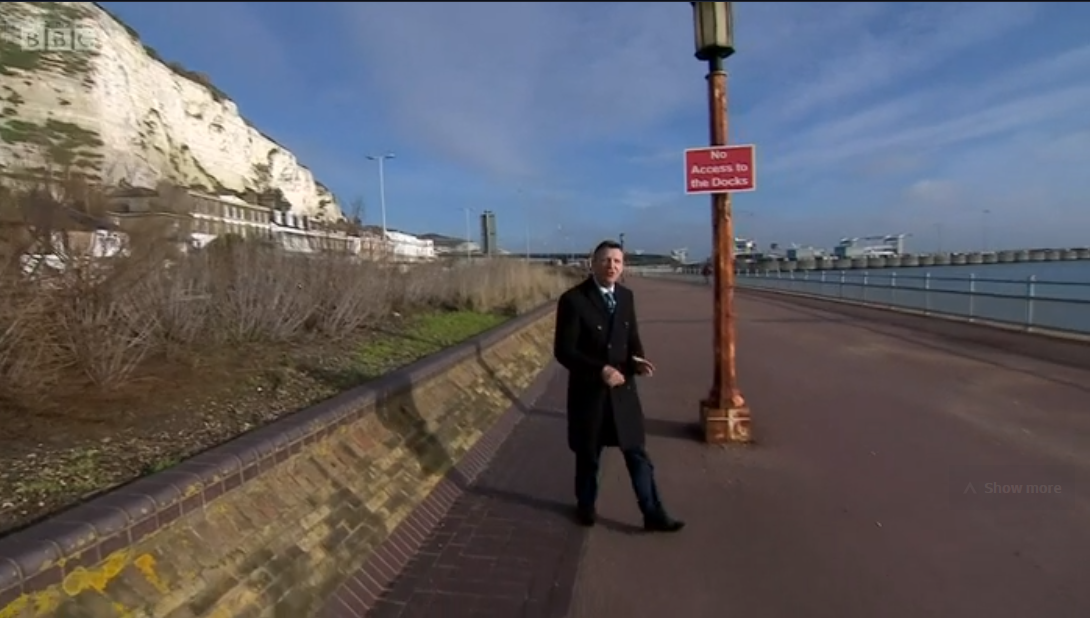
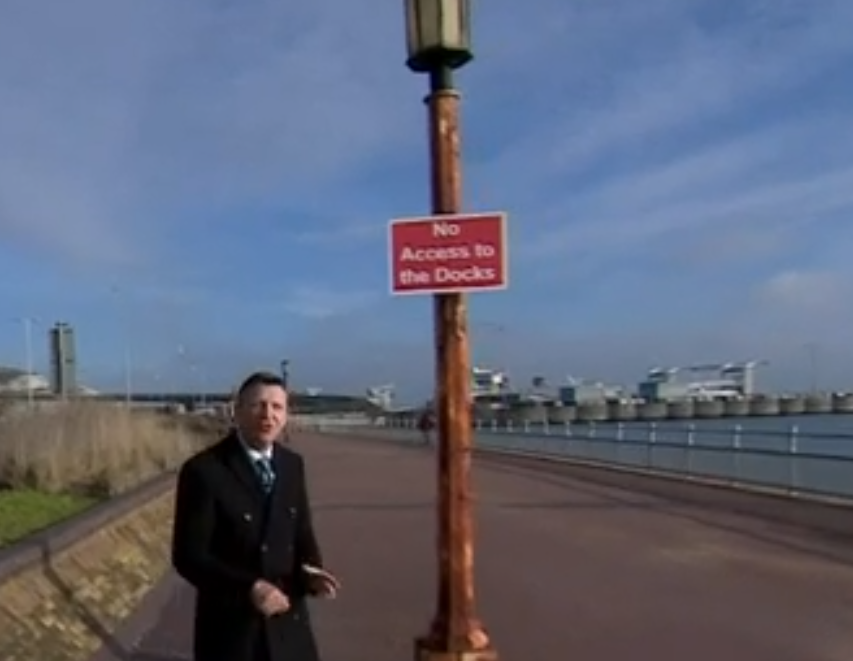
"No Access to the Docks"


The BBC's home editor Mark Easton dispatched himself to Dover yesterday to report on all the problems at the border. 

Unfortunately for him, there weren't any. All the lorry drivers he asked "Has it been difficult for you today?" said "No". 

Still, it didn't stop his report from mainly being about the "tangle of red tape, customs checks and regulatory inspections", the "extra hassle", the "fears of widespread disruption", the "largely untested" new IT systems to speed up customs processing, the "still not fully ready to open" inland customs facilities and how "fingers are being firmly crossed": 

The government accepts there will be bumpy moments as people adapt to the new post-Brexit environment but insists that today marks the moment when the United Kingdom takes back control of its destiny. 

He's always been a canny propagandist journalist. Just look at where he began his bit to camera, underneath a sign saying "No access to the docks". Very clever Mark!

Saturday, 12 December 2020

A never-ending story


Sky News's home editor Jason Farrell has an investigation today about the mainly-Pakistani-origin paedophile grooming gangs continuing to sexually abuse children in northern England. It's a story I suspect his equivalent at the BBC, Mark Easton, will continue to steer well clear of.

Thursday, 6 February 2020

Mark his words


Computer problems prevented me posting this a couple of days ago, but there's no time like the present, so...


Charlie, on the Open Thread, noted that BBC Home Editor Mark Easton "does not like the emergency Jihadi legislation one little bit".

As I've said before, I personally think that Mark Easton is the BBC's most seriously biased reporter. He has a propagandist's gift for cleverly loading the language of his reports in such as way as to steer viewers and listeners in the direction he desires. 

In his report on last night's BBC One News at Ten [Craig - well, it was 'last night' when I first wrote this] he could have said this:
This evening, the Government announced emergency legislation to keep new and existing terrorism offenders in prison for longer and with tougher controls on release.
But, being Mark Easton, a loaded word was added:
This evening, the government announced controversial emergency legislation to keep new and existing terrorism offenders in prison for longer and with tougher controls on release.
With Mark Easton something is "controversial" if he doesn't agree with it.

The worst was yet to come though. Mark Easton employs every trick in the book here to steer the argument his own way:
The trouble is we've been over this ground before: searching for a way to balance the rights of the public to be kept safe against the human rights of those dealt with by the courts. The government may well find even today's proposals come under legal challenge. The Government will most certainly get its emergency legislation through the Commons but will it get through the courts? For ministers to retrospectively basically increase the prison terms of people already convicted by court and change the terms of their release is certainly I think open to legal challenge. But perhaps the bigger problem with the Government's approach is that it won't necessarily stop actually extremely dangerous terrorist offenders being released from prison without anything in their way. It just delays that process. No, the Government could have gone for indeterminate sentences but, as we know, that idea is expensive and difficult to manage and some would argue it goes against the principles of fair justice. Many people, I think, would challenge that idea. And it just goes to show that governments, whenever they deal with this problem of radical extremism, discover there really are no easy answers. 
Despite this, the BBC's 'degrees of separation', once again, fell down. In the BBC newsreader's introduction, the News at Ten said:
Critics say the new plans would merely defer the problem of what happens on release.
Later, as we've seen above, Mark Easton didn't even bother to pretend it was 'critics' saying it. He said it himself:
But perhaps the bigger problem with the Government's approach is that it won't necessarily stop actually extremely dangerous terrorist offenders being released from prison without anything in their way. It just delays that process.
So, ergo, Mark Easton is himself a "critic" of the Government's plans here out of the BBC's own mouth and, thus, took a side. QED.

Saturday, 14 December 2019

“RTs are not endorsements”


Aha. I see that BBC home editor Mark Easton response to the results of the election is to re-tweet the following:

Monday, 9 December 2019

Mark Easton sums up Mark Easton's view of the election


Here (h/t anonymous on the open thread) was the BBC's home editor Mark Easton giving us the benefit of his wisdom on tonight's BBC One News at Six:
Clive Myrie: With me as the BBC's home editor, Mark Easton. For some, the choice in this election seems stark and clear, yet, as we have shown there, clearly there are people who are still undecided about this election. 
Mark Easton: You know, I'm 
really struck by the number of people I've met who still say they haven't made up their mind who they are going to vote for on Thursday. The campaign itself, if anything, has deepened the sense of scepticism, cynicism, certainly not enthusiasm. The party leaders are not seen to be trustworthy, certainly not particularly likeable. I think, on the issues, people are generally fed up with Brexit. They want it out of the way, you know, whatever happens, one way or the other. They want to move on. We want to talk about other things. And on those other issues, real frustration, I think, that we are not talking more about the the health service, about crime, and housing, and climate change, the cost of living. The manifestos, I think, are often seen as a wish list, rather than a credible road map for government, and many of the voters I've met here today have said they are going to make their mind up in the voting booth itself, they are going to look down the card and make the decision, I don't know, based on their final instinct. In India, you know, they have a box on the voting card that reads 'none of the above', and I suspect if you had that here for this election, it would get a huge amount of support. 

Saturday, 7 December 2019

Small wonder people are calling...


I did enjoy Beltane's comment here:

popeye
The BBC bias is just everywhere and brought into everything, it’s not even subtle anymore. 6.00pm news about the serial rapist and how he managed to get out of prison and rape multiple victims. An “expert” went on and on about austerity and cutbacks in police numbers before letting slip that he was released early from prison due to “an administrative error”. So nothing to do with Government policies after all but the Labour campaign message once again getting delivered to the gullible public.
Beltane
That was no expert Popeye, that was Mark Easton.

On looking into this, I was struck by how Mark Easton's studio conversations with the two newsreaders of the BBC News at Six and News at Ten were almost word-for-word, though four hours apart. 

Also, the BBC home editor was - characteristically - strongly editorialising both times.

Here are transcripts:

BBC News at Six:
Well, the most fundamental responsibility of the criminal justice system is to keep people safe, and McCann was known to be extremely dangerous, in fact the courts had done everything they could to protect the public by putting him on a sentence that meant he would be in jail until experts decided that the risk was low enough to release him. But the system failed, and not just once. It failed time and time again. Somehow despite all the red flags, the warnings, the history, despite a judge saying that he must go back to jail to continue the indeterminate sentence he was on, the Probation Service did not recall McCann to prison when he broke his parol license. Instead he was treated like a model prisoner and released in the normal way, and then, as we know, went on his appalling violent rampage. Now, a number of probation officers have been disciplined, two were sacked, but the failures in this case are so egregious that I think you have to look at whether the system itself is broken. An all-party parliamentary committee recently said that the Probation Service...er....said that budget cuts and botched reforms have left the Probation Service in a mess. The district responsible for McCann was more than 100 probation officers short. Huge budget cuts to the courst, to the Prison Service, perhaps also explain why communication broke down, in the criminal justice system. Now there was a time, you know, when catastrophic failure like this would have seen a government minister offering to resign. No hint of that tonight. Instead, we had that apology, the Ministry of Justice accepting that McCann was released in error, copies of an internal review sent only to victims not published. Small wonder there are calls tonight for an independent inquiry to be held in what went wrong and how we might be able to keep people safe from people like McCann. 
BBC News at Ten
You know, Clive, the most fundamental responsibility of the criminal justice system is to keep the public safe. McCann was known to be extremely dangerous, in fact the courts had done everything they could to keep the public safe by giving him a sentence that meant he could not be released from prison until experts were convinced that it was safe enough. But the system failed. And not just once, it failed time and time again, somehow despite all the red flags, the warnings, the history, despite a judge saying he should go back to prison, back on the indeterminate sentence he had been on, the Probation Service did not recall McCann to prison. In fact, when he broke his license instead he was treated like a model prisoner, released in the normal way, and then as we know went on this appalling rampage. Now, a number of probation officers have been disciplined. But the failures in this case are so egregious you have to ask yourself whether the system itself is broken. An all-party parliamentary committee said budget cuts and what it called "bodged government reforms" had left the Probation Service in a mess. The district responsible for McCann was more than 100 probation officers short. Now there was a time when a catastrophic failure like this would have seen perhaps a government minister offer to resign. No hint of that tonight. Instead, an apology, and that unpublished internal review from officials. Small wonder people are calling for an independent inquiry. 
It sounds as if Mark is placing the blame on the government, and is himself calling for an independent inquiry into the the effects of government budget cuts and botched government reforms too - and for a government minister to go. 

Saturday, 16 November 2019

Mark Easton does it again


Bias on the rocks


There's a discussion on the Open Thread about a Mark Easton report on Thursday evening's BBC One News at Ten, launched by this comment:

Anonymous14 November 2019 at 22:15 
A new angle from Mark Easton tonight. There is not enough immigration. Lowestoft's most vulnerable residents are at risk because they can’t get enough migrants to do jobs in public services. In the middle of the report they hastily inserted a clip intended to embarrass Priti Patel. It ended with a sympathetic Jeremy Corbyn asking for a decent and fair system where public services can be properly resourced (with immigrants?). Blatant bias, editing and manipulation on this report and very clear where the BBC sit with immigration and which party they support

Mark Easton's track record of bias, especially on the subject of immigration, has been highlighted so many times on this blog, and this week's report is just another in a long line of such biased, manipulative reports. 

As noted in the above comment, many of Mark's favourite tricks were there: 

First, Mark builds his pro-immigration argument with detailed 'facts and figures'. Then he reinforces it with an articulate, sympathetic 'talking head'. And then he goes back to building his pro-immigration argument. 

Next, he introduces a chronically edited interview with Priti Patel, the severe editing of which makes her look both evasive and stupid. He pre-prepares his viewers by telling them that she "couldn't say whether it should go down or up" and added a rising, incredulous inflection to his tone of voice while doing so. 

(The editing here makes that Conservative video showing Keir Starmer being silent in response to a question when he'd actually answered straight away look honest and agenda-free in comparison). 

Then we get the 'other side' of the argument. Or rather we don't. He just doesn't bother even trying to make it. Where are the detailed 'facts and figures' showing the impact of immigration on schools, housing, the NHS, etc? And instead of an articulate, sympathetic 'talking head', who do we get instead? Yes, three not-so-articulate vox pops speaking their minds. 

Finally, after rubbishing Priti Patel and the Conservatives earlier, Mark gives us a quick, uncritical run-through of the positions of three other UK parties - Labour, the Lib Dems and the SNP, before ending with a banal parting observation. 

It really is classic Mark Easton.

Here's a transcript:


Newsreader: The Conservatives say they will seek to control immigration by introducing a points based system that would be firm but fair - if they win the election. But the Home Secretary Priti Patel did not set a specific target for reducing overall numbers. The Prime Minister said immigration could come down in some sectors but he didn't want the UK to be closed to the rest of the world. Here's our Home Editor Mark Easton. 
Mark Easton: People have called Lowestoft home since the Stone Age. Its name from the Old Norse means 'homestead', but not enough people want to come and live here these days. If Lowestoft has an immigration problem, it's not that there are too many migrants coming to the town, but too few. The national immigration figures explain the problem. Since the Brexit referendum in 2016 net migration into the UK has fallen. Still historically high, but down 20%. Within that change is a more dramatic shift. Net migration from outside the EU has gone up 21%. But from inside the European Union it's down by more than two thirds in just three years. That huge fall in overall EU migration to the UK has seen some sectors that have relied on European workers struggling to adapt. In this part of the world, that's led to insurmountable recruitment problems. As chief executive of a community trust in Lowestoft, Emma Ratzer knows how desperate staff shortages can be for the town's most vulnerable citizens. 
Emma Ratzer, Access Community Trust: We don't have much immigration out here, which will be, you know, good news to hear for lots of people, but, actually in terms of finding people to fill social worker posts, GP posts, teaching jobs, it's actually a real problem for us. 
Health is a significant concern. There have been moves to bring in GPs from abroad. Care homes are closing, there aren't enough willing people locally to fill the vacancies. And it's that problem that lies behind confusion today as to what a Conservative government would do about immigration. A statement from party headquarters this morning quoted the Home Secretary saying "We will reduce immigration overall" but by this afternoon she couldn't say whether it should go down or up. 
Priti Patel, Home Secretary: The Conservative Party wants to control immigration. (edit) Interviewer: I'll ask again, do you want immigration to go up or down? Priti Patel: Well, we'll be controlling immigration, and that...Interviewer: (interrupting) Does that mean it goes down? Priti Patel: Well, we'll be able to control immigration numbers... (edit) 
InterviewerDo you want to reduce the numbers of immigrants that come to this country? Priti Patel: We want immigration that is fair... 
(edit) 
InterviewerThe suggestion is you want to lower immigration, is that right? Priti Patel: We will be able to control who comes to our country, and also the reasons as to why people are coming here. 
In Middlesbrough on Teesside, one can find the other side of the argument, that migrants put extra pressure on public services. Local children recently couldn't access school places in the town because of unexpected foreign arrivals. 
Female vox popWell, I think they do need to bring down the population. We haven't got enough spaces. Male vox pop 1: I just think money's concentrated, and stuff like that. I think it becomes an impact on the fabric of the town. Male vox pop 2: All the parties give you all the spiel, what they are going to do, what they are not going to do, and then at the end of the day you don't see any difference with any of them. 
It's the different experiences of places like Middlesbrough and Lowestoft that explain why the parties won't be clear about immigration. Labour's talked of extending free movement, the Liberal Democrats want a system that works for the economy, and the SNP wants more immigration for Scotland. But in truth, Britain still doesn't know what controlling our borders should look like. Mark Easton, BBC News, Lowestoft.

Tuesday, 4 June 2019

Munroe, Paris and Chelsea delete, delete, delete a Doctor Who story writer


Alpha Centauri, a gender-fluid alien from the less serious end of the Jon Pertwee era

Four full episodes of Doctor Who have been written by screenwriter and novelist Gareth Roberts. He who also writes Doctor Who novels and short stories, and the BBC recently asked him to write another Doctor Who short story for a new anthology. Gareth duly wrote it and submitted it. But news of his involvement leaked out and some intolerant transgender people demanded that the BBC drop him, or else.

Why? Because (in 2017) he'd tweeted a couple of "cheerfully vulgar" things that 'offended' them - namely "I love how trannies choose names like Munroe, Paris and Chelsea. It's never Julie or Bev is it?" and "It's almost like a clueless gayboy's idea of a glamorous lady. But of course it's definitely not that." (Gareth is himself gay).

And guess what? Instead of simply ignoring the censorious transgender militants or, even better, telling them to sling their hooks, BBC Books caved in.

Gareth's story will no longer be in the anthology (though the BBC will still pay him for it).

Now you, like me, may think this is shocking, but take care not to bring up the BBC licence fee, as Toby Young did, or the BBC's finest will be after you:
This is shocking. It’s one thing for a commercial publisher to muzzle an author for their dissenting views on transgenderism. But for BBC Books to do it — a publicly-owned company — is an affront to free speech. Why should everyone pay the license fee if some views are censored?
Yes, it was Mark Easton, the BBC's Home Editor no less, who was on that as quick as can you say 'Nick Robinson':
BBC Books is not a publicly-owned company.
That's Toby told!