Showing posts with label immigration. Show all posts

Tuesday, 16 August 2022

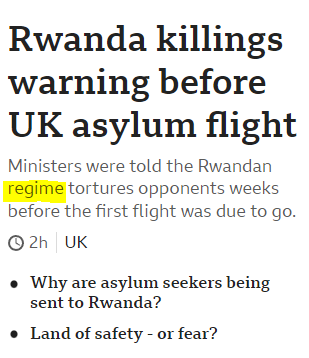
The BBC regime cracks down on the UK government's immigration plan


The lead story on the BBC News website this evening is:
Yes, the pro-mass immigration BBC is going after the UK Government again over their 'deport illegal immigrants to Rwanda' plan.

You can tell that BBC activism is in full flow because of the BBC's use of the word 'regime' rather than 'government' as regards Rwanda. 

The last decade or so of the Assad government in Syria always got the 'regime' treatment from the BBC after they switched to disapproving of it.

Sunday, 7 August 2022

Shush!


GB News, reviewing the MoS front page story last night


We've been doing this so long now that we can just guess what the BBC will do sometimes.

Before going to bed last night I was reading The Mail on Sunday's scoop about a leaked intelligence report showing that nearly 4 in 10 people illegally crossing the English Channel come from Albania - i.e. from a peaceful country and, therefore, economic migrants not refugees, despite what the BBC insists. The leak was passed to the paper via Reform UK leader Richard Tice.

My instinct, based on past experience of the BBC and these kind of 'unhelpful' stories, is that the BBC would downplay it. So the first thing I did after logging on this morning was to check the BBC News website's daily The Papers section to see if they've included The Mail on Sunday or not.

This is where it gets interesting. They have mentioned it but are downplaying it.

There show full screenshots of all the Sunday front pages, except one: 

The Sunday Times, The Sunday Telegraph, The Observer, The Sunday Express, The Sunday People, The Sunday Mirror, The Sun on Sunday and The Daily Star on Sunday are all there, but not The Mail on Sunday.

But scroll down and - in a classic example of 'watertight oversight' in action - you'll see that the BBC has mentioned it.


To my mind there's only one reason for them NOT showing the Mail on Sunday front page and that's because they deliberately chose not to draw attention to it because they don't like the story.

Isn't that a fair assumption?

Update: Checking TVEyes...GB News has been showing that front page and discussing it since around 10.30pm yesterday. Neither of the BBC News Channel's paper reviews at 10.30pm and 11.30pm even mentioned it, neither showing it nor discussing it. 

Saturday, 25 June 2022

'Newswatch', 24 June 2022 - Transcript of interview with Dominic Casciani


Samira Ahmed: Hello and welcome to Newswatch with me, Samira Ahmed. How should BBC journalists describe people crossing the English Channel in small boats? Asylum seekers, refugees, illegal migrants?

Samira Ahmed: When news of Thursday's two by-election results came in, Boris Johnson was in Rwanda, and hanging over his trip, there was the government's controversial plan to send asylum seekers to that country. That term 'asylum seekers', along with 'refugees', is the most common one being used around this issue on the BBC, as you can hear in these two recent reports.
BBC reporter: It's a hotel in Kigali like many others. Inside, one of the rooms made up and ready to receive their unwilling guests - refugees forcibly removed from the UK.
BBC reporter: The government's policy to remove asylum seekers to east Africa is on hold, but the Home Secretary this lunchtime insisted it will happen.
Samira Ahmed: But some Newswatch viewers aren't happy with the use of those terms. Sue Crooks wrote:
Sue Crooks: I am annoyed by your manipulation by language in news programmes. 'Refugees' are those fleeing for their lives. 'Asylum seekers' are those identified as at risk because of their views. 'Economic migrants' are those who seek to improve their lives by migration. 'Illegal immigration' is, as it states, illegal. Please don't insult the viewers by using the wrong label to influence sympathy.
Samira Ahmed: Meanwhile, Astrid Jillings had a different point to make:
Astrid Jillings: Before me knew better we referred to people with a disability as 'handicapped'. We now know better and use inclusive language. I was reminded of this in the past few days. 'Asylum seekers' and 'migrants' are temporary terms and do not reflect the whole identity of people that have left their homes behind to start a new life in a different country. It concerns me that some people don't view these people as individuals. My request to the BBC is to set an example by referring to these people as 'people' as by using more inclusive terms like 'people seeking asylum' or 'people that have migrated', etc.
Samira Ahmed: Well, someone who's been thinking about the use of language in this context is Dominic Casciani, who's the BBC's home and legal correspondent. Thank you for coming on Newswatch. How should we describe these people crossing the Channel?
Dominic Casciani: Well, Samira, this is really complicated because the law is about to change, which is going to, to be frank, completely muddy the waters here about the language. Now, the basic fact is claiming asylum when you're saying you're a refugee in need of protection is not a crime. That's slightly complicated by what's happening at the Channel at the moment where you can have a situation where somebody is crossing because they're an economic migrant - they're effectively seeking to better themselves, you know, they basically want to improve their life in some shape or form - they haven't necessarily got a claim on asylum. Now, in that context, if they haven't already got a visa or permission to enter the UK, technically speaking, you could say they're an illegal migrant because they're arriving without authorisation. To complicate matters further, you can then have an asylum seeker, someone who sourced asylum elsewhere in Europe on their way to the UK. I've spoken to people in the past who've claimed asylum in Germany, in Sweden, in places like this, and then decided to come to the UK. So they have some kind of refugee claim - or say they do - but then they've decided to come to the UK to claim asylum here. Now, in that context, are they an asylum seeker or someone who's basically, effectively, 'asylum shopping', to use language which is deployed by some, looking for a better life? That's quite a complicated mix to start getting your head around, so I can understand how the audience can be a little bit confused by some of this.
Samira Ahmed: So, given that some people, certainly viewers are saying this, who didn't claim asylum in the first safe country or did, and then have chosen to move, some viewers are saying they're illegal migrants. Does the BBC ever use that term?
Dominic Casciani: Well, not necessarily in that context. But let me talk to you about something which is about to happen. This coming Tuesday, the law changes, and technically speaking, there could be people after Tuesday who cross the Channel who could be classed as an illegal asylum seeker because they didn't already have entry clearance, to use the jargon - didn't have permission from the Home Secretary to arrive in the UK. Now, what that means is from the middle of next week, if ministers start using phrases like 'illegal asylum seeker', well, it will depend on the context, because technically, you can have people who are coming in, seeking asylum, and then they're taken to court for basically breaking the criminal law there because the accusation would be that they didn't have any good reason to come because they could have claimed asylum elsewhere or there may be some other reason. So, it's getting more and more complicated, this area of law here.
Samira Ahmed: How far, then, is it ever appropriate to use the term 'refugee' for the people we're talking about coming across the Channel?
Dominic Casciani: I think the term 'refugee' has to be used in very, very specific circumstances. Now, from my perspective, I see this as a legal definition in as much as somebody is not a refugee in my reporting until they have refugee status, and what that means is they've claimed asylum, they've been given some kind of - they've been given status by the Home Office that's recognised they have a need for protection, and, therefore, they are protected by the UK and settled in the UK with that status. At that point, in law, they are a refugee, they have a right to remain in the UK. So, when I'm reporting this issue, I will talk about asylum seekers, I will talk about migrants, but the word 'refugee', I'll try to reserve that for that very, very specific category of people who've got status. When we're interviewing people, so, for instance, you can be talking to refugee charities or, for instance, like, campaigners or people who, for instance, are working with asylum seekers and migrants along the English Channel on the French side of the coast, they will very often say in quotes to us in clips, "We're supporting "these refugees, don't criminalise these refugees." We have to accept that that's their opinion, that all these people are refugees and we have to obviously, you know, reflect what they're saying, but we have to be very, very careful to make sure that that language is their language rather than ours, so there's that difference there.
Samira Ahmed: Now, one of the viewers we heard from was saying we should use the term 'people' with an added-on description, people claiming asylum, for example. What do you think?
Dominic Casciani: Yeah, look, it's not unreasonable, but it's just that some of this is about terminology, around snappy language in news, you know. News is supposed to be digested fairly quickly, so very often we will go to shorthand. So I take the point, there is this issue about whether or not you just basically categorise people in one particular way forever. I mean, we've had this thing around the disabled. We very, very rarely see that kind of language now, 'the disabled'. We talk about people with disabilities.
Samira Ahmed: Or people using wheelchairs.
Dominic Casciani: Or people using wheelchairs. So, yeah, you've got to be careful not to dehumanise people, you know, because if you dehumanise people, then you're actually making it very - a lot harder actually for the audience to understand the motivation of the person behind it.
Samira Ahmed: Dominic Casciani, thank you so much.
Dominic Casciani: Thanks.
Saturday, 18 June 2022

Comparing GB News with Newsnight


For lots of reasons I've not seen much of GB News or the BBC for months, but I actually sat down today and watched last night's Newsnight on BBC Two and - live - this afternoon's GB News with Nana Akua.

Such a random snapshot proved useful because last night's Newsnight dealt with much the same topic as GB News's 'Great British Debate': the Rwanda/Channel-crossing migrants issue: so it made easy a simple exercise to compare and contrast them.

And the contrasts couldn't be clearer.

Nana's GB News debate saw Nana, the presenter, lay out the pros-and-cons of the debate, but she also declared her own hand. On the question 'Should illegal migrants be tagged like criminals?' she said:
'...But critics say that the plan treats those fleeing persecution as criminals...Well, they are, aren't they? They crossed the Channel illegally. Sorry, did I say that out loud?
She then interviewed Phil Brewer from the Human Trafficking Foundation, who disagreed with her. He argued that the tagging plan won't work and will impact badly on the mental health of the Channel-crossing people being tagged.

What was so pleasing here was that Nana didn't just let him talk but was clearly happy to let him do so, despite her not sharing his point of view. He wasn't interrupted or belittled. He was simply listened to. And he listened to her in return. And Nana left it up to GB News viewers to listen and decide too. 

It was all about listening to open-minded people with strong views listening with an open mind to each other.

Then came Kevin Saunders, former Chief Immigration Officer at UK Border Force, who was pro-tagging and, with caveats, pro-Rwanda option echoed Nana's sentiments. Nana didn't disguise the fact that she agreed with him. It was all in the open.

And Kevin quoted the Full-Fact approved stat that some 70 per cent of those crossing the Channel are fighting-aged men aged 18-40. Newsnight's Lewis Goodall, in contrast, ignored that and made more of the the Full-Fact approved stat that the large majority of 'asylum seekers' crossing the Channel are given asylum in the UK, thus showing that they aren't mere economic migrants.

Then on GB News came a discussion on the issue featuring comedian Leo Kearse and broadcaser Lois Perry. Nana continued to make plain her own views to viewers, but kept outlining both sides. Lois and Leo aired their views, sometimes disagreeing, sometimes agreeing, though they broadly agreed with Nana.

Standing back and judging, this was clearly a debate with a bias - a bias in favour of tagging and the Rwanda plan. But the bias was openly presented and the dissenting voice was treated no differently to the agreeing voices and given full freedom to make his points uninterrupted and in just as friendly a spirit.

Compare that to last night's Newsnight and you'll find yourself in a very different place.

The starting point here was a report from Newsnight policy editor Lewis Goodall. It used Lucy Halliday from Care4Calais, an opponent of the government's Rwanda plan, as a 'talking head'. Next came a sympathetic 'asylum seeker' who says he fled the Taliban in Afghanistan. And then a lawyer working for the 'asylum seekers', Jacqueline McKenzie of Leigh Day solicitors. 

It was one of those BBC reports that spoke with one voice on one side of the argument.

And then it was back to the Newsnight studio for Lubna Shuja of the Law Society, who sounded unsympathetic to the Rwanda plan, and former Labour home secretary David Blunkett, who also disagreed with it.

Watching Newsnight again, after a few months' abstinence, brought it home to me just how one-sided the BBC can be when it really puts its mind to it.

Though Mark Urban, presenting, struck a detached tone, everything else felt like a campaign video.

Lewis Goodall, reporting, came across as a man on a mission, a campaigner telling you what you must believe if you're a good person like him.

And that's what's so galling. Lewis Goodall, someone who uses long threads on Twitter to garner 'likes' from left-leaning types, gets to play the righteous voice of impartial BBC authority on Newsnight and Twitter. 

And Newsnight gets away with presenting the most one-sided airing of a matter of public controversy imaginable with no dissenting voices whatsoever. 

All at the public's expense.

Seriously, give me the honest bias and openness to other points of view of GB News any day over the narrow, preachy 'curating' of stories and opinions by the 'impartial' BBC.

Red ink


The BBC's language police swung into action early today. 

There's a lead story on the BBC News website headlined Migrants: Some due for removal from the UK could be electronically tagged. Newsniffer reveals some telling edits.

The BBC has evidently been massaging the message:

I
became
II
became
III
became
IV
became

Saturday, 11 June 2022

All Biased on the Easton Front


Alastair Stewart tweeted last night that “the only voices on BBC News tonight were opponents of #Rwanda”. 

BBC One's News at Ten certainly bore that out, with [a] a campaigner against the government's policy and [b] an illegal immigrant facing deportation being the two featured voices in Mark Easton's report. And the campaigner against the government's policy was the sole voice featured in the opening headlines too. 

Mark Easton's report itself was, as Charlie notes on the open thread, typical Mark Easton, using every trick in the book to reinforce the case that Priti Patel's Rwanda policy is wrong and illegal, with the arguments of government opponents dominating and government opponents being said to have 'pointed' things 'out' while people reacting favourably to the judge's ruling went severely underreported - as did what the judge actually said. 

The structure of the report says it all. It began with a 'talking head' - the campaigner against the government. Then came what the lawyer representing those trying to stop next week's flights said in criticism of the government. Then came what a barrister for the UN said in criticism of the government. Mark then added his own point to reinforce what the critic from the UN had said. The government's legal team then got a sentence-long summary of their position from Mark before turning to thee plight of the 'asylum seekers' and 'a Syrian' saying he has family here and that his future and his kids' futures will be 'destroyed' if he's sent to Rwanda. A final sentence - a characteristic Mark Easton move - then feigned impartially with a brief, even-handed summary of the present legal situation from both the Home Office and campaigners' perspectives. 

Why didn't he quote what the judge had ruled, given that the judge had some 'helpful' things to say from the government's perspective? Why didn't he quote Priti Patel's response, already reported elsewhere by that time? Why did he pile on the critics of the policy but exclude supporters of it?

The answer is surely that he was making the case against the government under the guise of impartial reporting, as ever.

The report has been re-broadcast throughout the night and was still showing on BBC Breakfast this morning.

It's to be hoped that many viewers can see through this though. Here, for example, is a tweet from someone who obviously watched Mark Easton's report on this morning's BBC Breakfast:
BBC news this morning with a report about boat migrants. Every clip they showed was with young children being carried into the UK. Who are they kidding? Everyone can see the boats being unloaded with men only. Women and children are few and far between.... 

That's a familiar complaint. 

Monday, 7 March 2022

More on Mark Easton


I may not be watching BBC News at the moment but I can guess what certain reporters are up in their broadcasts from their tweets - especially when they link to their own BBC One news reporting.

The BBC's pro-open borders/mass immigration home affairs editor Mark Easton - their most shamelessly biased reporter - hasn't been letting a world crisis get in the way of his agenda-pushing. 

In fact, he's latched onto it and exploited it. 

He's been plugging away relentlessly at one single thing for two weeks, trying to shame the UK government into opening our borders to far larger numbers of refugees.

He's been at this kind of thing for years - though this time he has genuine refugees to latch onto.

And now the poor Ukrainians are his convenient excuse for pushing his pro-immigration, open borders hobby-horse yet again.


He uses every trick in the book here, using careful framing, loaded questions that aren't genuinely meant as either/or questions, editorialising hashtags, heart-tugging individual cases, etc. 

It's a masterclass in the art of biased agenda-pushing very consciously just-about covering itself so it can get away with it with BBC bosses:

  • Feb 25: Should Britain offer sanctuary to Ukrainians fleeing the war? The Home Office says refugees should stay in the first safe country they reach. But Nottingham's Ukrainian community hopes the UK will agree to do more. #bbcnewssix 
  • Feb 28: Asked today if Ukrainian pensioner refugee Valentina Rumyantsyeva could come to London on the Eurostar having been turned back on Saturday, the Home Secretary said 'yes'. But the UK Home Office has since told me she is still not eligible to join her daughter. 
  • Mar 1: Someone from the UK Home Office contacted Ukrainian refugee Valentina in Paris after my piece last night promising she would get a visa to the UK. Still nothing in writing. But on what basis? The current rules mean she remains ineligible. Compassion or desperate PR? 
  • Mar 1: UK government to ask the public to sponsor a Ukrainian refugee. Reluctant to put money into a conventional resettlement scheme, the UK Home Office is looking at #BigSociety to help out. Will it work? 
  • Mar 1: "Leave to enter outside of the rules!" Valentyna Klymova, in the yellow beret, now has her visa to come to London. She is tired, relieved and delighted she has helped the UK Home Office become more generous to refugees. #bbcnewssix 
  • Mar 1: Valentina has arrived at St Pancras, wrapped in the Ukrainian flag as passengers gave her a round of applause. #bbcnewsten 
  • Mar 3: Ukrainian refugee Valentyna arrived in London on Tuesday to join her daughter, her visa stating she had 'leave to enter outside the rules'. But rules allowing other parents, grandparents, adult children and siblings to seek sanctuary here don't start until tomorrow. 
  • Mar 4: On Tuesday Priti Patel said Ukrainian refugees with family in the UK could stay for a year. Today the UK Home Office increased the limit to 3 years, matching the EU offer (although EU doesn't demand family ties). Still playing catch-up? 
  • Mar 6: The only UK visa application centre in Ukraine at Lviv has closed, according to the UK Home Office website. Guidance changing by the hour (see below) causing confusion consternation for those fleeing the war.
  • Mar 6: In a letter to Priti Patel, French interior minister Gerald Darmanin says that 150 Ukrainian refugees have been turned back at Calais by Border Force officials, accusing the Home Secretary of a "lack of humanity" and a "completely unsuitable" response.
  • Mar 6: Priti Patel has responded to Gerald Darmanin: “Let me just correct what has been said by the French government. The British government is not turning anybody back at all”.
  • Mar 7: What did Priti Patel mean when she told The Sun “I’m urgently escalating our response … to create a humanitarian route” for Ukrainian refugees”? Downing Street insists nothing has changed but the UK Home Office says a new route IS being worked on. #confusion
  • Mar 7: Ukrainian refugees stuck in Calais tell me there’s a gap as wide as the English Channel between the supportive rhetoric of the UK government and their experience on the ground.

Sunday, 9 January 2022

Penguins and Polar Bears


OMG The Daily Mail, bless them, give so much free content to their website users that people ought to be at least a bit grateful to them, despite everything.

So much content. No paywall. And no licence fee. And certainly no paywall/licence fee collectors.

Today, they've been reporting on immigration matters under the headline: Migrants 'are staying in four-star hotel rooms at £125-a-night on the taxpayer' as Britons struggle to afford spiralling energy bills amid cost of living chaos, saying that “more than 18,000 migrants are staying in hotels across Britain”.

Meanwhile, over at the licence-fee-funded BBC News website, 'blog favourite' Dominic Casciani has a new piece with a very different headline: Asylum seekers: The homes where ceilings have fallen in. 

He writes:
Damp, debris and falling ceilings - a BBC investigation into accommodation for asylum seekers has uncovered serial concerns about housing conditions. Refugee organisations say they hear regularly about properties residents believe are unsafe, and they struggle to get help on a national phone line.
The BBC and OMG The Daily Mail really are at absolute opposite poles on this - though I'm not sure which are penguins and which are polar bears.

The piece by the BBC's Dom C results from “a BBC investigation”. 

Or so Dom says. 

I'm inclined to agree with StewGreen when he writes, over at Biased BBC, that “since the article quotes charity Refugee Action I suspect the report actually comes from them”.

I strongly doubt that Dominic Casciani didn't do too much investigating here, and that he mainly just listened and took notes from campaign groups and talked to one asylum seeker called Adam. 

Could be wrong of course, but that's what it looks like to me.

To conclude then: I don't believe that the Daily Mail is approaching this without a biased agenda. And I certainly don't think the BBC is approaching this without a biased agenda either. 

Only one of them claims to be impartial though. And only one of them extorts a licence fee from the British public. And it's not OMG The Daily Mail. Cue RVW:

Sunday, 28 November 2021

The BBC spins a story [Part 919]


Just before 6.20pm I checked the Sky News website and saw this lead headline: 

The Sky report quoted Gerald Darmanin, the megaphone-mouthed French interior minister, sounding off tonight and saying that those crossing the Channel are:

...attracted by England, especially the labour market which means you can work in England without any identification. 
Britain must take its responsibility and limit its economic attractiveness. Britain left Europe, but not the world. 
We need to work seriously on these questions, without being held hostage by domestic British politics.

M. Darmanin is very 'off-message' there, BBC-wise - at least in the first two paragraphs of the quote above.

He's saying [a] that the people in the boats are mainly economic migrants, and [b] that the UK's economically attractiveness is acting as a magnet for such people, and [c] that we in the UK need to make our country less of an easy touch to deter them from coming. And I think he's right on all three counts.

I wondered how the BBC News website would report that and saw that they got round to it late, at 6.54pm, under this headline:

I wanted to know if the BBC would downplay the 'off-message' bits, and sure enough those bits  - the ones Sky led on - weren't featured prominently in the opening paragraphs of the BBC report.

Moreover, it was the BBC-palatable bits that led the BBC report. 

[The BBC evidently wants to keep the focus on French anger at the non-'serious' UK.]

You have to go to the 15th paragraph of the whole BBC report, close to the end, to get a short mention of M. Darmanin's 'off-message' bits. 

Now, I don't think there's any way that this isn't deliberately deceptive on the BBC's part.

They omitted the bit about how the migrants crossing the Channel are ''attracted by England, especially the labour market which means you can work in England without any identification''. 

And - even more of a giveaway - that short 15th paragraph [''But he also argued that the UK had to assume responsibility by making itself less economically attractive for illegal migrants''] is immediately followed by a longer one that re-asserts the BBC's preferred take:

In the few studies that exist, family ties have been identified as the main reason migrants wish to travel from France to the UK. Immigration expert Marley Morris told the BBC the UK had introduced policies that make it much harder to work illegally.

Note in passing here that this is cannily, preemptively caveated with the words ''in the few studies that exist'' - yet those studies are the ones the BBC have been citing again and again in recent days -  and that the BBC then adds a touch of 'bias by authority' by calling Marley Morris an ''immigration expert''. I'd never heard of him, but he's a think-tanker from the centre-left IPPR with views to match. [I see that back in 2019 the BBC weren't averse to properly introducing him as ''Marley Morris, of the Institute for Public Policy Research, a centre-left think tank". Here they were keeping schtum and just going for ''immigration expert''.]

For me, this is an example of the BBC 'controlling the narrative' at its clearest. I don't see any other explanation for it.

To summarise:

The mouthy French interior minister said some things at a high-profile meeting that the UK was excluded from - some of which fitted the BBC's ongoing narrative, and some of which went completely against it. And, after waiting to report it for a while, the BBC crafted a report to;

[1] put all the emphasis on the criticism of the UK they approve of, and 

[2] both [a] downplay and [b] try to counteract the criticism of the UK that flatly contradicts their ongoing narrative. 

And [3] there was a spot of 'bias by omission' too.

It's agenda-spinning, biased, dishonest reporting, plain and simple.

Please feel free to read it for yourselves and disagree if you think I'm wrong.

Saturday, 27 November 2021

Migration Watch and the BBC

  
Alp Mehmet on GB News

There were a brief few years when the BBC slightly thawed on the issue of immigration and began interviewing Migration Watch, who they'd previously help at arm's length [to put it mildly]. 

Migration Watch, after all, had begun to establish a strong track record of predicting where trends would lead with an accuracy far exceeding other experts, not to mention governments. 

The thaw didn't last and Migration Watch began to be frozen out again. 

A scan of TVEyes shows just one appearance on either BBC1, BBC2 or the BBC News Channel over the past 6 months - namely September 9, 2021, when Alp Mehmet, Chairman of Migration Watch UK, appeared on the BBC News Channel for  three minutes. [Not now available].

In contrast, in the wake of the tragedy in the Channel, Mr Mehmet has been on ITV's Good Morning Britain, Sky News and GB News.  

Indeed, Alp has been on GB News many, many times in recent months. 

Checking BBC radio [rather harder with TVEyes] I've found just one interview, and it's a recent one - 24 November, Radio 5 Live, Alp Mehmet. [Presenter Nuala McGovern did plenty of interrupting and contradicting of course. It was a very BBC interview on the subject.] I can find nothing on Radio 4, Radio 2 or Radio 1. 

Has anyone else seen or heard anything else from Migration Watch on the BBC during the past 6 months?

Friday, 26 November 2021

"Lies, damned lies, and statistics"


The BBC's home editor Mark Easton has an advocate's way with statistics. 

On Wednesday's News at Ten he made this statement:
There aren't more asylum seekers asking for sanctuary in Britain.
By Thursday's News at Ten - which began with the statement “Boatloads of desperation continue to wash up on Kent's beaches. Only a fraction of asylum seekers in Europe choose the UK” - Mark Easton added this, almost in passing:
Figures released today indicate asylum applications at their highest level for six years, at 37,000.

And there's a canny bit of jiggery-pokery here. The Times reports the same figures and says:

Asylum claims are higher than the number recorded at the peak of the 2015-16 European migration crisis at the height of the Syrian civil war, when applications hit 36,546.

That asylum claims are comparable or even slightly higher than they were in 2015 - at the very height of the European migrant crisis - is quite something.

It's all about how you frame it obviously. The Times's headline couldn't be further from Mark Easton's 'frame': 

Asylum claims at highest level for 20 years as Channel crossings surge

I'm intrigued though about what was going on throughout 2001. 🤔 Ah, yes.

Thursday, 25 November 2021

It isn't impartial broadcasting


This morning's BBC Breakfast included an interview with the French MP for Calais and a former Chief Immigration Officer for UK Border Force in light of the tragedy in the Channel yesterday.

In a very BBC moment, BBC Breakfast presenter Naga Munchetty decided to interrupt when the latter, Kevin Saunders, said something that, however factual, was clearly unpalatable to her. 

She then took umbrage with him when he reacted with bemusement to her interruption. 

And, not letting it go, she then went on to try and shame him by playing the time-honoured 'please think of the children' card. 

It was all rather aggressive from the BBC presenter. 

Here's a transcript of that section:
Kevin Saunders, Former Chief Immigration Officer for the UK Border Force: In the longer term, we have got to have offshore reception centres for these people. The draw to the UK is phenomenal. They want to come here because basically everything is free. And that's the attraction. That's why they wants to come. They are going to get housing, education, money, everything. That's why they are wanting to come...
Naga Munchetty, BBC: [interrupting] Because they are seeking asylum.
Kevin Saunders: Ah, er...um...
Naga Munchetty: Sorry, what do you mean by...what does that gesture mean?
Kevin Saunders: I was in France for 16 years pulling people out of the back of lorries and such like. Most of the people that I dealt with were not asylum seekers, they were economic migrants. And I do think it's a little bit disingenuous of some of the people who've never met a migrant in their life to say that they are all asylum seekers. They are not all asylum seekers. A lot of them are just plain economic migrants.
Naga Munchetty: What about those who aren't like the child that died on that boat yesterday?
Kevin Saunders: I mean, I'm not saying that everybody is an economic migrant. But a lot of them are.

And then came a report from the BBC's Lewis Goodall which contradicted the lived testimony of Mr Saunders, former Chief Immigration Officer for the UK Border Force. 

Here are some quotes from that:  

  • Some of those have made that journey two, three, four or five times to try and make it to the UK. Why? Well for some of them at least they feel they have already risked everything coming from countries where they have been persecuted perhaps, or where their family have been imprisoned, and so it's merely the latest in a series of risks. 
  • And of course some people say, well, why don't they just stay in France? There are a few reasons for that. Sometimes it's about family connections, their last family in the world might be in the UK. Sometimes it's about language, they can speak English, they don't speak French. One of the other reasons is they feel they have been treated badly in France and I don't think people necessarily appreciate just how poor conditions are in the camps, and I call them 'camps' charitably. They are basically really just woods and roadsides where people with kids - women, men and children - are living. 
  • To understand that, we spent some time in some camps in Calais and Dunkirk and here is a sense of what we found there. When you think of Dunkirk, this almost certainly is not the escape you think of. But in 2021, this is what Dunkirk is. Thousands of people from around the world, men, women, children too, living in the woods, wondering the motorway, waiting for the call to flee at dawn across the sea from France to Britain.
  • We should remember, too, that in terms of numbers at least, compared to other European countries, or indeed elsewhere, we are not talking about that many people. It's just more visible.   
  • There's much discussion in Britain about whether these people are genuine asylum seekers. It's a fair question. But also fair to consider whether many or most would credibly take these sort of risks if they weren't.
Now, who would you trust to know whether the bulk of the people crossing the Channel are migrants or refugees: the former Chief Immigration Officer for the UK Border Force who has dealt with these people for 16 years or a BBC 'instant expert' Newsnight reporter who has just popped over to France for a couple of days and talked to a few people?

And this isn't just any old BBC journalist. Lewis has a reputation. 

And, as per an earlier post, both Mark Easton and Newsnight were on a concerted mission to try to defuse this as a story before yesterday's tragedy struck and Lewis Goodall was obviously despatched to help advance that mission. 'Defusing the story' is now impossible, so deflecting it seems to be the new approach. 

Watching a Lewis Goodall report is like watching a university debating society in action. Note, as ever, how Lewis uses the tricks of rhetoric to advance it further - that last quote in particular.

Lewis just can't imagine that people who have travelled so far and are trying so hard can be economic migrants. For him, 'it stands to reason' that they must be asylum seekers. Well, it doesn't for me, and I think that's an absolutely ridiculous thing to say.

Note also his 'we should remember' in the fourth quote. Should we really? Why is a BBC reporter telling us what we should think?

As for the Dunkirk references [and there were images from the war], it crossed my mind that Mark Easton was playing the 'little ships' card. Lewis Goodall, unlike the very canny Mark Easton, was less discreet about using that analogy.

And he really hammers home the 'women and children' angle - despite everything we've seen with our own eyes from video after video over the past couple of year [something the full report heavily reinforces]. 

It's a one-sided argument disguised as a report, loaded in both its content and language.

The whole report also goes out of its way to tug at the heart strings, and - in typical Lewis Goodall style - features talk of what he calls ''this political purgatory''. This gets him into familiar territory, and he negotiates the UK-French angle by putting the emphasis on the French side's criticisms of the UK government. 

Even while he's emphasising his own fears for the lives of the migrants he's spoken to he can't but advance his own position on matters of controversy, and do it with a partisan politician's way of winning an argument. 

Whatever this is, it certainly isn't impartial broadcasting.

Wednesday, 24 November 2021

''You gotta be kidding me''


I spotted a tweet from the BBC a few days back:
 

When you see the BBC asking a question like that on this kind of subject you can guess the answer they'll give before you even click on the article. 

The article itself is a joint venture between the BBC's Paul Adams and BBC Reality Check and it rules that the actions of Poland and Lithuania aren't legal.

Incidentally, the tweet, one of the images within in the article, plus the thumbnail of the embedded video all show children. As someone I follow observed, ''The BBC do like their child pics''. 

Meanwhile, the Polish government is not impressed with the BBC. Government spokesman StanisÅ‚aw Å»aryn tweeted: 
Dear @BBCWorld, @BBCNews, this piece is full of bias! Why aren’t you putting any pressure on the Belarusian regime? You are fully aware that it’s Lukashenko who's playing with the fates of those people, aren’t you? Minsk is cynically using the migrants only for its political purposes. Those foreigners came to Belarus upon a mandatory invitation issued by state authorities, and on tourist visas. And now they want to illegally cross the Polish border. What we’re dealing with here is nothing but a hostile political operation controlled by the Belarusian services, incl. the KGB. And you're implying that Poland should be criticized? You gotta be kidding me.

Tuesday, 23 November 2021

Of gut reactions and BBC narratives


If you're worried about thousands upon thousands upon thousands of largely adult male migrants from the Middle East and Africa arriving illegally on our English Channel shores and then melting, unchecked, into the Home Counties  - especially given recent terrorist attacks by such people - and if you think that a population rise of around 10 million people in just 20 years in a small country isn't necessarily a good thing, then the BBC's chief propagandist on the immigration question, Mark Easton, was there - as ever - to waive away all your worries yesterday. 

To sum him up: It's not a big deal. The government's pandering to pro-Brexit sentiment over the issue. And what problems exist are because of Brexit. And there's nothing we can legally do to stop the poor migrants in their dinghies. And, shush, don't even mention concerns about terrorism. And please think of the migrant children.

And where the canny Mark Easton led, Newsnight followed last night. 

Emily Maitlis's latest monologue contrasted the ''hard numbers'' [that ''net migration to the UK is actually down. More people are leaving than coming into the country, in other words. The UK currently takes far fewer asylum seekers than many of our European neighbours''] with people's ''perception''.

And in the following report Ben Chu continued that theme and followed the Mark Easton line almost to the letter, and warned us against our ''gut reaction'' on seeing ''images of cross-Channel migrant crossings''.

 ''A closer look at the numbers suggests there's more complexity to this subject - and, indeed, the wider immigration debate - than a gut feeling might lead us to believe'', he said, arguing that ''in the scheme of things'' those poor migrants crossing the Channel aren't a ''big'' problem. 

To sum him up: Everything's hunky-dory as far as numbers go, with no population explosion whatsoever, we've not taken in many asylum seekers compared to other countries, and UK businesses are crying out for more migrants. 

The propaganda from the BBC is massively ramping up again, and I'm guessing the Mark Easton/Newsnight tag-team - all saying the same thing, all spinning the same narrative - were just the tip of the iceberg as far as the BBC's output goes. 

The hope remains, of course, that most of the public will see through it all - though whether they should be made to fund it is another matter entirely.

Saturday, 30 January 2021

Another Tale of Two Headlines


Here's a cryptic BBC headline: 

Fire breaks out at asylum-seekers barracks

What does that mean? The use of the passive tense suggests it could have been accidental (an unattended chip pan, some faulty wiring). But it's ambiguous and could also mean it had been started deliberately. But if the latter, by whom? By racist local residents attacking the asylum seekers maybe? Or by the asylum seekers themselves?

Ah, read on!...

"The fire began [passive tense again] after "upset" residents "caused a bit of a ruckus in the dining room", a charity said."

So it was the asylum seekers ("residents"). But a supportive charity says they were "upset" and it was only "a bit of a ruckus", so no big deal by the sounds of it:

Contrast that with this far more instantly understandable Daily Mail headline:


Another contrast is that the BBC uses the term "asylum seeker" while the Mail used "migrants".

Different agenda I suppose.

Saturday, 28 November 2020

A missing detail


I'm seeing lots of underwhelmed, sceptical, even derisive comments on my social media feels about Priti Patel's deal with her French counterpart Gerald Darmanin to double the number of officers patrolling French beaches and to increase drone and radar surveillance in a declared attempt to stop illegal immigrants crossing the Channel. 

The BBC's report on the story is, of course, critical of Priti Patel too, but - being the BBC- their criticism comes from the opposite direction. 

Their online report quotes only one other person, a critic of Ms Patel: Bella Sankey, director of the pro-migrant charity Detention Action. 

Being sceptical of the BBC's bona fides, I looked her up. She was the Labour Party candidate in Arundel and South Downs in the 2019 general election. 

The BBC didn't mention that of course.

It's a very old story as far as BBC reporting goes. Not as old as Beowulf, but not far off.

Tuesday, 15 September 2020

Business as usual with the BBC's illegal immigration reporting


Yasminara Khan in Dover


I see that Newsnight tackled the issue of illegal migrant Channel crossings last night - the issue highlighted by Nigel Farage earlier this year.

It did so. of course, in the usual BBC way...by focusing mainly on the problem of the far-right. 

The language used throughout was fascinating. For example, there's a huge divide between those who prefer to use them term 'asylum seeker' and those who prefer the terms 'illegal' and 'migrant' - and Newsnight placed themselves emphatically in the former camp.

Also look out for the way reporter Yasminara Khan introduced Conservative MP Adam Holloway who wants to tighten the rules for asylum seeks: 

We have seen social media posts across far-right networks in which the names and addresses of hotels housing asylum seekers are being widely shared. They are calling for the boycott of some of the hotel chains. Fake anti-Muslim conspiracies have been shared. But some go even further...

Cue Mr Holloway talking about tightening asylum rules, which makes it sound as if Adam Holloway was "going even further" than the far-right (with their sharing of hotel names and addresses and their spreading fake anti-Muslim conspiracies). 

Either that was very clumsily-worded by Ms Khan, or it was a deliberate smear against Mr Holloway. Either way it should have been picked up by a Newsnight editor, re-edited or removed.

Here's a transcript:


Emily Maitlis: Throughout the summer, the footage of asylum seekers arriving on British shores in dinghies and small boats prompted much concern. Some were concerned about the welfare of those arriving and what they were fleeing, accusing the Government of not showing enough compassion. Others worried that the numbers were reaching peaks not seen since the Brexit referendum, and this concern has brought protest onto the streets. Britain First - a pro-repatriation group - leading the way. Yasminara Khan brings us this report on an issue that may have been buried by Covid, but has not gone away. 

Yasminara Khan: Covid-19 means 2020 will be remembered for one thing. But alongside the pandemic there have been culture clashes. And rumbling debates about identity. And with the summer heat and people landing on British beaches in dinghies, a perennial issue that slipped out of public consciousness has, among all the turbulence, come back. Asylum and immigration. 

Protestor: Boris, you're not listening. Priti Patel, you're not listening. Now is the call-out to the patriots of this country. If our Border Force and our government can't protect this border then the people must. 

Professor Matthew Goodwin: At the moment it is not seen as a top three issue. Immigration is way down the list. But if it moves up the list and voters are saying the government is managing it badly, that's that potent cocktail. 

David Moreland, UKIP: The public have been treated like idiots. Oh, well, we'll just ignore it, let it carry on, let it carry on. But it's getting worse and worse and worse and I really do fear, going forward, this is going to cause some major civil uprising. I wouldn't be the least bit surprised. 

For many, Dover is a visual symbol. Not just of our borders but of Englishness itself. Of Empire and of wars fought to protect the country from invasion. And it's here in Dover that, for some, the battle to protect English borders and identity still goes on today. Anti-immigration protesters gathered in Dover earlier this month. A massive police presence and a turn-out nowhere near the thousands promised by the organisers. But real anger. Varied views here, too. In the shadow of cliffs that in World War II were the last glimpse of home for pilots leaving to take on Nazi Germany, among the crowd, one woman wears a T-shirt emblazoned with a swastika. There is a clear and visceral backlash to the summer's Black Lives Matter demonstrations, too. 

Protestor: Take the knee! Take the knee - go on! There's a black man over there. Bend the knee! That's all you're good for. Bending down and BEEP. 

On the demo, we met David Moreland, a former UK Parliamentary candidate and party spokesman. He has got long expressed anti-Muslim and anti-immigration views. 

David Moreland: I'm here representing a large number of the country standing up against what I consider to be illegal migration in mass formation into the UK. The political elites at the moment are doing absolutely nothing to stop our country being... And it is an invasion. We are being invaded. There are some people here who should be entitled to come over and I fully agree with that. But the bulk of them have got no right to be here and we're doing nothing to remove them or stop them. 

Anger at a perceived loss of national identity, at immigration, are nothing new. But this summer has seen a huge rise in the number of people arriving on this by dinghy. In the last three months, 4600 people made the crossing. In the whole of 29, that number was 1800. Asylum seekers, once processed by officials, are placed in hotels and hostels temporarily. The system that is supposed to disperse those seeking refuge around the country has been disrupted due to Covid. Some asylum seekers have had to stay in temporary accommodation longer. And with that has come negative attention, protests and even vigilante action from groups such as Britain First - an anti-migrant, anti-Muslim, pro-repatriation group. 

Matthew Collins, Hope Not Hate: Britain First are knocking on the hotel doors, declaring themselves spokespersons for the Great British taxpayer. And they are portraying what are potentially very vulnerable people, portraying them as some kind of thieves. Or that they are there stealing from the Great British taxpayer. And I think that's not just sinister, it's really quite cruel as well. 

The Home Office has condemned the violence and abuse directed at asylum seekers as completely unacceptable. 

Matthew Collins, Hope Not Hate: No matter what the Home Secretary says, she hasn't got a grip on this at all. And her statements and the Government statements about this issue have become harsher and harsher and harsher. And I think that is, of course, to the detriment of us as a country and also, I think, puts these people coming to this country at greater risk because the public sympathy, or the empathy the public should have with these people, whether it's up for debate or not, has evaporated. 

We have seen social media posts across far-right networks in which the names and addresses of hotels housing asylum seekers are being widely shared. They are calling for the boycott of some of the hotel chains. Fake anti-Muslim conspiracies have been shared. But some go even further. 

Adam Holloway, MP (Conservative): I don't care what the far-right are doing. That's for them and if they want to wander into hotels and intimidate young illegal immigrants, asylum seekers, then that just tells you about them. What I'm more interested in is, until we can change the rules so that is very difficult for you to claim asylum if you come in illegally in this way, then sadly this will go on and on. And also, frankly, we'll have more drownings, like that poor boy the other day. 

The logjam caused by coronavirus is causing another set of problems. We understand that just last week, Coventry Council won an injunction against the Home Office to prevent a third hotel in the city being used to house asylum seekers after police, health services and even charities supporting migrants said they were too stretched. Newsnight has seen a letter from six council leaders in the West Midlands - Labour and Tory - to the Home Secretary, Priti Patel. 

"We can no longer accept a situation in which less than half of councils house asylum seekers in their areas and in which just 20 of the UK's 343 local authorities are home to as many as 50% of all dispersed asylum seekers." 

The Labour leader of Coventry Council, George Duggins, was one of those who signed the letter. I asked him, when are the council told that asylum seekers will be arriving in the city? 

George Duggins, Labour: Well, sometimes when they arrive. It is often as late as that, when they arrive. And it's often after the fact. So this is all part and parcel of what needs to be a realignment of the relationship between the Home Office and local authorities. There needs to be a complete revision as to how the Home Office deal with this going forward. 

Despite the publicity given to the rise in Channel crossings, overall numbers of asylum applications are down. There were 4850 claims between April and June this year. Down from 7657 in the same period last year. And on the wider question of immigration - not asylum - away from the far right extremes, many voters remain concerned about the scale of immigration. Taking back control was, of course, the Leave slogan. And Leave won the Brexit referendum. 

Professor Matthew Goodwin: For many voters that put Boris Johnson into office, they were expecting to have what they would call control over immigration and lower numbers overall. And what we have seen with the latest data on net migration is that we are running at a net migration level of around 312,000 per year, which is actually not far off the peak of around 330,000 before the referendum. And I think probably over time, some Leave voters, some Boris Johnson voters, some Conservative voters will start to say, actually, does this government have a grip of immigration? 

However you define "grip", no one would suggest it's an easy thing to achieve. Those shouting loudest and angriest will always be there. Massing on Dover is nothing new for the far-right. The question for the Government is, if worries about control and numbers become a mainstream concern again, what then? 

Emily Maitlis: We did ask the Home Office for an interview, but nobody was available. In a statement, the Home Office said: The UK has a statutory obligation to provide destitute asylum seekers with accommodation and support whilst their asylum application is considered. Asylum seekers are housed where appropriate accommodation is available and we are encouraging more local authorities to help. We take the well-being of asylum seekers extremely seriously and any abuse is completely unacceptable. 

Saturday, 22 August 2020

“On the palm of fate we walk, and don’t know what’s written”


The sad story of Abdulfatah Hamdallah, the 28 year old Sudanese migrant who drowned after trying to cross the English Channel last week, is a tale of shattered dreams. In The Guardian's account, he left the Sudanese state of West Kordofan because life there was "tough" and there was "nothing he could do" in Sudan. He joined his siblings in Libya where they worked as car washers in Tripoli in order to send some money to their children back home. He eventually left for France, travelling via Italy. But, having been in France for some three years and having his asylum claim rejected by the French, he made the fateful decision, even though he couldn't swim, to use an inflatable dinghy with shovels for oars and set off in the middle of the night across the English Channel. The paper quotes Abdulfatah’s last words on Facebook, written in Arabic in June: “On the palm of fate we walk, and don’t know what’s written”.

His death was widely covered, but not - initially at least - well-covered. The media took the false claim that Abdulfatah was 16 at face value, and some media outlets used that for reporting that crossed into open activism. 

The first draft of the BBC News website's report on the story made particular play of his wrongly-ascribed age. Here are its first four paragraphs:

A 16-year-old boy from Sudan who disappeared at sea has been found dead on a French beach.

French minister Marlene Schiappa said the boy's body was found on a beach in Sangatte, Calais, on Wednesday.

UK Home Secretary Priti Patel said the death of the young migrant was a "brutal reminder" that people smugglers exploit the vulnerable.

The Home Office would not confirm whether the boy was trying to reach the UK.

Its headline was: 

Channel crossings: Body of teenage migrant found on French beach 

In the remaining five paragraphs, Abdulfatah Hamdallah is also called "this child" and classed as one of "the boys camping in Calais". 

The report went through eight revisions - all increasingly extremely unbalanced in their focus on criticism of the UK and dismissal of UK government responses -  not one of which corrected his age from 16 to 28. The final version is still up, uncorrected, still under the same headline. It's the report most readers will have seen.

The BBC did mention the fact - smuggled it in, so to speak - in a couple of other, later, far-less-prominent articles. In the first, Channel crossings: People smugglers 'not behind migrant death', BBC Paris correspondent Lucy Williamson added a rather sheepish-sounding 'analysis' to it which ends:

But the message from this tragedy is no less shocking, some feel, just because the man who rowed into the Channel using stolen shovels, was not a teenager himself.

Indeed. 

Finally, yesterday the BBC website published a further report headlined: 

Channel crossings: Sudanese man who died trying to reach UK is named

But TV Eyes confirms that viewers of BBC One's main bulletins have never heard the correction.  The emotionally-charged report from Lucy Williamson on Wednesday's News at Ten, for example (which focused on the conditions in the Calais camps, accusations against the UK government and how Abdulfatah Hamdallah's desperate final act was "a teenage retort to police, politicians and laws") contained 6 uses of 'boy/boys' and 5 uses of 'teenager/teenagers/teenage', and there have been no updates since Thursday. 

The story has evidently been dropped by BBC One. This isn't untypical of the BBC these days. Whether it was dropped deliberately or simply because BBC News increasingly has the attention span of a gnat is hard to say. But surely it merited a short, on air-correction at the very least?


