Correction 30 May: An earlier version of this piece stated there had been one mass shooting in the UK following Dunblane. There have been two, based on the definition widely used in the US of four or more deaths.
- 6 hours ago
Correction 30 May: An earlier version of this piece stated there had been one mass shooting in the UK following Dunblane. There have been two, based on the definition widely used in the US of four or more deaths.
Dear @BBCWorld, @BBCNews, this piece is full of bias! Why aren’t you putting any pressure on the Belarusian regime? You are fully aware that it’s Lukashenko who's playing with the fates of those people, aren’t you? Minsk is cynically using the migrants only for its political purposes. Those foreigners came to Belarus upon a mandatory invitation issued by state authorities, and on tourist visas. And now they want to illegally cross the Polish border. What we’re dealing with here is nothing but a hostile political operation controlled by the Belarusian services, incl. the KGB. And you're implying that Poland should be criticized? You gotta be kidding me.
That number included tens of thousands of drivers from EU member states who were living and working in the UK.
I'd read in The Times that, according to available figures [figures already noted by the BBC's own More or Less at the very start of September], 19,000 out of some 45,000 EU drivers have left in the last couple of years, so saying ''tens of thousands'' for that 19.000 figure looked misleading, to put it mildly. [In fact it was plain wrong.]
That number includes thousands of drivers from European Union (EU) member states who were previously living and working in the UK.
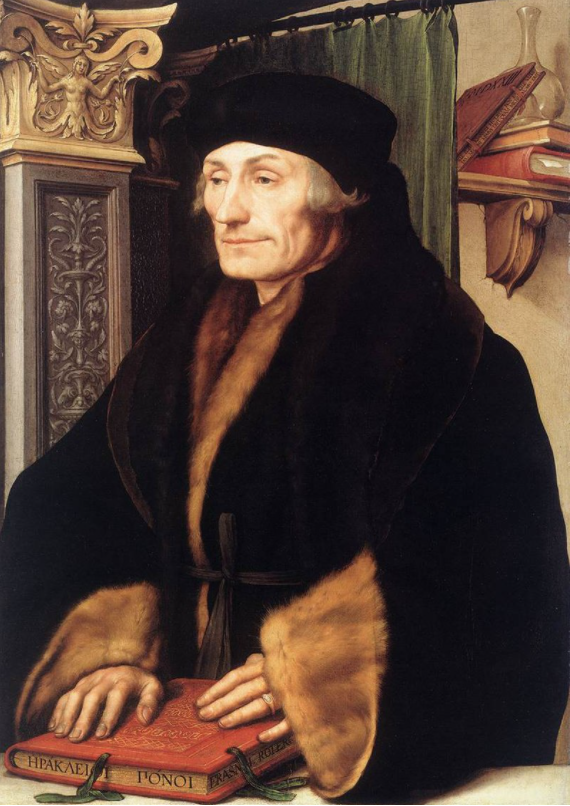
| Erasmus, as per Hans Holbein the Younger |
A recent piece on the BBC News website headlined Erasmus: What could happen to the scheme after Brexit? and written by BBC Reality Check's Anthony Reuben has been described today as showing "the BBC's pro-EU bias both blatant & unrestrained...written wholly (& ultra-sympathetically) from the EU viewpoint...Could have been written in Brussels." It certainly only cites pro-Erasmus points, including a House of Lords report that "warned the benefits of the Erasmus programme would be very difficult to replicate with a national programme as the government is planning" and which claimed that "vocational education and training would stop, and that leaving Erasmus would 'disproportionately affect people from disadvantaged backgrounds and those with medical needs or disabilities'".
Is this true though? Googling around, I found an LSE post from 2017 by Charlie Cadywould that, while being in support of the UK staying in the Erasmus scheme, does have some issues with it, saying:
It has a real problem reaching people from deprived backgrounds, ethnic minorities, and those who don’t go to university. The scheme has been expanded to include a vocational element, but it represents a miniscule portion of the Erasmus programme, which is still dominated by university students. If we look just at the raw numbers of Brits who participated in Erasmus to study in 2015, 11,981 (86 percent) were enrolled in higher education, compared to 1,943 (14 percent) participating in vocational education or training.
However, while higher education study placements typically lasted for the best part of a year – the average length was 211 days of funded study – vocational learners typically only spent two or three weeks abroad. In fact, when the total number of days funded through Erasmus in 2015 is aggregated, less than 4 percent went to those enrolled in vocational education and training programmes.
Anthony Reuben of the BBC's Reality Check evidently took Baroness Helena Kennedy & Co's word for it that Erasmus disproportionately helps the disadvantaged and has a key vocational element. I think Charlie Cadywould's analysis suggests the reverse is true and that it actually favours "elites" and those attending universities on non-vocational courses.
Sticking with the BBC's Reality Check correspondent Chris Morris...
I'm reviewing his performances on the BBC News Channel on Christmas Eve and have come to the bits where he responded to the two press conferences announcing the EU/UK deal - the first from the EU, the second from the UK government.
Both performances absolutely epitomise the BBC's reporting of the two sides over the past four and a half years.
After the EU press conference, the BBC presenter and Chris Morris reviewed what Michel Barnier and Ursula von der Leyen said.
Words like "interesting", "fact", and "highlighted" were deployed, along with several uses of "said".
Their remarks were presented without criticism, or countering points, or distancing words. It was all very respectful.
Then Chris belittled concerns about fishing.
In contrast...
After the UK press conference, the BBC presenter reintroduced Chris Morris with the words, "I want to speak to Chris Morris, who has been sitting with me listening to those news conferences, and listening to Boris Johnson in particular, and was quite keen to just pick up on a few of the things that you heard".
Guess what happened next? What precisely was it that Chris Morris was "quite keen" to say?
Yes, the BBC's reality checker-in-chief launched straight into 'reality checking' Boris Johnson, picking up on something the UK PM said and disagreed with it. The phrases "ignores the fact" was quickly deployed.
A long litany of negative points about what Brexit means the UK then followed, plus more "I'm not quite clear where the argument comes" towards positive claims about the post-Brexit future.
Then came more negative stuff about what we'll be losing regarding access to EU crime databases.
And then, to conclude, "I think both sides will try as hard as they can to move towards a situation which suits both of them. Obviously, as much cooperation as possible but it won't be quite the same as being inside the tent."
There's not a doubt in my head that Chris Morris wishes we were still "inside the tent". His entire reporting leaves no room for doubt about that.
Feel free to mention Sherlock, and bears in woods, and the exact faith of popes...
********
Anyhow...
Just to end today's string of Chris Morris posts, here's a complete transcript of one of the BBC Reality Check chief correspondent's contributions to the BBC News Channel on the morning of Christmas Eve. It oozes bias:
The world would be a much better, saner place if we all had our predictions replayed back to us every now and then. Predictions are a way of expressing our preferences while sounding knowledgeable. For elites, they are a way of standing ahead of others, pre-empting us.
Chancellor of the Exchequer Sajid Javid has said there was not "a single doubt" in his mind that the UK would "have agreed and finalised a very ambitious deep and comprehensive trade deal" with the European Union (EU) before the end of next year.That's when a post-Brexit transition period is due to come to an end.""Because there's already an agreement, there's already an agreement in principle. It's there," he told BBC Radio 4's Today programme.But this is not the case.
While "Get Brexit Done" may be a good campaign slogan, slogans don't make trade agreements.
Ratifying any agreement before the end of next year would take several months, so the negotiations themselves would need to be completed by the summer.
One other thing: as well as negotiating with the EU, the UK would also need to sign up to a series of trade agreements round the world to replace those it has as part of the EU.All of that could take up most of the next decade. It won't be done when the UK leaves the EU - it will only just have begun.
Wrong again. By Christmas Eve 2020 the UK had secured trade deals with 61 countries plus the EU.
This seems to me to perfectly illustrate Ben's point that "predictions are a way of expressing our preferences while sounding knowledgeable".
The BBC's Chris Morris's surely got this so badly wrong because he wanted to believe it would be painfully hard for the UK to sign up to trade deals around the world, and that is down to his feelings about Brexit.
One of the minor agonies of the Brexit process since 2016 has been the existence of the BBC’s Reality Check, usually presented by Chris Morris. Rather than arguing the issue with political leaders, Morris gives ex-cathedra pronouncements on where the truth lies, which are then unquestioningly accepted by his flock of fellow-BBC staff. Funnily enough, his version of reality seems always to coincide with the view from Brussels.
On the Today programme yesterday, Morris was asked by a deferential Mishal Husain to pronounce on whether “Get Brexit done” was misleading. He said, in essence, that it was. He complained that the slogan gave the “impression” that everything would be settled by 31 January 2020, whereas in fact the Tory “rush” for a trade agreement by December 2020 was itself unrealistic.
When (and before) Boris Johnson became Prime Minister, BBC experts kept telling us that the EU would never reopen negotiations or offer Britain better terms than those they had given Mrs May. Yet they did, very quickly.
Nobody wants to be the one that says it's not going to happen. But it's not going to happen. Maybe, maybe, there is a 0.0000-0.3% chance that it will happen.
The current proposals on the table are not acceptable to the EU, full stop. Let's be honest about that. The chances of getting a deal now, between now and the EU leader's summit is zero, let's be honest.
The problem reached its zenith after Brexit. Like most London middle-class liberals, the BBC couldn’t understand why 17.4 million had voted to leave the EU. But then it has never seemed to make any attempt to do so. After the referendum, it panicked, apparently believing that the Leave vote was a consequence of its failure to dispel politicians’ “lies” or “populism”.
Thus for the last three years, it has gladly wheeled out its “Reality Check” fact-checkers to pick holes in the case for Brexit, deploying them only occasionally to question the case for Remain. Its ostensibly impartial presenters, meanwhile, feel the need to stand in judgment over the argument, determining what is “true” as if viewers were incapable of making up their own minds.
Michael Gove: Under Boris's leadership we are truly a party for the whole nation. Just think about it: next year both the Durham Miners Gala and the Notting Hill Carnival will take place in seats represented by Conservative MPs.It was a great line which captured this seismic nature of the election result and it was picked up and rebroadcast. But the detail wasn't actually true. The Miners Gala is held in the City of Durham, a seat Labour retained. Maybe it was an honest mistake after a long night - we've all made those - but this has been an election characterised by bluster and distortion where the end always seemed to justify the means. And that begs the question: do facts not really matter much any more? The evidence from the campaign suggests that quite often they don't, and trying to fact check them up the agenda simply doesn't work if false claims and misrepresentation can be pumped out to hundreds of thousands of people unfiltered via social media. There's always been spin of course and politicians should be trying to persuade us that we should vote for them. That's what it's all about. But in this new era - you can call it post-truth politics, if you like - the narrative is far more important than the detail, and if the facts don't quite add up the story can be embellished by half truths and smokescreens. If it works for Donald Trump across the pond then why not here? It's not so much about politicians always lying as about politicians not really caring whether something is true or not. That's where we've got to. And no party came out of the election with entirely clean hands on any of this. There were Lib Dem bar charts which displayed numbers sufficiently out of context to make an honest statistician blush. There was Labour's insistence that the NHS is for sale and that medicines will become more expensive after Brexit, based more on fear factor than on fact.
Jeremy Corbyn: He stood in front of a bus in 2016 and promised £350 million a week for the NHS. Now we find out that £500 million a week could be taken out of the NHS and handed to big drugs companies under his plans for a sell-out trade deal with Donald Trump and the USA.But the party and the leader that was called out on the facts most often was also the party and the leader that won an unexpectedly large majority. And the Conservatives did that, as we know, primarily by providing a simple answer to an incredibly complex problem. 'Get Brexit done' was a comfort blanket. It was what people wanted to hear, and it appears that many voters either didn't know or didn't care that reality will be a lot more complicated. And now, well we've already moved on to new slogans - 'a one nation government', 'a people's government'. What does that really mean in practice? Whatever you want it to mean really, as long as you don't have to deal with any of those pesky facts.
On Wednesday, Chris ‘Reality Check’ Morris seemed to endorse Plaid Cymru’s idea that the ‘lies’ of politicians should be subjected to legal supervision. Behind all this is the conceit that BBC journalism should sit in judgment. This is truly wrong, and quite different from the justified search for accuracy in reporting.The BBC’s constant attacks on social media campaigns are not crusades for truth, but protests by a cartel. On big issues on which it feels strongly, such as Brexit (which it opposes) and climate change (whose wildest alarmists it swallows whole), it is just as biased, though not as cheapskate, as the dotty rubbish to be found online. It is captivated by the Robinson idea of ‘very high-profile journalists’, never wondering whether it is good for democracy that journalists should be more high-profile than elected politicians. And it is beside itself with rage that a once high-profile journalist, one Boris Johnson, jumped ship, got elected and became Prime Minister.I was curious to find out what Chris Morris had said and where. He had a busy day that day, but it was during an exchange on that morning's Today that the Plaid idea was brought up. Here's what was said:
Chris Morris: Well, I mean, in the election overall I think there's probably been more false and misleading statements than ever before. And you can argue it's always been like this, that politics is to some extent about winning by any means necessary. But the amplification effect of social media has really had an impact this time. It doesn't really matter if people like me come up with learned explanations about why a number is wrong if that number then is pumped out by hundreds of thousands of people unfiltered on social media. And I think there will be a corrosive impact if it doesn't matter any more whether things are true or not. And that's one of the reasons why Plaid Cymru has suggested a new law which would make lying by politicians illegal. This was Plaid's leader Adam Price on the programme earlier:
Adam Price, Plaid Cymru: We cannot have a civil and respectful debate about any issue if we accept as the new normal that politicians can make false and misleading statements with impunity because then, you know, we can't have any kind of democratic discourse at all.
Now, that begs a couple of questions. One, how do you really define what a lie is when numbers in particular can be used in different ways to make different points and, two, something we are asked quite a lot, often by really quite angry listeners, why don't we call politicians liars, and my answer that is really because (a) it would become the story and I'm not sure that's useless. That's more reality TV than Reality Check, and also I'm not sure that lying in a deliberate hiding of the truth is the most difficult thing we're dealing with. It's bluster. I'm probably not allowed to use the full word on a breakfast programme, but it's BS. It's not really caring whether what you say is true or not. And I think that's a problem in politics now.
Mishal Husain: And what are the things that have come back again and again throughout this campaign that you and others have not managed to make go away?
Chris Morris: Are you giving me the whole of the rest the programme or about a minute to answer that? I mean, there have been numbers which come back time and time again. I mean, Labour saying that average households had lost about £6,000 a year since 2010 when, in fact, the average household has been calculated by saying you have two railcards and a two year old child, so that was not necessarily representative. The Conservatives talking about building 40 hospitals when we know they've only provided the money so far for six and building hasn't started at any of those six sites. And then, overall, 'get Brexit done'. I mean, the Conservatives are right that if they win and we leave in January then legally we will have left the EU. We heard Michael Gove a few minutes ago saying we can then focus on the NHS and crime and so forth, but is he really saying that next year we'll suddenly stop talking about Brexit and its impact altogether when we have to do a trade deal in record time? I think the reality is that, yes, legally we'll have left the EU, if the Conservatives win, at the end of January but we'll still be talking about Brexit and its impact for years to come.Is Charles Moore being fair to the BBC's Chris Morris there? Was Chris Morris being biased there?
Chris Morris: Another issue, I guess, is the pace of modern media. The fact that you can say live on air, on TV or radio, you can say something which isn't really correct, but to fact check it can take a few minutes. Sometimes it even takes a few hours if it's something complicated, and by then the conversation has moved on. Then of course, there are those things, and you have given some of those examples of claims or numbers that have been used again and again during this election, and it's notable that in some cases, even though there's been pretty comprehensive take-downs by BBC Reality Check and other fact-checking organisations, politicians have just continued to use them. And then the Prime Minister himself has made a particular thing really of doubling down on certain things, even when the evidence really doesn't stack up, most notably, of course, the issue of him saying that there will be no checks on trade between Great Britain and Northern Ireland after Brexit, even though that is precisely what internal government documents and his own Brexit Withdrawal Agreement say there will be. You can then look at labour and Jeremy Corbyn, his message that the Tories are going to put the NHS up for sale. But when you look at the documents he released to prove that, that's not what they say. They don't talk about wholesale privatisation of the NHS. So I think we're in an age where politicians feel in a sense they can get away with things and they can communicate much more directly with voters than perhaps they could before. I think voters are smart enough sometimes to work this out. But if we get to a point where politicians don't care whether something is true or not, then that does I think get pretty corrosive for the state of our democracy.I'm off out soon, so I'm dumping this post lower down the blog. Please feel free (of course) to have your say, and to bias-check Chris Morris.

Chris Morris: Of course, there's going to be pressure - that's what trade talks are all about. There will also be trade-offs. If the UK turns down some of these American requests, then we can expect the Americans to reject some key British demands for access to their market. But none of this is really proof that the NHS is somehow for sale, even if the US would like it to be on the table. But producing a definitive verdict on what the politicians are saying is not a straightforward affair.
Jessica Parker: Looking online, what to take at face value? Last night, a brief rebrand of a Conservative Party Twitter account to factcheckUK. The Conservatives say it was still clear who is running the account, but one senior Labour figure said Twitter should have taken it down.
Getting love-bombed by Charles Moore again. Can you get love-bombed behind a paywall? https://t.co/uqmC1LtmBg— Chris Morris (@BBCChrisMorris) November 26, 2019
“Get Brexit done”, is the Conservatives’ principal slogan and unique selling point, so obviously it should be open to scrutiny. One should object, however, to the pretence that this is merely a factual question on which the media, rising above base politicians, can shed the clear light of truth.
One of the minor agonies of the Brexit process since 2016 has been the existence of the BBC’s Reality Check, usually presented by Chris Morris. Rather than arguing the issue with political leaders, Morris gives ex-cathedra pronouncements on where the truth lies, which are then unquestioningly accepted by his flock of fellow-BBC staff. Funnily enough, his version of reality seems always to coincide with the view from Brussels.
On the Today programme yesterday, Morris was asked by a deferential Mishal Husain to pronounce on whether “Get Brexit done” was misleading. He said, in essence, that it was. He complained that the slogan gave the “impression” that everything would be settled by 31 January 2020, whereas in fact the Tory “rush” for a trade agreement by December 2020 was itself unrealistic.
Morris might well be right about the struggles ahead, but he made no allowance at all for the fact that we are dealing with political issues here, not just technical ones. When (and before) Boris Johnson became Prime Minister, BBC experts kept telling us that the EU would never reopen negotiations or offer Britain better terms than those they had given Mrs May. Yet they did, very quickly.
Nor, in applying “reality” to the Tory manifesto yesterday, did Morris mention that Brexit is an event in law: if the new Parliament votes to approve his deal, that event of leaving the EU will indeed take place by 31 January. In that important sense, we will have got Brexit done.
If I had the resources of the BBC (over £5 billion a year, the great bulk coming from a compulsory licence fee), I would set up a Reality Check on its own claims. It would keep several hundred reporters busy throughout the “24/7 news cycle” 365 days of the year.
- A man on BBC Question Time said he earned more than £80,000 a year but that did not put him in the top 5% of earners. HMRC figures show £75,300 put you in the top 5% in 2016-17. If you adjust that by earnings growth it suggests you now need to be earning about £81,000.
- The member of the audience on BBC Question Time also said earning £80,000 a year didn't even put him in the top 50% of earners. Anything over about £25,500 would put you in the top 50%.
- Thanks to Jolyon Maugham. The HMRC figures do indeed exclude those not earning enough to pay income tax, which means the BBC Question Time audience member would have been well inside the top 5% of earners. You can read more about it here:
- https://www.bbc.co.uk/news/50517136.
- Correction: The HMRC figures exclude those who do not earn enough to pay income tax. If these people are included then the audience member would have been well inside the top 5% of earners.
Throughout #Election2019— Kamal Ahmed (@bbckamal) November 10, 2019
our super workers @BBCRealityCheck will be sorting through the headlines and noise. Our job is to inform our audiences so they know what is going on. Today, do Labour’s spending plans cost £1.2trn? #onthesideoftheaudience https://t.co/ghcvLWSQNW
So Chris Morris is going to put his mucky paws all over our General Election, claiming he's undertaking Reality Checks? The branding is a thin disguise for anti-Conservative opinion pieces. Let's see his latest:
https://www.bbc.co.uk/news/uk-50222315
In this he examines the Conservative Party slogan: Get Brexit Done. Have they analysed "For The Many Not The Few" on Reality Check one wonders...
Well it seems to me this is exactly the sort of thing the BBC should NOT be doing - second guessing political slogans. Chris doesn't waste time. In the first para he is already concluding that the Conservatives have got it wrong and "it's not that simple".
He then misleadingly claims that "Brexit has been pushed back to 31 January 2020" before immediately contradicting himself by conceding it could take place before then.
He claims that Brexit will be "loved and hated in equal measure". No evidence given for this assertion. At the Referendum a million more people loved than hated the idea. But for Chris 52-48 has become 50-50.
Morris uses Remainer language throughout, referring to the WA as setting out the "divorce" agreement. This suggests a union of two parties, but that was never the case: we joined a club. A better analogy would be settling the bar bill.
At the end of the opinion piece he states: "Whatever happens in the next few months, the fallout from the Brexit referendum will remain with us for years to come."
The dictionary definition of "fallout" is "the adverse results of a situation or action". That is a very biased word to use in context.
Image copyrightGETTY IMAGES