Saturday, 8 April 2017

Marking our own homework

The BBC’s Newswatch programme explored the difference between the way complaints will be dealt with by the BBC’s new independent external regulator Ofcom, the body that, from Monday, is replacing the BBC Trust. 

“Now, who decides what constitutes impartiality, balance and accuracy in BBC news reports?” asks Samira Ahmed “and passes judgment when those values have been infringed”


She spoke to two media experts, Professor Steven Barnett, Professor of communications at Westminster University, and Stewart Purvis former chief executive of ITN and a former partner at Ofcom.

Formerly a complaint would go to the BBC Trust, explained Steven Barnett, adding: “which, despite the name, in my view at least, was actually a pretty independent body [..] the perception was that it was just  - once again - the BBC.” (Marking its own homework, as Samira put it earlier.)

Initially your complaint will still go to the BBC, and “if you then want to escalate it” it will ultimately be dealt with by Ofcom, said Professor Barnett. 

Samira pointed out that the BBC chair wants a scientific approach to this (analysing bias) but Stewart Purvis says we want human judgment involved. We want people to take account of the context, background and a series of factors before the regulator comes to a decision. 

Samira said it would be good if the BBC did a proper ‘head count’ of people on panel shows and the amount of airtime. “I’ve heard complaints about people being talked over and not getting their fair share”.

“You’ll always get complaints from people who see the news through their own lens” 
opines the professor of communications. 
Particularly on some of the big issues like the referendum, Brexit, the Middle East, which is the ones they get the biggest lot of complaints” 
“You can count the number of minutes as much as you want - you can count the number of heads, you can count the number of times on different sides that someone is for or someone is against. In the end it is going to be a matter of judgment.” 

“It’s going to politicise Ofcom in a way that it hasn’t been before. It’s going to put it in the firing line. It will put it under pressure from those that aren’t great friends of the BBC, I’m thinking in particular of the major publishers, and some of those who are the major critics of the BBC. Once Ofcom comes down, which they will, on the side of the BBC, I suspect we are going to see more criticism of Ofcom than we have seen so far.”

Actually, as far as I’m concerned, that’s all fine and dandy. Apart from one or two tell-tale signals.

In search of a credible snapshot of Steven Barnett’s own “lens” (other than just his appearance, which, let’s face it, he looks like a lefty - let’s see if he ‘talks like a lefty’ and quacks like one) what does one do these days but turn to Twitter. So, through his Twitter feed thing, he makes no secret of the fact that he’s the academic variety of your bog standard, lesser spotted anti-Brexit, anti-Islamophobia, anti-Trump, pro-refugee, liberal lefty.

I just thought, if the media is entirely in the hands of left-wing media studies professors, what hope is there for “impartiality”, now and forevermore.

Now, I’m the first to admit, and I think arch stopwatch/calcuator specialist Craig would agree, that your stopwatch findings aren’t the be-all and end-all of bias evaluation.  But they are a significant  indicator of what the BBC deems “right’ or ‘wrong’. 

For example, no-one in their right mind would be happy if the BBC suddenly felt it had to give an equal platform to (insert something that’s universally considered to be beyond the pale) say, advocates and opponents of paedophillia, or Islamic State. 


But when it comes to areas and opinions where the left-liberal consensus that dominates the media gets a more generous slice of the BBC’s platform than opposing or contrasting views, which might represent a considerable number of viewers, then your stopwatch gauge comes in handy. Not everyone shares the same view on what is or isn’t ‘beyond the pale’. Especially on issues such as the ones Steven Barnett cited, viz: Brexit and the Middle East .

Friday, 7 April 2017

Life's too short


If you’ve got a spare 5 minutes, listen to caller “Caitlin” spout handfuls of cliches and meaningless banalities in a quavery voice on the Stephen Nolan show. 
You’d get a better picture of the programme, which was about the Livingstone affair, if you heard the whole thingbut you might feel life’s too short. 

Towards the end of the show when the torrent of falsehoods reaches a crescendo, Nolan silences Douglas Murray. “Let Caitlin speak!” So Douglas was prevented from putting matters straight.  What unsatisfactory chairmanship. A truly pathetic way to chair a phone-in.

Lorry rams crowds

It’s terrible to hear about another vehicular attack; as someone online laments: “and Sweden isn’t even involved in fighting ISIS!”

The BBC says: “Stockholm lorry rams crowds, killing at least three people” and tells us that Swedish officials are calling it a terrorist attack.


At the bottom of the page they have this “Timeline”:


Oddly enough, it seems like only yesterday when the BBC reported another vehicle ramming. Oh yes, it was yesterday.


Why does the BBC think car-rammings in Israel are somehow not worth including in their  "Vehicle ramming Timeline" ?


A question


Wailing Lord Hall


As noted by David P. on the last open thread, a fine article about BBC bias by Simon Jenkins in the Guardian includes a remarkable passing comment about the BBC's director-general:
After the Brexit vote last June, Robinson’s boss, Lord Hall, went round the London dinner circuit wailing that BBC balance had “lost us the election”. It had given too much credibility to leave. 
It's the first I'd heard of that. Has it been reported elsewhere?

If Lord Hall did behave like that then that's surely a serious breach of BBC impartiality by the corporation's editor-in-chief. 

Or am I missing something?

Stopwatches and calculators


Over at The Conservative Woman David Keighley has posted a thoroughgoing critique of Nick Robinson's remarkable Radio Times intervention in the BBC bias debate, wherein the Today presenter essentially called for people like us to stop monitoring the BBC and simply trust the corporation's editorial judgements and its "bias towards understanding".

It's a very tendentious piece, evidently provoked by two things: (1) those 70+ pro-Brexit MPs who criticised the BBC in an open letter and (2) that News-watch study which showed a massive imbalance towards negativity in Today's business coverage.

Nick Robinson's criticism of the use of "stopwatches and calculators" is, of course, a familiar BBC trope. Senior BBC figures have been rejecting unhelpful statistical studies of their outputs for years by dismissing "stopwatches and calculators", so Nick is treading a well-trodden BBC track....

....except that (a) the incoming BBC chairman Sir David Clementi has himself called for "scientific" monitoring of bias and (b) the BBC's impartiality reviews over the last decade have themselves used studies that employ "stopwatches and calculators" (from the ex-BBC/far-left-dominated Cardiff University media department), so it's clearly been OK to use statistical studies of BBC bias if the conclusions help the BBC and counter the wrong kind of statistical studies - i.e. the ones they don't want the public to believe.

If (and acting under whose authority?) Nick Robinson is telling us to 'get over it' and stop worrying about BBC bias and just trust the BBC to 'do the right thing', then he's frankly pretty much asking for a blank cheque. 

And he's not going to get it. 

Going down well (so far)


I haven't seen much of the BBC's coverage of the Trump administration's military strike on a Syrian regime airbase but I'm getting a strong sense from the Twitter feeds of many familiar BBC reporter that the US military action is going down well with the (duly impartial) BBC.

Here's a small selection, beginning with the the BBC's Washington bureau chief, Paul Danahar:


...a point that Newsnight presenter James O'Brien has already taken on board: 


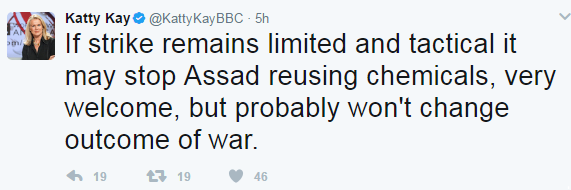
Even Katty Kay is positive about the strikes:


And for the first time ever, I've actually seen BBC reporters re-tweeting criticism of Stop The War types opposed to US military action - including Hugh Sykes:


...and John Sweeney:


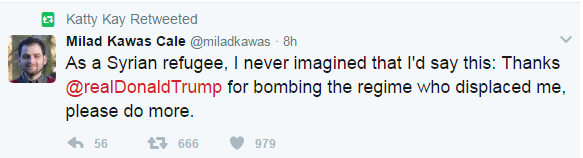
John Sweeney is also among those BBC reporters re-tweeting Arab appreciation for President Trump's actions (and not - for once - re-tweeting Arab criticism):


...as is Katty Kay:


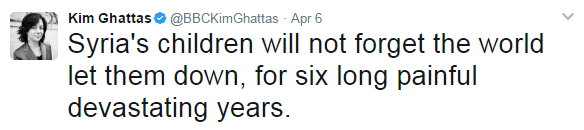
Others, like Kim Ghattas, are following their earlier tweets criticising the lack of action (by persons unspecified) over the last few years:


...with attacks on those critical of last night's strike:


Others are tweeting about editorials that back the action (and not tweeting about editorials which criticise the action), such as Ian Pannell


...while others are placing a positive gloss on the politics of the military strike, such as Barbara Plett:


Others are even hoping that President Trump might go even further and do something even better, such as Laura Bicker:


The BBC's Middle East editor, Jeremy Bowen, has tweeted nothing about the strikes yet. Nor has the BBC's World Affairs editor John Simpson.

How much of any of this is feeding into the BBC's actual reporting I can't yet say (as I've not had time to check it out), but a definite BBC point of view is emerging on Twitter. 

There are also, naturally, plenty of digs at Donald Trump for his past flat-out refusal to back military action in Syria, though even here - as with Quentin Somerville - there are surprising defences of Trump:


As for my Twitter feed in general, it's been fascinating seeing nearly all the anti-Trump types backing the strikes and nearly all the pro-Trump types opposing them - and Trump. 

It's all gone topsy-turvy today.

Thursday, 6 April 2017

The Livingstone affair continued.


The Ken Livingstone affair has turned into a soap opera.
100 Labour MPs have now expressed their disgust at the leniency of Livingstone’s punishment - temporary suspension rather than expulsion from the party. This is widely seen as a tokenistic punishment for bringing the party into disrepute, the offence with which he was charged and found guilty by a hitherto anonymous committee of three. (It now appears that at least one of the three was far from impartial) 
Jeremy Corbyn has come up with a “sorry if anyone has been offended” apology. (If Corbyn’s statement  sounded slightly more generous than that, its belated timing suggests the sheer weight of numbers of the Labour MPs  who have spoken out forced him to make it.) 

I have had a good look at LabourList.org  - not a site I would normally visit; I ought to say they are making a genuinely sincere effort to examine this issue. Here’s a snippet:
“LabourList reported these comments at the time – as did dozens of other media outlets. Ken has since adopted various defences, all of which are hopeless.

  • accusing the Jewish Chronicle of “printing a lie”;  
  • attacking Labour’s disciplinary panel, saying only a “biased or rigged jury” could find him guilty of breaking party rules; 
  • refusing to apologise and claiming there was “real collaboration” between Nazis and Zionists before the Second World War; 
  • apologising “if anyone is upset” by his views when he appeared on BBC Newsnight this week. 

I am not aware of any television programmes, newspapers or blogs which have published significant corrections to their reports of Livingstone’s comments. The editor of the JC derided the ex-MP’s attack on the paper as “bonkers”.
One of the most disturbing aspects of this whole pantomime is the amount of unadulterated Jew-hate that it has unearthed, both in below-the-line comments sections and in general.
The BBC hasn’t helped by narrowing the argument to a diversionary one, of semantics. ‘Did the former Mayor of London say that Hitler was a Zionist, or did he actually say that Hitler “supported” Zionism?’
Who cares? Lost amongst all this irrelevant dancing-on-heads-of-pins obfuscation is ‘context’.
Livingstone insists that his bizarre interpretations of the Ha’avara Agreement are “true” because they come from published material. The public might not know that the work he cites was penned by a tiny number of Marxist, anti-Zionist activists whose revisionist history  is generally considered to be deeply flawed.

As far as I know, no-one from the BBC’s vast reservoir of experts has delved into that argument at all; certainly not in a sufficiently erudite fashion to persuade the public that it’s nonsense. It’s up to the Jews, apparently, to refute these unfounded theories for themselves, and ‘they would do that wouldn’t they’. 
So the stench of an injustice - that Ken has been vilified for ‘telling the truth’ - ever-lingers.

To put paid to Livingstone’s loopy distortions once and for all, the BBC (as per its charter obligations to educate and inform) should immediately air legitimate, authoritative rebuttals such as those by Paul Bogdanor, which are perfectly accessible for those that care to look. 

I suppose the BBC considers them too dry, too difficult and too demanding and not at all what the loony left and the anti-Zionists want to hear.   They are “In our Time” territory at the very least. 


“First, Hitler despised Zionism. In fact he ridiculed the idea as he was convinced that the Jews would be incapable of establishing and then defending a state. More importantly, he and his government viewed the prospect of a Jewish state in Palestine as part of the broader international Jewish conspiracy which his fevered imagination presented as a dire threat to Germany. While (after robbing them of most of their possessions) the Nazis did allow some German Jews to leave the country in the 1930s in order to travel to Palestine, that policy was primarily driven by a desire to get the Jews out of Germany rather than to build a Jewish state in Palestine. 
By the late 1930s the Grand Mufti of Jerusalem, Haj Amin al-Husseini, who later collaborated with the Nazis in wartime Berlin, had informed German diplomats stationed in Jerusalem that the entry of Jews into Palestine from Germany was angering local Arabs. For reasons of their own, the Nazis cut off Jewish emigration in 1941 to pursue their goal of murdering Europe’s Jews. This ignorance about the implications of the Holocaust is stunning.”


Defending himself during the Labour Party inquiry into his past statements about antisemitism, Ken Livingstone has unleashed a series of unfounded charges of “collaboration” between Jews and Nazis. 

According to him, not only was there a deal with the Third Reich (the Transfer Agreement or Ha’avara), but the SS also established training camps for German Jews, Hitler passed a law permitting the flying of the Zionist flag, and the Nazis supplied weapons (Mauser pistols) to the Jewish underground. 

All these claims are distortions or inventions. The Transfer Agreement, for example, allowed the salvaging of some German-Jewish assets from confiscation by Hitler’s regime while facilitating the rescue of many thousands of individuals. In his written submission to the Labour inquiry, Livingstone cites two sources on the agreement: one paper by Yf’aat Weiss and another by Francis Nicosia, who is also the author of two books examining the issue. Neither the papers nor Nicosia’s books endorse the “collaboration” fantasy.


“Brenner was born to an Orthodox Jewish family in 1937. By his teenage years, he was an atheist and a Marxist. In the 1960s he was arrested repeatedly for his activities in the civil rights movement and for marijuana possession, ultimately spending several years in prison. An acquaintance from those years remembered him as ‘a non-student “Marxist agitator” who would stand near the Bancroft strip and rail about the Pope, the Bay of Pigs, and marijuana, indifferent to the fact that most passersby thought he was “certifiably crazy”’ (Berkleyan, 2004).”

Revisionist historian Lenni Brenner

It shouldn’t really be necessary to have to rebut "Ken’s" theories at all. Why not? Because the all important context has been forgotten. 
Don’t forget, the reason his opinion was sought in the first place was because of Naz Shah’s unfortunate reTweet, and also because of the spate of antisemitic comments made by several Labour MPs, which eventually forced Jeremy Corbyn into the disgraceful Shami Chakrabarti debacle.
It shouldn’t be necessary to remind anybody that Livingstone’s ridiculous TV and radio performances were specifically concocted to defend Naz Shah even after she had confessed to her own, allegedly inadvertent, antisemitism; she’d apologised profusely for it and made considerable effort to understand it.

I don’t care whether the Labour Party expels Ken Livingstone because Jeremy Corbyn’s hopeless leadership has rendered the Labour Party an irrelevance. 

This particular episode together with numerous others, which Daphne Anson has neatly collated all but guarantees that “Ken” has made enough of a fool of himself to demolish what credibility he once had, and it looks as if he’s taking his racist followers with him. So, good.

I care more about the BBC’s duty to put things right. It must cease caving in to revisionists and distorters of history and it must replace nonsense with authentic historical data, tout suite. Pandering to Jew-hating Islam, for whatever reason, is wrong. By giving undue credibility to fools the BBC flaunts its own ineptitude.

Update: 
Naz Shah has tweeted again.  (Some of the replies are illuminating) 


Monday, 3 April 2017

Hope and Chutzpa

I feel the urge to revisit some recent topics.

Sayeeda Warsi is one of the BBC’s privileged Muslim spokespersons whose visceral hatred of Israel is always allowed to stand unchallenged. Since I posted my earlier comments several further reviews of her book The Enemy Within have materialised.
Jenni Russell, for instance, in the Sunday Times (£) has written a rather respectful review, but one gets a vague impression that she’s written it through gritted teeth.  If that’s not purely a figment of my imagination, one might well ask, why? Why submit a review that seems to be holding something back? I know. That sort of speculation is  above my pay grade.

Here’s a passage:
“She identifies the anger over Salman Rushdie’s novel The Satanic Verses, in 1988, as the first time that British Muslims became politicised as a community. Furious Muslims felt the state was failing them by refusing to prosecute Rushdie for blasphemy. The government, horrified by the bounty placed on Rushdie’s head by Iran, felt bound to defend one of liberal Britain’s fundamental rights, to speak and publish freely. Mutual incomprehension “set Muslims on a journey of simmering resentment and a narrative of grievance”. After 9/11 and the war on terror, Muslims came to be seen as a problem, with their religion, not their Britishness, as their defining identity.”

To me that seems almost conspicuously non-committal. Has Ms Russell caught the BBC’s value-judgment-o-phobia?

Another article on the Baroness cheered me up far more. It’s by Col. Richard Kemp. Surprisingly the BBC still consults him on military matters from time to time, which is surprising. One would think his commitment to defending the IDF would have discredited him altogether in the eyes of the BBC.

Here are a couple of passages:
The chutzpah of Sayeeda Warsi. I mean that in the Yiddish sense of despicable insolence, but likening the Israel Defence Force to the Islamic State is much worse, it is dangerously irresponsible. Warsi excuses IS and Muslims who leave Britain to murder and rape for them yet condemns the IDF and British Jews who serve in their honourable ranks. 

Coming from the most prominent Muslim parliamentarian, this will make Islamic jihadists sniff blood. It will encourage UK Muslims to join terror groups and embolden IS. Repeating the lie that Israel committed war crimes in Gaza validates Hamas’s human shield strategy and encourages further violence and killing. She has blood on her hands.
Her arguments are absurd. She obviously doesn’t care about the so-called loophole she demands is closed: allowing British citizens to join a foreign army. If she did, she would apply the same in reverse, condemning the thousands of Gurkhas and Commonwealth soldiers in the ranks of the British forces today. 

[…]The IDF are the diametric opposite of this (IS) evil. They are the army of our close allies, at the forefront of the war on terror. Israeli intelligence has saved many British lives on the battlefields of Iraq, Afghanistan and Libya, here at home and abroad.
Israeli drone, counter-IED and battlefield medical technology have made our forces more effective and kept British soldiers alive and fighting. 

Israel’s staunch military backing to Egypt and Jordan has held IS at bay and prevented an even worse immigration flow into Europe. 

Will our young people who join the IDF cut off their victims’ heads, burn them in cages, bury them up to their necks and leave them to die, line them up and shoot them in the back of the head, systematically destroy their cultural heritage, rape their women and children, torture their prisoners, beat and abuse their elders, as IS do? 

I won’t even answer that. The IDF complies with the Geneva Conventions and with Jewish morality handed down across the centuries. In their efforts to avoid civilian casualties in battle, they are admired and emulated by armies throughout the world. 

I have seen many young British IDF soldiers in action. I hugely admire their dedication, humanity, professionalism, courage and fighting spirit. 

I abhor and reject the contemptible accusations of Sayeeda Warsi. Unlike these brave Jewish men and women, she has never put herself in harm’s way for her country, has no understanding of the depredations of our bestial IS enemies or the righteousness of our friends and allies of the IDF.

*************

The other piece I want to quickly revisit concerns our old friend Ken Livingstone and his wretched hearing.

On Harry’s Place Sarah AB draws our attention to a pathetic Steve Bell ‘cartoon’ that the Guardian deems worth publishing. In my opinion it has nil merit. It’s really badly drawn and its message contains neither wit nor humour. Any discernible satire, should anyone wish to discern some, misses whatever target was in Steve Bell’s head and lands - bullseye fashion - upon seriously unfunny antisemitism.


Tomorrow. The verdict.

************

I see Owen Jones has put his social media flounce behind him and has returned to Twitter. Having been  vilified by the Corbynistas for not being sufficiently antisemitic, (at least not enough to boycott the Jewish Labour Movement) he used the first Henry Smith Memorial Lecture  to try out  a spot of damage limitation by keeping a toe in both camps. 

Firstly condemning antisemitism - why, some of his best friends are Jews -  then denouncing Benjamin Netanyahu: “riddled with bigotry”,  and the current Israeli government: “hard-right, bigoted, violating international law and making peace impossible.” 
Here’s a taster from a report in “Jewish News”:
“But Mr Jones — who has not yet visited Israel — did not pull his punches when it came to condemning the current Israeli government. Describing himself as a passionate supporter of Palestinian self-determination, he described Mr Netanyahu’s government as “hard-right, bigoted, violating international law and making peace impossible.”

Owen’s Twitter thingy gave me a nasty shock, too. Owen is appearing at the Hall for Cornwall next week.. His performance is titled: “The Politics of Hope”.
I’m well aware that there is a strong Corbynista contingent in west Cornwall, as well as a mini branch of the PSC.  (H/T David Collier)The Corbynistas in the audience, if they could afford the £13 per ticket, could easily turn into a nasty little baying mob. 

It’s a great shame that so many social justice warriors believe their racist campaign is morally righteous. For disseminating misinformation and bias, I hold the BBC responsible.

**************

One of the least offensive stories of the day is the undercover apostrophe doctor. Many viewers must be baffled. The greengrocers amongst us, at any rate. 
The BBC really ought to set out the proper rules for apostrophes so that the people who aren’t quite sure could get educated. (Oh, they do!) I have to say that the intrusive ‘greengrocer’s apostrophe’ undermines many an otherwise fine bit of prose.


Open Thread


Let your mice play:

Changing priorities


It is interesting how news stories that have dominated the BBC News website for a day or two suddenly drop down the news agenda. 

The horrific killing of a young Kurdish-Iranian asylum seeker has been the lead story on the BBC News website for a couple of days and yet, this morning, has dropped to the 'small print' section of the BBC's home page main headlines as their 7th-placed story. 

Sky News, in contrast, still has it as their second story and ITV has it among their 'large-print' headlines as their 5th-placed story. 

Another difference between the three broadcasters is that both Sky and ITV have a major update on the story - the release of images of those the police want to question in connection with the attack:


...whereas the BBC's report includes no mention of the police's release of images, let alone the images themselves.

Presumably that's the BBC being 'cautious' again.

Will this be a topic next week?


Talking of Samira Ahmed...

Of all the Twitter complaints that can be made about Dateline London - and there are often complaints (along the lines made on this blog for years) that the programme has a pronounced left-liberal bias and too little variety of viewpoints - only one has been picked up and run with by Newswatch presenter Samira Ahmed on Twitter
Samira Ahmed‏ @SamiraAhmedUK  19h19 hours ago Seeing some viewer concerns re politicians on journos' forum #DatelineLondon. Send thoughts to @newswatchbbc. http://www.bbc.co.uk/programmes/b08l99r9 
The politician in question was Michael Gove.

Given that Samira has also used her Twitter feed to encourage viewers to contact the programme and complain about the presence of Nigel Farage on various programmes, it's not the first time that she's asked for viewers to 'send' in their 'thoughts' on stopping certain (right-wing) politicians from getting invited onto BBC programmes. 

I think her mask of impartiality on Newswatch is slipping dangerously.

That said, maybe Dateline isn't the place for politicians of any political hue to appear, even those who write for The Times.

"You get impartiality by really good judgement"


For those who didn't see this week's Newswatch, here's a transcription of the interview between Samira Ahmed and the BBC's chief political advisor Ric Bailey. 

Mr Bailey makes the usual case that the BBC is getting it about right and that you can't measure bias with a stop-watch, as well as having a dig at those MPs who criticised the BBC's Brexit coverage, while Samira Ahmed gets confused between Lloyds of London and Lloyds Bank: 

SAMIRA AHMED: Well, let's take a step back and examine the BBC's approach to reporting on our forthcoming departure from the European Union with the corporation's chief political adviser, Ric Bailey. As you heard, there are strong feelings on all sides. Is there something different about Brexit which makes the BBC's commitment to impartiality actually quite a new challenge? 
RIC BAILEY: I think whenever you have a referendum, in particular, opinion becomes very polarised and views become very entrenched and it is very difficult often to appreciate or even value impartiality in those circumstances. That vote is now done, it's over. Leave have won and our job now is to really scrutinise carefully the execution of Brexit, if you like. How the government carries out Brexit, how it carries out the negotiations, to scrutinise not just the government but other politicians. That's why Andrew Neil did all these interviews this week with party leaders across the UK, but also of course to scrutinise European Union officials and politicians in Europe. So our job now is much more intricate and complicated than a simple, sort of, mathematical balance between people who were Remain or Leave. So that journalistic challenge is really very strong. But the audience trust the BBC to do it more than anyone else. 
SAMIRA AHMEDBut, as we were saying, we do get a lot of complaints, especially from pro-Brexit viewers, who say the BBC, they feel, is actually rerunning the referendum by always airing what might go wrong or might not work. How do you answer that? 
RIC BAILEYThere will be parts of the community who will have concerns about it and we should report that. I don't think every time we find somebody who is optimistic or pessimistic we should suddenly have to find the opposite view every time. We're no longer in that situation of a sort of mathematical balance. What we do have to do is report it properly, so that the audience understands what the challenges and issues are. But that must be a broad range. It mustn't just be those people who are worried, it must be also those people who think there are opportunities. 
SAMIRA AHMEDWe heard a reference to the march last weekend, that the BBC supposedly goes to great lengths to ensure their coverage is impartial. Could you give us an insight into how you do that, how you monitor and measure impartiality? 
RIC BAILEY: In the end we put a lot of obligation on individual editors of programmes to do that and part of what I do is to help them make those judgements. But across time, it may not be one individual programme, it may be a series of programmes, people have to think about making sure they're getting that range of views, and that will be different for different programmes. 
SAMIRA AHMEDIs that partly about a head count, or about measuring air time? 
RIC BAILEYI think it's really important that we don't pretend that you can get impartiality by the stop watch, or the abacus or a calculator. You don't measure impartiality by maths. You get impartiality by really good judgement, and that's what our editors are trying to do all the time. 
SAMIRA AHMEDPeople also wonder how the BBC should be reporting a story like, say, Lloyds Bank moving lots of jobs to Brussels. To some viewers, it is an example of emphasising the negative, when that's only one event in a big, often very quickly changing picture. 
RIC BAILEYI think you have to make judgements on individual stories, and you have to decide what level of prominence they're due, and you have to take advice on that from the business community and so on. So, in the end, editors make judgements about those things. I agree that it's important that when you hear those stories you are also hearing other stories that might reflect something from a different perspective. After all, this is going to go on for a long time. Over the next couple of years of negotiations there will be many examples of this and I think it's quite right that editors should be challenged to think about a wide range of views, not just those stories that you've heard talked about by viewers today. 
SAMIRA AHMEDOn the other hand, many viewers have got in touch with Newswatch to say any criticism, any critics of Brexit, are just labelled 'Remoaners' and they feel the BBC is cowed by the political criticism, notably from those MPs who complained to the director-general. Are you cowed? 
RIC BAILEYOne MP actually said this week that relying on MPs to be arbiters of impartiality was a bit like asking Sir Alex Ferguson to referee a home match at Old Trafford. I think you've got to remember where criticism is coming from. It's very important that the BBC listens to criticism and acts on it, particularly if there's evidence, but it's also really important that we're robust in defending the BBC's editorial decisions and its journalism when we get political pressure. Sometimes there will be genuine issues, sometimes there will be political pressure, and it's very important to the BBC's independence that it withstands that. 
SAMIRA AHMED: Ric Bailey, thank you very much. 

Saturday, 1 April 2017

While the cat’s away

With Craig temporarily off-piste, or piste-off - I’m not quite sure - this site is likely to become more Jewy than some readers might find necessary. 
It might even make some of our readers piste-off too, but I make no apology. While the cat’s away and all that.

Here are some things that have been on my mind for the last few days, then I’ll leave you alone.

One of the issues that have been simmering away for quite a while is that faux academic symposium which is taking place in Cork, right now.
  
(Update: More here. David Collier is there, reporting the event on our behalf.)

It calls itself a conference, and with all the speakers bar one hell-bent on delegitimising Israel, it certainly lives up to the definition: a formal meeting of people with a shared interest.

Of course this is something the BBC has no interest in, but as it is so controversial, (well, it is with some of us) you’d think at least it would have been featured on The Big Questions. Perhaps it will be, tomorrow?


The other thing that is taking place right now has been reported by your most trustworthy of broadcasters. 
It’s Ken Livingstone’s optimistic response to the hearing which is to decide whether his ‘Hitler’ remarks brought the Labour party into disrepute. Things are going his way, he’s beginning to think

Good old Ken. I hope they do reinstate him, for the very good reason that it will further cement the Labour party’s well-established ‘disrepute’. 

Never mind that he’s steadfastly determined that Hitler’s helpful approach to deporting Germany’s Jews was ‘supporting Zionism’ and nothing to do with antisemitism, despite Naz Shah’s belated admission that the Tweet in question absolutely was.

Never mind whether he did or did not say that Hitler was a Zionist. Even he realises that that is an absurdity too far.


Ho hum. We’ll just have to wait and see.

Antisemitism still going strong

With an agenda to promote diversity and social cohesion, the BBC necessarily turns a blind eye to the antisemitism within the Muslim community. 
It would be ridiculous to deny that hatred of Jews is the default position of Muslims, as even Mehdi Hasan, one of the most prominent offenders, has freely, (and rashly) admitted. 

The irony is that many of the high profile Muslims who mask their visceral antisemitism with the societally acceptable ‘intellectual’  anti-Zionism, are also claiming that Muslims are the new Jews. These are the people who complain of Islamophobia and carefully tag “antisemitism and other forms of racism” onto the complaint.

Let me say this. There’s no need to look for the ‘new’ Jews because the antisemites haven’t finished with the ‘old’ Jews yet.

The BBC constantly features Muslim politicians and personalities without seeing any need to challenge their racism or question their default hostility to Israel. The Muslim perspective, with its intrinsic, Koran-rooted Jew-hate, is a given; and it is understood that these are the terms upon which their contribution, whatever it may be, must be taken and accepted.

Look at Andrew Marr’s recent fawning interview with Sayeeda Warsi

Perhaps flushed with success due to the positive reception the media is giving to her then 'soon-to-be released' book, she decided it was a good time to  announce that she believes British citizens who fight in the Israeli army should be prosecuted 
Oddly enough, even though the piece is in the Israel-hostile Independent, she gets a drubbing in the below-the-line comments. 

Initially attracted by the headline “The BBC plunges into a period of National mourning” I read this piece by Iain Dale on the Conservative Home website, a site I rarely visit, and spotted an enthusiastic paragraph about Warsi’s book. 

“There were two new books out this week which may be of interest to ConservativeHome readers. Sayeeda Warsi has written a book called The Enemy Within, which is allegedly how some people described her when she was a minister in the Cameron government.
It’s certainly not a kiss-and-tell account of her time in government.  Instead, it’s a thoughtful tome about the place of Muslims in Britain today. It’s incredibly well-researched (and heavily footnoted), and I hope it gets a much wider readership than simply Muslims who are interested to read about the views of Britain’s first Muslim cabinet minister. It deserves to.”
That prompted me to ‘Look inside” on the Amazon page promoting the book. 
I can understand why people were intrigued by its autobiographical beginning. It’s as readable as any other bit of ‘me’ journalism.

However, what stood out for me, in the light of Warsi’s comments about British citizens fighting for the IDF was her own self-confessed ‘dual loyalty’. She and her family feel a strong affinity with Pakistan, and are loath to sever their links with that country.
Openly stating such a thing with pride, almost as a plea for understanding and empathy, seems hypocritical at the least, as it throws her antipathy towards Jews who identify with Israel into sharp focus.

Warsi’s Twitter feed indicates that amongst the most enthusiastic supporters of her book are well known anti-Israel lobbyists. Peter Oborne, Shami Chakrabarti and Sir Alan Duncan as well as assorted Muslims and folk from the Labour Party.
 
Book launch

As for Iain Dale’s comment:  “It’s incredibly well-researched (and heavily footnoted) I refer you to Douglas Murray: (£)
“Perhaps it was after seeing drafts of these pages (the autobiographical section) that the publisher had the idea of persuading its author to broaden her authorial viewpoint. Although this has allowed the book to gain in length, it has not gained in depth. Much of the resulting text reads like poor cut-and-pastes from Wikipedia. […] 
“On to this historical and personal structure are welded some reflections on life as a Muslim in Britain. These portions are the book’s principal points of interest. Most interesting is her account of the Salman Rushdie affair. Like many an observer before her, she sees the Satanic Verses controversy as the turning point for Britain’s Muslim communities. However, Warsi appears to believe that the government was wrong to defend Rushdie and that a prosecution for blasphemy in 1989 could have gone some way to avoiding our present troubles. 

A final joist contrived to hold all this up consists of some policy-wonkery. Three chunks of this have had to be lifted from the main text and dumped as separate appendices at the end. However, the residue lingers within the main body like snail-trails of bureaucratese. It is here that we read of “current failures in policy making”, and while Warsi is careful not to tell any interesting stories it is in these sections that we get the most sideways score-settling and rewriting of events”
For those of you without access to the Times, at the time of writing there are only 5 comments below this review, including a reference to this “Much friendlier review” in the Telegraph, but as I am not a subscriber, I can’t read past the first paragraph, which is about anti-Muslim sentiment. 

Read this open letter from Emanuel Miller on Harry’s Place (Warsi certainly won’t) - and catch the below-the-line comments before they disappear. Miller’s affinity with Israel almost mirrors Warsi’s with Pakistan. Here he eloquently sets out the reasons that inspired him to join a scheme that enables British volunteers to fight with the IDF. 

This is one case which deserves the label “you of all people.”  
Baroness Warsi, that you, of all people should wish to criminalise “foreign ties,” which racists disparagingly term “dual loyalty” is hypocrisy of the purest kind.