Sunday, 19 December 2021

A BBC whistleblower speaks


The Spectator has a scoop - a detailed critique of the BBC written by a BBC whistleblower, headlined How the BBC lost its way on Covid I’ve seen from the inside how the corporation has failed in its reporting on the pandemic. 

It's written under a pseudonym. The author - who has taken no fee - is described as a ''BBC News employee who has worked at the Corporation for several years''.

It's a fascinating read that won't go down well at the BBC.

The author criticises the lack of balanced discussion and the heavy-handed treatment of people with concerns about lockdowns and vaccines and sees the BBC as acting as a supporter and promoter and enforcer of further restrictions. He describes the corporation's record as ''a dismal failure'' and argues that the demands of the 24-hour news cycle have ''exacerbated'' the crisis because the BBC panicked and is still panicking.
The atmosphere in these BBC offices in the early days of the pandemic became comically oppressive. Absurd in-house ‘safety measures’ were introduced, including baffling one-way arrow stickers on floors which routinely pointed the wrong way, making navigating staircases the stuff of an Oscar Reutersvärd fever dream. Ludicrous lift capacity limits were also imposed: only one person at a time would be allowed to travel in an elevator capable of holding a small crowd – but only up, not down. Then, in a move that could have come straight from the sitcom W1A, ‘proximity monitoring devices’ were issued to staff to enforce social distancing. These re-purposed pagers issued a quacking noise whenever one colleague came ‘dangerously’ close to another.
This had an effect on the editorial stance of the BBC, he says, and soon saw respected colleagues ''succumb'' to ''the whole gamut of coronavirus measures'' as ''the only viable route out of the crisis'' and ''dismiss'' alternative strategies ''as dangerous or the work of cranks without any effort being made to properly examine their ideas''. And ''in a further deterioration of journalistic standards'', the author says the BBC conflated and confused the effects of lockdown with those of Covid-19, always blaming Covid-19, and changed how they reported the daily death figures and removed context. 
Licence fee payers might have expected the BBC’s well-remunerated senior correspondents to step up to the plate and interrogate the long-term impacts of the lockdown strategy. Covid restrictions may have saved the lives of mainly older people in the short term but what of their impact on the lives and livelihoods of younger generations in the longer run? Anyone who held such hopes was to be seriously disappointed. 
He notes, as we've noted, that BBC political correspondents ''lined up to pile pressure on ministers to take ever more draconian steps to tackle the coronavirus''. And he slams the BBC's Health Cluster news department for failing to scrutinise No. 10’s medical advisers ''but instead amplifying them, becoming, in effect, the government’s Covid propaganda wing'' and says that, ''blinded by liberal sensibilities and hamstrung by an unhealthy departmental culture'' its reporters ''went out their way to characterise the suggestion that Covid-19 might have leaked from a Chinese lab as a conspiracy theory promoted by Donald Trump. 
On a BBC News webpage (which remains online), one BBC health hack said the World Health Organisation had ‘closed the lid’ on the lab leak theory after visiting Wuhan in February. 
He says he thought things might have been getting better as ‘Freedom Day’ beckoned in July, but ''noble cause corruption'' is kicking in again.
The national broadcaster should surely feature both sides of the debate and not just relentlessly make the case for further restrictions while ignoring the toll they have on our society. The BBC insists that it has ‘covered the pandemic with great care and in detail’ but there are signs that the corporation is once again failing in this critical function. 

He foresees this happening again and again. 

This is a heavily abridged version, so please read the whole thing and see what you think of it.

The BBC’s Sketchy Obituary of Richard Rogers, Architect


Guest Post by Arthur T

It’s easier to copy the two contrasting obituaries of Richard Rogers and Zaha Hadid (2016), than to relay second-hand the reasons, biases and omissions of the less respectful of the two - that of Lord Rogers of Riverside. However, a comparison of the length and detail of the two is telling. Rogers’ 249 words and two illustrations, Hadid’s 839 words and 5 images - Rogers shown unsmiling against a black background, Hadid shown relaxed against a sunny sky. ‘Dame’ in Hadid’s, but no ‘Lord’ in Rogers’. There’s also a section in Hadid’s from the then BBC Arts Correspondent, Will Gompertz, but no similar write-up for Rogers. Rogers’ article is given little prominence on the BBC News website homepage. I guess it won’t be long before it disappears altogether.

Richard Rogers: Millennium Dome architect dies aged 88

Millennium Dome architect Richard Rogers has died at the age of 88.

A spokesman said he had "passed away quietly" on Saturday evening.
He first came to prominence with his radical designs for the Pompidou Centre in Paris and the Lloyd's of London building.
Lord Rogers was regarded as one of the world's most successful and influential architects, and he won most of his industry's major honours. He was knighted in 1991.
Born in 1933 to an Anglo-Italian family in Florence, he trained at the Architectural Association School of Architecture in London before graduating with a master's from Yale.
In the 1970s and 1980s, he became widely known for two buildings that were controversial at the time for putting amenities like lifts and air conditioning ducts on the outside -the Pompidou in Paris and the Lloyds building in London.
His other creations included the European Court of Human Rights in Strasbourg, the Welsh Assembly in Cardiff, Terminal 5 at Heathrow Airport and Terminal 4 of Madrid's Barajas Airport.
He also built 3 World Trade Center in New York, an 80-storey skyscraper on the site of the former Twin Towers.
His critics over the years included Prince Charles, who spoke about his dislike of Lord Rogers' designs on several occasions…..

Architect Dame Zaha Hadid dies after heart attack

Will Gompertz looks back at the life of "trailblazer" Dame Zaha Hadid

Architect Dame Zaha Hadid, whose designs include the London Olympic Aquatic Centre, has died aged 65.
Iraqi-born, this year she was the first woman to receive the Royal Institute of British Architects (Riba) Gold Medal in recognition of her work.
She died following a heart attack on Thursday in a Miami hospital, where she was being treated for bronchitis.
Her designs have been commissioned around the world, including Hong Kong, Germany and Azerbaijan.
• Dame Zaha Hadid's award-winning designs
Collecting her Gold Medal in February, Dame Zaha said she was proud to have been the first woman to win in her own right.
"We now see more established female architects all the time," she said.
"That doesn't mean it's easy. Sometimes the challenges are immense. There has been tremendous change over recent years and we will continue this progress."
Dame Zaha's other creations include the Serpentine Sackler Gallery in London, the Riverside Museum at Glasgow's Museum of Transport, and Guangzhou Opera House in China.
She twice won the Riba Stirling Prize, the UK's most prestigious architecture award. In 2010 she won for the Maxxi Museum in Rome, winning again in 2011 for the Evelyn Grace Academy in Brixton.
Born in Baghad, she studied maths at the American University of Beirut - where she later designed a building on campus which was completed in 2014 - before embarking on her career at the Architectural Association in London.
In 1979 she set up her own company - Zaha Hadid Architects.
Her first major commission to be constructed was the Vitra Fire Station in Weil am Rhein in Germany.
The striking London Acquatics Centre in Stratford, which resembles a wave, features two 50-metre pools and a diving pool. After being used for the Olympics and Paralympics it was opened to the public in 2014.
"I love the London Aquatics Centre because it's near where I live," Dame Zaha said at the time.
London Mayor Boris Johnson wrote on Twitter: "So sad to hear of death of Zaha Hadid, she was an inspiration and her legacy lives on in wonderful buildings in Stratford and around the world."
She designed one of the stadiums that will take centre stage at the Qatar World Cup in 2022.
Last year, however, the Japanese government scrapped plans to build the futuristic-looking stadium she designed for the 2020 Olympics in Tokyo, opting instead for a scaled-down, less costly design.
Riba president Jane Duncan said: "This is absolutely terrible news. Dame Zaha Hadid was an inspirational woman, and the kind of architect one can only dream of being.
"Visionary and highly experimental, her legacy despite her young age, is formidable. She leaves behind a body of work from buildings to furniture, footwear and cars, that delight and astound people all around the world. The world of architecture has lost a star today."
Analysis: Will Gompertz, arts editor
Dame Zaha Hadid was an extraordinary human being. She was not only one of Britain's greatest architects, but one of the world's great architects of the 21st Century and late 20th Century.
She was most famous in the UK for the Aquatic Centre for the 2012 Olympic Games and for Maggie's Centres in Scotland.
She won the Stirling Prize for architecture twice and was the first woman to win the Pritzker Prize for architecture - Dame Zaha was an extraordinary woman considering where she came from and what she made of her career.
It was very much a man's world but she was determined to shape it and bend into the way she saw it, into Zaha Hadid's world.
Her architecture was modern and futuristic with very noticeable sensuous lines, she brought a femininity to Modernism.
Dame Zaha always had a problem in Britain to be taken as seriously as she should have been.
People tried to knock her quite a lot and she didn't get the commissions she thought she should.
She was very frustrated by that especially as she traded very well overseas. I don't know what the reason for that is but it wasn't because she wasn't a great architect.
Her legacy is to prove what can be done; that you can be a Baghdad-born British citizen who can cut through all the red tape, all the machismo, all the macho behaviour and become an internationally-respected architect who creates buildings which will stand the test of time.
And Dame Zaha will be seen as a leading light for any architect, especially female architects who have come from abroad and are living in Britain, to show that they can succeed in this country even through all the brickbats you receive along the way.

Why the difference? There’s no ‘more to follow’. Rogers was of Jewish descent, Zahid of Muslim descent. Does the anti-Semitic bias routinely displayed by the BBC extend to this level? I would estimate that Rogers’ output of completed works exceeds that of Zahid’ by a factor of fifty or so. Lord Rogers is one of the most important and influential architects of the 20th C. His contribution cannot be cancelled in this way.

A poll


Ah, polls! To believe them, or not to believe them, that is the question. 

There's a poll out today which the BBC won't like one bit. 

It's from Savanta ComRes, one of the UK's leading pollsters, and it finds that the public wants to defund the BBC. 

The poll was commissioned by...🥁...Defund the BBC.

The results say that 64% want a nationwide referendum on the BBC’s funding, with a mere 13% saying they would not support a referendum. 

And if a referendum was held, 62% say they would vote to scrap the licence fee against a mere 24% who say they would keep it. 

Those are quite some results.

Huw Edwards has never felt he belonged in England


I’ve enough fight in me to work till my eighties, says Huw Edwards runs a scaremongering headline in today's Sunday Times.

While Huw's tucking into his Welsh rarebit this morning I hope he doesn't read the comments.

It's interesting just how unappreciative most of them are about the great BBC man and his autocue reading abilities. 

That sense some have that he's rather 'chippy' won't have been dispelled by this bit either:
Edwards, a fluent Welsh-speaker, has signalled that he wants to make more programmes in Wales. He says that as a Welshman he has never felt he belonged in England.

Charming! 

Saturday, 18 December 2021

Twas the Saturday before Christmas


Thank you, even more than normal, for your comments this week. 

You really have captured all the main goings-on involving the BBC, particularly on the open thread - with a special doff of the cap to Charlie. 

It's been invaluable, so thanks again.

-----------

Today, as JunkkMale notes, has been dominated by a mass 'flounce' by BBC types after Camilla Tominey, the delightful associate editor of the Daily Telegraph, published a BBC-bashing piece headlined The BBC is wilfully ignorant about Tory Britain. She began:
It may be apocryphal but it is a story worth telling anyway. A young producer turned up at the BBC to do a shift on election night in December 2019. Huw Edwards had just revealed the results of the exit poll, predicting a landslide Conservative majority and the complete evisceration of Jeremy Corbyn. According to the tale, the rookie journalist arrived at the newsroom in Portland Place to find half of Auntie’s staff in tears.

It might not be true but it certainly is believable.
Now, I dislike that kind of thing as much as anyone, possibly more so - the 'it's probably not true, but it reflects a real truth' nonsense. It drives me up the wall, round the ceiling and down the chimney, even while Santa might be busily climbing back up. Now, what I want is, Facts - to quote Mr Gradgrind. Camilla was probably just being rhetorical, but shouldn't have said it. 

But it's been huge fun watching The BBC Collective, and their allies, take to Twitter to spit out feathers and dummies at Camilla en masse. 

Nick Robinson, Marianna Spring, John Simpson and countless others have all piled in with furious 'tally-hos'. 

To sum up their grievance: It's not true and it's soooooo unfair.

You'd have to have a heart of stone not to burst a blood vessel laughing your head off at it all.

But, of course, such laughter might be misplaced. 

They're all piling in because they've spotted an obvious, easy chink in a BBC critic's armour. 

Camilla's opening paragraph is indefensible, so it was evidently all hands on deck and all grist to the Twitter mill from the BBC - and their fans - to exploit the situation to their advantage. 

Unfortunately for them, they're probably peeing into the Twitter wind - a tiny minority echo chamber. The folk 'below the line' at the Telegraph and their readers are somewhere else and on Camilla's side rather than the BBC's side - in another echo chamber possibly.

But maybe they're not peeing into the Twitter wind after all because although Twitter may be something some 5/6 of the UK population don't ever engage with they are still reaching the people who matter to them - their many fellow Twitter users in the high ranks of the media and the political class. In other words, their guardians.

Meanwhile, if this wasn't complicated enough already, Dame Nick Robinson also went on a massive [self-] righteous rant on Twitter about how Camilla had reported - or misreported -  a part of the story involving John Redwood MP, with Camilla swatting him off with a kiss and various counter-points. 

This was six of one and half a dozen of the other, though pompous Nick - being in his echo chamber - had the bulk of the support on Twitter.....which he really shouldn't take as reflecting anything much.

If you can't be bothered with any of the above I don't blame you. It's enough to make your head whirl like Recep Tayyip Erdoğan after hours of dervishing at an Ottoman revivalist rally. 

Nick Robinson disagrees [again]


If there's one thing we know about Nick Robinson is that he can do no wrong. Never mind 'papal infallibility', the popes have nothing on the BBC's Nick.
 
It sounds as if his latest Political Thinking with Nick Robinson isn't quite as friendly as normal. And, inevitably, that's now spilling over onto Twitter:
Katharine Birbalsingh: A lively ding dong between me and ⁦Nick Robinson for 40 mins. We disagree politely and but you can hear how annoyed he makes me! Well worth it to hear a little of my backstory and what I think is important for children to succeed.
Nick Robinson: It was lively, interesting and enjoyable but if I were your teacher I’d ask you to write an essay explaining “the difference between disagreeing and asking challenging questions”.

Nigel Kennedy v The Bleeb Bleeb C


Richard Morrison's Times review of Nigel Kennedy's autobiography made me chuckle, especially the violinist's run-ins with the BBC. I remembered the earlier spats but didn't know about this one:
Later Kennedy caused friction at the BBC’s Last Night of the Proms [back in 2013] where he appeared alongside two formidably woke American women: the conductor Marin Alsop and the singer Joyce DiDonato (neither of whom Kennedy names). Irritated that DiDonato had declared that she would be dedicating her performance “to transgender people around the world” (“WOT D FUKK?? WHY?” Kennedy asks, not unreasonably), the violinist announced at his rehearsal with the BBC Symphony Orchestra that he was dedicating his performance “to all the forgotten and displaced heteros”.

“As I finished my sentence,” he writes, “my eyes rested on the front of the viola section. I saw two very unamused women glowering at me as if heterosexuals shouldn’t be allowed to be recognised or celebrate anything. The conductor also seemed rather unsupportive.”

I bet she did. “The Bleeb Bleeb C [sic] won’t make shows with me any more,” Kennedy observes. “Jimmy Savile was OK, but apparently I’m not.”

Redacted distracted


Catching up with what's been happening this week, I see that investigative journalist Andy Webb is still doggedly pursuing the BBC over Bashirgate, using FoI requests against the tight-lipped broadcaster. He wrote in The Times this week about how “even now the BBC is fighting tooth and nail to prevent the exposure of documents which suggest a much more recent attempt to obscure aspects of the scandal.”

To sum up the present state of play between him and the BBC, the Information Commissioner’s Office ruled that the BBC had breached the Freedom of Information Act and threatened the corporation with contempt of court proceedings. So the BBC released lots of already publicly available news clippings and a handful of “almost entirely redacted” emails between senior BBC executives from late last year!

Nonetheless, one detail did emerge which piqued his interest:
In an email of October 31, 2020, Bashir replies to questions posed by his boss, the executive editor Richard Burgess, concerning the “Diana note”. On November 13 Burgess emails a group of BBC bigwigs, including the company secretary, Phil Harrold, for which we have just the intriguing title: “Here are the notes from my conversation with Martin Bashir today . . .” Yet on November 7 Harrold had briefed the BBC board in an email: “. . . we are unable to discuss any of this with Martin Bashir, as he remains seriously unwell”. The board may have cause to wonder whether there’s something they missed?
Andy Webb has appealed against “the BBC’s heavy censorship of the disclosed documents” and has a second FoI request awaiting a ruling by the ICO. He says:
It is a painstaking process, winkling documents from the BBC in this way, yet it was a single document released to me in October 2020 that ignited the fury of Diana’s brother Earl Spencer and ultimately led to the setting up of the Dyson inquiry. I suspect there is more to come and that there are tough questions which the BBC has yet to face on how current bosses attempted to manage the scandal only 12 months ago.

I wish him luck. 

Friday, 17 December 2021

Correct/Clarifty


After a nearly two month gap where nothing happened, the BBC's Corrections and Clarifications has finally jerked back into life and posted another correction/clarification - an unusually quick one.

Today
BBC Radio 4, Monday 13 December

In an item about the rise in infections caused by Omicron and its impact on the NHS we said: ‘NHS England says between 20 and 30 per cent of critical care beds are occupied by Covid patients.... three quarters of those haven't been vaccinated.’

We also said that the ‘vast majority’ of those in critical care are unvaccinated. In fact, the most recent figures from the Intensive Care and National Audit Research Centre (ICNARC) show that 51% of intensive care patients in England with Covid in November were vaccinated and 48% were not.
15/12/2021

As ever, the BBC here protects the identity of 'the guilty party' at the BBC responsible for getting this so badly wrong. But, using TVEyes, it was quite easy to track down Martha Kearney as the one incorrectly laying emphasis on it being the ''vast majority'' [twice, at 6.55am and 8.39am - the later time before asking her interviewee if he thought it was time for ''compulsory'' vaccines].

In fairness to Martha, she was probably fed the false fact by inept elements of the Today journalistic team and simply parroted it. But I'd have hoped for better from her and that she'd have fact-checked it herself before repeating it [repeatedly].

Maybe BBC Trendling's Mike Wendling could free up a few of his disinformation team to reality-check the BBC itself for fake news and disinformation?

I won't be going


I'd no idea there even was such a thing, but I learned today that the BBC Correspondents' Charity Dinner is back after a Covid hiatus, 

And it's going to better than ever, apparently. 

It will be held on 24th February 2022 at The Grand Ballroom at The Langham in London W1. 

''With tables in previous years hosted by Jeremy Vine, John Simpson, Andrew Marr, Mishal Husain, Ben Thompson and Fiona Bruce, this really is a night not to be missed'', says the BBC. 

''Prices start from £3,500 for a table of eight, plus two BBC correspondents'', the BBC continues. 

I'll admit that it's a bit out of my price range. I'm much more comfortable with the 2for1 £11.00 meal offer at my local Greene King pub. 

[Not so long ago it used to be a 2for1 £9.00 deal. What's the world coming to!].

Anyhow, even if we all clubbed together and bankrupted ourselves for an ITBB table of 8 + two BBC journos we'd probably end up sitting on the same table as Orla Guerin and Mark Easton. 

And frankly I don't fancy sitting in stony silence while Mark waffles on about about how the beautiful Lune Valley could cope with tens of thousands more houses being built while not mentioning that he means because of immigrants.

And I'd only end up drowning the world's sorrows [with a third bottle of wine so overpriced it later sees me dragged off to a Dickensian debtors' prison] after enduring two hours of depressing Orla droning on and tugging our heartstrings about the plight of those poor Houthis. O, the humanity!

So I'll pass on that.

Tuesday, 14 December 2021

Dirty Secret


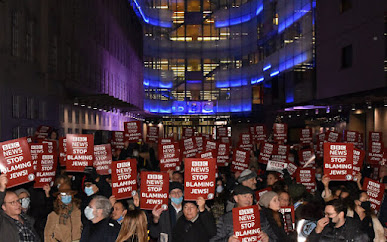
I can't find much coverage of the protest that took place outside Broadcasting House on Monday evening. The BBC rarely reports protests against itself (well, why would it?) but the only "mainstream' press report I can find so far today is in OMG The Daily Mail.

The protest, which was by all accounts well attended, was to register the anger about the BBC's biased and inflammatory reporting of an ugly incident that took place recently on London's famous Oxford Street.  Phone cameras inside the bus caught images of several angry young men spitting, banging shoes against the windows, and making hostile gestures at a group of young Jewish passengers who had just been celebrating Chanukah.

The BBC's report identified the victims as Jewish, but the identity of the perpetrators was left to the imagination. However, a specific religion was alluded to indirectly, in the form of a two-word insult that allegedly came from inside the bus, namely: "Dirty Muslims." 

The BBC chose to report this peculiar and quite unlikely (but allegedly overheard) exclamation in a way that suggested it was a provocation, impliedly an altercation between two evenly-matched rivals. That the Jews got what was coming. "They asked for it."

Originally the report read "racial slurs were heard from inside the bus" - later amended to the singular: "a racial slur."  Still a slur, but just the one.  

This allegation was vigorously denied, but let's get real. Even if someone did utter such a remark, would that amount to an irresistible provocation, whether it was uttered before, during, or after the incident? 

Come on, man!

The fact that the BBC insisted on keeping the 'racial slur' phrase in their report despite the lack of corroborating evidence was the primary reason for that protest. The whole thing has drawn attention to the BBC's covert hostility to the Jewish community and its history of one-sided, 'half-a-story' reporting of matters concerning Israel. People are once again asking to see the famous Balen report, the one that the BBC has devoted a few hundred thousand quidsworth of legal fees to keep secret.

They might as well stay quiet and ignore the protest and let the BBC keep it as "Our dirty little secret" 

The BBC rules against Will Grant


Of the millions of people who watch an incorrect report on BBC One's News at Ten, how many ever become aware of the correction on the BBC website? 

I'd put it in the low thousands at best. 

Three months ago many US media outlets and senior US Democrat politicians falsely claimed that US border guards had used whips to beat Haitian illegal immigrants crossing from Mexico.. 

I saw many flat-out rebuttals of that at the time, including on the BBC's least favourite US channel Fox News, but BBC One's News at Ten featured a report on 23 September 2021 which simply parroted that false story. 

Will Grant, the BBC's Mexico, Central America and Cuba correspondent, said:

As migrants attempted to cross from Mexico to a makeshift camp in Texas this week, they were pushed back by mounted Border Patrol officers using whips.   

Here's the BBC Executive Complaints Unit's ruling:

Complaint 

A report about Haitian immigrants to the United States included this statement: As migrants attempted to cross from Mexico to a makeshift camp in Texas this week, they were pushed back by mounted Border Patrol officers using whips. A viewer complained that the claim that whips had been used was false. The ECU considered the complaint in the light of the BBC’s editorial standards of due accuracy.

Outcome 

Reports on social media and news media that Border Patrol officers had used whips were based on photographs taken by an agency photographer who subsequently stated that he had not seen whips being used at the time. Moreover the Department of Homeland Security, which is responsible for border control, stated on 20 September that the images showed long reins used to control horses – an explanation entirely compatible with the images themselves. In view of these points, the ECU agreed that the report’s claim about the use of whips was not consistent with the BBC’s standards of due accuracy. 

Upheld 

Further action

The finding was reported to the Board of BBC News and discussed with the programme-makers concerned.

This is such an interesting one as it shows the BBC simply joining the pack and spreading the same inaccurate lines that their cousins in the US media were spouting without verifying it first. 

Confirmation bias is trumping true fact-checking at the BBC these days on so many fronts - as per the Oxford Street incident too. 

[P.S. It took a lot of digging to find out the name of the BBC reporter responsible. The BBC don't make it easy in their complaints rulings]. 

The Curious Case of the Vanishing Welsh NHS Logo


This is a bit odd...

There was a report by BBC health correspondent on the BBC's News at One yesterday which contained the following section:
Dominic Hughes, BBC: And in hospitals, where staff are already under pressure, there is real anxiety over what the next few weeks may bring, particularly for patients that need high levels of care.
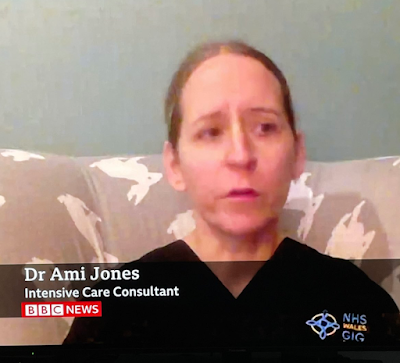
Dr Ami Ross, intensive care consultant: It's awful, you feel like you are giving them a Third World service.
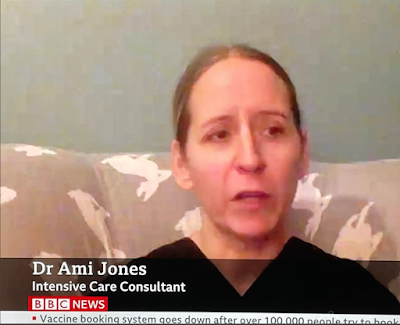
The report was re-broadcast every hour during the afternoon, but someone on Twitter spotted a slight change between the report as broadcast at 1:05pm and the report broadcast at 2:05pm and later and took to Twitter about it:
Sam Lowry: Spot the difference - Dr Ami Jones on BBC News at 1pm, saying how terrible things are with intensive care wards, then again on BBC News at 2pm when they’ve realised this reflects badly on Keir Starmer & have edited out the fact this is happening in the Labour-run NHS Wales!!
Here's the screengrab Sam took at 1:05pm:
And here's her 2:05pm screengrab:
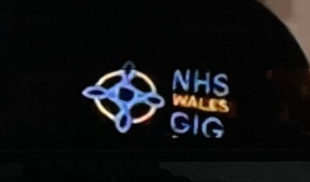
As you'll have spotted, what disappeared was this:
Now, I never just trust screengrabs posted on the internet so I checked TV Eyes to see if this really did happen. 

And it did. 

The report was otherwise identical.

So what do you make of this? 

Why did they crop it? Was it because the BBC was removing something inconvenient for Labour? Or did they remove the 'NHS Wales GIG' logo because it was advertising, even though it was only adverting the public sector Welsh NHS [so not a commercial brand]?

[Note: 'GIG' is the Welsh acronym for 'National Health Service' - 'Gwasanaeth Iechyd Genedlaethol'.]

Monday, 13 December 2021

I vacillate


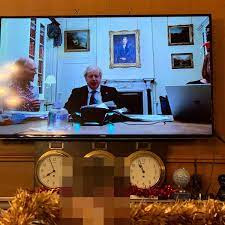
It’s quite late in the day, but I wanted to let the dust settle before sticking my neck out about Party-gate. There’s still no sign of a let-up, so I dillied and dallied until wallpaper-gate complicated everything by gate-crashing party-gate. Oh, and quiz-gate.

Obviously, Party-gate is divisive. It has certainly divided me. Afraid to watch BBC because of one’s mental ‘elf, one peeks through one’s fingers at Sky, where Beth Rigby is spoutin’ off about Boris’s shortcomings. I think it’s fair to float the idea that the BBC is on a similar mission, which is to Bring Down Boris.


The media class obviously hate Boris’s regime so they are all busily squeezing the last drop of juice out of last year’s was-it-or-wasn’t-it party at Number 10.


An illicit party for the toffs while the ordinary people obediently abided by the rules? (If they did)


Whether the media is sincere or purely politicking, we can’t be sure, but are Beth Rigby and her cohorts really and truly incandescent with fury, or is there a soupçon of malicious satisfaction in there?  


“A Party!” they exclaim! “During lockdown! A lockdown that was both instigated and violated by the Tories themselves!  One rule for them and another for us!” 


Fair point!  But the media weakens their case by making a fuss about the wine, the cheese, the unspecified nibbles, and….  tinsel!  Gilding the lily that way makes all the ire look petty and spiteful.


Yup. It’s probably a disgrace!! But Isn’t the outrage beginning to look a little laboured and quite a lot insincere?


I ask myself, is it valid to tie the privileges enjoyed by Boris and the spads so tightly and so inextricably to the restrictions and sacrifices that we lesser beings complied with last year? (If they did) Are the two situations truly worthy of being pitted against one another, or are they entirely separate?  I’m not too sure about that.


Many of us are uncomfortable about the hypocrisy, and hypocrisy it surely is. Or is it? And if it is, to what degree? Yet I can still see how government-haters got themselves worked up about it, but hypocrisy isn’t confined to last year’s bend-the-rules party. Hypocrisy and double standards are everywhere. Not saying that that’s a good thing, but don’t we reluctantly accept a bit of hypocrisy as a grim fact of life?   Maybe on this occasion, let’s choose a better noose with which to hang ourselves?


The pain of bereavement is heightened when others, oblivious to your suffering, seem to be enjoying themselves, but when that happens  - in my own experience at least - you neither begrudge nor resent other people’s happiness. Loss and grief needn’t be shackled to resentment. because the two emotions aren’t co-dependent -  in my opinion. (Those are my principles and if you don’t like them I have others.)  Nana Akua gave a thoughtful monologue about this particular issue the other day on GBNews. My views still ricochet from one position to another. 


Allegra Stratton and the spads giggling over how to pitch the not-a-party to a hungry press pack was bad, but I found it even more disturbing to listen to Rigby (and I’m guessing her ilk at the BBC) continually announcing that  “the public is incensed” when in reality, it’s the media itself that’s incensed. The media is at once implanting and projecting outrage onto ‘the public” because it smells blood and thinks it’s a good time to cancel Boris and topple the Tories. 


From a street in a northern constituency Sky airs ‘random’ vox-pops. The reporter asks two passers-by how incensed they are about Party-gate. The answer is: “Please let’s just move on now”.  Then they close in on a blue-haired battleaxe chewing on a wasp. She obligingly regurgitates Beth Rigby’s words as verbatim as she can manage. She is outraged!


They put her on a loop. On Sky; on the hour. 


Thus, the media presents their own opinion as “what people are sayin’ “ with the kind of circularity that eats its own tail, and it occurs to me yet again that the media is actually running the country. 


Rigby and her ilk at the BBC teach the viewers what to think, who to vote for, what to be angry about, and coerce you into believing you thought of it all by yourself.  

Sunday, 12 December 2021

Nick Robinson, BBC Director of News?


The Mail on Sunday is on fire today. They are also reporting that Nick Robinson has has been ''sounded out by BBC bosses'' to replace Fran Unsworth as Director of News. ''BBC sources say'' he's considered an ''impartial and safe'' figure. [No laughing at the back!]. 

Another twist in the Martin Bashir scandal


In another extraordinary twist, Martin Bashir has u-turned and written an apologetic letter to the mother of murdered nine-year-old school girl Karen Hadaway admitting that he lost her daughter's clothes. 

He's spent 17 years claiming he couldn't remember doing so and even in May this year was still saying, ‘I may have lost it but I don’t remember.’ 

Ms Hadaway called his apology ‘utter nonsense’ and ‘too little, too late’, adding: 
When I met him, my husband had just had a breakdown and been in hospital for seven weeks – completely broken because he couldn’t do anything about his little girl’s killer. The BBC was our last hope. We’d been let down by everyone. Bashir spent hours with me, we met twice – how could he have forgotten me? When he pretended he never met me, I felt more powerless than ever. My husband died not long after of a heart attack. His heart was broken, literally.
The Mail on Sunday reports that Ms Hadaway is now taking legal advice and is considering pursuing the BBC for compensation.

Cod liver oil commissioning


Sunday Times arts columnist Patricia Nicol has written a piece headlined Why changes are needed at Radio 4. 

Despite the headline, she's a huge fan of BBC Radio 4 and doesn't accept many of the criticisms being made of it. Her only real beefs with the channel are with its comedy and drama output. “When did a new comedy format on Radio 4 last make you laugh out loud? Or a drama warm your cockles?”, she asks. 

My favourite line from her column is:
Too much of Radio 4’s drama feels like cod liver oil commissioning, sternly administered to do you good.

Strictly Come Social Engineering?


The BBC's nemesis at the Mail on Sunday Katie Hind has a piece today headlined Strictly can't get much more diverse than that! Four contestants and not a single straight white man - the dream semi-final for BBC chiefs who wanted a 'less pale and stale' series:.
The BBC has been praised for having the most diverse Strictly Come Dancing semi-final in the show’s history. The line-up for last night’s programme featured two black contestants, a gay man and the favourite to win the overall title – deaf EastEnders actress Rose Ayling-Ellis.
She quotes one of those helpful 'sources':
There is a great deal of delight that Strictly is reflecting Britain today with its line-up. This year and last, there was a real effort to ensure that there was diversity – particularly with the introduction of the same-sex couples. Last year it didn’t go quite so well, but this year has been an absolute triumph. And viewers have clearly loved it. Audience figures have been really high.

Saturday, 11 December 2021

By the bonnie bonnie Banksy of the BBC News website


I may have lost touch somewhat in the earlier parts of this year but one quirk of the BBC News website that even I spotted throughout the entirety of this year - possibly, but not definitely, one that even some of you eagle-eyed types might have missed - has been the BBC's continuing willingness to report every single burp of graffiti artist Banksy on their news home page.

He's been their favourite artist. He can no do no wrong. His every doing must be reported...and has been.

And Banksy's back there again, yet again, this very afternoon, right there among the BBC News website's top headlines. 

The BBC's headline story today is obviously there to pander to both the BBC's and Banksy's would-be woke allies in the 'culture wars' - Queues form as Banksy Colston statue trial T-shirts go on sale.

The BBC piece begins:
Large queues formed as limited-edition T-shirts made by anonymous street artist Banksy went on sale.
The Bristol-born artist announced on Friday night that the shirts would go on sale at locations in the city.
He said they had been created to show support for the four people about to go on trial accused of pulling down the statue of slave trader Edward Colston.
Now, if that sounds like PR rather than reporting [#prasnews], well, what follows is even more so - and frankly one of the oddest BBC News website pieces I've ever read. I'll continue from where the last 'block quote' left off:
The shirts quickly began appearing for resale online, with one seller asking for £9,000.
Local radio station Ujima began announcing the sale points on its breakfast show from 09:00 GMT.
Once the locations were made public hundreds of people quickly formed a queue at one of them - That Thing on Stokes Croft.
Similar queues appeared outside Friendly Records in Bedminster and Rough Trade on Nelson Street.
And the BBC piles on photos galore of happy, shiny people laughing and holding hands with happiness as they queue up or jubilantly brandish their Banksy t-shirts.

And the following paragraphs quote from people who are overjoyed to be lining up for Banksy, plus a quote from Banksy himself.

It's purely a puff piece and reads like it's been written by a BBC ultra-fan. And yet there it is, top headline news on the 'impartial' BBC News website.

The piece ends seriously however: 
The statue of Edward Colston, a 17th Century slave trader, was pulled down during a Black Lives Matter protest in Bristol in June 2020.

Is the BBC acting as Banksy's agent? It certainly reads like it. 

Whatever. Put it in your heart where tomorrow shines...

A gruesome tale


I was going to write about this first thing yesterday morning, but couldn't think what to say. Plus it's such a gruesome story that it's not something I particularly want to think about, but it's Saturday afternoon and I've taken a deep breath...

Under the banner BBC USED LICENCE FEE PAYERS MONEY TO LAVISH TENS OF THOUSANDS OF POUNDS ON TWO MURDERERS, the Defund the BBC campaign has taken up the outrage of many on reading the Daily Mail's story about it yesterday, tweeting:
This story is so outrageous it’s almost hard to believe. Two men with previous violent convictions that the BBC hired, and paid £52,000 for their last bit of work alone, have been convicted of murdering a man and forcing his children to watch him die.
The BBC's role in it, as presented by the Mail, is quite complicated and has several facets, but I'll try to boil it down into eight points:
  1. Both murderers were used as undercover operatives on several BBC projects, being paid considerable amounts of money by the BBC. 
  2. But they weren't murderers when the BBC producer at the time, Fiona Campbell, used them on her undercover crime documentaries. All she could have known about them was that one of them had a conviction for violence and the other had been cleared on a rape charge. 
  3. The murder took place during the post-production stage of their final BBC investigation together when they were used as consultants. 
  4. Ms Campbell's decision to use the men was signed off by three senior figures at the BBC back then: Peter Horrocks, the then-head of current affairs who went on to become the director of the World Service, Steven Whittle, the head of editorial policy, and Roger Law, the head of the BBC legal department.
  5. Despite one of the murderer's being jailed and the other going on the run after the murder, the BBC broadcast this final documentary, including the pair’s secretly filmed footage. 
  6. Ms Campbell told police she didn't ask them how they obtained information.
  7. Ms Campbell was criticised by a judge in a separate trial related to the pair’s involvement in the counterfeiting programme for allowing them to operate without effective scrutiny.
  8. Rosie Campbell is now the £215,000-a-year controller of BBC3, and credited with hits like Fleabag, Normal People and Killing Eve. 
It raises many ethical questions but, given that her bosses authorised their use and it was evidently legal, I don't think Fiona Campbell will face any questions from her present bosses over this.

That said, it would be interesting to know from her present bosses: [a] if the BBC would still use people with convictions for violence in their undercover crime reporting; [b] if they would still not ask those working undercover for them what methods they used - especially in light of the judge in the counterfeiting trial saying the BBC shouldn't have allowed them to operate without effective scrutiny; [c] when exactly the BBC first became aware of the murder trial, and when [or if] the men's involvement with the BBC was first publicly acknowledged; and [d] whether the BBC would still go ahead and broadcast a programme if such a thing were to happen again now.

This Daily Mail story is causing a bad smell around the BBC, fairly or unfairly, but I think that's as far as can be gone with this...[edit] except for pursuing the BBC over those questions. 

Belief


“Dancers who accused a leading choreographer of transphobia have claimed she has jeopardised their safety by publicising her resignation”, begins a BBC News website report today by the BBC's new culture editor Katie Razzall. 

[Some might call that 'victim-shaming'].

It's another 'trans war' story where a woman, Rosie Kay, felt she had to leave the dance company she founded because of hostility from trans activists. 

Katie Razzall writes, “However, in an open letter seen by the BBC, the dancers claim that, by going public, Kay has caused "potential detriment to our careers".” 

Does “seen by the BBC” mean 'handed to the BBC by an interested party with an obvious motive'?

Anyhow, Nick Timothy, former Joint Downing Street Chief of Staff to Theresa May, isn't too impressed with Ms Razzall about this, tweeting:
Given that this BBC piece will have been vetted by lawyers and various others, the intellectual dishonesty of sentences like, “Kay doesn't believe a person can change their biological sex” is depressing if not surprising.

Indeed. And you can bet your bottom euro that Katie R, culture editor of the BBC, would never dare write “Kay's critics believe a person can change their biological sex” - despite that being a lot more accurate. 

Tellingly, Ms Razzall's language echoes that used by Ms Kay's critics, quoted just a few sentences later:

The dancers behind the letter wrote that they "respect Rosie's right to hold the belief that biological sex is immutable".
It isn't a belief, it's a fact.

Update: One reply to Nick Timothy quotes from the article - the bit where one of Ms Kay's critics said "she is now using her power as someone that has a louder voice than we can hope for" - and responds: “...say the cretins who can command a fawning article by the BBC while Kay seems to be in the process of having her career destroyed”. 

As the great Ray Davis once wrote, it's a mixed up, muddled up, shook up world. And the BBC's not helping.

Lord Grade criticises the BBC


The BBC is still keeping its mouth shut firmer than a member of the clam mafia but the pressure on the corporation over the Oxford Street antisemitic bus incident continues to grow. Now former BBC chairman Lord [Michael] Grade has joined the chorus of criticism, saying: 
Given the available evidence, or rather lack of it, it is worrying that the BBC has so far defended its report that there were ‘clearly’ anti-Muslim shouts from the bus, while the antisemitic gestures were only ‘alleged’. They need to provide the evidence to support their defence or rethink and issue an urgent correction and apology.

Someone senior at the BBC is surely going to have to say something sometime about this, you'd have thought?

On Newswatch


Someone copied Samira Ahmed into a tweet this morning which encapsulates what many of us have said here over the years about the BBC's Newswatch:
Every week Samira Ahmed beautifully presents a whole host of individual public criticisms of BBC news programmes and, every week, the same paternalistic responses of self-justification from the BBC heads of news. Their arrogance is astounding.
This week's self-justifying BBC editor was Paul Royall, Paul Royall, editor of BBC News at Six and Ten. He even used the hallowed formulation of BBC editors on the programme. not once but twice. He said, “I think we get the balance right” and later “So I do think we get the balance right, we do take it seriously, we do take great care.”

Friday, 10 December 2021

Megha Mohan - another update


So the BBC's first global gender and identity correspondent Megha Mohan, who appeared to have deleted her Twitter account after being told off for failing to comply with BBC guidance that “staff should also not post offensive or derogatory comments or content on social media and avoid abusing their position as a BBC employee in personal interactions”, brought her account back to life on 7 December and is busy tweeting again. And Jess Brammar, head of the BBC's news channels, has been singing her praises. She's still working at the BBC. Indeed she's been covering ''the first female Samoan PM'' and the former president of the Marshall Islands who was the first female leader of a Pacific island, and reporting on climate change in places like Samoa, the Marshall Islands and Fiji. There's no stopping her. 

Julian and John


I have mixed feelings, none of them particularly strong in any direction, about Julian Assange. He arouses very strong, partisan passions in others though.

We recorded back in January what Charlie called ''a love letter'' to Mr Assange from the BBC's world affairs editor John Simpson on BBC One's News at Ten. 

And, in another case of a BBC reporter 'not' hanging up his opinions at the door, John's tweets have been similarly lacking in impartiality. This, for example, is what he tweeted on May 26, 2019:
Alan Rusbridger, writing in defence of Julian Assange: 'Whenever you read about journalists harming national security, massive alarm bells should start ringing.' Absolutely right. Assange revealed uncomfortable truths about US policy & tactics, & the US wants to punish him for it.
And with today's developments, the BBC's world affairs editor John Simpson is back in action again, campaigning about it once more on Twitter:
After today’s judgement in the Julian Assange extradition case, journalists in many countries will be worried about the precedent it sets. No one who reveals secrets which the US wants to keep hidden can be certain of staying safe.
Will this erupt in another BBC report/'love letter' on News at Ten, if his bosses let him?

Sour grapes


As we discussed on an earlier thread, you can do lots with dried grapes. 

You can turn currants into spotted dick, raisins into rum & raisin ice cream, and Sultanas into dopey far-left Labour MPs. 

What to do with sour grapes though? 

Well, the BBC has turned some into a report today about GB News hiring the mighty Eamonn Holmes. 

The BBC News website piece in question has a rather spiteful last eight paragraphs, especially the final four about Eamonn himself. 

Sticking with the food imagery, in terms of the tastes of food this BBC piece manages to combine 'sour' and 'bitter' flavours that turn the stomach.

Cut to spectacular visuals


He has a point:

Razia Iqbal sticks up for Joe Biden


I saw a tweet last night from journalist and broadcaster Mike Yardley: 
Just heard a BBC presenter slapping down the ex head of Estonian's army for noting that Putin's threats to the Ukraine had parallels to the Hitler pre WW2. Why? This situation could quite easily escalate. It's brinkmanship at the moment, but that's still a very dangerous game.
That intrigued me so I hunted for the interview he was talking about and found it on Radio 4's The World Tonight. 
 
It was an extraordinary interview by the BBC's Razia Iqbal. 

It's a long time since I've heard her [because I no longer listen to The World Tonight] and she interrupted so loudly I feared I might not be hearing anyone of anything ever again as she almost burst my ear drums. 

Plus, she was remarkably rude to a man whose grasp of English was magnificent but not perfect. 

And as most of her interruptions were to stick up for Joe Biden it's as if she was channelling Jen Psaki and acting as Joe's spokeswoman, protecting 'her man'. 

A transcript can't quite do justice to the impact of her hectoring here, but it's worth a try anyhow:

------------------
 
Razia Iqbal: Ukraine's president Volodymyr Zelensky has thanked the US president Joe Biden for his strong support in the face of Russian threats as the West accuses Moscow of preparing to invade, based on the serious military build-up on the border. While for Moscow any prospect of Ukraine joining NATO is a red line, Washington refuses to countenance any red lines being drawn by President Putin. And now Mr. Biden's announcement that a small group of larger NATO countries will hold talks with Moscow is causing concern on the alliance's eastern flank where members close to Russia are particularly worried that issues of security must not be negotiated over their heads. Let's speak to Riho Terras who is a member of the European Parliament and the former commander of the Estonian defence forces. Good evening.
Riho Terras: Good evening.
Razia Iqbal: What's your main concern about this planned meeting between President Biden, some of the big NATO members and Moscow?
Riho Terras: Well, I think that President Biden has given in to the blackmail of Russian president Putin who increased the pressure, military pressure, on the border with Ukraine. He was on the warpath, and now he's invited to talk to the important people, other heads of state of the big countries in Europe and the American president and...
Razia Iqbal: [interrupting] That's a pretty serious word. It's a pretty serious word 'blackmail'.
Riho Terras: Yeah, Well, how can we label it differently if President Putin is gathering his troops along the Ukrainian border and is on the warpath, and once you draw a new line in Europe, once you create a new security architecture which fits to his taste and doesn't care about NATO or an independent country, like Ukraine is?
Razia Iqbal: Are you concerned and that the smaller countries such as Estonia and Latvia and Lithuania have not been invited? Is that the issue, that you feel you should be at the centre of these discussions?
Riho Terras: No, I think the problem here, definitely the problem is, that the aim of Putin is to break the unity of our two alliances, the European Union and NATO, and if President Biden tries to invite only certain countries to the discussion and not the alliances as a whole and is not discussing the topic with his allies, that is exactly what Putin wants - to break the unity of NATO, which is our strength, which is our centre of gravity.
Razia Iqbal: [in a tone of increasing incredulity] Well, I mean, what evidence do you have that President Biden is doing any such thing? Even if he has this meeting, he has also been taking part in the meeting at in Riga recently, which, of course, suggested that he was deeply concerned and for him the red line over Ukraine, as it's being drawn by Moscow, is unacceptable.
Riho Terras: Why are all the other countries then excluded from the meeting? Why does he want to meet only with the big boys? If he...
Razia Iqbal: [interrupting, incredulously] What do you think is going to happen?
Riho Terras: It smells very much like Munich 1938, and the Munich agreement when Chamberlain came out to say...
Razia Iqbal: [interrupting, even more incredulously] Surely, surely you're not comparing this to the Second World War? That's, that's, that's...just absurd!
Riho Terras: To what extent is it absurd? This is exactly a country who is threatening another sovereign country with a military invasion and Ukraine is not at all on the discussion right now. [Mr Terras clearly meant 'in on the discussion' but Razia failed to pick up on that.]
Razia Iqbal: [incredulously] Well, but that's, that's clearly not true. Ukraine was obviously the top of the list in the summit, the video call summit between the two presidents. What is it that you think...
Riho Terras: [interrupting] Well the discussion was about Ukraine but the Ukrainian president was not involved in the discussion. That is exactly what is not acceptable...
Razia Iqbal: [interrupting] What, what...
Riho Terras: ...that the heads of state of the big countries are trying to divide the world.
Razia Iqbal: But, but... [incredulously] Do you not think that President Biden is going to do everything he can to make sure that the NATO alliance is one that is held together?
Riho Terras: Yeah, that means that the first thing is to discuss with the allies how to solve the problem...
Razia Iqbal: OK.
Riho Terras: ...and then, then NATO should be at the table of this discussion.
Razia Iqbal: Riho Terras, member of the European Parliament and a former commander of the Estonian defence forces, thanks for being with us.

Barely even half the story


A black American actor is found guilty of faking a white supremacist hate crime against himself. The two men he paid to stage the attack are black themselves. All manner of senior Democrats fell for the hoax, including Joe Biden and Kamala Harris. Joe Biden tweeted, ''We are with you Jussie'' and Kamala Harris called it ''an attempted modern day lynching''. And Black Lives Matter [BLM] called his trial a “white supremacist charade”. 

It's interesting how little of the above you'll find in the BBC's account of the verdicts on Jussie Smollett this morning. In fact, the only bit of all that they do report is that he's been found guilty! 

This is another example of how the BBC - like so many of their US counterparts - ''use the lens of race on every story, until the colours change''. Once again, they've ''turned the race filter off'' - or at least massively turned it down.

This video from comedian Dave Chapelle from 2019 - with some strong language - was true then and is true now, and very funny too. It puts BLM's inflammatory response in clear context:

Thursday, 9 December 2021

The BBC upholds a complaint against Justin Rowlatt


The BBC has upheld a complaint against its Climate Editor Justin Rowlatt. 

It's one of those rulings where the BBC's write-up attempts to put the best possible gloss of the matter, but it's still a ruling against him on grounds of [in]accuracy:
Wind turbines: How UK wants to become ‘Saudi Arabia of wind’, bbc.co.uk 09 December 2021  
Complaint 
In a video attached to this report the BBC’s Climate Editor, Justin Rowlatt, described the UK offshore wind industry as “now virtually subsidy free”. A viewer of the video complained that this was inaccurate. The ECU considered the complaint in the light of the BBC’s editorial standards of due accuracy. Outcome As explained to the complainant in previous correspondence, Mr Rowlatt’s intended meaning was that the most recently approved offshore wind projects were expected to operate without subsidy (or with “negative subsidy”) because the price at which the successful companies would sell the energy they produce to the Government was expected to be lower over the lifetime of the project than the wholesale electricity price on the UK market. However, it was not clear from the context that Mr Rowlatt was referring only to recently approved projects, and the ECU considered viewers likely to form the impression that the industry as a whole was “now virtually subsidy free”. As existing installations are expected to receive significant subsidies over their lifetime, that impression would have been inaccurate. Upheld
Further action 
The finding was reported to the Board of BBC News and discussed with Mr Rowlatt. The article has been amended to remove the inaccurate impression.